





Introduction
Individual practiceFootnote 1 forms the largest component of musical training, amounting to thousands of hours over a musician’s career. Given that the quality of practice is a major factor for musical success (Bonneville-Roussy & Bouffard, Reference BONNEVILLE-ROUSSY and BOUFFARD2015; Duke et al., Reference DUKE, SIMMONS and CASH2009; Suzuki & Mitchell, Reference SUZUKI and MITCHELL2022; Williamon & Valentine, Reference WILLIAMON and VALENTINE2000), it is critical that music students acquire the self-regulatory skills required for effective practice such as goal setting, time management, self-monitoring and self-evaluation (McPherson, Reference MCPHERSON2022; Zimmerman, Reference ZIMMERMAN and ZIMMERMAN2000). These skills allow musicians to plan, monitor and evaluate their own learning (Zimmerman, Reference ZIMMERMAN and ZIMMERMAN2000), which is crucial for musicians as they mostly practise alone without any guidance (Macnamara & Maitra, Reference MACNAMARA and MAITRA2019).
This unsupervised practice is complemented by one-to-one lessons, which usually form the core of musical training (Carey et al., Reference CAREY, BRIDGSTOCK, TAYLOR, MCWILLIAM and GRANT2013). In these lessons, instrumental teachers not only impart technical and musical skills but also act as mentors who guide their students vocationally and psychologically (Gaunt, Reference GAUNT2008). Teachers are often a source of inspiration and motivation for students, and relationships between teachers and students can be close and important, extending beyond the lessons themselves (Gaunt, Reference GAUNT2008, Reference GAUNT2010). Students commonly seek advice from their teachers on a broad range of issues – including those that may be beyond the expertise of the teacher – such as performance anxiety and physical health (Huang & Yu, Reference HUANG and YU2022; Pecen et al., Reference PECEN, COLLINS and MACNAMARA2018; Perkins et al., Reference PERKINS, REID, ARAÚJO, CLARK and WILLIAMON2017; Waters, Reference WATERS2020; Williamon & Thompson, Reference WILLIAMON and THOMPSON2006). For example, Williamon and Thompson (Reference WILLIAMON and THOMPSON2006) found that conservatoire students were more likely to discuss health issues with their instrumental/vocal teacher than healthcare professionals. Given the significant role that music teachers play in students’ development, it is essential to understand their perspectives on instrumental practice and the ways in which they guide their students’ practice.
Most of the published studies of expert musicians’ experiences of practice have focused on expert performers rather than teachers (Chaffin, Reference CHAFFIN2007; Chaffin et al., Reference CHAFFIN, IMREH and CRAWFORD2002, Reference CHAFFIN, LISBOA, LOGAN and BEGOSH2010; Hallam, Reference HALLAM2001; Holmes, Reference HOLMES2005; López-Íñiguez & McPherson, Reference LÓPEZ-ÍÑIGUEZ and MCPHERSON2020), and few studies have explored the perspectives of instrumental teachers. Exceptions include investigations of music teachers’ approaches to teaching practice through the use of questionnaires (Barry & Mcarthur, Reference BARRY and MCARTHUR1994; Baughman, Reference BAUGHMAN2017). Barry and McArthur’s questionnaire asked about the extent to which music teachers advocated various strategies that the authors had identified as effective through a review of the literature. Ninety-four teachers in pre-college and college settings responded to the questionnaire. Most respondents reported that they ‘always’ or ‘almost always’ discuss the importance of practice and specific practice strategies. While some strategies were endorsed by most respondents (e.g., setting specific goals, marking the score), others were endorsed to varying extents (e.g., mental practice, use of metronome). Similarly, Baughmann surveyed 46 college vocal teachers in the USA about the methods they employed in lessons to teach practice strategies. These included analysing or marking the score, focusing on the most difficult sections of the music, and setting goals. Respondents also reported that they often discussed the benefits of mental practice although they did not necessarily provide guidance on how to engage in mental practice. In terms of the methods they used to track and assess students’ practice, logs and diaries were reported most often.
In these studies, the researchers administered surveys consisting of multiple-choice questions and items measured by Likert-type scales. Thus, the respondents did not generate the reported strategies and methods themselves; instead, they were given a list of specific strategies and asked to report how often they used them. This method is limited insofar as it a) restricted the variety of responses that could be given and b) primed respondents as though they were being asked leading questions in the context of an interview.
More open-ended approaches such as semi-structured interviews may yield more valid and varied responses, and provide more useful insights into instrumental teachers’ experiences of teaching skills for effective practice. The perspectives of conservatoire teachers, who have extensive experience of both performing and teaching, may be of particular interest. While studies involving conservatoire teachers often touch on the topic of music practice (Gaunt, Reference GAUNT2008; Purser, Reference PURSER2005; Zhukov, Reference ZHUKOV2012), no researcher has yet conducted an in-depth exploration of conservatoire teachers’ views on effective practice.
Aim of the study
The aim of the study was to explore conservatoire piano teachers’ views on effective practice. Specifically, we investigated the following research questions:
-
• What are the most important elements of effective practice, according to conservatoire piano teachers?
-
• What are the most important elements for teaching students to practise effectively, according to conservatoire piano teachers?
Methodology and methods
We conducted semi-structured interviews with conservatoire piano teachers. This method of data collection was chosen to allow for an open-ended exploration of participants’ views. We took a pragmatic epistemological approach to this study (Morgan, Reference MORGAN2014). A pragmatist is not concerned with finding a single truth but instead seeks knowledge that would be of use in the real world (Giacobbi et al., Reference GIACOBBI, POCZWARDOWSKI and HAGER2005). For this reason, experiential knowledge is seen as a valuable source of knowledge for pragmatists (Allemang et al., Reference ALLEMANG, SITTER and DIMITROPOULOS2022). In this study, we sought to explore the experiential knowledge of conservatoire piano teachers as we believed that this could be useful for music students, teachers, and educators.
The interviews and main analysis were conducted by the first author, who is a conservatoire-trained pianist but not a conservatoire teacher. The interviews were therefore conducted by someone familiar with piano repertoire, technique, and practice strategies, which helped build rapport with participants and enabled nuanced and effective conversations. At the same time, not being part of the conservatoire teaching system allowed them to maintain a degree of distance and minimise potential biases. The research team was complemented by the second and third authors who have extensive experience conducting qualitative research as well as research in music psychology and education.
Participants
Potential participants were identified through personal contacts and the websites of Australian and UK conservatoires. Piano teachers were invited to take part via an email that briefly explained the study and contained the participant information sheet. Teachers who were interested in taking part in the study were asked to email the first author to schedule a mutually convenient date and time for an interview.
Eight piano teachers (6 male, 2 female) who were currently teaching at a conservatoire in the UK (n = 5) or Australia (n = 3) participated in the study. Participants represented five institutions between them. They had been teaching in higher education for an average of 22.6 years (SD = 5.3) and were currently spending 20.4 hours (SD = 7.9) per week on one-to-one tuition at their institution. Seven participants were currently performing actively and reported that they typically gave between two and 20 concerts per year.
Procedure
All interviews took place online via Zoom except for one that was conducted in person. Two participants requested that they be interviewed together, but the others were interviewed individually. The same approach to the interviews and analysis of data was used with all the participants, whether they were interviewed via Zoom, in person, as individuals or together. Nevertheless, it is possible that the participants who were interviewed together were influenced by each other’s responses. Interviews lasted approximately 45 minutes each and were audio recorded.
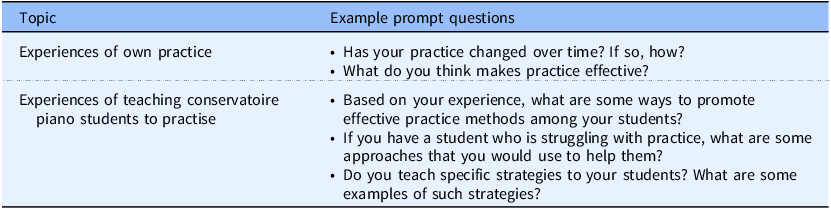
The interview schedule consisted of two main sections (see Table 1). The first section was based on the participants’ own experiences of practising as pianists. The second part was about their experiences of teaching conservatoire students how to practise.
Overview of interview schedule

Table 1. Long description
A table with two columns and three rows. The columns are labeled ‘Topic’ and ‘Example prompt questions’. The first row under ‘Topic’ lists ‘Experiences of own practice’ and ‘Experiences of teaching conservatoire piano students to practise’. The corresponding ‘Example prompt questions’ for ‘Experiences of own practice’ are ‘Has your practice changed over time? If so, how?’ and ‘What do you think makes practice effective?’. The corresponding ‘Example prompt questions’ for ‘Experiences of teaching conservatoire piano students to practise’ are ‘Based on your experience, what are some ways to promote effective practice methods among your students?’, ‘If you have a student who is struggling with practice, what are some approaches that you would use to help them?’, and ‘Do you teach specific strategies to your students? What are some examples of such strategies?’
Interviews were transcribed verbatim, and participant codes were assigned (T1–T8). All identifiable information was removed from transcripts to ensure anonymity. Given that many people know each other in the world of classical music, extra care was taken to ensure that participants could not be identified from the reporting of findings, and this was reiterated to the participants prior to the interview. In addition to the names of people and places, information such as references to specialist repertoire was also removed from the transcripts.
Before the interview session began, participants provided their written informed consent. At the start of the session, the interviewer explained the approach to anonymisation and the data analysis, gave participants the opportunity to ask questions, and asked them to confirm their consent verbally before beginning to record the interview. At the end of the session, the interviewer debriefed the participants and gave them the opportunity to answer any (further) questions. Participants were free to withdraw from the study at any time without consequences while the data collection and analysis were ongoing, but not once the data were published (anonymously). The study was granted ethical approval by the Royal Northern College of Music Research Ethics Committee.
Analysis
Template analysis (TA; King, Reference KING, SYMON and CASSELL2012) was used to analyse the data. TA is a type of thematic analysis that involves the use of a structured template to organise the themes. We deemed TA to be a suitable method of analysis for the current study for several reasons. First, TA is a ‘technique rather than a methodology’ (King, Reference KING, SYMON and CASSELL2012, p. 429) and is therefore not linked to any epistemological position. It is a flexible approach that can – and should – be tailored to the needs of each study (King, Reference KING, SYMON and CASSELL2012), making it highly suitable for our pragmatic epistemological approach to this study. Second, it combines top-down and bottom-up approaches, meaning that it is possible to have a priori themes in mind before starting analysis if they are appropriate and helpful for the analysis (Brooks et al., Reference BROOKS, MCCLUSKEY, TURLEY and KING2015). In TA, a priori themes are ‘tentative’ (Brooks et al., Reference BROOKS, MCCLUSKEY, TURLEY and KING2015, p. 203) and can be modified or removed during analysis if necessary. This was suitable for the current study as we wanted to take a bottom-up exploratory approach, but we also had broad ideas for themes related to our aims. Third, TA employs a hierarchical coding structure, such that themes can have several levels of nested sub-themes. This was something that we expected to identify in our analysis (e.g., different types of skills and strategies under a broader theme of elements of effective practice). Furthermore, we expected to identify some descriptive themes such as specific practice strategies, and TA makes no distinction between descriptive and interpretative themes, unlike reflexive analysis (Braun & Clark, Reference BRAUN and CLARKE2021).
We conducted TA through the following steps: 1) familiarise yourself with the data; 2) conduct preliminary coding; 3) develop the initial template; 4) refine the template; and 5) finalise the template (Brooks & King, Reference BROOKS and KING2014; Brooks et al., Reference BROOKS, MCCLUSKEY, TURLEY and KING2015; King, Reference KING, SYMON and CASSELL2012). We began with two loose themes in mind: ‘important elements of effective practice’ and ‘important elements for teaching effective practice’, as these reflected the overall aims of the study. The first author conducted the first two steps (i.e., familiarisation with the transcripts and development of the initial template). A quarter of the transcripts were then coded by the third author, and the template was clarified and refined further through discussion. The final codebook with explanations and examples is provided in the Supplementary Materials.
Findings
The final template is presented in Figure 1. We identified four overarching themes: a) experiences of conservatoire piano teachers; b) skills and strategies for effective practice; c) characteristics of effective practice; and d) teaching conservatoire piano students to practise effectively. In the following section, the sub-themes contributing to each overarching theme are italicised.
The final template of themes and subthemes.

Experiences of conservatoire piano teachers
There was a common trajectory for participants’ experiences with practice over their careers. Many participants (n = 6) reported that they ‘used to practise a lot’ (T3), often excessively: ‘When I was a student, I practised eight to ten hours a day, I mean it was crazy’ (T6). Furthermore, many participants said that this practice was often ineffective, involving ‘a lot of repetition’ which ‘didn’t have a lot of…mindful intent’ (T3); ‘I would simply practise…without actually thinking about what I was doing or why I was doing it, or if it was effective’ (T7).
Five participants developed effective practice habits through necessity. As young students, participants often had the ‘luxury of just staying at home and practising all day’ (T6) but as they ‘got weighed down with more and more responsibilities…[they] need[ed] to maximise the efficiency’ of their practice (T3):
I think probably my experience mimics lots of people in that, you know, the older you get, the less time you have to practise…so you know, you have to make the most of the smaller amount of time that you practise. (T2)
Participants also developed skills for effective practice through experience (n = 4): ‘I mean I don’t think when I started off, I was really aware of the difference between playing and practising…but…gradually, you realise the difference between the two’ (T5). For some participants (n = 3), this was enhanced by their training: ‘I also got exposed to a lot of other people, talking to them, and you know, having lessons from them… And then you would pick up other ideas’ (T7).
Learning to practise well was also seen as a lifelong learning journey (n = 4), ‘something you gain in a lifetime’s experience’ (T7): ‘It’s an evolving craft, it’s an evolving art, it’s something that we all just keep going with and keep trying to improve upon’ (T2). Several participants (n = 4) also discussed the ways in which their teaching and playing have affected each other over their careers:
When I started to teach…you learn a tremendous amount about your own approach to the instrument and practice, just by…watching what students do…seeing the effectiveness of some students’ practice versus the you know, the total ineffectiveness of other students. (T3)
Interestingly, four of the participants spoke about the idea of planned, organised practice as distinct from a more intuitive, creative process of practice. Effective practice required ‘a system where the technical is balanced with the analytical and the creative’ (T1), and there was a degree of intuition involved in practice: ‘You need to be methodical, yes, you need to be disciplined. But there’s also intuition that gets involved in it, that you kind of intuitively know what needs to be worked on’ (T6). One participant talked explicitly about the conflict between, or incompatibility of the two, believing that planned, organised practice could ‘take away the absolute essential ingredient—love and joy’ (T5):
The kind of organisational approach of textbooks about practising, that could potentially upset your mental health… if you feel you’re not meeting your targets…I think there’s got to be more of a kind of a spiritual dimension to practice…losing yourself, getting into the flow, getting into peak experience, that’s what we want, surely. You won’t necessarily get that by the kind of plastic pedagogue books that you read. (T5)
Skills and strategies for effective practice
Specific strategies
Seven of the eight participants believed strongly that self-recording was a useful strategy for practice. They used the strategy themselves and encouraged their students to do so: ‘I video a lot, the days before [a performance], I tend to take a few recordings, listen back. That helps’ (T1); ‘I ask my students to record themselves and listen back, see how they do, how they’re doing, what they sound like’ (T2).
Participants believed that self-recording was useful because ‘it’s so much harder to listen to yourself while you’re playing’ (T3) and therefore recordings could ‘help people realise…what their playing is actually like’ (T5). However, one participant was wary of using self-recording as a tool as they believed that ‘the machine you’re using can alter the sound of your performance’ and therefore believed that this strategy was only beneficial for identifying ‘wrong notes’ and ‘mis-readings’ (T7).
Five participants discussed the importance of mental practice: ‘Extremely important, is I do as much practice away from the piano as possible’ (T8). Mental practice was crucial for the musical aspects of practising: ‘I think the musical practice, the thinking…this goes on more outside the keyboard’ (T7). It was also seen as ‘a great way of making sure that you’ve got good security with memory [as you can] go through it and you know, just checking that…the notes are all there’ (T6). Furthermore, mental practice was not only seen as a useful strategy per se but also ‘a way to avoid injury [and an important skill] if you’ve got a long flight to concerts and you’re traveling’ (T5).
Four participants discussed the importance of doing practice performances in the days or weeks leading up to performances. Such practice performances could involve a simple run-through or a recorded performance (see self-recording above) or an informal performance to colleagues or friends: ‘Sometimes, sort of four or five days before a concert, I’ll have some friends over for dinner and I’ll sit them on the sofa and say, ‘Will you listen to me?’’ (T6). Run-throughs of programmes were seen as an important strategy to ‘build up stamina’ (T6), while performing to an audience, albeit small and familiar, was stressed as ‘the most valuable thing as the performance gets closer…because it feels completely different to perform it in front of someone’ (T2).
Domain-specific skills
Piano-specific skills and knowledge such as fingering and pedalling were a prerequisite for effective practice (n = 7): ‘How can you help somebody who doesn’t even know the basis of fingering?’ (T6). To start learning a piece, you first need to ‘do all the groundwork of figuring out fingerings and you know, pedalling and phrasing and articulation and simple, note learning’ (T5). One participant also spoke about the time-consuming nature of learning notes for pianists:
I think an activity and a skill to develop is probably how to have our notes more quickly, how to memorise notes more quickly, I mean if we could all figure out how to do that, a lot of us would spend…less time practising, right? …pianists spend more time learning notes than anyone else. (T2)
Many participants (n = 6) believed that having a healthy technical and physical approach to playing was crucial for effective practice, performance success, and prevention of injuries. ‘I think the most important thing is doing things well…technically doing them well…the more I did things well and moved well…I was less injured [and] felt more easy about playing and more in tune with practising’ (T7). One participant found that ‘a technical awareness…of a deeper nature’ was ‘hugely helpful because you can’t really practise effectively unless you’re totally aware of your technique and your body, and using your body well, because any tension that comes into the act of practice is disruptive’ (T8). Such physical and technical awareness was also necessary to solve technical problems in pieces: ‘If I was trying to solve a technical problem…I just experimented, ‘Well, how can I play this without injuring myself?’’ (T4).
Harmonic and structural awareness was also discussed as an important skill for effective practice, memorisation, and performance by six participants: ‘You’ve got to develop your theoretical, analytical memory, that you look at all the patterns and you know, the chord names’ (T5). One participant believed that ‘memorising the form’ was a crucial aspect of memorisation (T1), while another said that ‘an analysis of the score’ and ‘an understanding of…the harmonic structures’ (T3) were necessary to break passages down into smaller parts for practice.
Three participants referred to the importance of developing an ‘inner ear’ (T5), or the ability to ‘hear what you want to play’ (T8). These participants conceptualised practice as the process of ‘try[ing] to reproduce that at the piano’ (T5): ‘When I’m practising I’m looking at the technical way to achieve what I’m hearing in my head’ (T7).
Self-regulatory skills
Seven of the eight participants discussed the importance of time management. The aspects of time management that participants spoke of could be divided into two broad categories. The first was about planning when and how much to practise. Participants believed that ‘over-practice is a frequent problem in a conservatoire setting’ (T1) and therefore advised their students to ‘take breaks’ (T2) to ‘allow the brain to absorb what you’re doing’ (T1): ‘Don’t practise for too long in a period of time, maximum two hours at a time then… have a break from the practice, you know, rest, clear your head…have a little nap, I mean anything’ (T6). Some participants also talked about the need to plan and schedule practice so that ‘you’re not cramming it’ (T1). This was especially important once starting a freelance career: ‘After you’ve left [higher education], it’s going to be a matter of juggling…your money earning time and the travel time…and being able to practise’ (T7).
The second aspect of time management concerned the content of practice (what to practise). This involved ‘allocating time for practice and dividing that that time to cover everything that needs to be covered’ (T3). It was crucial that musicians divide their time between pieces to ensure that they ‘weave in and out of various pieces…throughout the practice session [so that they do not] run out of time’ (T1). It was also important to find a ‘balance in practice between run-throughs and…actual, hardcore practice’ (T6). Within a piece, one needs to identify and prioritise the ‘weakest’ (T6) or ‘most difficult’ sections (T1). A participant gave an example of Chopin’s Fourth Ballade, which has a notoriously difficult coda section at the end: ‘very often…when I sit down for a session, I’ll start with the coda. I won’t actually start from the beginning of the piece’ (T6). Prioritising was an issue that participants commonly addressed with their students who were struggling: ‘I do sometimes feel that I have to say…okay for this week, you need to do a little bit more of this and a little bit less of that’ (T2).
Most participants (n = 6) spoke about the role of concentration in effective practice. They talked about how it is important to ‘kind of get in the state to practice…prepare yourself psychologically’ (T5) and get into a ‘positive and…meditative mind state’ (T3) before practice. Two participants said that they explicitly ensured that electronic devices did not interfere with their concentration: they either turned their devices off or took steps to ‘minimise distraction’ (T2) if they needed the device for practice (e.g., metronome, scores on iPad), such as by disallowing notifications or putting the screen ‘face down, so [they] can’t see what’s coming up’ (T1). Some participants also talked about the importance of taking breaks (see time management above) for concentration: ‘A break can help if your mind is starting to wander, get up, you know, get a drink of water, stretch, and then resume’ (T2).
Problem-solving was another frequently discussed skill for practice (n = 6). Effective practice required one to ‘identify the issue or the challenge…then come up with some ways of overcoming that’ (T2). Breaking difficulties into smaller manageable parts was crucial for addressing challenges: ‘Breaking down a texture into different parts, different lines, you know, extracting melodic and harmonic lines and structures and, so working on one part at a time. And then building up from there’ (T3). It was also important to be ‘flexible’ (T8) and engage in ‘observation and experimentation’ (T4) to solve problems creatively: ‘How many times you see…students with problems and they never tried a different fingering or they never tried to adjust their arm a little…they get stuck in a tempo…and they never thought of another way of thinking about the piece.’ (T8)
Six participants discussed the necessity for self-evaluation to improve playing: ‘You’ve got to have the ability to listen…to react to what you’re hearing…reacting and understanding and adjusting’ (T5). It was imperative that this self-evaluation is non-judgemental and constructive. Participants spoke about how evaluation should be ‘very specific’ and ‘concrete’ rather than ‘general’ (T4). This was a skill participants believed students often lacked:
It might seem like a simple thing for people to do, evaluate their performance, but it’s very hard for some people…they’ll make a general kind of…self-deprecating comment…but they don’t actually know how to analyse their performance and how to…specifically identify what the problem is. (T3)
Some participants also spoke about the importance of analysing mistakes like a ‘referee’ (T7) and ‘observing them’ (T3) rather than reacting to them: ‘I try to be very grateful when I make a mistake…I try to identify what the weakness is and why they are…without having a whip behind you’ (T7).
Four participants discussed the role of goal setting and the importance of setting ‘certain specific goals’ (T2) for practice sessions. One said that it can be useful to ask students to listen to a recording of themselves then ‘create practice goals from that’ including ‘micro goals for…particular works or sections of works or…single passages’ (T3). Another spoke about the importance of sticking to your goals and plans, rather than getting side-tracked by a new problem: ‘A lot of times we practise and we encounter a problem, and instead of continuing with what you intended to do, you veer off into this problem’ (T4).
Characteristics of effective practice
Most participants (n = 7) believed that effective practice could be characterised as being thoughtful, while ineffective practice could be characterised as being mindless. Participants thought that it was important ‘to arrange your practising with thought’ (T7) and ‘allow your brain to absorb what you’re doing’ (T1). In contrast, ‘just…moving their fingers’ (T8), ‘playing aimlessly’ (T3), and ‘playing things over and over in a mindless fashion’ (T4) were seen as hallmarks of ineffective practice. Some participants referred to such types of practice as ‘finger factory’ (T1) or ‘empty practice’ (T8). They believed that this was an element that students often struggled with:
I teach [students]…how to think about what they’re going to do, and to think before they put their hands on the [keys], and to think about what they, you know, what they want to achieve, even within a bar, within two bars. (T3)
I think it’s very clear to you that, without some repetition, it’s not going to feel comfortable, right? But thinking in between the repetitions…really listening to yourself, really checking the pedal, really observing your hands…and then thinking about what you want to do before you do it again, it’s hard to take that amount of time when you’re young and you’re impatient. (T2)
Five participants also spoke about the importance of developing good habits since habits can be difficult to reverse:
Habits that you bring to playing a piece early on as you learn it will stick with you later when you get close to performing, so you want to make your early practice habits on a piece as tidy and thoughtful as possible. (T2)
A similar idea was discussed in relation to mistakes, since ‘every time you play something incorrectly, it leaves an imprint on your mind’ (T3) and ‘so you have to figure out a way to make what you do correct click, that has to become the norm’ (T2). Habits could also be used to facilitate effective practice; for example, one participant said that taking the time to set goals and reflect ‘can be time consuming’ but ‘if you get in the habit of doing it…you do not necessarily have to write everything out…so comprehensively but it just becomes…a habitual part of your practice’ (T4).
Finally, five participants discussed the role of passion and inspiration for effective practice and successful performances: ‘The main things that make artists effective and successful: love is the first thing. You don’t love what you’re doing, forget it’ (T5). Repertoire choice was considered a large aspect of intrinsic interest, as it ‘helps with the inspiration’ (T1), while ‘love of the repertoire’ and ‘enthusiasm’ could be a ‘catalyst to a lot of practice’ for students (T6). One participant also said that it is crucial for students to ‘see music in its wider context’:
If they’re not thinking outside of their practice room…if they’re not engaging with other artists…finding inspiration with new music and composers and so on, it becomes very stale and it doesn’t matter, even if you practise well, if you have nothing else burning inside of you, it’s not gonna help. (T8)
Teaching conservatoire piano students to practise
Five participants discussed the importance of individual tailoring when discussing teaching methods for effective practice. Participants did not have ‘a ready-made system for practising’ (T1) because ‘everybody is different, everybody has their own unique approach’ (T5) and ‘some people will find [that] certain kinds of practising help, and other people won’t’ (T7). Advice and strategies were not only tailored to each individual, but also ‘what stage a student is [at], what they’re preparing for’ (T8).
Participants also discussed the role of non-musical factors and the importance of seeing students as a whole person: ‘I think it’s really important to sort of chat to the students to find out how they live their life…and I will do that, you know, for any student, whether I thought they were struggling or not’ (T1). Several participants also spoke about how this factor was ‘really neglected’ (T6) when they were younger: ‘I don’t think my teacher would ever sort of talk about you know, how do you feel today or whatever, you just sort of sat down and you got on with it’ (T6). Health and well-being in particular were emphasised as crucial for effective practice and performance success: ‘Health is important, they’ve got to stay healthy…good physical and good mental health, I think is really crucially important (T6);’ ‘I mean practising is everything that you do, it’s how much sleep you get, what you’re eating, whether you’re indulging in positive thoughts and actions and chatter’ (T5).
Four of the participants believed that early training was critical for developing technical skills and good practice habits: ‘The earlier that they learn effective practice…the better and the faster they progress’ (T3). Teaching at a conservatoire level meant that these participants were often assigned students who were ‘already formed [but] may have not had the most ideal education before they come so they’re arriving with a whole lot of bad habits, including dreadful practice techniques and not having a clue how to practice’ (T5). With such students, addressing practice habits was the ‘the first thing you have to do…alongside, you know, undoing things’ (T3), although this was ‘very difficult [since] you don’t have very long with students at conservatoire level’ (T5).
Other aspects of teaching that were mentioned included the importance of teaching other skills such as sight-reading and improvising (n = 4). Interestingly, there was a notable tendency to evaluate efficacy of practice by outcome among some of the participants (n = 4). Participants believed that their students practised well because they are ‘playing in performances that seem to work really well’ (T5) or are ‘doing competitions and doing extremely well in them’ (T6). However, no participant mentioned ever observing their students’ practice. Furthermore, only two participants discussed the importance of fostering independence, saying that they ‘want students to develop as independent thinkers’ (T1) and that teachers need ‘to know when to allow the student to be themselves and take ownership…to just ease off so that it doesn’t become just parroting what you’re trying to say’ (T8).
Discussion
The aim of this study was to explore conservatoire piano teachers’ perspectives on effective practice. Eight participants shared their experiences as both performers and teachers in semi-structured interviews. Template analysis of their responses allowed us to identify the elements of effective practice and the teaching of effective practice that they believed were most important. While we identified several distinct themes and sub-themes, it is worth noting that there were overlaps between some of them, which are discussed below where relevant.
What are the most important elements of effective practice, according to conservatoire piano teachers?
The skills and strategies for (i.e., elements of) effective practice discussed by the participants were generally consistent with the literature. This included self-regulatory skills such as goal setting, self-evaluation, concentration and time management (McPherson, Reference MCPHERSON2022), as well as specific strategies such as self-recording (Boucher et al., Reference BOUCHER, CREECH and DUBÉ2021; Deniz, Reference DENIZ2012), mental practice (Iorio et al., Reference IORIO, BRATTICO, MUNK LARSEN, VUUST and BONETTI2022) and practice performances (Antonini Philippe et al., Reference ANTONINI PHILIPPE, KOSIRNIK, VUICHOUD, CLARK, WILLIAMON and MCPHERSON2020; Lehmann et al., Reference LEHMANN, SLOBODA and WOODY2007). It appears that most teachers developed and became aware of these skills and strategies through their own experience rather than through formal training or exposure to research. It was also interesting to see that many participants learnt to practise effectively through necessity.
Participants also discussed the domain-specific skills that are required for effective practice, including piano-specific skills, a healthy technical and physical approach, harmonic and structural awareness, and an inner ear. To help music students practise effectively, self-regulatory skills and domain-specific skills may need to be considered simultaneously. For example, consider this scenario: a piano student is struggling to play a passage because they are using suboptimal fingerings and hand positions. Self-regulatory skills are not necessarily going to help them overcome this challenge if they do not possess the necessary domain-specific knowledge about fingerings and hand positions. Training programmes that target both self-regulatory skills and musical or instrument-specific skills may be more beneficial. Such training could promote autonomous, independent learning as students become equipped with the skills to manage their learning.
Almost all the participants spoke at length about the importance of engaging in mindful practice that involves pausing and thinking. Participants believed that many students struggled to engage in such practice and in fact, many of the participants reported that they used to practise excessively and mindlessly when they were younger. Past studies have also found that pausing to think is an important element of effective practice (Palese & Duke, Reference PALESE and DUKE2022; Suzuki & Mitchell, Reference SUZUKI and MITCHELL2022). This is a simple yet crucial aspect of practice that should be emphasised to music students who may be prone to practising randomly and intuitively without forethought or reflection (Hatfield, Reference HATFIELD2016). It was also evident that mindful practice was closely linked to some of the skills that participants discussed, such as goal setting and concentration.
Passion and inspiration were also identified as crucial elements of effective practice and success. The role of intrinsic interest in musical training has been discussed in past studies (Evans, Reference EVANS2015; Renwick & McPherson, Reference RENWICK and MCPHERSON2002; Suzuki & Pitts, Reference SUZUKI and PITTS2024). Even if a student has the self-regulatory skills and strategies to practise effectively, they will not practise effectively if they are not internally motivated and inspired to practise (Hatfield, Reference HATFIELD2017). However, it was interesting to note that some participants perceived the planned and organised approach to practice as being separate from – and sometimes conflicting with – a more intuitive, inspired way of working. Such beliefs could be barriers to the adoption of self-regulatory skills by musicians. Pecen et al. (Reference PECEN, COLLINS and MACNAMARA2016) discuss the importance of cultural sensitivity when adopting principles from sport psychology for musicians, such as using appropriate terminology and framing support in a way that is congruent with the musicians’ artistic identity. In a similar manner, researchers working with musicians should ensure that self-regulatory skills such as goal setting and planning are presented as complementing, rather than hindering, the artistic elements such as passion, inspiration and creativity, to ensure acceptability.
What are the most important elements for teaching conservatoire piano students to practise effectively, according to conservatoire piano teachers?
Participants believed that the key elements for teaching conservatoire piano students to practise effectively are individual tailoring and a holistic approach to teaching that considered non-musical factors such as health, both general and in relation to practice. Participants believed that teaching needed to be adapted to each student and that it was important to see them as a whole person, rather than just a piano student. The unique value of the one-to-one setting of instrumental lessons was clear, as such a tailored and personal approach would not otherwise be possible.
Participants also encouraged their students to use specific skills and strategies to facilitate effective practice. However, there appeared to be a strong overlap between participants’ own experiences of practice and the ways in which they taught their students to practise. Participants often recommended skills and strategies that they had found effective for their own practice; in other words, it appeared that teachers tended to teach what worked well for them. This is consistent with findings from previous studies that musicians learn to teach through experience rather than formal training (Haddon, Reference HADDON2009; Mills, Reference MILLS2004; Mills & Smith, Reference MILLS and SMITH2003). Furthermore, musicians’ teaching practices are often influenced by how they were taught, which can perpetuate traditions (Haddon, Reference HADDON2009; Mills & Smith, Reference MILLS and SMITH2003). While experiential knowledge from expert musicians can be valuable for students, it is also highly problematic as it could discourage experimentation, critical reflection, and the questioning of established norms. These are all factors that are essential for developing independent and empowered learners.
Several teachers spoke about the lasting effect of early training. Ideally, students entering conservatoire training will already be equipped with some skills and strategies for effective practice. This suggests that training for effective practice needs to be targeted at younger students. The fact that most of the participants reported that they used to practise excessively or ineffectively when they were younger further highlighted the need for more support for music students. One way of addressing this challenge would be to ensure that current conservatoire students, who will be the music teachers of the next generation, are equipped with not only skills and strategies for effective practice but also the ability to teach such skills and strategies to young students.
Limitations, future directions and implications
The current study explored the experiences of a specific group of participants: conservatoire piano teachers based in the UK and Australia. Future work could extend this to other countries or instruments and comparisons could be made. We also chose to focus on the conservatoire setting, but it is unclear to what extent the findings apply to teachers in other educational contexts, or how experiences across different settings may intersect or inform one another.
To ensure that conservatoire students practise effectively, it is not sufficient to equip the students with the necessary skills and strategies; it is equally – if not more – important to provide training to teachers so that they have the necessary knowledge and strategies to support their students. Studies are needed to explore how such training could be designed and implemented effectively. Part of such teacher training could also incorporate methods to monitor and evaluate students’ practice. Participants in the current study tended to evaluate students’ practice by their performances rather than by observing how they practised, something that was also noted by Gaunt (Reference GAUNT2008). For example, music students find watching a video recording of their own practice with a researcher useful (Burwell & Shipton, Reference BURWELL and SHIPTON2013; Pike, Reference PIKE2016): something similar could be done with instrumental teachers during lessons. However, some participants in the current study did discuss the lack of allocated lesson time in their current teaching arrangements for addressing practice habits with their students in depth, suggesting that a broader change of structure may be needed if training for effective practice is to become commonplace in conservatoire education.
Teacher training focused on promoting effective practice should also be provided to current students as well, given that most music students are likely to teach at some point in their careers or may already be teaching while studying (Brook & Young, Reference BROOK and YOUNG2019). As mentioned above, these future teachers are crucial in ensuring that the next generation of musicians are equipped with skills and strategies for effective practice from the very start of their musical training. Early exposure to effective and healthy practice habits may also be key to changing harmful attitudes that prevail among musicians such as the belief that the quantity of physical practice is the most important factor for success (Pecen et al., Reference PECEN, COLLINS and MACNAMARA2018).
Finally, collaborations between researchers and instrumental or vocal teachers should also be explored further. This study has shown that conservatoire teachers possess a wealth of knowledge and experience as performers and teachers that could be harnessed by researchers. Collaborations between researchers and instrumental teachers could provide interesting and rich avenues for exploration, especially given the critical and influential role that teachers play in music students’ lives. For example, a training programme for enhancing students’ practice, targeting both instrument-specific and self-regulatory skills, designed in collaboration between researchers and teachers could be highly effective.
Supplementary material
The supplementary material for this article can be found at https://doi.org/10.1017/S0265051726101089.


 Open access

