I. INTRODUCTION
Hybrid composite materials, formed by combining organic and inorganic materials, can show superior properties compared with their pure components; they have potential applications in medicine,Reference Maria, Montserrat and Blanca1 optics,Reference Ferreira, Andre and Carlos2 membrane separations,Reference Kumar and Guliants3 tissue engineering,Reference Tsuru, Hayakawa and Osaka4 catalysis,Reference Schubert5 and electrochemistry.Reference Combarieu, Morcrette, Millange, Guillou, Cabana, Grey, Margiolaki, Ferey and Tarascon6 Of particular interest are layered organic-inorganic hybrid materials, inspired by natural materials such as bone, wood and nacre. The advantages come from a combination of physical properties such as high toughness and strength, while having a relatively low density.Reference Sanchez, Arribart and Guille7–Reference Yamamoto, Kojima, Okuyama, Abasolo and Gril9 These materials can, in principle, provide significant information concerning the relationship between structure and properties. Recently methods based on ice-templating have been used to fabricate complex composites.Reference Estevez, Kelarakis, Gong, Da’as and Emmanuel10, Reference Nayar, Pramanick, Guha, Mahato, Gunjan and Sinha11 So called freeze-casting is a simple and environmentally friendly process, offering micrometer-level control to prepare layered, interconnected scaffolds, into which a second component can be incorporated.Reference Deville, Saiz, Nalla and Tomsia12–Reference Suwanchawalit, Patil, Kumar, Wongnawa and Mann15
The ultimate challenge is finding a feasible method to tailor the physical properties of organic-inorganic hybrid materials for specific applications. The aim of the present work is to demonstrate that physical properties of hybrid materials can be tailored by controlling the structure of inorganic-organic hybrids produced by freeze-casting methods. In particular, samples with different thicknesses of inorganic (Al2O3) and organic (PMMA) layers in lamellar composites were investigated. The physical properties of the anisotropic structures were explored, with emphasis on thermal conductivity, in comparison with recent studies of two natural inorganic-organic hybrid structures: ivoryReference Jakubinek, Samarasekera and White16 and nacre.Reference Tremblay, Johnson, Werner-Zwanziger and White17 The results provide a guide to further understand the relationship between the tunable properties and structures of hybrid materials.
II. EXPERIMENTAL METHODS
A. Materials
Chemical reagents and sources were as follows: Al-400 (α-Al2O3 powder, ∼400 nm, 7.0–9.0 m2/g, Alfa Aesar, ≥99.95%), Al-40 (α-Al2O3 powder, ∼40 nm, 32–40 m2/g, Alfa Aesar, ≥99.95%), polymethyl methacrylate (PMMA, Aldrich, ≥99%), polyvinyl-alcohol (PVA, Aldrich, ≥99%), sucrose (BDH Chemicals, ≥99.5%), methyl methacrylate (MMA, Aldrich, ≥99%), sodium lauryl sulfate (SLS, Fluka Chemika, ≥99%), potassium persulfate (KPS, Aldrich, ≥99.95%), [c-(methacryloxy)-propyl]trimethoxysilane (γ-MPS, Aldrich, ≥98%), and methanol (Aldrich, ≥99.95%). All reagents were used as received.
B. Preparation of the porous Al2O3 scaffold
The preparation of the Al2O3 lamellar structure followed a published approach.Reference Munch, Launey, Alsem, Saiz, Tomsia and Ritchie18, Reference Launey, Munch, Alsem, Barth, Saiz, Tomsia and Ritchie19 Slurries were prepared by mixing α-Al2O3 powder in distilled water with the dispersant (PMMA, 5 vol% of the Al2O3), organic binder (PVA, 5 vol% of the Al2O3) and sucrose (2.5 vol% of the water content). The overall Al2O3 content in the slurry was varied from 30 to 40 vol%. Two different sizes of α-Al2O3 powders were used: Al-400 had ∼400 nm particles, and Al-40 had ∼40 nm particles. To investigate the effect of Al-40 on the interior structures of the scaffolds, different amounts of Al-40 (0–15% of the total Al2O3) were added to the ceramic slurry. Slurries (typical volume ∼5 cm3) were degassed by stirring in a vacuum desiccator until the air bubbles were completely removed (typically 15 min). The degassed slurries were then poured into a Teflon mold (diameter 23 mm, height ∼10 mm) and placed on a cold plate (Stir-Kool Model SK12, Thermoelectrics Unlimited, Inc.) for freezing. Freezing occurred from the bottom (T = −40 °C) to the top of the sample, with an ice growth front speed of ∼30 μm/s. Frozen samples were then freeze-dried (Edwards Modulyo Freeze Dryer System) at −50 °C and 1000 Pa for 24 h. The green bodies (freeze-dried samples) were subsequently calcined in an air furnace at 500 °C for 2 h (Neycraft Vulcan A-130 Benchtop Furnace) to remove the organic components. This was followed by sintering at 1100 °C (2 h) to prepare cylindrical porous ceramics. The same synthetic conditions and post-treatment processes were used for all compositions to contrast the interior morphologies. All characterized specimens were extracted from the mid-point along the ice growth direction of the cylindrical specimen, to allow direct comparison of properties.
C. Preparation of layered Al2O3/PMMA hybrid composites
Surface modification of inorganic materials can be used to produce hybrid composites, as we showed earlier with nanoscale zeolites.Reference Zhan, White and Lumsden20 In the present investigation, we washed the porous scaffold Al2O3 monoliths with deionized (DI) water and dried at room temperature for 15 h, then refluxed in 5% γ-MPS/methanol for 2 h at 80 °C, and then stirred at room temperature overnight; this enables an organic grafting and bonding process at the ceramic surface.Reference Launey, Munch, Alsem, Barth, Saiz, Tomsia and Ritchie19 A typical mole ratio of γ-MPS to Al2O3 was 1:10.
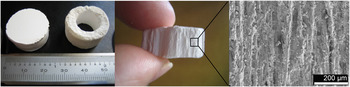
After rinsing with DI water and drying in an oven at 50 °C for 24 h, the grafted porous scaffold monolith was subsequently impregnated with PMMA via emulsion polymerization. Typical emulsions consisted of 54 mL of DI water (dispersion medium), 0.116 g of SLS (emulsifier), 0.116 g of KPS (initiator) and 23 mL of MMA (monomer). The solution was placed into a flask and stirred at 40 °C for 30 min. Then 2 g of the bulk of porous Al2O3 scaffold was suspended in the solution and heated to 80 °C for 7 h with stirring, while polymerization of the MMA occurred. After this step the samples were washed with distilled water and dried at 40 °C for 24 h. The samples prepared in this study had dimensions typically in the centimeter scale and lamellar structures in the micrometer range (Fig. 1).
Typical layered Al2O3/PMMA hybrid materials.

D. Characterization
The microstructures of the samples at half-height of the monolithic cylinders were analyzed with a cold field emission analytical scanning electron microscope (Hitachi S-4700 SEM). The elemental composition was measured by energy-dispersive x-ray spectroscopy on the SEM. Thermogravimetric analyses (TGA, SDT Q600) were performed in the temperature range 20–1000 °C with a heating rate of 5 K/min under an argon atmosphere.
The thermal conductivity, κ, of hybrid Al2O3/PMMA materials was determined from T = 2–300 K using the thermal transport option of a Physical Property Measurement System (PPMS, by Quantum Design). In this method, a square wave heater current is applied to the sample and the temperature response is monitored and modeled to give the 1D thermal conductivity.Reference Maldonado21 The samples were shaped to a rectangular cuboid geometry (2–3 mm in length and 30 mm2 in cross-section), oriented in a particular direction, attached to gold-plated copper leads using silver-loaded epoxy (Tra-Duct 2902), and then mounted on the thermal transport fixture for 1D thermal conductivity measurements. The sample was surrounded by a shield to reduce radiative losses (also corrected using the Stefan-Boltzmann law) and measurements were carried out at <10−4 Torr to minimize convection. The lamellar structures were anisotropic and thermal conductivity was determined in both principal directions, along the lamellae and across the lamellae.
The Vickers microhardness was determined both along and across the growth direction of the hybrid materials. The load was slowly applied using a diamond indenter perpendicular to the surface under test. An indentation time of 10 s and a load of 1 kg force (kgf) were used. At least six indentations were made on each sample and the distance between any two indentations was kept to more than five times the diagonal length of the indentation mark so as to ensure that surface effects were independent of each other. The diagonal length of each indentation impression was measured using SEM and the average diagonal indentation length, d, was calculated. The Vickers hardness (HV) was calculated usingReference Yin, Tao, Zhou and Ding22:

where HV is the Vickers microhardness (units kgf/mm2), F is the applied force (in kgf) and d is in mm.
III. RESULTS AND DISCUSSION
A. Structural control of the Al2O3 scaffold using different particle sizes
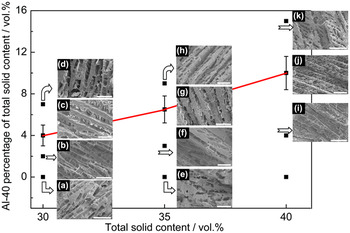
Ice templating is ideal for fabrication of porous, lamellar bulk materials, due to the anisotropic crystal growth of ice. Moreover the thickness of the lamellae and the pore dimensions can be controlled by fine-tuning the solidification velocity and/or particle size during the freeze-casting process.Reference Deville, Saiz and Tomsia23 However, a process-associated limitation is imposed by the viscosity of the slurry. We found that, with Al-400 as the sole source of Al2O3, the interconnected and open porous structure was lost when the solid content of the slurry was above ∼30 vol%, as shown by SEM [see Figs. 2(a) and 2(e)]. This occurs because the viscous Al-400 slurry hinders the plate growth of the ice crystals.Reference Deville24 Diluting Al-400 with smaller Al2O3 particles (Al-40) changes the slurry viscosity, particle interactions, and surface energetics at the ice/particle boundary.Reference Zhang, Hussain, Brust, Butler, Rannard and Cooper25 This is due to the more favorable interactions for the Al-40 particles in the slurry,Reference Lu, Kessler and Davis26 influencing the ice growth and the final scaffold structure. In particular, finer particles fill interstitial sites between the coarser ones, thus reducing viscosity.Reference Munro and Plucknett27 However, freeze casting of pure Al-40 leads to an inhomogeneous structure. Therefore, we explored the relationship between total Al2O3 content and Al-400/Al-40 proportions on the overall structure of the Al2O3 scaffold.
SEM views of structures of Al2O3 scaffolds as a function of total solid (Al2O3) content and of the volume% of Al-40 for the total Al2O3 (Al-40 and Al-400) solid content. The scale bar on each image is 50 μm. The red line indicates optimal conditions for the nominally lamellar structures for different total Al2O3 content of the slurry.

Figure 2 shows the influence of Al-40 concentration on the interior structures of Al2O3 scaffolds of varying solid contents of ceramic slurry (30–40 vol%). The interior structures of the scaffolds prepared with pure Al-400 were found to be disordered and disconnected when the total solid content was above 30 vol% [Figs. 2(a) and 2(e)]. As the Al-40 content is increased while holding the total solid content constant, the SEM images show that the interior structures of the scaffolds have greater porosity, owing to more facile ice growth. The results also show that the optimal ratio of Al-40 to total solid content leading to an ordered nominally lamellar structure depends on the total solid content, increasing from ∼4% Al-40 to ∼10% Al-40 as the total solid content increased from 30 to 40 vol% [Figs. 2(c), 2(g), and 2(j)]. We also observed a general decrease in the distance between the Al2O3 lamellae as the total solid content increased (i.e., thinner ice plates grew with higher Al2O3 content). The architectures with interconnected lamellae provide a suitable scaffold for the introduction of an organic component, as shown below. (Totally lamellar scaffolds would be very fragile but these are strengthened by some interconnections between the layers.)
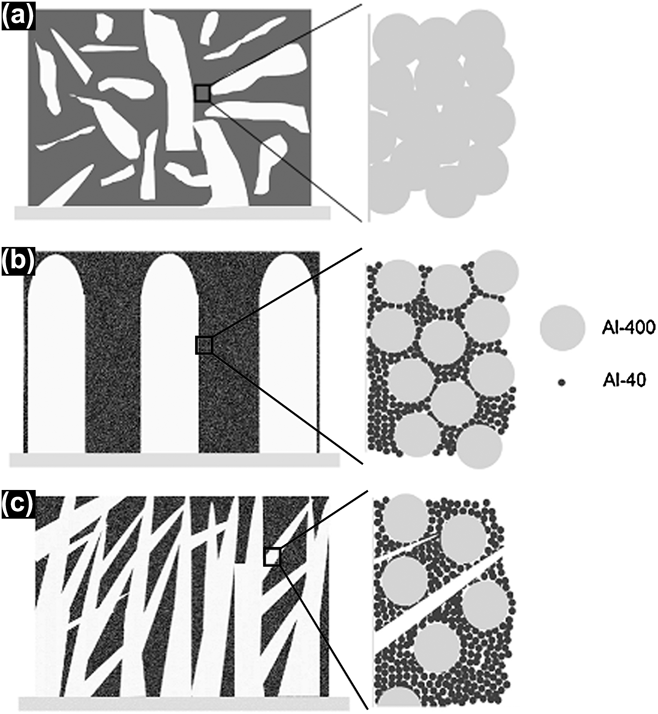
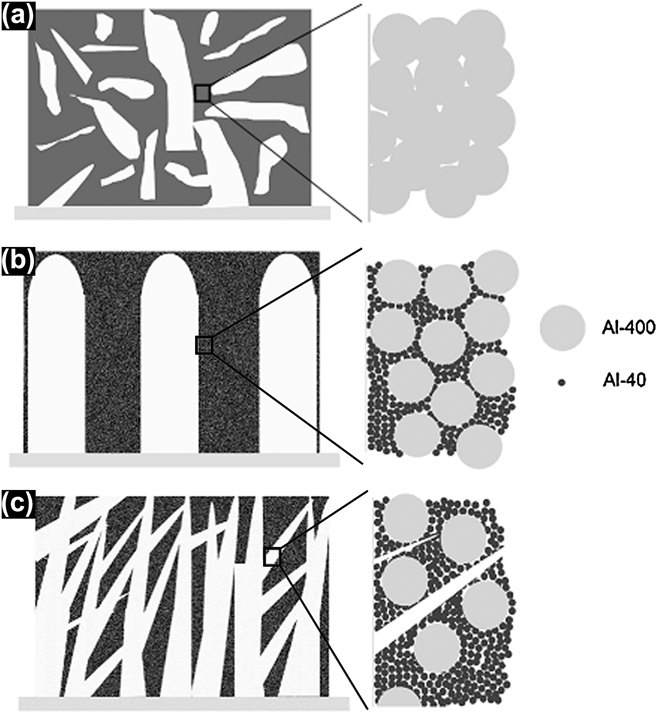
The SEM images show that the Al-40 plays a key role in tailoring the interior structures of Al2O3 scaffolds prepared with a high-ceramic-content slurry. The interconnected and open porous structure gradually deteriorates as the solid content of slurry increases (>30 vol%) in the absence of Al-40 (Fig. 2). This is explained by the interaction between Al-400 particles in the slurry being detrimental to the upward growth of ice crystals, as shown schematically in Fig. 3(a). Adding the smaller Al-40 particles into ceramic slurry in place of some Al-400 particles changes the viscosity of the ceramic slurry, resulting in a change in the ice-growth pattern and interface velocity. At a certain Al-40/Al-400 proportion, the regular sheets of ice lead to a lamellar ceramic structure [Fig. 3(b)]. However, excessive Al-40 results in a less regular structure [Fig. 3(c)]. This can be explained by the larger surface area of the smaller particles which gives rise to more nucleation sites and lateral growth of ice crystalsReference Deville, Maire, Bernard-Granger, Lasalle, Bogner, Gauthier, Leloup and Guizard28 [Figs. 2(d), 2(h), and 2(k)]. We found that there is an optimal amount of Al-40, keeping the solidification primarily along the direction of the imposed temperature gradient, thereby yielding homogeneous, layered structures of different Al2O3 content. However, at very high solid content (>50 vol% in the slurry) we found non-interconnected and closed porosity within the scaffolds regardless of the addition of Al-40, producing architectures unsuitable for fabrication of layered hybrid materials.
Schematic (2D) view of the influence of Al-40 particles on ice growth during the freeze-casting process of a 30 vol% solid content ceramic slurry. (a) The pure Al-400 slurry is viscous and prevents regular ice growth; (b) an optimized Al-40/Al-400 slurry allows regular ice growth; (c) too much Al-40 allows easy ice growth and leads to an inhomogeneous structure.
B. Characterization of hybrid materials
To produce lamellar organic-inorganic hybrid materials, an organic polymer was introduced to fill the spaces between the lamellae of the inorganic scaffolds, first by preparation of the Al2O3 surface, and then by PMMA infiltration using emulsion polymerization. The final organic component replicates the original ice structure. Therefore, the thickness of Al2O3 and PMMA layers of hybrid materials can be tailored by choosing inorganic scaffolds with different lamellar structures. Here we chose three hybrid materials with different interior structures to evaluate their physical properties. They were all fabricated by the same preparation conditions except for different organic or inorganic component ratios.
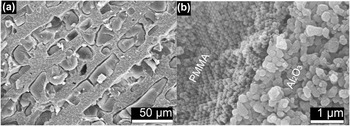
Figure 4 shows a typical interior structure of an Al2O3/PMMA hybrid material, showing both the lamellar structure [Fig. 4(a)] and the distinct boundary between Al2O3 and PMMA [Fig. 4(b)]. The latter shows that the introduction of γ-MPS on the surface of porous Al2O3 scaffold improves the hydrophobic properties of alumina and produces a distinct boundary between the Al2O3 and PMMA layers and good adhesion between the two components.
SEM images of the interior microstructure of Al2O3/PMMA hybrid materials, cross-sectioned perpendicular to the ice solidification direction, prepared by freeze-casting Al2O3 scaffolds (30 vol% Al2O3, 6% of Al2O3 is Al-40) followed by PMMA emulsion polymerization and infiltration. (a) The lamellar structure of the Al2O3/PMMA hybrid material; (b) a close-up view of the boundary between the Al2O3 and PMMA layers.

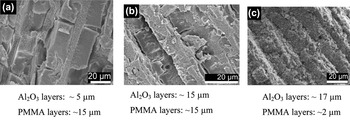
Figure 5 show the structures of the three hybrid specimens that were investigated in detail. The slurries ranged from 20 vol% Al2O3 to 40 vol% Al2O3, with the proportion of Al-40 increasing at higher loading. All show homogeneous, layered organic-inorganic hybrid structures. More interesting is the thickness of Al2O3 layers increased from ∼5 to ∼17 μm with increased Al2O3 content in the slurry, while the thickness of PMMA layers decreased from ∼15 to ∼2 μm. The scaffold structures enable the liquid grafting agent (γ-MPS) to react with Al2O3 layers, favoring infill of PMMA into the porous regions.
The interior microstructures of the three hybrid specimens investigated in detail, cross-sectioned parallel to the solidification direction, showing the tunable thickness of Al2O3 and PMMA layers. The initial ceramic slurry was: (a) 20 vol% pure Al-400; (b) 30 vol% double alumina source (6% of Al2O3 was Al-40); (c) 40 vol% double alumina source (10% of Al2O3 was Al-40).

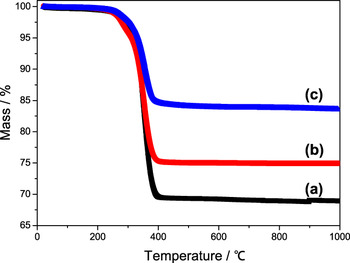
Thermogravimetric analysis (TGA) thermograms for the three hybrid samples with different layered structures are shown in Fig. 6. All three materials (mass ∼2.5 mg) show a single mass loss occurring near 400 °C. This is attributed primarily to removal of PMMA from the hybrid materials,Reference Zhang and Blum29 with a minor contribution from γ-MPS bonding between the two components.Reference Munch, Launey, Alsem, Saiz, Tomsia and Ritchie18 Moreover, the mass loss of the three samples decreased from ∼30% to ∼15% as the thickness of PMMA layers decreased (Fig. 5).
TGA thermograms of layered hybrid materials prepared from Al2O3 scaffolds with increasing Al2O3 content of the slurry: (a) 20 vol% pure Al-400; (b) 30 vol% double alumina source (6% of Al2O3 was Al-40); (c) 40 vol% double alumina source (10% of Al2O3 was Al-40).

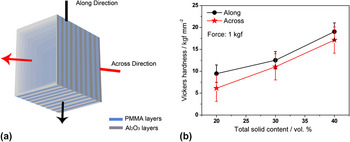
The Vickers hardness (HV) of the three hybrid specimens was investigated. Since these materials have an ordered structure, some anisotropy is expected and thus measurements were made both along and across the ice growth directions [Fig. 7(a)]. The hardness increases as the Al2O3 content increases [Fig. 7(b)]. As the thickness of Al2O3 lamellae increased and the thickness of the PMMA lamellae decreased, the hardness of hybrid materials increased in both directions. HV more than doubled as the volume ratio of Al2O3 to PMMA increased. We also note that the HV data obtained for indentation along the lamellar direction is slightly higher than that across the lamellae. The finding that the microhardness values are higher if the layers are indented edge-on than face-on has also been seen for lamellar structures of biological origin, for instance shell,Reference Yang, Kashani, Li, Zhang and Meyers30 boneReference Ziv, Wagner and Weiner31 and lobster.Reference Sachs, Fabritius and Raabe32
(a) Model of the structure of the layered Al2O3/PMMA hybrid materials. (b) Microhardness results for the Al2O3/PMMA hybrid materials at room temperature.

C. Thermal conductivity
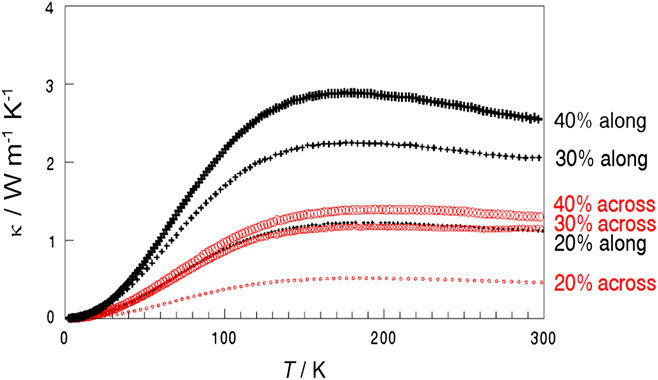
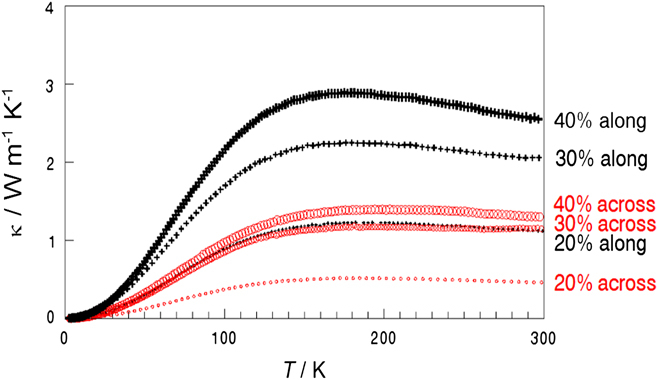
The results for thermal conductivity (κ) measurements of the three Al2O3/PMMA hybrid materials are shown in Fig. 8. In general, the thermal conductivity is higher with the higher inorganic content. As for the layered natural composite nacre,Reference Tremblay, Johnson, Werner-Zwanziger and White17 the thermal conductivity for a given Al2O3/PMMA hybrid is higher in the direction along the layers than the direction across the layers.
The thermal conductivity, κ, of three Al2O3/PMMA hybrid materials, determined along or across the layers [see Fig. 7(a)], with the overall Al2O3 content (vol%) of the slurry as indicated. The 20% sample was made from pure Al-400; the 30% and 40% samples were from a double alumina source (6% and 10% of Al2O3 was Al-40, respectively). Typical uncertainty in thermal conductivity in this temperature range is ±10%.
The physical properties of composites generally are inadequately predicted by a rule of mixtures,Reference White33 but our complete understanding of the thermal conductivity of natural composites such as ivoryReference Jakubinek, Samarasekera and White16 or nacreReference Tremblay, Johnson, Werner-Zwanziger and White17 is impeded by the inability to control the structures. However, with synthetic hybrid materials, we can produce lamellar materials with a range of structures, allowing further understanding of thermal conductivity mechanisms.
Knowledge of the room-temperature thermal conductivities of the components (κ of a chemical vapor deposition (CVD) film of Al2O3 is 27 W/(m K),Reference Cahill, Lee and Selinder34 and that for a thin film of PMMA is 0.2 W(m K)−1Reference Chu, Touzelbaev, Goodson, Babin and Pease35) allows quantitative models of the thermal conductivity of these hybrid materials. In these simple models, we neglect boundary scattering contributions.
The extreme models for thermal conductivity through a hybrid composite material, κcomp, could be represented by heat conduction for thermal resistors in series or in parallel, placing bounds on κcomp as:

where κa and κp are the thermal conductivities of alumina and PMMA respectively, and V a/V and V p/V are the volume fractions of alumina and polymer, respectively. On this basis, the room-temperature thermal conductivities should have a lower bound in the range 0.3–1 W(m K), and an upper bound in the range 7–25 W(m K) (lower values for each range are for the 20% Al2O3 slurry and higher values are for the 40% Al2O3 slurry). From the data in Fig. 8, it is clear that the room-temperature thermal conductivities of all the Al2O3/PMMA composites fall within these bounds, which contrasts with our investigations of nacre where the thermal conductivity fell slightly below the comparable bounds.Reference Tremblay, Johnson, Werner-Zwanziger and White17 The availability of thermal conductivity data from three compositions of Al2O3/PMMA composites, in both directions of heat flow, allows for a more detailed examination.
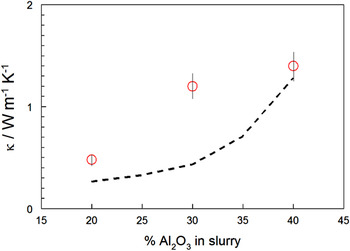
In the heat flow direction across (i.e., perpendicular to) the layers, each layer can be modeled as a thermal resistor, and the bulk sample can be considered to have thermal resistance as per a series of thermal resistors (alternately Al2O3 and PMMA) in a line. Without any fitting parameters, we have calculated the room-temperature thermal conductivity in this direction based on the thickness of each layer, and find semiquantitative agreement with the experimental observations at different Al2O3 solid content (Fig. 9).
Thermal conductivity of Al2O3/PMMA hybrid materials at T = 300 K, in the direction across (i.e., perpendicular to) the layers. The open circles designate the experimental data (with error bars) and the dashed line indicates the results for a model based on a linear series of thermal resistors, alternately Al2O3 and PMMA, of thicknesses as given in Fig. 5.

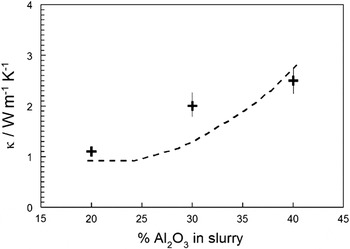
A similar model for thermal conductivity along the layers, treating each component as a thermal resistor in parallel with the other components, overestimates the thermal conductivity by about an order of magnitude. However, we know that the layers are not monolithic slabs. Assuming a reasonable (5 μm thick) layer of PMMA between interrupted Al2O3 slabs gave a good fit to the experimental data with reasonable Al2O3 slab lengths (100 μm, 200 μm, and 300 μm for the 20%, 30%, and 40% samples, respectively), as shown in Fig. 10.
Thermal conductivity of Al2O3/PMMA hybrid materials at T = 300 K, in the direction along the layers. The crosses designate the experimental data (with error bars) and the dashed line indicates the results for a model based on a parallel series of thermal resistors, alternately Al2O3 and PMMA, with dimensions as given in Fig. 5 and breaks in the Al2O3 slabs approximately every 100–300 μm, infilled with 5 μm of PMMA.

We also can compare our results for the thermal conductivity based on an effective medium approximation for a composite with spherical filler particles in the matrixReference Bruggeman36:
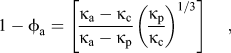
where φa is the volume fraction of Al2O3.
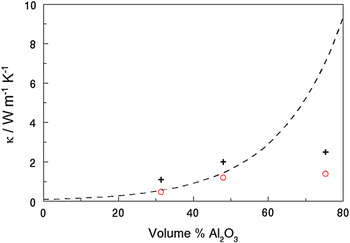
The results, shown in Fig. 11, are quite similar to the experimental results at low loading, as also found for randomly dispersed Al2O3/epoxy composites at low loadings.Reference Wong and Bollampally37 However, the effective medium model significantly overestimates the thermal conductivity of the present Al2O3/PMMA composites at the highest Al2O3 loading. This finding contrasts with results for Al2O3/epoxy composites where the Al2O3 was in the form of fibers, leading to thermal conductivities in excess of the effective medium prediction.Reference Hojo, Kagawa and Takezawa38 In that case, the predominant mechanism of heat conduction was through the Al2O3 fibers, which led to an enhancement of thermal conductivity relative to the effective medium model. The effective medium model also underestimates the thermal conductivity of Al2O3/polyester nanocomposites.Reference Moreira, Sphaier, Reis and Nunes39 For the present composites, the lamellar structure lowers the thermal conductivity relative to the effective medium model, showing the importance of structure in determination of thermal conductivity.
Thermal conductivity of Al2O3/PMMA hybrid materials at T = 300 K, where ○ and + indicate experimental results across the layers and along the layers respectively, and the dashed line indicates the results for an effective medium model based on spherical particles of Al2O3 in a PMMA matrix. Results are presented as a function of volume% Al2O3 in the composite (average of data from SEM and TGA).

Overall, the anisotropy of the thermal conductivity of the Al2O3/PMMA composites is similar to that of nacreReference Tremblay, Johnson, Werner-Zwanziger and White17 (all the Al2O3/PMMA composites have thermal conductivities about a factor of 2 higher in the direction along the layers compared with across the layers, about the same as observed for nacre). Furthermore, the thermal conductivity of the Al2O3/PMMA composites is of approximately the same value as for nacre, and quite low for a high mineral content material, quite likely for the same reasons, i.e., due to the combination of lamellar microstructure and interrupted mineral plates. Most interestingly, the temperature dependence of the thermal conductivity of the Al2O3/PMMA composites from ∼3 K to 300 K (Fig. 8) is very similar to our results for nacre,Reference Tremblay, Johnson, Werner-Zwanziger and White17 indicating that, from the thermal conductivity perspective, the Al2O3/PMMA composite is a nacre mimic.
IV. CONCLUSIONS
A method to fabricate Al2O3 scaffolds with interconnected open porosity was developed using two alumina sources with different particle sizes. The optimal ratios of small particles to total solid content to retain a lamellar structure were determined. This method offers controllable lamellar ceramic scaffolds that can be infilled with polymer to fabricate Al2O3/PMMA hybrid materials. The physical properties, especially thermal conductivity, of the lamellar hybrid composite materials can be tailored within a certain range by controlling the thickness of Al2O3 or PMMA lamellae. The thermal conductivity across the lamellae is well modeled by a linear series of thermal resistors (alternately Al2O3 and PMMA). Along the lamellae, the thermal conductivity is not well modeled by monolithic slabs, but is well represented by parallel thermal resistors of continuous slabs of PMMA and ∼200 μm long slabs of Al2O3, joined by PMMA. This model is very similar to the model used to understand the thermal conductivity of nacre.Reference Tremblay, Johnson, Werner-Zwanziger and White17
ACKNOWLEDGMENTS
We thank Robert L. White, Josef W. Zwanziger, Peng Zhang, Jeff Dahn, Ping Li, and Patricia Scallion for help in this work. This research was financially supported by NSERC, and the Canada Foundation for Innovation, Atlantic Innovation Fund and other groups which fund the Facilities for Materials Characterization managed by the Institute for Research in Materials at Dalhousie University.