Schema therapy (also known as schema-focused therapy) was developed by Young, Klosko and Weishaar (Reference Young, Klosko and Weishaar2003). It focuses on the identification and modification of core schemas (also referred to as early maladaptive schemas, EMSs). Young (Reference Young1994) defined EMSs as “extremely stable and enduring themes that develop during childhood and are elaborated upon throughout an individual’s lifetime” (p. 9). The EMSs combine an inherited, vulnerable temperament with a dysfunctional experience with parents, siblings and peers. Young postulated that a schema is located at the deepest level of cognition and that a person is not always conscious of his/her schemas’ impacts on emotions and behaviors. According to Young’s theory, EMSs are comprised of memories, emotions, cognitions and bodily sensations regarding oneself and one’s relationships with others. They are underlying cognitive structures that organize one’s experience of the world, and reflect childhood experiences related to attachment and approval/disapproval experiences. Young hypothesized that a child must negotiate five primary tasks in order to develop in a healthy manner: Connectedness, autonomy, worthiness, reasonable expectations, and realistic limits (Rafaeli, Bernstein, & Young, Reference Rafaeli, Bernstein and Young2011). He proposed that EMSs arise when parents or caregivers make it difficult to achieve one or more of these basic needs. EMSs are described as general vulnerability factors for a broad range of psychopathologic conditions, and constitute predisposing factors for the development and maintenance of clinical symptom states (Young, Reference Young1994; Young et al., Reference Young, Klosko and Weishaar2003). In other words, EMSs are not specific for a given pathology, e.g. borderline personality disorder or obsessive compulsive disorder (OCD), and can be considered to be “transdiagnostic”. It has also been postulated that EMSs are present in non-clinical populations - albeit to a lesser extent than in clinical populations. Examples of EMSs are dependence (the belief that one is unable to have one’s everyday responsibilities without help from others) or failure (the belief that one has failed or is inadequate, relative to others).
Young (Reference Young2005) hypothesized that there are 18 EMSs, which can be allocated to five domains reflecting childhood tasks: (A) Disconnection & rejection, (B) impaired autonomy & performance, (C) impaired limits, (D), other-directedness, and (E) overvigilance & inhibition. These domains are linked to their hypothetical origins in childhood. For example, the disconnection & rejection domain is associated with safe attachment and protection; the impaired autonomy & performance domain is linked to autonomy and competency; the impaired limits domain is linked to self-control; other-directedness is associated with free expression of needs, and the overvigilance and inhibition domain is associated with spontaneity and play (Kriston, Schäfer, Jacob, Härter, & Hölzel, Reference Kriston, Schäfer, Jacob, Härter and Hölzel2013). Five schemas are linked to domain A: Abandonment/instability, mistrust/abuse, emotional deprivation, defectiveness/shame, and social isolation/alienation. Four schemas make up Domain B: Dependence/incompetence, vulnerability to harm or illness, enmeshment/undeveloped self, and failure. Two schemas are linked to Domain C: Entitlement/grandiosity, and insufficient self-control/self-discipline. Domain D includes three schemas: Subjugation, self-sacrifice and approval-seeking/recognition-seeking. Domain E is composed of four schemas: Negativity/pessimism, emotional inhibition, unrelenting standards/hypercriticalness, and punitiveness (Rafaeli et al., Reference Rafaeli, Bernstein and Young2011). The latest short version of the YSQ (YSQ–S3; Young, Reference Young2005) includes 90 items (five for each of the 18 schemas).
The first study of the YSQ–S3 (Soygut, Karaosmanoglu, & Çakir, Reference Soygut, Karaosmanoglu and Çakir2009) focused on Turkish university students. The researchers performed two principal component analyses: One on the 90 items and the other on first-order factors (in order to explore higher-order factors). They selected 14 first-order factors (emotional deprivation, failure, pessimism, social isolation/mistrust, emotional inhibition, approval seeking/recognition seeking, enmeshment/dependence, entitlement/insufficient self-control, self-sacrifice, abandonment, punitiveness, defectiveness, vulnerability to harm, unrelenting standards) and five higher-order factors. For three EMSs (emotional deprivation, emotional inhibition and self-sacrifice), the items were grouped together in the same way as in Young’s model. The other three first-order factors corresponded to Young’s schemas (failure, approval seeking, and abandonment). The other schemas corresponded to clusters of Young’s theoretical EMSs (i.e. enmeshment, dependence & subjugation; social isolation & mistrust abuse; entitlement & insufficient self-control). Of the five higher-order factors, four had been described by Young (impaired autonomy & performance, disconnection & rejection, impaired limits, and other-directedness). The items (schemas) which compose these higher-order factors generally correspond to Young’s theoretical model, with the exception of the other-directedness domain. The fifth higher-order factor (unrelenting standards) covers the unrelenting standards and approval-seeking schemas. The “overvigilance & inhibition” higher-order factor was not found in the Turkish version. Next, Soygut et al. (Reference Soygut, Karaosmanoglu and Çakir2009) explored the YSQ–S3’s internal reliability, test-retest reliability, convergent validity and criterion-related validity. The researchers studied the convergent validity with the Symptom Checklist–90–Revised (SCL–90–R). A clinical population was compared with a population of students: Nine of the 14 schemas (emotional deprivation, failure, pessimism, social isolation, emotional inhibition, enmeshment, abandonment, defectiveness, and vulnerability to harm) and two of the five domains (impaired autonomy & performance, and disconnection & rejection) differentiated between the two groups. The second study (Saritas & Gençöz, Reference Saritas and Gençöz2011) of the YSQ–S3 also focused on the Turkish version but applied it to an adolescent sample (mean age: 16). The researchers used principal component analysis to examine the higher-order factor structure. Only three higher-order factors were found: Impaired limits/exaggerated standards, disconnection & rejection, and impaired autonomy/other-directedness. The first factor (the domain) included two schemas from Young’s impaired limits domain and three schemas from the overvigilance & inhibition domain. The second factor included three schemas from Young’s disconnection & rejection domain, together with schemas from other domains. The third factor included three schemas from the impaired autonomy domain and some schemas from other domains. Next, the convergent validity of the three higher-order factors was studied with regard to the State-Trait Anxiety Inventory and State-Trait Anger Inventory. The third study of the YSQ–S3 looked at the French Canadian version (Hawke & Provencher, Reference Hawke and Provencher2012). Eighteen confirmatory factor analyses (CFAs) were performed on the five items of each EMS, in a mixed population (96 axis I patients and 973 non-clinical participants). The single-factor model was confirmed for 14 EMSs but not for the punitiveness, enmeshment, entitlement and self-sacrifice schemas. Next, five CFAs were conducted on the higher-order domains. Only three of the five domains demonstrated a good fit to the data (disconnection and rejection, impaired autonomy and performance, and other-directedness). Lastly, the researchers tested two full models in a CFA: the first model brought together the five correlated domains with their respective EMSs, and the second model added the total score as a third-order factor. These two models failed to produce acceptable goodness-of-fit indexes. The researchers concluded that the internal validity of the YSQ–S3’s second-order factors (domains) had not been confirmed. Next, the two groups of participants (clinical and non-clinical) were compared: All but two of the EMSs (entitlement and unrelenting standards) differentiated between the groups. In a fourth study, Kriston, Schäfer, Jacob, Härter, and Hölzel (Reference Kriston, Schäfer, Jacob, Härter and Hölzel2013) studied the factorial validity of the German version of the YSQ–S3 in a community sample (n = 1,150). They performed a CFA of the 18 correlated factors corresponding to Young’s model. This version showed “acceptable” factorial validity. The reliability of 17 of the 18 schema scales was sufficient. The convergent validity (studied with the SCL–K–9) and the criterion-related validity were satisfactory. The clinical sample was composed of inpatients and outpatients. All the schemas differentiated between clinical participants and those reporting no mental health problems. In the fifth study, the Spanish version of the YSQ–S3 were studied in a population of 971 students (Calvete, Orue, & Gonzalez-Diez, Reference Calvete, Orue and Gonzalez-Diez2013). Several CFAs were performed, in order to probe the 18 EMSs and the five domains proposed by Young. The correlated 18-factor first-order structure yielded better goodness-of-fit indexes than the uncorrelated 18-factor first-order structure. Next, the researchers studied the second-order structure of the YSQ–S3 in an exploratory factor analysis (EFA). Three factors were found. The first second-order factor (an unlabeled factor) loaded on the scales of self-sacrifice, approval seeking, unrelenting standards, negativity, punitiveness and entitlement. The second factor (impaired autonomy & performance) loaded on the scales of failure, dependence, vulnerability to harm, enmeshment, abandonment, subjugation and insufficient self-control. The third factor (disconnection & rejection) loaded on the scales of emotional deprivation, mistrust, defectiveness, social isolation and emotional inhibition. Next, the researchers performed several CFAs to compare this solution with previous second-order solutions. The researchers found that all the hierarchical models showed acceptable goodness-of-fit indexes but that their own solution was better (for three domains). They concluded that only two domains (disconnection & rejection, and impaired autonomy) may have been validated, with slight changes. The internal reliability was not adequate for six EMSs (dependence, vulnerability to harm, enmeshment, subjugation, unrelenting standards, and entitlement). The test-retest reliability (6 months) was relatively adequate. Convergent validity was studied with the SCL–90–R and the Social Anxiety Questionnaire for Adults. The results of this study should be interpreted with caution because all the analyses (i.e. the CFAs and EFAs) were performed on the same sample. Lastly, Bach, Simonsen, Christoffersen, and Kriston (Reference Bach, Simonsen, Christoffersen and Kriston2017) examined the factorial validity of the Danish version of the YSQ–S3 in a mixed clinical and non-clinical sample by using the same methodology as Kriston et al. (Reference Kriston, Schäfer, Jacob, Härter and Hölzel2013). The researchers concluded that the evidence for the postulated first-order 18-factor structure was weak but acceptable. The criterion-related validity was satisfactory for the 18 schema scales. The internal consistency of the 18 EMSs was good.
Hence, the six studies of the YSQ–S3 have yielded contradictory results. An exploratory method (principal component analysis) has been applied once to the full set of 90 items (Soygut et al., Reference Soygut, Karaosmanoglu and Çakir2009) and three times to the 18 schemas (Calvete et al., Reference Calvete, Orue and Gonzalez-Diez2013; Saritas & Gençöz, Reference Saritas and Gençöz2011; Soygut et al., Reference Soygut, Karaosmanoglu and Çakir2009). Fourteen schemas were identified in a Turkish non-clinical population but only six of these were similar to those postulated by Young (Soygut et al., Reference Soygut, Karaosmanoglu and Çakir2009). In this new structure, the number of items per factor varied. The 14 schemas were clustered into five higher-order factors: four had been described by Young, and one was new (with unrelenting standards replacing Domain E, overvigilance and inhibition). The other two studies to have explored the schemas’ domains (Calvete et al., Reference Calvete, Orue and Gonzalez-Diez2013; Saritas & Gençöz, Reference Saritas and Gençöz2011) found three-factor solutions. Two domains (impaired autonomy, and disconnection & rejection) were selected in both studies. The third factor was referred to as “impaired limits/exaggerated standards” in the Turkish version (Saritas & Gençöz, Reference Saritas and Gençöz2011) and as an “unlabeled factor” in the Spanish version (Calvete et al., Reference Calvete, Orue and Gonzalez-Diez2013). These two studies yielded different schema clustering patterns. In both studies, the impaired autonomy Domain (B) encompassed three EMSs from Young’s theoretical model (dependence, enmeshment and vulnerability), and two schemas from other domains (subjugation in the other-directness domain, and abandonment in the disconnection & rejection domain). The disconnection & rejection domain (A) covered three EMSs from Young’s postulated domain (emotional deprivation, social isolation and defectiveness) and one EMS from another domain (emotional deprivation). In other words, the results of the various exploratory analyses differed from the Young’s theoretical model of schemas and domains, and also varied from one study to another. Three CFAs have been performed on the 18 schemas (Bach et al., Reference Bach, Simonsen, Christoffersen and Kriston2017; Calvete et al., Reference Calvete, Orue and Gonzalez-Diez2013; Kriston et al., Reference Kriston, Schäfer, Jacob, Härter and Hölzel2013). The structure with 18 correlated first-order factors postulated by Young showed acceptable factorial validity in two studies (Calvete et al., Reference Calvete, Orue and Gonzalez-Diez2013; Kriston et al., Reference Kriston, Schäfer, Jacob, Härter and Hölzel2013) but was weakly supported in one study (Bach et al., Reference Bach, Simonsen, Christoffersen and Kriston2017). Two studies included a CFA of the 18 SMSs grouped into five domains (Calvete et al., Reference Calvete, Orue and Gonzalez-Diez2013; Hawke & Provencher, Reference Hawke and Provencher2012). The correlated five-factor structure failed to produce acceptable goodness-of-fit indexes in the two studies. In the study of the French Canadian version (Hawke & Provencher, Reference Hawke and Provencher2012), the single-factor model was confirmed for 14 EMSs but the structural validity of the second-order factors was not confirmed. Only one study (Calvete et al., Reference Calvete, Orue and Gonzalez-Diez2013) used a confirmatory method to test the hierarchical structure of the YSQ–S3 by comparing several models (including that Young’s model). The various solutions gave acceptable goodness-of-fit indexes but the researchers concluded that their own solution was better. Only two domains (disconnection & rejection, and impaired autonomy & performance) may have been validated.
The study of convergent validity was performed twice with the full SCL–90 R (Calvete et al., Reference Calvete, Orue and Gonzalez-Diez2013; Soygut et al., Reference Soygut, Karaosmanoglu and Çakir2009) and once with a shorter version (SCL–K–9; Kriston et al., Reference Kriston, Schäfer, Jacob, Härter and Hölzel2013). One study (Saritas & Gercoz, 2011) focused on the relationships between the schemas on one hand and anxiety and anger on the other. Another study has looked at the relationships between the schema scales and social anxiety (Calvete et al., Reference Calvete, Orue and Gonzalez-Diez2013). The YSQ–S3’s convergent validity has not been extensively studied. Four studies have examined the criterion-related validity (Bach et al., Reference Bach, Simonsen, Christoffersen and Kriston2017; Hawke & Provencher, Reference Hawke and Provencher2012; Kriston et al., Reference Kriston, Schäfer, Jacob, Härter and Hölzel2013; Soygut et al., Reference Soygut, Karaosmanoglu and Çakir2009).
The YSQ–S3 has been translated into several languages (Turkish, German, Dutch, Finnish, Greek, Spanish and French). However, studies of the factorial structure have given some contradictory results. Hence, a firm basis for the structure of the EMSs needs to be developed. Studies of the YSQ–S3’s convergent validity and criterion-related validity are thus required. The objective of the present study was therefore to investigate the YSQ–S3’s first-order and higher-order factorial structure in a French population. Internal consistency, convergent validity and criterion-related validity were assessed. The links between some personality traits considered to be stable in adulthood (neuroticism, extraversion, and psychoticism) and the (YSQ–S3’s) SMSs have never been studied. We thought that it would be valuable to study the SMSs that are constituted in childhood and their links with the memories of an adult concerning dysfunctional parental attitudes (overprotection or rejection) or functional parental attitudes (warmth).
Methods
Procedures
We performed two studies of the psychometric qualities of the French version of the YSQ–S3. In the first study, volunteer non-clinical participants (N = 605) completed the different questionnaires anonymously under the supervision of three research assistants, after having received information on the study’s objectives. First, we conducted EFAs on each of the five domains in order to find the best solution; this was performed on a randomly selected subset (N = 246) of the 605 participants in the initial sample. We then performed CFAs on the remaining participants (N = 359). Secondly, we used the whole sample to perform CFAs of the YSQ–S3’s higher-order factor structure. In the subsequent analyses (reliability, convergent validity and criterion-related validity), we selected the solution with the best goodness-of-fit indices. We focused on the relationships between the different schemas and the perceived parental rearing behaviors, and then the relationships with three personality dimensions (extraversion, neuroticism and psychoticism) in subgroups of the whole sample (for convergent validity). The statistical significance of the product-moment (r) was interpreted according to Cohen’s criteria (1992). For the second study of the criterion-related validity, the YSQ–S3 questionnaires from 30 clinical participants (suffering from OCD) were compared with those of 30 non-clinical participants.
Participants
Study 1: The non-clinical group
The main sample consisted of 605 participants (132 men and 473 women) with a mean and standard deviation (SD) age of 20.63 (1.94). The first subgroup (used for the EFA) was composed of 246 participants (53 men and 193 women) selected at random from among the 605 participants. The second subgroup was composed of the participants not selected for the EFA (N = 359; 79 men and 280 women). Only 450 participants completed the three personality dimensions and the perceived parental rearing behaviors. The convergent validity with the perceived parental rearing behaviors was calculated for a subgroup of 432 participants (missing data). Volunteers were recruited on the Savoie Mont-Blanc University campus (Chambéry, France).
Study 2: The clinical and non-clinical groups
A subsample of the main sample was chosen for comparison with the clinical sample. Thirty patients with OCD (including 18 men) and 30 non-clinical participants (including 11 men) completed the YSQ–S3. There was no significant difference in terms of gender (χ2 = 3.27, p = .07). The mean age (standard deviation) was 30.03 (12.56) for the non-clinical sample and 33.70 (7.34) for the OCD sample; the difference was not significant, t(58) = 1.37, p = .17. The mean number of years of full-time education was 15.66 (2.10) for the non-clinical sample and 14.26 (2.93) for the clinical sample; the difference between the two groups was significant, t(58) = 2.12, p = .03. Clinical participants were recruited from the Savoie Mont-Blanc University Psychological Consultation Center (Chambéry, France). Non-clinical participants were recruited through advertisements within and outside Savoie Mont-Blanc University. All participants gave their informed consent, and the research was approved by the independent ethics committee at Savoie Mont-Blanc University.
Material
The YSQ–S3 is a 90-item questionnaire designed to assess 18 EMSs: Emotional deprivation (S3; Items 1, 19, 37, 55 and 73), abandonment (S1; Items 2, 20, 38, 56 and 74), mistrust/abuse (S2; Items 3, 21, 39, 57 and 75), social isolation (S5; Items 4, 22, 40, 58 and 76), and defectiveness/shame (S4; Items 5, 23, 41, 59 and 77), making up the disconnection & rejection Domain A; failure (S9; Items 6, 24, 42, 60 and 78), dependence/incompetence (S6; Items 7, 25, 43, 61 and 79), vulnerability to harm or illness (S7; Items 8, 26, 44, 62 and 80), enmeshment/undeveloped self (S8; Items 9, 27, 45, 63 and 81) representing Domain B (impaired autonomy & performance); entitlement/grandiosity (S10; Items 14, 32, 50, 68 and 86), insufficient self-control/ self-discipline (S11; Items 15, 33, 51, 69 and 87) forming Domain C (impaired limits); subjugation (S12; Items 10, 28, 46, 64, 82), self-sacrifice (S13; Items 11, 29, 47, 65 and 83), approval-seeking/ recognition-seeking (S14; Items 16, 34, 52, 70 and 88) making up Domain D (other-directedness) and emotional inhibition (S16; Items 12, 30, 48, 66 and 84), unrelenting standards (S17; Items 13, 31, 49, 67 and 85), negativity/pessimism (S15; Items 17, 35, 53, 71, 89), punitiveness (S18; Items 18, 36, 54, 72 and 90), forming Domain E (overvigilance & inhibition). Each of the YSQ-S3 items is rated on a 6-point scale (from 1 = “completely untrue of me” to 6 = “describes me perfectly”). The score for each schema is the sum of the scores obtained for the five constitutive items. Higher scores indicate a greater presence of the maladaptive schema for the respondent.
The abbreviated form of the Eysenck Personality Questionnaire Revised (EPQR-A, Eysenck, Eysenck, & Barrett, Reference Eysenck, Eysenck and Barrett1985) evaluates three independent dimensions of personality: Extraversion, neuroticism and psychoticism. The different versions of the EPQR-A, including the French version (Bouvard, Aulard-Jaccod, Pessonneaux, Hautekeete, & Rogé, Reference Bouvard, Aulard, Longuepée, Rogé and Hautekeete2010; Lewis, Francis, Shevlin, & Forrest, Reference Lewis, Francis, Shevlin and Forrest2002), have a three-dimensional factorial structure.
The short form of the EMBU (derived from the Swedish “egna minnen betraffande uppfostran”, meaning “my memories of upbringing”) inventory (s-EMBU; Arrindell et al., Reference Arrindell, Sanavio, Aguilar, Sica, Hatzichristou, Eisemann and van der Ende1999) is a means of rapidly measuring perceived parental rearing behaviors from an adult’s point of view. The questionnaire includes 22 items and is completed first for the mother and then for the father. Three dimensions are examined: Rejection, emotional warmth and (over)protection, giving a total of six subscores per individual. The s-EMBU’s psychometric properties have been studied in culturally different populations (Arrindell & Engebretsen, Reference Arrindell and Engebretsen2000; Arrindell et al., Reference Arrindell, Akkerman, Bagès, Feldman, Caballo, Oei and Zaldívar2005). The French version studied here has three dimensions, and showed much the same internal consistency and convergent validity as in the literature (Bouvard, Aulard, Longuepée, Rogé & Hautekeete, Reference Bouvard, Aulard, Longuepée, Rogé and Hautekeete2010).
Statistical analyses
In order to test the YSQ–S3’s internal validity (Study 1), several analyses were performed on the non-clinical group. A subgroup was constituted in order to perform five EFAs (one per domain). For these EFAs, we used MPLUS 7.1 software (Muthén & Muthén, 1998-2015) to generate the same indices as in the confirmatory analyses. We assessed the chi-squared (χ2), the degree of freedom (df), the root mean square error of approximation (RMSEA), the goodness of fit (using the comparative fit index, CFI), the Tucker-Lewis index (TLI), and the standardized root mean square residual (SRMR). The criteria for factor extraction were (i) a scree test (Cattell, Reference Cattell1966) and (ii) the interpretability of the resulting factor structure (Gorsuch, Reference Gorsuch1983). For each domain, a multifactorial solution was selected. For each factor, only items which loaded > .40 were selected as being representative of a factor. Items saturating more than two factors were deleted. A second subgroup was used to perform CFAs. Three models were tested in each of the five domains: The solution that we had identified using EFAs, a single-factor solution, and Young’s theoretical solution. We assessed the χ2, df, RMSEA, CFI, TLI and the weighted root mean square residual (WRMR), the smaller the residual (> 1.00), the better the index (Yu, Reference Yu2002). Lastly (using the whole group), we performed confirmatory analyses of the scale scores (the second-order factor structure) by comparing our five-factor solution, Young’s theoretical solution and Calvete et al.’s solution (2013) with three superfactors. The selected goodness-of-fit indexes were the Akaike information criterion (AIC), χ2, df, RMSEA, CFI, TLI and SRMR. The model with the smallest AIC was selected (Hooper, Coughlan, & Mullen, Reference Hooper, Coughlan and Mullen2008). To test reliability (internal consistency), we calculated Cronbach’ alpha coefficients for each of the scales. Correlation coefficients were calculated to test the convergent validity between the two questionnaires (the s-EMBU and the EPQR-A) and the YSQ–S3 in subgroups of the non-clinical sample.
For the assessment of criterion-related validity (Study 2), we used a t-test to compare the clinical group with a non-clinical group. The Bonferroni correction was used to adjust for multiple comparisons of OCD patients vs. non-clinical participants, for the 18 schemas. The threshold for statistical significance was set to p < .05/18 = .003.
Results
Study 1
Exploratory factor analyses of the domains
Our results for the disconnection & rejection Domain A are shown in Table 1. Five factors were found, as in Young’s theoretical solution (2005). The first factor corresponded to defectiveness/shame (S4), and comprised five items (5, 23, 41, 59 and 77). The second factor corresponded to abandonment/instability (S1), and comprised only four items (2, 20, 38 and 56). The third factor corresponded to emotional deprivation (S3), and comprised four items (1, 37, 55 and 73). The fourth factor corresponded to mistrust/abuse (S2), with five items (3, 21, 39, 57 and 75). The fifth factor corresponded to social isolation/alienation (S5), and comprised five items (4, 22, 40, 58 and 76). Two items (19 and 74) were deleted due to dual saturation. The confirmatory indices obtained for this five-factor solution were satisfactory (χ2 = 4,937.03, df = 300, RMSEA = .05, CFI = .97, TLI = .96 and SRMR = .03).
Domain A: Exploratory Factor Analysis

Note: The loadings for items selected for the factor are shown in bold type.
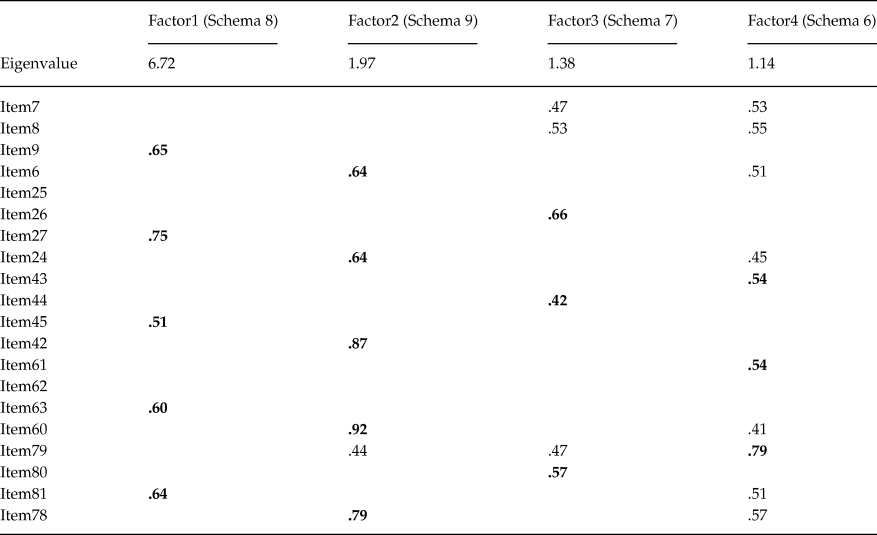
Table 2 corresponds to Domain B (impaired autonomy & performance), which covers four factors. The first factor corresponded to enmeshment/undeveloped self (S8), and comprised five items (9, 27, 45, 63 and 81). The second factor corresponded to failure (S9), and comprised five items (6, 24, 42, 60 and 78). The third factor corresponded to vulnerability to harm/illness (S7), and comprised three items (26, 44 and 80). Lastly, the fourth factor corresponded to dependence/incompetence (S6), and comprised three items (43, 61 and 79). Two items (7, 8) were deleted due to dual saturation, and two others (25 and 62) were deleted because of the absence of saturation. The confirmatory indices obtained for this four-factor solution were satisfactory (χ2 = 3486.99, df = 190, RMSEA = .05, CFI = .97, TLI = .95 and SRMR = .04).
Domain B: Exploratory Factor Analysis

Note: The loadings for items selected for the factor are shown in bold type.
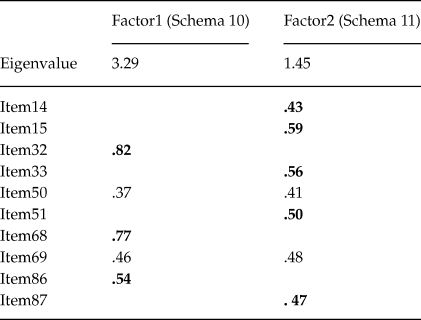
Domain C (Table 3) included two factors. The first factor (corresponding to entitlement, S10) included three items (32, 68 and 86). The second factor (insufficient self-control, S11) included five items (14, 15, 33, 51 and 87). Two items (50, 69) were deleted due to dual saturation. The confirmatory indices obtained for this solution with two factors are satisfactory (χ2 = 794.97, df = 45, RMSEA = .09, CFI = .92, TLI = .86 and SRMR = .06) with the exception of the RMSEA and the SRMR (> .05).
Domain C: Exploratory Factor Analysis

Note: The loadings for items selected for the factor are shown in bold type.
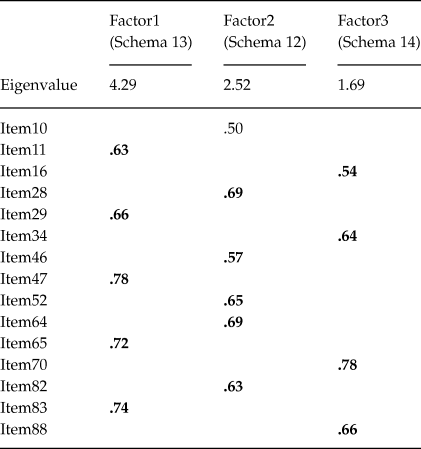
Domain D (other-directedness) encompassed three factors (Table 4). The first factor corresponded to self-sacrifice (S13), and included five items (11, 29, 47, 65 and 83). The second factor corresponded to subjugation (S12), and included six items (10, 28, 46, 52, 64 and 82). Lastly, the third factor (approval seeking, S14) includes four items (16, 34, 70 and 88). The confirmatory indices obtained for this three-factor solution are satisfactory (χ2 = 1741.32, df = 105, RMSEA = .04, CFI = .98, TLI = .97 and SRMR = .03).
Domain D: Exploratory Factor Analysis

Note: The loadings for items selected for the factor are shown in bold type.
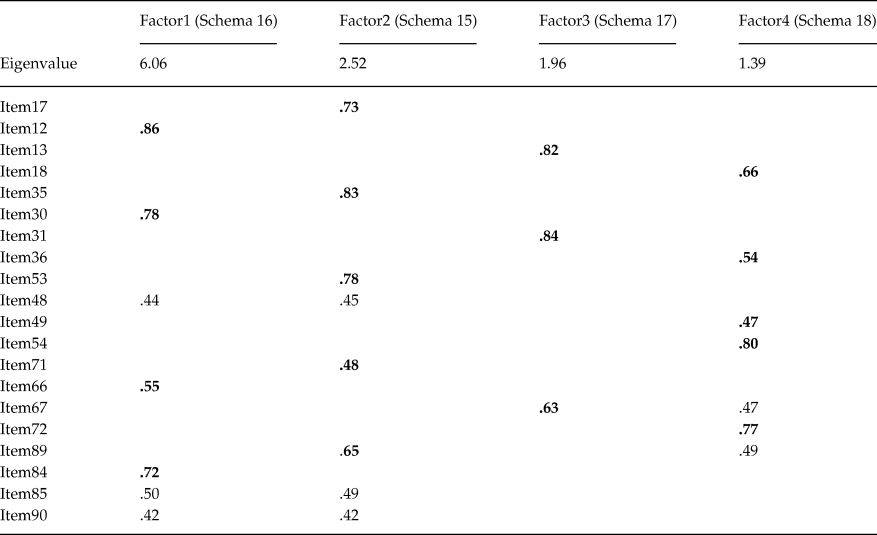
Domain E (over vigilance and inhibition) was constituted of four factors (Table 5). The first factor (emotional inhibition, S16) was composed of Items 12, 30, 66, and 84. The second factor is negativity/pessimism (S15), which included the Items 17, 35, 53, 71, and 89. The third factor (unrelenting standards, S17) was composed of 3 items 13, 31, 67. Lastly, the fourth factor (punitiveness, S18) included five items (18, 36, 49, 54, and 72). Three items (48, 85 and 90) were deleted due to dual saturation. The confirmatory indices obtained for this four-factor solution were satisfactory (χ2 = 2,952.42, df = 190, RMSEA = .05, CFI =.96, TLI = .94 and SRMR = .04)
Domain E: Exploratory Factor Analysis

NB: the loadings for items selected for the factor are shown in bold type.
Confirmatory factor analyses of the domains
We performed three CFAs on a second sub-sample: The solution that we found with the first sample, a one-factor solution, and Young’s theoretical solution. Our solution gave the best indices in all cases (Table 6).
Goodness-of-fit Indexes in the CFAs of the Domains

Note: The selected solution is shown in bold type. RMSEA = root mean square error of approximation; CFI = comparative fit index; TLI = Tucker-Lewis index; WRMR = weighted root mean square residual.
Confirmatory factor analyses of the higher-order structure
Using the study population as a whole, we performed CFAs on three solutions: Young’s theoretical solution, our five-factor solution and Calvete et al.’s (Reference Calvete, Orue and Gonzalez-Diez2013) three-factor solution (Table 7). The confirmatory indices obtained for Young’s theoretical solution were χ2 = 1,024.76, with df = 125, RMSEA =.10, CFI =.78, TLI =.73, SRMR = .06 and AIC = 60,338.82. The confirmatory indices obtained for our five-factor solution were as follows: χ2 = 10,41.71, df = 125, RMSEA = .11, CFI =.76, TLI = .71, SRMR = .07 and AIC = 58,566.44. Lastly, the confirmatory indices obtained for Calvete et al.’s three-factor solution were χ2 = 967.35, df = 132, RMSEA =.10, CFI =.80, TLI =.77, SRMR =.06 and AIC = 60,338.82. The three models tested gave similar but not fully satisfactory results, although our five-factor solution yielded the smallest AIC. Consequently, we decided to select this solution for our subsequent analyses.
Factorial Solution of Calvete’s Model, Young’s Model and Our Five-Factor Solution

Note a: the items added to our factorial solution are indicated between square brackets and in italics; the deleted items are indicated between brackets and in italics.
Mean (SD) and internal consistency of the 18 schemas
The mean (SD) values were calculated for all the participants in the non-clinical group (Table 8). The coefficients for internal consistency were satisfactory for 14 schemas in our factorial solution (S1, S2, S3, S4, S5, S8, S9, S12, S13, S14, S15, S16, S17 and S18), and ranged from .70 to .88. We obtained coefficients below .70 for two schemas (S6 and S7) in the impaired autonomy & performance domain and for two schemas (S10 and S11) in the impaired limits domain.
Internal Consistency, and Means (SD) (whole Sample)

Convergent validity
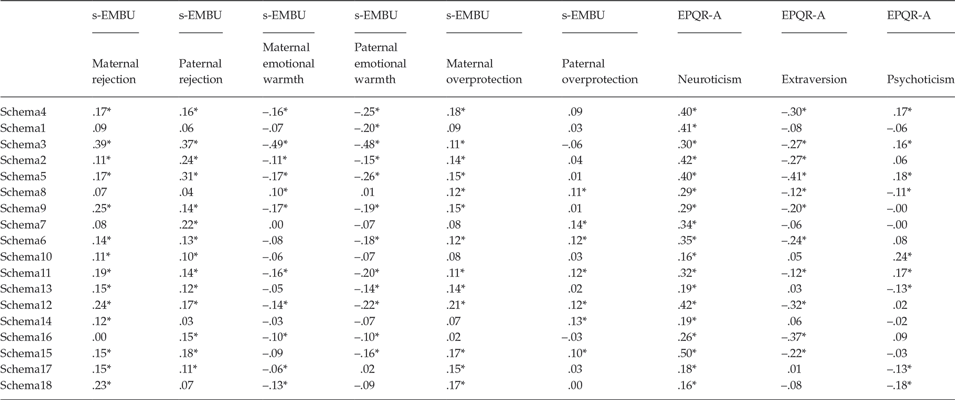
The product-moment (r) was interpreted according to Cohen’s criteria (1992). The assessment of convergent validity with the EPQR-A revealed some statistically significant correlations between the neuroticism scale and the 18 schemas (Table 9). We noted a strong correlation with S15, nine moderate correlations (the five schemas in Domain A, S6 and S7 in Domain B, and S11 and S12) and eight weak correlations (S8, S9, S10, S13, S14, S16, S17 and S18). We noted four moderate correlations (S4, S5, S12 and S16) and seven weak correlations (S2, S3, S6, S8, S9, S11 and S15) with the extraversion scale. The psychoticism scale showed nine weak correlations with S3, S4, S5, S8, S10, S11 (all from Domain C), S13, S17 and S18. The convergent validity with the s-EMBU revealed statistically significant correlations between the maternal and paternal rejection scales and 12 schemas (S4, S3, S2, S5, S9, S6, S10, S11, S13, S12 S15 and S17). Schemas S7 and S16 were weakly correlated with the paternal rejection scale, and schemas S14 and S18 were weakly correlated with the maternal rejection scale. The maternal and paternal emotional warmth scales were significantly and negatively correlated with 8 schemas (S4, S3, S2, S5, S9, S11, S12 and S16). Four schemas (S1, S6, S13 and S15) were weakly correlated with the paternal emotional warmth scale, and two schemas (S8 and S18) were weakly correlated with the maternal emotional warmth scale. The maternal and paternal overprotection scales were weakly correlated with 5 schemas (S8, S6, S11, S12 and S15). Two schemas (S7 and S14) were weakly correlated with the paternal overprotection scale, and eight schemas (S4, S3, S2, S5, S9, S13, S17 and S18) were weakly correlated with the maternal overprotection scale. All but five of the correlations were weak (Cohen, Reference Cohen1992). Schema 3 was moderately correlated with the maternal and paternal rejection scales and the maternal and paternal emotional warmth scales. Schema 5 was moderately correlated with the paternal rejection scale.
Correlations between the YSQ–S3 and Two Questionnaires (s-EMBU and EPQR-A)

*p < .05.
Study 2
The OCD patients obtained higher scores than healthy participants for the 18 schemas. Fourteen schemas (S3, S2, S5, S9, S8, S7, S10, S11, S12, S13, S14, S16, S17 and S18) did not differentiate between the groups (Table 10). There was a statistically significant intergroup difference for four schemas: Abandonment/instability (S1), defectiveness/shame (S4), dependence/incompetence (S6) and negativity/pessimism (S15).
Mean (Standard Deviation) of the 18 Schemas in the two Groups

*Bonferroni correction: p < .05/18= .003.
Discussion
The objective of the present study was to validate the psychometric qualities of the YSQ–S3. Given that a continuum between the normal emergence and pathological emergence of schemas has been postulated, we assessed a non-clinical sample in our study of internal validity. In one subgroup, we used MPLUS software to perform an EFA for each of the domains; this yielded the same indices as the CFA, in addition to the factorial composition. On the whole, the five-factor solution was similar to the theoretical structure postulated by Young. Eleven items (7, 8, 19, 25, 48, 50, 62, 69, 74, 85 and 90) were not selected, due to dual saturation or the absence of saturation. The number of items per schema varied from 3 to 6. Seven schemas were similar to those postulated by Young: Defectiveness (S4), mistrust/abuse (S2), social isolation (S5) (Domain A), enmeshment (S8), failure (S9) (Domain B), self-sacrifice (S13) (Domain D) and negativity/pessimism (S15) (Domain E). Four schemas were similar to those postulated by Young but comprised four items: Abandonment/instability (S1), emotional deprivation (S3) (Domain A), approval seeking (S14) (Domain D) and emotional inhibition (S16) (Domain E). Four schemas were similar to those postulated by Young but comprised three items: Vulnerability to harm (S7), dependence/incompetence (S6) (Domain B), entitlement (S10) (Domain C) and unrelenting standards (S17) (Domain E). Only three schemas differed in their composition with regard to Young’s theoretical solution: insufficient self-control (S11, Domain C), subjugation (S12, Domain D) and punitiveness (S18, Domain E). The indices used in the confirmatory analyses were satisfactory, with the exception of two (RMSEA and SRMR) for Domain C. The present study is the first to have applied an EFA to each of the five domains; in a non-clinical sample, the resulting solution was quite similar to Young’s theoretical solution. The confirmatory analysis of each of the five domains appeared to favor our solution over a single-factor solution and Young’s solution. It is noteworthy that Domain A (disconnection & rejection) and Domain B (impaired autonomy) yielded the best indices, which is in line with the reports by Soygut et al. (Reference Soygut, Karaosmanoglu and Çakir2009) and Calvete et al. (Reference Calvete, Orue and Gonzalez-Diez2013). The CFAs of the higher-order structure compared two five-factor models (Young’s model and our solution) and a three-factor model (Calvete et al., Reference Calvete, Orue and Gonzalez-Diez2013). All three solutions gave similar indices, which were not really satisfactory; however, the AIC argued in favor of our solution. This is also in line with previous results (Calvete et al., Reference Calvete, Orue and Gonzalez-Diez2013; Hawke & Provencher, Reference Hawke and Provencher2012). Since the schemas’ overall clustering into domains did not appearing to be satisfactory, we decided to study our solution’s 18 schemas in subsequent analyses.
According to the three studies (including the present one) having studied the internal consistency of the YSQ–S3’s schemas in a non-clinical sample, between two (Soygut et al., Reference Soygut, Karaosmanoglu and Çakir2009) and six schemas (Calvete et al., Reference Calvete, Orue and Gonzalez-Diez2013) yielded coefficients under .70. Three schemas were common to two of the 18-schema studies (Calvete et al., Reference Calvete, Orue and Gonzalez-Diez2013 and the present study): Dependence (S6), vulnerability to harm (S7) and entitlement (S10). Schema 7 gave the same result in the study of Soygut et al. (Reference Soygut, Karaosmanoglu and Çakir2009). The internal consistency of S11 (insufficient self-control) was below that of the reference in our study. Schemas S8 (enmeshment), S12 (subjugation) and S17 (entitlement) were only present in the Spanish study (Calvete et al., Reference Calvete, Orue and Gonzalez-Diez2013), and S4 (defectiveness) was only present in the Turkish study (Soygut et al., Reference Soygut, Karaosmanoglu and Çakir2009). Our solution improved the internal consistency of three schemas and degraded the internal consistency of one (S11), relative to Young’s theoretical model as studied by Calvete et al. (Reference Calvete, Orue and Gonzalez-Diez2013). In our solution, S11 included four items similar to those postulated by Young and a fifth item that differed.
The three personality scales were correlated with the EMSs. The neuroticism scale was positively correlated with the 18 schemas. Unsurprisingly, the most strongly correlated schema was S15 (negativity/pessimism). The extraversion scale was negatively correlated with 11 schemas. Moderate correlations were observed for defectiveness/shame (S4), social isolation/alienation (S5), subjugation (S12), and emotional inhibition (S16). The more a person is introverted, the higher the schemas’ scores. The psychoticism scale was positively correlated with Domain C (impaired limits) and three schemas from Domain A (disconnection & rejection), and was negatively correlated with schema S8 (enmeshment/undeveloped self), S13 (self-sacrifice), S17 (unrelenting standards) and S18 (punitiveness). It should be noted that the psychoticism scale can be defined as a continuum between empathic behavior and schizoid behavior (Eysenck, Reference Eysenck1992). Domains A (disconnection & rejection) and E (overvigilance & inhibition) were correlated with the three dimensions of the perceived parental rearing behavior questionnaire (s-EMBU). Domain B (impaired autonomy) was correlated with emotional warmth and overprotection, and Domain D (other-directedness) was correlated with rejection and overprotection. Domain C (impaired limits) was correlated with rejection. These results argue in favor of Young’s hypothesis, i.e. the schemas can be attributed to domains reflecting childhood tasks. Detrimental parental rearing behaviors favor the emergence of schemas. Taken as a whole, these results suggest that maladaptive schemas are developed during childhood. The convergent validity of the French version of the YSQ–S3 is similar to that of previous versions (Muris, Reference Muris2006). The main limitation of our study is that a non-clinical sample is not necessary representative of the general population. Our main sample was primarily composed of young women. These results must therefore be interpreted with caution.
The YSQ–S3’s criterion-related validity was satisfactory, since four schemas showed a statistically significant difference between the OCD group and the healthy group. More importantly, the OCD patients had higher scores than the healthy participants for the 18 schemas. The criterion-related validity of the maladaptive schemas in the YSQ–S3 has been evidenced in several different clinical populations (Bach et al., 2015; Hawke & Provencher, Reference Hawke and Provencher2012; Kriston et al., Reference Kriston, Schäfer, Jacob, Härter and Hölzel2013; Soygut et al., Reference Soygut, Karaosmanoglu and Çakir2009). It appears that the maladaptive schemas are “transdiagnostic”, rather than being specific for one pathology. Some of the psychometric qualities of this third version remain to be studied – notably the convergent validity, the criterion-related validity and the test-retest reliability.
In conclusion, we confirmed the internal validity of the 18 schemas distributed across five domains. The CFAs of the high-order structure did not give satisfactory results. Two domains (disconnection & rejection, and impaired autonomy & performance) were confirmed in a non-clinical population. In our solution, reliability was satisfactory for 14 schemas. The correlations between the schemas and the neuroticism, extraversion and psychoticism scales went in the expected direction. Poor parental rearing behaviors were linked to high scores in the different schemas. Lastly, 4 schemas differentiated between clinical and non-clinical groups. The overall psychometric qualities of the French version of the YSQ–S3 authorize its use in clinical populations.