INTRODUCTION
According to the definition provided by the World Health Organization (WHO, 2002) the fundamental aim of palliative care is to achieve the best quality of life possible for persons with life-threatening illness and their families; the definition also stresses that family members should be supported during the caring process. Some studies have described family members as undertaking caregiving willingly, finding it rewarding with positive values (Stajduhar & Davies, Reference Stajduhar and Davies2005; Andershed, Reference Andershed2006). Nevertheless, the physical, emotional, and social impact of caring on family members is considerable and the situation is often arduous and exhausting (Hudson et al., Reference Hudson, Aranda and Kristjanson2004; Eggenberger & Nelms, Reference Eggenberger and Nelms2007; Grande et al., Reference Grande, Stadjuhar and Aun2009). Although this impact has been well documented, research demonstrates that family members providing support to individuals receiving palliative care report unmet needs for information, communication, and support from health and community services (Kristanjson et al., 2003; Aoun & Kristanjson, Reference Aoun, Kristjanson and Currow2005; Andershed, Reference Andershed2006). Despite these unmet needs, several literature reviews report only a few interventions addressing family members in palliative care and find that intervention designs and outcome measures vary (Harding & Higginsson, Reference Harding and Higginson2003; Hudson, Reference Hudson2004; McMillan, Reference McMillan2005; Herbert & Schultz, Reference Herbert and Schultz2006; Grande et al., Reference Grande, Stadjuhar and Aun2009; Lindström & Melnyk, Reference Lindström and Mazurek–Melnyk2009).
Individually targeted, support and education interventions such as massage, personal home visits, or phone calls from health professionals are described as resulting in decreased feelings of burden, physical pain, and sleeping disorders (MacDonald, Reference MacDonald1998; McMillan et al., Reference McMillan, Small and Weitzner2005); improved health and quality of life (Low et al., Reference Low, Perry and Wilkinson2005; Walsh et al., Reference Walsh, Jones and Tookman2007); and a sense of inner power and well-being (Cronfalk et al., Reference Cronfalk, Strang and Ternestedt2009) among family members. Studies also report increased feelings of preparedness, competence, and reward relating to caring for family members (Hudson et al., Reference Hudson, Aranda and Hayman–White2005, Reference Hudson, Quinn and Kristjanson2008). Demiris et al. (Reference Demiris, Parker–Oliver and Courtney2007) described a videophone communication medium, whereby family members could talk to health professionals face-to-face allowing the professionals to observe the ill person, which resulted in less anxiety on the part of family members. Furthermore, interventions have been delivered in group formats during ongoing palliative care. Henriksson and Andershed (Reference Henriksson and Andershed2007) found that a support group program provided a sense of safety and relief in the everyday lives of participants. Similar findings were described by Witkowski and Carlsson (Reference Witkowski and Carlsson2004), who found that the opportunity to meet others in a similar life situation was especially appreciated. Harding et al. (Reference Harding, Leam and Pearce2002) found that identifying with others and validating feelings, asking questions of professionals, and providing mutual support were valuable group outcomes and Milberg et al. (Reference Milberg, Rydstrand and Helander2005) concluded that support groups for family members seemed to make a valuable contribution during ongoing palliative care.
However, there is no consensus as to what sort of intervention best eases the situation of family members (Walsh, Reference Walsh, Jones and Tookman2007) and the optimal design of interventions to meet family members' needs is unknown. It is generally difficult to identify transferable principles and understand the reasons underlying the success or failure of given interventions (Grande et al., Reference Grande, Stadjuhar and Aun2009). According to Harding et al. (Reference Harding, Higginson, Leam, Donaldson, Pearce, George, Robinson and Taylor2004), there is a value in qualitative data that describe important and valued aspects of an intervention. More research is needed to provide information about interventions supporting family members in palliative care (McMillan, Reference McMillan2005). This study aims to describe family members' experiences about the content, structure, and approach of a potential intervention including a support group program for family members of persons with life-threatening illness during ongoing palliative care.
METHOD
Design
The study was a pilot project in a developmental phase in which a potential intervention, a support group program, was investigated. The design of the study was qualitative descriptive (Polit & Beck, Reference Polit and Beck2004), with interviews as data collection method.
The Support Group Program
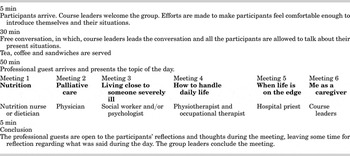
Family members of persons with life-threatening illness were invited to take part in a support group program during ongoing palliative care. The program was delivered by the multi- professional team caring for the ill persons and took place at the care unit. The group met for an hour and a half a week, for 6 weeks, and each meeting had a special topic with a professional guest from the caring team (Table 1). The program was developed based on an inventory of the needs of family members at a palliative care unit, the experience of palliative care staff and a comprehensive study of the relevant scientific literature. At the time of the present study the program was implemented and delivered in three settings. At one of these, the program differed slightly, including an extra meeting at which library information was distributed. The program aimed to offer family members a chance to meet others who were in similar situations, obtain information, and discuss matters with professionals. An important feature of the meetings was open-mindedness concerning family member needs. In each of the three settings, two nurses from the team acted as group leaders and participated in each meeting. The nurses initiated and coordinated the program and also led the group in conversations during the meetings. The researchers in this study were not involved in the delivery of the support group program.
The support group program

Settings
The support group program took place in three settings and towns in Sweden. Two of the settings were specialist palliative care units providing care for severely ill, dying persons, mostly with cancer diagnoses. In these settings, the persons were cared for via advanced home care or at an inpatient hospice/palliative ward. The third setting was a hematology unit, where some of the persons were in a palliative phase but there were also persons in an earlier stage of their life-threatening illness. This setting cared for persons with malign hematological diseases and brain tumors. All three settings delivered 24-hour services and were staffed by multi-professional teams.
The Participants
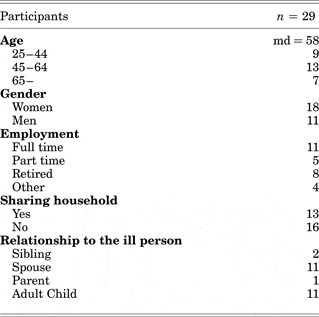
Six support groups were conducted during the study period (January–June 2009), two in each setting, and altogether 39 family members took part in the program. Written information about the study was delivered by the nurses at the caring unit in a separate envelope, together with the invitation to the support group. Those reported as family members by the ill person were invited, and these could be persons unconnected by blood. The first author visited the first meeting of each group to present oral information about the study. After the last meeting the family members received a letter inquiring about study participation, which was followed up by a phone call from the first author. Three persons declined to participate in the study. Seven persons were excluded; two of them attended only the first meeting, and five could not be reached despite several attempts by telephone. Finally, 29 persons participated in the study, all of whom gave their written consent. They were all family members (Table 2) of persons with life-threatening illness, and had all taken part in the support group program in one of the three settings. Some of the participants in the study belonged to the same family.
Participants in the study

The ill persons, 14 women and 8 men were 40–86 (median 64) years old and had been ill for between 1 month and 10 years (median 1 year). All except for 2 (diagnosed with amyotrophic lateral sclerosis [ALS] and myelofibrosis) were diagnosed with cancer and at the start of the support group program all had been cared for at one of the three settings for between 9 days and 1 year (median 2 months). Most were being cared for in their own home. By the time data collection started, two of the persons had died.
Data Collection
The first author conducted 29 telephone interviews between March and June 2009. The interviews took place approximately 2 days to 1 week after the last meeting of the support group, and family members were given the opportunity to choose the day and time. After family members received oral information about the study and gave their consent, questions were asked about the support group program. The interviewer started by asking participants to describe their experiences relating to each of the topics covered in the group meetings, what was more valuable or less valuable, and whether there were any missing topics. Questions were also asked about the program structure and the group meeting experience. A semi-structured interview guide was used.
Data Analysis
The interviews were analyzed using qualitative content analysis (Graneheim & Lundman, Reference Graneheim and Lundman2004). After all interviews were transcribed verbatim, the audiotapes were listened to again to confirm the transcribed text. The texts were then reread to gain an overall impression of their content; then, while bearing in mind the aim of the study, the text was divided into meaning units. The meaning units were condensed without changing their central messages and were thereafter coded.These codes were compared based on differences and similarities and sorted into three categories. Quotations from the interviews are used in this article to illustrate the content of the categories.
Ethical Considerations
Participants were told that they could join the support group program without participating in the study. Moreover, they could withdraw from the study without giving a reason whenever they wanted while remaining in the support group. The care of the ill person would not be influenced by whatever choice they made. As the interviews were conducted by phone, the interviewer put extra effort into sensitivity to tone of voice changes, silence, and pauses and always offered the respondent the option of declining to answer or interrupting the interview. The study was approved by a Regional Ethical Review Board in Sweden (2008/341).
RESULTS
The results are presented according to three categories representing the family members' experiences of the support group program's content, structure, and approach.
The Content Reflected Everyday Life
The participants felt that the topics presented in the program reflected their every day lives and focused on situations significant to their lives with severely ill persons.
The first meeting was about nutrition which was of immediate interest to participants. They expressed worries about the ill person's lack of appetite and changed eating habits. Through conversations in the group these concerns were partly relieved.
I had a lot of problems with my mother. She'd lost her sense of taste, had no appetite, and had lost a lot of weight. This was so important to me – very good information, at just the right time. We had just been dealing with this for a week or so and had wondered, oh, how are we going to manage this in the best way?
The participants appreciated the practical examples of things they could do to make it easier for the ill person to eat, and several related that they had tried some of the recommended recipes fairly soon after the session.
Everything was laid out nicely on trays. So, in addition to her talk about the ill person's nutritional needs, we could sample various suggested dishes. This was great, and we were given recipes that have come in very handy. The idea of serving only small portions of tasty foods — you don't really think about that, realize you can do something about it.
The second meeting was about palliative care, its definition and aim, as well as the diseases the participants were encountering, common symptoms, and symptom management. For many of the participants this was the most important meeting. They thought the information provided gave them the knowledge and understanding that they needed to cope with the situation.
It was really interesting, because you found out so much about the disease and how it progresses. That is this kind of thing I remember, because now we're seeing that she is starting to get worse and it was like he said, there are ups and downs, and he explained how the body works and what happens.
The participants felt relieved and comforted when they understood that much could be done to help the ill person and relieve disease symptoms.
When the topic of the day was living close to someone severely ill, the participants felt valued as individuals and that they were encouraged to prioritize and take care of themselves. They talked about crises and reactions to them, and many participants felt reassured in their feelings and thoughts. It was comforting to hear they were not alone in what they were thinking.
Everybody in this situation knows that you are so unhappy, but you still have to be happy. Sometimes you get sad about things that are actually not … maybe somebody says something that hits you the wrong way. And of course, you don't take it out on the ill person, but you often take it out on other people around you, and everybody could relate to that. Sometimes you react to things that are actually unimportant, things you wouldn't ordinarily react to. There was a lot of that kind of talk, so it felt wonderful!
The occupational therapist and the physiotherapist were guests at the meeting addressing how to handle daily life. Those participants who had received information and practical assistance in their homes earlier on and those having a family member already at an advanced stage of illness would have preferred that this meeting came earlier in the program. Conversely, other participants thought this information was given too early, because their sick relative did not yet need any assistive devices. The meeting provided an understanding of how much help was available and how daily life could be made easier for the ill person and the family. The participants also reported receiving help on how to approach the ill person regarding physical activity, and advice about the best way to be supportive without pushing too much or being too passive.
A priest took part in the meeting about living on the edge: the participants appreciated the contribution mainly as input from a fellow human being, not from a religious role model.
However, the involvement of the priest turned people's thoughts to religion, which was perceived as both positive and negative. Many participants said that they were not believers, but could see the priest as a useful dialogue partner. The meeting triggered and actualized thoughts about death. Many participants thought it was difficult to talk about disease and death in everyday life. The group conversations made this difficult topic somewhat easier to handle.
He [the priest] really made me think. How you handle these questions is a pretty big problem – what happens afterwards, with death, and what it's like afterwards. You actually do want to ask. How you learn to listen and how the person who is ill opens up, and maybe only once, so you really have to pick up the signals. Personally, I think that gave me some new ideas.
At the last meeting focusing on the caregiver role, the participants stated that they knew each other quite well and had no problems sharing their experiences. The conversations mostly concerned living with someone seriously ill. The participants appreciated this meeting because it enabled free and open conversation, although there was sadness that it was the last meeting.
Most participants felt that the program had not passed over any important area or could not think of anything more they would have wanted covered. One suggestion, however, was coverage of how to talk to and behave with children when a parent or grandparent is severely ill. Some participants wanted more information and discussion concerning death and the actual process of dying. One participant expressed a wish to talk about changes in sexuality.
The Structure Offered an Opportunity to Establish Relationships
The participants felt that the program structure, with weekly meetings, time for free group conversation, and input from professionals on the caring team, offered an opportunity to establish relationships.
An important aspect of the support group program was that the group leaders and guest professionals were members of the team caring for the ill person. The participants were able to meet members of all the professions, which were seen as advantageous. They felt invited and encouraged to get in touch, and several participants contacted the various members of the team for consultation and help after the meeting. The participants got the impression that the team members were competent and could offer a great deal of help to the ill person. This gave them confidence that the ill person was being given good day-to-day nursing care.
The structure of the program, opening with half an hour for conversation, coffee, and sandwiches provided an opportunity to establish relationships with other participants. This first half hour seemed to be an important part of the program and was highly valued by participants. Even with this half hour for free conversation, many participants wanted still more group meeting time especially to talk with other participants.
We always started with half an hour of free discussion, when we were able to talk about anything on our minds. It was such a relief.
The participants felt that weekly meetings were needed for continuity and that this schedule was not too time consuming. They did not have the time to come to the support group more often than once a week because of their life situations, and needed time between meetings to think about what they had discussed in the group and to think about the upcoming topics. The participants thought 90 minutes was about the right meeting length, because talking about difficult subjects was sometimes a strain. However, some participants would have liked a more flexible schedule, because they did not want to be interrupted if the group was in the middle of an interesting discussion.
Group size was important, and participants who were in smaller groups were disappointed and thought people should be required to attend all meetings once they had started the program. There were only two or three participants in the group at some meetings, and discussions became less productive and participants did not open up to the same extent.
The people sitting there know how it feels inside, since everybody feels the same way, and that's pretty important. Sometimes there were only two people at a meeting, and then you didn't really get what you really wanted out of it. It was really a shame there were so few of us.
The time when the support group had started was important. Some participants would have preferred to start meeting earlier in the disease trajectory whereas others thought the program had started too early. Most study participants considered that the support group program had started at a suitable time for them when they needed and were receptive to support in this form.
An Open Approach Contributed to a Warm Atmosphere
Many participants found it nerve-racking and felt unsure of themselves the first time they were to meet as a group. These feelings were assuaged by the warm and relaxed atmosphere in the meetings from the very start. The group leaders were seen as companions who shared feelings and thoughts and gave advice and support as they guided the group in relaxed conversation. An opening question might be: How has your week been, how are you? The question prompted conversations containing various narratives from the participants' daily lives with seriously ill persons. From an early stage, these conversations made the participants feel a sense of mutual affinity based on the similarity of their situations: everyone there understood what they were going through.
For me, the best thing about it was meeting other people in the same boat, people on the same wavelength. It was good when everyone shared – we had a time in every meeting when we just talked about our situations and how the week had gone. It gave such a comforting sense of belonging. Sometimes you could see yourself in something [someone else had said] and think, “Oh yes, that's how it is for us right now,” or “That's how it was for us, too.”
The warm atmosphere was created through a sense of shared responsibility in the group. The participants felt that the atmosphere permitted personal questions, which were received with interest and which guided the conversations. No one was appointed as the expert; instead, the group's shared resources were used in the conversations, as everyone had experience and knowledge of the topics being discussed. The warm atmosphere allowed participants to talk about difficult subjects.
We sat and talked a lot. Since everyone's dealing with the same thing, you become a pretty tight-knit group and talk about things that you might not go round telling just anyone. You can open up and talk about the hard things.
Many said that they always felt sad on the inside, but tried to appear happier and stronger on the outside. Within the group, they felt free to cry and talk about how tired they were; the support group became a place where they could drop the facade they felt they were constantly wearing for themselves, the ill person, other family members, and others. In the group, they could even talk about what the participants perceived as the most forbidden of thoughts: anger and annoyance toward the ill person and toward the disease itself.
You get so tired … you feel, you are not the only one who is this tired, and these sort of forbidden feelings bubble up and you push them back down, but you do get annoyed, you do get angry. You feel a lot of strange feelings like that. You feel ashamed of yourself. But it isn't really strange — you're not the only one who feels like that.
The warm atmosphere allowed the participants to drop their facade for a while and, although this was sometimes difficult and arduous, it was a relief afterward.
DISCUSSION
This study describes a pilot developmental phase of a potential intervention including a support group program delivered to family members during the time when someone close to them was under care because of a life-threatening illness. The results indicate that the support group program met different types of family member needs, as reported in the literature, such as information, practical care, emotional support, and assurance of good patient care (Kristjanson et al., Reference Kristjanson, Hudson, Oldham, ÒConnor and Aranda2003; Andershed, Reference Andershed2006). Informational needs were met when the family members felt that the present support group program covered topics of immediate interest reflecting their lives with someone severely ill. They improved their knowledge and understanding of the illness, symptoms, and psychological aspects. While meeting practical, informational and emotional needs, the structure of the program was found to be inviting, offering an opportunity to establish relationships with the other participants and the caring team. The family members felt invited to contact the caring team, both on behalf of the ill person, and concerning their own personal needs. Through sharing competence and benefiting from the caring team's resources, the participants felt reassured that the patient was being cared for in the best way possible. The support group program emphasized an open-minded approach to family members needs, which contributed to a warm atmosphere in which participants could share feelings and thoughts and meet their emotional needs.
To meet family members needs, the present support group program involved all the caring team professions as resources in the meetings. This strategy is supported by Herbert and Schultz (Reference Herbert and Schultz2006) who asserted that the complex needs of family members are unlikely to be met by one healthcare professional alone, but require input from multidisciplinary teams including, for example, physicians, nurses, and social workers.
In the present study, family members were and felt invited by the caring team who encouraged them to interact and express their needs during and after participation in the support group program. The results emphasize the responsibility of health professionals to initiate contact with and support family members. This could be especially important, as previous research has indicated that family members may choose not to express their own needs to health professionals because they perceive them as less important, and may not wish to impose (Harding & Higginson, Reference Harding and Higginson2001; Wennmann-Larsen & Tishelman, Reference Wennman-Larsen and Tishelman2002; Hudson et al., Reference Hudson, Aranda and Kristjanson2004).
As this study was a developmental phase of a potential intervention, we can learn from the participants' experiences of the support group program described here and formulate ideas about relevant group discussion topics and how to structure meetings appropriately to meet family members' needs. The program had predetermined topics, but the participants valued the possibility of influencing the content based on their own needs and wishes. They also appreciated their own experiences and knowledge being seen as resources in the discussions. Lindström and Melnyk (Reference Lindström and Mazurek–Melnyk2009) believe that by allowing family members to choose what topics they want to know more about, interventions could be individualized to provide optimal support. It is a challenge to develop interventions appropriate for as many people as possible, while still allowing room to accommodate individual needs. Group interventions have the advantage of providing opportunities for individuals to interact and develop networks with others who are undergoing similar experiences (Bloom, Reference Bloom, Baider, Cooper and De-Nour2000; Poppelstone-Helm & Helm, Reference Poppelstone-Helm and Helm2009). Another important advantage of group interventions is their relatively low financial costs and workload for health professionals supporting many family members (Popplestone-Helm & Helm, 2009). However, support groups may not be appropriate for all family members, and, particularly vulnerable persons may have their needs best met in individually targeted interventions (Ell et al., Reference Ell, Nishitimo and Mantell1988). Even negative feelings after attending a support group have been experienced with feelings of sadness and more anxiety (Plant et al., Reference Plant, Richardson and Stubbs1987), which needs to be considered when developing interventions. Plant et al. (Reference Plant, Richardson and Stubbs1987) also described low uptake of the group and reasons for not attending were caused by a fear of finding the experience of listening to others too depressing. This indicates that group leaders should be sensitive and open minded in discussions about emotive topics such as illness, dying, and death. Witkowski et al. (2004) described that some participants had problems speaking in a group, and that there were also persons thinking other group members spoke too much. Even if such experiences were not found in the present study, we need to consider that those who declined participation in the support group program or in the study actually could have been in need of an individually targeted intervention. With the currently existing wide variety of interventions it is difficult to compare results, but Lorenz et al. (Reference Lorenz, Lynn and Dy2008) suggest that the more successful interventions are individual rather than group based. In all intervention development we need to involve the users to ensure that we are addressing what is important to family members in a manner acceptable to them (Grande et al., Reference Grande, Stadjuhar and Aun2009). Finally, we need to bear in mind that not all family members of persons with life-threatening illness may be in need of a professionally delivered intervention.
The group leaders in all three settings in this study were nurses. These nurses initiated, coordinated, and presented the support group program with its fundamental ideas to their caring team members, who acted as guest speakers at the meetings. Milberg et al. (Reference Milberg, Rydstrand and Helander2005) found that the group leaders' knowledge, experience, and competence were valuable and that group leaders need to be calm and discuss matters naturally. The nurses acting as group leaders in the present study were seen as companions who shared feelings and thoughts, gave advice and support to participants, and helped foster the perceived warm atmosphere. This finding indicates that leading interventions to support family members in palliative care could be a productive future challenge and task for nurses.
Methodological Considerations
Regarding the trustworthiness and credibility (Lincoln & Guba, Reference Lincoln and Guba1985) of the present results, the risk of gate-keeping must be considered. All the family members participating in the support group program were invited to participate in the study. The invitations to join the support groups, however, were delivered by the nurses on the caring teams. These nurses could have refrained from inviting certain family members to the support groups, to protect them, thinking they might not fit into a group, or have the strength or desire to participate. The family members who attended the groups could represent those with a positive attitude, more strength and the least need for intervention (Pasacreta & Mccorkle, 2000). Few negative aspects of the support group program are evident in the result, despite encouragement from the interviewer to talk about both positive and negative experiences. We should consider that those family members who consented to participate in the study might have been those with a positive experience of the program. The participants could also have felt gratitude toward the caring team and felt obliged to give positive answers. However, the researchers in this study were not involved in the delivery of the program, which was clarified to the participants before the study was conducted.
To support the credibility of the present study, the transcribed interviews were read by all the authors and the analysis was performed jointly in discussions. The manuscript was peer reviewed in seminars involving researchers experienced in qualitative content analyses.
The present support group program was implemented by various staff members in three settings, indicating that the results of this study could be transferrable to other settings in similar contexts. This inference is supported by Stake (Reference Stake, Denzin and Lincoln1994) and Denscombe (Reference Denscombe1998) who suggest that whereas each case is unique, each serves as an example of a broader group.
CONCLUSION
The support group program described here was a positive experience for the participating family members, covering topics of interest, reflecting their lives with severely ill persons, structured to make participants feel invited by the caring team, and using an open-minded approach that fostered a warm atmosphere in which participants shared feelings and thoughts. The results of this study indicate that the support group program could work as an acceptable and useful intervention for family members, and that the results could also contribute to the design and delivery of similar interventions. The support group program would benefit from further refinement and from research into its effectiveness in meeting the needs of family members of persons with life-threatening illness.
Relevance to Clinical Practice
The results of this study should encourage nursing staff to develop and deliver interventions for family members of persons with life-threatening illness. Key strengths of the studied support group program were the nurses from the caring team, who acted as group leaders, and the input of the multi-professional team. The results indicate the importance of the caring team inviting and interacting with family members, and that it is possible in nursing to perform group interventions during ongoing palliative care resulting in positive experiences for participants as described here. This support group program emphasized the needs and wishes of the group participants, which allows the caring team to modify the program to meet the needs of family members in various care contexts.
ACKNOWLEDGMENTS
This study was supported by grants from: The Health Care Sciences Postgraduate School, The Erling-Person Family Foundation,The Non Profit Foundation for the Red Cross Hospital, and the Red Cross University of Nursing.