1. Introduction
An important kind of scientific explanation, most clearly found in evolutionary biology, involves explaining the origin and properties of something (e.g., an organism) by detailing the historical sequence of events that led to it. Historical explanations are also found in cosmology, geology, and other sciences. Various answers have been given by philosophers of science and philosophers of history as to what makes an explanation historical and the unique features of such explanations (see Kaiser and Plenge Reference Kaiser, Plenge, Kaiser, Scholz, Plenge and Hüttemann2014). Going beyond these disputes, even a cursory look at evolutionary explanations makes it clear that historical dynamics can lead to surprising results that are hard if not impossible to explain ahistorically (e.g., vestigial traits, the necessity of preadaptations in the evolution of complex traits, the effects of historical population bottlenecks). The significance of such factors is an important aspect of the debates concerning adaptationism in evolutionary biology (Gould and Lewontin Reference Gould and Lewontin1979). One kind of evidence appealed to by historical explanations is diachronic evidence, that is, evidence that can at least be chronologically ordered if not precisely dated (e.g., studying skull fossils to piece together the eye structure in various evolutionary stages). In contrast, the comparative method in evolutionary biology is a paradigmatic case of the use of synchronic evidence from multiple organisms to deduce historical facts. Working with living organisms typically results in synchronic evidence, although experimental evolution produces diachronic evidence in the lab. Likewise, fossil data are typically used as diachronic evidence, although analyzing multiple fossils from a single point in time is an exercise in the use of synchronic evidence. Here, we are interested in identifying historical facts on the basis of synchronic evidence, of the sort readily obtained from extant organisms.
We look at arguments that purport to infer past coevolution between two characters on the basis of the properties of an extant organism. We show that evolutionary biologists employ such inferences, and we analyze their strength. We argue that these arguments are particularly relevant for studying cognitive-cultural coevolution in humans, an idea that has been endorsed by philosophers and evolutionary thinkers alike.
Biologists are routinely interested in determining whether two characters of an organism coevolved. Examples of such claims from the recent literature include the coevolution of speech and language (Dediu and Levinson Reference Dediu and Levinson2013), the coevolution between the leptin hormone that affects energy metabolism and bone (Karsenty and Oury Reference Karsenty and Oury2012), moth morphological adaptations for camouflage and behavioral phenotypes (Kang et al. Reference Kang, Moon, Lee and Jabłoński2012), and coevolution of genetic characters that affect population structure with those that affect social behavior (Hochberg, Rankin, and Taborsky Reference Hochberg, Rankin and Taborsky2008; Powers, Penn, and Watson Reference Powers, Penn and Watson2011).
To understand what we mean by coevolution, consider the evolution of eyes. Evolutionary changes to the eye were presumably related to complementary changes in the visual cortex that had to handle the new visual input. In one scenario, cells become light sensitive, and brain areas evolve to process the novel neural input. Evolutionary changes to the brain enabling it to make sense of this input then cause further evolution of the eye toward greater visual acuity, since the novel processing in the brain benefits from improved quality of visual information. In this scenario, coevolution in our sense has occurred.
In an alternative non-coevolutionary scenario, the changes are driven solely by succeeding changes in eye structure, with brain changes always following suit but not affecting the succeeding evolutionary changes in the eye. In such a scenario, none of the changes in eye structure depend on prior evolutionary changes in the brain’s vision processing abilities. The more specific and complex the interaction is, the less likely this alternative becomes.
We are interested in distinguishing between such alternatives. In our analysis, the two coevolving characters may be morphological, behavioral, or cognitive: the shapes of the fibula and the tibia, and the eyes and the structure of the visual cortex are examples of pairs of morphological characters; the musculature of the leg and running are an example of a pair of morphological and physiological characters; intelligence and tool making are an example of a pair of cognitive and behavioral characters; and so on, for every other possible combination.
We aim to clarify the appropriate notion of coevolution and its functional and developmental consequences. Hence, our discussion is conceptual and qualitative. Moreover, we focus on cases in which it is intractable to assess the probabilities required for using the available synchronic evidence to calculate the likelihood of coevolution. We illustrate the importance of this task with several concrete cases. The inference patterns we discuss provide a plausible evolutionary explanation for the relation between the characters and can guide further empirical investigation. Without studying directly each character’s evolution and their relationship, we cannot provide conclusive support for coevolution. However, the two patterns of inductive inference we present make a coevolutionary hypothesis probable. We show that evolutionary biologists employ such inferences, and we analyze their strength. In the cases we have in mind, synchronic evidence originating in extant organisms is advantageous over nonextant organisms, especially for behavioral characters: they enjoy readily available evidence, and they are open to repeatable experimental analyses.
The first argument infers coevolution from complex mutual functional dependencies between two characters, to the extent that neither character in its evolved form can exist independently of the other. Such evidence favors the hypothesis that the two characters coevolved. For example, the complex interaction between the eye and the visual cortex makes a unidirectional evolutionary scenario improbable. The appeal of this argument is its simplicity, although we discuss some of its subtleties.
The second argument infers coevolution from complex mutual dependencies between the development of two characters. Moreover, it infers constraints on the evolutionary order: certain developmentally earlier stages must have evolved before developmentally successive stages. To safeguard against the problems with inferring evolutionary order from developmental order (the recapitulation fallacy), we use Wimsatt’s notion of generative entrenchment (Schank and Wimsatt Reference Schank, Wimsatt, Fine and Machamer1986). The argument takes its cue from evolutionary-developmental biology (evo-devo). We view it as particularly relevant for evo-devo inspired approaches to the coevolution of culture and cognition (e.g., Tomasello Reference Tomasello1999; Donald Reference Donald, Nucci, Saxe and Turiel2000; Sterelny Reference Sterelny2010; Stotz Reference Stotz2010). In particular, we suggest that if culture provides necessary developmental scaffolding for cognitive development, then it is likely that characters requiring the social scaffolding and the cognitive characters enabling this scaffolding have coevolved.
Our contributions are:
• An explicit definition of coevolution of characters;
• two inductive inferences for coevolution based on synchronic evidence; and
• an analysis of these inferences, including their applicability, and scenarios in which they fail.
In the next section we formally define what we mean by coevolution. Sections 3 and 4 present our arguments. Section 5 concludes.
2. Coevolution
We are interested in cases in which two (or more) characters coevolved, in the sense that some stages in the evolution of each required the presence of the other character in the organism at some stage in its evolution. We note that in the literature the term coevolution is often defined as evolutionary interactions between two populations or species, for example, an evolutionary arms race between predator and prey. However, we focus on evolutionary interactions between two characters that are manifested by single individuals.
What follows is a semiformal approximation of the desired notion of coevolution:
Two characters A and B have coevolved if the evolutionary sequence of A is A−n, … , A−2, A−1, A0, where A0 = A, and that of B is B−m, … , B0, where B0 = B, such that
a) there exist i and k such that B−k is an evolutionary cause of A−i, and
b) there exist j and l such that A−l is an evolutionary cause of B−j.
In interpreting this definition much hangs on what is considered an evolutionary cause. For our purposes, these consist of causes producing significant changes in a character’s frequency in a population, that is, any factor that plays an essential role in explaining the transition of a population from A−i−1 to A−i. Commonly discussed and debated evolutionary causes include natural selection, sexual selection, migration, and drift.
To demonstrate this definition, consider the two accounts of eye structure–visual cortex evolution from the introduction. A simplistic evolutionary sequence of the eye may be represented by
A−3 Light-insensitive skin cells.
A−2 Slightly light-sensitive skin cells.
A−1 Primitive eyes.
A0 Eyes as found today.
Similarly, a visual cortex evolutionary sequence may be simplistically represented by
B−2 Brain without a visual cortex.
B−1 Brain with rudimentary processing of signals from light-sensitive cells.
B0 Visual cortex as found today.
These stages may be given a coevolutionary explanation. The stage A−2 is the evolutionary cause of B−1; that is, the brain evolved to take advantage of the additional light-sensitive sensory input. The stage B−1 is an evolutionary prerequisite of A−1, that is, the additional processing abilities’ evolution selected for more developed eyes. In this scenario, coevolution has occurred (i = −2, j = −1, l = −1, and k = −1).
Alternatively, here is a non-coevolutionary explanation. In this scenario, the improvements to the eye depend on the phenotypic plasticity of visual processing in the brain or on general purpose processing rather than on specific evolutionary changes in the brain. This available flexibility facilitates the selection of the fully formed eyes first, and only when state A0 is reached does the brain start to evolve a visual cortex (stages B−1 and B0). The brain’s evolutionary changes are all subsequent to the eye’s evolution. This scenario is not coevolutionary: there is no bidirectional dependence, as none of the A−i’s depends on any of the B−i’s. As the adaptations’ complexity increases, such a non-coevolutionary explanation, in which all evolutionary dependencies are unidirectional and functional dependencies are bidirectional, becomes unlikely. Additional evidence may make the non-coevolutionary hypothesis more likely. For example, consider evidence that skin cell light sensitivity evolves much quicker into primitive eyes than any appropriate cerebral adaptation. Such evidence supports the hypothesis that skin light sensitivity evolved independently, before the appropriate brain changes evolved, unless we have reasons to suspect that the effects of the cortex on the evolution of the eyes were profound.
A concrete illustration from the biological literature concerns the coevolution of moth wing patterns for camouflage and their choice of resting spot and body orientation (Kang et al. Reference Kang, Moon, Lee and Jabłoński2012). Sargent (Reference Sargent1968, 101) argues that adaptations in moth behavior were caused by the wing patterns: “In species in which melanics appear sporadically, genetic differences in selection of backgrounds may not become established.” Kang et al. later state that moth behavior is an evolutionary cause for the wing patterns: “Therefore, the positioning behaviours performed by moths after landing are essential to account for the almost perfect match between the pattern on the moth wing and the pattern of the bark” (Reference Kang, Moon, Lee and Jabłoński2012, 1696).
These examples are coarse-grained, for example, bunching together all functional relationships of the eyes and cortex. More realistic analyses will take into account mechanistic aspects of the two characters’ interaction, for example, the organization of neural networks or the identification of signaling molecules. The choice of characters depends on the hypothesis we wish to infer, that is, which two characters have supposedly coevolved. We expect that inferring coevolution of coarsely bunched characters will be easier than that of more fine-grained characters and less interesting. Moreover, additional evidence may lead us to revise our chosen granularity. For example, there may be evidence suggesting that only particular parts of the eyes coevolved with the visual cortex (e.g., the retina), whereas other parts did not (e.g., tear ducts). Such evidence could include organisms with extremely primitive eyes that have tear ducts. In such cases, we may repartition the eye into two separate characters, only one of which coevolved with the cortex.
Our definition of coevolution is either/or in nature: either two characters have not coevolved, or, once they have at least one evolutionary dependency on each other, they have. This stance is methodological: by considering the minimal coevolutionary interaction required, we emphasize the various subtleties in the coevolutionary arguments and examples. We note, however, that characters may influence each other’s evolution to a greater or lesser degree.
3. The Codependence Argument
With a definition for coevolution under our belt, we present our first inference of coevolution based on point-in-time evidence, the Codependence Argument:
Assume two independent and well defined hereditary characters A and B such that
1. character A in its evolved form requires B in its evolved form, and
2. character B in its evolved form requires A in its evolved form.
Then, unless there is contrary evidence, conclude that A and B coevolved. (By “requires” we mean a significant functional dependency.)
Justification: The complexity of the functional dependence of A on B postulated by assumptions 1 and 2 implies that their functional interaction itself is the result of cumulative evolution on both A and B.
There are three cases:
a) the evolutionary history of A is independent of B in the sense that each stage of the evolutionary history leading to A was unaffected by the evolutionary state of B at the time, or
a′) vice versa, or
b) A and B coevolved.
According to option a, before emerging in the fully formed shape we currently encounter, the precursors of B did not influence A’s evolution in any way. It is improbable that, throughout the evolution of the interaction of A and B, the natural selection on A that was involved in creating or maintaining their complex dependency was unaffected by the corresponding evolutionary state of B.
Similarly, option a′ is improbable. Coevolution, option b, remains as the only viable option.
For example, consider the eye structure–visual cortex example. The visual cortex intricately relies on eyes’ structure, their muscular control, and so on, to provide it with sensory input, while properties of the eyes are advantageous because of intricate visual processing; for example, the location of the two eyes allows stereoscopic vision in various animals. By the Codependence Argument we should conclude coevolution occurred.
Biologists implicitly employ this line of reasoning routinely. For example, Gilbert and Epel (Reference Gilbert and Epel2009, 96) argue for coevolution of Wolbachia and Drosophila melanogaster thus: “The ability of Wolbachia to rescue only females suffering from a certain kind of Sxl mutation suggests that there is a very specific interaction between the bacteria and the Sxl protein in the female fly. Such specificity of interaction between the host and parasite indicates that the insect and the bacterium have coevolved to give Wolbachia an important role in oogenesis in the female fly.” Here, the interaction’s specificity and its profound effects on reproduction indicate the significant degree of functional dependence.
The level of support this inference provides for the coevolutionary hypothesis depends on the credence assigned to assumptions 1 and 2 and the extent to which the two characters are significantly functionally dependent. We can deduce codependence from various kinds of evidence, such as the consequences of malfunction, mechanistic and functional analysis of interactions, and functional models of the characters, such as the models used in cognitive science.
We consider several scenarios in which the Codependence Argument is not applicable or fails.
1. Consider a case in which A and B came into existence simultaneously rather than coevolved. The codependence between the characters should not be used to conclude that they coevolved. This scenario, however, is too miraculous to be accepted for complex characters of the sort explained by cumulative evolution, without conclusive and incontestable proof.
2. One interesting scenario in which the Codependence Argument is not applicable is when A and B are not independent characters but are in fact two manifestations of the same underlying character. For example, A and B may be two distinct behaviors that share a neural basis that evolved for producing A and was later co-opted for B. Hence, the traits did not coevolve. In this case the premise that A and B are independent is not fulfilled, thus the Codependence Argument does not apply, and indeed coevolution did not occur.
3. The Codependence Argument fails when the trait A evolved separately from B (as in case a in the justification), as demonstrated in the non-coevolutionary account of the eye structure and visual cortex, which relied on plasticity to explain the interactions between the evolving eye and brain. In other words A evolved “off to the side” of B, and we call this scenario side-by-side evolution.
This scenario is unlikely by default. Not only the precursors of B must not have influenced the evolution of A in any way, but there must be some external factors that play the same role as B in establishing the functional dependence.
This scenario also fails to explain why the two traits have become codependent, if indeed they are. An advantage of the coevolutionary account, in contrast, is that it is not merely consistent with codependence—it suggests an explanation of it. Consider the non-coevolutionary eye example. Subsequent to the evolution of the eye in its extant form there was a subsequent phase of brain evolution in which some of the plastic changes that were required for the evolution of the eye became increasingly innate, thereby establishing structures in the brain that are dependent on the existence of eyes for their functioning.Footnote 1 This explanation does not account for the reason this selection in the visual cortex only occurred after the eyes fully evolved.
The “side-by-side” evolutionary scenario requires two evolutionary accounts (and two sets of evolutionary causes), one for the evolution of A and the other for B, whereas the coevolutionary account is more parsimonious, since evolutionary changes in one of the traits are evolutionary causes for changes in the other. These considerations do not rule out side-by-side evolution but ceteris paribus decrease the prior probability we should assign to this possibility. Additional evidence supporting such separate accounts and causes could increase this probability, challenging the coevolutionary hypothesis.
Symbiotic relationships illustrate side-by-side evolution when the partners have each evolved in symbiosis with partners different from their current partner. The functional dependence between the two symbionts is insufficient evidence for deducing their coevolution (see Dunlap et al. Reference Dunlap, Ast, Kimura, Fukui, Yoshino and Endo2007). However, in such cases it remains true that the functional adaptations for symbiosis depended on symbiotic partners with the appropriate characters.
4. The Codependence Argument assumes that the functional relationship results from evolutionary changes in each character. However, developmental plasticity operating afresh in every generation can also induce functional relationships. The more likely that this explains premise 1 or 2 of the argument, the weaker the evolutionary conclusion we can draw. Developmental plasticity can be investigated independently of the evolutionary analysis, inform the characters’ delineation, and help determine constraints on evolutionary history.
For example, consider bone shape and the manner in which muscles wrap around the bones in a fully developed organism. The intricate anatomical fit between the two characters, and the observation that when one is misshapen, the other also is, may imply codependence, enabling the Codependence Argument. However, the codependence may have a developmental account: muscles flexibly wrap around misshapen bones. This hypothetical plasticity explains the intricate match between muscle and bone and also why the muscles grow in a different shape when the bone is misshapen. The existence and degree of this flexibility can be investigated independently of the evolutionary analysis.
Summary: We take the Codependence Argument to be a valid inductive argument, when “requires” is instantiated appropriately and depending on the degree of belief we have in the independence of the two characters and the extent of their functional dependence.
4. Codevelopment and Coevolution
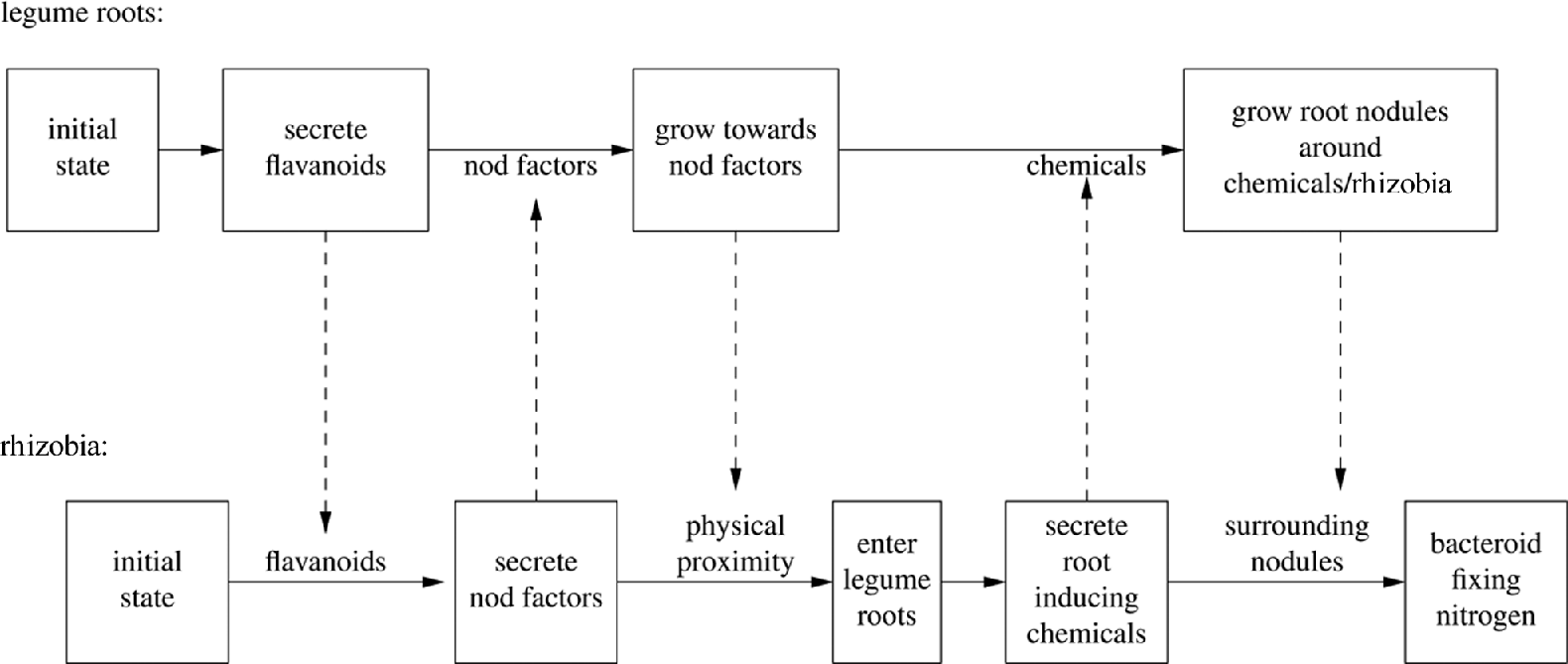
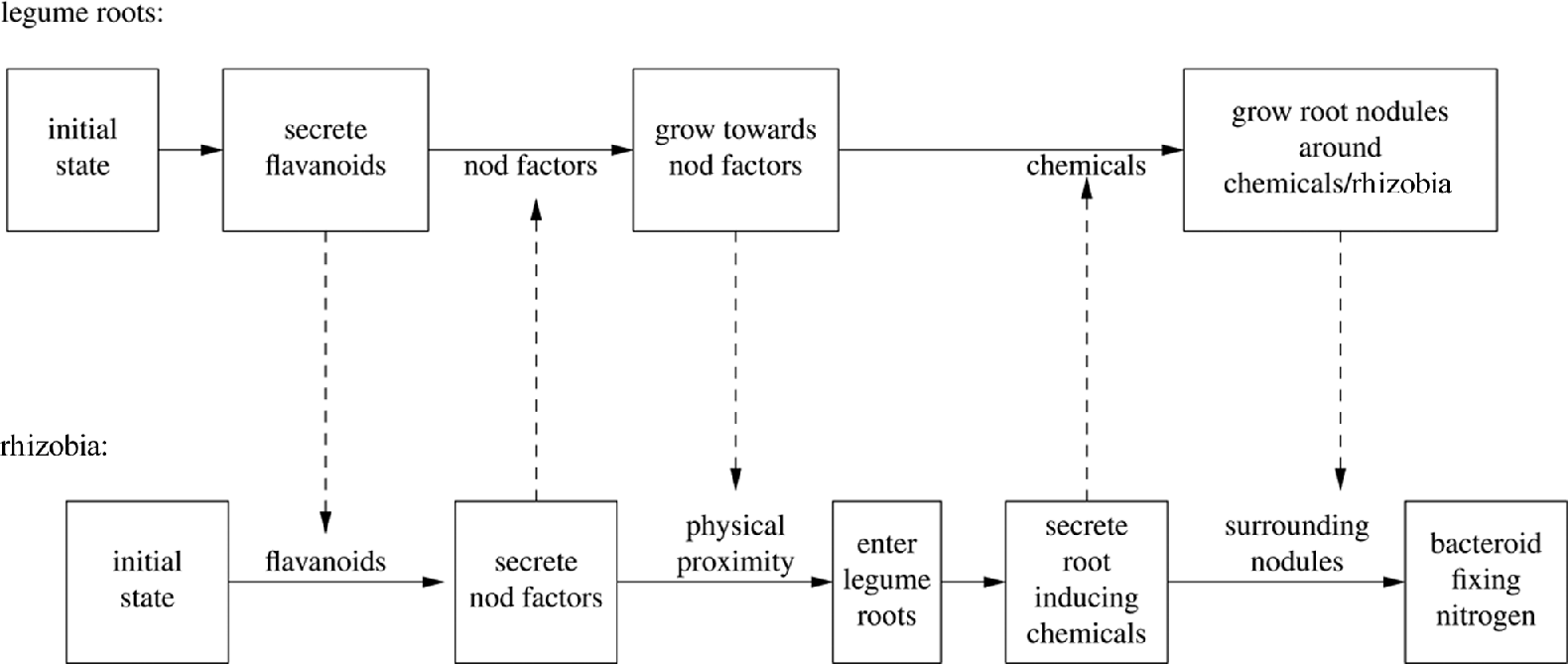
The Codependence Argument suffers from two drawbacks. First, it lends rather little confirmational support due to its very abstract nature, and it is limited in the empirical data it suggests to further support or refute the hypothesis. Second, developmental plasticity limits the applicability of the argument. In most cases, even though developmental processes are flexible, species-typical development is predictable. The argument we discuss now uses the this developmental trajectory, if it exists, as evidence for coevolution. It applies even in cases involving developmental plasticity and purports to infer evolutionary relations from observations about the development of the characters during the life of individuals. To illustrate, we use the legume-rhizobia symbiosis responsible for nitrogen fixation by plants. We describe this process schematically by the following stages involving signals that are unique to the symbiosis of particular species: (1) legume roots secrete flavanoids; (2) rhizobia bacteria recognize specific flavanoids and secrete nod factors; (3) nod factors bind to root hairs and induce their growth in the direction of the rhizobia and to surround them; (4) the rhizobia enter the root and (5) secrete chemicals that induce root cell division resulting in root nodules; (6) the rhizobia change shape, resulting in the formation of bacteroids in which nitrogen fixation occurs, inside the nodules (see fig. 1).
Developmental interactions of legume and rhizobia.
This example involves two species. Identifying and experimentally manipulating interactions may be easier in cross-organism interactions, while it may be easier to gain confidence that signals have a single possible point of origin in cases involving two subsystems of a single organism. The distinction between the cases may be blurred. The division of labor between symbiotic organisms may involve critical life functions, leading to obligatory symbiosis. For example, the gut microbiota in humans is responsible for critical metabolic processes that the human host lacks the enzymes for. In the extreme case of endosymbiosis, mitochondria are not only obligatory for the life of the eukaryotic cell, but during evolution critical mitochondrial genes moved from the mitochondrial genome to the cell nucleus, cementing the symbiotic relationship.
We represent a developmental system, for present purposes, as an abstract state machine, or a labeled transition system: it can be in any of a series of discrete stages and responds developmentally to external cues, depending on its state. These systems are abstract, and each state may correspond to several developmental stages. For example, the rhizobia’s developmental state “enter legume roots” consists of many lower-level events. The states in the transition system may correspond to an easily distinguishable biological phenomenon, such as the state “root growth” in the example above. However, due to uncertainty of experimentation and data and depending on explanatory aims, we may decide to group distinct phenomena into a single abstract state. Consider the stages in human psychological development. Since Piaget, it is common to understand cognitive development as a series of stages whose order is invariant among individuals, while the precise age at which individuals attain each stage varies. A well-known example is the series of stages of moral development proposed by Kohlberg. If reliable, such developmental evidence is presumably helpful for understanding evolution. However, the stages are probably not simply mappable onto neurobiological developmental stages.
The argument we present is based on the following observation. Consider a codependence scenario in which some stimuli of one developmental system must come from or be filtered by a second developmental system and are produced solely for this purpose and at specific developmental stages. During the systems’ evolution, specific triggers or cues from one system were called on as developmental triggers for the other and enabled specific later developmental stages. Thus, provided that the triggers (or the propensity to provide them) have sequentially evolved, the two systems’ development would become coupled as a result of their coevolution. Furthermore, the developmental order of the triggers reflects their evolutionary order. Should we then suspect coevolution occurred when codevelopment is observed? Our argument enables this inference and allows us to infer constraints on the evolutionary order that rely on properties of the development of the characters in ontogeny. Before presenting this argument, we discuss the problems inherent in inferring evolutionary relationships from developmental relationships.
4.1. Developmental Evidence for Coevolution
Developmental interactions provide support to the functional dependence required by the Codependence Argument and can thus support the conclusion that characters coevolved. Despite its abstract nature and limitations, this developmental use of the Codependence Argument appears in the literature.
For example, consider the well-known symbiosis between the Hawaiian squid Euprymna scolopes and the bacterium Vibrio fischeri. Accumulation of the bacteria in the squid’s light organ causes them to produce light that hides the squid’s shadow from potential predators and prey. Gilbert and Epel (Reference Gilbert and Epel2009, 91) observe that “the squid and the bacterium have coevolved such that each plays a fundamental role in the other’s development: the squid actively accumulates a high enough population density of V. fischeri to allow the bacterium to express its latent bioluminescence, while the bacteria trigger important morphological changes in the light organ of the host” (our emphasis).
Both species evolved adaptations that appear specific to their codevelopmental interaction. V. fischeri, but not other bacteria, is attracted to a component of the mucus secretions of the squid and is probably adapted to adhere to it. The squid, in turn, responds to the presence of the bacteria with morphological changes (induced apoptosis), as well as changes in gene expression, providing the bacteria with a more hospitable environment for colonization. If each indeed adapted to the other, we have a case of coevolution.
If the bioluminescence is the only character of the bacteria we appeal to, coevolution would not be a necessary conclusion. The bioluminescence of V. fischeri could have evolved separately and before the symbiosis (such quorum-sensing behavior might be beneficial as an antipredator deterrent), and the squid then evolved mechanisms to make use of it. All evolutionary changes in this scenario are on the squid’s side. This is an instance of the side-by-side scenario in which the Codependence Argument fails. Dunlap et al. (Reference Dunlap, Ast, Kimura, Fukui, Yoshino and Endo2007, 521) describe such a scenario, opposing a coevolutionary history of the two species:
Furthermore, the animal requires no obvious biochemical or nutritional contribution from the bacteria for its growth or development, and the developmental program giving rise to the light organ and accessory tissues runs independently of the presence of the host’s native bacteria (Claes and Dunlap, 2000). This “hard-wiring” of light-organ development indicates a significant biological independence of the animal from bacteria, native or otherwise, in formation of the attribute of the animal most central to symbiosis, the light organ and its accessory tissues. These general attributes make it difficult to envision the selection necessary for strict species specificity or codivergence to arise, as well as for the obligate dependence necessary to facilitate and select for coevolutionary changes. It is evident from the results presented here that bacterial affiliations in bioluminescent symbioses are less specific than previously thought.
Dunlap et al. (Reference Dunlap, Ast, Kimura, Fukui, Yoshino and Endo2007) thus agree that developmental dependence supports evolutionary interaction yet find inadequate the evidence for the two species’ strict dependence. In section 2, we note the importance of the specificity of the interaction for establishing functional dependence. The specificity of developmental triggers plays the same role. Cospeciation (codivergence), the scenario Dunlap et al. (Reference Dunlap, Ast, Kimura, Fukui, Yoshino and Endo2007) study, is a specific and strong case of evolutionary specificity of interaction. To defeat the assumption of specificity, they appeal to evidence of related host species harboring different bacteria species, instances of multiple bacterial partners, as well as lack of evidence for parallel patterns of divergence in the two species’ phylogenetic trees. Ascertaining whether triggers are specific to a particular developmental interaction and whether they evolved as adaptations for this role is in general a nontrivial empirical question.
4.2. Evolutionary Order
The Codependence Argument does not use developmental evidence or provide conclusions regarding the evolutionary history of the two systems. We now focus on means to infer that developmentally earlier stages have evolved earlier.
The developmental interactions’ order need not match their evolutionary order—in many cases this conclusion is unlikely. Consider the role of nod factors in directing root growth in the direction of the rhizobia.Footnote 2 Imagine a scenario in which the nitrogen fixation symbiosis evolved in densely populated regions, in which roots are very frequently in contact with the bacteria so that there is no need to induce and direct root growth. In sparsely populated areas, to which the plants subsequently migrate, nod factors have an evolutionary advantage (to both plant and bacteria). In this hypothetical case, nod factors, which are developmentally early, evolve late, after other interactions that are developmentally later in contemporary development.
As another example, consider the squid-bacteria symbiosis. If the only selective advantage from the squid’s perspective is the light emitted by the bacteria inside the squid’s light organ, earlier developmental stages (e.g., mucus secretions, induced apoptosis) would not become fixed before the subsequent developmental stages that produce the functional result exist.
The last two examples illustrate the recapitulation fallacy. They show that codevelopmental order need not (and often would not) match coevolutionary order. The general problems with inferring phylogeny from ontogeny are notorious. There is no general reason that ontogeny should follow phylogeny, and historically ontogenetic evidence has led to problematic evolutionary analyses.
However, by restricting our attention to codevelopmental interactions we can present a valid inference pattern and indicate the type of evidence that is required to support it. The argument we present infers probable constraints on evolutionary order, rather than a specific historical trajectory. Thus, we do not infer that something appeared earlier in evolution because it appears earlier in development, but rather we infer constraints on evolutionary order on the basis of the relationships between the stages of particular developmental processes, that is, on the basis of the role of specific triggers. Ontogenetic dependence on a trigger can only evolve once the trigger exists.
Compare: “plumulaceous feathers are hypothesized to be primitive to pennaceous feathers not because the first feathers of extant birds are typically plumulaceous, but because the simplest differentiated follicle collar would have grown a plumulaceous feather” (Prum and Brush Reference Prum and Brush2002, 273). Prum and Brush illustrate that an early developmental stage may have evolved late, provided it does not depend on a trigger from an evolutionarily prior stage for its initiation. The assumptions in our argument rule out this scenario.
To guard against mistakenly inferring evolutionary order from developmental order, we recall the concept of generative entrenchment (Schank and Wimsatt Reference Schank, Wimsatt, Fine and Machamer1986). In a developmental system, the correct behavior of one stage affects the correct behavior of subsequent developmental stages. The degree to which a given stage affects later stages is its generative entrenchment. Wimsatt and Schank argue that more generatively entrenched states evolved earlier. There are, of course, scenarios in which stages that are more generatively entrenched evolved later. For example, consider the role of language in human cognition. Presumably, many cognitive functions and stages of cognitive development depend on language, probably more functions than the number of developmental stages that depend on color vision. Nevertheless, we have good reasons to think that color vision is prior. Wimsatt and Schank’s argument suggests that, lacking such reasons, entrenchment is good evidence for evolutionary order.
We are concerned with a generative entrenchment dependency between two particular stages, which they call relative generative entrenchment. They argue that a stage that is relatively more entrenched than another evolved earlier (Schank and Wimsatt Reference Schank, Wimsatt, Fine and Machamer1986). The essence of their argument is that once a stage evolves, later stages become reliant on this stage, increasing its relative generative entrenchment over time. Without additional evidence to explain the relative entrenchment, we may infer that the developmentally earlier stage (i.e., the more generatively entrenched stage) is evolutionarily older. In order to establish the degree of relative generative entrenchment between two stages of causally connected developmental processes, we may study the degree in which injury to one induces injury in the other. Wimsatt and Schank call the degree in which the later stage becomes nonfunctional asymmetric functional dependency and observe that such dependency is evidence for relative generative entrenchment. Thus, to determine relative generative entrenchment relationships between the stages of a development system, we may experimentally suppress or reinforce particular triggers in the system in order to evaluate their asymmetric functional effects and, consequently, their relative generative entrenchment. For example, suppressing the chemical secretion in the rhizobia may result in no nodule growth, signifying high relative generative entrenchment. Suppressing the flavanoid secretion in the legume roots while increasing the rhizobia concentration may result in some rhizobia entering the legume roots without any need for flavanoids to trigger root growth. In this case, we would not have enough evidence for high relative generative entrenchment.
4.3. The Codevelopment Argument
To formalize the discussion, consider a labeled transition system describing a character’s development and a trigger t originating in stage s in that system that can only be produced by s. If we suppress this trigger, later stages in the system may not be reached or may not become fully functional, terminating the development abnormally. We say that these stages are developmentally dependent on s. If we consider this developmental dependency for all such triggers in the system, we obtain a relation we call the development dependency graph, consisting of pairs of stages s′, s such that, for some trigger t originating only in s, suppression of t makes s′ dysfunctional or missing.
The Codevelopment Argument:
Assume labeled transition systems describing the development of two independent and well-defined hereditary characters A and B such that
1. states in B’s development are developmentally dependent on states in A’s development, and
2. vice versa.
Then, unless there is contrary evidence, conclude that A and B coevolved. Moreover, the development dependency graph extends to a constraining partial order on the evolutionary history of the development systems.
Justification: Consider any state s′ that is developmentally dependent on a state s. That is, there is a trigger t, supplied only by state s, whose suppression renders state s′ dysfunctional. Therefore, s′ is asymmetrically functionally dependent on s. Thus, s is generatively entrenched relatively to s′ and, hence, according to Wimsatt and Schank, evolved earlier than s′. Therefore, the development dependency graph forms a constraining partial order on the evolutionary history of the developmental systems.
Assumption 1 implies there is a state s′ in B’s development that developmentally depends on a state s in A’s development. By the above argument, s evolved before s′. It is unlikely that despite s′ evolving after s and relying functionally on s it has evolved independently of s, and hence s is an evolutionary cause of stage s′. A symmetric argument shows the dependency of A’s evolution on B’s; hence, A and B coevolved.
In general, coevolution need not result in codevelopment. Consider a simple predator-prey evolutionary arms race. Both predator and prey become fast runners, each trying to outrun the other. The two species’ running abilities thus coevolve. It is not true, however, that they then necessarily have to codevelop in ontogeny: a predator grown in the absence of prey (say in a zoo) may still develop the musculature, and so on, needed for fast running, even if not to the exact same extent. Additionally, other developmental triggers (such as cubs running after each other) may act as substitutes to interaction with prey. Either way, it is obvious that the predator and prey do not have to codevelop with one another. In general, the same external cues (e.g., gravity, sunlight) may influence the development of both coevolved developmental systems (without the development of one depending on the other). Even independent cues (such as the genetic cues of each organism) may contribute to achieving the desired results, provided that the developmental systems create the appropriate characters at appropriate times in ontogeny. However, when codevelopment meeting the conditions outlined above is observed, the Codevelopment Argument supports the hypothesis that the characters coevolved, and coevolution explains codevelopment. Our degree of confidence in coevolution occurring increases with the number of cross-system developmental dependencies, as each potentially supplies evidence for coevolution.
The development dependency graph contains intersystem edges and intrasystem edges. Both kinds of edges constrain the evolutionary order. For example, the stage in which the rhizobia secrete the nodule-triggering chemicals might depend on triggers produced at the stage in which the rhizobia enter the root. More formally: if a and a′ are two stages in system A and b a stage in B, such that a′ relatively depends on b and b relatively depends on a, then by the Codevelopment Argument, a precedes b which precedes a′ in the evolutionary order; hence, a precedes a′. Therefore, we deduce a constraint on stages of the same system, on the basis of triggers occurring between two systems.
This inference is useful when the two developmental systems describe two separate biological systems. For example, the rhizobia’s propensity to secrete chemicals inducing growth in the legume roots seems tightly coupled with their ability to secrete nod factors. However, because the mechanisms reside in the same organism, it is hard to isolate them in order to analyze their relationship. We can use the dependency with the legume roots’ development to experimentally inhibit or reinforce the signals between the two systems. More generally, the intersystem triggers are typically easier to isolate and identify than intrasystem triggers, as stages within the same system cannot be completely separated and might have hidden dependencies.
The development dependency graph may not be a partial order. For example, consider the scenario in which stage c depends on stage b via trigger s, and b depends on stage a via trigger t. If t is suppressed, b will become dysfunctional, but it may still be able to produce s, allowing c to develop. This shows that the development dependency graph may not be transitive and hence not a partial order. However, the constraints imposed by the dependency graph on the evolutionary history extend to a (potentially nontotal) partial order, because the evolutionary history relation they restrict is ordered. If we cannot demonstrate a relative dependency between two stages, we do not infer constraints on their evolutionary history; thus, the interactive development of the two systems does not have to exactly match their evolutionary history.
While we discuss codevelopment in terms of specific triggers or cues, it is probable that the interaction does not involve a specific cue flowing between the systems but rather classes or families of triggers that may elicit the required result. For example, tigers develop running abilities through play (i.e., cubs chasing each other). The exact nature of the game is not important, only the fact that the game exercises the muscles appropriately. Thus, the developmental interaction consists of a class of triggers (games involving running) rather than a particular form of game.
Similarly, the exact point in the organism’s development in which the cue from one system is required by the other is probably contingent, as it often depends on other stimuli. It may be that one system’s development would proceed to a, b, c, d, e before the cue needed by the other system is asked for, even though the first system is ready to provide it once a, b, c have developed. The order most often observed in ontogeny may in fact be different from the evolutionary order due to now prevalent external stimuli. This factor may be of particular importance for the study of cognitive development, since the prevalence of developmental cues may result from cultural niche construction and developmental scaffolding (e.g., intentional teaching, exposure to toys). Such considerations constrain our ability to deduce evolutionary order on the basis of developmental order—since the observed species-typical developmental order is probably not determined by developmental constraints alone—but do not affect the coevolutionary conclusion.
Whether the triggers involved in developmental dependence can be produced elsewhere is important for the argument. Among the relevant factors for ascertaining this are the trigger specificity, trigger consumption context (e.g., does the source have to be internal to the organism?), and the richness of trigger interaction and their complexity (how many triggers, how dependent they are on one another, how information rich they are).
Two special cases that are of particular importance for cognitive-cultural coevolution make it particularly easy to establish developmental dependence. (1) The trigger from A may be a response to B, in which case it cannot be produced before B’s need. For example, the social interactions that are required for normal development, such as the role of linguistic interactions in the acquisition of language. (2) The developmental interaction between the two systems may consist of passing back and forth an artifact, physical or mental, that is successively modified. For example, consider tool making, in which a concrete tool is successively fashioned. Experience with concrete tools and tools in the making affects the development of both tool-making and tool-use abilities. The developmental interactions between the two are probably obligatory, since generally tools that exercise tool-use abilities are outcomes of tool building.Footnote 3 In these two cases the trigger’s uniqueness of origin required by the argument is guaranteed.
5. Concluding Remarks
We presented arguments that suggest coevolutionary origins on the basis of observations on a synchronic relationship between characters. The Codependence Argument relies on empirical evidence regarding the nature and extent of the dependency, on whether their precursors were codependent as the fully developed characters are, and on the assumption that no other characters or external sources could have supplied the necessary resources each character supposedly required from the other in prior stages of their evolution.
The Codevelopment Argument complements the Codependence Argument in two ways. First, it provides additional suggestions for empirical work by showing the importance of the analysis of the developmental dependencies between the developmental systems. Examples of relevant questions include the extent to which the development and functioning of each system depends on the normal functioning of the other (this can be deduced by studying individuals in which one of the systems is injured either accidentally or deliberately); the specificity and complexity of the triggers; identifying the classes of triggers each system provides the other and their molecular basis, if relevant; and ascertaining the variation in developmental order among normal individuals and whether the observed order of developmental stages is in accordance with the prediction based on coevolution. Second, while in the Codependence Argument developmental and evolutionary explanations competed, the Codevelopment Argument uses codevelopmental dependencies to strengthen the coevolutionary conclusion. The argument attempts to deduce coevolutionary consequences from the observed predictable developmental trajectories of characters. In particular, it allows us to infer constraints regarding the plausible coevolutionary history that led to them. We showed that the extent to which each system plastically reacts to changes in the other can be used to infer evolutionary constraints. On the basis of such developmental considerations, the Codevelopment Argument provides constraints on the plausible evolutionary history, which the Codependence Argument does not provide. We analyzed the extent to which such inferences are possible.
We argued that the Codevelopment Argument is especially applicable to the analysis of cognitive evolution: large amounts of developmental data exist, including cross-cultural data and data on pathologies, while the genetic and neural bases of the characters are highly complex, and it is difficult to study their evolution directly. In addition, diachronic evidence for cognitive characters is particularly hard to establish since behavior does not fossilize and interpretation of available evidence (e.g., evidence of tools and tool use) is notoriously difficult. In contrast, some of the triggers affecting cognitive development occur in conversational settings or involve persistent artifacts, and such triggers make it easier to establish the developmental dependence that the Codevelopment Argument uses as evidence.
Considering the plasticity of the central nervous system, the observed predictable developmental trajectory of some cognitive characters such as moral cognition and language is surprising. The developmental scaffolding provided by social institutions and culture more generally may be crucial for this predictability. This scaffolding suggests the possibility of coevolution between the characters requiring the social scaffolding and the cognitive characters enabling this scaffolding. The Codevelopment Argument is particularly well suited for analyzing such coevolution and, thus, has the potential to allow cognitive-cultural coevolution accounts to take advantage of codevelopmental evidence.