IntroductionFootnote 1
For many years, public support for the justice system in the UK and the Netherlands has been stable and fairly unproblematic. According to comparative studies, ‘[t]he peoples of these countries tend to value individual liberty, to support the rule of law, and to reject the proposition that law is an external, repressive force’ (Gibson and Caldeira, Reference Gibson and Caldeira1996, p. 70). Moreover, it has been argued that both the Dutch and the British ‘fit into the Northwest European pattern of high trust in law and legal institutions in contrast to Southern Europeans who demonstrate predominantly attitudes of alienation and disbelief’ (Blankenburg, Reference Blankenburg1998, p. 19). In recent years, however, there have been several signs which suggest that this may be changing. According to recent public opinion polls, no more than four out of ten citizens in the UK say they trust the legal system (Van de Walle and Raine, Reference Van de Walle and Raine2008, p. 19). Moreover, only 4 percent of British respondents are very confident that the justice system is reducing the level of crime (Roberts and Hough, Reference Roberts and Hough2005, p. 49). Similarly, nearly five out of ten respondents in the Netherlands feel that the legal system does not work equally for everyone (Van Velthoven and Ter Voert, Reference Van Velthoven and Ter Voert2004, p. 173). In addition, nine out of ten people feel that crimes are being punished too lightly (Koomen, Reference Koomen2006, p. 4). These survey results are also reflected in various types of social protest in both countries.
Who are these ‘critics’ of the justice system? What is their social background and what are their motives? Both for analytical reasons and for policy purposes it is important to have a clear view of those members of the public who, apparently, have lost confidence in the law. Thus far, however, there is surprisingly little known about them. Occasionally, the media reports on individual protesters like Matt O'Connor, founder of the ‘Fathers4Justice’ movement in the UK (Ross, Reference Ross2006), or Ton Derksen, who played a leading role in the public protest against a controversial court ruling in the Netherlands (Koelewijn, Reference Koelewijn2005).Footnote 2 Most studies, however, only produce general statistics, while the persons behind these figures remain invisible. Based on a literature review and an analysis of existing opinion data, this article aims to put a face to these numbers. The main purpose of this article is to explore two different approaches for analysing the critics of the justice system and to demonstrate how these may be applied in empirical socio-legal studies.
The article is in two parts. After a brief analysis of public opinion polls in the UK and the Netherlands, and in particular public criticism of the justice system, the first part of the article will discuss two ways of tracing the profile of the critics. The first, conventional, approach looks at age, gender, education and other similar characteristics to draw the demographic profile of the critics. Although this approach is important, it has several shortcomings. Therefore the article will also consider a second, alternative, approach. Based on people's level of legal awareness and legal identification, it distinguishes four different normative profiles: ‘legalists’, ‘loyalists’, ‘cynics’ and ‘outsiders’. This alternative approach still requires further empirical testing. Therefore, the second part of the article will discuss how these normative profiles may be applied in future comparative studies on legal mobilisation and legal protest. The article will conclude that, considering the diminishing public support for legal institutions and legal authorities in the UK and the Netherlands, it is important to keep track constantly of those people who have lost confidence in the administration of justice in their country. Although this article discusses the two profiles separately, future studies may also explore different ways to combine the demographic and the normative profile of the critics.
Public criticism of the justice systemFootnote 3
Since the 1990s, there has been a strong increase in the number of public opinion surveys dealing with law and legal issues in many European countries, including the UK and the Netherlands. Although not all studies are equally pessimistic, most scholars agree that this survey evidence points to a considerable level of public dissatisfaction with the justice system. To analyse the current public opinion climate in both countries, this section discusses some of the most relevant public opinion data from the past decade.Footnote 4
Great Britain
According to the World Values Study, confidence in the British justice system has declined from 65.7% in 1981 to 49.1% in 1999–2000 (Van de Walle and Raine, Reference Van de Walle and Raine2008, p. 59). Similarly, Genn (Reference Genn1999, p. 234) has found that almost three quarters (72%) of her respondents (strongly) agreed that the justice system works better for the rich than for the poor. Also, two thirds (65%) of these respondents (strongly) agreed that most judges are out of touch with ordinary people's lives (p. 239).
In 2002–2003, the percentage of the British public who felt that the police were doing an excellent job dropped from 64% (in 1996) to 48% (Roberts and Hough, Reference Roberts and Hough2005, p. 43). Furthermore, a 2003 MORI survey found that only 4% of British respondents were very confident that the justice system was reducing the level of crime. An even smaller percentage was very confident that the criminal justice system was ‘stopping offenders from committing more crime’ (p. 49). Similar results were found in the European Social Survey. In 2004, only four out of ten UK citizens said that they trusted the legal system (Van de Walle and Raine, Reference Van de Walle and Raine2008, p. 19). Finally, according to the British Crime Survey 2005–2006, 56.5% of all respondents were not (at all) confident that the criminal justice system was effective in bringing people who commit crimes to justice. Also, 61.7% felt that the criminal justice system was not (very) effective in reducing crime (p. 34).
Considering these and other British figures, Van de Walle and Raine (Reference Van de Walle and Raine2008, p. 5) concluded that ‘public opinion on the criminal justice system is quite poor’. Moreover, Genn (Reference Genn1999, p. 246) concluded in her study of the British civil justice system that, although the public regard the courts as important, ‘there is some lack of confidence in the fairness of hearings, a belief that the courts serve the interests of the wealthy, and that the judiciary are remote and out of touch’.
The Netherlands
The Netherlands Institute for Social Research (SCP) has reviewed a series of available opinion survey datasets on confidence in the justice system (Dekker, Maas-de Waal and Van der Meer, Reference Dekker, Maas-de Waal and Van der Meer2004). This evidence suggests a decline in confidence between 1981 and 1999 (see Van de Walle and Raine, Reference Van de Walle and Raine2008, p. 9). While in both 1981 (65%) and 1990 (63%) nearly two-thirds of the Dutch population expressed a (very) high level of confidence in the justice system; in 1999 this was only less than half (48%) of the population (Dekker and Van der Meer, Reference Dekker and Van der Meer2007, p. 12). Starting from the end of the 1990s, however, this downward trend seems to have been arrested. According to the Eurobarometer, between 1997 and 2005 the level of trust in the Dutch legal system fluctuated between 51% and 64%, with no clear trend (p. 14).
In 2003, 81% felt that the Dutch justice system was too slow and inefficient, 71% felt that ‘[t]he criminal justice system takes too little notice of the victims’ and 69% agreed that ‘[c]rimes too often remain unpunished because of mistakes by judges or district attorneys’(Van Koppen, Reference Van Koppen2003, p. 2). More recent figures show that nearly five out of ten respondents (42.4%) (completely) disagree with the statement that ‘[t]he legal system works equally for everyone, regardless whether someone is rich or poor’ (Van Velthoven and Ter Voert, Reference Van Velthoven and Ter Voert2004, p. 173). Also, nearly nine out of ten (87%) people in the Netherlands (strongly) feel that crimes are being punished too lightly (Koomen, Reference Koomen2006, p. 4). Moreover, there is a general feeling that most judges are out of touch with society. One study found a sizeable majority for these critical statements: ‘Judges do not try hard enough to explain their decisions to the common man’ (82%), ‘Judges decide too often in a way unacceptable to the ordinary citizen’ (61%), and ‘The Dutch judge lives in an ivory tower’(48%) (Elffers and De Keijser, Reference Elffers, De Keijser and Kury2008, p. 457). While most people still agree that ‘the criminal justice system makes a significant contribution to the well functioning of society’, overall support for this statement has dropped, from 76% in 2003 to 65% in 2008 (Ettema, Reference Ettema2008, p. 13). In addition, nearly two-thirds of the Dutch population (62%) say that they have ‘no faith in the way in which crime is being handled in the Netherlands’ (p. 14).
Considering these figures, De Roos (Reference De Roos2000) has described the public perception of the Dutch justice system as one characterised by a ‘deeply rooted unease’. Similarly, the SCP recently suggested that the Netherlands has shifted from a typical ‘high trust’ country like Denmark or Switzerland to a ‘low trust’ country like Belgium or Germany (Dekker and Steenvoorden, Reference Dekker and Steenvoorden2008, p. 1).
Tracing the demographic profile of the critics
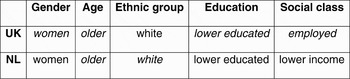
What do we know about those members of the public who, according to a growing number of public opinion polls, have lost confidence in the administration of justice? One way of studying these ‘critics’ more closely is by exploring some of their demographic characteristics (using a regression analysis or similar techniques). Are, for example, men more critical than women? Or are older respondents perhaps more critical than younger respondents? Based on a review of existing opinion data, we will focus on five of these variables: gender, age, ethnic group, education and social class. This will allow us to draw the average demographic profile of the critics of the justice system in the UK and the Netherlands.
Gender
According to the European Social Survey, women in the UK have less trust (43.3%) in the legal system than men (47.1%) (Van de Walle and Raine, Reference Van de Walle and Raine2008, p. 24). Other studies suggest a slightly bigger gender difference. Genn (Reference Genn1999, p. 229), for example, has analysed the responses to this statement: ‘If I went to court with the problem I am confident that I would get a fair hearing.’ In her view, women generally express less confidence than men (52% agreeing or strongly agreeing with the statement as compared with 62% of men). According to the British Crime Survey, women have a more positive view of the criminal justice system's effectiveness in bringing people accused of crimes to justice and in reducing crime. Women are, however, less confident that the rights of the accused are being respected (Van de Walle and Raine, Reference Van de Walle and Raine2008, p. 36). In the Netherlands, Van Velthoven and Ter Voert (Reference Van Velthoven and Ter Voert2004, p. 178) have found that Dutch women are generally (slightly) less positive about the justice system than men. Other studies indicate that 65% of the female respondents have confidence in the courts as opposed to 74% of male respondents in the Netherlands (Van der Meer, Reference Van der Meer2004, p. 27).
Age
The British Crime Survey shows that older respondents have a more negative view of the ability of the criminal justice system in reducing crime and prompt and efficient functioning. Older people are also less confident that the justice system brings people who committed crimes to justice (Van de Walle and Raine, Reference Van de Walle and Raine2008, p. 37). Similarly, older respondents in the Netherlands are more critical about the justice system than young respondents (Van Velthoven and Ter Voert, Reference Van Velthoven and Ter Voert2004, p. 178). In 2007, 63% of the oldest half of the respondents had confidence in the courts. Among the youngest half of the respondents this is 76% (Van der Meer, Reference Van der Meer2004, p. 28).
Ethnic group
In the UK, White respondents are more negative about the criminal justice system than Asian and Black respondents, except when it comes to respecting the rights of the accused (Brown, Reference Brown, Parmentier, Vervaeke, Doutrepont and Kellens2005, p. 175). This is also confirmed by the results of the British Crime Survey (Van de Walle and Raine, Reference Van de Walle and Raine2008, p. 37). In the Netherlands, most surveys do not distinguish between different ethnic groups. However, judging from a limited number of small-scale studies among second-generation Turkish and Moroccan ‘immigrants’, Bijlevelt, Goudriaan and Malsch (Reference Bijlevelt, Goudriaan, Malsch and Tyler2007, p. 297) conclude that ‘all in all, there is no proof that migrant groups in the Netherlands, as a whole, view the criminal justice system as inherently less legitimate than ethnic Dutch’. Sometimes people with an ethnic minority background tend to be slightly more positive about the justice system than ethnic Dutch.
Education
In the UK, of the respondents with no qualifications, 40.0% trust the legal system, while this increases to 58.7% with a higher education (Van de Walle and Raine, Reference Van de Walle and Raine2008, p. 25). Genn (Reference Genn1999) has found a similar effect in the responses to this statement: ‘If I went to court with the problem I am confident that I would get a fair hearing.’ In her study, respondents with degree-level qualifications were less likely to disagree with the statement and more likely to express no opinion than other groups (p. 229). This is also reflected in the British Crime Survey. Those with a higher education are more confident that the criminal justice system brings people who have committed crimes to justice. However, those with a lower education give a more positive evaluation with regard to the promptness and efficiency of the system (Van de Walle and Raine, Reference Van de Walle and Raine2008, p. 38). In 2002, 62% of those Dutch respondents with a lower education had confidence in the courts. Among those with a higher education, this was 80% (Van der Meer, Reference Van der Meer2004, p. 28). Similarly, Velthoven and Ter Voert (2004, p. 178) have found that the level of confidence in a fair treatment and the trustworthiness of judges drops if the level of education decreases.
Social class
Based on their comparative survey of European legal culture, Gibson and Caldeira (Reference Gibson and Caldeira1996, p. 73) concluded that ‘differences in legal values are rooted mainly in social class’. The British Crime Survey (which looks at social class in terms of employment) suggests that the unemployed generally have a more positive attitude towards the criminal justice system, though they are less confident that it respects the rights of the accused. By contrast, the inactive and the employed are less confident that it will bring people to justice. Yet they are more confident that the system protects the rights of the accused (Van de Walle and Raine, Reference Van de Walle and Raine2008, p. 39). In the Netherlands, surveys look at social class in terms of income. According to Van der Meer (Reference Van der Meer2004, p. 29), the level of confidence in the justice system rises with the level of income. Moreover, respondents with a lower income have less confidence in the fairness of legal procedures (Velthoven and Ter Voert, 2003, p. 178).
Discussion
Figure 1 summarises the main findings of this section. Based on their answers in public opinion surveys, this figure shows which respondents are (relatively speaking) the most critical about the justice system in the UK and the Netherlands. The list of surveys discussed in this section is not exhaustive. Moreover, not all studies are equally conclusive and some of the findings are contradictory.Footnote 5 But if we combine all variables into one single demographic profile, the average critic of the justice system may be characterised as follows: she is an older White woman, with a lower education and with a low income.Footnote 6 The findings in Figure 1 suggest that, despite important differences in the legal system of the two countries, the average demographic profile of the British and the Dutch critics looks remarkably similar.
Tracing the demographic profile.

Shortcomings of the demographic profile
Exploring the demographic characteristics of respondents has been more or less common practice in most public opinion studies (see, e.g., Jerolmack, Reference Jerolmack2003; Dekker et al., Reference Dekker, Maas-de Waal and Van der Meer2004; Van de Walle and Raine, Reference Van de Walle and Raine2008). However, this conventional way of profiling the critics of the justice system has several shortcomings.
First, scholars admit that the demographic profile of respondents is usually not very helpful in explaining public opinion. Van de Walle and Raine (Reference Van de Walle and Raine2008, p. 11) argue, for instance, that ‘[m]ultivariate statistical models containing variables such as gender, education, [and] age […] explain little of the variation in levels of trust in the legal system in European countries. This includes the UK.’ Similarly, in their review of the Dutch survey literature, Dekker and Van der Meer (Reference Dekker and Van der Meer2007, p. 31) argue that the level of public confidence in courts can only ‘to a very limited extent’ be explained by these variables.
Second, the fact that most demographic profiles are not very helpful in explaining public opinion is closely related to a more general shortcoming of survey research. Sarat (Reference Sarat1977, p. 455) has argued that although surveys are an excellent tool for recording what people think, they usually are less informative about how people think about law. How do they arrive at their opinions, what are their assumptions, and how intensely do they feel about a particular issue? Similarly, most demographic profiles are limited to what people think about the justice system, but they are not very informative about how they arrived at their critical opinions.
A final shortcoming of most demographic profiles is that they do not cover the entire legal system. Most, if not all, public opinion polls in the UK and the Netherlands are limited to issues of criminal law. As a result, these surveys may be helpful in analysing the critics of the criminal justice system, but they fail to provide us with similar information about the critics of civil or administrative law.
Considering these shortcomings of the demographic profile, this article will introduce an alternative way of profiling the critics of the justice system.
Tracing the normative profile of the critics
Based on a review of the literature, two elements appear to be particularly important for studying the present public opinion climate about legal issues: these are the level of ‘legal identification’ and the level of ‘legal awareness’ of the general public. In this section, both elements will be employed to draw the normative profile of the critics of the justice system.
Legal identification
In their book The Common Place of Law, Ewick and Silbey (Reference Ewick and Silbey1998) introduced a model to assess the various ways in which people describe their relationships to the law. This model has quickly become a widely used frame of analysis in many so-called ‘legal consciousness’ studies (see, e.g., Hertogh, Reference Hertogh2004). Ewick and Silbey (Reference Ewick and Silbey1998) identify three predominant types of legal consciousness. ‘People describe their relationships to law as something before which they stand, with which they engage, and against which they struggle’ (p. 47 emphasis in original). However, as Nielsen (Reference Nielsen2000, p. 1060) has rightly pointed out, these three approaches should be considered three general orientations or prototypes towards law, but this typology ‘is not meant to be a discrete set of options to describe the legal consciousness of particular individuals at particular times’. In other words, ‘some people cannot be said to be “before” the law and others “against” the law’ (Ewick and Silbey, Reference Ewick and Silbey1998, p. 50). Therefore, in our effort to trace the profile of the critics of the justice system, we need to create a different model which can be used to examine the orientations towards law elaborated by Ewick and Silbey. One way of doing this is by focusing on one other concept which is frequently used in the literature on public dissatisfaction with the justice system. This is the concept of ‘legal alienation’. Genn (Reference Genn1999, p. 247; emphasis added), for instance, has found that in the UK ‘[r]espondents’ views of the legal system often conveyed a sense of alienation from the institutions and processes of the law'. Similarly, Blankenburg (Reference Blankenburg, Chorus, Gerver and Hondius2006, p. 18; emphasis added) has concluded that ‘[c]omparative surveys […] point to an increasing alienation on the part of the citizens from Dutch politics and also from law as an institution’.
The concept of ‘alienation’ has, of course, a long and controversial history. Whereas some scholars argue that it should be considered ‘one of the great traditions in sociological thought’ (Seeman, Reference Seeman1959, p. 783), others claim that ‘we shall always be reduced to confusion when we read about alienation’ (Ludz, Reference Ludz, Geyer and Schweitzer1976, p. 3). Using Seeman's (1959) typology, we may differentiate between four different sentiments of alienation. In real life, people's feelings about the justice system will probably cover one or more of these four categories. A first type of legal alienation is ‘legal powerlessness’. This may be defined as the expectancy held by the individual that his own behaviour cannot determine the occurrence of the outcome of legal processes. This element is also reflected in Gibson and Caldeira's (1996, p. 65) study, when they ask their respondents to react to this proposition: ‘My interests are rarely represented in the law; usually law reflects the views of those who want to control me.’ A second type of legal alienation is ‘legal meaninglessness’. According to Genn (Reference Genn1999, p. 247), ‘[t]here is a lack of sympathy with the jargon of the law [and] the mystifying procedures of the courts’. Or, as one of her respondents explained about his day in court: ‘It was a bit of mystery to me. I mean it was just like going into sort of a puzzle and coming out’ (p. 223) A third type of legal alienation is what Sampson and Jeglum Bartusch (Reference Sampson and Jeglum Bartusch1998) refer to as ‘legal cynicism’. This ‘anomie about law’ refers to a (perceived) ‘state of normlessness in which the rules of the dominant society (and hence the legal system) are no longer binding in a community or for a population subgroup’ (Sampson and Jeglum Bartusch, Reference Sampson and Jeglum Bartusch1998, p. 782). Finally, a fourth type of legal alienation is ‘legal value-isolation’. The alienated in this sense are those who assign low reward value to those legal goals or beliefs that are typically highly valued in a given society. Anderson (Reference Anderson1999, p. 9), in his ethnographic study of the inner-city ghetto areas of Philadelphia, argues, for example, that ‘alienation from broader society's institutions, notably that of criminal justice, is widespread’. In this article, the term ‘legal alienation’ will be used as an umbrella term which covers all four types of alienation.
Legal awareness
A second element which is particularly useful for tracing the normative profile of the critics of the justice system is their level of legal awareness. Nielsen (Reference Nielsen2000, p. 1061) has suggested that ‘[b]ecause legal consciousness is contingent, it may change according to […] the subject's knowledge about the law and legal norms’. Most studies indicate that people's legal awareness is quite poor. In the UK, a 2003 MORI poll demonstrated that 32% of the British respondents did not know very much about courts; 41% did not know much about the crown prosecution service; and 45% knew hardly anything or nothing at all about youth courts (Roberts and Hough, Reference Roberts and Hough2005, p. 8). Studies in the Netherlands have produced similar results. One study has asked three basic questions about the Dutch criminal justice system: in a murder case, (1) who decides about the prosecution of a suspect?; (2) who decides whether this suspect is guilty or not?; and (3) who finally decides about the actual sentence? Less than one third (29%) of all respondents gave the right answer to all three questions; and 14% answered all questions wrongly (Van Koppen, Reference Van Koppen2003, p. 18).
Legalists, loyalists, cynics and outsiders
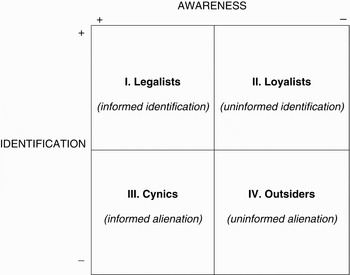
In order to employ both elements in our analysis, we need to address two basic questions. First: ‘Are people aware of the law?’ How much do they know about the justice system in general, about specific rules and regulations, or about a particular court case? Second: ‘Do people identify with law?’ To what extent does the law reflect their own personal values, their own sense of right or wrong, and their own ideas of justice? To consider these issues more systematically, we can transfer both questions to a simple two-by-two matrix (Figure 2). The first question has been put on the horizontal axis and the second question is placed on the vertical axis. Each field corresponds with a different normative profile (Hertogh, Reference Hertogh2007; Reference Hertogh and Adler2010).
Tracing the normative profile.

I. Legalists
The first category in Figure 2 is that of the ‘legalists’. People in this category are well aware of the law. Also, these people generally identify with law. This normative profile reflects the model of the homo juridicus, the legal equivalent of the homo oeconomicus (Teubner and Hutter, Reference Teubner, Hutter, Baums, Hopt and Horn2000).
We know from decades of law and society research, however, that this model is not an accurate description of reality. First, many knowledge and opinion about law (KOL) studies have demonstrated that most people are generally not aware of the legal rules (see, e.g., Podgorecki et al., Reference Podgorecki1973). Second, from the international legal consciousness literature we know that not all people equally identify with law. For example, in reunified Germany, former East and West Germans have very different ideas about the Constitution and about human rights (Noelle-Neumann, Reference Noelle-Neumann1995). Both the fact that a high level of legal awareness and a high level of legal identification are not self-evident suggests that, besides the ‘legalists’, there are at least three other normative profiles.
II. Loyalists
The second category is that of the ‘loyalists’. People with this profile generally identify with law as well. Contrary to the previous profile, however, their legal awareness is limited. They have a general idea of what the law is and they trust that it will be all right. They feel that the justice system should be respected and that it generally serves them well.
III. Cynics
Similar to the first normative profile, the ‘cynics’ are also well aware of the law. The main difference with the first profile is, however, that the degree in which these people identify with law is much lower. They are aware of the law, yet this also makes them more critical. They generally do not feel that those norms and values which they consider important are sufficiently reflected in the law.
IV. Outsiders
The final category in Figure 2 is that of the ‘outsiders’. The legal awareness of people with this normative profile is limited. People do not identify with law either. This is the mirror image of the first profile; while the ‘legalists’ regularly turn to law, the ‘outsiders’ have turned their backs on law.
How do we apply these normative profiles in future research?
Tracing the normative profile of the critics of the justice system may be a good alternative for the conventional approach. However, unlike the demographic profile which has already been applied in numerous studies, this alternative approach still requires future empirical testing. This section aims to demonstrate how the different normative profiles which were introduced in the previous section may be applied in empirical socio-legal studies. Inspired by similar research in political science, it discusses two suggestions for a comparative study of normative profiles in the UK and the Netherlands. These studies focus on legal mobilisation and legal protest in both countries. Unlike previous studies of the demographic profile, these future studies will not be limited to what people say but will also look at what they do to demonstrate their discontent about the justice system.
Legal mobilisation
In political science, voter turn-out rates are considered an important indicator for political alienation (see, e.g., Levin, Reference Levin1960; Southwell, Reference Southwell1985; Zipp, Reference Zipp1985; Southwell and Everest, Reference Southwell and Everest1998). It has been argued that ‘alienated voters [are] more likely to abstain from voting than their more allegiant counterparts’ (Southwell and Everest, Reference Southwell and Everest1998, p. 44). Similarly, scholars in the field of law of society focus on legal mobilisation. How do people resolve their disputes? How often do they take their disputes to court? And how often do they refuse to take up legal advice? In future comparative studies, these legal mobilisation figures may also be used to trace the normative profiles of disputants in the UK and the Netherlands.
Paths to justice
By way of example, let us consider Genn's (1999) study of legal mobilisation in the UK. Based on their behaviour in reaction to a ‘justifiable problem’, she distinguishes between three different groups of people: the ‘lumpers’ (who did nothing to resolve their problem), the ‘self-helpers’ (who tried to resolve the problem themselves) and the ‘advised’ (who tried to resolve the problem with help from an outside legal adviser) (p. 68). According to Genn (p. 137), ‘those expressing a positive view of the judicial system were somewhat more likely than those expressing a negative view to obtain [legal] advice’. Furthermore, ‘alienation from the legal system plays a role in decisions not to try and obtain redress when faced with a justiciable problem’ (p. 228). Combined with findings about their legal awareness, this should help us to identify the normative profiles of these disputants.
Genn (Reference Genn1999) argues that the lumpers are generally characterised by a low level of legal identification. Their reasons for failure to take action are related to ‘negative experiences of the legal system or negative beliefs about legal processes’ (p. 71). Their level of legal awareness is also fairly low. Following the terminology of Figure 2, lumpers may thus be qualified as ‘outsiders’. Most self-helpers have a low level of legal identification, as well. Many of them share ‘previous negative experiences of legal advisers or legal processes; a sense of powerlessness about certain types of problem; and in some cases a sense of alienation from the legal system’ (p. 76). Contrary to the previous group, however, the level of legal awareness among most self-helpers is fairly high. They are ‘relatively knowledgeable about sources of advice’; and they have ‘general knowledge about the existence of CABx [Citizen Advice Bureaux] and other local advice centres’ (p. 76). For the purpose of this article, self-helpers may thus be characterised as ‘cynics’.
Finally, the group of the advised are characterised by a high level of legal identification. For example, ‘[a]mong those whose first adviser was a solicitor or other legal adviser, only seven percent said they would probably or definitely not recommend others to seek advice from that source’ (Genn, Reference Genn1999, p. 98). Some members of this group also have a fairly high level of legal awareness. One respondent, for example, who took a general law course at university, states: ‘with the courses I've been on, you know a little bit about law as well, so you should never be afraid of using the law’ (p. 91). Others within this group, however, combine their high level of legal identification with a much lower level of legal awareness. When, for instance, one respondent was asked if he knew much about the legal system, he answered: ‘No, definitely not. No. No’ (p. 91). In terms of Figure 2, those advised with a higher level of legal awareness may be characterised as ‘legalists’, whereas those with a lower level of legal awareness qualify as ‘loyalists’.
Comparing the UK and the Netherlands
Genn's (1999) study has been replicated in several other countries, including the Netherlands (Van Velthoven and Ter Voert, Reference Van Velthoven and Ter Voert2004). This allows us to draw several comparative conclusions. In the UK, about 5% of the respondents did nothing to resolve their legal problem, as opposed to 10% in the Netherlands; about 35% tried to resolve the problem themselves, as opposed to 46%; and finally, in the UK, about 60% tried to resolve the problem with help from an outside adviser, as opposed to 44% in the Netherlands. Translated into the terms of Figure 2, these figures suggest that the number of ‘outsiders’ (lumpers) in the Netherlands is twice as high as in the UK. There are also more ‘cynics’ (self-helpers) in the Netherlands than in the UK. Finally, the group of ‘loyalists’ and ‘legalists’ combined (advised) is considerably smaller in the Netherlands than the same group in the UK. Based on these figures, it could be argued that the level of legal alienation in the Netherlands is both higher and more profound than in the UK. Furthermore, the critics of the justice system in the Netherlands are more likely to be ‘cynics’ and ‘outsiders’ than the critics in the UK.
These are only preliminary conclusions. Moreover, these conclusions do not cover the general population of the UK and the Netherlands, but only those respondents who reported having experienced one or more justiciable problem(s) during the previous five years.Footnote 7 Additional surveys and interviews are needed to test these early findings. Yet even at this point, the secondary analysis of Genn's (1999) study suggests that these and other legal mobilisation figures may be quite useful for analysing different normative profiles.
Legal protest
Some important studies in political science also focus on political protest as the indicator for alienation (see, e.g., LeBon, Reference LeBon and Genevie1978 [1896]; Muller and Opp, Reference Muller and Opp1986; Kaase, Reference Kaase and Dogan1988). In these studies, ‘protest represents an expression of deep-seated feelings of frustration, anger, and alienation, not just with particular leaders or issues, but also with the political system’ (Norris, Walgrave and Van Aelst, 2005, p. 190).Footnote 8 This type of research suggests that, in future comparative studies, we may also trace the normative profile of the critics of the justice system in the UK and the Netherlands by looking at various types of legal protest.
Loyalty, voice, exit
Following Hirshman's (Reference Hirshman1970) typology, there are three different tactics which people may choose to protest against the justice system (see also Toharia, Reference Toharia, Jensen and Heller2003). First, when someone disagrees with some element of the justice system, he or she may choose not to do anything with this or they may try to resolve the matter by mobilising the law (‘loyalty’). This tactic covers a variety of different actions, including writing a petition, filing an official complaint and bringing the case before a court (of appeal). Second, protest against the justice system may also be expressed by means that are outside, but not against, the law (‘voice’). This tactic covers, for instance, readers' letters to newspapers, critical blogs on the Internet and protest marches. Finally, the third and most radical way to protest against the law is to look for whatever ways possible to move away from the justice system (‘exit’). This may be done by trying to ridicule or to ignore the law, by taking the law into one's own hands (Rattner and Yagil, Reference Rattner and Yagil2004) or by other forms of ‘legal disobedience’ (Rattner, Yagil and Pedahzur, Reference Rattner, Yagil and Pedahzur2001).
According to Jasper (Reference Jasper1997, p. 237), ‘[t]actics are rarely, if ever, neutral means about which protesters do not care’. In his view, ‘[j]ust as their ideologies do, their activities express protestors’ political identities and moral visions'. Similarly, all three tactics of legal protest suggest a different normative profile of the protesters. ‘Legalists’ and ‘loyalists’ are the least critical about the justice system. If, however, they have some form of criticism, they will most likely aim to address this within the boundaries of the justice system (loyalty). ‘Cynics’, on the other hand, are much more critical and they have considerably less confidence in legal procedures and legal authorities. Therefore, it is likely that they will favour different forms of protest outside the justice system (voice). Finally, ‘outsiders’, who are neither very knowledgeable nor very positive about the justice system, will most likely demonstrate their anger and frustration by turning against the law (exit). In this way, future comparative studies may look at different tactics of legal protest in order to identify the ‘normative profile’ of the protesters. One way of doing this is by focusing on important examples of national legal protest, like the ‘Fathers4Justice’ movement in the UK and the ‘Committee for Lucia’ in the Netherlands.
Fathers4Justice
‘Fathers4Justice’ (F4J) is a fathers' rights' movement aimed at family law reform and equal contact for divorced parents with children, which has become most well known for a series of protests involving men dressed as Batman, Spiderman and other comic book characters scaling bridges, courthouses and other public buildings.Footnote 9 Motivated by ‘a growing sense of frustration on the part of some fathers with the more traditional routes of law reform and campaigning’, the founders of this movement felt they needed ‘“[s]omething stronger” – a strategy which will make politicians and policy makers “sit up and take notice”’(Collier, Reference Collier, Collier and Sheldon2006, p. 55). Over the years, their protests have included physical attacks on government offices; protests outside the homes of solicitors, barristers and judges; and a series of confrontations with senior government figures. Moreover, in 2006 the organisation was temporarily disbanded, following allegations of a plot by members to kidnap the son of then-Prime Minister Tony Blair. The British press has described F4J as ‘The Outlaw Fathers’ and ‘The New Militant Men's Movement’ (p. 53).
Committee for Lucia
The Dutch ‘Committee for Lucia’ is concerned with the case of Lucia de Berk, a nurse jailed for life in 2003 for murdering seven patients and attempting to murder three more. The members of the Committee, none of whom are related to Lucia or belong to her circle of friends, describe themselves as ‘merely individuals driven by the certainty that Lucia is the victim of a gross miscarriage of justice’.Footnote 10 During the complex court case, the prosecution claimed that most of the patients died as a result of ‘medically unexplained’ causes, and in many of these cases Lucia was on duty ‘noticeably often’ when someone died (see, e.g., Buchanan, Reference Buchanan2007). The statistical probability of her being present at so many deaths was central to the prosecution's case. The members of the ‘Committee for Lucia’ felt, however, that Lucia had been unjustly convicted. The Committee used their own website to publish numerous studies and documents which were critical about Lucia's conviction. They also organised an on-line petitionFootnote 11 and a protest march outside the prison walls. One member, a professor of mathematical statistics, has repeatedly criticised the flawed nature of the statistical arguments of the prosecution (see, e.g., Meester, Collins, Gill and Van Lambalgen, Reference Meester, Collins, Gill and Van Lambalgen2006). One other member has written an influential book critical of the case (Derksen, Reference Derksen2006). Both have also submitted official presentations to a Dutch legal advisory committee, which examines selected closed cases and looks for evidence of errors in the police investigation. Following these and other campaigns by the members of the Committee, Lucia was released from jail in 2008 pending a review of the case. In April 2010, after a retrial, she was officially acquitted. The acquittal marks one of the biggest miscarriages of justice in Dutch legal history.Footnote 12
Comparing the UK and the Netherlands
The members of both movements are serious critics of the justice system, yet their choice of tactics is quite different. While the protesters in the UK frequently use illegal forms of action and other types of ‘legal disobedience’ (exit), the Dutch protesters choose to mobilise the law (loyalty) or express their discontent by means that are outside, but not against the law (voice). Considering these differences, and translated into the terms of Figure 2, one might hypothesise that most members of the British ‘Fathers4Justice’ movement qualify as ‘outsiders’, while most members of the Dutch ‘Committee for Lucia’ may be characterised as ‘loyalists’ or ‘cynics’. Additional interviews with these and other protesters are needed to test these early findings.
Discussion
The purpose of this section was to illustrate how the four different normative profiles, which were introduced earlier, may be employed in future socio-legal research. Our analysis suggests that empirical studies on legal mobilisation and legal protest may be quite useful for tracing the normative profile of the critics of the justice system. Yet it also demonstrates that more research is needed before we can draw any general conclusions about the ‘national’ normative profile of the critics in the UK and the Netherlands. Furthermore, the analysis illustrates that, although one may differentiate between four different normative profiles in theoretical terms, this is not necessarily an accurate description of reality. Rather than placing people in one box or the other (in Figure 2), in real life it is more likely that people will have one or more different (or overlapping) normative profiles. For example, based on legal mobilisation figures (related to the civil justice system) most Dutch respondents were characterised as ‘cynics’ and ‘outsiders’. Yet, based on our discussion of legal protest (related to the criminal justice system), most members of the Dutch ‘Committee for Lucia’ were identified as ‘loyalists’ and ‘cynics’.
Conclusion
Public opinion studies in the UK and the Netherlands usually focus on the level of support for the justice system. Yet, considering the decreasing level of public trust in legal institutions and legal authorities in both countries, it is equally important to look at those people who have lost confidence in the law. Thus far, however, these people have remained largely anonymous. This article has therefore discussed two ways of tracing the profile of the critics of the justice system.
The first approach focuses on their demographic profile. Seen from this perspective, the critics of the justice system in the UK and the Netherlands look rather similar. Based on a review of the available survey evidence, it was established that the average critic in both countries is an older White woman, with a lower education and with a low income. Although this approach is useful, it was argued that this conventional way of profiling the critics has several shortcomings. Therefore, this article has also discussed a second, alternative approach. Based on people's level of legal awareness and legal identification, it distinguishes four different normative profiles: ‘legalists’, ‘loyalists’, ‘cynics’ and ‘outsiders’. Seen from this perspective, there are also several differences between the critics of the justice system in the UK and the Netherlands. Legal mobilisation figures suggest that, in general terms, the group of ‘cynics’ and ‘outsiders’ in the UK is probably smaller than the same group in the Netherlands. Furthermore, it was argued that most members of the Dutch ‘Committee for Lucia’ are ‘cynics’ and ‘loyalists’, while the British ‘Fathers4Justice’ movement is largely run by ‘outsiders’. However, these are only preliminary findings which still need to be tested in future comparative studies.
Based on our brief analysis of legal mobilisation and legal protest, we may formulate three hypotheses which may guide these future studies. Each hypothesis challenges a commonly held belief about the critics of the justice system. First, surveys usually focus on issues of criminal law. Because most demographic profiles are based on these opinion data, one could easily get the impression that these people are only critics of the criminal justice system. However, both our review of legal mobilisation figures and our discussion of the ‘Fathers4Justice’ movement suggest that some people are equally concerned about civil justice. Therefore, our first hypothesis for future research is that the critics of the justice system are probably not only concerned about criminal justice, but about law in general.
A second commonly held image is that most critics of the justice system belong to a small (underprivileged and isolated) group of people with certain demographic characteristics (Elchardus and Smits, Reference Elchardus and Smits2002; Elchardus, De Groof and Smits, Reference Elchardus, De Groof and Smits2008). This idea is supported by the fact that the demographic profile of the British and the Dutch critics look remarkably similar (see Figure 1). However, the normative profile of the critics has also revealed important differences between the two countries. This suggests that public criticism about the justice system is less about who you are, and more about where you are (see Van Aelst and Walgrave, Reference Van Aelst and Walgrave2001). In other words, ‘[critical] legal consciousness is not a permanent or essential aspect of a person's identity or life, although it may end up being empirically stable’. Instead, public dissatisfaction with the justice system is ‘situationally specific’ (Ewick and Silbey, Reference Ewick and Silbey1998, p. 50). A second hypothesis is, therefore, that the critics of the justice system are not limited to certain minorities but that they probably come from all walks of life.
A final stereotype is that all critics of the justice system are ignorant about law, and that they will become more supportive of the law if they are provided with more information (see Chapman, Mirrlees-Black and Brawn, Reference Chapman, Mirrlees-Black and Brawn2002). This idea is supported by the fact that those with a lower education have less confidence in the legal system than those with a higher education. Genn's (1999, p. 76) study shows that most self-helpers are characterised by ‘a sense of alienation from the legal system’. Yet these people are also well informed about the law. Similarly, most members of the ‘Fathers4Justice’ movement and the ‘Committee for Lucia’ seem fairly knowledgeable about the legal system. Yet their high level of legal awareness has decreased rather than increased their level of legal identification. These examples underscore Sarat's (1977, p. 441) important observation that, for the average citizen, ‘familiarity breeds contempt’; ‘those who know law and the legal system from first-hand experience tend to be less satisfied than those to whom it remains remote’. Therefore, our third and final research hypothesis is that not all critics of the justice system are ignorant about law. In fact, some of them may even be better informed than most supporters of the justice system.
In both the UK and the Netherlands, a considerable number of people have lost confidence in the law. But there is also a large group of people in both countries who are still fairly positive about the justice system. Yet, in order to prevent the current situation from developing into a full-scale ‘legitimacy crisis’ (see, e.g., Friedrichs, Reference Friedrichs1980), it is important to keep track constantly of the critics of the justice system. Although this article has discussed the two profiles separately, future studies may also explore different ways to combine the demographic and the normative profile of the critics. Are ‘loyalists’, for instance, more likely to be men than women? Are there more ‘cynics’ among people with a higher education than among people with no qualifications? And are there perhaps more ‘outsiders’ among older people than among young people? Questions like these will help us to look beyond common stereotypes and consider the critics of the justice system as real persons with genuine concerns about the administration of justice in their country.