Introduction
Instrumental activities of daily living (IADL) are complex everyday activities such as handling finances, shopping or managing medication. The loss of independence in these activities is a key factor affecting the quality of life in patients with dementia and their caregivers. Mild cognitive impairment (MCI) can be regarded as a transitional state between normal ageing and dementia. Although impairment in IADL is by definition excluded in MCI, cross-sectional studies have shown that limitations in IADL abilities are common in MCI (Tuokko et al. Reference Tuokko, Morris and Ebert2005; Perneczky et al. Reference Perneczky, Pohl, Sorg, Hartmann, Komossa, Alexopoulos, Wagenpfeil and Kurz2006; Wadley et al. Reference Wadley, Crowe, Marsiske, Cook, Unverzagt, Rosenberg and Rexroth2007; Brown et al. Reference Brown, Devanand, Liu and Caccappolo2011; Reppermund et al. Reference Reppermund, Sachdev, Crawford, Kochan, Slavin, Kang, Trollor, Draper and Brodaty2011b).
Some activities are more cognitively demanding than others and recent findings by our group suggest that restrictions in functional abilities in individuals with MCI are in particular present in highly cognitively demanding activities (Reppermund et al. Reference Reppermund, Sachdev, Crawford, Kochan, Slavin, Kang, Trollor, Draper and Brodaty2011b). These highly cognitively demanding IADL are associated with cognitive performance in several domains and men seem to have more difficulties than women in performance of IADL with higher cognitive demands. However, little is known about longitudinal changes in IADL performance and about the relationship between cognitive and functional decline. Most longitudinal studies examined associations between IADL limitations and progression to dementia (Purser et al. Reference Purser, Fillenbaum, Pieper and Wallace2005; Pérès et al. Reference Pérès, Chrysostome, Fabrigoule, Orgogozo, Dartigues and Barberger-Gateau2006; Di Carlo et al. Reference Di Carlo, Lamassa, Baldereschi, Inzitari, Scafato, Farchi and Inzitari2007; Luck et al. Reference Luck, Luppa, Angermeyer, Villringer, Konig and Riedel-Heller2011), rather than progression to MCI. Luck et al. (Reference Luck, Luppa, Angermeyer, Villringer, Konig and Riedel-Heller2011) reported a higher conversion rate to dementia, a shorter time to clinically manifest diagnosis and a lower chance of reversibility to cognitively normal (CN) for individuals with MCI plus IADL limitations. Purser et al. (Reference Purser, Fillenbaum, Pieper and Wallace2005) examined 10-year trajectories of incident disability for CN individuals and those with MCI. The estimated probability of progression to disability, and hence becoming eligible for a formal diagnosis of dementia, was much higher in the MCI subgroup with IADL limitations at baseline. There was no significant difference in the progression rate between CN participants and MCI without functional limitations at baseline. Similar findings were reported by Pérès et al. (Reference Pérès, Chrysostome, Fabrigoule, Orgogozo, Dartigues and Barberger-Gateau2006) and by Di Carlo et al. (Reference Di Carlo, Lamassa, Baldereschi, Inzitari, Scafato, Farchi and Inzitari2007). Even for individuals with normal cognition, self-reported IADL restrictions predicted progression to dementia after 2 years (Pérès et al. Reference Pérès, Chrysostome, Fabrigoule, Orgogozo, Dartigues and Barberger-Gateau2006) and 4 years (Di Carlo et al. Reference Di Carlo, Lamassa, Baldereschi, Inzitari, Scafato, Farchi and Inzitari2007), respectively. One limitation of the aforementioned studies is the use of self-reported IADL rather than informant-based measures. A second limitation is that items did not consider higher-order or more complex IADL, e.g. being able to do two tasks simultaneously versus preparing food. Third, few studies have examined functional abilities across MCI subtypes; however, there is increasing evidence for early IADL decrements in particular in individuals with amnestic MCI (aMCI) (Farias et al. Reference Farias, Mungas and Jagust2005; Bangen et al. Reference Bangen, Jak, Schiehser, Delano-Wood, Tuminello, Han, Delis and Bondi2010; Luck et al. Reference Luck, Luppa, Angermeyer, Villringer, Konig and Riedel-Heller2011). This is in line with the finding that aMCI represents an increased risk for Alzheimer's dementia (Jungwirth et al. Reference Jungwirth, Zehetmayer, Hinterberger, Tragl and Fischer2012).
The aims of this study were to examine informant-based IADL over a 2-year period in community-dwelling older individuals with MCI and to compare them with CN individuals. Furthermore, the study explored whether functional ability is predictive of cognitive decline over a 2-year period and whether highly cognitively demanding IADL are a better predictor of MCI and dementia than IADL with low cognitive demand. Baseline and 2-year follow-up data from the Sydney Memory and Ageing Study (MAS) (Sachdev et al. Reference Sachdev, Brodaty, Reppermund, Kochan, Trollor, Draper, Slavin, Crawford, Kang, Broe, Mather and Lux2010) were used to address these aims.
We hypothesized that individuals with MCI would have more difficulties in IADL compared with CN individuals at both time points and that IADL in general and highly cognitively demanding IADL in particular would predict MCI and dementia at follow-up in CN individuals.
Method
Study participants
The MAS sample included 1037 community-dwelling participants aged 70–90 years without dementia at baseline. They were assessed with a comprehensive cognitive and medical assessment and with the informant-completed Bayer-Activities of Daily Living Scale (B-ADL; Hindmarch et al. Reference Hindmarch, Lehfeld, de Jongh and Erzigkeit1998; Erzigkeit et al. Reference Erzigkeit, Lehfeld, Pena-Casanova, Bieber, Yekrangi-Hartmann, Rupp, Rappard, Arnold and Hindmarch2001) at baseline and 2 years later. Exclusion criteria were a score of 23 and below on the Mini-Mental State Examination (MMSE; Folstein et al. Reference Folstein, Folstein and McHugh1975), adjusted for age and education (Anderson et al. Reference Anderson, Sachdev, Brodaty, Trollor and Andrews2007), dementia [according to Diagnostic and Statistical Manual of Mental Disorders, Fourth Edition (DSM-IV) criteria (APA, 1994)], developmental disabilities, psychotic symptoms, schizophrenia or bipolar disorder, multiple sclerosis, motor neuron disease, progressive malignancy and English inadequate to complete a psychometric assessment. To ensure the validity of neuropsychological scores, all participants from a non-English-speaking background (i.e. not able to speak English at a basic conversational level by the age of 9 years; n = 164) were additionally excluded from the present analysis as were participants who did not have an available informant or missing B-ADL data (n = 60) or missing neuropsychological data (n = 77). A total of 134 participants withdrew or died prior to the 2-year follow-up. The final sample comprised 602 participants of whom 227 were classified as MCI (50.7% females) and 375 as CN (57.6% females) at baseline (see Table 1). The mean age was 78.2 (s.d. = 4.6) years.
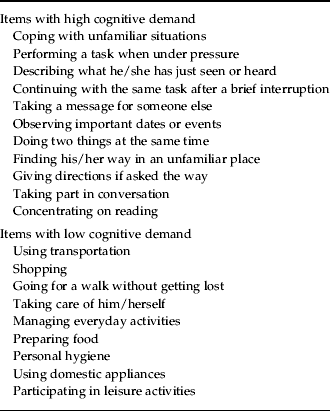
Bayer Activities of Daily Living scale (Hindmarch et al. Reference Hindmarch, Lehfeld, de Jongh and Erzigkeit1998; Erzigkeit et al. Reference Erzigkeit, Lehfeld, Pena-Casanova, Bieber, Yekrangi-Hartmann, Rupp, Rappard, Arnold and Hindmarch2001) items with high and with low cognitive demanda

a Results from a factor analysis described by Reppermund et al. (Reference Reppermund, Sachdev, Crawford, Kochan, Slavin, Kang, Trollor, Draper and Brodaty2011b). Subscales were formed based on the results of the factor solution, with the score for each factor calculated as the average of ratings on items that loaded on each factor with a factor-pattern loading greater than 0.45.
Participants were assessed either at a study centre or in their own homes. All assessments were conducted by trained research psychologists. Informants were relatives or close friends of the participants, preferably cohabiting, that is, the informant had to know the person well enough to answer questions about his or her memory, thinking and daily functions, and had at least 1 h contact per week with the participant.
MCI diagnoses were made according to published criteria (Petersen et al. Reference Petersen, Smith, Waring, Ivnik, Tangalos and Kokmen1999; Petersen, Reference Petersen2004) as follows: (1) presence of subjective complaints by either the participant or informant; (2) presence of cognitive impairment in one domain or more (based on a threshold equivalent to 1.5 s.d. or more below published normative data); (3) normal or minimally impaired in functional abilities (i.e. a score of <3 on the B-ADL adjusted for physical impairment); and (4) no dementia according to DSM-IV criteria. aMCI was diagnosed if cognitive impairment in the memory domain was present (with or without impairment in a non-memory domain) and non-amnestic MCI (nMCI) was diagnosed if cognitive impairment in one or more non-memory domains was present. Individuals who did not meet the criteria for MCI were classified as CN. Consensus diagnoses were made by an expert team consisting of geriatric psychiatrists, neuropsychiatrists, clinical and research neuropsychologists, on the basis of all available clinical and neuropsychological data.
The study protocol was approved by the University of New South Wales Human Research Ethics Committee and written informed consent was obtained from each participant and informant.
Functional assessment
The B-ADL is an informant-based instrument that was developed to assess functional disabilities in the early stages of dementia or cognitive impairment (Hindmarch et al. Reference Hindmarch, Lehfeld, de Jongh and Erzigkeit1998; Erzigkeit et al. Reference Erzigkeit, Lehfeld, Pena-Casanova, Bieber, Yekrangi-Hartmann, Rupp, Rappard, Arnold and Hindmarch2001). It contains 25 items which are completed by an informant sufficiently familiar with the participant.
Each item is introduced with ‘Does the person have difficulty …’, and the informant rates the frequency of the participant's difficulties in performing everyday activities from 1 (never) to 10 (always). The total score is given by summing up each item score divided by the number of items, with higher scores corresponding to more severe deficits. The B-ADL was administered at baseline and at the 2-year follow-up.
Based on our previous work (Reppermund et al. Reference Reppermund, Sachdev, Crawford, Kochan, Slavin, Kang, Trollor, Draper and Brodaty2011b) the B-ADL items were divided into two categories: items with high cognitive demand and items with low cognitive demand. These categories were derived from a factor analysis of the B-ADL to get a better understanding of the underlying level of cognitive contribution to everyday activities. We found that the B-ADL items can be differentiated into two factors: one comprising activities with low cognitive demand (like preparing food or personal hygiene) and another comprising activities with high cognitive demand (like doing two things at the same time or giving directions if asked the way). Table 1 shows the activities included for each factor.
Neuropsychological assessment
All participants underwent an extensive neuropsychological assessment at baseline and 2-year follow-up. The MMSE (Folstein et al. Reference Folstein, Folstein and McHugh1975) was used as a screen for global cognitive functioning. Composite scores for five cognitive domains were formed as follows:
Memory: logical memory (Wechsler, Reference Wechsler1997a) (story A delayed recall), Rey Auditory Verbal Learning Test (Rey, Reference Rey1964) (total learning, short-term recall, long-term recall) and Benton Visual Retention Test-recognition (Benton Sivan & Spreen, Reference Benton Sivan and Spreen1996).
Attention/processing speed: Trail Making Test A (Reitan & Wolfson, Reference Reitan and Wolfson1985) and Digit Symbol Coding (Wechsler, Reference Wechsler1997b).
Executive functions: Trail Making Test B (Reitan, Reference Reitan and Wolfson1985) and Controlled Oral Word Association Test (Benton, Reference Benton1967).
Visuo-spatial function: Block Design (Wechsler, Reference Wechsler1981).
Language: Boston Naming Test (30 item version) (Fastenau et al. Reference Fastenau, Denburg and Mauer1998; Kaplan et al. Reference Kaplan, Goodglass and Weintraub2001) and Semantic Fluency (animals) (Spreen & Benton, Reference Spreen and Benton1969).
Depressive symptoms and cardiovascular risk index
Depressive symptoms and cardiovascular events have been shown to be predictors of cognitive decline (Modrego & Ferrández, Reference Modrego and Ferrández2004; Barnes et al. Reference Barnes, Alexopoulos, Lopez, Williamson and Yaffe2006; Gorelick et al. Reference Gorelick, Scuteri, Black, Decarli, Greenberg, Iadecola, Launer, Laurent, Lopez, Nyenhuis, Petersen, Schneider, Tzourio, Arnett, Bennett, Chui, Higashida, Lindquist, Nilsson, Roman, Sellke and Seshadri2011) and were therefore included as covariates in our analyses.
Depressive symptoms were assessed with the 15-item short-form of the Geriatric Depression Scale (GDS; Yesavage et al. Reference Yesavage, Brink, Rose, Lum, Huang, Adey and Leirer1982; Sheik & Yesavage, Reference Sheik, Yesavage and Brink1986), a self-rating questionnaire shown to be reliable and valid for the assessment of depressive symptoms in the elderly. A higher score indicates more symptoms of depression.
The CardioVascular Risk Factor Index (CVR) is a computed variable based on the research of the Framingham Stroke Study which was reported by D'Agostino et al. (Reference D'Agostino, Vasan, Pencina, Wolf, Cobain, Massaro and Kannel2008). It is based on a regression model using current smoking status, diabetic status, systolic blood pressure, total cholesterol level, high-density lipoprotein level and the use of antihypertensive medication. A higher score indicates a higher 10-year risk prediction of a cardiovascular event (coronary death, myocardial infarction, coronary insufficiency, angina, ischaemic stroke, haemorrhagic stroke, transient ischaemic attack, peripheral artery disease and heart failure). The CVR was available for 583 participants (96.84% of the sample).
Statistical analyses
Statistical analyses included independent-samples t tests, and χ2 tests for comparing variables of interest between the MCI and CN groups.
Logistic regressions were carried out with diagnosis at baseline (MCI versus CN) and 2-year follow-up (MCI and dementia versus CN), respectively, as dependent variables and functional ratings as independent variables.
The extent to which functional ratings of CN individuals at baseline predict diagnostic classification (MCI, aMCI, nMCI and dementia versus CN) at follow-up was investigated with multinomial logistic regression analyses. Age, sex, education, sex of the informant, GDS score and CVR score were entered as additional independent variables into the regression.
Because the B-ADL scores were not normally distributed, normal scores for these variables were computed using Blom's procedure (Blom, Reference Blom1958). The level of significance was set to p < 0.05. All statistical analyses were performed using IBM SPSS Statistics 20 for Windows.
Results
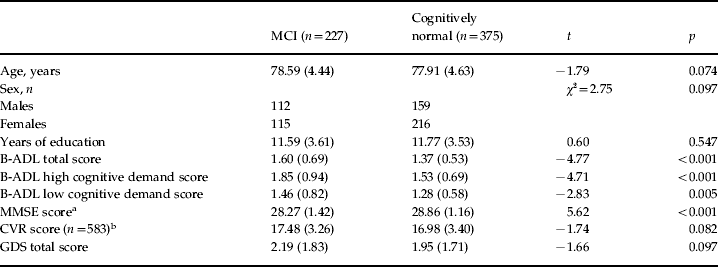
The demographic and functional characteristics for the two groups (MCI and CN groups at baseline) are listed in Table 2. Compared with CN individuals, the MCI group had a significantly lower MMSE score and more informant-reported functional deficits (i.e. higher B-ADL total score) at baseline. Moreover, the MCI group had more informant-reported deficits on the B-ADL items with high and low cognitive demand. There were no significant differences between the groups regarding depressive symptoms or cardiovascular risk factors.
Baseline characteristics for the MCI and cognitively intact groups
MCI, Mild cognitive impairment; B-ADL, Bayer-Activities of Daily Living Scale; MMSE, Mini-Mental State Examination; CVR, CardioVascular Risk Factor Index; GDS, Geriatric Depression Scale (15-item version).
Data are given as mean (standard deviation).
a Adjusted for age and education (Anderson et al. Reference Anderson, Sachdev, Brodaty, Trollor and Andrews2007).
b Based on age, smoking status, diabetic status, systolic blood pressure, cholesterol level, high-density-lipoprotein level and antihypertensive medication (D'Agostino et al. Reference D'Agostino, Vasan, Pencina, Wolf, Cobain, Massaro and Kannel2008).
Two separate logistic regression analyses were carried out, with the high cognitive demand B-ADL score and the low cognitive demand B-ADL score included as predictor variables, respectively. These revealed a significant association between diagnosis at baseline (MCI versus CN) and the high cognitive demand B-ADL score [odds ratio (OR) 1.49, 95% confidence interval (CI) 1.23–1.80, Wald χ2 = 16.73, degrees of freedom (df) = 1, p = < 0.001] as well as the low cognitive demand B-ADL score (OR 1.26, 95% CI 1.03–1.53, Wald χ2 = 5.09, df = 1, p = 0.024), indicating that more informant-reported functional deficits are associated with MCI. We repeated the analysis with both high and low cognitive demand scores as independent variables in the same model. The high cognitive demand B-ADL score was associated with MCI (OR 1.50, 95% CI 1.19–1.88, Wald χ2 = 11.84, df = 1, p = 0.001) whereas the low cognitive demand B-ADL score was no longer significantly associated with MCI (OR 0.99, 95% CI 0.78–1.26, Wald χ2 = 0.01, df = 1, p = 0.916). Thus, only the highly cognitively demanding IADL had an independent association with MCI when both subscales were included in the model. The analyses were repeated at follow-up and confirmed the results that the high cognitive demand B-ADL score, but not the low cognitive demand B-ADL score, was associated with MCI (data not shown).
Predictors of MCI and dementia
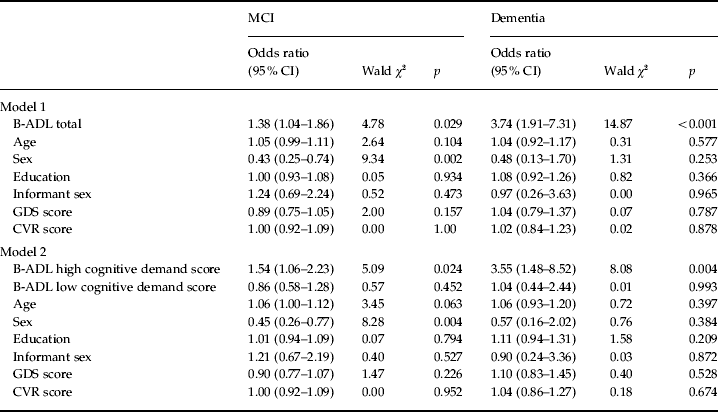
To assess whether functional performance of CN individuals at baseline predicted MCI or dementia 2 years later, logistic regression analysis was conducted with diagnostic classification, (MCI, dementia or CN at follow-up), as the dependent variable and the baseline B-ADL total score, age, sex, education, sex of the informant, GDS score and CVR score as independent variables (see Table 3). The analysis was repeated using separate B-ADL high and low cognitive demand scores. Of the 375 individuals who were CN at baseline and had no missing CVR score, 13 developed dementia, 75 were classified as MCI and 287 as CN at follow-up. The B-ADL total score and the B-ADL high cognitive demand score were significant predictors of MCI and dementia whereas the B-ADL low cognitive demand score did not predict MCI or dementia. Furthermore, being male significantly contributed to the prediction of MCI. Age, depressive symptoms, the cardiovascular risk factor and sex of the informant did not contribute to predict MCI or dementia.
Multinomial logistic regression results for predicting MCI versus CN and dementia versus CN at follow-up (n = 375 CN individuals at baseline)
MCI, Mild cognitive impairment; CN, cognitively normal; CI, confidence interval; B-ADL, Bayer-Activities of Daily Living Scale; GDS, Geriatric Depression Scale (15-item version); CVR, CardioVascular Risk Factor Index.
To examine whether pre-morbid intelligence quotient (IQ) instead of years of education would contribute to the prediction, we ran an additional regression analysis, exchanging years of education with the National Adult Reading Test (Nelson & Willison, Reference Nelson and Willison1991) predicted IQ as an independent variable. However, the results remained generally the same for the B-ADL high cognitive demand score predicting MCI (OR 1.47, 95% CI 1.02–2.13, Wald χ2 = 4.15, df = 1, p = 0.042) and dementia (OR 3.60, 95% CI 1.46–8.86, Wald χ2 = 7.75, df = 1, p = 0.005) as well as for the B-ADL low cognitive demand score not predicting MCI (OR 0.84, 95% CI 0.57–1.25, Wald χ2 = 0.71, df = 1, p = 0.399) or dementia at follow-up (OR 1.16, 95% CI 0.49–2.73, Wald χ2 = 0.12, df = 1, p = 0.735).
MCI subtypes
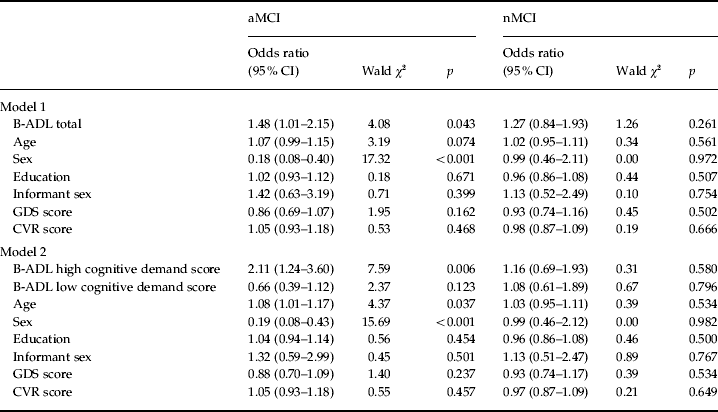
To find out whether functional performance in CN at baseline would also predict aMCI versus nMCI at follow-up, we conducted multinomial logistic regression with diagnostic classification (aMCI, nMCI and CN at follow-up) as the dependent variable. A total of 41 participants were classified as aMCI and 34 as nMCI. Table 4 shows the results.
Multinomial logistic regression results for predicting nMCI versus CN and aMCI versus CN at follow-up (n = 362 CN individuals at baseline)
nMCI, Non-amnestic mild cognitive impairment; CN, cognitively normal; aMCI, amnestic mild cognitive impairment; CI, confidence interval; B-ADL, Bayer-Activities of Daily Living Scale; GDS, Geriatric Depression Scale (15-item version); CVR, CardioVascular Risk Factor Index.
The B-ADL total score, the B-ADL high cognitive demand score and sex (being male) were significant predictors of aMCI but not of nMCI. The B-ADL low cognitive demand score neither predicted aMCI nor nMCI. Depressive symptoms, the cardiovascular risk factor and sex of the informant predicted neither aMCI nor nMCI. However, older age significantly contributed to the prediction of aMCI by highly cognitively demanding IADL.
Discussion
In contrast to dementia, where functional impairment is necessary to make the diagnosis, the original criteria for MCI by Petersen (Petersen et al. Reference Petersen, Smith, Waring, Ivnik, Tangalos and Kokmen1999; Petersen, Reference Petersen2004) require intact activities of daily living. Our findings, however, suggest that some functional disturbances are common in MCI. Compared with CN individuals, significantly more informant-reported IADL difficulties were present in MCI. These results rather support the revised diagnostic criteria for MCI with the inclusion of a criterion relating to increasing difficulty in performing everyday tasks without loss of autonomy (Winblad et al. Reference Winblad, Palmer, Kivipelto, Jelic, Fratiglioni, Wahlund, Nordberg, Backman, Albert, Almkvist, Arai, Basun, Blennow, de Leon, DeCarli, Erkinjuntti, Giacobini, Graff, Hardy, Jack, Jorm, Ritchie, van Duijn, Visser and Petersen2004) and are in line with other recent studies (Tuokko et al. Reference Tuokko, Morris and Ebert2005; Perneczky et al. Reference Perneczky, Pohl, Sorg, Hartmann, Komossa, Alexopoulos, Wagenpfeil and Kurz2006; Wadley et al. Reference Wadley, Crowe, Marsiske, Cook, Unverzagt, Rosenberg and Rexroth2007; Brown et al. Reference Brown, Devanand, Liu and Caccappolo2011; Reppermund et al. Reference Reppermund, Sachdev, Crawford, Kochan, Slavin, Kang, Trollor, Draper and Brodaty2011b).
The severity of informant-reported functional impairment was relatively low, indicating that even though individuals with MCI have increasing difficulties performing complex everyday activities, they are still able to do them mostly independently. However, our findings indicate that MCI may represent a functional status between the subtle decrements associated with ageing and more severe deficits associated with dementia and that individuals with MCI might benefit from assistance with more complex IADL.
Cognitive decline at an early stage seems first to cause difficulties in more complex IADL with high cognitive demands like finding the way in an unfamiliar place or doing two things at the same time (Reppermund et al. Reference Reppermund, Sachdev, Crawford, Kochan, Slavin, Kang, Trollor, Draper and Brodaty2011b). These activities require more cognitive resources than simple IADL and are, therefore, more vulnerable to early cognitive changes than activities with low cognitive demand like personal hygiene or preparing food.
Functional ability at baseline and in particular in activities with high cognitive demand predicted MCI and dementia at follow-up. Age, depressive symptoms, cardiovascular risk factors and the sex of the informant were not associated with MCI or dementia; however, men were more likely to develop MCI at follow-up. The results of the present study support previous findings from longitudinal studies that IADL restrictions may predict cognitive decline (Pérès et al. Reference Pérès, Chrysostome, Fabrigoule, Orgogozo, Dartigues and Barberger-Gateau2006; Luck et al. Reference Luck, Luppa, Angermeyer, Villringer, Konig and Riedel-Heller2011). Gold concluded in a recent review that IADL restrictions may predict incident dementia even better than cognitive testing (Gold, Reference Gold2011).
To date, there are no objective standards to define minimal IADL impairment, nor recommendations or guidelines as to which instrument to use to assess IADL in the elderly, non-demented individual. Our study confirms that highly cognitively demanding activities present difficulties for individuals with MCI and that they can be used to predict MCI. This could be a useful guideline for clinicians and help refine MCI criteria.
However, it may be difficult for clinicians to use the B-ADL to distinguish between CN and MCI given the small variance between the groups at baseline. It is more likely to find more obvious differences between MCI/CN groups and dementia. Our findings highlight the need for IADL instruments inquiring about more subtle or complex IADL. A recent qualitative study by De Vriendt et al. (Reference De Vriendt, Gorus, Cornelis, Velghe, Petrovic and Mets2012) supports our findings that more advanced activities of daily living are impaired in MCI and that this functional decline interacts with adaptation and coping mechanisms which can lead to activity disruption and insufficiency in functioning.
Restrictions in highly cognitively demanding activities predicted aMCI but not nMCI at follow-up whereas activities with low cognitive demand did not predict MCI. Luck and colleagues reported that individuals with aMCI have a higher risk to develop dementia earlier than individuals with nMCI (Luck et al. Reference Luck, Luppa, Angermeyer, Villringer, Konig and Riedel-Heller2011). The highest conversion rate and the shortest time to incident dementia were present in individuals with aMCI plus IADL restrictions. Our study adds to these findings that restrictions in IADL with high cognitive demands can predict incident MCI, in particular aMCI. Memory performance may be more important for IADL with high cognitive demand than other cognitive domains. In a previous study we found that highly cognitively demanding IADL were negatively correlated with performance in five cognitive domains, i.e. memory, attention/processing speed, executive function, language and visuo-spatial ability (Reppermund et al. Reference Reppermund, Sachdev, Crawford, Kochan, Slavin, Kang, Trollor, Draper and Brodaty2011b). In contrast, IADL with low cognitive demand were only associated with attention/processing speed and to a lesser extent with executive function but not with memory.
Our study has some limitations. First, the assessment of IADL was based on the subjective reports of informants. Informants vary in their actual contact with the participants and in their capabilities to provide valid information. Performance-based IADL measures have the advantage of objectively scoring individuals on their ability to perform everyday activities rather than relying on subjective self-ratings or second-party judgements. However, performance-based measures may have limited ecological validity as individuals may perform differently in their familiar environment compared with an unfamiliar laboratory environment. Luis et al. (Reference Luis, Loewenstein, Acevedo, Barker and Duara2003) suggested that information from a collateral source, although potentially biased, may provide the most reliable measure of change in functional ability. We agree with Bangen et al. (Reference Bangen, Jak, Schiehser, Delano-Wood, Tuminello, Han, Delis and Bondi2010) that future studies using multiple measures including self- and informant-reports as well as performance-based instruments are necessary to assess functional impairment and to explore similarities or discrepancies between different measurement strategies.
Second, a basic problem with the concept of IADL is the influence of factors other than cognitive impairment on functional status. One of the main confounding factors is the presence of physical impairments. In particular mobility-related limitations can have a strong influence on IADL scores, especially in older people (Wilms et al. Reference Wilms, Riedel-Heller and Angermeyer2007). Although reported difficulties on the Bayer items should be a consequence of cognitive decline rather than a result of physical impairments, informants may not always be able to distinguish these. Future research into IADL and cognitive decline should focus on the distinction between physical disabilities and poor IADL performance and on how assistance can be provided for individuals who are not demented but whose cognitive and functional performance is not normal either. Third, our sample represents relatively healthy individuals with more education and possibly better functional abilities compared with the general older population in Australia. Depressive symptoms were not associated with cognitive decline. In a previous cross-sectional study with the same cohort, clinically relevant symptoms of depression (i.e. a GDS score of 6 or above) were associated with worse performance in memory and executive function (Reppermund et al. Reference Reppermund, Brodaty, Crawford, Kochan, Slavin, Trollor, Draper and Sachdev2011a). However, there were no significant differences on IADL scores between depressed and non-depressed participants. If the prevalence of depression was higher in this cohort, associations with cognitive and functional decline might have been present.
Finally, longer follow-up duration is needed to examine the predictive value of IADL for cognitive decline.
Despite these limitations, we confirmed that individuals with MCI function worse in complex everyday activities compared with cognitively intact individuals, in particular in activities requiring more cognitive resources. Functional restrictions and in particular restrictions in highly cognitively demanding activities in elderly CN individuals are a predictor of MCI and dementia over a 2-year period, indicating that subtle cognitive impairment may be causing functional impairment which has an unmeasured silent burden on society. These findings suggest that functional status is an important factor for future cognitive status in the elderly and it can be used to detect cognitive decline at an early stage.
Acknowledgements
The authors thank all participants and their supporters in the Sydney Memory and Ageing Study (MAS), and the MAS research team. This study was supported by a National Health and Medical Research Council of Australia Program Grant (no. 350833) and Capacity Building Grant (no. 568940).
Declaration of Interest
None.