According to 2016 Census data White non-Hispanics turned out to vote at 65% compared with 59% for African Americans, 49% for Asian Americans, and 48% for Latinos. Why does this discrepancy continue to be an artifact of American elections? The answer is what I call the cycle of undermobilization, and creates a self-fulfilling prophecy that will not be remedied until our political institutions address three critical issues. First, there needs to be a marked increase in the outreach and contact with Black, Latino, and AAPI voters. If voters are not regularly contacted, they will not vote. Second, candidates, parties, and institutions charged with upholding our democracy must address the efficacy deficit in minority communities. If people of color do not believe the political system cares about “people like me” it makes it much more difficult for any amount of outreach to resonate. And third, contact to minorities needs to be culturally appropriate and campaigns must incorporate more Black, Latino, and Asian-American staff to ensure this outcome.
The importance of voter mobilization is presented in the article by Ramirez, Solano & Wilcox-Archuleta, “Selective Recruitment or Voter Neglect? Race, Place and Voter Mobilization in 2016” (2018). The authors make the case that even after controlling for whether a voter lived in a coveted battleground state, minority voters receive less contact than Whites. The Ramirez, Solano & Wilcox-Archuleta contribution to this debate is that the race of the person doing the contact is also very important to consider, finding minorities are much more likely to report contact by co-racial group members and be neglected by Whites. Coupled with prior findings by Nuño (Reference Nuño2007) that co-racial contact can actually be more effective, future research should continue on this trajectory of studying mobilization as the outcome variable of interest. If not, we will not be able to understand and unpack the cycle of undermobilization.
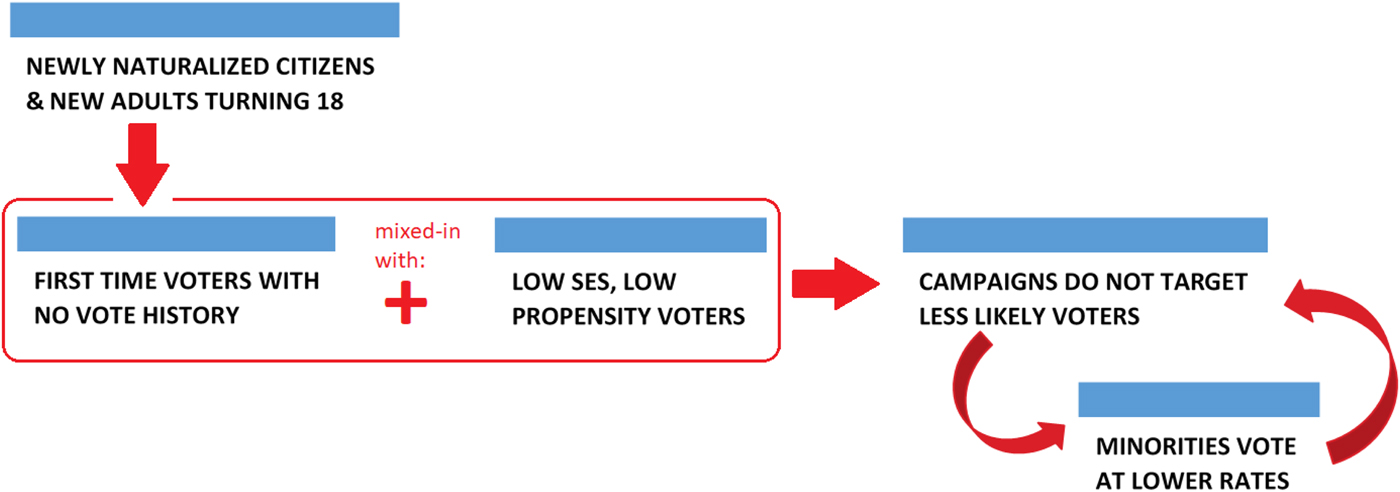
Having studied campaigns closely for the past two decades as a political scientist, and more recently having collaborated with campaign teams over the past decade with Latino Decisions, I have seen up close and personal what how certain groups of voters are neglected. Namely, campaigns do not mobilize voters, or whole communities, that seem too expensive or too unreliable. Voters with comparatively less vote history do not get the attention of campaign dollars. To the political party or interest group, a voter who is brand new to the electoral scene carries more risk. Will they actually turnout to vote? Will they cast a ballot for your candidate? In reality, these are the exact voters we should be focusing on if we want to “fix” democracy and make participation more equal. Latinos and Asian Americans in particular, who have turnout rates more than 15 points lower than Whites are particularly at risk of being ignored, as corroborated by the Ramirez, Solano, and Wilcox-Archuleta (Reference Ramirez, Solano and Wilcox-Archuleta2018) findings. Because of their relative youth and foreign-born status, each year millions upon millions of new Latino and AAPI voting-eligible citizens enter the electorate and do so with a big round zero on the voter file for their vote history. Others may be infrequent voters due to socioeconomic characteristics that are well documented to be correlated with registration and turnout (Rosenstone and Hansen Reference Rosenstone and Hansen1993). The end result is that millions of people of color are on the voter rolls, but with little-to-no vote history, they are almost certain to be ignored by outreach efforts. The cycle begins. If they are ignored by campaigns, this relative lack of voter mobilization will reproduce lower rates of voter turnout. Then, given their latest wave of “underperformance” Blacks, Latinos and Asians enter a new election cycle with yet another strike against them of having not voted. When campaign consultants pull the new voter rolls, they will direct less resources and outreach to less reliable voters with low vote history scores, perpetuating the cycle of under-mobilization (Figure 1).
Figure 1.The cycle of undermobilization of minority voters.
The American National Election Study documents the discrepancy in outreach, even in the infamous 2008 Obama wave election in which people of color and young voters were supposedly mobilized. According to the ANES, in 2008 47% of Whites reported being contacted and asked to vote, compared with 38% of Blacks, 33% of Latinos, and 21% of Asian Americans. If people of color are being contacted at lower rates, they are going to turn out at lower rates. The problem here is not a political deficiency of people of color, but rather a political deficiency of current campaign outreach efforts. To break the cycle of undermobilization there must be a large-scale, consistent effort at outreach, engagement, persuasion, and GOTV targeted to minority voters. If this happens, we know what to expect based on the extant literature—increased voter turnout. Field experiments, survey experiments, and analysis of validated voter records are a point to the great success of targeted mobilization efforts in the Black, Latino and Asian-American communities. Michelson and Valenzuela found higher Latino voting when targeted with a culturally appropriate message about Latino empowerment (Valenzuela and Michelson Reference Valenzuela and Michelson2016). Using bilingual, multilingual Asian speakers, Wong found that telephone calls and sending mail to Asian-American households resulted in higher voter turnout (Wong Reference Wong2005). Likewise, field experiments among African American voters demonstrate that turnout goes up when Black voters are contacted (Green and Michelson Reference Green, Michelson and Fisher2009; Bedolla and Michelson Reference Bedolla and Michelson2012).
As scholars and pundits pour over election results and lament “underperformance” of minorities, the Ramirez, Solano, and Wilcox-Archuleta (Reference Ramirez, Solano and Wilcox-Archuleta2018) article is sure to spark an important conversation over why mobilization matters. What have we learned? The extremely selective recruitment in competitive battleground states, with even more selective recruitment of medium- and high-propensity voters, leads to massive neglect of the average Black, Latino, and Asian-American voter. If we expect our democracy to be reflective of the diverse population that is America then political institutions, such as candidates, political party's and related campaigns must do better in reaching out, and mobilizing minority communities. Cost-per-vote analysis obstructs the damage that is being done to our democracy by privileging certain voices over others. Whether it is costly or not, our political institutions can do more to give all eligible voters an equal mobilizing boost, to get out and vote.





 You have
Access
According to 2016 Census data White non-Hispanics turned out to vote at 65% compared with 59% for African Americans, 49% for Asian Americans, and 48% for Latinos. Why does this discrepancy continue to be an artifact of American elections? The answer is what I call the cycle of undermobilization, and creates a self-fulfilling prophecy that will not be remedied until our political institutions address three critical issues. First, there needs to be a marked increase in the outreach and contact with Black, Latino, and AAPI voters. If voters are not regularly contacted, they will not vote. Second, candidates, parties, and institutions charged with upholding our democracy must address the efficacy deficit in minority communities. If people of color do not believe the political system cares about “people like me” it makes it much more difficult for any amount of outreach to resonate. And third, contact to minorities needs to be culturally appropriate and campaigns must incorporate more Black, Latino, and Asian-American staff to ensure this outcome.
The importance of voter mobilization is presented in the article by Ramirez, Solano & Wilcox-Archuleta, “Selective Recruitment or Voter Neglect? Race, Place and Voter Mobilization in 2016” (2018). The authors make the case that even after controlling for whether a voter lived in a coveted battleground state, minority voters receive less contact than Whites. The Ramirez, Solano & Wilcox-Archuleta contribution to this debate is that the race of the person doing the contact is also very important to consider, finding minorities are much more likely to report contact by co-racial group members and be neglected by Whites. Coupled with prior findings by Nuño (Reference Nuño2007) that co-racial contact can actually be more effective, future research should continue on this trajectory of studying mobilization as the outcome variable of interest. If not, we will not be able to understand and unpack the cycle of undermobilization.
Having studied campaigns closely for the past two decades as a political scientist, and more recently having collaborated with campaign teams over the past decade with Latino Decisions, I have seen up close and personal what how certain groups of voters are neglected. Namely, campaigns do not mobilize voters, or whole communities, that seem too expensive or too unreliable. Voters with comparatively less vote history do not get the attention of campaign dollars. To the political party or interest group, a voter who is brand new to the electoral scene carries more risk. Will they actually turnout to vote? Will they cast a ballot for your candidate? In reality, these are the exact voters we should be focusing on if we want to “fix” democracy and make participation more equal. Latinos and Asian Americans in particular, who have turnout rates more than 15 points lower than Whites are particularly at risk of being ignored, as corroborated by the Ramirez, Solano, and Wilcox-Archuleta (Reference Ramirez, Solano and Wilcox-Archuleta2018) findings. Because of their relative youth and foreign-born status, each year millions upon millions of new Latino and AAPI voting-eligible citizens enter the electorate and do so with a big round zero on the voter file for their vote history. Others may be infrequent voters due to socioeconomic characteristics that are well documented to be correlated with registration and turnout (Rosenstone and Hansen Reference Rosenstone and Hansen1993). The end result is that millions of people of color are on the voter rolls, but with little-to-no vote history, they are almost certain to be ignored by outreach efforts. The cycle begins. If they are ignored by campaigns, this relative lack of voter mobilization will reproduce lower rates of voter turnout. Then, given their latest wave of “underperformance” Blacks, Latinos and Asians enter a new election cycle with yet another strike against them of having not voted. When campaign consultants pull the new voter rolls, they will direct less resources and outreach to less reliable voters with low vote history scores, perpetuating the cycle of under-mobilization (Figure 1).
The cycle of undermobilization of minority voters.
The American National Election Study documents the discrepancy in outreach, even in the infamous 2008 Obama wave election in which people of color and young voters were supposedly mobilized. According to the ANES, in 2008 47% of Whites reported being contacted and asked to vote, compared with 38% of Blacks, 33% of Latinos, and 21% of Asian Americans. If people of color are being contacted at lower rates, they are going to turn out at lower rates. The problem here is not a political deficiency of people of color, but rather a political deficiency of current campaign outreach efforts. To break the cycle of undermobilization there must be a large-scale, consistent effort at outreach, engagement, persuasion, and GOTV targeted to minority voters. If this happens, we know what to expect based on the extant literature—increased voter turnout. Field experiments, survey experiments, and analysis of validated voter records are a point to the great success of targeted mobilization efforts in the Black, Latino and Asian-American communities. Michelson and Valenzuela found higher Latino voting when targeted with a culturally appropriate message about Latino empowerment (Valenzuela and Michelson Reference Valenzuela and Michelson2016). Using bilingual, multilingual Asian speakers, Wong found that telephone calls and sending mail to Asian-American households resulted in higher voter turnout (Wong Reference Wong2005). Likewise, field experiments among African American voters demonstrate that turnout goes up when Black voters are contacted (Green and Michelson Reference Green, Michelson and Fisher2009; Bedolla and Michelson Reference Bedolla and Michelson2012).
As scholars and pundits pour over election results and lament “underperformance” of minorities, the Ramirez, Solano, and Wilcox-Archuleta (Reference Ramirez, Solano and Wilcox-Archuleta2018) article is sure to spark an important conversation over why mobilization matters. What have we learned? The extremely selective recruitment in competitive battleground states, with even more selective recruitment of medium- and high-propensity voters, leads to massive neglect of the average Black, Latino, and Asian-American voter. If we expect our democracy to be reflective of the diverse population that is America then political institutions, such as candidates, political party's and related campaigns must do better in reaching out, and mobilizing minority communities. Cost-per-vote analysis obstructs the damage that is being done to our democracy by privileging certain voices over others. Whether it is costly or not, our political institutions can do more to give all eligible voters an equal mobilizing boost, to get out and vote.