

INTRODUCTION
What was the significance of the Asian Financial Crisis in 1997 to citizen support for the nascent democracy in South Korea? Did the disappointing economic performance of the new regime alter the way in which these fervent democrats, who had toppled the resilient military dictatorship, saw democracy? Was “democratization to blame” for the crisis (Kim Reference Kim2000a) in the eyes of Koreans at that time? The political economy literature has given surprisingly little attention to these questions while continuously revisiting the causes and economic consequences of the crisis (Lai Reference Lai2012; Woo Reference Woo and Muchhala2007; Chopra et al. Reference Chopra, Kang, Karasulu, Liang, Ma and Richards2001; Haggard and Mo Reference Haggard and Mo2000). This article answers these political questions by focusing on ordinary Koreans’ support for democracy in the wake of the traumatic economic crisis of 1997.
The idea that economic conditions affect ordinary citizens’ support for democracy draws largely upon two bodies of the traditional comparative politics literature. First, the transition literature posits that newly democratized regimes cannot be consolidated without ordinary citizens’ unconditional support for democracy (Linz and Stepan Reference Linz and Stepan1996; Inglehart and Welzel Reference Inglehart and Welzel2005; Diamond Reference Diamond2008). Second, studies on political behavior establish that individuals’ political decisions are strongly shaped by their perception of economic conditions (Fiorina Reference Fiorina1981; Lewis-Beck Reference Lewis-Beck1986). Synthesizing these two literatures suggests that we should observe a notable decline in support for democracy in nascent democratic regimes when their economic performance is disappointing.
This line of reasoning is far from new. Earlier theoretical studies put forth the argument that economic success is expected of the new democracies, and that the regime's legitimacy weakens when this expectation is unmet (e.g., Lipset Reference Lipset1959; Huntington Reference Huntington1991; Prezeworski Reference Przeworski1991). Recent empirical studies have found evidence supporting this argument; individuals in transitional democracies were more likely to support democracy when economic conditions were favorable (Cordova and Seligson Reference Cordova and Seligson2010; Dalton Reference Dalton1994). Economic failures on the other hand were found to propel people away from democracy, inspiring authoritarian nostalgia (Jhee Reference Jhee2008).
This line of research, however, does not seem to map into what survey researchers have reported about post-crisis Korea. For instance, an outright rise of authoritarian nostalgia was generally not found in the years following the crisis, unlike some of the other East Asian countries such as the Philippines, Thailand, and Mongolia (Chang, Chu, and Park Reference Chang, Chu and Park2007). More importantly, many have found that it is political and societal rather than economic factors that exerted the strongest influence over Koreans’ support for democracy (e.g., Park and Shin Reference Park and Shin2006).
This article proposes that while, in general, there was no significant relationship between the economy and democratic support in the general public, there was such a relationship in a certain group of Koreans: the poor. Drawing upon the idea that the poor citizens view democracy as a tool for economic redistribution (Acemoglu and Robinson Reference Acemoglu and Robinson2006; Boix Reference Boix2003), I argue that it is precisely the Koreans in the low-income brackets whose support for the regime wanes under worsening economic conditions. To many poor Koreans the financial crisis signaled the evaporation of the opportunity for redistribution, the foremost reason they stood up against the dictatorship and brought in democracy.
Utilizing the first wave of the Asian Barometer Survey (ABS I) for South Korea, the article finds corroborative evidence for this argument. The article makes an important contribution to the literature on Korean democracy, where the role of the poor has been largely overlooked and the effect of economic conditions on support for democracy is found to be insignificant. This article is composed of five parts. The following section discusses the previous studies that have grappled with the relationship between economic conditions and democratic support, pointing out that these discussions did not include the possible conditioning effect of income levels—i.e. the poor—and delineates possible ways in which such an effect can be explained. The third section introduces the research design to test the proposed hypothesis. The fourth section demonstrates whether and how the results of the empirical analysis support the hypothesis. The final section briefly reviews the findings and discusses the theoretical and empirical contributions of this article to the existing literature on democracy and democratization.
CRISIS AND DEMOCRATIC SUPPORT
Literature on Economic Conditions and Democratic Support
Since Lipset's (Reference Lipset1959) pioneering work, the positive link between economic conditions and the viability of democracy has been at the heart of comparative political economy. Earlier studies have found that economic failures destabilize society, threatening the survival of young democratic regimes (Huntington Reference Huntington1968; O'Donnell Reference O'Donnell1973).
As these earlier claims were supported by later empirical investigations focusing on elite/macro-level factors (e.g, Przeworski et al. Reference Przeworski, Alvarez, Cheibub and Limongi2000; Bueno de Mesquita et al. Reference Bueno de Mesquita, Smith, Siverson and Morrow2003; Huntington Reference Huntington1991), a group of studies emerged to shed light on the micro foundations of this debate, namely citizenry support for democracy under challenging economic conditions. The rationale was that, although hardly a sufficient condition on its own for democratic survival (Bermeo Reference Bermeo2003), ordinary citizens’ support for the regime was considered indispensable for any functioning democracy (Norris Reference Norris2011; Diamond Reference Diamond2008; Linz and Stepan Reference Linz and Stepan1996). Given that economic difficulties were almost ubiquitous in the third-wave democracies, researchers examined whether those citizens who took down dictatorships maintained their support for democracy even under economic hardship, a “critical test” for a young democracy to prove itself ‘durable’ (Bratton and Lewis Reference Bratton and Lewis2007).
Not surprisingly, a number of studies have found that there is a significant relationship between economic conditions and popular support for democracy in Latin America, Central and Eastern Europe, and the Former Soviet Union, where many nascent democratic regimes turn out to be unstable (Kotzian Reference Kotzian2011; Cordova and Seligson Reference Cordova and Seligson2010; Evans and Rose Reference Evans and Rose2007; Dalton Reference Dalton1994). One assumption shared in these studies is that citizens in young democracies are not yet convinced that “democracy works” (Brender and Drazen Reference Brender and Drazen2007, 5) and thus it might take a long time for these inexperienced citizens to accept democracy as “the only game in town” (Linz and Stepan Reference Linz and Stepan1996, 5). Economic failure in the transitional period, the literature presumes, would be seen as a failure of the entire regime and not only of a particular government (Graham and Sukhtankar Reference Graham and Sukhtankar2004). Crises could turn citizens away from democracy itself.
It is puzzling that the empirical evidence equivalent to that reported by this body of literature has been hard to confirm in the Korean context. Despite the fact that Korea, as a young democracy, has had a fair share of economic difficulties since the 1997 crisis, it is actually non-economic factors such as “Asian Values” (Park and Shin Reference Park and Shin2004) or governance/political performance (Park and Shin Reference Park and Shin2006; Park Reference Park2004) that empirical studies have found to determine citizenry's attitude toward democracy. Given that average Koreans’ support for democracy and rejection of authoritarianism has substantively declined since the crisis (Shin and Lee Reference Shin and Lee2006), the lack of discussion about the channels through which deteriorating economic conditions affect citizenry support for democracy is striking.Footnote 1 Filling this gap, the following section presents the framework in which the economy, particularly the Korean poor's evaluation of national economic conditions, affects their support for democracy.
Theories of Economic Conditions, Income Level, and Democratic Support
Why are there few, if any, findings about the positive linkage between economic conditions and democratic support in South Korea? Two possibilities exist: 1) non-economic factors exert much stronger influence over Koreans’ support for democracy and therefore one should not find a notable effect of economic factors; 2) economic factors matter that have not previously been highlighted—such as income levels discussed below.
First, it could be that economic conditions did not affect Koreans very much in their support for democracy. Democracy might simply be a desirable form of governance to many Koreans, in which case what might detach people from democracy would be the current democratic regime falling short of this ideal. These people might have expected from the new regime the hallmarks of a functioning democracy such as political freedom and tolerance, respect for human rights and diversity, or effective control of corruption that were not offered by the authoritarian rule. For these Koreans, it might be not a sluggish recovery of the national economy or mounting fiscal deficits, but rather a lack of political reforms, human rights abuses, or corruption scandals that would lead to their cynicism about, and disenchantment with, democracy (Norris Reference Norris2011).
This scenario is plausible in the Korean context, given how persistently the citizens had attempted to bring about democratization under two brutal military dictatorships (Kim Reference Kim2000b). It is also consistent with recent findings in other cases of nascent democracies that “popular demand for democracy does not require an economic miracle” (Bratton and Lewis Reference Bratton and Lewis2007, 25). Indeed, Park and Shin (Reference Park and Shin2006) find survey evidence in line with this possibility. However, the idea that the regime's political performance overrides the importance of the economic one does not explain the gradually declining level of democratic support in the aftermath of the crisis (Shin and Lee Reference Shin and Lee2006; Chang, Chu, and Park Reference Chang, Chu and Park2007), during which a noticeable improvement was made in the realms of human rights and political reforms (Hahm Reference Hahm2008).
An alternative, second scenario posits that the regime's economic performance is related to Koreans’ support for democracy, but contingent on class position. One aspect of Korean democracy that makes this possibility plausible is the distributive conflict that was at the heart of the transition in the late 1980s. Unlike many other cases, where the society is generally poor and the opposition groups “were often too weak to check the predatory tendencies of state elites and of other more privileged social forces” (Haggard and Kaufman Reference Haggard and Kaufman2012, 513), Korean democratization was led by strong social forces representing the interests of the poor. In essence, this interest was geared toward income redistribution; democracy was viewed by the public as a de jure conduit to redistribution of wealth, from which they had previously been excluded under non-democratic rule (Acemoglu and Robinson Reference Acemoglu and Robinson2006; Boix Reference Boix2003).Footnote 2
Against this historical backdrop, the financial crisis was a tipping point. The Korean poor's expectations of economic betterment were high in the period following the transition. The financial crisis, as well as its immediate aftermath (Kang Reference Kang2015), signaled to the Korean poor that a decade-long economic expansion had come to an abrupt end, and that the democratic regime was incapable of fulfilling the promised redistribution. In essence, the Korean poor lost one of their most fundamental reasons to remain committed to democracy; the poor turned out to be the ‘weak link’ that would break away from the pro-democratic coalition in times of economic hardship. By contrast, the middle class, let alone the rich, were not likely to see democracy as a vehicle for redistribution and, thus, their support for democracy was unaffected by changing economic conditions.
This second scenario is more compelling than the first one. It provides a convincing explanation as to why the literature at large has not found a significant relationship between the economy and democratic support in Korea: regression models not attentive to this income level factor would fail to show this empirical pattern, given the relatively small number of the poor in Korean society.Footnote 3 In addition, unlike the first model, the second scenario is consistent with the historical trend of declining support for democracy. Drawing upon this reasoning, a testable hypothesis can be generated as follows:
Hypothesis 1: The poor who believe that the economy has changed for the worse are less likely than other income groups to support democracy.
RESEARCH DESIGN
Data and Measurement
To test this hypothesis, I use the first round of the Asian Barometer Survey (ABS I) on South Korea.Footnote 4 ABS I provides a particularly useful source for this analysis as the survey was conducted in 2003, asking respondents whether the economy had changed for the better or worse over the past five years. As a result, the survey effectively captures the respondents’ retrospective evaluation on the changes in the economic conditions since the 1997 crisis.Footnote 5 The five-year span is also long enough to capture any lingering effect of the economic crisis. Although the South Korean government fully repaid the IMF emergency loan by 2001, studies have shown that the crisis affected Koreans’ lives in various ways well past this “graduation” (Ha and Lee Reference Ha and Lee2007; Choi and Choi Reference Choi and Choi2007).Footnote 6
The dependent variable against which Koreans’ evaluation of economic conditions is tested aims to capture their support for democracy. Following the conventional wisdom in the democratic support literature (Rose, Mishler, and Haerpfer Reference Rose, Mishler and Haerpfer1998; Shin and Tusalem Reference Shin and Tusalem2007; Chu and Huang Reference Chu and Huang2009; Carlin and Singer Reference Carlin and Singer2011),Footnote 7 this variable measures whether ordinary citizens rejected authoritarianism while simultaneously supporting democracy. As democratic support is a multi-layered phenomenon in which both normative and practical elements coincide, simply asking people whether they support democracy does not produce a satisfactory measure of whether they are truly attached to democratic values. Instead, I follow Shin and Tusalem (Reference Shin and Tusalem2007), who also use ABS I, and take the probability that a respondent is an “authentic democrat” as the dependent variable. As such, “authentic democrats” have strong pro-democratic and “anti-authoritarian orientations” (Shin and Tusalem Reference Shin and Tusalem2007, 15).
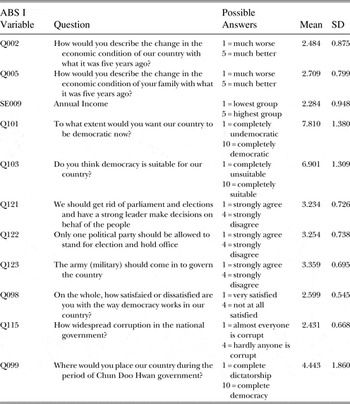
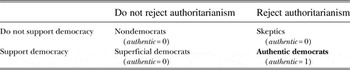
Specifically, two sets of questionnaires of the ABS I— namely Q101 and Q103 as well as Q121, Q122 and Q123—were employed to quantify pro-democratic and anti-authoritarian orientations, respectively. People who answered 6 or higher on both Q101 and Q103 as well as 3 (somewhat disagree to authoritarianism) or 4 (strongly disagree to authoritarianism) on Q121, Q122, and Q123 were coded 1 for “authentic democrat”; those responding lower than these were coded 0. In other words, authentic democrats are viewed as those who perceived democracy to be desirable and suitable and disagreed with authoritarian ideas.
Also following Shin and Tusalem (Reference Shin and Tusalem2007), I labeled those who embrace democracy but do not reject authoritarian values as “superficial democrats.” Similarly, people who do not support democracy but accept authoritarian ideas were labeled as “nondemocrats,” whereas those who reject both authoritarian and democratic ideas were labeled as “skeptics.” This typology is summarized in Table 2.
Questionnaires for Key Variables and Summary Statistics

Note: Number of observation = 1,166.
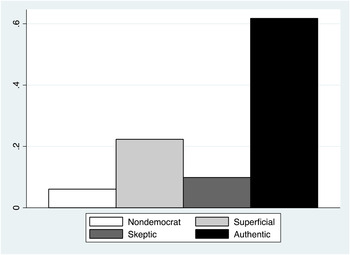
Types of Democratic Support (the Dependent Variable)

Figure 1 graphically reports the distribution of South Koreans over the four types of regime support based on the ABS I. The fact that a non-negligible portion of the respondents (i.e., more than 20%) were superficial democrats affirms the idea that simply asking if one supports democracy cannot capture his/her true preference for political regimes.
Types of Regime Support

The first set of independent variables measure Koreans’ retrospective evaluation of the national and private economy in order to gauge the perceived degree of the crisis. Two questionnaires of the ABS I—Q2 (changes in national economic conditions) and Q5 (changes in personal economic conditions)—are used. Each contains five data points ranging from 1 (economy much worse) to 5 (economy much better). Using variables gauging both personal (“pocketbook”) and national (“socio tropic”) economic conditions together in the right-hand side of the equation is grounded on the economic voting literature (Fiorina Reference Fiorina1981; Lewis-Beck Reference Lewis-Beck1986). People's retrospective evaluation of their pocketbook economy reflects how the regime “treated” them in the past, whereas their assessment of the past national economic conditions is indicative of the expectation about their private well-being in the future (MacKuen et al. Reference MacKuen, Erikson and Stimson1992; Hibbs Reference Hibbs1993). Both are potentially relevant in examining how the Korean poor's expectations about economic circumstances were affected after the crisis.
Another core independent variable is income level, which is measured using question SE009 (the level of income) of the ABS I. This variable is employed to distinguish between the poor, the middle class, and the rich. Multiplicative interaction terms with this variable and the economic conditions variables enable us to distinguish between the poor who perceived that the economy had changed for the worse (i.e., “there was a serious economic crisis”) from the poor who did not.
It is worth noting that both the economic variables and the income variable are treated as continuous, not ordinal, despite the fact that each has five data points. Aside from being not uncommon in the democratic support literature (e.g., Krieckhaus et al. Reference Krieckhaus, Son, Bellinger and Wells2014; Lee Reference Lee2008; Bratton and Lewis Reference Bratton and Lewis2007), this choice is justified for several reasons. First, using the continuous measure allows us to see how democratic support changes depending on different income groups as well as different (perceived) degrees of economic crisis. Treating them as ordinal, by contrast, results in resorting to a dummy variable approach which would shed light on only the dichotomy of the rich (or poor) and the rest of the population (or the worst economic conditions and the others). This coding method would reduce the opportunity to evaluate whether and how finer gradations of the independent variables lead to the changes in the dependent variable. Second, econometrically speaking, it is known that this concern is generally unwarranted when the data point is larger than four and the observations approximate a normal distribution (Fagerland, Sandvik, and Mowinckel Reference Fagerland, Sandvik and Mowinckel2011). Most importantly, the dummy variable approach does not yield a result different from that of the benchmark model (see Appendix Table A3 and Figure A2).
To isolate the effect of the core independent variables, two sets of control variables—political and demographic variables—are included. The first political variable is whether the respondent “voted” in the last election. People who actively participate in democratic political processes, such as elections, are likely to be more supportive of democracy than those who abstain. People's “satisfaction with the current democratic regime” and their perception of “corruption control” in the national government are also important control variables. The idea is consistent with the first scenario delineated above: that people expect “better politics” from democratization and when not provided, democratic support declines. Particularly those who see that the current regime 1) is satisfactorily democratic (Rose, Mishler, and Haerpfer Reference Rose, Mishler and Haerpfer1998; Kapstein and Converse Reference Kapstein and Converse2008) or 2) does a good job controlling corruption (Diamond Reference Diamond2008) are more likely than others to support democracy. Indeed, if the first scenario holds, then the effect of these variables may override the importance of the economic variables.
Another factor to be considered is people's ‘perception of the previous authoritarian regime.’ As Jhee (Reference Jhee2008) points out, the image people have of the old regime has a resilient effect on their current political decisions. Positive evaluation of the authoritarian regime is likely to lead to the acceptance of authoritarian values and/or the rejection of democratic values (Rose, Mishler, and Haerpfer Reference Rose, Mishler and Haerpfer1998; Chang, Chu, and Park Reference Chang, Chu and Park2007).
Regarding the demographic variables, “age,” “educational attainment,” and “social classes” are also included to control for the effect of each individual's personal traits on democratic support. Given the recent literature on the importance of the generational effect on political learning (Mishler and Rose Reference Mishler and Rose2007) or that on democratic satisfaction (Neundorf Reference Neundorf2010), the variable for age of respondents was converted into six dummy variables in order to take into consideration the possible generational effect. The median age group (the forties) was used as the baseline indicator. Similarly, following the empirical literature emphasizing the correlation between levels of education and democratic support (Evans and Rose Reference Evans and Rose2007), educational attainment was included in the analysis as three dummy variables: primary, secondary, and tertiary education. “No educational attainment” was used as the baseline indicator for these variables.Footnote 8 Finally, people's self-perceptions of their own position in the society—“social class”—was also used to account for the stigma attached to the “working class” in Korea. The state-led modernization of the 1960s and 1970s generated the idea that being poor is unethical. Hence, some low-income Koreans might believe that they belong to the “middle class” and behave accordingly regardless of the income levels they reported on SE009 (Lett Reference Lett1998). Three dummy variables (middle-high, middle-low, and low) that took the concept of social class into account were included while middle class was used as the baseline indicator.Footnote 9
Models
Since the dependent variable is dichotomous (authentic support = 1; otherwise = 0), a binary logistic model with Huber-White (robust) standard errors is used to estimate the first model. The model can be written as follows:
 $$\eqalign{{\rm Log}\,{\rm it[\,p}\left( {authentic = 1} \right)] & = {\rm \alpha \,+\,} {\rm \beta} _{\rm 1}\,national\,economy + {\rm \beta} _{\rm 2}\,private\,economy + {\rm \beta} _3\,{income} \cr & \quad + {\rm \beta} _4\,income \times national\,economy + {\rm \beta} _5\; income \cr & \quad \times private\,economy\, {\rm \Sigma \beta _i}\left[ {control\,variables} \right] + {\rm \varepsilon},}$$
Where i indicates the number of control variables, β the coefficients, and ε the error term.Footnote 10 For Hypothesis 1 to be supported, the interaction term (either β4 or β5) needs to be significant and the marginal effect of the economic variables—[β1 + β4] or [β2 + β5]—should be positively significant in the low values of the income variable such that the result indicates that the poor's support for democracy changes with economic conditions.
RESULTS AND DISCUSSION
Benchmark Model
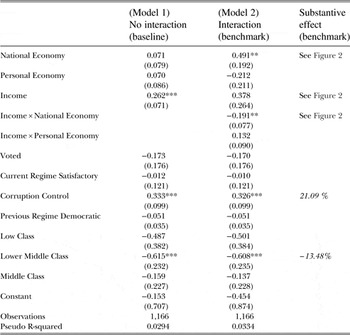
Table 3 reports the results of the baseline and the benchmark binary logistic models. The table's first column indicates the result without the interaction terms between the people's evaluation of the national (private) economy and their income level. The insignificance of the economic variables in the baseline model (Model 1) is consistent with existing literature: few empirical studies find a significant tie between economic conditions and citizenry support for democracy in Korea.
Benchmark Model

Logit estimates with robust standard errors in parentheses. *** p < 0.01, ** p < 0.05, * p < 0.1. The results for educational attainment and age groups are abbreviated to save space. ‘Substantive Effect’ is the change in the probability of authentic support driven by the change from the minimum to the maximum values of the independent variable when all the other variables are held at their median values (only the effects of the statistically significant variables are calculated).
The second column presents the result of the benchmark logit model. The marginal effect of the national economic condition variable on the probability of authentic support (i.e., [β1 + β4]), as well as the interaction term, is statistically significant (p = 0.017) as Hypothesis 1 posits.Footnote 11 When the conditional effect of income-level is considered, the national economic performance variable does show strong significance. Taken together, Model 1 and Model 2 indicate that the lack of findings on the relationship between the economic conditions and democratic support in Korea was indeed due to the fact that while support for democracy in the population as a whole was not sensitive to national economic conditions, the attitudes of the poor were.
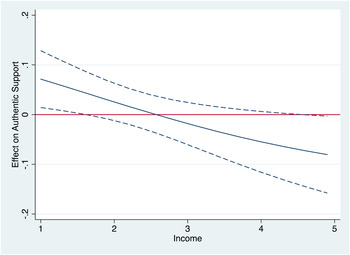
The substantive effect of this significance is illustrated in Figure 2. The horizontal axis indicates the level of income, 1 being the poorest and 5 the richest. The marginal effect of one-unit increase in the national economic condition on the probability of “authentic support” (solid line) is significant when the level of income is the lowest (=1) as the 95% confidence intervals do not include zero. Specifically, the probability of authentic support decreases (or increases) by about 7% for the poorest income group when the national economic condition deteriorates (or improves) by one unit. This result implies that when the economic crisis is perceived to be in full swing (the change from 5 to 1 in the national economy variable), the probability of a poor Korean to be an authentic democrat decreases by 28% (=7% × 4). This magnitude of change is greater than those caused by the other significant predictors of authentic support (see the third column of Table 3).
Effect of National Economy on Democratic Support Conditional on Income

On the other hand, all other income groups turn out to be insensitive to national economic conditions in their support for democracy, lending further support to Hypothesis 1. It should be noted that the marginal effect of the national economy attains some statistical significance (p = 0.045) for the richest income group, indicating that the rich tend to support democracy more when the economy is in worse shape. Although not inconsistent with Hypothesis 1, this counter-intuitive result deserves some explanation given the conventional wisdom that decrease in the national income makes democracy less appealing to the rich elites (Przeworski Reference Przeworski2005). As Acemoglu and Robinson (Reference Acemoglu and Robinson2006) posit, the rich elites are wary of redistributive pressures. The redistributive mechanism built into democracy may be a way to tame this pressure and avoid revolutions. Once democracy is in place, however, elites would prefer a less redistributive democratic regime to a more redistributive one. Post-crisis structural reforms pave the road for such less distributive regimes to emerge. Governments, be they democratic or not, are often found to selectively protect elites’ interests in restructuring processes (Halac and Schmukler Reference Halac and Schmukler2004), reversing whatever redistribution of wealth had been achieved previously. This was particularly the case in Korea where job security evaporated while income inequality increased in the wake of the crisis, both for economic and policy reasons (Kalinowski Reference Kalinowski2007; Kim, Eungi, and Lee 2013). In sum, the negatively significant effect of economic conditions on the Korean rich's support for democracy might be explained in terms of their anti-redistributive proclivity. This result, however, should be taken with a grain of salt; there were only twenty-five respondents belonging to the richest income group and therefore the result is likely to be unstable. In fact, in alternative models, this effect becomes entirely insignificant (see, for example, Figure A2).
It is also important to note that the private economy variable, along with its interaction term with the income variable, is insignificant. This result is in fact in line with the conventional wisdom of the economic voting literature that has consistently found that “socio tropic” considerations are much more critical than are “egocentric” ones when it comes to how individuals’ evaluation of economic conditions affect their political decisions (Lewis-Beck Reference Lewis-Beck1986; Iyengar Reference Iyengar1989; MacKuen et al. Reference MacKuen, Erikson and Stimson1992; Nadeau, Lewis-Beck, and Belanger Reference Nadeau, Lewis-Beck and Belanger2013). The benchmark result supports the idea that the Korean poor see robust national economic performance as a “public good” which will eventually generate benefits such as “enhanced prospect of private economic mobility” (Hibbs Reference Hibbs1993, 13).Footnote 12
Robustness Checks
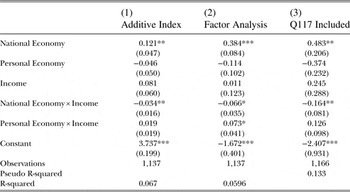
While the result of the benchmark model presents evidence supporting Hypothesis 1, questions regarding its robustness remain. First of all, several concerns about measurement of the dependent variable need to be addressed. To begin, one possible source of problems in the dependent variable lies in its arbitrariness. One could claim that although previously used (e.g., Shin and Tusalem Reference Shin and Tusalem2007), the threshold of 6 for Q101 and Q103 is arbitrary. One alternative is an additive composite index of all six variables that capture two discrete concepts—support for democracy and rejection of authoritarianism—as used by Welzel and Inglehart (Reference Welzel and Inglehart2005), Jamal and Nooruddin (Reference Jamal and Nooruddin2010), and Krieckhaus et al. (Reference Krieckhaus, Son, Bellinger and Wells2014). Similarly, one can utilize a factor variable of all five indicators (Dalton Reference Dalton1994). Another issue regarding the dependent variable is the exclusion of a regime preference variable, namely, Q117. Scholars using ABS often include Q117 to see if respondents find democracy preferable ‘to any other kind’ of regime. Although using these three alternative measures for the dependent variable obscures the theoretical distinction between different types of democratic support depicted in Table 1, it might be meaningful to demonstrate that the result from the benchmark model is robust against a battery of widely used alternatives.Footnote 13 As shown in Table 4, however, using these three alternatives does not alter the result of the benchmark model significantly.
Alternative Dependent Variables (Abbreviated)

OLS estimates in Columns 1 and 2 and logit estimates in Column 3 with robust standard errors in parentheses. *** p < 0.01, ** p < 0.05, * p < 0.1. The results for the control variables are abbreviated to save space. The full result is available in Appendix Tables A1 and A5.
Turning to the issue of model specification, the discussion about the relationship between the citizenry support for democratic regime and its political performance deserves additional scrutiny given the empirical findings favoring this relationship over the economy–support nexus. One possible problem would be that there are not enough control variables for political performance in the benchmark model. When a group of additional variables reflecting existing studies (e.g., Park and Shin Reference Park and Shin2006; Bratton and Mattes Reference Bratton and Mattes2001) are plugged into the benchmark model, however, this concern proves unwarranted (see Appendix Table A7 for result).
A more complicated source of bias would be simultaneity. Shocks such as the 1997 crisis can be overwhelming and even traumatic to Koreans “whose self-image rests on [the country's] economic prowess” (Eichengreen, Perkins, and Shin Reference Eichengreen, Perkins and Shin2012, 270). These panicky individuals might lose overall confidence on the society itself as a consequence of the dramatic social shock (Lynch, Kaplan, and Shema Reference Lynch, Kaplan and Shema1997). This implies that a latent variable such as “national pride” or “patriotism,” which is known to be more prevalent among the poor than others (Solt Reference Solt2012), could negatively affect both citizenry support for democracy and their view on the national economy. In this case, democracy does not have to be seen as a vehicle for redistribution for the empirical result such as Model 2 of Table 3 to appear to support Hypothesis 1.
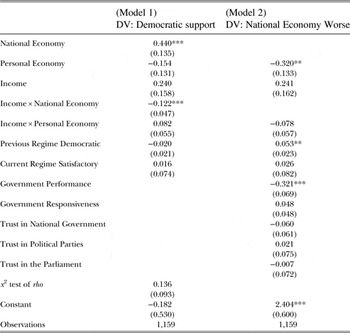
To check whether such a latent variable was at work in the benchmark model, I employ a bivariate probit model (Heckman Reference Heckman1978; Chiburis, Das and Lokshin Reference Chiburis, Das and Lokshin2012), which tests whether two different processes are the function of a common latent variable. Specifically, I construct a second model to be used together with the benchmark model in which perceptions of national economic conditions are the dependent variable.Footnote 14 In addition to the control variables in the benchmark model, the variables for institutional trust and general government performance are included, once again, to make sure that the latent variable the bivariate model captures is about panic and trauma, not about the evaluation on the regime's performance. If the concern about simultaneity bias is warranted, the result of the bivariate probit model should show 1) the effect of the national economy weakens in the benchmark model and 2) the correlation between the error terms of the two equations is statistically significant.
Table 5 presents the result of the bivariate probit model. The marginal effect of the national economy variable is not weaker than that of the benchmark model. More importantly, rho is insignificant, indicating that the two models are mutually independent and a latent variable to tie them together is not likely to be at work, upholding Hypothesis 1.Footnote 15
Bivariate Probit Models: Testing Simultaneity

Logit estimates with robust standard errors in parentheses. *** p < 0.01, ** p < 0.05, * p < 0.1. The results for other control variables are abbreviated to save space.
CONCLUSION
The Asian Financial crisis came as “a shock, a puzzle, a disgrace, and a daunting challenge” (Kim Reference Kim2000b, 127) and exerted an unambiguously significant impact on South Koreansociety. While qualitative studies have consistently highlighted a notable decline in popular support for democracy following the financial crisis (Kalinowski Reference Kalinowski2007; Lee Reference Lee2005), quantitative research has generally failed to support this finding. Utilizing ABS I, this article fills a gap in the literature by looking at the class base of support for democracy in the face of crisis.
The primary finding of this article is that the Korean poor's support for democracy, unlike those in other income brackets, is elastic to their evaluation of national economic conditions. It suggests that the poor viewed democracy as an instrument for income redistribution and when the crisis shattered the opportunity for such redistribution, they lost their primary reason to support the regime. This finding suggests that the lack of findings on the relationship between the economy and democratic support in Korea can be attributed to the lack of attention to differential levels of support for democracy across social classes.
A straightforward implication of this article is that redistributive policies are key to cementing the poor's support for Korean democracy. The article also implies that, in the years following 2008 when the Global Financial Crisis started to unfold, one should observe a similar effect of income level on democratic support, although its sheer degree should be relatively modest given that the effect of the crisis on the Korean society has been less dramatic (Eichengreen et al. Reference Eichengreen, Perkins and Shin2012).Footnote 16
When generalized, the findings of this article contribute to the broader literature on democratic consolidation in several ways. First, the article implies that the fragility of young democracies may lie in the role of the poor. The political economy literature is rife with findings that poor economic performance destabilizes young democracies (Przeworski et al. Reference Przeworski, Alvarez, Cheibub and Limongi2000; Goldstone et al. Reference Goldstone, Bates, Epstein, Gurr, Lustik, Marshall, Ulfelder and Woodward2010); however, the traditional explanations for why this is the case have focused almost exclusively on the role of elites, or the “coup coalition,” who are wary of the overgrown popular demands in times of economic crisis (e.g., O'Donnell Reference O'Donnell1973). Therefore, the importance of one axis of the anti-coup coalition, the non-elite public, has been largely overlooked. By contrast, the article suggests that it can also be the public, particularly the poor, who contribute to weakening support for democracy. In times of economic hardship, the poor are the first to break away from the anti-coup coalition; the poor are the “weak link.” While such breakaway would not necessarily lead to the breakdown of democracy in countries like Korea, where the regime is consolidated and a diverse set of ‘shareholders’ of democracy exist, it does imply that economic crises can trigger autocratic reversal in unconsolidated regimes heavily dependent on the poor public's support.Footnote 17
Similarly, the article also provides empirical evidence for the relationship between egalitarian policies and survival of democracy at the individual level. While the aggregate level analyses have increasingly found that redistributive policies are key to the survival of young democratic regimes citing the social stability those policies bring about (Houle Reference Houle2009; Reenock et al. Reference Reenock, Bernhard and Sobeck2007), the micro foundation of these findings has not been explored. The findings of this article suggest that it is the poor whose support for democracy is fluid. This article suggests the importance of further research on the relationship between economic conditions, redistributive policies and support for democracy.