

Beginning in the mid-1970s, the decade-long transition to democracy is today seen as the most consequential historical process in contemporary Spain, as well as the most contested. After General Francisco Franco's demise in 1975, his forty-year-long dictatorship began to collapse and reforms were implemented slowly, arguably until Spain's admission into the European Economic Community in 1986. Political consensus is often cited as a driving force that allowed the legalization of political parties, the implementation of a free-market economy, and the re-establishment of fundamental rights. Both academic and media discourses have revisited the political transition and the cultural production of those years. Especially since anti-austerity protests that started with the 15-M movement in 2011, there has been a general attempt among Spanish cultural critics to identify examples that legitimated the consensus around subsequent interpretations of the transition. These cultural practices configure an archive such that it reinforces the consensual and non-belligerent narrative of the transition, which has successfully been termed a cultura de la transición (‘culture of transition’), or CT. This term refers to a hegemonic culture whose products could be broadly labelled autonomous and described as non-confrontational vis-à-vis the legitimacy of the political consensus that facilitated the transition. In other words, the CT supports the thesis of exceptionalism used to characterize the process of Spain's democratization in which the population yielded their participation in the political transition to politicians. The autonomy of culture is guaranteed as long as there is no interference in the triumphant narration of the political transition as a common effort of Spaniards. In exchange, those products that remain close to this interpretation of the transition are gratified, and problematic products and practices are marginalized. Guillem Martínez gives the examples of the depoliticized films of Pedro Almodóvar, and, although Martínez does not mention it by title, Javier Cercas's Soldiers of Salamis, ‘a novel about the Spanish Civil War with good fascists’.Footnote 1
The CT is not a set of works; rather, as Amador Fernández-Savater explained it, it should be understood in the same way Bourdieu uses habitus, describing it as a system of structures of perception and action that dictate how one should talk about, think about and perceive the transition. The CT constructs this habitus, which reproduces the idea that only a consensual democracy such as that originating in 1978 with the Constitution is able to avoid future clashes in Spanish society.Footnote 2 In fact, political parties that steered democratization and a new neoliberal party, Ciudadanos (Citizens), often refer to the exemplary transition and its consensus as a model to overcome current domestic political problems. In 2016 Spain organized a repeat election and remained 315 days without a government because no party was able to get a majority of votes in the parliament. One of the political initiatives during that time was a political agreement to form a government in coalition that the leader of Ciudadanos, Albert Rivera, and the secretary general of the social democrat party, PSOE (Partido Socialista Obrero Español, or Spanish Socialist Workers Party), Pedro Sánchez, staged in the parliament. They both signed the agreement in a public act. Ultimately both parties were unable to convince other parties to vote for them, but after signing the agreement Rivera appeared before the press in front of the painting El abrazo, by Juan Genovés, a symbol of the reconciliation of Spaniards during the transition. He solemnly claimed, ‘This country made a great effort in the transition; today we have to do the same’.Footnote 3
As a matter of fact, Spaniards made great sacrifices also during the economic crisis that began in 2008. The reality of those years challenged the rights of assembly, access to work or affordable housing guaranteed by the Spanish Constitution. In 2013, the unemployment rate peaked at 26.1 per cent, and the number of people affected by evictions after the surge of home foreclosures reached an average of 184 a day.Footnote 4 In 2015, the Spanish government introduced a ‘gag law’ that curtailed freedom of speech. It resulted in the prosecution of citizens for tweeting or making jokes that were interpreted as glorifying terrorism. More recently, the aspirations of Catalans to vote in an independence referendum that was declared unconstitutional resulted in violent repression, the incarceration of politicians and, ultimately, the suspension of the regional government. When politicians like Rivera use grandiloquent language to remember the protagonists of history, one wonders who makes it onto that list. Certainly politicians would be on it, and some artists as well, but even among artists the reasons to be included respond to the habitus, or the discourse established by the CT.
In this article, I will study the practices of José Pérez Ocaña (1947–83), an artist, performer and LGBT activist associated with countercultural and anarchist movements who transferred performances from exclusively gay bars to the busiest street in Barcelona, Las Ramblas. In light of more recent acts of direct political intervention, he could be said to have ‘occupied’ Las Ramblas with his theatrical events, encouraging the participation of passers-by. In a certain way, Ocaña has been appropriated by the CT and revisiting his performative practices reveals that they are not merely examples of the reformism that tolerated certain controlled expressions of freedom; rather, they show an artist who, together with his audience, collaborated to transform his theatrical events into opportunities for political performance. In his improvised occupation of the street, Ocaña was aware of the double operation taking place: he was providing visibility and voice to an excluded group, as well as testing new democratic liberties.
Today, these performative practices have been significantly mediated by Ventura Pons's documentary Ocaña, retrat intermitent (Ocaña, an Intermittent Portrait) (1977), committed to constructing a subjectivity out of the artist's intimate confessions through an extended, though edited, interview. I am not the first to notice that attention to Ocaña's performances has been limited to those featured in the documentary. In a thoughtful article for the catalogue of a 2010 commemorative exhibition dedicated to the performer in Barcelona at La Virreina subtitled ‘The Ocaña We Deserve’, Paul B. Preciado reflected on the reception of Ocaña to argue that ‘kitsch’, ‘camp’ and ‘queer’ are labels that hegemonic discourses use to shape countercultural practices.Footnote 5 Meanwhile, in one of the most compelling studies of Pons's film, Josep-Anton Fernàndez questions the illusion of camp to grant visibility to excluded subjects, for camp is only possible within the rules of a hegemonic culture. He questions how subjects like Ocaña, ‘subjected to a double symbolic domination (sexual and national) [,] use camp in order to find a space in representation’.Footnote 6 Recently, William Viestenz disagreed with both Preciado and Fernàndez, claiming that their positions responded to a ‘desire to present the artist as a stable historical symbol’.Footnote 7
In this article, my concern is to study Ocaña's performances as they have been inscribed in or excluded from the spaces of representation of the transition to democracy. I share Viestenz's disappointment in Ocaña's construction as a symbol of the transition, but in my opinion the issue is the documentary form used to read his practice. Most of the problems we face when using Ocaña as an example for constructing continuity in the critical discourse of the transition hinge on the selection of his artistic practices and the sources that mediate them: rarely does consideration of his performances go beyond the practices featured in the film. Performances featured in Pons's film present Ocaña as an example of the reformism of the transition that allowed for an alleged sexual freedom. Unlike what Ocaña experienced when we examine his public acts, in Pons's documentary he is never harassed, expelled from a stage or relegated to the back of a demonstration.
As I will demonstrate, Ocaña's practices open up a different dimension that both changes how we think about his acts and overcomes the norms of representation of the CT. I approach Ocaña's performances as a dynamic practice that unravels when we look at the archive of counterculture. This is challenging due to the scant documentation that is accessible, but examining the remains of the archives of the counterculture from the period yields the potential to open up new readings and add significance to what has otherwise been ignored or appropriated by hegemonic culture.Footnote 8 I will begin by reading Ocaña's street performances in drag as a political intervention into public space. Then I will move on to study a set of Ocaña's acts and appearances in the year 1977 that reveal the political dimensions of his practice in the heyday of the transition. Among these acts are his troubling participation in the first gay rights parade, and two scandalous performances, one on the stage of the landmark Canet Rock music festival, and the other in the Anarchist Days in Barcelona. My final section will assess the legacy of Ocaña's performances in Barcelona.
Occupying the street
Ocaña belonged to a cohort of low-income gay men who emigrated from Andalusia to Barcelona in the 1960s looking for a place that would permit them to express themselves freely, albeit in the secluded space of gay bars near Las Ramblas. In 1977, Spain's progress towards democracy was evinced by the legalization of all political parties and the celebration in June of the first elections in forty years. In the streets of Barcelona, there was a push for sexual liberation that was embodied daily on Las Ramblas by an immigrant from Andalusia in drag who tested the new democratic achievements in Spain. In spite of the democratic advancements, transvestism was considered a felony by the laws still in effect since the dictatorship. The first public performance featured in Ocaña, retrat intermitent shows him strolling along Las Ramblas. He is accompanied by his friends, also Andalusian immigrants. Ocaña, dressed as a woman; Camilo, dressed as a pimp; and the cartoonist Nazario walk up and down the thoroughfare, starting from Café de la Ópera. We see them stopping to chat with passers-by. At one point, near the end of their stroll down Las Ramblas, Ocaña shows us his penis and exposes the fictionality of his performance of gender, thus provoking his audience. This is probably the most analysed scene of the film, paradigmatic of Ocaña's provocative artistic practices, and also one that eclipsed his other public appearances participating in demonstrations and music festivals, for which he nonetheless earned notoriety. Ocaña's image as a free spirit permeates Ventura Pons's film, although conversely it encourages a depoliticized reading of his public acts. I still believe that Pons's film offers the most comprehensive material for approaching Ocaña's practices, but I argue that we need different tools to assess the political dimension of his walks.
If there is a performance that encapsulates Ocaña's practices, this would be his symbolic occupation of Las Ramblas, a example of which we see in the film. Nevertheless, Ocaña's presence in Las Ramblas seems to have been detached from the contradictions of the incipient democracy. Judging from the natural reaction of passers-by, one who knows nothing from Spain's history would get the impression that Spanish society had embraced sexual liberation shortly after Franco's death. Coincidentally, this self-indulgent vision of both Spanish society and politics is the one promoted by the CT: an assessment of practices that is free from political significance and oblivious to the struggles of democratization. Modernity is the keyword that the CT deploys to characterize the Spanish transition, and sexual diversity is one of the examples that illustrates this narrative. Ocaña's walks, along with the transvestites featured on television, and gay characters in films in the late 1970s – all studied by Alberto Mira in his cultural history of homosexuality – could give a false impression of a society that rather, as Mira insightfully notes, was not able to ‘go from fear and ultraconservatism to progressiveness in less than five years’.Footnote 9 In order to respond to this reality, I want to begin my interpretation of Ocaña's performances precisely by reassessing his occupation of the street.
Examining the promenade scene, one notices that Ocaña's performance manipulates the conventional act of walking and transforms it into an opportunity for a movable performance in which he modifies his path to meet passers-by. His actions do not interrupt pedestrian traffic on Las Ramblas. Some of the pedestrians interact with the performers, while others continue to converse among themselves, but all are contributors to the performance. Ocaña's body is meant to be read in relation to other bodies on Las Ramblas. In other words, the performing artists need to engage the people who share the path with them. He imagined a script that would be repeated by multiple walks, but embodied differently every day, with or without fellow performers, impersonating a young girl or an old lady, being harassed or accompanied by passers-by. As Ocaña walks, dressed as a woman, he explicitly invites onlookers to abandon the passive role of spectators and become fellow walkers.Footnote 10 How exceptional would his walks be if they were not signified by the passers-by? In fact, Ocaña admits in the film that he would often confront those who called him a clown, noting that they were wearing business suits, thus inadvertently performing their own roles in society. It is worth mentioning that this performance is mediated by the presence of the film crew and, as film spectators, we focus our attention on the performers, who have been isolated from the crowd in the first shot. As a performance artist, Ocaña is conscious of the importance of his body in his practice and he uses it to make the passers-by aware of their shared ownership of the public space. It is the focus on the re-enactment of the performance that opens up the complexities of Ocaña's walks and shows the efficacy of his practices.
Further, whenever Ocaña appeared on Las Ramblas, people would recognize him and would participate in the performance. When Pons shot his film, Ocaña was a regular on Las Ramblas and had been featured in some newspapers as a transvestite artist. This is a label that often irritated Ocaña, who used the film and the numerous interviews he gave during its promotion to assert that ‘transvestism is in a way playing theatre’.Footnote 11 While Ocaña rejects newspaper labels, he nonetheless ‘proposes some labels of his own’, as Alberto Mira claims.Footnote 12 It is for this same reason that Ocaña's walks have to be assessed as his way of expressing and controlling his public image, a custom that was replicated in his interviews in the media. For example, he was conscious of the importance of avoiding tacit identification with any labelling and stressed that he was more than anything else a person. Ocaña touches upon this topic several times in the film and also contradicts himself. As we have seen in this section, he did not have a comfortable position in the public realm, be it in the street with his performances or featured in the media. In what follows, I will challenge the assimilation of Ocaña into the CT, which sidestepped his struggles to be recognized as a political subject. Because Ocaña was criticized in artistic circles, rejected by gay movements and despised by the anarchist union, his utopian defence of free love forestalled any explanation of his troublesome position in society. By making a case for his status as a radical queer performer, I will challenge his assimilation as an artist, a gay man or a politicized subject.
Occupying the stage
Ocaña's public performances did not go unnoticed, and were clearly understood as subversive during the transition to democracy, according to his coverage in the media. I will illustrate this with three main examples that occurred in the summer of 1977: Ocaña's performances in International Anarchist Days, Canet Rock and the gay pride parade. At a time when gay visibility was yet to be normalized, mainstream media regarded him with contempt. One example is an article published in September 1977 in the tabloid Primera Plana, which focused on the opening of his exhibition in Barcelona. The reporter mocks the art featured in the exhibition; he says Ocaña installed ‘his own bed in an art exhibition, along with his own painting, his own family photos and memorabilia’.Footnote 13 Nonetheless, the interest of this article was in his work as a performer and a polemicist. This and other articles are accessible at Archivo Ocañí (Ocaña's Archive), the online repository curated by Ocaña's friend Pere Pedrals, which also allows us to view some of his media appearances.Footnote 14 This online repository helps us to construct a more nuanced profile of the artist and reveals the tensions that countercultural practices faced when threatening hegemonic culture. For Ocaña, as for other new political subjects who populated urban areas during the Spanish transition, fitting into a given group was hard; thus he chose to disidentify and to confront both the norm and the logics of counterculture. As José Esteban Muñoz explains, disidentification is ‘a strategy that tries to transform a cultural logic from within’, and it will be helpful here for reflecting on the mechanisms used by Ocaña to fit into the models of gay identity and visibility that ultimately became dominant.Footnote 15
Muñoz challenges Althusser's concept of ideological interpellation, arguing that identity formation is a process that is complicated when subjects with several minority identities take a stand regarding one of them, and identifying with one component is simultaneously an implicit identification against another one, thus the processes of inclusiveness and exclusiveness are bonded. Furthermore, building on Michel Pêcheux and Judith Butler's elaboration of misrecognition as a resistance to interpellation, Muñoz finds ‘an understanding of a “disidentificatory subject” who tactically and simultaneously works on, with, and against a cultural form’.Footnote 16 Ocaña was able to experience this triple tactic as his performances were featured in the most important output of counterculture at the time, Ajoblanco, and on national television. Ajoblanco, an anarchist monthly journal, featured him multiple times, first as the impromptu protagonist of a New Year's party at the Poble Espanyol. He celebrated the arrival of 1977 by climbing on top of a friend's van dressed as a femme fatale and stripping naked in front of an enthusiastic crowd of twenty thousand people.Footnote 17 In the June issue, he is featured setting up his exhibition at Mec-Mec gallery; he rejects the transvestite label and demands to be considered an artist, saying, ‘I am not a transvestite, I am a performer’.Footnote 18 However, his appearances at International Anarchist Days and Canet Rock only served to fuel his being labelled a transvestite in the media. Later that year, Angel Casas interviewed him at his exhibition for the Popgrama television programme. Ocaña is seen leaning on the threshold to the gallery, visibly uncomfortable as the interviewer brings up recent episodes in which he stripped naked. He answers the question ‘who are you?’ by admitting that he is attracted to men, but does not allow Casas to call him homosexual or transvestite. This attitude resonates with Muñoz's account of minorities who resist sexual identity labels that would result in their exclusion from ‘other minoritarian positionalities’ implied by acknowledging one's sexuality and the difficulties of performing that identity in the public sphere.Footnote 19
One could argue that Ocaña's self-exclusion from any group – even countercultural groups – explains his problematic recognition as a political subject during the transition to democracy, but this is certainly not the only exclusion he faced. Ocaña's artistic practice during the post-Francoist regime has tended to be packaged with other non-normative behaviours in the discourse of the CT as evidence of the progressiveness of society, rather than as what they are better understood to be when viewed in perspective – as Preciado puts it, ‘an inventory of practices of performative disobedience to the interpellation of the sexual subject’.Footnote 20 Certainly, this is not the image of Ocaña's performances that has been inscribed in the CT, which has failed to register the significance of his subversive practices at the principal countercultural festivals of 1977, namely Barcelona's International Anarchist Days and Canet Rock. In his documentary, Pons portrays his participation in Anarchist Days, but it is limited to a slideshow of photographs showing Ocaña and his troupe, and then we only receive a brief commentary by the performer, without further development. More recently, Morrosko Vila-Sanjuan features Ocaña in Barcelona era una fiesta (Barcelona Was a Rave) (2010), a documentary dedicated to exploring counterculture in the city during the 1970s. Interviews include countercultural figures such as Quim Monzó, Nazario and Javier Mariscal, now a renowned writer, cartoonist and graphic designer respectively. As they discuss their experiences and cultural productions, slides and found footage are shown in the background. Surprisingly, Ocaña is not actually mentioned in any of the interviewees’ responses, but he nonetheless embodies the counterculture in the clips projected, which feature found footage that illustrates what the others are narrating.
What was Ocaña actually doing? My first example finds him on the stage of Parc Güell. Between 22 and 25 July 1977, Barcelona was the capital of anarchism. International Anarchist Days consisted in town hall meetings on political issues during the daytime, which took place downtown at Saló Diana. At night, there were concerts and theatrical performances at Parc Güell. On the first night, Ocaña occupied the stage and improvised a striptease while a folk singer performed. Ocaña's performance was repeated by popular demand over the next two days, against the wishes of the organizers. Ocaña and his flamenco ballet took the stage and he performed a character inspired by the topic of the celebration. In the above-mentioned footage, we see the performers clapping, singing and making out onstage. Ocaña proclaimed, ‘I'm not a pure gypsy woman, I am an anarchist gypsy, so I call for an amnesty for all queers’.Footnote 21 He then proceeded to perform a striptease and ended up having oral sex onstage with his friend Camilo. One could argue, as Jill Dolan does, that ‘making visible gay male or lesbian bodies in motion, engaged in sex acts, is perhaps one most radical way to disrupt dominant cultural discourse on sexuality and gender’.Footnote 22 Even if we consider the fact that a performance artist is aware of their body at all times, in this case Ocaña interpreted the idea of free love too literally for the audience, whose reactions were mixed. Even on this explicitly political stage, Ocaña resisted being used as an example of sexual liberation, this time in the countercultural realm, and alienated part of his audience. Some newspapers mentioned that the performance had won the audience over, but there were other reports pointing out that some of the European activists, ‘supposedly in the latest fashion, could not believe what they were seeing’.Footnote 23
The second example I want to use took place several weeks later, just a few miles north of Barcelona. Following his scandalous performance at the Anarchist Days, Ocaña was added to the line-up of the third annual Canet Rock festival, which was twelve hours long and inspired by Woodstock. As the second band, Casavella, played a Yugoslavian folk song, Ocaña and his troupe invaded the stage and did a ten-minute-long striptease that delighted some audience members (Fig. 1). In the Mundo Diario newspaper one reviewer said, ‘I am still laughing when I remember the band staring at them in surprise. Ocaña and his wiener ruined their concert, and even won the audience over’.Footnote 24
Ocaña performed a striptease on the stage of the Canet Rock music festival in 1977, photograph courtesy of Pere Pedrals, Archivo Ocañí.
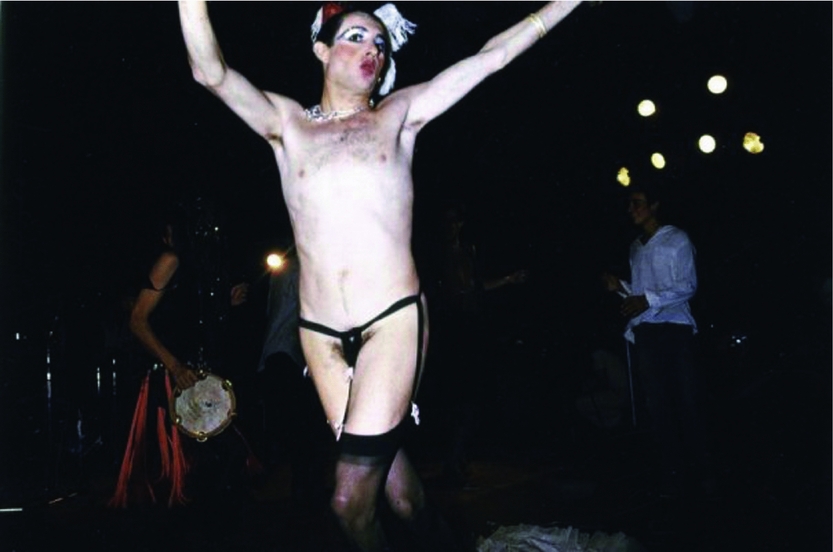
Ocaña's act of stripping in public was his way of exercising the performative right to appear, which Butler has defined more recently as a demand to be recognized or valued.Footnote 25 For Butler, embodied action in public is a fundamental exercise of freedom. In this regard, she perceptively asks, ‘what do we call those who do not and cannot appear as “subjects” within hegemonic discourse?’Footnote 26 Connecting her analysis of precarity with her previous work on gender norms, Butler notes that the right to appear hinges on norms of recognition that also determine who is to be excluded.
Butler's ideas on gender performance depend on both the importance of enactment and the right conditions for the performance to take place. Because this enactment is what defines gender, Butler claims, place and circumstance affect the performance of gender differently.Footnote 27 In this regard, it should be taken into consideration that the way one performs one's own gender is always negotiated with hegemonic forces. Gender norms dictate ‘how and in what way we can appear in public space, how and in what way the public and private are distinguished, and how that distinction is instrumentalized in the service of sexual politics’.Footnote 28 It is clear that these norms are instilled solidly in the formation of gender. If we consider how this applies to Ocaña's experience, it is surprising to observe how gender norms – which one would expect to be more fluid in countercultural spaces denoting themselves as free zones – were equally effective in both International Anarchist Days and Canet Rock. The right to appear is, then, contended rather than an entitlement. As Ocaña demonstrated, new performances of gender ‘can emerge in ways that break with, or deviate from, mechanical patterns of repetition, resignifying and sometimes quite emphatically breaking those citational chains of gender normativity’.Footnote 29 Ocaña's insistence on being present and having his presence recognized in countercultural spaces and in the public sphere was his own resistance to these norms. Indeed, as Luis Moreno-Caballud claimed about his performances, Ocaña realized that their efficacy needed to be ‘validated in community, in the construction of a daily relationship with others’.Footnote 30 Thus they were recognized as performance regardless of how well they were received or their potential to transgress the norm. As one would expect, both the gendered dimension of this performance and the confusion of private and public limits were the main areas of contention.
In my opinion, these appearances offer a side of Ocaña that has been watered down by the CT, as this culture only appropriates the less problematic performances featured in Pons's documentary. I would like to include a third example of Ocaña's public performances that explicitly refers to his political engagement. On 26 June 1977, the first gay pride parade in Spain took place on Las Ramblas. More than four thousand people attended this demonstration, organized by the FAGC (Front d'Alliberament Gai de Catalunya, or Gay Liberation Front of Catalonia). By that time, Ocaña had earned some popularity, but he had yet to appear at Canet Rock and International Anarchist Days. The representatives of the Gay Liberation Front disdained him and his friends because they arrived dressed in drag, turning a political parade to raise awareness for a cause into a festive celebration. One of Ocaña's friends, the cartoonist Nazario, confirmed that it was their performance that they disliked: ‘organizers sent us to the back of the march because we were dressed up as “clowns”. Back then, they wanted to project an image of masculinity’.Footnote 31 Gender norms played a role in the hegemonic representation of gay subjectivities in this parade, which explains Ocaña's disidentification. It is worth noting that the transition to democracy was a period in which the struggle for hegemony was at stake in most spheres, in spite of the illusory spirit of consensus that has prevailed during Spain's process of democratization. Because individuals like Ocaña represented the stereotypical image that the Gay Liberation Front of Catalonia wanted to avoid, he suffered a type of double exclusion that amplified his marginality. He referred to himself as an outcast in Ocaña, retrat intermitent. Having to endure the symbolic violence of both heterosexual and gay men because of his persona, Ocaña's occupation of the public space became his political statement.
Ocaña's participation in this protest is featured in Pons's film as a set of photographs, but the film neither elaborates on the details of his participation nor questions him about the demands set by the organizers. In addition to increasing gay and lesbian visibility, the demonstration had a political objective: to eliminate the 1970 Law on Social Dangerousness that declared homosexual acts a felony and established a maximum sentence of five years’ imprisonment for offenders. Between 1975 and 1981, fifty thousand people were arrested and charged, and ultimately 181 were convicted of homosexuality.Footnote 32 According to Ocaña, retrat intermitent, it would seem that wherever there was a party, Ocaña was sure to be there, but his identity as a political subject is diluted. Archival works accessible in repositories and new documentaries can help us approach his practices as a performer through a different lens. For example, some museums such as MACBA (Museum of Contemporary Art in Barcelona) and Museo Nacional Centro de Arte Reina Sofía (Queen Sofia National Museum and Art Center) curate films of the Video-Nou collective, a group of activists who recorded aspects of public life often excluded from newscasts, particularly having to do with the counterculture.Footnote 33 Ocaña was the protagonist of several of these videos, one of which is a performance filmed just a few hours before the 1977 gay parade in an apartment shared by the cartoonist Pepicheck and some of his friends. It features lip-sync performances by Ocaña and his friend Camilo and a couple of skits similar to those included in Pons's documentary. Image and sound quality are amateur, but they indicate the type of performance that the organizers of the parade rejected. The last part of this film seems spontaneous. Both Ocaña and Camilo join as many as eight other friends to harass Pepicheck, who is trying to get some rest in bed. Some of the participants are already dressed for the parade. Ocaña keeps singing coplas, but Video-Nou videographers were busy recording how this group was engaging in sexual activities. The scene is shot with close-ups, and the cameraman constantly changes subjects, allowing us to glimpse, hear or guess at what is happening on the bed. This ordinary way of appearing and expressing sexuality was not naturalized in any form in public spaces. On the contrary, these tensions are evidence of the struggle confronted when defining a new political subject emerging from gay activism.
The following year, gay pride celebrations exposed evidence of divided forces in gay activism, with the Gay Liberation Front of Catalonia (FAGC) sharing the stage with the dissident CCAG (Coordinadora de Col·lectius per l'Alliberament Gai, or Gay Liberation Coordinating Committee), which Ocaña supported at this time. The 1978 demonstration, banned by the authorities, supported the struggle of prison inmates to improve their conditions and called again for repeal of the Law on Social Dangerousness. It became clear that there was a shift in dispositions within gay pride activism: the divided leadership was an example both of the formation of a class and of the struggle for hegemony within the group, which Pierre Bourdieu finds essential for its existence. ‘A “class”’, Bourdieu says, ‘be it social, sexual, ethnic or otherwise, exists when there are agents capable of imposing themselves as authorized to speak and to act officially in its place and in its name’. Certainly this was the role the FAGC had assumed, which meant the exclusion of multiple subjectivities within gay activism who felt disidentified but still wanted to have their voices heard. Bourdieu goes on to point out that the hegemonic group, ‘by recognizing themselves in these plenipotentiaries, by recognizing them as endowed with full power to speak and act in their name, recognize themselves as members of the class, and in doing so, confer upon it the only form of existence a group can possess’.Footnote 34 On the one hand, the hegemonic group, the FAGC, did not want transvestism to interfere with its demands; on the other hand, the CCAG had a camp perspective on identity that was difficult for mainstream society to accept at the time.Footnote 35 Nazario raises a compelling point that confirms the struggle for hegemony within activism in Spain. He compares the struggle to what had happened earlier in Paris to the transvestite activists Les Gazolines, also marginalized by their peers who preferred to project a masculine image.Footnote 36 Furthermore, Esther Newton explains in similar terms in her influential study Mother Camp how the gay scene in New York in the 1970s experienced ‘a shift from effeminate to masculine styles’, which pushed to the margins anyone not conforming to these norms.Footnote 37
None of these exclusions discouraged Ocaña, who continued to occupy public space. Preciado defines Ocaña's disidentificatory performance as campceptualism or ‘queer modernity’, which he explains as a strategy of political performance.Footnote 38 By the summer of 1978, when the gay pride parade took place, Ocaña was already a public figure of national dimensions and had been featured by mainstream media outlets. His visibility was making police authorities nervous. On 25 July 1978, Ocaña dressed up as an old woman during the festivities of Sant Jaume. As he and Nazario were singing on Las Ramblas, near Teatre del Liceu, some policemen started harassing them and, ultimately, they were arrested after a clash between protesters and policemen. Ocaña and Nazario spent three days at the Modelo Prison in Barcelona and newspapers reported that their arrest had been planned. The Gay Liberation Front released a statement denouncing the prosecution of ‘those gays who venture outside bars and areas tolerated by the system’.Footnote 39 Pons's film had made Ocaña a more visible figure, but also a more vulnerable one. Perversely, Ocaña's arrest confirmed that the struggle for gay rights was nonetheless advancing toward achieving its ongoing demands for liberty.
However, these examples of opposing hegemonic norms do not seem to play a role in the recognition of Ocaña as a political subject of the transition. They are diluted in Pons's documentary, silenced in Vila-Sanjuan's use of Ocaña as a backdrop or rendered invisible in the body of criticism that has been produced on these films. As mentioned earlier, CT rejects behaviours that destabilize a normalized image of the transition to democracy, and, almost inevitably, violence is normally ignored. Ocaña's disidentification with hegemonic discourses functions, borrowing Muñoz's ideas, as ‘an act of tactical misrecognition that serves as a bulwark against the effects of dominant publicity’.Footnote 40 This worked at different levels and certainly was not only experienced by Ocaña. He and his fellow performers felt excluded not only from gay activism but also from the group of artists who devoted their practices to give visibility to gay people. Among them, Nazario mentions Alberto Cardín and Terenci Moix. Ocaña regarded them with contempt and called them ‘intellectual bitches’, as if they were all separated by the abyss of a social divide.Footnote 41 In contrast, Ocaña and his friends were clearly recognized as part of the counterculture. In fact, Ocaña rarely attended theatrical performances, and when he did, he saw his performances validated by international performing artists, such as Lindsay Kemp and Copi, who played in Barcelona. Lindsay Kemp staged her controversial play Flowers – based on Jean Genet's Notre Dame des fleurs – at Teatre Romea for over a week in December 1977.Footnote 42 Onstage, an all-male troupe in drag accompanied by a female performer played sexually explicit scenes that repulsed the critic of the newspaper La Vanguardia, who wrote that performers imitated ‘jerks and pornographic orgasms’.Footnote 43 The following year, the queer Argentinian performer Copi performed at Saló Diana his monologue The Loretta Strong Show, consisting of a sarcastic performance of his cartoons in drag. These two plays made a great impression on Ocaña.Footnote 44 Shortly after his improvised onstage sex acts in the summer of 1977, which resulted in his expulsion from the stage on multiple occasions, as discussed above, Ocaña saw Barcelona's audience accepting the aestheticized versions offered by Kemp and Copi.
I want to finish my analysis of Ocaña's performances by considering the exhibition of his art, in which he also had a distinctive predisposition to theatricality. His first exhibition at Mec-Mec gallery in 1977 is what we would now call an installation. Titled Un poco de Andalucía, it featured examples of Holy Week sculptures, popular festivals and his naïf paintings, in which he represented popular traditions. In Ocaña, retrat intermitent, we see him setting up this installation. What immediately draws our attention is the theatrical display of all these elements. There is a fascinating overlap between this scene and the one recorded by Video-Nou videographers.Footnote 45 Here, Ocaña leads a tour through his exhibition in which once again he erases the boundaries between public and private. Among the works and artifacts in the exhibition, his own bed and toilet were displayed. He regretted that journalists wanted to interview him lying on his bed, as Pons and Ángel Casas did. The closing of the Video-Nou footage shows Pons's main unit shooting a scene. Pons gives instructions to Ocaña and Camilo, who are dancing sevillanas. Authorship of the skits in Ocaña, retrat intermitent are to date a point of contention, as we see in the documentary directed by Juan J. Moreno, Ocaña, la memoria del sol (Ocaña, Memory of the Sun) (2010). Pons claims that he selected texts, motifs and scenes for Ocaña, while both Nazario and Marta Sentís, who photographed the shooting of the documentary, maintain that there was no planning and Ocaña improvised everything. In my opinion, it is hard to believe that Ocaña was the only person responsible for selecting and staging all performances featured in the documentary. It is true that we see him improvising skits in Video-Nou's footage, but the pieces in the documentary are clearly rehearsed and directed by someone.
Probably one of the most compelling theatrical scenes featured in Pons's documentary takes place after we have seen Ocaña in all his facets, walking in drag along Las Ramblas, performing a Mater Dolorosa, enacting a skit onstage, reciting poetry in a cemetery and causing a disruption onstage at Canet Rock. Fifty minutes into the film, Ocaña plays a woman dressed in a mantilla, standing on a balcony and watching a religious procession that he has prearranged with his friends. This film scene takes place near the site of his exhibition, on Seca Street, in the Born quarter. His performance mimics a Holy Week procession in Andalusia. But as Fernàndez perceptively notices, it is a pastiche of different elements that subverts the solemnity of a Holy Week procession. Fernàndez points out the dissonance of the joyful figures of big-head puppets and the Virgin of the Assumption – typically paraded in August – and the untimely saeta that Ocaña sings while wearing a mantilla.Footnote 46 The sculpture that is being paraded is his own, one that we have seen earlier in the film. The scene features the baroque aesthetics of a religious procession, and yet one of the penitents is featured performing a sadomasochistic act: one of the priests is whipping him. Neighbours and onlookers who participate in the performance, clapping, shouting and cheering during the procession, join Ocaña. This piece is quite different from his walks along Las Ramblas in that the audience consciously participates by becoming part of the procession instead of being roped into participation by Ocaña. Audience members understand the playfulness of the piece and collaborate by not interrupting it.
Once again, Ocaña resisted conforming to norms and having his art confined in the gallery. Rather, he brought his art to the streets of the Born quarter and challenged his impromptu audience. Nazario offers a personal explanation of the audience involvement. Performing in the street in Barcelona was a novelty in the 1970s, but he says, ‘because people associated it with the newly established democracy, there was a very special complicity with the audience; I think it cannot be outdone’.Footnote 47 Yet Ocaña's resistance to norms, his troubling relationship with artistic circles, gay movements and anarchist unions, resonate today to claim a position as agent of the process of democratization largely co-opted by the triumphant discourse of the political transition.
Where is Ocaña?
Today, one can only wonder where that space of dissent along Las Ramblas has gone. Following the credits in Ocaña, la memoria del sol, while Carlos Cano's ‘Ocaña Ballad’ is playing, Pons says that twenty-five years after his passing, Ocaña is still alive. The scene transitions to a shot of tourists sitting on one of the terraces along Las Ramblas, and then cuts to a close-up of a tree on which someone has carved, ‘Ocaña on es? [sic]’ (Where is Ocaña?). Certainly, his type of performance has long ago disappeared from Las Ramblas and has been replaced by the more palatable tourist attraction of mime artists. On a recent trip to Barcelona, I paid a visit to Ocaña Café, a multi-level restaurant and club at Plaça Reial, where Ocaña rented an apartment for most of his time in Barcelona. At the door, a couple of drag queens greeted me and my friend in English, ‘Hola, welcome!’ We wandered around the different spaces of the complex: a Mexican restaurant called Ocaña DF, a cocktail bar and a lounge. I could not find a single trace of Ocaña, not even a picture of him or one of his paintings. Back home, disappointed with my visit, I checked their website and read their description of Ocaña Café as ‘romantic, roguish and underground, like the Plaça Reial’. A link lets the visitor read about José Pérez Ocaña, characterized as ‘provocative, outrageous, funny, [his] mould-breaking performances were a proud affirmation of individuality, freedom and sexuality’.Footnote 48 Each year this restaurant organizes an homage to Ocaña. His friend Nazario has been involved in some events at the restaurant. Lamentably, this case only confirms the image of counterculture that the CT has made readily available.
The novelist and cultural critic Manuel Vázquez Montalbán observed that in the 1970s and 1980s transvestites took over Barcelona's stage and later occupied the streets, and then, when there was a solid democracy, ‘nobody knew where to place them. Maybe they had already accomplished their mission and had become living archaeological pieces’.Footnote 49 As critics, it is our responsibility to acknowledge the presence of these protesting bodies on the street and the exclusion they suffered regarding recognition within hegemonic discourses. My aim in this paper has been to reconsider Ocaña's performances and place them within the context of the struggles for liberty that took place in Barcelona in the late 1970s. In this regard, Ocaña's performances should not be encapsulated, but seen as a dynamic practice that revealed the lack of democratic culture in the public sphere, permeated by the fight for hegemony within gay activism. Ocaña's walks along Las Ramblas and his public performances in the streets and on the stages of the counterculture were unprecedented in Barcelona. Indeed, they are still undervalued in assessments of political performance of this period. Ocaña belongs to a group of cultural agents of the transition to democracy who have helped us question the hegemonic culture of the transition and the narrative of the democratization process. The CT that appropriated a depoliticized image of Ocaña has lost legitimacy and is losing ground. A counterhegemonic reading of the transition currently occupies the realm of representation of the political subject, who, like Ocaña, tests the limits of an imperfect democracy.



