

1. Darwinian Gradualism and the Mueller-Huxley Challenge
In 1873, within two years of the publication of The Descent of Man Footnote 1, Friedrich Max Mueller wrote:
There is one difficulty which Mr Darwin has not sufficiently appreciated … There is between the whole animal kingdom on the one side, and man, even in his lowest state, on the other, a barrier which no animal has ever crossed, and that barrier is – Language … If anything has a right to the name of specific difference, it is language, as we find it in man, and in man only … If we removed the name of specific difference from our philosophic dictionaries, I should still hold that nothing deserves the name of man except what is able to speak … a speaking elephant or an elephantine speaker could never be called an elephant.' and (quoting Schleicher) ‘If a pig were ever to say to me, “I am a pig” it would ipso facto cease to be a pig’.Footnote 2
What is the nature of a species? Darwin sought to establish continuity, and the links between species. In his ‘Recapitulation and conclusion’ to The Origin Of Species, he wrote:
Hereafter we shall be compelled to acknowledge that the only distinction between species and well-marked varieties is, that the latter are known, or believed, to be connected at the present day by intermediate gradations, whereas species were formerly thus connected.Footnote 3
Thus gradualness of change and the principle that there is no difference other than a quantitative one between varieties and species were fundamental. But shortly after publication of The Origin T.H. Huxley wrote to his mentor that he hoped that Darwin had not loaded himself ‘with an un-necessary difficulty in adopting Natura non facit saltum so unreservedly’Footnote 4. Thus was initiated a division of opinion amongst evolutionists between those, on the one hand, who follow Darwin in strict gradualism, and those, on the other, who following Huxley take a saltational view of transitions, and therefore a more discrete and categorical view of the nature of species.
But what is a species? One attempt at a definition is the Biological or Isolation Species Concept: a species is a ‘group of actually or potentially interbreeding natural populations that are reproductively isolated from other such groups.Footnote 5 A more specific and functional definition of a species is ‘the most inclusive population of individual bi-parental organisms which share a common fertilization system’.Footnote 6 Thus, according to Paterson, a species is defined by a ‘specific mate recognition system’. I will argue that this concept is crucial to the question raised by Mueller and to the doubt that Huxley expressed to Darwin.
2. Saltations Modulated by Sexual Selection
The theory of punctuated equilibriaFootnote 7 followed a history of challenges to the gradualist version.Footnote 8 Goldschmidt formulated the concept of the “Hopeful Monster” the outcome of a ‘macromutation’, doomed to maladaptive failure that just occasionally might succeed.Footnote 9 The case for saltation has been argued at a macro-evolutionary level by Stanley on the grounds that the amounts of change seen within species and other taxa are simply insufficient to account for the overall pattern of evolutionary change that is seen over time.Footnote 10 All such general arguments come up against the difficulty that Goldschmidt's ‘hopeful monster’Footnote 11 ran into: the greater the magnitude of the saltational change the less likely it is to have survival value, and the greater the difficulty the hopeful monster will have in identifying a mate. The possibility that the monster can identify an individual with the same mutation is clearly dependent on reproduction already having taken place, and even if this be assumed the new mutation is at a severe statistical disadvantage with respect to the existing population. Thus Goldschmidt's proposal, which challenged Darwinian gradualism and appeared to conflict with the principle of natural selection, has been widely disregarded.
But here Darwin's juxtaposition of The Descent of Man Footnote 12 and the theory of sexual selection introduces a new possibility. If sexual selection and speciation were in some way interdependent this might solve the problem of discontinuity and elucidate the significance of mate selection. Darwin himself made no specific proposal. A role for sexual selection in modifying a primary change in a sexually dimorphic feature to establish a new species boundary has been argued in relation to Hawaiian Drosophilid species by KaneshiroFootnote 13 and Carson.Footnote 14 Similar arguments apply in the case of the prolific speciation of cichlid fishes in the lakes of East AfricaFootnote 15 and in birds.Footnote 16
What constitutes a saltation? By definition it is a genetic change of sufficient magnitude or novelty to account for a species difference. Goldschmidt considered that environmentally selected changes in genes were never sufficient to account for species differences. The latter he suggested were accounted for by chromosomal rearrangements, but chromosomal theories of speciationFootnote 17 have been criticized on the grounds that such rearrangements are frequent, often without phenotypic effect, and sometimes present as polymorphisms within a population.
Here it is argued that it is not chromosomal change per se that plays a role in speciation but change on the sex chromosomes. Such changes may be associated with sexual dimorphisms, that themselves are necessary to the construction of a mate recognition system, and are species specific. Furthermore non-recombining regions of X–Y homology have a special status in that they can account (as in the case of lateralization in humans, see below) for quantitative differences in a characteristic between males and females. Such dimensions of variation are plausible substrates for sexual selection.
The Y chromosome in mammals (like the W in birds) has a unique role, because it is not necessary for survival. While the X is the most stable chromosome across species (Ohno's lawFootnote 18) the Y is by far the most variable; it can be seen as a test-bed of evolutionary change. One possibility is that the primary change in speciation takes place on the Y, located in a region of homology with the X allowing correlated but independent change in the two sexes. Differing ranges of variation in a single variable have the potential to explain the type of runaway sexual selection envisaged by Fisher.Footnote 19 Thus a primary and saltational change on the heterogametic chromosome creates a target for selection by the other sex to define a new mate recognition system. A role for the gene prdm9 (that is involved in speciation and species differences in recombinationFootnote 20) in stabilizing the relationship between X and Y chromosomes has been suggested.Footnote 21
In man the mate recognition system (the capacity for language) is defined by the dimension of asymmetry. Broca wrote “Man is of all the animals the one whose brain is most asymmetrical. He also possesses the most acquired faculties. The faculty of language distinguishes us most clearly from the animals”.Footnote 22 The concept that asymmetry of the hemispheres is the defining feature of the human brain and the cerebral correlate of language is referred to as the Broca-Annett axiom – it implies that the genetic basis of this evolutionary innovation is the speciation event for modern Homo sapiens. To approach such predictions it is necessary that the cerebral dominance gene or right shift factor be identified.
The Genetics of Cerebral Dominance
An important clue to the location of the gene comes from sex chromosome aneuploidies. Individuals (present in the general population with a frequency of approximately 1 in 1000) who lack an X chromosome [XO, Turner's syndrome] have non-dominant hemisphere [spatial] deficits on cognitive testing. Individuals with an extra X [XXY, Klinefelter's, and XXX syndromes] have verbal or dominant hemisphere deficits (Table 1). A possible explanation is that an asymmetry determinant is present on the X chromosome. But then the question arises of why males, who only have one X chromosome do not have spatial deficits such as are seen in Turner's syndrome. The answer must be that the copy of the gene on the X chromosome is complemented by a copy on the Y i.e. that the gene is in the X/Y homologous class.Footnote 23 A hormonal explanation will not account for the similarity of the changes in XXY individuals, who are male, and XXX individuals, who are female. The case that the gene is present also on the Y chromosome is strongly reinforced by the verbal deficits/delays that are observed in XYY individuals.Footnote 24
Neuropsychological impairments associated with sex chromosome aneuploidies

The hypothesis is further strengthened by evidence that Turner's and Klinefelter's syndrome individuals have corresponding deviations in anatomical asymmetryFootnote 25 and by the demonstration of a same sex concordance effect – the tendency for handedness and sex to be associated above chance expectation – the hallmark of X-Y linkage.Footnote 26 A role for an X-Y homologous gene is consistent with the presence of a sex difference – brain growth is fasterFootnote 27 and lateralization to the right is stronger in females.Footnote 28 Females have greater mean verbal fluency and acquire words earlier than males.Footnote 29 These facts are related, and they inform us of the nature of the genetic mechanism: the gene is present on both X and Y chromosomes.
3. The Xq21.3/Yp Duplication
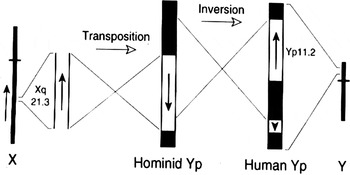
When we come to consider where on the X and Y such a gene might be located there is an important lead. A major chromosomal rearrangement took place in the course of hominin evolution. A 3.5 Mb contiguous block of sequences from the X chromosome was duplicated onto the Y chromosome short arm. That event is now dated at 6 million years.Footnote 30 It is therefore a candidate for the transition from a great ape/hominin precursor to Australopithecus. The homologous block thus created was subsequently subject to three deletions (small segments of the chromosome, that might influence the function of affected genes, are lost), and was split by a paracentric inversion (by a recombination, presently undated, of LINE-1 elementFootnote 31, a further re-arrangement of the structure of the chromosome, to give two blocks of homology in Yp11.2 (Fig. 1). Two regions on the human Y chromosome short arm thus share homology with a single region on the human X chromosome long arm (Xq21.3).Footnote 32 Genes within this region are therefore present on both the X and Y chromosomes in Homo sapiens but on the X alone in other great apes and primates.
The Xq21.3/Yp duplication of 3.5 megabases from the Xq21.3 region of the X chromosome long arm to the Y chromosome short arm now dated at 6 million years, ie coincident with the separation of the chimpanzee, and hominin lineages. A second event (a “paracentric inversion”) reversed the direction of most of the duplication, and some of the pre-existing Y short arm, but has not been dated.

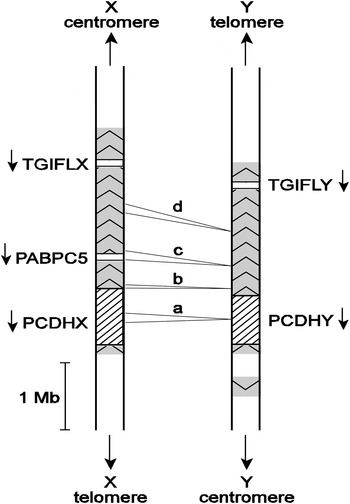
An explanation for the retention of the duplicated block on Yp can be sought in its gene content. Three genes are known to be expressed within this region; PABPC5, a poly (A)-binding protein; TGIF2LX and Y, (homeobox-containing genes with testis-specific expression) and the ProtocadherinX (PCDH11X) and ProtocadherinY (PCDH11Y) gene-pair (all are located in the larger distal segment - Figure 2). The Y gametologue of PABPC5 has been lost as a consequence of one of the deletions during hominin evolution (c in Figure 2), and TGIF2LY has been inactivated by a frameshift mutation. This leaves PCDH11X and PCDH11Y (each comprising seven extracellular cadherin motifs, a short transmembrane region and an intracellular cytoplasmic tail) that code for cell adhesion molecules of the cadherin superfamily as salient because both forms of the gene have been retained and are highly expressed both in fetal and adult brainFootnote 33 including the germinal layer of the cortex (T.H. Priddle, personal communication). The protein products of this gene pair are thus expected to play a role in intercellular communication perhaps acting as axonal guidance factors and influencing the connectivity of the cerebral cortex. This gene pair may thus have been subject to selective pressure throughout hominin evolution.Footnote 34
Alignment of the homologous regions on the X long arm and Y chromosome short arm to show four deletions (a to d) on the Y and the content of genes.

The Y chromosome is described as consisting of strata revealing points in evolution at which blocks were added to the chromosome from the autosomes or the X [33]. For the reasons given above, it is suggested that the duplication from the Xq21.3 region of the X chromosome in hominins, and regions of XY homology in the mammalian radiation in general, have particular significance because they are relevant to sexual dimorphisms and the formation of mate recognition systems.
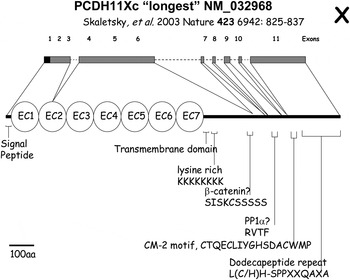
The structure of the ProtocadherinXY molecule (figure 3) reveals points of interest – 1) the ectodomain comprises seven Protocadherin repeats, structures that interact with the same features on the surface of another cell to generate adhesive forces, 2) a beta-catenin binding site is consistent with the reportFootnote 35 that this molecule is involved in gyrification of the human cerebral cortex, 3) a protein phosphatase 1 alpha binding site indicates a role in axo-dendritic formation, 4) the dodecapeptide repeat motif is of unknown function, but is specific to this molecule. The protein coded by this gene is the only Protocadherin that includes both beta-catenin and protein phosphatase 1alpha binding sites. It is plausible that has a role in synaptogenesis, and as an axonal guidance factor.
Structure of the protocadherin 11X/Y gene pair.

The arguments for the Xq21.3/Yp duplication having critical relevance to hominin evolution can be summarized:
1) the timing at approximately 6 million years of the original duplication relative to the chimpanzee/hominin bifurcation.
2) the extent of change in the Protocadherin Y (16 coding changes), and particularly the Protocadherin X sequence (5 coding changes, including two to sulfur-containing cysteines) since the duplication. These changes appear fixed across populations.
3) the case that the genetic determinant of cerebral asymmetry is present on the X and Y chromosomes.
While the first argument relates to the Australopithecus speciation event, the third is concerned with the capacity for language in Homo sapiens. It may be implied that the presence of the homologous block on the Y-chromosome created a field for genetic innovation throughout the extent of the hominin lineage.
4. Species-specific Variation is Epigenetic
The salient issue is the nature of the transition to modern Homo sapiens, now considered to have taken place 160 thousand years ago. What was the critical change? Although not dated the paracentric version is a candidate.
In mammals genes on one X chromosome are subject to the process of X inactivation, but gene sequences that are also represented on the Y chromosome are protected from this influence. Such genes are expressed from both X and Y in males and from both Xs in females, a similar dosage thus being maintained in each sex. A possible mechanism is by epigenetic (modifications of gene expression without alteration of the DNA sequence itself; mechanisms include methylation of the DNA sequence, and modifications of the histone structures with which the DNA sequence is associated in the structure of the chromosomes) suppression of unpaired chromosomes in male meiosis.Footnote 36 Gene sequences that have been transferred from the X to the Y are in a new situation; a phase of epigenetic equilibration must be assumed. If X–Y pairing in male meiosis plays a role, the orientation of the sequence on the Y is also relevant. The paracentric inversion on the Y short arm could have been critical to the form of expression of the PCDH11XY gene pair.
A magnetic resonance imaging (MRI) investigation in monozygotic twins of handedness and asymmetry of the planum temporaleFootnote 37 suggested an epigenetic influence on cerebral asymmetry, and this may account for the stochastic element incorporated in genetic theories.Footnote 38
Epigenetic control of X and Y encoded sequences may have an even more fundamental role in embryogenesis. According to the hypothesis developed here the X and the Y chromosomes encode a pattern of genetic activity that encompasses the most recently acquired sexual dimorphism in a particular species. It seems worth considering that the primary function of “meiotic suppression of unpaired chromosomes” (MSUC) is to pass on to the embryo a genetic message that specifies those features that characterize the species. Such features are apparent in late ontogeny but may need to be imposed soon after fertilization in a sex-dependent way at a time when gene expression in general is suppressed.
The scenario has a further implication. If the mechanism of imposition of the message is by MSUC there is, particularly in Homo sapiens, scope for variability of pairing and thus variations in the epigenetic message. Such variation will be species-specific, in the case of Homo sapiens related to asymmetry and therefore to language. According to this theory species-specific variation including that relating to pathologies with a uniform incidence across populations is distinct from Mendelian variation and has its origin in meiosis and the transitions between species.Footnote 39
5. Characteristic of Putative Cerebral Dominance Genes in Hominid Evolution
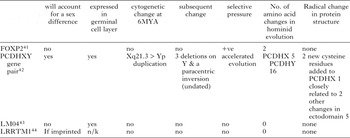
Other candidates for cerebral asymmetry have been suggested. On the basis of expression comparisons in foetal brain Sun et al. suggested LM04Footnote 40. FOXP2 was proposed from family studies of language abnormalities, and also has been suggested as having a role in hominin speciation. LRRTM1was identified on the basis of an interpretation of linkage studies in handedness and psychosis. Table 2 summarizes the findings. It can be seen that the arguments for the Protocadherin XY gene pair are more numerous and some of them perhaps stronger than those of the other candidates, and that the timing of the initial duplication is more closely related to hominin evolution.
Summary of findings related to candidates for cerebral asymmetry.

6. Conclusion
5 to 6 million years ago, 3.5 megabase of DNA duplicated from the long arm of the X to the short arm of the Y chromosome, an event that created a Hominin stratum on the Y. Consistent with a saltational account this genomic change is regarded as the speciation event for Australopithecus. Within the transposed block a gene pair – Protocadherin11X and Protocadherin11Y – has been subject to accelerated evolution, with 16 amino acid changes in the Y protein and five in the X. The latter are particularly significant in that they include the introduction of two sulphur containing cysteines, likely to have changed the function of the molecule, and are expressed in both males and females. Change on the Y is conceived as the initiating event in speciation, with change on the X representing the sexually selected phase of accommodation that establishes a new mate recognition system. The paracentric inversion, which has not been dated, is a candidate for the sapiens speciation event as it has implications for XY pairing in male meiosis and epigenetic control of PCDH11XY gene expression. Cerebral asymmetry (the torque), according to Paul Broca the anatomical correlate of language, may have been introduced at this late stage in the hominin lineage.