Limestone quarriers are a challenging population to study. On the one hand, they are forever evident in the enduring records of their work, namely the quarry features and the edifices and artistic programs made from limestone. From this evidence, quarriers can be studied in abstraction; experimental work has generated energetic values (e.g., Outwater Reference Outwater1957; Ruiz Reference Ruiz1985; Woods and Titmus Reference Woods, Titmus, Robertson, Marci and McHargue1996) that have been summed into person-days and totaled for structures and monumental constructions (e.g., Abrams Reference Abrams1987, Reference Abrams1994; Abrams and Bolland Reference Abrams and Bolland1999; McCurdy Reference McCurdy2016; McCurdy and Abrams Reference McCurdy and Abrams2019). On the other hand, their identities and social roles, and how those intersected with various segments of Classic Maya society remain understudied. This “invisibility” has led some to propose that quarrying limestone was unskilled work performed by laborers (Abrams Reference Abrams1994) or skilled labor organized by governing bodies (Ringle et al. Reference Ringle, Gallareta Negrón, Bey, Masson, Friedel and Arthur2020). Inherent in these arguments is the notion that quarrying is work that lower-status persons performed at the behest of individuals or groups with more power. However, elite artisans working in clay, jade, shell, and pyrite, among other materials, performed various tasks throughout their careers, including what Inomata (Reference Inomata2007:136) refers to as the “tough” and “dirty” work, defying the “popular image of elites as privileged individuals who were freed from hard physical labor.” How then might this disrupt established assumptions surrounding limestone quarriers and those that engaged in the “tough” and “dirty” work of limestone extraction? And how can we approach our scholarship in novel ways so that our methodologies present opportunities to study challenging or “invisible” populations?
From abstraction to a reality, we consider methods for identifying limestone quarriers in the archaeological record. The material correlates associated with limestone quarriers’ activities, namely the implements they used for their work, offer an enduring and concrete avenue to study the associated population. Thus, by examining the context and distribution of what we refer to as a limestone-quarrier toolkit, we provide a framework for archaeologists to identify limestone quarry workers. Here we build on the long history of quarry studies in Mesoamerica (e.g., Holmes Reference Holmes1900, Reference Holmes1919; see also Clark Reference Clark and Hirth2003; Horowitz, Clarke, and Seligson Reference Horowitz, Clarke and Seligson2021) and globally (e.g., Ericson and Purdy Reference Ericson and Purdy1984). To provide a discussion of the archaeologically visible toolkit used for limestone quarrying, we draw upon multiple lines of evidence, including experimental and use-wear analyses, and ethnographic and ethnohistoric studies, among others. Citing these diverse datasets, we organize these implements into a general, rather than fixed, typology where tool functions are discussed alongside tool forms. We argue that by creating these associations it will become easier for archaeologists to identify quarry-related personnel throughout the archaeological record, including in residential spaces.
This paper sets out to establish a replicable approach to study limestone quarriers’ identities within Classic Maya society. To accomplish this, we utilize a growing body of literature from which the process of extraction may be studied and we establish the foundation for the quarrier toolkit, namely the functions of individual tools. We build on this work through an examination of quarry tool use and recovery context as well as a consideration of multifunctionality. We also explore how these toolkits appear on an assemblage level, to increase comparability of such studies. We then provide an example of this application to a case study from the site of Xultun, Guatemala where residential and quarry assemblages are compared (Figure 1). The Xultun distribution patterns are explored to examine their implications for the proposed quarrier toolkit and Maya studies more broadly. Following Inomata (Reference Inomata2007), we find that Maya elite were involved in some of the “tough” aspects of limestone extraction activities. We conclude that by “seeing” quarry workers, we also increase the archaeological visibility of numerous “invisible” aspects of Classic Maya society.
Map showing location of sites discussed in the text. Image by Mary E. Clarke.

Tools of the limestone-quarrier trade
Limestone extraction in Classic Maya society can be studied through the associated lithic implements. These are defined here in reference to scholarship focused on microwear/use-wear analyses, experimental approaches, and excavations in quarries and residences (Table 1). Although the literature lacks consistency in typological terminology in that, for instance, adzes, oval bifaces, ovate bifaces, and general utility bifaces are distinct terms often applied to the same tool form (see Hruby Reference Hruby2008:146–154, Table 5.1), it is generally possible to align term and form through the associated type descriptions, illustrations, or photographs.
Previous studies of limestone quarry tools in Mesoamerica and their suggested functions.

Limestone-quarrier toolkit
Focusing on those tool types that have been recovered archaeologically, there are several that are associated with quarrying limestone. These include chisels, oval bifaces, adzes, hammerstones, picks, saws, and drills. Here we discuss the generally accepted forms organized within a limestone-quarrying toolkit (Table 1).
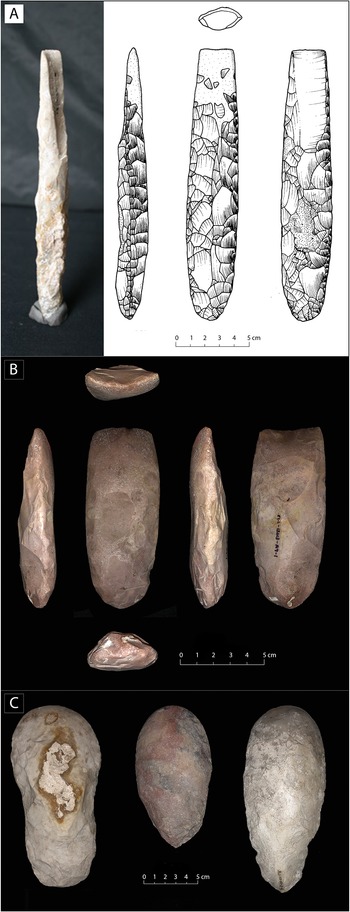
Chisels (Figure 2). This tool type is produced through percussion, although chisels exhibit a polished bit on the distal end. Generally medium in their length (approximately 8–10 cm) and relatively thick in their cross section (approximately 1.5–2 cm), they are characterized by distinctive polish on their oval shaped distal ends (Figure 2c). Because of the shape, these artifacts are generally grouped into oval or ovate biface tool quantifications (e.g., Moholy-Nagy Reference Moholy-Nagy2003:13). Some chisels also have a distinctive “channel” on the polished end (Figure 2a and 2b). The raw material varies from fine- to coarse- to medium-grained chert. Hruby (Reference Hruby2008:158, 162) observed that fine-grained materials were reserved for medium-sized (8 cm), thick celtiform bifaces and suggests that medium celts were used for wood and stone working. In addition to the polishing on their bit ends, hammering use-wear has been observed on the proximal ends. Use-wear analysis of tools can determine which chisels were used for stone working, one example being the polish identified by Emery and Aoyama (Reference Aoyama2007:75). This polish formed through working stone is also observed in what Andrews and Rovner (Reference Andrews IV and Rovner1973) identified as a stone mason’s tool kit at the sites of Muna and Dzibilchaltun (Figure 3, especially Figures 3b and 3d; Parker et al. Reference Parker, Bey and Gallareta Negrón2019; Rovner and Lewenstein Reference Rovner and Lewenstein1997). While it remains difficult to discern the frequency with which these tools were used on stone without additional microwear analyses, they were part of the stone mason’s tool kit and were used during the construction process— others have suggested chisels as a main implement for shaping stone (Bessac Reference Bessac1986).
Composite of chisels where (a) and (b) show the distinctive channel and those chisels included in (c) show polish on the oval shaped distal end. (a) Photograph by Jason S. R. Paling, illustration by A. Castillo; (b) and (c) photographs by Mary E. Clarke.

Select examples of stone mason’s tools identified by Andrews and Rovner (Reference Andrews IV and Rovner1973): (a) polished adzes, (b) stemmed chisel, (c) beaked graver, (d) teardrop-shaped chisel, (e) chert celt (fragment), (f) triangular chisels, (g) adze, (h) banana-shaped smoother, (i) brick-shaped smoother, (j) smoothers, (k) pestle, (l) smoothers, and (m) banana-shaped smoother (fragments).

Adzes and oval bifaces. Oval bifaces (Figure 4) are among the most common tool categories in Maya lithic studies and are frequently referred to by scholars using various names (Hruby Reference Hruby2008:146–154). These tools are teardrop-shaped and would have been hafted during use. Importantly, Shafer and Hester (Reference Shafer1983, Reference Shafer, Hester and Mary1990) employ the term “oval biface” to reference a specific form that is a temporal marker for the Maya Preclassic period, which is not what we discuss here. Use-wear experiments for oval bifaces have shown they were used for chopping trees, woodworking, quarrying, and agricultural activities (Gibson Reference Gibson1986; Lewenstein Reference Lewenstein1987; Puleston Reference Puleston1971; Shafer Reference Shafer1983; Wilk Reference Wilk1977, Reference Wilk1978).
Oval bifaces: (a) Hamontún, Group 41 (illustration by A. Castillo), (b) to (d) Buenavista del Cayo, Belize (photographs by Rachel A. Horowitz), and (e) Succotz Lithic Workshop, Belize (photograph by Rachel A. Horowitz).

Adzes (Figure 5) are triangular in form and have wide distal edges with a beveled edge. Due to their shape, they are infrequently distinguished from oval bifaces, hence their combination here. Hafted transversally, where the cutting edge is perpendicular, rather than parallel, to the handle, adzes provided an inner/outer working end used in a scraping motion drawing the tool toward the user (Beirne Reference Beirne, Riley, Kelley, Pennington and Rands1971; Wernecke Reference Wernecke2005; Wilk Reference Wilk1977), resulting in a use-wear pattern which distinguishes adzes from axes. Production was aimed at maintaining the thick cross sections rather than thinning the biface. Like oval bifaces, adzes are often noted as agricultural or woodworking tools (Gibson Reference Gibson, Thomas and Harry1991; Lewenstein Reference Lewenstein, Thomas and Harry1991) but are among tools recovered from stone-working contexts as well as limestone quarries (Woods and Titmus 2002:192). Andrews and Rovner (Reference Andrews IV and Rovner1973) identify bifacial adzes with polished bit ends as part of a stone-working tool kit (Figure 3). This is further supported by a lithic assemblage recovered from structure L8-8 from Aguateca, where the abandoned construction tool kit included oval bifaces with microwear polish consistent with stone-on-stone use-wear (Aoyama Reference Aoyama2006:30; Inomata et al. Reference Inomata, Ponciano, Chinchilla, Román, Breuil-Martínez and Santos2004).
Adzes from Tintal. Stippling denotes (a) cortex on the dorsal side and (b) use-wear polish on the ventral profile. Also noted is the presence of distal edge damage (photograph by Jason S. R. Paling; illustration by A. Cajas).

Microwear analysis reflects the variability in use of oval bifaces and adzes. Both Aoyama (Reference Aoyama2007) and Stemp and colleagues (Reference Stemp, Helmke and Awe2010) noted oval bifaces were used on meat, hide, wood, stone, grass, soil, shell, bone, antler, and on unidentified surfaces in motions consistent with cutting, scraping, whittling, chopping, chiseling, and digging. Significantly, of the 294 oval bifaces from elite residences within the central part of Aguateca, Aoyama (Reference Aoyama2007:16, Table 4) noted that most of the bifaces indicated they were used to chop or chisel stone. Conversely, in Stemp and colleagues’ (Reference Stemp, Helmke and Awe2010) analysis of oval and general utility bifaces from the hinterland center of Pook’s Creek, Belize, most tools were used on wood. While these tools have a general utility in that they are used for an array of tasks, the distributions in their wear patterns reflect the concerns of the represented population: their use in chopping and chiseling stone is concentrated towards site cores whereas their use to adze or chop wood is more dominant in hinterland areas.
Hammerstones. This category includes tools used for hard hammer percussion, or hammerstones (Figure 6). These percussion implements were used to make flaked stone tools as well as to add force behind other lithic tools, such as chisels (Clark et al. Reference Clark, Pastrana, Woods and Patten2020; Titmus and Woods Reference Titmus, Woods, Laporte, Escobedo and Arroyo2002:193; Woods and Titmus Reference Woods, Titmus, Robertson, Marci and McHargue1996). During quarrying activities, different sized and shaped hammerstones may be used for different tasks (Clark et al. Reference Clark, Pastrana, Woods and Patten2020:18). The hammerstone form is traditionally spherical in its cross section and can easily fit into one’s hand. Hammerstones are often naturally occurring spherical rocks, although cores and other tools were frequently repurposed as hammerstones. A tool’s use or reuse as a hammerstone is identifiable by a macrowear patterning consistent with battering or crushing and breakage patterns indicative of impact (Adams Reference Adams2002:151–152). Favorable raw materials for hammerstones include those which do not fracture conchoidally when used (Horowitz Reference Horowitz2018); however, a variety of materials were used for hammerstones in the Maya area including granite, quartzite, limestone, chert, basalt, sandstone, and schist, among other reused materials, such as chert cores, limestone, quartzite, and broken ground stone tools (Aoyama Reference Aoyama2006, Reference Aoyama, Inomata and Triadan2009; Barrett Reference Barrett2004; Clark Reference Clark1988; Clark et al. Reference Clark, Pastrana, Woods and Patten2020; Dahlin et al. Reference Dahlin, Bastamow, Beach, Hruby, Hutson, Mazeau, Hruby, Braswell and Mazariegos2011; Delu Reference Delu2007; González Cruz and Cuevas García Reference González Cruz and García1998; Hole Reference Hole and Kent1986; Horowitz Reference Horowitz2018; McAnany and Peterson Reference McAnany, Peterson and Patricia2004; Mitchum Reference Mitchum, Hester and Shafer1991; Moholy-Nagy Reference Moholy-Nagy2003; Paris Reference Paris2012; Shafer Reference Shafer, Hester and Shafer1991; Sullivan et al. Reference Sullivan, Awe, Montgomery, Hoggarth and Awe2016; Weeks Reference Weeks1980). Hammerstones are rare in many assemblages, perhaps due to the infrequency of their collection, or their reuse through time (Horowitz Reference Horowitz2018:179–180).
Hammerstones: (a) Hamontún (photograph by Jason S. R. Paling) and (b and c) Xultun (photographs by Mary E. Clarke).

Picks. Picks are a bifacial tool and frequently illustrate use on both the distal and proximal ends (Figure 7). Picks tend to be elongated, thick, and quite heavy, earning them the classifications of elongate biface (Figures 7b and 7c; Moholy-Nagy Reference Moholy-Nagy2003:14), large laurel leaf biface, thick (Hruby Reference Hruby2008:148, 166), spud biface (Rovner and Lewenstein Reference Rovner and Lewenstein1997:23, 65), and piochas (Woods and Titmus 2002:191), among other designations. They are often made of chert and chalcedony (Moholy-Nagy Reference Moholy-Nagy2003). Evidence of haft polish at Piedras Negras (Hruby Reference Hruby2008) indicates hafting of picks, which is also supported by experimental tool use (Clark and Woods 2015; Titmus and Woods Reference Titmus, Woods, Laporte, Escobedo and Arroyo2002). Thus, this tool type could be hand-held or hafted. The function of this tool has been explored through use-wear studies. Dennis Puleston (Reference Puleston1971:328) experimented with a hafted version to excavate a chultun in the limestone bedrock at Tikal. The quarrying marks resulting from this experiment were consistent with those noted on quarries and bedrock outcrops at Tikal (Carr and Hazard Reference Carr and James1986[1961]; cf. Wernecke Reference Wernecke2005:148). The connection between this tool type and limestone quarrying proposed by Puleston is supported by the recovery of two such tools within an abandoned quarry at Xultun (Clarke Reference Clarke2020). Although pick size varies, Hruby (Reference Hruby2008) suggests a consistent use and interprets the variability as a reflection of the scale of work or more accurately the production task.
Examples of (a) drill, and (b) and (c) two elongate picks from Xultun (photographs by Mary E. Clarke).

Proposed additions to toolkit
In addition to the toolkit discussed above, we propose additional tools which are not always included in the limestone-quarrier toolkit but should be considered as such.
Saws. The use of saws to cut limestone is a topic of considerable debate (Aldenderfer et al. Reference Aldenderfer, Kimball and Sievert1989:53; Holmes Reference Holmes1897:198). String saws have been proposed as a method of cutting stone using a counterweight, string, and an abrasive, such as water and ground stone (e.g., quartzite, chert, etc.). The string may have been made of leather, plant fiber, or animal sinew (Chenault Reference Chenault1986; Lothrop Reference Lothrop1955:49). String saws can be identified archaeologically by the presence of counterweights, such as the tool type popularly referred to as a “butt stone” (Figure 8; Paling Reference Paling2016:377) or those known as donut stones (Rovner and Lewenstein Reference Rovner and Lewenstein1997). Scholars have suggested such tools functioned as string-saw weights (Kovacevich Reference Kovacevich2006; Lothrop Reference Lothrop1955:49) or as plummets that functioned like a modern plumb bob (Stierlin Reference Stierlin1964). We argue that due to the large size of the butt stones (approximately 15–20 cm in length) they are best interpreted as string-saw counterweights. Plumb bobs, net weights, and other similar tools are better represented by smaller (approximately 3–5 cm) objects. Contextually, a butt stone was recovered from a residential complex at K’o (Patio Group 25) that neighbors an adjacent limestone quarry (Paling Reference Paling2016:377; Tomasic Reference Tomasic2009; Tomasic et al. Reference Tomasic, Paling, Rangel and Estrada-Belli2009).
Butt stone, proposed as a counterweight (illustration by A. Castillo; photograph by Jason S. R. Paling).

Drills. While drills have not been widely discussed as tools used in quarrying, the presence of drill holes in quarries and on stone monuments points to the use of drills in limestone extraction (Clarke Reference Clarke2020:51–55; Clarke and Gill, this issue). Drill holes visible in quarries suggest that drilling and scoring allowed extraction of materials of particular sizes (Carr and Hazard Reference Carr and James1986[1961]), and they are visible as well as on extracted blocks and monuments (Doering and Collins Reference Doering, Collins, Guernsey, Clark and Arroyo2010; Houston Reference Houston2016). At Aguateca (Inomata and Stiver Reference Takeshi and Stiver1998:435), the presence of drills alongside other stone-working materials was suggested as evidence of their use in stone manufacturing (Aldenderfer et al. Reference Aldenderfer, Kimball and Sievert1989:53). The size of the drill holes in limestone quarries would reflect the overall drilling process; that is, we anticipate that smaller drills would have been used to start the drilling process, and larger drills used to drill the larger holes identified in quarries, much in the way that when using a modern drill, a smaller drill bit is often used to begin drilling and then a larger one is used in later activities. For example, drill holes at the Xultun quarry (XUL 12H26 B6) range in size from 6 to 15 cm wide at their opening to 5 to 8 cm wide at their terminus while their overall depths range from 6 to 20 cm (Clarke Reference Clarke2020; see also Doering and Collins Reference Doering, Collins, Guernsey, Clark and Arroyo2010:277). Thus, drills for quarrying may have a variety of sizes. Drills are often pointed and used in a rotating motion to create perforations or conical depressions (Walters Reference Walters1982:19). Some scholars refer to larger drills as pointed-end bifaces or picks (Moholy-Nagy Reference Moholy-Nagy2003:137, Figure 22). Given the function, however, these tools should be referred to as drills (Figure 7a).
Finishing tools. The process of limestone extraction is both a sequential one and one that can be evidenced at different stages. Therefore, we might anticipate the presence of some tools used for finishing limestone blocks in a variety of locations such as quarries, construction sites, and residences, to name a few. We cannot assume that those involved in quarry extraction did not also participate in other activities such as finishing limestone blocks or the production of ground lime. This proposal must be evaluated based on the presence of finishing tools in association with the other tools connected with quarry workers. Finishing tools include smoothing, burnishing, and polishing stones in a variety of forms from banana- to brick-shaped, from pestles to circular disks, among others (Figure 3h–m). They are composed of materials including fine-grained limestone, chert cobbles, quartzite, and slate, and can also include reused granite or quartzite manos and metates (Andrews and Rovner Reference Andrews IV and Rovner1973; Gillot Reference Gillot2018; Navarrete et al. Reference Navarrete, Uribe and Martínez Muriel1979; Rovner and Lewenstein Reference Rovner and Lewenstein1997). Common among all noted forms is that they have been shaped to provide flat facets on the tool’s convex surface. Furthermore, ground stone manos and metates could have been used to grind lime to make lime plaster from the remains of the limestone used for cut stone blocks.
Absent artifacts
Although lithic tools were an important component of the overall quarrying toolkit, not all materials used left archaeologically visible signatures. Several hypotheses regarding what types of “absent” tools were likely used have been offered. These include measures, a surveyor’s rod, a water level, string saws, wedges, wooden pry bars, ropes, levers, and other implements (Daumas 1969; Eaton Reference Eaton, Hester and Shafer1991; Gillot Reference Gillot2018:159; Hammond Reference Hammond1990; Hiquet Reference Hiquet2020; Morris et al. Reference Morris, Charlot and Morris1931; Outwater Reference Outwater1957; Shook and Kidder Reference Shook and Kidder1952; Wernecke Reference Wernecke2005; Woods and Titmus Reference Woods, Titmus, Robertson, Marci and McHargue1996). Similarly, perishable materials such as those used for moving stone (e.g., ropes, rollers, sleds, and baskets), may not survive. Their production and use were, however, important components of the quarrying process (McCurdy Reference McCurdy2016). Digging sticks may also have had utility in quarrying practice, as they can be used to identify deposits of sascab or as tools for excavation (Eaton Reference Eaton, Hester and Shafer1991; Holmes Reference Holmes1897; Wernecke Reference Wernecke2005; Woods and Titmus Reference Woods, Titmus, Robertson, Marci and McHargue1996). Wood may also have been used for soft hammers for use with chisels or in flaked stone tool production.
Perishable materials may also have been used to extract limestone. Wooden wedges and dowels, or cunas, have been proposed as the means for separating slabs of stone (Holmes Reference Holmes1895:281; Winters Reference Winters1996). Natural fissures or cracks in the parent material would be altered by the placement or hammering of wedges into the section directing cracks in the raw material. Ethnographically, heating of the limestone and coolingwith water is a technique used to improve the ease of stone extraction (Cook Reference Cook1982; Searcy Reference Searcy2011:39; see also Kestle Reference Kestle and Robin2012). Thus, we must consider the universe of tools which are not identifiable in the archaeological record alongside those that are.
Summary
Based on the long history of research into quarry studies in Mesoamerica, here we propose a quarry worker’s toolkit. This toolkit includes chisels, adzes, oval bifaces, hammerstones, and picks, all of which are well established in the literature. We also propose the inclusion of saws, drills, and finishing tools, which include implements used to smooth, burnish, and polish. While not likely visible archaeologically, absent artifacts have been discussed as contributors to the quarrier toolkit. The identification of these tools when combined with analyses of their location of recovery, can increase the resolution of limestone-quarrier identities and offer insight into their household as well as the relationships they maintained with the landscape and society at large.
From lithic assemblages to quarriers and stone workers
Previous scholarship has drawn on lithic datasets to identify those that worked limestone. Here we offer an overview of this research to provide a contextual discussion of how the recognition of such toolkits can be used to people quarry spaces and discuss the organization and sociopolitical identities of limestone quarry workers.
Quarriers
Quarrying limestone is presumed to be a group endeavor that was organized on many scales, from the state to the household. The internal hierarchy of quarry workgroups, therefore, was likely to vary in relation to the scale of work. However, workgroups (and their internal hierarchies) which were organized on similar scales would illustrate similarities. This is the argument posed by Kestle (Reference Kestle and Robin2012) who compares the organization of limestone quarry work at the village site of Chan, Belize (Figure 1) to similar work quarrying resources for ground stone technology (Cook Reference Cook1973, Reference Cook1982; Hayden Reference Hayden and Hayden1987; Nelson Reference Nelson and Hayden1987). In a review of the ethnographic literature, Kestle (Reference Kestle and Robin2012:218) notes several patterns that potentially reflect methods of labor organization in ancient contexts, including among them (1) the quarry location and (2) patterns of tool storage.
Limestone quality is inconsistent across a landscape, even within a small area, creating, in some cases, a limited number of extraction points (see also Hutson and Davies Reference Hutson and Davies2015). The ethnographic literature illustrates that these valuable locations are entangled in issues of land ownership, which can be either private or communal (Cook Reference Cook1982:223). When quarries are included within the boundaries of communal lands they are assigned through private usufruct. Conversely, when they are within privately owned lands, they are either worked by the landowner or rented out (Cook Reference Cook1982:223; see also Cook Reference Cook1973, Reference Cook2014; Hayden Reference Hayden and Hayden1987; Nelson Reference Nelson and Hayden1987). Once rights or access to a quarry are established, teams of individuals are organized by the landowner, either directly with the owner managing the quarrying work, or by an individual hired to work as a quarry boss.
Kestle (Reference Kestle and Robin2012:218–219) proposes that access to limestone resources in Classic Maya society were similarly constructed. The soft marl found in certain quarries, Kestle (Reference Kestle and Robin2012:219) argues, was understood as publicly owned (see also Beekman Reference Beekman1992; Cook Reference Cook1982; Folan Reference Folan1982), whereas access to valuable limestone, however, was restricted. This parallel implies that labor organization for limestone quarries in Classic Maya society would first depend on the quality of the limestone and second on established understandings of land ownership and access rights to privately owned or communal land holdings. Only if one had access to a “valued” limestone quarry could extraction be performed.
Bridging these two discourses are quarrier lithic assemblages and a practice referred to as tool “caching.” Rather than carrying one’s tools to and from a quarry, ethnographic studies illustrate that quarry workers who work alone chose to leave their tools on site, but carefully hidden, or “cached.” Nelson (Reference Nelson and Hayden1987:124) argues that this primarily reflects an energetic concern, as leaving tools on site reduces the weight of exported materials when leaving the quarry. This practice has a great antiquity, as Hayden (Reference Hayden and Hayden1987:26) notes the recovery of a colonial period cache “of 15 two-handed pics, and another of stone pics, axes, and hoes, from which the wooden handles had rotted away.” In quarry work where individuals were organized in groups or companies, however, not all tools were cached on site. Axes and hammers were often brought home at the end of the day, while choppers (which broadly resemble hammerstones) and any tools produced on site were frequently cached (Cook Reference Cook1982:182–187; Hayden Reference Hayden and Hayden1987:26, 70, 80; Nelson Reference Nelson and Hayden1987:123–124). This pattern may be in part due to the ownership system, where the landowners also owned many of the tools (Cook Reference Cook1982:160–161, 177, 182–183, 2014:74–76, 109).
Patterns in tool storage suggested by the ethnographic literature, as Kestle (Reference Kestle and Robin2012:219) states, indicate the structure of labor organization and/or land tenure system. A diverse assemblage of formal and informal tools “cached” within a quarry would indicate an independent quarrier and suggest communal land or “publicly owned” quarries (Kestle Reference Kestle and Robin2012:219–220). An absence of formal tools within a quarry defined as “valuable”—based on the quality of stone—would lend support to an interpretation of restricted land access (Kestle Reference Kestle and Robin2012:219, 222–223). And finally, Kestle (Reference Kestle and Robin2012:220, 225) proposes that a high frequency of formal or specialized tools within a residence would potentially indicate the households of quarry owners.
Stone workers
Others have attempted to use the patterns of tools recovered from residential contexts to identify stone workers and their households. At Tikal, Becker (Reference Becker1973) recovered evidence of stone masons/construction workers and stone workers/monument carvers through the distribution of correlated lithic assemblages. Specifically, Becker saw the presence of stone smoothers and a proportionately large sample of elongate bifaces and obsidian blades as indicative of a household occupational specialization. Furthering this argument, Haviland (Reference Haviland1974, Reference Haviland1985) states that the unusually large number of hammerstones and bifaces, in comparison with other household groups, supports this identification. Studies at Aguateca also provided unique opportunities to identify toolkits associated with artisanal production (Inomata Reference Inomata2001). The quantity of tools, as well as the association between the tools and other goods in rapidly abandoned contexts, led to the conclusion that the residents of specific rooms at Aguateca carved limestone (Aoyama Reference Aoyama2006, Reference Aoyama2007; Inomata et al. Reference Inomata, Triadan, Ponciano, Pinto, Terry and Eberl2002).
The Chan, Tikal, and Aguateca examples provide some frameworks through which a quarry toolkit, such as that discussed above, can be applied to the archaeological record. As noted by other scholars (Aoyama Reference Aoyama2007; Clarke Reference Clarke2020; Haviland Reference Haviland1974, Reference Haviland1985; Inomata et al. Reference Inomata, Triadan, Ponciano, Pinto, Terry and Eberl2002; Kestle Reference Kestle and Robin2012; Parker et al. Reference Parker, Bey and Gallareta Negrón2019), it is not the presence or absence of limestone-working tools that permits the discussion of the occupations of individuals, but rather their frequency in relation to other households. Thus, one important consideration is that the identification of limestone quarriers suffers from equifinality in the associated archaeological assemblage. To avoid issues of equifinality, household assemblages must be examined in comparison between numbers and types of tools, providing a clear avenue for identification of specific activities (e.g., Clarke Reference Clarke2020; Inomata et al. Reference Inomata, Triadan, Ponciano, Pinto, Terry and Eberl2002; Kestle Reference Kestle and Robin2012).
Furthermore, the multifunctionality of many lithic tools is an important consideration. Thus, we propose using an assemblage-level comparison of tool types to identify limestone-quarrying areas and quarry workers. In addition to multifunctionality, it is important to note the multiple locations in which quarry implements might be identified. These tools may be noted in quarries, residences, or other storage spaces. Broken tools which were not recycled are most likely to have entered the archaeological record in or around quarries. Tools which had utility remaining may have been taken by quarry workers to their homes or to other nearby locations where they were stored for future use. The lithic assemblages from limestone quarries and neighboring residences at the site of Xultun provide an opportunity to evaluate the proposed toolkit as well as to evaluate limestone-quarrier identities and labor organization.
A case study from xultun, guatemala
Xultun is located in northern Guatemala within the Ixcan Rio Basin (Figure 1). It is a large, urban center with an occupation history that spans the Preclassic to Terminal Classic periods (250 b.c. to a.d. 950). Within Xultun’s sprawling urban core, two causeways, one formal and one informal, connect its monumental plaza groups where the northern terminus of the informal causeway is marked by both two stela blanks and the entrance to a concentration of residences and limestone quarries (Figure 9). Clarke et al. (Reference Clarke, Gill, Nahil, Beltrán and Saturno2016) conducted a survey of this area (approximately 13,894 m2) noting different types of extraction activities among over 50 distinct quarry features, including gridded and straight-edge quarries, quarry islands, and vertical mine features (Clarke Reference Clarke2020; Clarke and Gill this issue; see also Horowitz, Clarke, and Seligson Reference Horowitz, Clarke and Seligson2021). As others in this issue illustrate (see Gillot, Seligson, and Clarke this issue), many of the aforementioned quarry features are widely documented, but their density and demarcation is uncommon. Clarke (Reference Clarke2020) suggests that these densities indicate an area of focused quarry work at Xultun, referred to as the Stone Production District.
The Stone Production District of Xultun (map by C. Chiriboga, elaborated by Mary E. Clarke).

The first author directed excavations within both quarry and residential contexts in the Stone Production District (Clarke 2016, Reference Clarke, Saturno, Beltrán and Hurst2017, Reference Clarke2020; Clarke et al. Reference Clarke, Gill, Nahil, Beltrán and Saturno2016; Cordero Reference Cordero, Saturno, Beltrán and Hurst2017; Pérez Reference Pérez, Beltrán, Saturno and Hurst2017; Pérez et al. Reference Pérez, Clarke, Camilo, Martínez, Garcia, Beltrán and Saturno2016). While quarry features were studied to better understand the methods and types of extraction, excavations within residences were designed to target final occupation levels in both interior and exterior areas while also sampling an equal proportion of each group’s overall constructed volume. Following these excavations, Clarke conducted lithic analysis for all recovered stone materials from Xultun’s history of study, comparing the density of artifacts from the Stone Production District to other parts of the site (Clarke Reference Clarke2020). Dating of the assemblage from the households associated with the production district illustrates that the assemblage analyzed here dates only to the Late to Terminal Classic period occupation (Clarke Reference Clarke2020:374).
In the following sections, we compare the lithic assemblages recovered from final occupation levels within both quarry and residential contexts from Xultun’s Stone Production District. While the lithic analysis is based on typological classification of tools (Clarke Reference Clarke2020:553–649, Appendix C), we base our interpretations on the overall assemblages. By focusing on the applicability of the quarrier toolkit discussed above, we investigate the relationships between or among tools, toolkits and households, and households and their immediate environs to link these discussions to established discourses pertaining to identity and sociopolitics.
Limestone quarries and quarrying tools
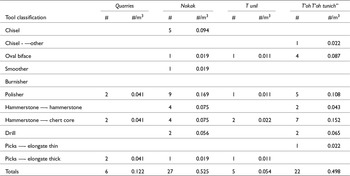
Lithic tools were recovered within the studied quarries, specifically from a gridded quarry (Table 2; Figure 10d–e). Artifacts from the reviewed quarry toolkit were present, including adzes/oval bifaces, picks, drills, and hammerstones. Additional tools recovered were bifacial fragments, a mano, and flaked stone production debris in low densities. These materials may represent additional aspects of the quarrying process.
Select examples of the lithics from the Tunil group, (a) to (c); and the gridded quarry, (d) and (e) (photographs by Mary E. Clarke).

The quarrier tool kit within the lithic assemblages from the Stone Production District.

Significantly, the find spots of the picks were mapped during excavation (Clarke Reference Clarke2020:178, Figure 5.17), illustrating their correlation with the specific extraction patterns visible within the quarries. In all cases, they were recovered within the channels between defined limestone blocks. The presence of these tools within quarry contexts points to their use in quarrying and suggests a practice of tool caching. It is important to note, however, that reuse of quarrying tools may occur, as will be discussed in the examination of the quarry-related households.
Associated households
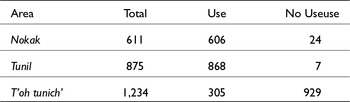
Three residential groups within the district were selected for study: Nokak, Tunil, and T’oh tunich’ (Figure 9). The Nokak group is one of three palatial/administrative complexes at Xultun. It sits atop a natural limestone outcrop, offering views of both a large plaza to the east and the limestone quarries to the north, south, and west. The Tunil group has a comparable footprint to residential groups within Xultun’s urban core. It has a central patio with rooms that encircle, branch outwards, and begin to build upon and borrow earlier structural elements, suggesting late additions for a growing or extended family. The T’oh tunich’ group is much smaller in contrast, presenting an open ended or “U” shaped patio that opens directly onto the quarry features. Excavations in the three residential groups focused on interior and exterior areas of both room and patio contexts. From the exterior contexts, soil samples were collected and processed through flotation. The recovered microartifacts were analyzed alongside macroartifacts to determine flint-knapping activity areas (Clarke Reference Clarke2020). Although results varied for each group (Table 3), the T’oh tunich’ household indicates the greatest quantities of debitage without evidence of use, suggesting these patterns stemmed from production activities. In addition to the observed patterns of tool production, the lithic assemblages for each household contain different frequencies (Table 2; Figures 10–12). The assemblage from the Nokak group, for example, includes chisels, adzes/oval bifaces, and hammering tools (Table 2). In addition to these tools, there are also drills, bifaces, and several manos and metates, among others. Among the items recovered from the Tunil group, adzes and hammerstones correspond to the reviewed toolkit. This assemblage also includes general bifaces, a ground stone mano, and other materials (Table 2). Similarly, the T’oh tunich’ assemblage contains a variety of tools, such as chisels, adzes, picks, drills, hammerstones, and bifaces. Like the other assemblages, there are also manos and metates and a variety of cores and flakes. The types of activities represented by individual tools are considered in the following section, as are their patterns within household assemblages.
The Nokak group lithic assemblage: (a) smoother, (b) slate polisher, (c) polisher/hammerstone, (d) hammerstone, (e) and (f) celtiform chisels, (g) adze, (h) oval biface, (i) pick with signs of reuse, and (j) drill (photographs by Mary E. Clarke).

The T’oh tunich’ lithic assemblage: (a) hammerstone, (b) hammerstone with cortex pommel, (c) hammerstone and polisher, (d) hammerstone, (e) adze, (f) and (g) oval bifaces, and (h) drill (photographs by Mary E. Clarke).

Debitage recovered within three sampled residential areas.

Cutting and chiseling stone
In comparing these assemblages, tools used to chisel and cut stone were found in both the Nokak and T’oh tunich’ groups (Table 2; Figures 11 and 12). While the distribution appears to be even, there is a clear preference in tool form; the residents of the Nokak group utilized polished celtiform bifaces more frequently than they did oval bifaces, whereas oval bifaces comprise the majority of the T’oh tunich’ assemblage, which also includes one irregular chisel. These tool concentrations reflect a difference in work performed by the corresponding households. A polished edge may have been used for heavy duty tasks, whereas the oval biface with the chipped edge may have been used for expedient work. In considering Classic Maya monumental architecture, not all masonry pieces were created equally, as some played integral roles in structures. This inequality in stone value may also have been reflected in the locations where materials were quarried as well as the methods and tools used to produce them.
Evidence for drilling
A unique form of drill recovered from the T’oh tunich’ group (Figure 12h), provides evidence for the use of drilling in quarry contexts. Its cross section resembles a pentagon, but only four surfaces are visible on the tool. The proximal end presents a snap break just above a notch formed along its perimeter (29 cm). Macrowear is extensive and focused on the lateral margins whereas the distal end is narrow (7 cm) and shows slight polishing and retouching to maintain its edge. Considering the form and wear patterns, this tool was used in a circular motion that created a polished distal end and extensively battered lateral margins. Given the context and macrowear patterns, it is probable that this tool was used in a circular motion to drill, such as drilled holes observed in the surrounding limestone quarries. The drilling would directly connect the residents of the T’oh tunich’ group to the stone production task of quarrying limestone blocks.
Hammerstones, hammering, and polishing
The tools within all three households indicate multifunctional tool use. Hammerstones showed various uses in hammering, presumably as part of chiseling or as grinding stones. This provides further evidence that chiseling and cutting and finishing stone surfaces were not performed as different activities, but rather were performed by similar individuals.
The frequency of multifunctional hammerstone tools differs considerably between the Nokak and T’oh tunich’ groups. The Nokak assemblage includes three hammerstones exclusively used for hammering and five used to both hammer and polish, whereas the T’oh tunich’ assemblage includes six hammerstones exclusively used for hammering and three used to both hammer and polish. Tools used to both hammer and polish suggest a different utility from those exclusively used for hammering. The multifunctional tool indicates a workflow that connects or includes the production tasks of chiseling and/or cutting stone and that of finishing stone surfaces. Conversely, hammerstones exclusively used to hammer suggest a focus on chiseling and/or cutting stone as well as a higher need to produce and/or retouch chipped stone tools. This is reflected in the results of the microartifact analysis, which indicate low volumes of retouching in the Nokak group’s central patio and a significantly higher frequency of lithic production debris in the central patio of the T’oh tunich’ group (Table 3).
Furthermore, the Nokak and T’oh tunich’ assemblages both show evidence of high densities of polishers (Table 2). The polishers from the Nokak group, however, present variability in that they include one slate polisher (Figure 11b), three fine-grain chert polishers, and five limestone polishers. Additionally, a smoother was recovered within a tomb assemblage in this group (Figure 11a). Polishers from the T’oh tunich’ group are predominantly of chert and show macrowear patterns indicating that they were multifunctional tools used to polish as well as hammer and plane surfaces. The one limestone tool recovered in the T’oh tunich’ group was medium-grained and exclusively used to polish.
The lack of diversity in polishing tools in the T’oh tunich’ assemblage suggests that stone polishing tasks associated with this household were focused and less diverse than those of the Nokak household, which required a stucco smoother, a slate polisher, and a larger number of fine-grained polishers. Tools used to both hammer and polish suggest a different utility from those exclusively used for hammering.
Discussion: Seeing limestone quarriers
The assemblages from the quarries and the three associated households at Xultun provide several important opportunities to address quarry workers in the archaeological record. Here we focus on the following points: 1) the segmented versus continuous quarrying process; 2) the proposed lithic toolkit and the information presented from Xultun; and 3) the use of distributional approaches to identify quarrying households and their implications for labor organization based on these ideas.
Continuity of limestone quarry processes
As with many types of lithic activities, archaeologists have segmented the limestone-quarrying process into pieces to analyze it more easily. However, evidence from the quarries at Xultun illustrates that there was continuity in the extraction and production process. While polishing tools are not evidence of extraction themselves, their prominence and frequency within these assemblages shows that they were used in association with quarrying activities. Furthermore, the evidence from the hammerstones is particularly compelling. Macrowear shows hammerstone use for polishing as well as for hammering, indicating both the multifunctionality of these tools and their use across “stages” of the limestone extraction and production process. Thus, we should expect that limestone quarry workers were not just involved in activities within quarries, but worked on finishing limestone blocks or participated in other quarry and construction-related activities.
The limestone-quarrier toolkit
We evaluate the proposed lithic toolkit based on the materials from Xultun. Xultun provides excellent contextual information as tools were found within the quarry. Picks within the gridded quarry connect their use to this type of production activity. A direct connection may be drawn between the gridded quarry block extraction and the use of these implements.
Additionally, we argue that the assemblage lends support to the proposed inclusion of drills and polishing tools as part of limestone extraction. The presence of both drill holes in the quarry and drills of suitable size in some of the associated households supports the use of drills in limestone extraction. This evidence connects with that from Aguateca (Inomata and Stiver Reference Takeshi and Stiver1998), indicating that drills of various sizes were part of limestone extraction activities (see also Doering and Collins Reference Doering, Collins, Guernsey, Clark and Arroyo2010).
The presence of hammerstones used for both hammering and polishing illustrates the multifunctionality of tools within the toolkit. That is, many of these tools may have served multiple functions even within the limestone-quarrying process. Thus, although we as scholars continue to use typological designations for ease of discussion, we should make note that the tools themselves were certainly used for a variety of functions.
To further this discussion, tools such as select bifaces were not always used for quarrying; that is, they are not exclusively part of the quarry worker’s toolkit. As discussed above, use-wear analyses of oval bifaces by Aoyama (Reference Aoyama2007) and Stemp and colleagues (Reference Stemp, Helmke and Awe2010) illustrate that their use appears to reflect the concerns of the represented population: their use in chopping and chiseling stone is concentrated towards site cores whereas their use to adze or chop wood is more dominant in hinterland areas.
Distributional approaches and limestone quarry organization
Finally, we can address the types of distributional information which have been used by others (Aoyama Reference Aoyama2006, Reference Aoyama2007; Inomata et al. Reference Inomata, Triadan, Ponciano, Pinto, Terry and Eberl2002; Kestle Reference Kestle and Robin2012). The multifunctionality of tools discussed above points to the importance of comparative studies of lithic assemblages within sites. Unfortunately, comparable data to that discussed from the households associated with the quarries are not available from Xultun. Despite this, several important claims can be made about the implications of the lithic distributions discussed above.
The households adjacent to the limestone quarries at Xultun and the contents of the quarries themselves provide insight into where we might expect to find certain tools. For example, the presence of picks within the quarries, but not the households, suggests where caching occurs. That is, some tools may have been left in the quarry, either for expedience, due to their utility, or through questions of ownership or organization.
We can also consider the distribution of picks at Xultun as they are rare in residential assemblages (Table 2). One elongate thin biface is included in the T’oh tunich’ sample and one elongate thick biface in the Nokak sample (Figure 11i). Significantly, both picks are distal fragments that were reused for hammering. Very few complete picks were recovered at Xultun and when they were, the contexts indicate work in progress, such as a quarried limestone patio (Schwendener Reference Schwendener, Saturno and Castillo2014) or the gridded limestone quarry in the Stone Production District. These contexts suggest a few lines of inquiry. Were these tools provided by “owners” or “managers” of quarries? Were they too heavy and not useful for other things, and thus not removed from the site? Were they provided by those sponsoring the work and thus not possessions? Although we cannot say for certain given the limited sample of picks, these possibilities advance an avenue by which the organization of limestone extraction may be evaluated.
The distribution of quarry tools can also help us to understand the questions raised in the introduction regarding the identity of quarriers. The limestone quarry working tools from Xultun are associated with households of varying socioeconomic statuses. The Nokak household, for example, corresponds to members of the royal court. These factors are interesting to consider alongside the distribution of tasks implied by lithic implements. Cutting and shaping limestone was performed by all three households. That said, the preliminary and expedient tasks were completed by the T’oh tunich’ household, whereas the Nokak household completed the heavier duty and perhaps more specialized tasks of finishing. These patterns suggest that the production process was organized, and tasks groups aligned with social identity. Regardless of its distribution between households, this work was coordinated, suggesting that the observed divisions reflect different roles related to experience- or knowledge-based distinctions (Clarke and Gill this issue; see also Houston Reference Houston2014). The involvement of individuals of various sociopolitical status in quarrying activities suggests that the Maya elite were involved in some of the “tough” aspects of limestone extraction activities (see Inomata Reference Inomata2007).
Conclusions
Archaeological studies have long attempted to “people” the archaeological record (see Robin Reference Robin2001). This work aims to discern the identities of past persons and to connect them to the various activities evidenced in the material remains of their past. When we consider limestone quarries and their associated personnel, studies of labor organization and energetic analyses come to the fore. In both cases, the “people” are presented in abstraction, defined as energetic values, person-days, and skilled or unskilled laborers, among other classifications (e.g., Abrams Reference Abrams1987, Reference Abrams1994; Abrams and Bolland Reference Abrams and Bolland1999; McCurdy Reference McCurdy2016, Reference McCurdy, McCurdy and Abrams2019; McCurdy and Abrams Reference McCurdy and Abrams2019). This scholarship has produced important intellectual advances relating to volumetric estimates of resource use, calculations of labor based on seasonal scheduling, and, more recently, arguments against the assumption of extreme costs for and exploitation of constituent populations. These advances aside, work on “peopling” this process has often overlooked the act of limestone quarrying (cf. McCurdy Reference McCurdy, McCurdy and Abrams2019; McCurdy and Hiquet, this issue), not to mention those that performed this work.
In this article, we illustrate that examinations and clear evaluations of tools used in limestone extraction set the stage to “people” limestone quarries and thus increase the archaeological visibility of limestone quarriers and quarrier households. We discussed the types of tools used for quarrying activities, offering a tool kit from which scholars may identify quarry workers in archaeological contexts. Evaluating the distribution of such tools at the site of Xultun, we illustrated how households associated with limestone extraction may be identified, not to mention how their relationships with one another and their surrounding production spaces may be considered. At Xultun, we see the involvement of prosperous households in various stages of limestone activities. Individuals of diverging sociopolitical identities participated in such tasks, indicating the variable social identities tied to limestone extraction. We should not, therefore, consider these individuals as a monolith nor assume they were the poorest peoples.
By increasing the archaeological visibility of limestone quarry workers, we may include a greater awareness of who quarry workers were in our interpretations of the Classic Maya past. As presented in this paper, we argue that limestone quarrying was part of a continuous process which involved both extraction and, in some cases, processing activities. Furthermore, individuals of different statuses were involved in quarry working, despite it being “tough” and “dirty” labor. Elite individuals participated in limestone extraction, thus complicating notions of who exactly those that “labored” in antiquity were. Finally, we presented an overview of quarry toolkits, with the intent that this toolkit can be used to further identify limestone quarriers in other areas. Through these activities, we have presented a picture of quarry workers as diversified individuals from multiple positions within Maya society. Future studies of limestone quarry toolkits can add to understandings of limestone quarry worker identities and organization, which have important implications for understanding Classic Maya economies, construction activities, and management practices of non-renewable resources.
Disclosure Statement
The authors declare no conflict of interest.