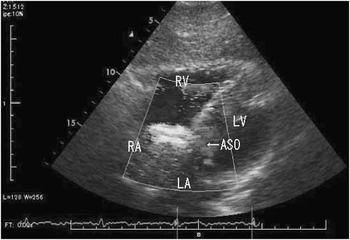
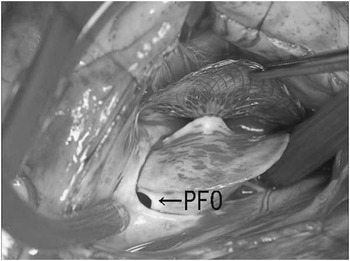
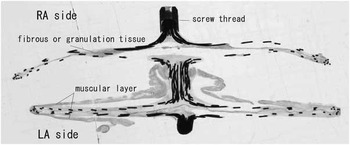
A46-year-old man with migraine was referred to our hospital. Head CT showed no abnormal findings. Transoesophageal echocardiography demonstrated the presence of multiple small atrial septal defects with left-to-right shunting and an atrial septal aneurysm, as well as right-to-left shunting that implied paradoxical cerebral embolism when the Valsalva manoeuver was performed. After cardiac catheterisation, the left-to-right shunt ratio was 1.43. According to his request, transcatheter closure of the atrial septal defects was performed successfully using the Amplatzer septal occluder (St. Jude Medical, St. Paul, MN, United States of America). A month later, however, transthoracic echocardiography showed recurrent left-to-right shunting through the interatrial septum because the Amplatzer septal occluder was vertically tilted (Fig 1). Accordingly, urgent surgery was carried out. At surgery, displacement of the septal occluder was confirmed (Fig 2). Next, the occluder including the thin aneurysmal wall was excised, and autopericardial patch closure of the atrial septal defect was performed. Histological examination demonstrated that the disc of the left atrial side was covered with atrial muscular layer, and the disc of the right atrial side was covered with fibrous or granulous tissue (Fig 3).
Transthoracic echocardiogram showing the ASO with vertically-tilted to the atrial septum because of the displacement due to fragility and hypermobility of the atrial septum. RA=right atrium; RV=right ventricle; LA=left atrium; LV=left ventricle; ASO=Amplatzer septal occluder.

Operative findings; Displacement of the ASO was confirmed, and the surface of the ASO was thinly endothelialized. ASO=Amplatzer septal occluder; PFO=patent foramen ovale.

The disc of left atrial side was covered with the atrial septal muscular layer (resin embedded section with loupe magnification).

Although transcatheter closure of an atrial septal defect associated with an atrial septal aneurysm is one of the therapeutic options, the indication of this treatment should be careful because the septal wall of an atrial septal aneurysm is thin, fragile, and hypermobile. To the best of our knowledge, this is the second case report to demonstrate ground section of the explanted Amplatzer septal occluderReference Sigler, Kriebel and Wilson 1 and the first report in atrial septal aneurysms.
Acknowledgement
The authors gratefully acknowledge Yoko Motomura for her assistance in writing this manuscript.
Financial Support
This research received no specific grant from any funding agency of from commercial or not-for-profit sectors.
Conflicts of Interest
None.
Ethical Standards
The authors assert that all procedures contributing this work comply with the ethical standards of the relevant national guidelines on human experimentation and with the Helsinki Declaration of 1975, as revised in 2008, and has been approved by the institutional committees - St. Mary’s Hospital, Japan.