1 Introduction
1.1 On the scope of phrasal lengthening
Research in phonetics has shown that linguistic prosodic structure affects both articulatory and acoustic quality of segments. For example, acoustic segment length is found to be longer both immediately before and after prosodic boundaries (e.g. Oller Reference Oller1973, Klatt, Reference Klatt1976, Wightman et al. Reference Wightman, Shattuck-Hufnagel, Ostendorf and Price1992). This generalization additionally holds true in the articulatory domain; many studies have shown that segments near a prosodic boundary (and on both sides of the boundary) have articulatory durations longer than like segments far from a prosodic boundary (Krivokapić Reference Krivokapić2007b; phrase-finally: Byrd & Saltzman Reference Byrd and Saltzman1998, Byrd Reference Byrd2000, Tabain Reference Tabain2003, Cho Reference Cho2004; phrase-initially: Byrd & Saltzman Reference Byrd and Saltzman1998, Cho & Keating Reference Cho and Keating2001, Fougeron Reference Fougeron2001, Cho Reference Cho2004). Articulatory lengthening has also been demonstrated to be proportionate to the strength of the boundary; the stronger the prosodic boundary, the more articulatory lengthening has been observed (e.g. Fougeron & Keating Reference Fougeron and Keating1997, Byrd & Saltzman Reference Byrd and Saltzman1998, Keating et al. Reference Keating, Cho, Fougeron, Hsu, Local, Ogden and Temple2004, Cho Reference Cho, Goldstein, Whalen and Best2006, Krivokapić Reference Krivokapić2007b, Byrd & Choi to appear).
The temporal scope of prosodic boundary effects refers to how far removed from the boundary the effects are observed. The temporal scope of boundary effects is relatively unexamined, particularly in articulation. However, there are acoustic studies that have considered this research question. The data from a series of experiments presented in Oller (Reference Oller1973) suggest that non-boundary-final stressed syllables undergo prosodic lengthening when near a prosodic boundary. Work on prosodic lengthening in Hebrew by Berkovits (Reference Berkovits1993a) suggests a ‘far greater proportion of lengthening in the final stressed syllable . . . compared to the initial unstressed syllable’ (p. 95). Berkovits (Reference Berkovits1993b) additionally finds a greater magnitude of prosodic lengthening in stressed environments versus unstressed environments. In another study on the effect of prosodic lengthening on acoustics, in this case in Hebrew, Berkovits (Reference Berkovits1994) finds lengthening in the initial stressed syllable of a boundary-adjacent bisyllabic word, but no lengthening is found for an initial unstressed syllable in a boundary-adjacent bisyllabic word. The study additionally found that lengthening was greater in magnitude for each consonant approaching the boundary. Dutch too has been shown to have preboundary lengthening in stressed syllables not immediately adjacent to the boundary when the syllable immediately adjacent to the boundary contained a reduced vowel (Cambier-Langeveld, Reference Cambier-Langeveld, Coerts and Hoop1997), although both the Berkovits and Cambier-Langeveld studies may not extend necessarily to English.
Work on English by Shattuck-Hufnagel & Turk (Reference Shattuck-Hufnagel and Turk1998) shows that stress can attract lengthening. This study found that while the majority of boundary-related lengthening happened in the syllable immediately adjacent to the boundary, a non-edge-adjacent stressed syllable also underwent boundary-related lengthening, as the lengthening phenomenon extended ‘leftward to include the most prominent syllable in the word’ (p. 1236). Similarly, Turk (Reference Turk, Ohala, Hasegawa, Ohala, Granville and Bailey1999) clearly attributes certain boundary-related lengthening data to the presence of lexical stress. In this study, it was found that phrase-final lengthening was not limited to the boundary-adjacent syllable and can spread leftward if lexical stress is present. Most importantly, it was found that in unstressed boundary-adjacent syllables, no significant lengthening happened; the prosodic lengthening occurred in a stressed syllable removed from the boundary. Finally, Turk & Shattuck-Hufnagel (Reference Turk and Shattuck-Hufnagel2007) present results that reinforce the possibility that stressed syllables removed from the boundary show phrase-final lengthening. This study measuring the acoustic duration of syllables found that phrase-final lengthening occurred most often for boundary-adjacent syllables but that statistically significant lengthening also occurred for the rime of main-stress syllables when these syllables were not adjacent to the boundary. The authors assert that the distribution of ‘boundary-related lengthening . . . cannot be explained without reference to the location of main lexical stress’ (Turk & Shattuck-Hufnagel Reference Turk and Shattuck-Hufnagel2007: 445).
The studies reviewed above focus on the co-occurrence of lexical stress and lengthening in the acoustic domain when a prominent syllable is non-final in the phrase. The interaction of boundary-related lengthening and prominent syllables at an initial phrase edge has not been examined and, to date, few studies in the articulatory domain address the scope of boundary-related lengthening.
Byrd & Saltzman (Reference Byrd and Saltzman1998) find articulatory lengthening in constriction formation duration of an onset consonant in a CV before a prosodic boundary; however more lengthening is found in an onset consonant of a CV immediately following the boundary. Examining linguapalatal contact, Fougeron & Keating (Reference Fougeron and Keating1997) find prosodic lengthening to extend beyond the boundary-initial segment to include other segments in the boundary-initial syllable. Byrd, Krivokapić & Lee (Reference Byrd, Krivokapić and Lee2006) examine articulation across a greater number of syllables and find little articulatory lengthening at a distance. Finally, Krivokapić (2007) finds articulatory lengthening up to two consonant constrictions preboundary and one or two consonants postboundary, with effects waning in magnitude as remoteness from the boundary increases.
However, we are aware of no studies that look explicitly at the interaction of phrasal juncture and prominence in the articulatory domain in syllables not at a phrase edge. Thus, the interaction between prominence and the scope of boundary-related lengthening in articulation remains unclear. It is wise to realize, however, that the interaction of prosody and stress is likely to be language-specific, as Cho & McQueen's (Reference Cho and McQueen2005) acoustic study on phrase-initial effects suggests. The above studies in acoustics and articulation do indicate that the scope of prosodic juncture lengthening is not limited to boundary-adjacent segments and may sometimes extend to gestures remote from the boundary. Below, we present a study specifically manipulating prominence of syllables in the neighborhood of a prosodic boundary in order to better understand the temporal scope of phrasal lengthening. All of the stimuli in the current study contained lexical stress in the target syllable. While pitch accent was not overtly controlled in order to allow for the most natural reading possible, it was the case that all subjects produced pitch accents at this point in the majority of utterances (see section 2 below).
1.2 The π-gesture framework for prosodic influences in speech production
A series of experiments and computational simulation work has led to the development of a computational model of junctural lengthening called the π-gesture (prosodic-gesture) model (Byrd et al. Reference Byrd, Kaun, Narayanan, Saltzman, Broe and Pierrehumbert2000, Byrd & Saltzman 2003, Byrd et al. Reference Byrd, Krivokapić and Lee2006). This framework extends a fundamental insight of Articulatory Phonology's conception of phonological units (e.g. Browman & Goldstein Reference Browman and Goldstein1992) to the prosodic level – namely, the view that linguistic cognitive units of phonological representation are dynamic and temporal in nature, rather than atemporal and symbolic. Within the π-gesture framework, prosodic boundaries are viewed as having a temporal extent or interval of activation. During this interval of activation, a π-gesture acts to slow the pacing of any coproduced constriction activation trajectories. This interval of local slowing or warping of speech rate, which has been shown in computational modeling to yield lengthened articulator trajectories and lessened overlap (Byrd & Saltzman 2003), must, like all gestures, be coordinated with other phonological material.
When the term scope of prosodic lengthening is used in the context of the π-gesture model, it refers to the constriction events in the gestural score that co-occur with the activity of a π-gesture, so consequently, the phonological interval over which the local prosodic slowing can be observed. For the purposes of experimental design and exposition, syllable (or segment) count is often used to quantify scope and we do likewise here. However, we wish to clarify that we do not grant this ‘counting’ any theoretical status. Rather, we assume that scope of boundary effects is defined in terms of the activation intervals and coordination of phonological units in an abstract planning domain (see e.g. Goldstein, Byrd & Saltzman Reference Goldstein, Byrd, Saltzman and Arbib2006). The scope of a π-gesture will be determined by two (potentially interacting) characteristics: first, the particular temporal extent of the π-gesture itself; and second, the coordination or alignment of the π-gesture with the constriction events in the neighborhood of the boundary. As has been reviewed above, the experimental data to date suggest that the scope of the π-gesture or prosodic lengthening is not large and is relatively local to the boundary. It remains to be seen, however, whether qualitative properties of the phonological units near the phrase edge (such as prominence) can under certain circumstances influence the scope of articulatory phrasal lengthening.
1.3 Experimental investigation
Given previous research, it is expected that segments immediately adjacent to the boundary will exhibit longer durations than segments remote from a boundary. Byrd et al. (Reference Byrd, Krivokapić and Lee2006) did not find consistent temporal lengthening in gestures in unstressed positions remote from the boundary. However, it is uncertain whether gestures located in syllables that are somewhat removed from the phrase edge but which are prominent may be affected by prosodic lengthening. That is, it is unknown whether (and under what conditions) constrictions that occur in segments near, but not strictly local to the boundary, will exhibit longer durations than similar ones phrase-medially.
Below we present a kinematic articulatory study on consonant production conducted using magnetometry. This experiment investigates whether or not boundary-related lengthening is strictly local, i.e. edge-adjacent, or may be attracted toward syllables somewhat remote from the boundary. In particular, boundary-related lengthening may be sensitive to the presence of prominent syllables that are not immediately at the phrase edge. We manipulate this prominence by placing lexically stressed syllables at varying distances from the phrase edge. These syllables are both rhythmically strong and are also a potential locale for pitch accent. Overall they can be expected to allow us to observe the effects of prominence on boundary-related articulatory lengthening.
Empirically, this is of interest for understanding possible patterns of articulatory lengthening at phrase boundaries. Additionally, it is of further theoretical relevance for the π-gesture model of phrase boundaries. We wish to understand whether or not it is possible for the π-gesture to be temporally coordinated with tract-variable gestures not only immediately local to the boundary but also attracted to constrictions removed from the boundary in the presence of prosodic or metrical prominence. Such an attraction would potentially engender prosodic lengthening of articulatory events somewhat removed from the phrase edge.
The current study examines this research question using articulatory data from three subjects for labial and lingual constriction gestures both pre- and postvocalically and pre- and postboundary, as well as looking at their coordination in the syllable. Importantly, the speakers produced sentences with an un-instructed prosody so that the effect of prominence in general could be observed without eliciting unusual or exaggerated focus, such as emphatic focus or instructed focus placed on certain lexical items.
2 Method
Electromagnetic articulography (Carstens AG200 EMA system) was used to record the motion of sensors adhered to articulators. Transducers were adhered to the articulators of interest: the lips (at the vermillion border) and the tongue tip (approximately 5 mm from the endpoint of the protruded tongue). The sampling rate for the articulatory data was 200 Hz, and the simultaneous audio data was captured at a sampling rate of 16 kHz. Head-movement correction was applied to the data by using transducers adhered to the maxilla and bridge of the nose; for each subject, data was rotated to the sampled occlusal (or bite) plane to define the x–y coordinate system.
2.1 Subjects and stimuli
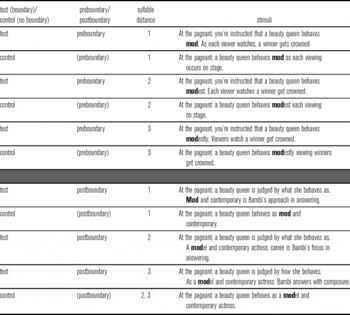
The consonants that were of interest in the current study were [m] and [d]. These consonants appeared in the syllable ‘mod’. This syllable occurred in six different test conditions having an IP boundary: one syllable away from the boundary (i.e. in the syllable immediately adjacent to the phrase edge), two away, and three away, both before (preboundary) and after (postboundary) an IP boundary. Recall that the position of the lexically stressed syllable with respect to the phrase edge was the independent variable of primary interest. Control sentences contained ‘mod’ in identical segmental contexts as the test sentences but lacked the phrase boundary occurring in the test sentences; that is, ‘mod’ in the control sentences was phrase-medial. To manipulate stress placement, preboundary the words ‘mod#’, ‘modest#’, and ‘modestly#’ were used, and postboundary, the strings ‘#mod,’ ‘#a model’ and ‘#as a model’ were used. Stimulus sentences were controlled for segmental composition surrounding the target consonants. The stimuli are given in table 1. Each test sentence is paired with a control sentence having the same target word string, but differing only in the presence of a boundary.
Stimuli sentences (bolding was not present for the subjects).

Notice that for the postboundary condition, test sentences 2 and 3 (i.e. having the stress in the second and third syllable after the boundary) are paired with the same control sentence since the target word string was identical in both these sentences (only boundary placement differed, which was, of course, irrelevant in the control sentence having no boundary). One other point to note is that above we refer to ‘mod’ as a syllable, however when this string of segments occurs in the word ‘model’ and ‘modestly,’ the [d] might be considered as phonologically syllabified as an onset of the second syllable or as ambisyllabic. This status is not crucial to the experimental hypothesis as it is the canonical order of the consonants and thereby their distance from the boundary that is of interest. So while we may refer to [d] as marking the end of the test syllable ‘mod’, what is experimentally important is that the test sentences always matched their paired control sentences in this regard and with respect to stress placement. In summary, the experimental stimuli have segmental context tightly controlled, allowing prosodic effects to be interpreted directly as the result of boundary presence/absence and the position of a prominent syllable with respect to that boundary.
In this report, we use the term prominence as a cover term to refer to the presence of either lexical stress and the possible additional presence of a pitch accent. In order to provide a more detailed view for the reader of the pitch accent and break indices of these sentences as read by our subjects, the token that informal listening determined to be most like its other repetitions for each subject was selected for transcription by a ToBI-trained transcriber. (Note that the productions across repetitions were very consistent.)Footnote 1 In general, the test sentences always had a bigger boundary than the control sentences; the control sentences generally ranged from no boundary to an ip boundary, and the test sentences always had an IP boundary.
Three subjects were recorded, all were native speakers of American English without any known speech or hearing deficits. The subjects are denoted below as A, L, and S. Subjects A and L read eight randomized test blocks and eight randomized control blocks. Subject S read seven randomized test and control blocks. Randomizations differed for each subject and block. Test blocks contained six sentences, and control blocks contained five sentences. Thus, a total of 88 sentences were recorded for subjects A and L, and 77 sentences were recorded for subject S. Test and control sentences were put into separate blocks so as to minimize within-condition prosodic variability in the readings; this blocking creates a situation in which a subject's choice of prosody for a written sentence is consistent across observations.
Recall that lexical stress or rhythmic prominence in these sentences was allowed to interact naturally with pitch accent or prominence in order to examine the general effect of (uninstructed) prominence on the boundary-related lengthening. The lexically stressed syllable in both control and test sentences was eligible to receive a pitch accent. And, indeed, all speakers placed a pitch accent on this rhythmically prominent syllable in all 33 sentences with only three exceptions – preboundary in A's 3σ control and postboundary in A's and L's 2/3σ control sentences.
2.2 Data analysis
The first order derivatives (velocity trajectories) of the articulator position trajectories were used to identify important kinematic landmarks in the consonant ([m] and [d]) constriction formation. These trajectories were smoothed with a 15-Hz low-pass filter. Different signals were used for the two test consonants. For the [m], Lip Aperture – the Euclidian distance between transducers on the upper lip and lower lip – was calculated as the relevant trajectory. Velocity zero crossings and extrema were algorithmically identified, using MView (under development, M. Tiede) in Matlab. For the [d], the horizontal (x) and vertical (y) transducer movement was used to calculate tangential velocity (which incorporates movement in both dimensions; as detailed in Löfqvist, Gracco & Nye Reference Löfqvist, Gracco and Nye1993), for which minima and maxima were identified; tangential velocity minima being the critical indicator of gesture edges.
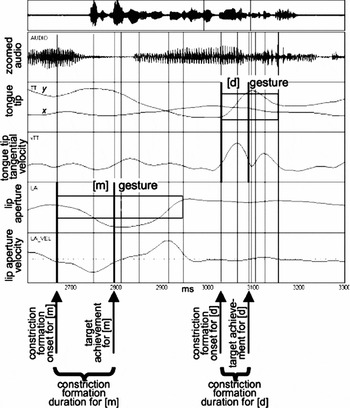
Two kinematic landmarks of both gestures were of importance for the current study. The first was the constriction formation onset. Constriction formation onset was defined in the bilabial gesture as the first velocity zero-crossing in the Lip Aperture trajectory. A criterial threshold of 2% of the range between the local velocity maximum and minimum local velocity was used to define the departure from zero-velocity for all measures used here. For the tongue tip gesture, constriction formation onset was defined by the timepoint of tangential velocity minimum (the same 2% threshold setting was used for tangential velocity minima). The second kinematic landmark that was of importance was the timepoint of target achievement for the constriction, which was defined as the second thresholded velocity zero-crossing (for Lip Aperture) or tangential velocity minimum (for Tongue Tipxy). An example of the kinematic marking procedure is shown in figure 1.Footnote 2
An example token demonstrating the data marking procedure (‘. . . as mod a[nd] . . .’). Note that while thresholded velocity events were used to determine these timepoints, the markings are shown in both the velocity and position panels.

The labial information for subject L had to be excluded for certain conditions for the reason that too few tokens were acceptable for data analysis. This is because the speaker either had a large amount of co-articulation between the labial gestures in [v] and [m] in the sentences resulting in a single continuous movement, or multiple peak velocities during that movement, not allowing an independent onset/target for the [m] to be observed.Footnote 3
From these two timepoints for constriction formation, two dependent variables were calculated:
• Constriction Formation Duration: The time (ms) from constriction formation onset to constriction target achievement;
• Delta Peaks: The time (ms) from [m] constriction target achievement to [d] constriction target achievement.
Since it reflects the coordination of the ‘mod’ sequence's initial and final consonant constrictions, the delta peaks variable also serves as an indirect indicator of syllable duration.
Unpaired, one-tailed t-tests were conducted to compare means of test versus control conditions, separately for each subject, with a criterial p-value set at p < .05. The one-tail was chosen because previous research on articulation and prosody suggests that significant articulatory lengthening and overlap decrease are expected for the boundary (test) condition as compared to the non-boundary (control) condition.
3 Results
3.1 Preboundary constriction formation duration
A comparison of means in the boundary condition versus the non-boundary condition was conducted for the constriction formation duration for [m] in the string ‘mod’ before the intonational phrase boundary. (Recall that subject L's [m]'s could not be analyzed here.) Before the boundary, there was no significant lengthening for any subject in any position (one, two, or three syllables away from the boundary) for the [m] in ‘mod’, ‘modest’ or ‘modestly’.
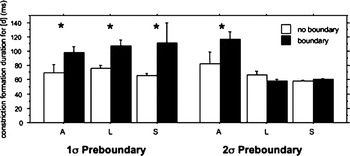
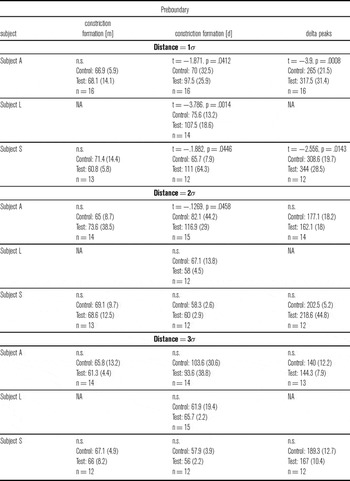
In contrast, and as predicted from early findings on prosodically driven articulatory lengthening, the [d] consonant in the syllable ‘mod’ that occurs immediately at the phrase edge showed significant lengthening of the constriction formation for all three subjects as compared to the non-boundary (control) condition (A: t(14) = −1.871, p = .0412; L: t(12) = −3.758, p = .0014; S: t(10) = −1.882, p = .0446).Footnote 4 When the test syllable occurred at a distance of two syllables away from the boundary, i.e. ‘modest#’, one subject, A, had constriction formation lengthening relative to the non-boundary control (t(13) = −1.822, p = .0458). When [d] was at the end of the third syllable away from the boundary, the constriction formation of this tongue tip gesture did not show lengthening for any subjects. Thus in summary, the preboundary prosodic lengthening effect was tightly linked to the edgemost articulation and did not tend to ‘travel’ further preboundary as a function of prominence placement, though one subject did show an influence at the two-syllable distance. The pattern of means for preboundary [d] constriction formation duration is shown in figure 2, and cell-by-cell information for the preboundary condition is given in table 2.
[d] constriction formation duration in the 1 syllable and 2 syllable preboundary condition.

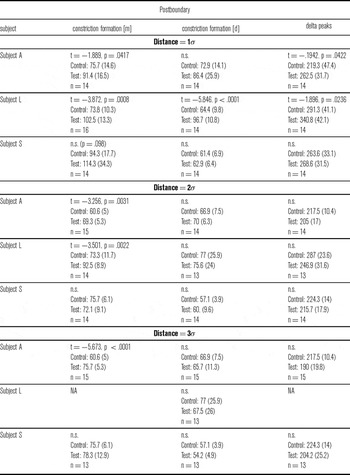
Cell by cell means and t-test results for the preboundary condition (n.s. indicates not significant; NA indicates an insufficient number of tokens for analysis; n = test n + control n).

3.2 Postboundary constriction formation duration
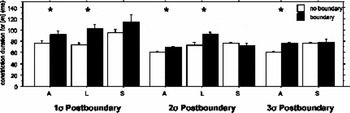
When the ‘mod’ syllable occurred after the boundary, the [m] was then the consonant constriction closest to the phrase edge. In this postboundary case, two of the three subjects showed lengthening of [m] constriction formation duration in the position 1 (boundary-adjacent) comparison (A: t(12) = −1.889, p = .0417; L t(14) = −3.872, p = .008). When [m] occurred in a stressed syllable located two syllables away from the boundary, i.e. with an intervening stressless syllable ‘#a mod. . .’, the same two subjects also showed lengthening in the constriction formation duration of the bilabial constriction (A: t(13) = −3.256, p = .0031; L: t(12) = −3.501, p = .0022). Finally, when the test syllable occurred three syllables after the phrase edge, i.e. ‘#as a mod. . .’, subject A showed lengthening of the constriction formation of [m] in the boundary condition as compared to the control non-boundary condition (t(13) = −5.673, p < .0001). (Too few tokens were available for use in the 3 syllable condition for subject L's [m]s for a t-test to be considered.) The constriction formation results for postboundary [m] are shown in figure 3.
[m] constriction formation duration in the 1, 2, and 3 syllable postboundary condition.

When considering the more remote [d] constriction in the postboundary condition, only one of the t-tests for one subject and one condition was significant. Only subject L had lengthening, and this lengthening only occurred in the constriction formation for [d] located in the syllable immediately adjacent to the boundary (t(12) = −5.846, p < .0001). The other subjects showed no postboundary lengthening of the [d] constriction formation. Cell-by-cell information for the postboundary condition is given in table 3.
Cell by cell means and t-test results for the postboundary condition (n.s. indicates not significant; NA indicates an insufficient number of tokens for analysis; n = test n + control n).

3.3 Summary of constriction formation duration results
The postboundary results for ‘mod’ mirror the pattern of preboundary results for ‘mod’ in that the consonant closest to the boundary (i.e. the [d] on the preboundary side and the [m] on the postboundary side) show boundary-related lengthening when at the phrase edge. Consonants in prominent syllables further away from the boundary are less likely to exhibit prosodic lengthening, although, this may occur asymmetrically for consonants in a postboundary prominent syllable.
When such a prominent syllable occurs after but relatively close to a boundary, it may exhibit prosodically-driven articulatory lengthening. Note that ‘a’ and ‘as a’ in the postboundary condition are extremely short intervening unstressed syllables. For one subject (subject A), boundary-related lengthening of the onset of the prominent syllable occurred as many as three syllables after from the phrase edge, and another subject (L) showed this pattern two syllables away. In the preboundary case however, there was much more modest evidence of a prominence effect. While all subjects showed lengthening of an immediately preboundary [d], only one showed such lengthening when this consonant occurred at a position one syllable removed from the phrase edge. It is possible that this pre-/postboundary difference may be because in the preboundary condition the intervening syllables (‘est’ and ‘estly’) are longer (simply by virtue of containing more phonological material).
3.4 Delta peaks
The third dependent variable examined in the current study was the temporal interval between the achievement of the constriction target in [m] to the achievement of the constriction target in [d]. This, we mentioned, is an indirect measure of articulatory syllable duration because it reflects the coordination between the two consonants in the ‘mod’ string (and likely is influenced by their coordination(s) with the vowel, as well).
The results indicate that this variable is only affected by the boundary context when the target string occurs immediately adjacent to the boundary. Significant results occur for this syllable condition in both the preboundary context and the postboundary context. For the preboundary condition, only subjects A and S could be included. At position 1, both speakers showed boundary-related lengthening of delta peaks (A: t(14) = −3.900, p = .0008; S: t(10) = −2.556, p = .0143). In the postboundary condition at position 1, subjects A and L had a longer time between the targets for [m] and [d] than when no boundary occurred (A: t(11) = −1.896, p = .0422; L: t(12) = −2.210, p = .0236). No subjects showed lengthening for this variable in the conditions further away from the boundary, on either side of the boundary. Cell-by-cell information is given in tables 2 and 3. In summary, the delta peaks variable for the ‘mod’ string only showed an influence of phrasal structure when this string was at a phrase edge.
4 Discussion
In summary, boundary-related articulatory lengthening of consonants adjacent to the boundary and of the articulatory interval spanning the consonants (delta peaks) for a boundary-adjacent syllable was prevalent, as has been found in other articulatory studies. Further, the current study was intended to investigate the question of whether prosodic lengthening occurs in prominent syllables at a distance removed from the boundary. To a degree, the answer to this question is subject dependent. Subject S never showed lengthening beyond the syllable immediately at the phrase final or initial edge; however, consonant constriction lengthening for the other two speakers did show some sensitivity to stress at a small remove from the boundary. Before the boundary, this lengthening was observed for one subject for the final constriction in the lexically stressed test syllable preceding the phrase-edge syllable, and after a boundary it was observed for two subjects for the initial constriction formation in the test syllable following the phrase-edge syllable.
The lack of wide scope effects for Speaker S merits a further comment. This subject's preboundary 2σ and 3σ control sentences had an intonationally marked break that the other subjects did not. Of course, the boundary at S's paired test sentences was clearly much larger; however the presence of a noticeable break in the control sentence likely minimized test versus control differences in these two cells.
Results from subjects A and L above suggest that syllable stress and its prosodic consequences can in a limited way attract lengthening in positions removed from the local phrase edge. In another articulatory study of prosodic scope, Byrd et al. (Reference Byrd, Krivokapić and Lee2006) investigated boundary-related lengthening in positions removed from the boundary. It was found that prosodic lengthening other than immediately local to the boundary was scarce (and in some cases, postboundary articulatory shortening occurred after edge-adjacent lengthening.) However, the present study differs from Byrd et al. (Reference Byrd, Krivokapić and Lee2006) in that the target sequence was prominent by virtue of bearing lexical stress and generally pitch accent and having short unstressed syllables intervening between the prominent target syllable and the phrase edge. The asymmetry observed here between the pre- and postboundary conditions is interesting in that Krivokapić (Reference Krivokapić2007a, Reference Krivokapićb) has suggested that pausing phenomena at phrasal junctures is sensitive to upcoming phonological and prosodic structure for the purpose of speech planning. The present study might also be taken as a hint that planning influences the properties of a junctural prosodic (π-)gesture.
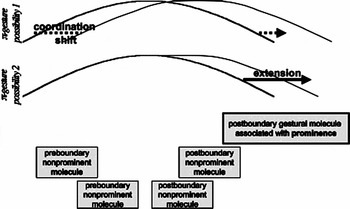
If further studies confirm the weak findings here that junctural lengthening is or can be sensitive to other prosodic events in the vicinity of the boundary, two possible interpretations of this sensitivity within the π-gesture model (Byrd & Saltzman 2003) of phrasal lengthening arise as possibilities. The first possible interpretation is that prosodic patterning of the nearby phonological constriction events influences the relative temporal organization of the activation interval of the π-gesture with respect to those constriction events. A π-gesture (of some particular fixed activation interval) could shift in a limited way in its coordination, effectively attracted in the direction of a locally stressed or pitch-accented syllable. This possibility is shown in the top panel of figure 4 for a situation having a postboundary prominent syllable, with the designation ‘coordination shift’ account.
Two possible π-gesture organizations in the presence of a prominent phonological event.

The second possibility concerns not the coordination of the π-gesture but rather its temporal extent relative to the constriction gestures. The π-gesture edge, i.e. its beginning or end of activation, could be attracted toward – ‘reach out’ toward – an alignment with a local primary-stressed or pitch accented syllable. An example of this is shown in the second panel in figure 4 for a situation having a postboundary prominent syllable, with the designation ‘extension’ account. Under this scenario, the phrasal lengthening simply lasts or persists longer in time.
It is possible that scope effects on phrasal lengthening in articulation, whether implemented via coordination shift or extension, could be asymmetrical. There may be planning reasons why a π-gesture may be more likely to remain active longer to influence a postboundary prominent syllable than to reach backwards from a final phrase edge to start earlier. However, one subject in this study did show the effect for both pre- and postboundary syllables.
The results presented above allow us to lay out these two possibilities, but further empirical work will be necessary to differentiate them. The shift account, but not the extension account, predicts that there will be a trading relation in that the presence of a prominent syllable near a boundary and attracting the π-gesture will decrease the magnitude of the lengthening exhibited by the syllables at the opposite edge of the π-gesture. This is because, if the π-gesture for example shifts rightwards (as shown in figure 4, though the reverse arrangement is of course possible), the gestures early in the π-gesture's field of activation would become coproduced with a portion of lesser activation of the now-shifted π-gesture. In contrast, under the extension account, constriction lengthening away from the prominent syllable would not change in magnitude, but the overall amount of boundary-induced lengthening would be predicted to increase. (This could be quantified perhaps by integrating under the FDA time-deformation functions outlined in Lee, Byrd & Krivokapić Reference Lee, Byrd and Krivokapić2006.) Finally, while both accounts could be consistent with the finding that constrictions between the phrase edge and the prominent material lengthen, the extension account would require such a finding; while the shift account, if the shift were dramatic enough and the π-gesture brief enough, could accommodate a situation in which intervening unstressed material showed little or no lengthening. The present study suggests the need for such a follow-up examination of the articulation of intervening unstressed material at a boundary. Such studies are currently underway in our laboratory.
Importantly, regardless of whether it is the edge-extension or coordination-shift account that receives future experimental support, the results presented above suggest the importance of further empirical data addressing the possibility that the temporal activation pattern of π-gestures – or equivalently the temporal pattern of local-rate-warping at prosodic boundaries – is not always limited to phrase-edge-adjacent articulations. Articulatory results from Krivokapić (Reference Krivokapić2007b) on the scope of boundary lengthening even in the absence of prominence suggest likewise. Prosodic properties such as lexical stress and pitch accent of the phonological material in the vicinity of a phrase edge may be relevant to the scope of prosodic lengthening at a phrase boundary.
Acknowledgments
The authors gratefully acknowledge the help of Sungbok Lee, Jelena Krivokapić, and Mark Tiede, the comments of Adrian Simpson and an anonymous reviewer, and the support of NIH grant DC03172.