

1 Introduction
In 2018, the National Highway Traffic Safety Administration (NHTSA) announced its approval of the “rear visibility” regulation, originally issued in 2014, during the prior administration (Szathmary, Reference Szathmary2018). In brief, the regulation requires all new motor vehicles to be equipped with cameras that allow drivers to see what is behind them. In 2014, NHTSA announced that “systems fulfilling the requirements adopted by today’s final rule are the most effective and the most cost-effective systems available for meeting the safety need specified” by Congress and “also afford the best protection to children and persons with disabilities” (79 Fed. Reg. 19,178 2014). It is worth noting what the agency chose to emphasize, and what it chose not to emphasize. NHTSA said that of the various options, cameras were the most effective and the most cost-effective, and that they would best protect members of vulnerable groups. It did not say that the benefits of the rule justified the costs.
In embracing the 2014 rule, the Deputy Administrator of NHTSA broadly stated, “This technology helps drivers see behind the vehicle, which we anticipate will help save lives and prevent injuries” (Szathmary, 2018; see also 79 Fed. Reg. 19,178, 2014). It is significant that in the Trump Administration, NHTSA explicitly endorsed an expensive regulation issued by the Obama Administration; the former has not been especially reluctant to revisit regulations issued by the latter.
With the Deputy Administrator’s statement, the long debate over rear visibility appears to have come to an end. For many reasons, the saga is extremely revealing. I emphasize three problems here. First, the grant of authority to NHTSA is remarkably open-ended; indeed, it is difficult to find in it any kind of “intelligible principle,” which is usually required by U.S. constitutional law. Second, on standard assumptions, it is challenging to identify a market failure, justifying the regulation. Consumers could demand rearview cameras; if the market was not supplying them, where is the problem? To be sure, there are externalities, but as we shall see, it is not clear whether they are sufficient to justify the mandate.
Third, the monetized costs of the regulation far exceeded the monetized benefits (according to the agency's own account). The agency drew attention to a set of benefits that it declined to quantify. It would have done far better to engage in “breakeven analysis,” showing that even at a lower bound, the unquantified benefits would justify the rule on cost-benefit grounds. With this claim, I mean to suggest the importance of breakeven analysis in regulatory analysis, and also to suggest the need to ensure that breakeven analysis is as disciplined as possible. I also mean to signal the value of learning enough to quantify and monetize the values that the agency found unquantifiable, including the lives of young children.
I will explore all of these problems here, with particular emphasis on the third, but my main interest lies elsewhere: rearview cameras count as “experience goods”; people do not know their value until they have had experience with them (Nelson, Reference Nelson1970; Laband, Reference Laband1991; Frost et al., 2008). In the domain of regulation, a great deal of attention has been paid to asymmetric information (see, e.g., Morse, Reference Morse1980; Becher, Reference Becher2008; Akinbami, Reference Akinbami2011), which may call for disclosure remedies or even mandates and bans. By contrast, no attention appears to have been paid to the possibility that regulatory benefits will produce experience goods, and for that reason increase social welfare. At least in principle (and this is my main point), that possibility should be taken to carve out a distinctive category of justifications for regulation. But the size of the category is uncertain, and there are prudential reasons, rooted in an appreciation of the risks of government error, for public officials to proceed with caution here.
To clarify the central claim, rearview cameras in motor vehicles confer significant benefits on drivers, but market pressures do not sufficiently register those benefits. One reason might be the distinctive nature of the motor vehicle market. Motor vehicles have numerous attributes, which are bundled together. Some relatively minor attributes, even if desirable and hardly unimportant, might not loom large enough in consumers’ minds to shift their choices in a way that affects manufacturers’ decisions. The larger and more intriguing problem is that many drivers cannot easily anticipate the welfare effects of certain products and product characteristics. Call it a problem of limited foresight, and it has an identifiable source.
Under plausible assumptions, this problem can produce a market failure, and an important one, but not of a standard kind. When experience goods are involved, there might be a distinctive ground for federal regulation, plausibly justified on welfare grounds, but not adequately captured in ex ante estimates of costs and benefits. The word “might,” in the foregoing sentence, is extremely important. Countless goods are experience goods, and even if the experience of experience goods is good, regulators usually should not mandate them. We would need a particular kind of welfare analysis in order to justify a mandate. I will suggest that in the context of the rear visibility rule, the required justification is more than plausible.
To bring the idea of experience goods in contact with a prominent psychological finding, there is often a difference between “decision utility” and “experienced utility” (Kahneman & Thaler, Reference Kahneman and Thaler2006). At the time of decision, people may make a welfare judgment, or prediction, that does not capture their welfare at the time of experience. For example, people might think that a bad outcome (a physical disability, a denial of tenure) will have a larger negative impact on experience than it actually has, or that a good outcome (an economic gain, a grant of tenure) will have a larger positive impact than it actually has (Sunstein, Reference Sunstein2008a). If rearview cameras are experience goods, and even putting one side the benefits that NHTSA identified but refused to quantify, the regulation might be justified on welfare grounds even if (according to standard measures) the monetized benefits are significantly lower than the monetized costs.
A survey, conducted in 2019 and reported here, supports this conclusion, finding that as many as 94 % of consumers would demand more to give up rearview cameras than they have to pay for them. The survey also finds that those who value such cameras the least are far less likely to have experience with them, further supporting the conclusion that for drivers who have not had rearview cameras, there is a disparity between decision utility and experienced utility. That disparity has general implications for federal regulation, suggesting that ex ante willingness to pay figures may understate ex post welfare benefits. Consider, for example, regulations designed to restrict the amount of time that airlines may keep consumers on the tarmac (U.S. Department of Transportation, 2015), or fuel economy regulations that reduce the number of times that drivers have to go to the gas station (U.S. Environmental Protection Agency, 2012). In both cases, and many others involving experience goods, there might be an unusual market failure akin to that described here. I will sketch the basic category while also offering some cautionary arguments about its use by public officials.
2 A death and a statute
We begin with a tragedy. In 2002, Cameron Gulbransen was a happy, smiling 2-year-old boy One day, his father decided to back his SUV into the driveway. (In the morning, the street tended to be filled with children and people walking dogs.) As always, he used his side view mirrors and the rearview mirror, and also looked over his shoulder in an attempt to avoid hitting anything. But as he backed in, he heard a small bump and was not sure what it could have been. As it turned out, it was Cameron, who was lying down with his blanket in his hand while bleeding profusely from his head. Cameron died shortly thereafter.
Five years later, Congress enacted the Cameron Gulbransen Kids Transportation Safety Act of 2007 (49 U.S.C. 30111 2008). The central provision of the Act states its purpose and provides a deadline: “Not later than 12 months after the date of the enactment of this Act, the Secretary shall initiate a rulemaking to revise Federal Motor Vehicle Safety Standard 111 to expand the required field of view to enable the driver of a motor vehicle to detect areas behind the motor vehicle to reduce death and injury resulting from backing incidents, particularly incidents involving small children and disabled persons” (49 U.S.C. 30111 2008, §2).
In a plain grant of discretion, the Act authorizes (without requiring) the Secretary to “prescribe different requirements for different types of motor vehicles to expand the required field of view” (49 U.S.C. 30111 2008, §2). It is possible that different requirements would be reasonable if (for example) cameras had more value on vehicles with substantial ride height than on traditional sedans and compact cars (perhaps because owners of substantial ride-height vehicles are more likely to have young children and perhaps because the need for additional visibility might be greater because of the ride height). In a further grant of discretion, it states that any standard “may be met by the provision of additional mirrors, sensors, cameras, or other technology to expand the driver’s field of view” (49 U.S.C. 30111 2008, §2).
With respect to timing, however, the Act has a degree of rigidity, requiring issuance of a final standard “not later than 36 months after the date of enactment of this Act” (49 U.S.C. 30111 2008, §2). But it also authorizes the Secretary to determine “that the deadlines applicable under this Act cannot be met,” in which event he must establish new deadlines and “notify the Committee on Energy and Commerce of the House of Representatives and the Committee on Commerce, Science, and Transportation of the Senate” of those new deadlines with an account of “the reasons the deadlines specified under this Act could not be met” (49 U.S.C. 30111 2008, §4).
In that sense, the Act has an unusual structure. Like many other statutes, it obligates the executive to meet a deadline (and thus overcomes its power of priority setting and time management). But unlike most such statutes, it allows the Secretary not to meet the deadline so long as he offers a public statement of reasons (apparently, but not self-evidently, with judicial review for arbitrarinessFootnote 1).
We can see the Cameron Gulbransen Kids Transportation Safety Act as a testimony to the power of the availability heuristic, by which people assess questions of probability of asking whether examples readily come to mind (Tversky & Kahneman, Reference Tversky and Kahneman1973). The name of the statute itself suggests that it was a response to a particular event. To be sure, the name is hardly decisive; perhaps Congress used a particular tragedy to add emotional salience, and particularity, to a problem that it had investigated with care. Congress undoubtedly knew that backover crashes occur and that they sometimes end in tragedy. But what else did Congress know? What did it know about costs and benefits?
From the evidence of the Senate Committee Report, it knew some important things (U.S. Senate Committee on Commerce, Science, and Transportation, 2008). (I bracket for now the meaning of the word “it” in this sentence.) With respect to costs, the Congressional Budget Office had provided Congress with some help, suggesting that total expense could be in the billions, because “it would cost vehicle manufacturers approximately $350 per car to install the equipment that would best enhance rearward visibility” (U.S. Senate Committee on Commerce, Science, and Transportation, 2008, p. 5) If we estimate that 17 million vehicles are sold annually in the USA, the total annual cost of the rule would be in excess of 5 billion. (As we shall see, the CBOs cost estimate turns out to have been wildly inflated. If the companies sincerely overestimated the cost, that overestimate might itself be the reason that rearview cameras were not installed. The companies might have simply been mistaken about the cost. It would remain, of course, to explain the companies’ error.)
Having asked NHTSA, Congress also had some information about the question of effectiveness, but that information was quite vague. For example, “The data the NHTSA received reported that sensor-based warning systems were generally able to detect adult pedestrians but were lacking in their ability to consistently detect child pedestrians. The report stated that camera systems performed well visually in daylight and indoor lighted situations, but required drivers to be able to quickly and accurately interpret the video information to be effective” (U.S. Senate Committee on Commerce, Science, and Transportation, 2008, p. 3) A reasonable member of Congress might be baffled by this information. Apparently, sensor-based systems do not detect children – and children were a central focus of the statute. And what on earth is meant by the phrase “were lacking in their ability to consistently detect child pedestrians”? Can numbers be assigned to this “lacking”? Apparently, cameras can work during the day, but require quick and accurate interpretation by drivers. That requirement is self-evident. The real question is simple: Are drivers capable of that? NHTSA did not say. Perhaps it did not know.
As far as the record shows, no one in Congress, and no one consulted by Congress, answered such questions, or did anything like a formal assessment of the likely consequences, including a comparison between costs and benefits. Of course, and regrettably, that is not so unusual; formal assessments of costs and benefits are rare within Congress. Much more remarkably, Congress did not even specify a rule of decision. This is highly unusual, and it raises an issue to which I will turn shortly. But the Senate Committee Report suggests that an exceedingly large expense was anticipated. Congress therefore had some general information, suggesting that cameras could be effective but that they would also be costly. At the same time, we might question in what sense it is fair to say that “Congress,” as such, understood that point. How many members of Congress knew about that possibility? How many of those who strongly supported the Act knew about it? While writing this article, I asked such questions to one member of Congress, an extremely intelligent and hardworking Senator, who had been there for enactment of the Act. He had no idea what I was talking about. He did not even recall the legislation.
These points raise the larger problem: Why, exactly, did Congress fail to specify anything like a rule of decision, or even standards, by which to cabin the discretion of the executive branch? What Congress appears to have done here is to say: “Here is a problem. Now fix it.” It seems to have done that without giving the executive branch criteria by which to decide what kind of fix would be best. Perhaps that particular question never occurred to relevant members. Perhaps members never even asked about appropriate standards.
Or perhaps they did ask that question, but thought better about trying to enact any answer into law. A cost-blind standard would run into obvious and convincing objections: Should the Department really insist on safety standards that would cost a great deal (billions of dollars?) but generate only modest safety benefits? Would a $5 billion expenditure be justified in order to save (say) 10 lives? In principle, there is much to be said for cost-benefit balancing, but with respect to the lives of young children, could that approach command a consensus within Congress? Would it be acceptable to value a child’s life, implicitly or explicitly, at $9 million, or $20 million, or $40 million? From the standpoint of political self-interest and consensus-building, a standard-free statute would have broad appeal.Footnote 2
There is a further problem. Notwithstanding what the Senate Committee Report learned from NHTSA and the CBO, it is fair to suspect that most members of the enacting Congress had little or no information about the problem. They might have known about Cameron Gulbransen, to be sure, and perhaps about other tragic cases, but they did not have anything like detailed information about possible technologies, their likely effectiveness, and their costs and benefits. In these circumstances, the “fix the problem” approach might seem to be attractive.
One final question: If the Act allows the Department a great deal of room to maneuver, does the Administrative Procedure Act (APA) impose constraints on the Department’s discretion? Does it require consideration of costs? Of course, the APA forbids action that is “arbitrary” or “capricious.” We could well say that some decisions about rear visibility would run afoul of that prohibition – perhaps by imposing large costs for modest benefits, perhaps for failing to obtain significant benefits for low costs. Under Michigan v. EPA (2015), it would appear clear that an agency must weigh advantages and disadvantages, and at least make some comparison between the two. The Court has not squarely resolved the question whether and when the arbitrary or capricious test, all on its own, requires the executive to consider costs, and exactly how; but the Michigan case gives a very strong signal that cost-benefit balancing, of one or another kind, will be mandatory. As we shall see, the rear visibility problem raises challenging questions about what such balancing might entail.
3 The executive branch, 1: From enactment to proposal
Now imagine that you are working at NHTSA. Your initial questions ought to be: What, exactly, has Congress directed you to do? How much discretion do you have? It is clear that whatever the answer, you have to do it by a specific date, or explain why that date proved not to be feasible. It is also clear that whatever you do, you “must expand the required field of view” to allow drivers to “detect areas behind the motor vehicle,” with the goal of reducing backing incidents, “particularly involving small children and disabled persons.” So far, perhaps, so good.
At the same time, you seem to have a great deal of discretion. You are authorized to consider “additional mirrors, sensors, cameras, or other technology.” Apparently, you can pick one of the three enumerated options, or select a fourth. You can “prescribe different requirements for different types of motor vehicles.” The latter provision seems to disable you from choosing to prescribe no requirements – but on the face of the statute, the available options appear to have a wide range. You could require all motor vehicles to have cameras, or sensors, or additional mirrors. Or you could require some types of vehicles – say, trucks – to have cameras, while requiring all others to have additional mirrors. You could mix and match.
3.1 Options
If your options have such a wide range, you might immediately ask: What is my rule of decision? How should you choose among the alternatives? As we have seen, Congress did not say. From the fabric of current regulatory law and practice, you might wonder about these possibilities:
(i) A safety-based, cost-blind standard, which would require the technology most likely to improve safety, at the highest level of stringency. This approach would, in a sense, simplify the regulatory inquiry. The question would be: What technology would be best, in terms of reducing relevant risks? Note that under this approach, the statute would be “technology-forcing.” It would authorize the agency to require companies to install technology that may not now exist.
(ii) Same as (i), but subject to a constraint of technological feasibility. Under this approach, regulators would not consider costs, but they would have to ensure that the technology is “feasible” to do what they are requiring. They would not consider costs in any way; they would not balance costs against benefits; they would not even entertain the question whether the regulation is economically feasible (bracketing the question of what that means).
(iii) Same as (i), but subject to a constraint of economic as well as technological feasibility. Regulators might be constrained not only by what is technologically feasible but also by economic feasibility. This idea is opaque, but it usually refers to significant adverse effects on businesses – in the extreme cases, to a large number of business failures. Agencies have enjoyed a degree of flexibility in understanding the idea of feasibility, but it does not refer to cost-benefit balancing (Masur & Posner, Reference Masur and Posner2010). A regulation might be feasible even if its costs greatly exceed its benefits.
(iv) Same as (i), but subject to a constraint of “best available technology.” The agency might conclude that it is forbidden to force technological innovation, and that it is both permitted and required to require the best technology that is now available for general use. This is a standard idea in federal regulation in the USA. It is not so different from (iii), but it is generally regarded as less stringent. It requires the agency to use what is now “available,” not to go to the point of economic and technological feasibility.
(v) Same as (iv), but also subject to a constraint of cost-effectiveness. Under this approach, regulators would ask whether one or another approach is more cost-effective. The idea of cost-effectiveness can be understood in different ways. In its usual version, it asks: What is the cheapest way of achieving a specific goal? If two methods are feasible and would both save 50 lives, the question would be which is least expensive. In some forms, regulators are allowed to have a degree of flexibility with respect to the goal, as in: What is the cheapest way of achieving substantial safety benefits? If an expensive but feasible regulation would save 51 lives while an inexpensive one would save 49 lives, regulators might choose the latter. This version veers in the direction of cost-benefit balancing.
(vi) Some form of cost-benefit balancing, alongside a requirement to maximize net benefits. There is, of course, a large literature on that form of balancing, and it raises many questions and doubts. But it is the standard method used within the executive branch of the federal government, and must be used unless Congress requires otherwise (Sunstein, Reference Sunstein2018). A requirement to maximize net benefits can be understood as supplemental to cost-benefit balancing. Two or more approaches might have benefits in excess of costs. If so, the question would be which has higher net benefits (or lower net costs).
(vii) A “least burdensome alternative” standard, which would require adoption of the approach that imposes the lowest costs. This formulation can be found in some corners of federal regulatory law. In principle, it is disconnected from an analysis of feasibility and from cost-benefit balancing, and close or perhaps identical to a freestanding requirement of cost-effectiveness (in the usual version described in [v] above). But some people think that it requires agencies to describe their goals at a level of abstraction (“significant savings in terms of lives”), and to choose the least burdensome way of doing that. On this understanding, it looks like the more flexible version of cost-effectiveness described in (v) above.
Remarkably, the text of the Act seems to give the Department no guidance on how to think about the choice among these possibilities. It appears to be close to a blank check. If executive branch officials are effectively given the authority to choose the rule of decision for important regulations – with no constraints on content – might there be a legitimate non-delegation problem (Sunstein, Reference Sunstein2008b)? Under longstanding law, the answer is highly likely to be “no” (Whitman v. American Trucking Association 2001), because the Court has not invoked the non-delegation doctrine to strike down an act of Congress in 80 years (and counting; Schecter Poultry Corp. v. U.S. 1935). Nonetheless, some justices have recently expressed interest in the doctrine (Gundy v. U.S. 2019), and the fact that the question is worth asking attests to the extraordinary breadth of the statutory grant of authority.
The Court has long required Congress to offer an “intelligible principle,” which would be both necessary and sufficient for validation (Gundy v. U.S. 2019). It is not easy to identify such a principle here.Footnote 3 If the Secretary is permitted to choose among the seven approaches sketched above, the non-delegation challenge would seem to be serious. Perhaps the best response to that challenge would invoke context and purpose, and suggest that something like (vi) is mandatory (Gundy v. U.S. 2019; Michigan v. EPA 2015).
Since 1981, American presidents have required officials (i) to identify a market failure, (ii) to show (to the extent permitted by law) that all regulations pass some kind of cost-benefit test, and (iii) to show that the chosen approach maximizes net benefits (Executive Order 13563 2011; Executive Order 12866 1993; Executive Order 12291 1981). For present purposes, relevant guidance comes from Executive Orders 12866 and 13563; since Executive Order 13563 incorporates Executive Order 12866, I shall sometimes refer to the former as shorthand. At first glance, the Act unquestionably “permits” the Department to use those ideas as the rule of decision (Executive Order 13563 2011, p. 3821). And because Executive Orders 12866 and 13563 require the Department to use a cost-benefit test and to maximize net benefits if it is permitted to do so, the essential task for the Department of Transportation seems straightforward: ensure that the benefits justify the costs, and maximize net benefits.
3.2 Market failure and experience goods
But what is the market failure? Consumers can demand cameras if they like. We should expect the motor vehicle market to provide an assortment of diverse offerings, in which consumers who are willing to pay for cameras (or some other technology) end up with them. The mix of offerings would change over time, depending on consumer preferences and perhaps decreasing costs. Why should government require all motor vehicles to come with cameras (or some other technology)? Why should consumers be compelled to buy them? Why would such a forced exchange be a good idea?
There are several imaginable answers. The first and most obvious points to externalities: drivers without cameras impose risks on others, including property holders, pedestrians, animals, and other drivers. In principle, the argument is secure. Insofar as backup maneuvers cause deaths and injuries to pedestrians or cyclists who are not family members, there are clear externalities. The question is their magnitude. It is also the case that drivers should of course be concerned about risks that they impose on themselves, and any crash imposes risks on them, not merely on third parties. Drivers’ concern for their own safety (and that of, say, their children) means that their consumption decisions should ensure that they take the externalities partly (or sufficiently?) on-board. This possibility raises some difficult conceptual and empirical issues, which remain to be fully answered. We should conclude that there are externalities here, but they might not be large.
The second market failure points to an inadequate information: consumers might not have a full sense of the safety benefits of cameras. Fortunately, deaths and serious injuries from backover crashes are relatively rare events (though backover accidents are not so rare). Are consumers able to think well about the benefits of reducing the very low risk that deaths and serious injuries will occur? Can they compare the costs of rearview cameras against the benefits? To do so, it would be important to know something both about the expected probabilities and the likely outcomes; to say the least, it is challenging to know those things. If consumers suffer from unrealistic optimism, the problem will be compounded (Sharot, Reference Sharot2011). Statistical knowledge, even if it exists, might not be enough if consumers also think: “I am a good driver, and the risk is essentially zero for me personally.” In short, ordinary consumers might well be inadequate decision makers when it comes to low-probability, high-consequence risks. Behavioral market failures of this kind would need to be shown, not merely asserted. But it is reasonable to think that with respect to very low-probability risks, drivers are making suboptimal tradeoffs.
A third and more speculative market failure, related to the second, points to the potential mismatch between (i) what consumers ask for or are offered and (ii) what will prove to be valuable to them or increase their welfare. To what extent do or will consumers want products or devices that do not yet exist? It is true that in many contexts, companies are able to answer that question with premarket tests. But in the period before the rear visibility regulation was finalized, the profit incentive to do so for rearview cameras was apparently modest, because consumers were not demanding or flocking to them. It is also true that companies that provide cameras should be expected to advertise their availability, while also providing information about their benefits (and also, perhaps, counteracting unrealistic optimism). But such information might not be an adequate corrective, especially in view of the very wide range of attributes that consumers consider in deciding what kind of car to buy.
All of these points are plausible. But the largest problem, I suggest, is that it is not easy to appreciate the benefits of cameras unless one has spent some time driving with them. Rear visibility is best seen as an experience good. If there is a mismatch between ex ante consumer demand and ex post consumer welfare, that is why. Drivers who have driven without cameras, and who are used to navigating without them, are unlikely to have a sufficient understanding of what it is like to drive with them. The point is not only about safety; it is also about ease and convenience. This is a market failure, but it is not a standard one. It involves limited foresight. It points to the difference between the welfare or utility expected at the time of decision (“decision utility”) and the welfare or utility actually enjoyed (“experienced utility”). It points to information that is best or only obtained through experience, and possibly also to changes in preferences and tastes. I speculate that the difference between decision utility and experienced utility is substantial in this context.
We lack conclusive data, but I will provide suggestive evidence in support of that speculation below. It is true that over time, markets should usually be expected to overcome the problem of limited foresight. People learn that electric shavers have significant advantages over straight edge razors, that air travel is better than train travel (at least over long distances), that large cell phones have advantages over small ones, that air conditioning really is great. Over time, products that deliver benefits, in terms of experienced well-being, will be rewarded in markets; information spreads. But in some cases, information spreads relatively slowly, and people can be locked into a suboptimal equilibrium for a long time. Regulation can be a justified response.
3.3 A glimpse inside government
If we stipulate that there is a market failure, or if we emphasize that the law requires action even if there is not, the numbers might make NHTSA’s task straightforward. Suppose, for example, that cameras would cost $400 million and create $600 million in benefits; that sensors would cost $100 million and create $80 million in benefits; and that additional mirrors would cost $50 million and create $25 million in benefits. With such numbers, the argument for cameras would seem conclusive, and NHTSA would have no discretion under Executive Order 13563. The principal qualification involves “different types of motor vehicles.” Suppose that trucks accounted for $100 million of the total cost of cameras – but $500 million of the total benefits. If so, Executive Order 13563 would appear to require NHTSA to make relevant distinctions, by requiring cameras in trucks but sensors or additional mirrors in other smaller vehicles.
The basic point is that if the numbers work out in certain ways, Executive Order 13563 might make NHTSA’s task fairly straightforward – and sharply constrain its discretion. At least this would be so if the technical experts, within the Department, were able to generate numbers of that relatively precise kind.
I can report that in 2009, officials from NHTSA asked for a White House meeting with me and offered some numbers on three proposals: mirrors only; sensors; and cameras. They sought preliminary guidance on the likely views of the Office of Information and Regulatory Affairs, which oversees federal regulations (Sunstein, Reference Sunstein2013). Their early analysis suggested roughly the following. (i) Mirrors would cost very little, but would do almost nothing about the problem. The cost-benefit ratio would be very bad. (ii) Sensors would cost much more, but would not do a great deal. The cost-benefit ratio would also be bad, although better than for mirrors. (iii) Cameras would cost the most by far. They would also prevent a significant number of premature deaths, and indeed were the only approach that would do so. For them, the cost-benefit ratio was the best of the available options. As I recall, the ratio was something like $15 million per life saved – well above the standard figure, which is now in the vicinity of $9 million (U.S. Department of Transportation, 2016), but well below the corresponding figures for mirrors and sensors.
I was aware that under U.S. Office of Management and Budget (“OMB”) Guidance and for reasons to be explained shortly, what matters is net benefits, not the cost-benefit ratio. NHTSA’s figures showed that all three options had net costs, not net benefits, and that mirrors had the lowest net costs and that cameras had the highest. An analysis of the cost-benefit ratio, favoring cameras, led in exactly the wrong direction; it suggested that the worst option was the best. It would therefore be standard for the Office of Information and Regulatory Affairs (“OIRA”) to argue vigorously in favor of mirrors, and perhaps to insist on selection of that option. Nonetheless, and over the objection of some members of my staff, I gave a strong signal that NHTSA should look carefully at cameras, and that we would be likely to be receptive to that approach. For better or for worse, my judgment on that count was a product of three considerations: (i) cameras were the only approach that would significantly dent the problem and perhaps were required by law, (ii) very young children were at risk, and (iii) there were likely to be non-quantifiable factors, on which we did not have an adequate handle, that would tip the balance.
3.4 The proposed rule
3.4.1 Numbers
As the analysis was formalized in the proposed rule, the official numbers did not make things easy. According to NHTSA’s estimates, there are 292 annual fatalities and 18,000 annual injuries from backover crashes (75 Fed. Reg. 76,186 2010). About 44 % of the fatalities involve children under the age of five; gruesomely, many of those “involve parents (or caregivers) accidentally backing over children” (75 Fed. Reg. 76,186 2010, p. 76,187). At the proposal stage, cameras would have cost $1.9 billion to $2.7 billion; sensors $300 million to $1.2 billion; and mirrors $600 million (75 Fed. Reg. 76,186 2010, p. 76,236). The monetized benefits, using a 3 % discount rate, would have been between $780 million and $920 million for cameras and around $47 million for sensors (and much less for mirrors; 75 Fed. Reg. 76,186 2010, p. 76,237).Footnote 4 Those benefits include deaths and injuries prevented, and also the prevention of property damage.
To have a sense of what we are talking about, a statistical life was valued, at the time, at around $6.1 million (it is now over $9 million), which means that in terms of statistical life equivalents, the rule would prevent between 130 and 160 deaths. Because much of the total monetized benefit comes from the prevention of accidents and property damage, the number of actual deaths prevented would of course be significantly lower. (See the discussion of the final rule below for some details.)
Consistent with the analysis during that early meeting, cameras would have been the only effective response to the problem of backover crashes, with the other two contributing very little – and again cameras would have had, by far, the best cost-effectiveness ratio. There is no question that in terms of cost per life saved, cameras were the preferred option. At the same time, all three options would have negative net benefits, which appears to mean that they would be worse than doing nothing at all – and of the three options, cameras would have, by far, the highest net costs. What seems, on one view, to be unquestionably the best option is, on another view, unquestionably the worst. Congress did not think at all about this prospect, and it might be doubted whether it was equipped to do so. By contrast, the executive branch certainly did.
Under Executive Order 13563, the issue would seem to be at an end, at least on these numbers. (As we shall see, the word “seem” is important here.) NHTSA should do nothing, because no approach would have net benefits, and if it ended up doing something (as the Act seems to require), additional mirrors would be preferable, because they would impose the lowest net costs. In this regard that the decisive question is not the cost-benefit ratio (on which cameras look like the best optionFootnote 5) but instead the net benefits or costs (U.S. Office of Management and Budget, 2003). The reason is that the latter figure provides valuable information about the social welfare effects, as the former does not. A rule that costs $1 billion but that has $1.5 billion in benefits has a benefit-cost ratio of 1.5 to 1, which is not nearly as impressive as a rule that costs $2 and that has $1000 in net benefits, for a ratio of 500 to 1. But in welfare terms, it is much better to deliver $500 million in net benefits than to deliver merely $998.
The analysis is symmetrical for rules that produce net losses. A rule that costs $100 and has benefits of $1 is much better or less bad than a rule that costs $500 million and has benefits of $100 million. I have noted that under OMB guidance (U.S. OMB, 2003), the task of the Department is to produce the highest net benefits or the lowest net costs, and on those counts, mirrors would be best. The whole point of cost-benefit analysis is to provide information about the effects on social welfare, and on this count, the net figure is what matters, not the ratio.
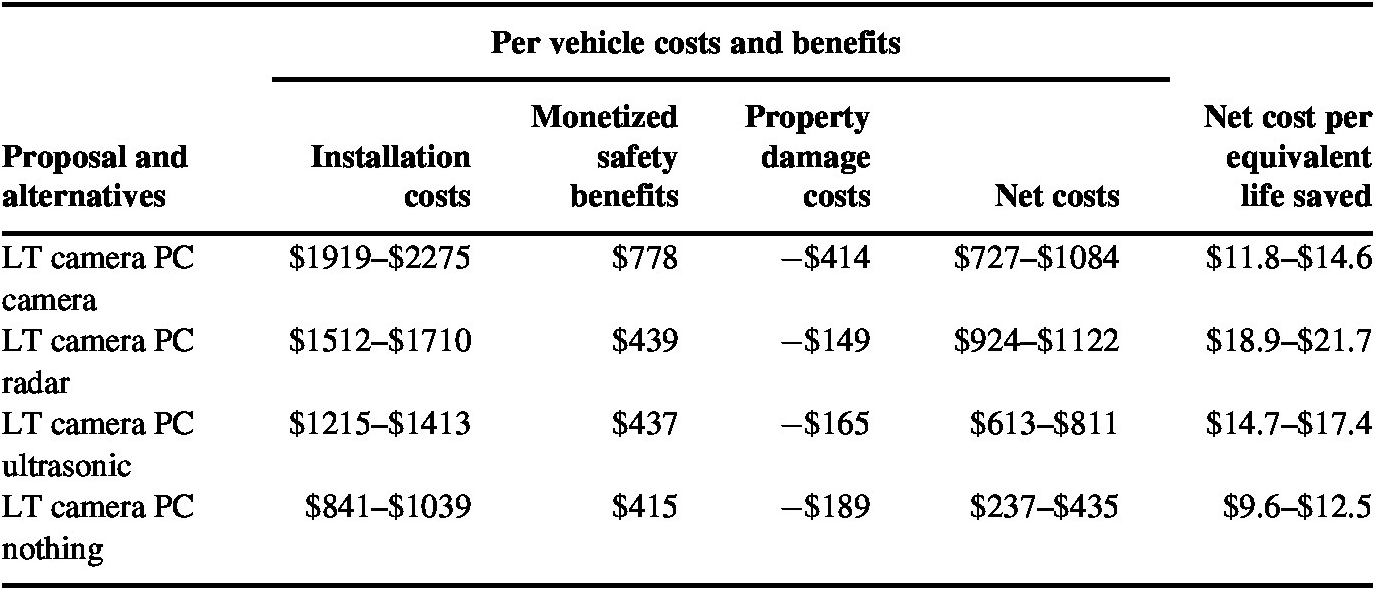
Under the Act and Executive Order 13563, there is a further question, which is whether to make distinctions among vehicles. It should go without saying that a great deal depends on the costs and benefits of doing so, and to know that, we would have to produce a set of numbers. We could imagine an analysis that would show that it would be best to require cameras on some vehicles and mirrors on others. Here as well, the Department had a great deal of information, some of which is captured in Table 1.
Rear visibility proposal and alternatives discounted at 3 % (millions of 2007$) in decreasing order of installation costs and monetized safety benefits, with LT referring to light trucks and PC referring to passenger cars.

The range of camera costs assumes 130° camera with the display in the dashboard (lower cost) to the display in the mirror (higher cost; 75 Fed. Reg. 76,186, p. 76,238 note 91).
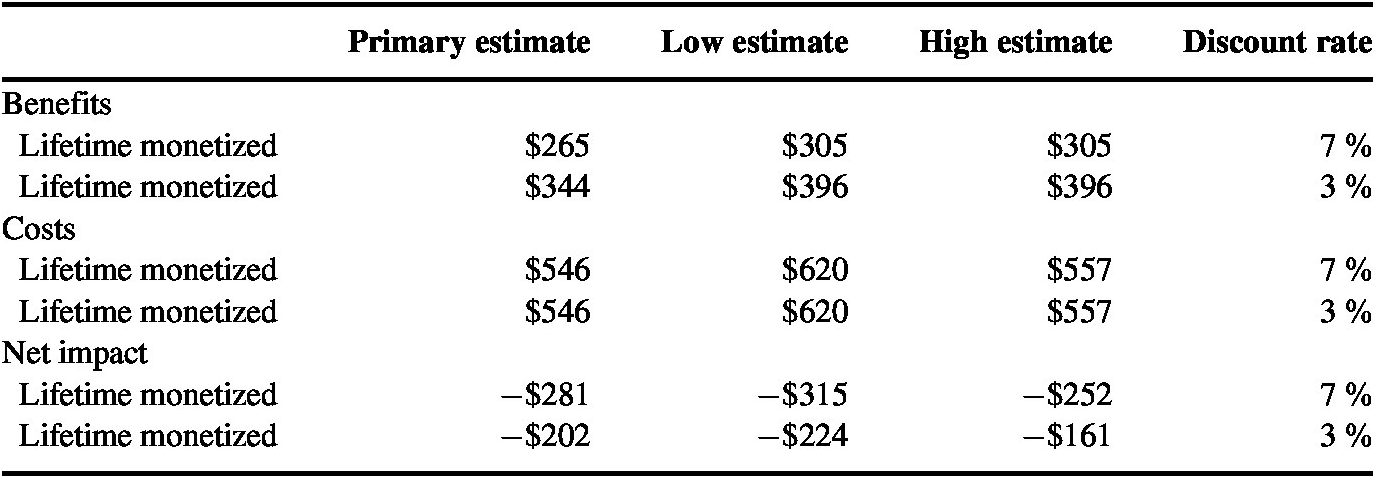
Summary of benefits and costs passenger cars and light trucks (millions of 2010$) MY2018 and thereafter.

Data sourced from 79 Fed. Reg. 191,181 (2014). “The different estimates in this chart show some of the different potential technology options. The primary estimate is the lowest installation cost option (which assumes manufacturers will use a 130 ° camera and will utilize any existing display units already offered in their vehicles). The low estimate and high estimate provide the estimated minimum and maximum net impacts possible. The low estimate is the 180 ° camera and assumes that manufacturers will install a new display to meet the requirements of today’s rule. It represents the minimum overall benefit estimate as it has the largest negative net impact. Conversely, the high estimate is the 180 ° camera and assumes that manufacturers that currently offer vehicles with display units are able and choose to use those existing display units to meet the requirements of today’s rule. This represents the maximum overall benefit estimate because it has the smallest negative net impact.” 79 Fed. Reg. 191,181, n.13 (2014).
Table 1 does not include mirrors, but it does show that with different forms of mixing and matching, net costs can move in significantly different directions. Restricting cameras to light trucks, and exempting passenger cars, would have lower net costs (and also higher cost-effectiveness). The precise choice is less important than the general lessons. From this information, we might draw three such lessons: (i) if NHTSA seeks to comply with Executive Orders 13563, it should do nothing; (ii) if it must do something, it should be inclined to favor mirrors; and (iii) whatever it does, it ought to make distinctions among categories of vehicles in a way that maximizes net benefits or minimizes net costs.
But these conclusions raise their own complications. We should agree that the Act requires the NHTSA to do something, even if all options have negative net benefits. Inaction is not an option. Indeed, the statute appears to contemplate that the NHTSA must do something with respect to every class of vehicle – even if each class might be treated differently. There is also an argument that the Act does not permit NHTSA to choose an option that has a de minimis effect on the problem that motivated it.Footnote 6 If additional mirrors would achieve almost nothing in terms of the statutory goal, it might be taken to be inconsistent with the Act to mandate them, even if the more effective responses had significantly lower net costs. To that extent, engagement with the evidence may have the virtue of sharply narrowing the category of responses that NHTSA might select.
3.4.2 Benefits without numbers
An equally fundamental problem is that the monetized numbers do not capture all of the variables at stake (Rowell, Reference Rowell2012). NHTSA itself emphasized that “the quantitative analysis does not offer a complete accounting” (75 Fed. Reg. 76,168 2010, p. 76,238). It referred to “equity,” made relevant by Executive Order 13563. It noted that “well over 40 % of the victims of backover crashes are very young children (under the age of five), with nearly their entire life ahead of them.” That can be taken to be a point about life-years. It added that “this regulation will, in many cases, reduce a qualitatively distinct risk, which is that of directly causing the death or injury of one’s own child” (75 Fed. Reg. 76,168 2010, p. 76,238). That can be taken to be a point about the searing effects of that kind of harm – a risk that is not adequately captured in the standard figure for the value of a statistical risk.
In addition, “drivers will also benefit from increased rear visibility in a variety of ways, including increased ease and convenience with respect to parking.” With these points in mind, NHTSA said that if the non-quantified benefits would amount to “$65 to $79 per vehicle, the benefits would justify the costs.” The agency said, “Taking all of the foregoing points alongside the quantifiable figures and the safety issue at hand, the agency tentatively concludes that the benefits do justify the costs” (75 Fed. Reg. 76,168 2010, p. 76,238).
Skeptical readers might have wanted a fuller analysis. Some of the relevant values could have been quantified; NHTSA could have specified upper and lower bounds for (for example) an increase in ease and convenience with respect to driving and parking. But within the Obama Administration, there was general agreement that this approach was sufficient for a proposed rule, designed for public comment. NHTSA had been candid about the numbers and the alternatives. It asked for comments on a wide range of possibilities. It did not commit itself to only one approach. While it emphasized what was quantifiable, it also recognized what was not, and it did not treat the quantifiable as if it were all that mattered.
3.4.3 Concerns
Officials within the executive branch were broadly supportive of the proposal but keenly interested in public comments, and alert to a number of substantive issues. Of these, three stood out. The first was the evident cost of the proposal. A required regulatory expenditure of $1 billion or more should have to meet a heavy burden of justification, not least in a difficult economic period, when automobile companies were struggling and also facing a number of significant regulatory burdens (perhaps above all involving fuel economy). In any administration, both political officials and technical experts are likely to ask serious questions about whether there is an adequate substantive justification for a regulatory burden of this magnitude. Regulations very rarely exceed the $1 billion mark (U.S. Office of Management and Budget, 2012). Indeed, any regulation of that kind would account for a significant percentage of the total costs of economically significant regulations in any given year. Such an imposition should, in principle, have a compelling justification.
The second concern involved the apparently low benefits of the proposal, at least in comparison to other regulations with similarly high costs. For example, some air pollution regulations would save 1000 or more lives per year (U.S. Office of Management and Budget, 2012), and the Department of Transportation issues regulations expected to save hundreds of lives annually (Sunstein, Reference Sunstein2014a). The rear visibility rule would not have anything like that impact. No one should diminish the costs of even a small number of unnecessary human deaths, not least in the context of deaths of small children killed by their parents. But it must be acknowledged that the benefits of the rear visibility rule would be far lower than the corresponding benefits for other comparably expensive rules – and that in terms of net benefits, the rule would be a genuine outlier.
The third issue, and in some ways the most pressing, involved the reliability of the evidence on which the benefits had been projected. Certainly for outsiders, it is natural to wonder whether cameras might prove distracting and counterproductive, at least for some drivers (perhaps older ones), and thus diminish rather than increase safety. NHTSA did not, of course, have a randomized controlled trial. Instead, it had experimental evidence involving the behavior of drivers under artificial conditions, which seemed to support its extrapolations. (For related evidence, see Kidd & Brethwaite, Reference Kidd and Brethwaite2014.) But for a regulation of this magnitude, the most reliable evidence, involving diverse kinds of drivers and diverse kinds of vehicles, would be highly desirable (Cicchino, Reference Cicchino2017).
In a letter to members of Congress in 2013, Secretary Ray LaHood elaborated on some of these points. He noted that in the aftermath of the original proposal, the Department completed “additional research, which included not only a different vehicle type, but also 143 additional participants.” In his account, the new work “has expanded and increased the robustness of the available information on the backover crash problem as well as on the ability of drivers to use rear visibility systems to their advantage in avoiding backover crashes.” At the same time, he said that “the Department believes that analyzing additional information through its Special Crash Investigations program will contribute significantly to its understanding of the backover crash problem. By identifying and analyzing cases that involve vehicles equipped with rear visibility systems, the Department will be able to further refine its understanding of how the proposed requirements address the real world safety risk” (LaHood, Reference LaHood2013, pp. 1–2).
Between the proposal and 2014, all of these issues received extensive discussion among a variety of officials, including above all technical experts. To this point, it might be added that the executive branch was dealing with a large number of regulations, many of them required by law. At any given time, the Department of Transportation was focused on a wide range of priorities. At any given time, OIRA, with its small staff of about 45 people, was dealing with dozens of regulations, sometimes more than 100, each of which was also subject to interagency scrutiny. Important issues must sometimes take a temporary back seat to other issues; there is inevitably a queue.
4 The executive branch, 2: The final rule
The regulation was finalized in 2014 (79 Fed. Reg. 19,178 2014; U.S. Department of Transportation, 2014). NHTSA estimated 267 annual deaths and 15,000 annual injuries (6000 of which are incapacitating) from backover crashes (79 Fed. Reg. 19,178 2014). It added that children under 5 years old account for 31 % of the fatalities each year, and that people of 70 years of age or older account for 26 %. It stated that cameras would have effectiveness rates of between 28 and 33 %, which would mean that they would save between 58 and 69 lives annually, compared with a situation in which vehicles lacked cameras. It was emphatic that the approach it chose was the only way to satisfy the law, stating in italics, “This Rule is the Least Costly Rule that Meets the Requirements of the K.T. Safety Act” (79 Fed. Reg. 19,178 2014, p. 19,181).
4.1 Quantification and its discontents
In terms of both costs and benefits, the most important change from the proposal stemmed from the fact that the automobile industry was moving rapidly in the direction of installing cameras on its own – which would decrease both costs and benefits substantially (79 Fed. Reg. 19,178 2014). According to the Department, about 73 % of covered vehicles would have rearview video systems by 2018, even without the regulation. With that assumption, the rule would cost $546 million to $620 million annually. This is a large amount in aggregate, but it is also useful to emphasize this finding: “We anticipate rear visibility systems will cost approximately $43-$45 for vehicles already equipped with a suitable visual display and between $132 and $142 for all other vehicles” (79 Fed. Reg. 19,178 2014, p. 19,181). (Most contemporary vehicles have a suitable display.)
In terms of social welfare, it is worthwhile asking whether those relatively small amounts might have modest adverse effects on consumers of new vehicles. A high but widely dispersed monetary cost might give a misleading picture of the welfare effects. If (say) a regulation requires 100 million people to pay $20 annually, the annual cost of $2 billion might overstate the welfare effect of the regulation (Dorman, Reference Dorman1996; Bronsteen et al., Reference Bronsteen, Buccafusco and Masur2013).
The rule would produce $265–$396 million in monetized benefits, including prevention of 13–15 annual deaths and 1125–1135 annual injuries. (“Thus, we believe that there will still be 13–15 fatalities and 1125–1332 injuries prevented annually that are a result of equipping the remaining 27 % of vehicles that we do not anticipate will have rear visibility systems by 2018” 79 Fed. Reg. 19,178 2014, p. 19,180.) The agency was aware that the proposed rule might itself have accounted for some of the growth of cameras and that without the proposal, adoption might be as low as 59 %, which would increase the costs to $827 million to $924 million, and increase the benefits from $398 million to $595 million.Footnote 7 Because of the growth of voluntary adoption of cameras, the agency expected to prevent only that small number of preventable deaths each year (79 Fed. Reg. 19,178 2014). In addition, the Department’s value of statistical life had changed, in the interim, to about $9 million (Trottenberg & Rivkin, Reference Trottenberg and Rivkin2013).
Table 2 summarizes various numbers, and these raise many further questions. Even with a degree of market penetration, mandatory cameras would cost hundreds of millions of dollars, without the kinds of safety benefits usually associated with rules having that expense. Return then to the options of sensors and mirrors; might either approach be preferable to cameras? The Department reiterated that for technical reasons, both would be inadequate. With respect to sensors, the agency found, on the basis of its own evidence, “that sensor-only systems have various technical limitations that lead to inconsistent object detection and that drivers with sensor-only systems generally either failed to respond to the sensor system’s audio warning, or paused only momentarily before resuming the backing maneuver” (79 Fed. Reg. 19,178 2014, p. 19,182). With respect to mirrors, the agency found “that drivers were unable to avoid targets behind the vehicle when assisted with additional rear-mounted mirrors such as rear convex ‘look-down’ or cross-view mirrors” (79 Fed. Reg. 19,178 2014, p. 19,182).
Perhaps surprisingly, and somewhat disturbingly, the agency did not offer actual benefits numbers for the two less expensive approaches, but it did say that “sensor-only and mirror-based rear visibility systems have demonstrated little to no success in inducing drivers to stop a backing maneuver to avoid a crash with a pedestrian behind the vehicle” (79 Fed. Reg. 19,178 2014, p. 19,183). Hence, “their lower cost is outweighed by the substantially reduced benefits that are likely to be achieved by these systems.” In these circumstances, cameras would be “not only the most effective systems at addressing the backover safety problem but also the most cost effective system” – and also the only way to fulfill the requirements of the Act, “as these other systems cannot be reasonably expected to address the backover crash problem” (79 Fed. Reg. 19,178 2014, p. 19,183). The agency added that ultrasonic sensor systems would be far more expensive than originally thought, costing between $79 and $138 per vehicle.
What about the fact that the quantifiable benefits were lower than the quantifiable costs? As it had in its proposal, NHTSA emphasized that “a simple quantitative analysis is not sufficient” (79 Fed. Reg. 19,178 2014, p. 19,235). It drew attention to equity. It noted that “victims of backover crashes are frequently the most vulnerable members of our society (such as young children, the elderly, or persons with disabilities)” (79 Fed. Reg. 19,178 2014, p. 19,180). It pointed to “strong reasons, grounded in unquantifiable considerations, to take action to prevent the deaths and injuries at issue here” (79 Fed. Reg. 19,178 2014, p. 19,236). It stated that “most people place a high value on the lives of children and that there is a general consensus regarding the need to protect children as they are unable to protect themselves” (79 Fed. Reg. 19,178 2014, p. 19,181). It said, “While the agency has used the Department’s standard monetary figure for the value of a statistical life, we acknowledge that various studies have placed the value of a statistical life at a higher value and the value of a statistical life of a child even higher” (79 Fed. Reg. 19,178 2014, p. 19,236).
It added: “In many cases, parents are responsible for the deaths of their own children. We continue to believe that avoiding that horrible outcome is a significant benefit which is not fully or adequately captured in the traditional measure of the value of a statistical life” (79 Fed. Reg. 19,178 2014, p. 19,236). It stated that “an exceptionally high emotional cost, not easily convertible to monetary equivalents, is often inflicted upon the families of backover crash victims” (79 Fed. Reg. 19,178 2014, p. 19,181). It emphasized: “Of course, any death of a young child is a tragedy, but we believe that this traditional measure also does not adequately account for the value of reducing the risk that parents will be responsible for the death of or serious injury to their own children” (79 Fed. Reg. 19,178 2014, p. 19,236). It referred to distributional impacts more broadly, including not only children but also people with disabilities and the elderly. “Especially in the context at issue, such people lack relevant control over the situation and are not in a good position to protect themselves. There are strong considerations, rooted in fairness and equity, to reduce these risks that they face” (79 Fed. Reg. 19,178 2014, p. 19,236).
It briefly noted as well that “[d]rivers will benefit in numerous ways from increases in rear visibility. For example, parking will be simplified, especially in congestion.” The increase in “ease and convenience” would provide “significant, but not yet quantifiable, benefits to drivers” (79 Fed. Reg. 19,178 2014, p. 19,236).
4.2 The absence of breakeven analysis
It is surprising and disappointing that the Department did not undertake a formal breakeven analysis. Such an analysis would have explored what the benefits would have had to be to justify the costs, and would have analyzed the assumptions that would support the conclusion that they did.Footnote 8 Perhaps it declined to do so on the ground that any such analysis would rest on highly speculative assumptions. But it would nonetheless have been possible. The Department did not offer a point estimate for the shortfall, but for purposes of analysis, let us stipulate that on reasonable assumptions, it was in the general vicinity of $200 million. Under breakeven analysis, the question was whether the unquantifiable values could make up the difference. Taken in the abstract, and without saying more, that question is difficult to answer. But the Department might have made a great deal of progress by saying a bit of about the relevant values.
Most obviously, the Department properly referred to the increased ease and simplification of driving. Suppose that the relevant improvement is valued, on average, at merely $25 annually, admittedly a somewhat arbitrary figure, but taken as a reasonable (and conservative) lower bound. Suppose too that the regulation would apply to eight million cars that would otherwise lack cameras. If so, it would produce $200 million in annual benefits. At that point, the monetized benefits are close to the monetized costs. We are essentially at the breakeven point.
The Department might have also noted that there is an emerging work on the valuation of children’s lives (Robinson et al., Reference Robinson, Raich, Hammitt and O’Keefe2019). At the time it finalized the rule, some preliminary work suggested that parents value a young child’s life at $18 million (Williams, Reference Williams2013) – a number that could add $90 million to its existing benefits figure (assuming that the rule would prevent five such deaths a year). At that point, the benefits exceed the costs. And indeed, that $18 million figure captures the parents’ valuation of children’s lives, not children’s valuation of their lives. It would have been an unusual step in view of the tentative nature of the existing research, but the Department might have undertaken a sensitivity analysis with values of $18 million and $27 million – both indicating that the benefits are comfortably in excess of costs. (Of course, it might be a form of illegitimate double-counting to attempt both to monetize children’s lives and to refer independently to “equity.”)
More recent and far more systematic work gives different numbers, generally suggesting higher values for children than for adults, in the range of a multiple of 1.5 (Robinson et al., Reference Robinson, Raich, Hammitt and O’Keefe2019). If we use that multiple for the $9 million VSL figure, the valuation of children would be $13.5 million, which would produce benefits of $67.5 million (again assuming prevention of five children’s deaths annually). As noted, the agency could plausibly say that the $200 million is a reasonable lower bound for the additional ease of driving and that even with that reasonable lower bound, the value of protecting young children would ensure that the benefits justify the costs. The discussion below of experience goods, with a relevant survey, strongly supports that conclusion.
Recall finally that we are speaking here of parents who would not only (only!) lose their children, but who would also be directly responsible for that loss. How much would it be worth to reduce the risk of that eventuality? Any reasonable lower-bound figure would fortify the conclusion that the costs would be justified. The numbers given here are of course speculative. But with an analysis of this admittedly tentative kind, the Department’s conclusion seems eminently sensible – not because of a laundry list of unquantifiable benefits, but because once we begin to speak of lower bounds and expected ranges, an apparently intractable puzzle begins to dissolve, or at least to look far more tractable.
5 Valuation and experience goods
My largest concern here is the possibility that rearview cameras will greatly improve drivers’ experience, even if consumers are not demanding such cameras in advance, even if their ex ante willingness to pay is low, and even if the market is not providing (many) cameras. If so, cameras count as experience goods, for which “information about the product’s quality or performance can be obtained only through buying and using the item” (Laband, Reference Laband1991, p. 497).Footnote 9
The category of experience goods remains incompletely understood, certainly but not only for use in law and regulation. They are typically taken to involve an information problem: advertising and search are not enough to provide consumers (and others) with the requisite information. If so, experience can produce changes in preferences as a result of learning. That is the simplest and most parsimonious understanding, consistent with the economic literature, and in the context of rear visibility, it is what I will be emphasizing.
But we might also see experience goods as involving changes in tastes and values, which are endogenous to experience. After using a product, people’s tastes might shift, not only because they know something they did not know before (belief-induced preference change), but also because they end up developing altogether new likes and dislikes. Just as one might develop, as a result of experience, a taste for a new food (carrots or celery), so one might develop, as a result of experience, a taste for a new commodity or product characteristic (retina displays on laptops), or a corresponding distaste for old commodities or product characteristics (rotary phones). It is admittedly challenging to distinguish between what happens as a result of new information, given static preferences, and what happens as a result of new experiences, producing new preferences. Let us bracket these questions for now; I will return to them.
5.1 Willingness-to-accept and willingness-to-pay
It is not easy to test the possibility that rearview cameras are experience goods. To obtain some information, I conducted a brief survey of 403 Americans in 2019, using Amazon’s Mechanical Turk:
As you may know, new motor vehicles in the U.S. are equipped with "rearview cameras" – a dashboard display that allows drivers to see behind them as they back up or try to park.
Suppose that you are buying a new car, and that the car dealer is willing to sell you the car of your choice with a rearview camera – or without one, at a reduced price. How much would the dealer have to pay you, in a reduced price, to get you to buy a car without a rearview camera?
The answers fell in the following categories:
Less than $50 – 5.26 %
$50–$99 – 7.77 %
$100–$199 – 13.28 %
$200–$299 – 16.79 %
$300–$399 – 12.78 %
$400–$499 – 8.77 %
More than $500 – 35.34 %
The most remarkable finding here may that over one-third of respondents said that they would demand more than $500 to give up rearview cameras. It is also noteworthy that 94 % of respondents would demand, to give up cameras, more than the standard cost of cameras ($43–$45, for vehicles with modern displays) – and that a lower bound of 74 % would be willing to demand more than the high-end amount ($132–$142, for vehicles without such displays).
It might be expected that the driver of low numbers is low income, and that the driver of high numbers is high income. To test for that possibility, I divided participants into two groups, both with about 200 people: those who earned less $60,000 annually and those who earned more than that. Among those who earned less, 93 % would demand $50 or more. Of those who earned more, 97 % would demand $50 or more. More generally, the willingness to accept figures are closely comparable across the two groups.
We might hypothesize that driver experience contributes to the relatively high numbers; those who have driven cars with cameras do not want to drive cars without them. (On that hypothesis, see below.) A “pure” endowment effect might also be at work. Through the phrasing of the question, people are asked to assume that cars do have cameras, and the question is how much they would demand to give them up (rather than pay to get them in the first place). When an endowment effect is at work, willingness-to-accept will be higher than willingness-to-pay, and we might question whether willingness-to-accept captures the welfare effects of a good (Frederick et al., Reference Frederick, Novemsky, Wang, Dhar and Nowlis2009).
With these issues in mind, I did another survey with this question:
As you may know, new motor vehicles in the U.S. are equipped with "rearview cameras" – a dashboard display that allows drivers to see behind them as they back up or try to park.
How much would you be willing to pay for a rearview camera in a car?
The results are consistent with the hypothesis of an endowment effect, accounting for a significant disparity between willingness to accept and willingness to pay. Notice the much lower numbers:
Less than $50 – 12.90 %
$50–$99 – 27.05 %
$100–$199 – 29.03 %
$200–$299 – 19.35 %
$300–$399 – 5.71 %
$400–$499 – 2.98 %
More than $500 – 2.98 %
But, even with willingness to pay, more than 87 % would be willing to pay more than the standard cost of a camera. Here as well, I divided participants into two groups: those who earn more and less than $60,000. About 86 % of the lower-income group would be willing to pay at $50, compared to 88 % of the higher-income group. Here again, the distribution of answers is not radically different between the two groups (though 75 % of the lower-income group would pay less than $200, compared to 63 % of the higher-income group).
5.2 The effects of experience
For present purposes, the main issue lies elsewhere. In both versions of the survey, I also asked people whether they now own a car with a rearview camera. Hypothesizing that cameras are experience goods, I expected that drivers value such cars more as a result of experience; if they did not own one, their valuation would be lower. The hypothesis was supported. In the willingness to accept condition, the low figures were dominated by people who do not own such a car: of the 21 people who said they would demand less than $50, almost all (20) did not have one. The numbers are less dramatic but in the same direction in the willingness to pay condition: of the 52 people who said that they would be willing to pay less than $50, the vast majority (38) did not own such a car.
On the high end, the results were more ambiguous. Of the 141 who would demand more than $500, 72 owned such a car, as compared to 69 who did not. Of the 11 who would be willing to pay more than $500, nine owned such a car; because of the small number of people in this category, it would be a mistake to make much of the finding, but it is suggestive. (It is true, of course, that some people may have chosen a motor vehicle with a rearview mirror, and so those who place a high value on mirrors might simply have an ex ante preference for them. But because such vehicles really started to penetrate the market after the rule was proposed in 2012, that is not very likely – a point to which I will return.)
The most important findings here involve the low numbers, which are dominated by people with cars lacking rearview cameras. Whether we are speaking of willingness to accept or willingness to pay, those who have had experience with such cameras are overwhelmingly likely to believe that they are worth more than $50.Footnote 10 Those findings are consistent with the view that on net, consumers are benefiting from rearview cameras. It is worth pausing over the relevant numbers. Suppose that someone owns a car for 5 years. Is it even possible, for the vast majority of consumers, that having a rearview camera is worth less than $10 per year? We might well conclude that at a cost of $45 per vehicle, the rearview camera mandate is essentially a no-brainer, and the real question is whether the executive branch struggled so long and hard over it. But that question is meant to raise puzzles about economic analysis as it is standardly practiced, not about the competence of executive branch officials.
As I have noted, there is a possible confound in the surveys. Perhaps a significant number of respondents actually sought a vehicle with a rearview camera; perhaps the numbers reflect that fact. To get more clarity on this question, I repeated the survey, but with one additional question: I asked people if they had desired, and specifically sought out, vehicles with cameras. (There were about 160 participants in both willingness-to-pay and willingness-to-accept conditions.) About 1/3 of participants reported that they did so. The key question, of course, is whether those who had vehicles with rearview cameras, but did not desire and seek out that technology, would report low willingness to accept and willingness to pay figures.
The answer is that they did not. In the willingness to accept condition, 96 % of those who did not seek out rearview cameras would demand $50 or more; 92 % would demand $100 or more; and 60 % would demand $500 or more. In the willingness to pay condition, 80 % of those who did not seek out cameras would pay $50 or more and 65 % would pay $100 or more. Because of the relatively small sample size, it would be a mistake to give a great deal of weight to the particular numbers. The larger point is that the principal findings in the larger study are replicated here, in general and also among the class of people who did not specifically seek out motor vehicles with rearview mirrors.
5.3 Experience goods and regulatory policy
I have emphasized that the surveys should be regarded as preliminary, and the same is true for the analysis. To understand consumer behavior, a great deal more might be done, perhaps with nationally representative examples. To understand my broader claim, a great deal of conceptual as well as empirical work remains. In principle, government regulation might deliver experience goods that improve social welfare. It is fair to say that this is a distinct category of market failure, and also to say that it is extremely hard to engage in ex ante cost-benefit analysis that would show whether a welfare improvement will occur. There is more reason for confidence in the existence of the category than in the proposition that regulators should frequently or readily proceed in order to deliver experience goods. At least over time, markets generally do well on this count, and regulators might not.
It is important to emphasize that automobiles are among the largest investments that people make, and test drives are typically taken prior to purchase. The whole purpose of test drives is to offer a sense of how drivers will experience various product characteristics. If test drives are not adequate on that count (because we are dealing with durable goods for which learning may be slow), at least they provide something beyond what can be found through search alone. In addition, the market for new cars is heavily influenced by the expert assessments of consumer-focused reporters who do test drives of new models and report their reactions to new technologies and features. This process facilitates market diffusion of new technologies and features, even when experience goods are involved. It remains true, here as well, that the process may be inadequate.
These points suggest that the difference between search goods and experience goods might be best understood as one of degree; they might not be dichotomous. With some goods, search provides all the information that one needs to have. With other goods, experience is essential; search provides a small fragment of what is necessary. With still other goods, search provides a great deal of information, but consumers miss something that might be important. Cameras that provide rear visibility probably belong in the third category. Something similar might be said about other safety-related features of cars, such as the beeping sounds that many cars make when drivers leave their lane, or when they get close to hitting what is in back of them. (Should such features be mandated? Possibly, with the same analysis of costs and benefits, and of experience goods, offered here.)
I have also noted that when experience increases valuation, it is not always clear why. In the simplest cases, and it is my emphasis here, what people gain is information; they see what they have been missing, and they can do that only or best with experience. In other cases, people’s tastes shift, and not merely because of learning. In such cases, it would be true but inadequate to say that they have gained information. Extreme cases involve “transformative experiences,” rarely relevant to regulatory policy, but nicely illustrating situations in which new experiences produce new tastes and values (Paul, Reference Paul2016; Ullmann-Margalit, Reference Ullmann-Margalit2017). In some situations, the main effect is that a new experience makes an old one seem less pleasant or less valuable; people obtain less welfare from consuming or experiencing it, only because they have consumed or experienced something different or better. In such situations, the argument for regulatory intervention seems weak; regulators should not order adoption of New Technology B when and because those who use it will then dislike Old Technology A. In other situations, the new experience produces a kind of dependency, as when people become addicted to cigarettes; cameras that provide rear visibility do not entirely lack this feature. The argument for regulation is plausible or potentially strong only when experience produces some kind of welfare gain, and when consumers cannot anticipate that gain ex ante.
I have referred to the problem as one of limited foresight, and it helps illuminate a number of other actual or potential regulatory interventions; many such interventions might be increasing the provision of experience goods. One of the advantages of vehicles with high fuel economy is that drivers save time; they do not have to go to the gas station nearly as often. Do consumers sufficiently take account of this benefit when they purchase vehicles? We do not know, but perhaps not. The U.S. Department of Transportation has issued a series of rules designed to protect airline passengers, for example by forbidding certain delays on the tarmac. It is fair to ask: What is the market failure? Perhaps there is none; perhaps the rules are unjustified. But perhaps consumers have not been sufficiently attentive to the welfare costs of those delays, either because of insufficient experience or because they have been low-probability events. (It is true that in these cases, the real problem may be is that the good in question has numerous characteristics and consumers do not sufficiently focus on one, because it does not loom large, even though it can have a real effect on welfare.)
It is important to emphasize that markets can and do handle experience goods, as emphasized in the original treatment (Nelson, Reference Nelson1970; see also Israel, Reference Israel2005). Regulation is hardly justified merely because such goods are involved. People obtain experience all the time, and they make decisions accordingly. Word-of-mouth can do a great deal to communicate the value of experience goods; social learning is critical (Feldman et al., Reference Feldman, Papanastasiou and Segev2017). It is also true that producers can adopt innovative approaches to solve the problem – as, for example, through free or low-cost trial periods. What remains to be specified are the circumstances in which markets fail because (for example) social learning and innovative approaches on the part of producers turn out to fail. The only points here are that under imaginable assumptions, experience goods provide a plausible ground for regulation on social welfare grounds, and that rearview cameras appear to be a case in point. A great deal of work remains to be done on this topic.
6 Courts: A brief note
The final rule was not challenged in court – an interesting fact that might be taken as a testimony to its essential reasonableness (and perhaps the extreme awkwardness, in terms of the “optics,” of an industry-led challenge to a rule designed to save the lives of young children). But it is easy to see the form that such a challenge might take. I have noted the possibility of a non-delegation challenge. On arbitrariness grounds, there were many possible avenues:
(i) Companies could argue that the agency lacked sufficient evidentiary basis for its benefits calculations, which were based, in part, on an extrapolation from experimental evidence.
(ii) Companies could contend that the costs were underestimated, and that without the government’s own initial proposal, moving the market toward cameras, an estimate of $1 billion or more would be more accurate.
(iii) Companies could object that it was arbitrary for the agency to proceed in the face of a “benefits shortfall” of hundreds of millions of dollars.
(iv) Companies could argue that if the agency was to consider unquantified factors, it was arbitrary for it not to attempt to quantify those factors, or at least to explain why it failed to do so.
(v) Companies could argue that it was arbitrary for the agency to disregard the less burdensome options (sonar and mirrors) without quantifying their costs and benefits (Corrosion Proof Fittings v. EPA 1991).
Under existing law, some of these challenges might have a genuine chance of success (see Business Roundtable v. SEC 2011). It is a bit puzzling that none of them was brought. As noted, public relations might have played a role. Because most new cars were being equipped with cameras, and because they promised to save lives, companies might have thought that it would be unwise to mount a legal challenge, and that it would be prudent simply to comply.
7 Conclusion
In terms of monetized costs and monetized benefits, the rear visibility rule seems questionable. On welfare grounds, it looks much better. The rule confers many benefits that are difficult to monetize. The fact that benefits are difficult or impossible to turn into monetary equivalents does not, of course, mean that they are not benefits. Apart from the savings in terms of premature death and property damage, the rule improves the experience of driving for many people. A breakeven analysis suggests that the rule was an excellent idea. A task for the future is to be more disciplined about breakeven analysis, and perhaps to help quantify some or all of the benefits that, in the government’s view, could not be monetized.
There is a separate point, and it involves the possibility that ex ante, drivers will not demand, or be willing to pay much for, a good that will greatly improve their experience. When experience goods are involved, it is plausible to think that federal regulation might increase welfare. Rearview cameras seem to be experience goods. My own survey supports this claim: experience with rearview cameras increases drivers’ valuation of them, generally producing a monetary valuation well in excess of their cost. This, then, is a situation in which analysis of monetizable costs and monetizable benefits provides essential information, but does not provide anything close to an adequate account of the welfare effects of an important federal regulation.
Acknowledgements:
The Program on Behavioral Economics and Public Policy at Harvard Law School provided valuable support. Many thanks to O. Bar-Gill, J. Graham, C. Jolls, L. Kaplow, E. Posner, K. Spier, and W. Kip Viscusi for superb comments on a previous draft, and to E. Lowens and Z. Manley for excellent research assistance. Participants in workshops at Harvard and Yale Law Schools offered essential suggestions and thoughts.