INTRODUCTION
Interpretations of obsidian lithic economies can be developed through any combination of three methodological approaches: chemical compositional analyses utilizing X-ray fluorescence (XRF; Shackley Reference Shackley2011), laser ablation-inductively coupled plasma-mass spectrometry (LA-ICP-MS; James et al. Reference James, Dahlin and Carlson2005; Kennett et al. Reference Kennett, Neff, Glascock and Mason2001), or neutron activation analysis (NAA; Glascock et al. Reference Glascock, Neff, Stryker and Johnson1994); technological analyses following ethnoarchaeological and/or experimental replication studies (Carballo Reference Carballo2011a; Clark Reference Clark1982, Reference Clark1985; Crabtree Reference Crabtree1968; Deal and Hayden Reference Deal, Hayden and Hayden1987); and use-wear analyses following experimental replication studies (Aoyama Reference Aoyama1995; Hurcombe Reference Hurcombe1992; Kononenko Reference Kononenko2011; Stemp Reference Stemp2016a; Walton Reference Walton2019). In recent decades, compositional studies have created regional and interregional models of obsidian source exploitation and exchange in Mexico's central highlands region during the Formative period (1500 b.c.–a.d. 100; Blomster and Glascock Reference Blomster and Glascock2011; Carballo et al. Reference Carballo, Carballo and Neff2007; Glascock and Cobean Reference Glascock, Cobean and Cobean2002; Golitko and Feinman Reference Golitko and Feinman2015; Johnson and Hirth Reference Johnson and Hirth2019; Knight and Glascock Reference Knight and Glascock2009). Technological analyses have also revealed patterns of lithic production and acquisition strategies in regional, site, and intrasite settings (De León et al. Reference De León, Hirth and Carballo2009; Healan Reference Healan2019; Walton and Carballo Reference Walton and Carballo2016). High-magnification use-wear analyses, however, have just begun to discern functions for specific tool forms and approaches for tool use in domestic settings (Walton Reference Walton2020). The inclusion of high-magnification use-wear analyses in investigations of lithic assemblages produces fine-grained datasets that enable microeconomic studies of household activities. These complement macroeconomic models of lithic production and exchange to collectively improve our reconstructions of ancient economies. For example, use-wear analyses can reveal how certain lithic technologies were used indiscriminately for various household tasks following multifunctional tool-use approaches. Also, such analyses can indicate whether certain technologies were used for only specific activities following unifunctional tool-use approaches. Perhaps foods or crafts were generated that exceeded individual household demand and offered for market exchange and tribute payments (Aoyama Reference Aoyama1999, Reference Aoyama2007, Reference Aoyama2009; Stemp Reference Stemp2016a). Likewise, use-wear analyses can detect craft specialization versus multicrafting, a Mesoamerican domestic production strategy where multiple craft-producing activities yielded goods that exceeded the needs of an individual household's consumption (Hirth Reference Hirth2009). Furthermore, use-wear analyses can help reveal the production and consumption of prestige goods or ritual practices, such as public ceremonies and acts of ritual bloodletting (Levine and Carballo Reference Levine and Carballo2014; Stemp Reference Stemp2016b; Stemp et al. Reference Stemp, Peuramaki-Brown and Awe2019; Walton Reference Walton2021).
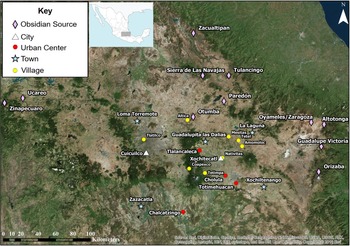
This article presents stone tool functions and household activities from four sites in northern Tlaxcala (Figure 1)—Amomoloc (900–650 b.c.), Tetel (750–500 b.c.), Las Mesitas (600–500 b.c.), and La Laguna (600–400 b.c. and 100 b.c.–a.d. 150)—to help develop microeconomic views of lithic economies in the central highlands. This investigation of 275 artifacts subjected to high-magnification use-wear analysis, coupled with results from previous technological and chemical sourcing studies (Carballo Reference Carballo2004, Reference Carballo2009; Carballo et al. Reference Carballo, Carballo and Neff2007; Walton and Carballo Reference Walton and Carballo2016) reveals several major findings. First, residents employed a multifunctional tool-use approach with blades manufactured from Mesa Central obsidian sources. Such blades became more frequent in toolkits starting in the Middle to Late Formative, followed by modified late-series pressure blades in the Terminal Formative. Over time, these blade tools increasingly performed functions linked to maguey fiber extraction and textile production. As social differences began to emerge in the Terminal Formative, maguey leaf processing was practiced less by those of higher status. The preparation and consumption of meat acquired by hunting and other methods increased slightly over time with the formation of larger towns like La Laguna in the Late and Terminal Formative. In this region, where obsidian sources were not proximate to settlements, bipolar tools, including recycled blades, were used primarily as kitchen utensils but sometimes as tools for other activities. In contrast, unifacial scrapers were used for non-food production tasks, and bifacial drills were used for producing skin/hide products and maintaining and altering lapidary goods. Finally, while specific tools were used for domestic ritual bloodletting, these and other lithic artifacts were neither exchanged as prestige goods nor used to produce prestige goods, often viewed as driving forces of Formative economies in Mesoamerica.
Google satellite imagery of central Mexico and the locations of obsidian sources and notable Formative (ca. 1500 b.c.–a.d. 100) sites, including Amomoloc, Tetel, Les Mesitas, and La Laguna, highlighted in this article. Image courtesy of Google.

FORMATIVE LITHIC ECONOMIES IN THE CENTRAL HIGHLANDS
Lithic economies were one of the mechanisms that integrated cultural traditions from eastern and western Mesoamerica in Mexico's central highlands during the Formative period (Plunket and Uruñuela Reference Plunket and Uruñuela2012). Residents exploited local sources of obsidian, chert, basalt, and felsic stones, if any, or acquired obsidian through regional and interregional exchange networks supplied by intermittent household production. The networks were accessed primarily through gateway communities, emerging urban centers, and cities (Boksenbaum et al. Reference Boksenbaum, Tolstoy, Harbottle, Kimberlin and Neivens1987; Charlton Reference Charlton and Hirth1984; Healan Reference Healan2019; Johnson and Hirth Reference Johnson and Hirth2019; Nichols and Stoner Reference Nichols and Stoner2019; Tolstoy et al. Reference Tolstoy, Fish, Boksenbaum, Vaughn and Earle Smith1977). Major obsidian sources include the Mesa Central sources northeast of Mexico City (Paredón, Tulancingo, Otumba, and Pachuca or Sierra de Las Navajas, hereafter SDLN); Sierra Madre Oriental sources in eastern Puebla and western Veracruz (Oyameles/Zaragoza, Guadalupe Victoria, and Orizaba); and the Ucareo-Zinapecuaro source area in Michoacán (Figure 1). Clark (Reference Clark, Johnson and Morrow1987) proposed that regional obsidian exchange networks developed due to elite control associated with the rise of chiefly centers, but more recent work suggests a stronger role for independent consumer demand (Hirth et al. Reference Hirth, Cyphers, Cobean, De León and Glascock2013). Otumba was the dominant source for obsidian tools at most Early and Middle Formative sites in the Basin of Mexico (Johnson and Hirth Reference Johnson and Hirth2019:304). However, lower frequencies of other obsidian sources at early sedentary sites in the Basin also indicate long-distance exchange networks following natural transportation corridors leading to the Gulf Coast, Mixteca Alta, and the Valley of Oaxaca (Blomster and Glascock Reference Blomster and Glascock2011; Carballo and Pluckhahn Reference Carballo and Pluckhahn2007; Cobean Reference Cobean2002; Parry Reference Parry1987). For example, five obsidian sources appear at the village of Coapexco (1520–1350 cal b.c.), and four of these sources comprise at least 10 percent of the lithic assemblage (Johnson and Hirth Reference Johnson and Hirth2019:304). Coapexco's location in the Amecameca pass made it a likely effective gateway community that imported pre-prepared cores of Ucareo-Zinapecuaro obsidian from the west and Zaragoza obsidian from the east and exported pressure blades to consumer sites in the central highlands (Johnson and Hirth Reference Johnson and Hirth2019:307).
In their discussion of Formative obsidian networks, Johnson and Hirth (Reference Johnson and Hirth2019:300) identify “processor” sites as communities with inhabitants who engaged in mining and preparing obsidian for exchange, which could have involved the creation of value-added items in the form of finished tools. Processor sites with evidence for mining/quarrying or core preparation have been found for the Classic onward (e.g., Cobean Reference Cobean2002; Hernández and Healan Reference Hernández and Healan2008; Pastrana Reference Pastrana1998; Pastrana and Domínguez Reference Pastrana and Domínguez2009), but they have remained comparatively elusive for the Formative. For example, despite its very high density of obsidian artifacts and short distance from the Otumba obsidian source, the small village of Altica (1250–800 cal b.c.) did not systematically prepare obsidian nodules, cores, or tools for exchange (Healan Reference Healan2019). Instead, residents of this earliest settlement in the Teotihuacan Valley obtained Otumba obsidian nodules to produce expedient percussion flakes and blades, unlike the bipolar tools commonly found at contemporaneous sites in the Basin (Boksenbaum Reference Boksenbaum1980) and other regions in Early to Middle Formative Mesoamerica (e.g., Clark Reference Clark, Johnson and Morrow1987; Parry Reference Parry1987; Walton Reference Walton2017). The use-wear data from Altica indicate that residents used their percussion tools for subsistence (foraging and non-intensive maize agriculture) and woodworking attributed to the construction and maintenance of houses and agricultural plots (Walton Reference Walton2020).
Over the Middle Formative (900–500 b.c.), the population increased and some groups moved to previously unoccupied areas. Social differentiation began to increase at functionally urban centers such as Chalcatzingo, but expressions of social difference became more pronounced at the larger Late Formative (500–100 b.c.) cities of Cuicuilco and Xochitecatl, which exhibited political and religious institutions through monumental architecture analogous to later Classic (a.d. 100–600) cities. Social differentiation generally increased but manifested differently at smaller towns and villages in the Late and Terminal (100 b.c.–a.d. 100) Formative (Carballo Reference Carballo2009, Reference Carballo2011b; Plunket and Uruñuela Reference Plunket and Uruñuela2012; Serra Puche and Lazcano Arce Reference Serra Puche and Lazcano Arce2011). The trade of obsidian prismatic blades (i.e., blades removed from prepared blade cores by pressure, hence the nomenclature of pressure blades) began during the Archaic (ca. 4000 b.c.; Macneish et al. Reference Macneish, Nelken-Terner and Johnson1967:22; Niederberger Reference Niederberger1976), but they were not traded extensively across the central highlands until the Late Formative. Clark (Reference Clark, Johnson and Morrow1987) originally attributed this increase in pressure blade production and trade to the emergence of social elites. In the Late Formative, a concentration of lithic production debris attached to the city of Xochitecatl's Edificio del Serpiente indicates institutional sponsorship of lithic production events utilizing labor tribute, an arrangement which may foreshadow later state-sponsored production events near Teotihuacan's Moon Pyramid (Blanco Reference Blanco and Paz1998; Carballo Reference Carballo2011a). However, recent studies have cast doubt on the purported evidence for elite sponsorship from Chalcatzingo and Loma Torremote. These studies developed new models highlighting source proximity, access to exchange networks, and population increase as primary factors linked to higher frequencies of pressure blades in lithic assemblages over the course of the Formative (Walton Reference Walton2017; Walton and Carballo Reference Walton and Carballo2016). Evidence from the urban center of Chalcatzingo, which has the earliest well-documented blade workshop deposit (T-37), lends itself to conflicting interpretations about how production debris is linked to one (Grove Reference Grove1987:75–76) or multiple (Hirth Reference Hirth2008) residences. Santley's (Reference Santley, Santley and Hirth1993) interpretation of lithic production at the town of Loma Torremote is problematic in a different way. Here, Santley (Reference Santley, Santley and Hirth1993:82) identifies an elite residence as the head of a local redistributive economy that provided obsidian pressure blades to other residences but argues that this and other diachronic developments at the site were all “density-dependent phenomena.” While a concentrated zone of blade production correlates with a probable elite/political leader's house compound cluster at Loma Torremote, correlation does not equal causation. Instead, I argue that dense residential nucleation, an overall increasing population, and Loma Torremote's position in the regional economy—rather than the correlating increase in social status differentiation—together created a setting where inhabitants of one house compound could supply other neighboring house compounds by increasing their scale of lithic production, especially if raw materials were easy to acquire. De León and colleagues (Reference De León, Hirth and Carballo2009) demonstrate that obsidian was indeed easy for residents in the Basin of Mexico to obtain—primarily in the form of whole blades—and select sites along the lakeshores specialized in obsidian production and trade via water transport (e.g., Boksenbaum et al. Reference Boksenbaum, Tolstoy, Harbottle, Kimberlin and Neivens1987).
This model for an increasing scale of blade production in connection with more spatial restriction of the activity at Loma Torremote is supported by a contrasting model in northern Puebla-Tlaxcala Valley, where a different set of conditions lead to different testable expectations for the organization of domestic lithic production. The smaller and lower populated sites of Amomoloc, Tetel, Las Mesitas, and La Laguna were located farther from obsidian sources and regional exchange systems and settlement patterns were relatively dispersed, which created scenarios where all households provisioned themselves and independently conducted lithic production (Walton and Carballo Reference Walton and Carballo2016). Resource accumulation strategies shifted away from local cherts and Sierra Madre Oriental obsidian sources toward the use of Mesa Central obsidian sources and fewer raw material sources around 600 b.c. (Carballo et al. Reference Carballo, Carballo and Neff2007). Paredón became the primary source for blades and other tool forms increasingly over time, while the importation of whole SDLN blades also increased from La Laguna's Late Formative to Terminal Formative occupation. Local blade production was not conducted at Amomoloc, where residents imported whole blades. Starting in the Late Formative, blade production took place primarily in all residential contexts, rather than institutional contexts, and a production strategy for exchange did not emerge in either elite or commoner residences as social differentiation increased and more rural areas became integrated with regional economic systems. The primary lithic production zone (Area I) located just beyond the main civic-ceremonial zone at Terminal Formative La Laguna, however, indicated that more frequent lithic production activities took place in a combined domestic-communal setting linked to suprahousehold feasting and communal ritual (Carballo et al. Reference Carballo, Barba, Ortíz, Blancas, Cingolani, Toledo Barrera, Walton, López and Couoh2014a; Walton and Carballo Reference Walton and Carballo2016). The most active blade makers were not necessarily the most productive nor skilled. Blade production output levels doubled from the Late to Terminal Formative occupations at the secondary production zones linked to elite (Area H) and commoner (Area F) residences, but the primary blade production zone at Area I increased its productivity by only 23 percent (Walton Reference Walton2017:Table 8.2). The Area I production zone exhibits both higher rates of overshot and other blade production errors compared to the secondary production zones. The blade makers in these commoner and elite residences were equally skilled. Lower densities of blade production- and blade consumption-related artifacts at Area H compared to Area F, despite similar blade production outputs, further indicate that these equally skilled commoners were more active contributors to the site's blade economy.
The production, trade, and consumption of long-distance prestige goods, usually classified as network strategies (Blanton et al. Reference Blanton, Feinman, Kowalewski and Peregrine1996), were a prominent focus of Middle Formative economies in many regions of Mesoamerica. Blanton and colleagues (Reference Blanton, Fargher, Heredia Espinoza and Blanton2005) link the increase in obsidian production in the central highlands during the Early to Middle Formative (ca. 1200–500 b.c.) to a regional economic transformation focused on prestige or socially valued goods. They argue that this transformation produced few, if any, systemic changes to agroeconomy, demography, market systems, or household economic strategies. Compositional and technological analyses have produced little to no evidence indicating that obsidian artifacts were viewed as prestige goods by Early and Middle Formative residents of the central highlands. However, obsidian tools may have been used to craft prestige goods from other materials, which can be detected through use-wear analyses. Obsidian began to be transformed into specialized tools designed for domestic rituals during the later Middle Formative but more frequently for public ritual practices in the Terminal Formative (Walton Reference Walton2021; Walton and Carballo Reference Walton and Carballo2016). Simply put, social elites and public institutions neither systemically controlled or sponsored lithic production systems nor stimulated consumer demand for obsidian prestige goods during the Early and Middle Formative. However, a noticeable shift took place around 500 b.c. with an increase in obsidian pressure blade production and the growth of distribution systems, reflecting an economic transformation in regional goods—defined by links to regional-scale systems of tribute flow and periodic markets—in response to population growth, regional urbanism, and state formation (Blanton et al. Reference Blanton, Fargher, Heredia Espinoza and Blanton2005; Carballo Reference Carballo2016). Here, the effects of elites and social institutions on Formative lithic economies can be detected through compositional and technological analyses, and the addition of use-wear analyses may enable us to see the impacts of these changes on individual households.
SITES AND EXCAVATION CONTEXTS
The villages of Amomoloc (900–650 b.c.), Tetel (750–500 b.c.), and Las Mesitas (600–500 b.c.), and the town of La Laguna (600–400 b.c. and 100 b.c.–a.d. 150) are in northern Tlaxcala, adjacent to the Tlaxcala Corridor that connects the Basin of Mexico with the Gulf Coast to the east and the Maya region to the south (Figure 1). The first permanent residents of northern Tlaxcala migrated as fully operational maize agriculturalists from Early Formative centers, likely in the adjacent Puebla-Tlaxcala Valley to the south (Lesure et al. Reference Lesure, Borejsza, Carballo, Frederick, Popper and Wake2006:489). These migrations to higher elevations (over ca. 2,400 m asl) in Tlaxcala reflect macroregional processes of population in-filling across the peripheral landscapes of the central highlands by 800 b.c. (Lesure Reference Lesure2014:6). Pottery and figurines from Amomoloc, Tetel, and Mesitas show close cultural ties with the nearby contemporaneous site of Xochitecatl, but there is no current evidence to support a model of Xochitecatl's direct political control over north-central Tlaxcala during the Middle and Late Formative (Lesure Reference Lesure2014:6).
Lesure (Reference Lesure2014:8) defines Amomoloc as a modest village, between two and seven hectares, that was largely a single component site. The excavation contexts include loose domestic refuse and secure features comprising refuse-filled pits, roasting pits, and one burial. Carballo and Lesure (Reference Carballo, Lesure and Lesure2014:23–25, Figure 2.7) hypothesize the boundaries of seven distinct house yards at Amomoloc, based on concentrations of secure pit features.
Lesure (Reference Lesure2014:8) defines Tetel as a small village that covered about two hectares. Lesure and Carballo (Reference Lesure, Carballo and Lesure2014:54–69, Figure 3.3) identify five possible house yards based on loose domestic refuse and secure pit features filled with domestic refuse and two deposits of human bones. A basaltic extrusion lies just 300 m from the site, and it supplied residents with raw material for flaked basalt tools, which were not included during technological analysis (Carballo Reference Carballo2004).
Lesure (Reference Lesure2014:8–9) defines Las Mesitas as a dispersed homestead, which was likely part of a scatter of dispersed homesteads, each surrounded by cultivated fields. The excavations themselves originated from an eroded road cut, but a light scatter of sherds around the site covers about seven hectares. Excavated materials came mostly from areas A and F, which likely represent one house yard, but additional house yards may have been located near areas D and E (Carballo and Carballo Reference Carballo, Carballo and Lesure2014:76, Figure 4.2). The excavation contexts include loose domestic refuse and secure refuse-filled pits, one of which also contained a human burial.
Carballo (Reference Carballo2016) classifies La Laguna as a town (>30 ha) with two Formative occupations prior to its abandonment near the onset of the Classic and Teotihuacan's militaristic expansion across the central highlands. Domestic contexts used for use-wear analyses comprise both occupations across three distinct household compounds—Area I, Area H, and Area F—ranging from the site center to the periphery (Walton and Carballo Reference Walton and Carballo2016:Figure 2). Excavations in Area I revealed a house compound and outdoor space, and during the Terminal Formative it functioned as a combined residential and communal space for suprahousehold rituals and food storage, production, and consumption (Carballo et al. Reference Carballo, Barba, Ortíz, Blancas, Cingolani, Toledo Barrera, Walton, López and Couoh2014a). Excavations in Area H uncovered an elite residential platform with an additional kitchen and storage facility, while excavations in Area F discovered a single-structure commoner residence (Carballo Reference Carballo2009).
TOOLKITS AND SAMPLING STRATEGY
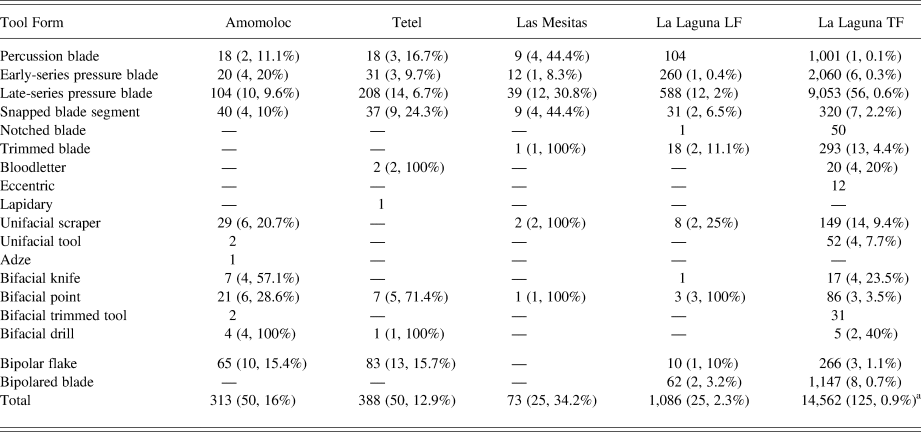
The artifacts that comprise the sample for use-wear analysis (Table 1) were chosen as part of a larger project investigating how different obsidian sources and lithic technologies may have been used for specific tasks in domestic spaces within sites and over time in the central highlands (Walton Reference Walton2017). To best identify and evaluate these patterns, I chose use-wear specimens—after completing technological classifications for each assemblage—first by scarcity of technological forms and second by proportion to their occurrence. The specimens almost exclusively originate from secure excavation contexts in association with structures (e.g., pit features, occupation floors, structural collapse, and sealed platform fill), keeping the number of specimens from unsecure excavation contexts (e.g., surface lots, geological disturbance, bioturbation, and looter pits) limited to associations with ceramic phases and general site areas to a bare minimum necessary for achieving the project's goals. When reading Table 1, it is important to note that the tool counts originate from all excavation contexts at Amomoloc, Tetel, Las Mesitas, and Terminal Formative La Laguna, respectively. The Late Formative excavation lots at La Laguna were identified only by clear stratigraphic and archaeological evidence that differentiated them from the higher Terminal Formative excavation lots. Therefore, all tool counts presented for Late Formative La Laguna reflect only secure excavation contexts. The tool counts presented for the extensively excavated Terminal Formative occupation at La Laguna include those from both secure and unsecure excavation contexts linked to households and public spaces because eight use-wear specimens were chosen from unsecure household excavation contexts and technological diversity in public lithic consumption is essential to consider for diachronic analysis. We identify 723 tools from the most secure Terminal Formative contexts (Walton and Carballo Reference Walton and Carballo2016:Table 1), compared to the 1,086 tools listed for the Late Formative occupation, making the 125 Terminal Formative use-wear specimens (17.3 percent) proportionately comparable to the other samples in this study (Table 1).
Sampling strategy for high-magnification use-wear analysis. Use-wear specimen count and percentages are in parentheses. LF, Late Formative; TF, Terminal Formative.

a Refer to the end of the first paragraph of the section Toolkits and Sampling Strategy, which explains how the 125 specimens from Terminal Formative La Laguna more accurately represent 17.3 percent of all tools from the most secure contexts, whereas this table presents the sampling strategy in terms of all excavation contexts at all sites.
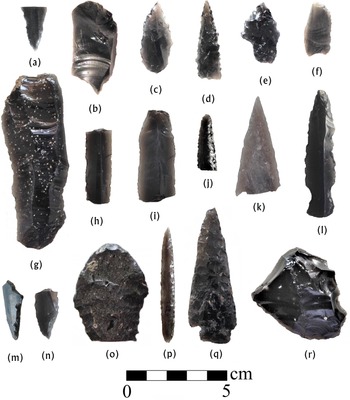
My technological classification system is based on experimental replication studies (Carballo Reference Carballo2011a; Clark and Bryant Reference Clark and Bryant1997; Hirth and Flenniken Reference Hirth, Flenniken and Hirth2006) in addition to my own observations during analysis. Bipolar flaking refers to the smashing of either small irregular pebbles/cobbles (Boksenbaum Reference Boksenbaum1980:20–23) or spent blade cores on anvils to recover flat flakes (Figure 2f) and angular chunks. A bipolared blade can be produced by taking a blade and striking one end with a hammer stone while the opposite end is placed on an anvil. Unifacial forms include “scrapers,” outlined originally by Tolstoy (Reference Tolstoy, Ekholm and Bernal1971), created from percussion flake or blade banks using percussion trimming along one or more edges along one face or side of the material (Figure 2r), and what I call unifacial tools, which include variously shaped pieces with percussion and/or pressure trimming along one side or face of the material that do not fit within established scraper forms. Bifacial tool categories include completed and fragmented knives (Figure 2o), spear or atlatl dart points (Figures 2c–2e, 2k, 2l, and 2q), and drills produced either through percussion trimming or, more commonly, bifacial pressure retouch on late-series pressure blade segments (Figure 2a). Artifacts with bifacial trimming that do not fit within these categories are grouped under the label bifacial trimmed tool.
Photographs of use-wear specimens from Amomoloc: (a and b) Bifacial drills; (c–e) bifacial points; (f) bipolar flake; Tetel: (g) percussion blade; (h) late-series pressure snapped blade segment; (i) late-series pressure proximal blade segment; (j) bloodletter; (k) bifacial point; Las Mesitas: (l) bifacial point; La Laguna: (m and n) bifacial drills; (o) bifacial knife; (p) bloodletter; (q) bifacial point; (r) unifacial scraper. Photographs by the author.

Blades are defined as sequential percussion (Figure 2g) and pressure (Figure 2i) removals from blade cores. Early-series pressure blades exhibit dorsal scars from prior percussion blade removals, whereas late-series pressure blades exhibit only dorsal scars from prior pressure removals. Some late-series pressure blade segments—referred to as snapped blades—were produced by intentionally snapping off the proximal and distal ends, leaving the medial section flat (Figure 2h). Blades identified as notched or trimmed were deliberately modified as such prior to their use.
Technological criteria that can be used to identify bloodletters include very thin (i.e., 0.5 cm or often less in width) and precise bifacial pressure-trimming flake scars, or retouch, on distal and/or proximal ends of a pressure blade that is less than 1 cm wide (Figures 2j and 2p), or a similarly thin blade with an unusually tapered distal termination that ends with a fine point (Walton Reference Walton2021; Walton and Carballo Reference Walton and Carballo2016:115). Stemp and colleagues (Reference Stemp, Peuramaki-Brown and Awe2019) find that measuring cutting-edge/mass ratios to identify the finest range of blades in an assemblage can help to predict which blades may have been designed and used as bloodletters. Eccentrics are exquisitely knapped bifaces shaped into symbolic geometric, anthropomorphic, serrated, and zoomorphic forms, among others, and may be large in size (Walton and Carballo Reference Walton and Carballo2016:Figures 9–11). Eccentrics were recovered only in association with public ritual spaces at Terminal Formative La Laguna; thus, they were not sampled for this study focused on households.
Amomoloc
The Amomoloc toolkit is relatively balanced with different tool forms. Bipolar flakes were popular tools with 1.7 blades for every bipolar flake. Blades rarely underwent further modifications once they arrived at the site. Unifacial scrapers include irregular forms and crudely modified percussion flakes. Points exhibit primarily bifacial pressure retouch on blade or flake blanks. Knives exhibiting stages of bifacial percussion and pressure thinning were made from only obsidian. A rhyolite adze and smaller drills of obsidian and chert complemented the other tool forms. The use-wear sample includes 50 specimens from six house yards and three ceramic phases to prevent spatial or chronological bias in the study. The specimens comprise gray (48 percent), Paredón (32 percent), jet black (six percent), and Otumba (four percent) obsidian, in addition to chert (eight percent) and chalcedony (two percent). Results from LA-ICP-MS indicate that the gray category corresponds almost entirely to the Oyameles/Zaragoza and Otumba sources, and the jet black category comprises several sources including Oyameles/Zaragoza (Carballo et al. Reference Carballo, Carballo and Neff2007:33–38). The local chert and chalcedony specimens were included because they represent rare tool forms in the assemblage.
Tetel
The Tetel toolkit reflects a continued popularity for bipolar flakes and intentionally snapped blade segments in addition to a new tool form, obsidian bloodletters. However, larger and heavier bifacial tools such as knives, adzes, and bifacially trimmed flakes/blades are notably absent in assemblages from both Tetel and Las Mesitas, while points made from blades or flakes through bifacial pressure flaking continued to be the most popular bifacial tool form. The use-wear sample comprises 50 specimens from three house yards, as well as non-feature contexts to include the full range of tool forms at the site and prevent spatial or chronological bias. The specimens include Paredón (70 percent), Otumba (14 percent), SDLN (10 percent), and gray (four percent) obsidian in addition to one chert specimen (two percent), which was included because it is the only drill in the site's lithic assemblage.
Las Mesitas
The Las Mesitas toolkit is notable compared to the Tetel toolkit for its lack of bipolar tools. Blade forms dominate the assemblage with just two unifacial scrapers and one bifacial point made from a pressure blade. The use-wear sample comprises 25 specimens from four excavation areas. Most of the sample (n = 21) originates from the house yard represented by Area A and Area F. The specimens include Paredón (68 percent), SDLN (12 percent), gray (eight percent), and Otumba (four percent) obsidian. One chert and one chalcedony specimen were included because they represent the only unifacial scrapers in the assemblage.
La Laguna Late Formative Occupation (600–400 b.c.)
The Late Formative toolkit for La Laguna includes blades, unifacial scrapers, bifacial points, and bipolar flakes that appear similar compared to earlier assemblages, but it also includes blades that were modified by deliberate trimming or notching and blades that were recycled through bipolar percussion. The use-wear sample includes 10 specimens each from Area I and Area F and five specimens from Area H to prevent spatial bias in the sample, but the dataset is not large enough to enable comparisons between households. Therefore, it is best to analyze this Late Formative dataset on the site level. The specimens include Paredón (92 percent), SDLN (four percent), and an unspecific source of gray obsidian (four percent).
La Laguna Terminal Formative Occupation (100 b.c.–a.d. 150)
La Laguna's Terminal Formative toolkit is the most diverse one, including unmodified, snapped, notched, and trimmed blades, bloodletters, eccentrics, unifacial scrapers, unifacial tools, bipolar flakes, bipolared blades, and bifacial knives, points, drills, and trimmed tools. The use-wear sample includes 50 specimens each from Area I and Area F and 25 specimens from Area H. Area I specimens represent the Paredón (70 percent) and SDLN (14 percent) sources in addition to unspecific sources of gray obsidian (16 percent). Area F specimens represent the Paredón (88 percent), Otumba (four percent), and SDLN (four percent) sources along with unspecific sources of gray (two percent) and jet black (two percent) obsidian. Area H specimens represent the Paredón (92 percent) and Otumba (four percent) sources in addition to one unspecific source of gray obsidian (four percent).
METHOD FOR HIGH-MAGNIFICATION USE-WEAR ANALYSIS
The term “use-wear” applies to surface modifications that occurred during all stages of an artifact's use-life history (e.g., Fullagar Reference Fullagar, Balme and Paterson2006), which can include overlapping activities, hafting, burning, and post-discard soil abrasion. High-magnification use-wear analysis (e.g., Keeley Reference Keeley1980; Semenov Reference Semenov1964; Vaughan Reference Vaughan1985) can detect four attributes created by acts of obsidian tool use: striations, edge rounding, micropolishes, and residues (Kononenko Reference Kononenko2011:7–9; Walton Reference Walton2019:898). Striations, micropolishes, and residues are much more reliable attributes for determining specific materials, while edge rounding is more suitable for identifying materials according to a range of densities or activity durations.
Striations can be described in terms of their morphology (e.g., sleek versus rough-bottomed) and orientation (e.g., parallel versus perpendicular to the working edge). Different materials and activities can affect the locations of striations on tool surfaces. Thus, it is important to note whether striations are isolated or located near other striations; different materials tend to affect this characteristic more than activity motion or duration.
Edge rounding refers to the erosion/smoothing of tool edges, and degrees of edge rounding increase with denser materials and/or longer activity durations. I classify degrees of edge rounding as very light, light, medium, intensive, and very intensive, following a similar qualitative classification scheme used by Kononenko (Reference Kononenko2011). It is necessary to differentiate edge damage—the fracturing or chipping of a tool edge from either use or post-depositional processes—from edge rounding, which can be produced only through durations of tool use.
Use-wear polish can be created by repeated physical contact between tool surfaces and different materials. Researchers debate the specific mechanisms that contribute to polish formation. Fullagar (Reference Fullagar1991:2–3) summarizes theories of polish formation on stone tools and demonstrates that amorphous silica is a major contributor toward polish formation on stone tools used to process plants. Christensen et al. (Reference Christensen, Calligaro, Consigny, Dran, Salomon and Walter1998) argue that polish itself is an encrusted coating of the worked material spread across the irregular surface of the tool. There are four stages of polish development for obsidian tools (Fullagar Reference Fullagar1991:6; Kononenko Reference Kononenko2011:8). In stage 1, freshly flaked edges experience very light edge rounding as jagged edges and loosely adhering flakes are worn back. In stage 2, patches of smooth polish develop as the surface is abraded, peaks are leveled, subsurface cracks are deepened, and granular material is deposited into surface depressions. In stage 3, polish characteristics are strong enough to be linked with specific worked materials. During this stage, subsurface cracks are extended and flaked out of the surface just as other surface defects are smoothed out via abrasion. In stage 4, an extensive polished surface can be developed but only through contact with moist siliceous plant material. The distinguishable clarity and thickness of polish or pattern of alteration on a tool edge can be affected by numerous factors including activity duration, number of strokes, applied force, and the material properties of the tool itself.
Following Kononenko (Reference Kononenko2011:4), residues are the materials that are either attached to or absorbed by a tool surface. Residues often appear trapped within the varying topographies of microcavities on tool surfaces, but the exact formation processes that cause these residues to remain in contact with tool surfaces are still under investigation (e.g., Fullagar Reference Fullagar, Balme and Paterson2006). In this study, I recognize the colors and basic morphologies of residues that remained on tool surfaces after the artifacts were cleaned. Here, I recognize blood residues based on visual characteristics shared by blood residues (Walton Reference Walton2019:Figure 13) identified through chemical testing with Hemastix® active reagent strips, following a protocol developed by Matheson and Veall (Reference Matheson and Veall2014).
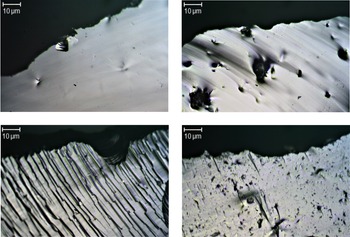
The use-wear characteristics and obsidian tool functions identified here are based on my systematic program of 300 experiments with 145 obsidian tool specimens that controlled for two obsidian sources, two activity durations (5 and 15 minutes), and 29 different materials that were accessible to prehispanic residents of central Mexico (Walton Reference Walton2019). In March 2018, I also performed four experiments using obsidian percussion flakes to cut slate and observe the resulting use-wear characteristics. The results from those experiments are the basis for identifications of stone cutting on artifacts in this study. Obsidian tools for experimentation were created to replicate six common tool forms found in central Mexican archaeology: percussion flakes, percussion blades, unifacial scrapers, bifacial knives, drills, and retouched pressure blades labeled variously as needles, perforators, or bloodletters (Walton Reference Walton2017:70–84). Each freshly knapped tool specimen for the study was cleaned and photographed before use to provide control data for each experiment (Figure 3). All specimens were used by hand with a single tool motion for each one.
Photographs of ventral surface topographies on four unused obsidian tools. Photographs by the author.

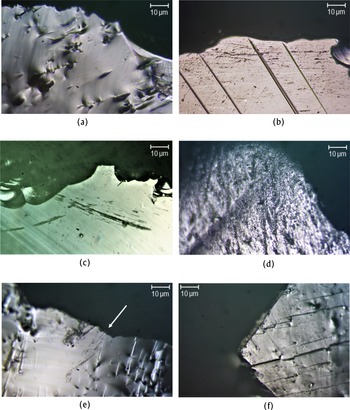
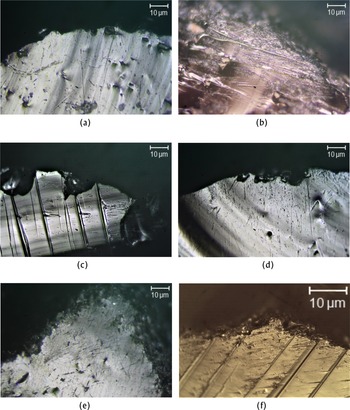
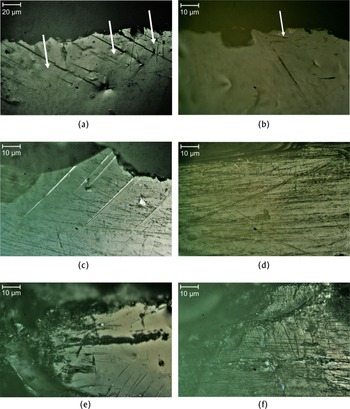
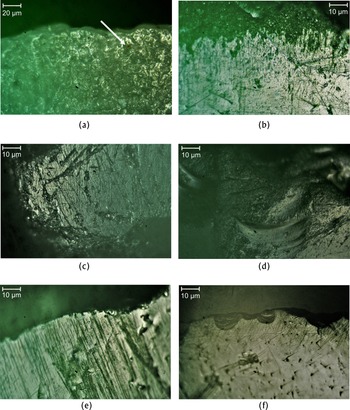
Comparing the experimental use-wear patterns replicated by different studies (Aoyama Reference Aoyama1995; Kononenko Reference Kononenko2011; Stemp Reference Stemp2016a; Walton Reference Walton2019), along with their own unique findings linked to specific resources within their respective geographic regions, reveals that some specific types of plants can be distinguished from broader categories of plants. The most generalized category of plant materials used with the method of high-magnification obsidian use-wear analysis is “soft plants,” which includes a wide array of plants (e.g., gourds, cactus leaves, cactus fruits, potatoes, tomatoes, avocados, and goosefoot) that produce very light to light edge rounding and striations that are extremely fine, thin, and isolated near a tool's puncture point (Figure 4a). Thicker grasses can produce more frequent and thicker striations, but generally their use-wear patterns—identified by Kononenko (Reference Kononenko2011:76) as part of a “non-woody plant” group—are essentially identical to those documented in the soft plant category that Aoyama (Reference Aoyama1995) and I (Walton Reference Walton2019) prefer to use. While the working of soft woods (Figure 5d) and hard woods can be distinguished in experimental studies based on comparing striation densities (Walton Reference Walton2019: Figures 5 and 6), making these distinctions becomes more challenging with archaeological specimens, often due to the presence of overlapping or adjacent activities that involved soft wood and hard wood. Thus, the safest approach is to use a generalized wood category, which I do here. Maize can be distinguished apart from grasses and other soft plants because it produces longer striations, polish development located farther beyond a tool edge, and higher degrees of edge rounding (Figure 4b). Maguey heart scraping can be identified because of the signs of that very specific tool motion: restricted groups of short perpendicular striations bunched together near the impact point, which further displays very light to light edge rounding (Walton Reference Walton2019: Figure 8). Maguey leaf can be identified through its extensive polish development, which can be present even at five minutes of tool use (Figure 4d).
Photographs of experimental results using obsidian tools. (a) 15 minutes of goosefoot cutting; (b) 15 minutes of maize cutting; (c) 15 minutes of turkey cutting; (d) 15 minutes of maguey leaf scraping; (e) 5 minutes of rabbit skin scraping with white arrow indicating striations; (f) 25 strokes of pig skin piercing. Photographs by the author.

Photographs of experimental results using obsidian tools. (a) 15 minutes of clay scraping; (b) 15 minutes of red ware ceramic cutting; (c) 5 minutes of boiled chicken bone cutting; (d) 15 minutes of huisache (wood) whittling; (e) 20 minutes of shell boring; (f) 5 minutes of slate cutting. Photographs by the author.

While the formation of a bright polish or film created by meat cutting usually takes about 40–55 minutes to form (Hurcombe Reference Hurcombe1992:43–44; Stemp Reference Stemp2016a:168), blood residues (Walton Reference Walton2019:Figure 9) and thick striations isolated near the tool edge (Figure 4c) can remain on an obsidian tool edge after only 5 minutes of tool use. The scraping of skin/fresh hide produces greasy, rounded edges and often visible striations on ventral surfaces positioned very close to the tool edge after 5 minutes of tool use (Figure 4e). The piercing of pig skin—used as a close substitute for human skin—can produce Stage 1 polish with very short diagonal striations and blood residues after only 5 strokes, while 25 strokes ensures that striations will be visible (Figure 4f).
Clay smoothing/shaping can be detected through striations with various lengths and widths that cross each other and run perpendicular and diagonal to a tool's edge, which create a very unpredictable or random scratchy pattern (Figure 5a). This randomness is likely due to the dispersion of various mineral inclusions within clay structures. The cutting of ceramic sherds can be detected via Stage 3 polish with intensive edge rounding and multicolored residues trapped in microcavities (Figure 5b). White powdery residues and very intensive edge damage resulting in crushed, multifaceted edge topographies help to distinguish shell working (Figure 5e) from bone working (Figure 5c), which produces a smoother, pitted polish that extends across the utilized edge towards the dorsal and ventral centers of a tool. Stone cutting (Figure 5f) produces Stage 3 polish with very intensive edge rounding and sharply defined striations via attrition.
The documentation and photography of use-wear characteristics on lithic artifacts was performed with a Brunel SP 202-XM dual metallurgical microscope and Canon Rebel XT EOS 350D. Each specimen was immersed in a warm 10 percent HCL solution for 10 minutes. After HCL immersion, each specimen was removed while wearing latex-free gloves and wiped clean with Kimwipes. Each specimen was viewed through incident light (bright field) and LED lights (dark field) because incident light is more useful for identifying polish stages and striations, while the LED lights are more useful for identifying residues. Both 100× and 200× magnifications are effective options for classifying and photographing use-wear patterns, while magnifications of 400× and 600× can be useful for distinguishing between very similar-looking polish stages/types and identifying residues.
RESULTS
All data generated from these analyses organized by archaeological sites and chronological periods are accessible via the Digital Archaeological Record (doi:10.6067/XCV8458758). The following sections for each archaeological site provide the underlying data that can be used to compare patterns of tool functions (Table 2) and household activities (Table 3), which I interpret more broadly in the discussion section. Here, I identify lithic material sources only by general category because specific obsidian sources were found to be used indiscriminately. Specimen size and weight were generally consistent within groups of technological forms unless noted otherwise.
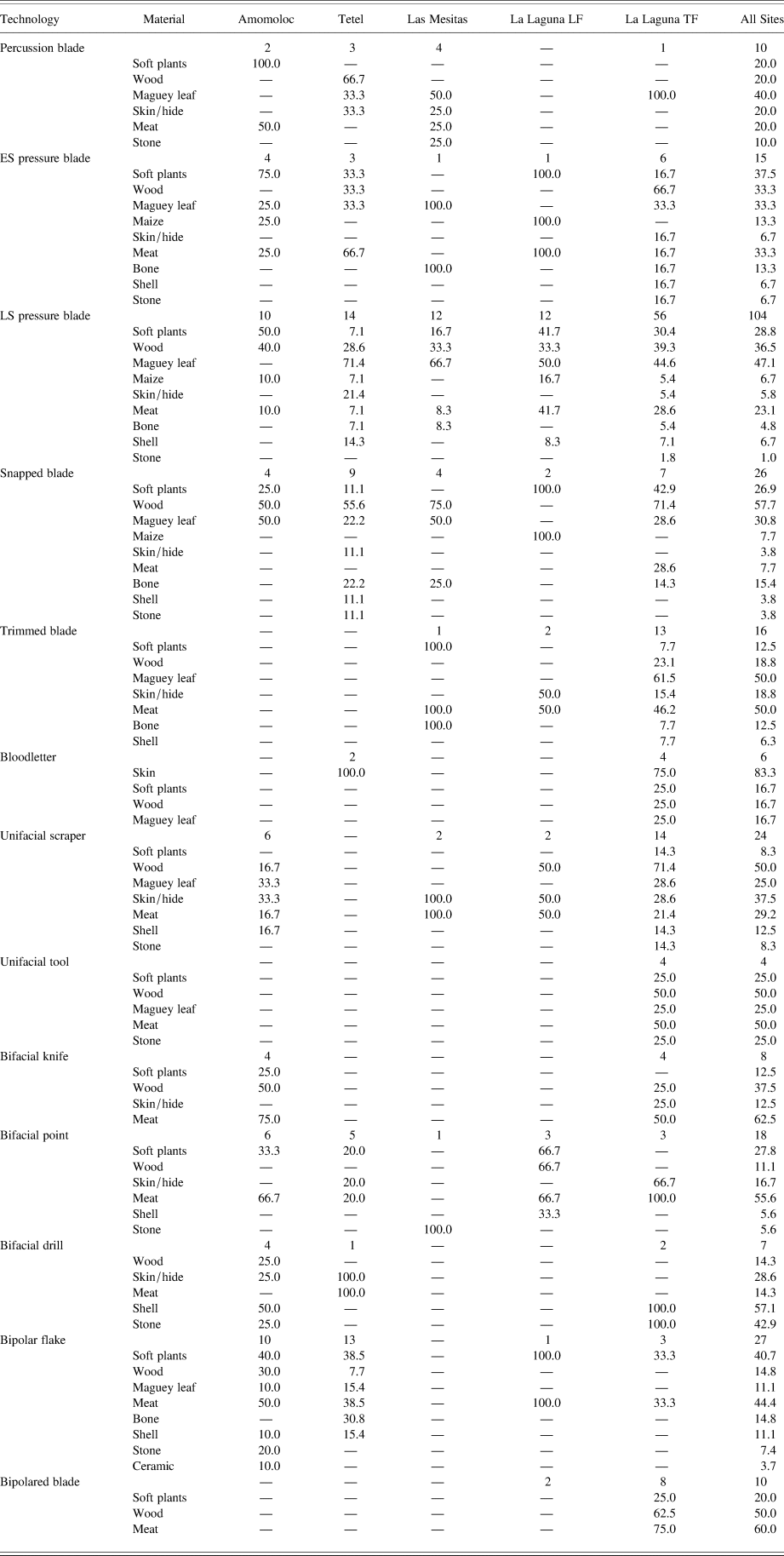
Material signatures detected on specimens. Tool forms are in numbers and material signatures are in percentages. ES, early-series pressure; LF, Late Formative; LS, late-series pressure; TF, Terminal Formative.

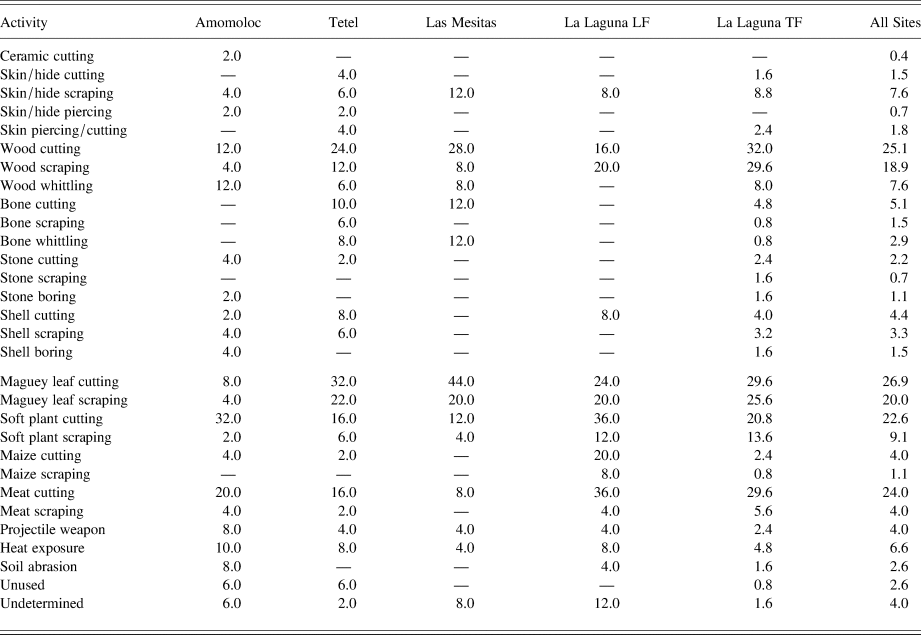
Activities and post-depositional processes detected on use-wear specimens. Values are in percentages. LF, Late Formative; TF, Terminal Formative.

Amomoloc
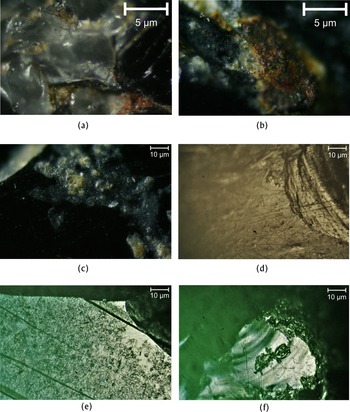
Both percussion blades from Amomoloc exhibit Stage 1 polish with striations indicative of soft plant cutting, while one also has signs of meat cutting with blood residues. Four early-series pressure blades exhibit Stage 2 to Stage 3 polish produced by the cutting of soft plants (Figure 6a), maguey leaf, maize, and meat, and the scraping of soft plants. Two of the late-series pressure blades were not used. One specimen exhibits a burnt surface and blood residue. The remaining late-series pressure blades exhibit Stage 2 to Stage 3 polish produced by the cutting of soft plants, wood, and maize and the whittling of wood. The snapped blade segments exhibit four specific activities, respectively: soft plant cutting (Stage 1); wood whittling (Stage 2; Figure 7f); maguey leaf cutting (Stage 3); and wood and maguey leaf cutting (Stage 3). These data suggest blades were used primarily for subsistence activities involving mostly soft plants followed by wood followed by maguey leaf, maize, and meat. In addition, late-series blades (unsnapped or snapped) were the preferred tools for wood cutting and whittling. Eight of the 17 used blade specimens (47.1 percent) demonstrate evidence for multiple activities. Overall, blade artifacts of different obsidian sources were used indiscriminately. The two unused specimens may indicate that the whole blades imported to Amomoloc arrived unused.
Examples of use-wear characteristics linked to specific activities. (a) Soft plant cutting (Amomoloc, Specimen 50), arrows indicate striations; (b) meat cutting (Tetel, Specimen 4), arrow indicates striations; (c) maize cutting (La Laguna, Specimen 69); (d) maguey leaf cutting (La Laguna, Specimen 25); (e) shell cutting (La Laguna, Specimen 62); (f) wood cutting (Tetel, Specimen 46). Photographs by the author.

Examples of use-wear characteristics linked to specific activities. (a) Hide scraping with white arrow indicating blood residue (Amomoloc, Specimen 42); (b) maguey leaf scraping (La Laguna, Specimen 148); (c) shell and stone boring (La Laguna, Specimen 122); (d) bone whittling (Tetel, Specimen 11); (e) wood scraping (La Laguna, Specimen 65); (f) wood whittling (Amomoloc, Specimen 2). Photographs by the author.

The unifacial scrapers include a specimen with a burnt surface and post-depositional soil abrasion preventing activity identification; a specimen with white residue and Stage 3 polish indicative of wood and shell scraping; a specimen with Stage 2 polish indicative of skin/hide scraping; a chalcedony specimen with Stage 2 polish indicative of maguey leaf scraping; and two chert specimens, one with blood residue and Stage 2 polish indicative of skin/hide and meat scraping (Figure 7a) and the other with Stage 2 polish indicative of maguey leaf scraping. From a technological perspective, obsidian may have been chosen over chert or chalcedony for scraping wood and shell, which are much denser than maguey leaf and animal hide/skin, because obsidian offers a sharper edge that can be regenerated quickly and easily. While one of the unifacial scrapers demonstrates multiple activities, four of the other five unifacial scrapers (80 percent) were used for only one type of activity, which could indicate a unifunctional tool-use approach.
The four bifacial knives present individualized cases that merit full description. The first specimen exhibits two small areas of polish produced by the friction of a hafted wooden handle, blood residue, and Stage 3 polish and striations indicative of meat cutting. A shorter bifacial knife fragment exhibits similar blood residue near concentrated diagonal striations and Stage 2 polish indicative of meat cutting; the missing section of the tool is most likely the hafted end. In contrast, a similarly sized bifacial knife exhibits brown and white residue alongside Stage 2 polish and striations indicative of wood whittling as the primary activity and soft plant and meat cutting as secondary activities. The final specimen exhibits blood residue but also pervasive soil abrasion on its surfaces, which prevents activity identification(s). Overall, this small dataset indicates bifacial knives were likely used to process animals just as they may have been used for similar tasks accomplished with blades or bipolar flakes (discussed later).
Six bifacial points of similar size include two specimens with burnt surfaces that prevent activity identification(s), one with projectile impact damage on its tip; one specimen with pervasive soil abrasion but also Stage 2 polish with diagonal striations near its tip, indicating use as a projectile weapon; and three specimens with blood residue and Stage 2 polish, one indicating hafting at its base and another indicating meat cutting in addition to use as a projectile weapon. Based on use-wear data and technological form, these bifacial points were likely used for hunting. The high frequencies of post-depositional surface alterations and blood residues demonstrate that these tools were likely discarded at the end of their intended use-lives.
Four bifacial drills provide two cases of Stage 3 polish from shell boring and one case of Stage 1 polish with blood residue produced by skin/hide piercing, wood boring, stone boring, and shell scraping, respectively, while the largest tool made of chert was not used. Obsidian sources were utilized for shell working, while chert was used for skin/hide piercing. These findings could reflect a preference for obsidian to bore through denser materials and chert to bore through but not accidentally cut animal hide/skin. One bifacial drill was used for multiple activities, but two were used for single activities, respectively. Based on my experimental results, obsidian bifacial drills dull quickly during use, making it difficult to use them for different activities.
Ten bipolar flakes provide six cases of Stage 2 polish, three cases of Stage 3 polish, and a single case of Stage 1 polish. There are three specimens with blood residues (Figure 8a) and one specimen with pink and red residue, likely ceramic material. Activities include: four cases of soft plant and meat cutting; two cases of wood whittling and stone cutting; and single cases of meat scraping and ceramic, shell, wood, and maguey leaf cutting. Fifty percent of the bipolar flakes, which are small handheld tools, were used for multiple activities, and two of these were used for three separate types of activities. Therefore, it is apparent that residents of Amomoloc practiced a multifunctional tool-use approach with bipolar flakes, utilizing them as kitchen utensils and/or crafting tools.
Examples of use-wear characteristics. (a) Blood residue (Amomoloc, Specimen 4); (b) blood residue (Las Mesitas, Specimen 23); (c) hafting resin (Las Mesitas, Specimen 3); (d) striations running across a notched surface indicating hafting (Tetel, Specimen 32); (e) burnt surface (La Laguna, Specimen 66); (f) damaged tip of a bifacial point (La Laguna, Specimen 19). Photographs by the author.

Tetel
Three percussion blades exhibit intensive Stage 3 polish produced by wood cutting and whittling, maguey leaf scraping and cutting, and wood and skin/hide scraping and wood cutting, respectively. Three early-series pressure blades exhibit less intense use in comparison. One specimen exhibits Stage 3 polish linked to maguey leaf cutting and scraping; the second exhibits Stage 2 polish produced by meat cutting (Figure 6b); and the third exhibits Stage 2 polish created by meat, soft plant, and wood cutting and wood whittling. The 14 late-series pressure blades include 11 cases of Stage 3 polish, one example of Stage 4 polish (maguey leaf and skin/hide cutting), one example of Stage 2 polish (maguey leaf cutting and scraping), and one example of Stage 1 polish (meat cutting). The activities that produced Stage 3 polish include the cutting of maguey leaf, skin/hide, bone, maize, soft plants, wood (Figure 6f), and shell and the whittling or scraping of bone (Figure 7d), skin/hide (blood residue present), maguey leaf, wood, and shell. The most frequently worked material was maguey leaf (71.4 percent). The activities and degrees of use that appear on nine snapped blade segments compare closely to those observed on late-series pressure blades. There are two cases of Stage 2 polish produced by wood cutting and wood and soft plant cutting, respectively. The activities that produced Stage 3 polish include the cutting of maguey leaf, wood, bone, stone, and shell, and the scraping or whittling of maguey leaf, wood, bone, skin/hide, and shell. Overall, blades of different obsidian sources were used indiscriminately to craft items of maguey leaf (48.3 percent), wood (41.3 percent), skin/hide (17.2 percent), bone (10.3 percent), shell (10.3 percent), and stone (3.4 percent). Multiple activities frequently appear on Tetel's blade specimens (86.2 percent), indicating that residents employed a multifunctional tool-use approach with blade tools.
In sharp contrast to multifunctional blade tools, two obsidian bloodletters with fine bifacial retouch from Tetel were used for one function—domestic ritual bloodletting—based on very few fine and shallow striations that run diagonal to the used edges, which contain isolated blood residues (Walton Reference Walton2021:Figure 3). While unaltered pressure blades (or any newly created obsidian tool edge) also could have been used for ritual bloodletting at Tetel and other sites, there are no cases of similar use-wear patterns indicative of this ritual practice on other tool form specimens in this study.
Two of the five bifacial points do not exhibit signs of use, and the burnt surfaces of one specimen prevent further investigation. The remaining specimens exhibit Stage 2 polish produced by hafting contact with soft plants (Figure 8d) and wood, and one specimen possesses evidence of use as a projectile weapon in contact with skin/hide and meat. The chert bifacial drill also demonstrates contact with skin/hide and meat through blood residue and Stage 1 polish produced by piercing.
Bipolar flakes include seven specimens with Stage 2 polish, five specimens with Stage 3 polish, and one specimen with no evidence of use. Three specimens exhibit blood residues, and one specimen exhibits a white powdery residue. The activities detected include meat cutting (38.5 percent), soft plant cutting (38.5 percent), soft plant scraping (23.1 percent), bone scraping (23.1 percent), maguey leaf cutting (15.4 percent), bone cutting (15.4 percent), shell scraping (15.4 percent), meat scraping (7.7 percent), bone whittling (7.7 percent), shell cutting (7.7 percent), and wood cutting (7.7 percent). Patterns of activities linked to specific obsidian sources do not exist. Two-thirds of the bipolar flakes with signs of use were used for multiple activities, indicating that residents of Tetel practiced a multifunctional tool-use approach with bipolar flakes, utilizing them as kitchen utensils and/or crafting tools.
Las Mesitas
The sample of four percussion blades includes one specimen with very light Stage 1 polish linked to meat cutting, while two other specimens exhibit more intensive Stage 3 polish linked to maguey leaf scraping; one of these specimens also has evidence for maguey leaf cutting, while the other specimen has evidence for skin/hide scraping as well. The final specimen exhibits a pervasive stone-abraded surface that prevents identifications of activities that may have predated this activity. The single early-series pressure blade exhibits Stage 3 polish produced by intensive bone whittling and maguey leaf scraping. One of the late-series pressure blades has blood residue but also burnt surfaces that prevent activity identification(s). Three late-series pressure blades exhibit Stage 2 to Stage 3 polish produced by maguey leaf cutting; one specimen also demonstrates maguey leaf scraping, while another also demonstrates soft plant cutting. The remaining eight late-series pressure blades exhibit two cases of Stage 2 polish linked to wood and maguey leaf cutting; one case of Stage 4 polish linked to maguey leaf and soft plant cutting; and five cases of Stage 3 polish on two specimens indicating wood cutting and whittling, two specimens indicating maguey leaf cutting, and one specimen indicating bone cutting and whittling. The four snapped blade segments include two specimens that exhibit one activity, respectively: maguey leaf cutting (Stage 4 polish) and wood cutting (Stage 3 polish). The other specimens exhibit multiple activities with Stage 3 polish, respectively: bone and wood cutting and whittling (blood residue present) and wood and maguey leaf cutting and scraping. The single trimmed blade specimen exhibits blood (Figure 8b), brown, and white residues, and Stage 3 polish indicative of meat, bone, and soft plant cutting and soft plant scraping. Overall, blade tools of different obsidian sources were used indiscriminately. Activities with meat and skin/hide were more likely to be accomplished with percussion blades, but bone working was accomplished only with pressure blades. Finally, 63.6 percent of blade specimens were utilized for multiple activities linked to five different types of materials, clearly indicating a multifunctional tool-use approach.
The chalcedony and chert unifacial scrapers both exhibit blood residues with Stage 3 polish linked to skin/hide scraping. The obsidian bifacial point exhibits Stage 2 polish indicative of contact with a stone-tipped pressure flaker and yellow and brown residues that might remain from resin used to haft the point (Figure 8c). While the point does not appear to have been used as a projectile weapon, the use-wear data are able to reveal the production steps that were taken to put this tool in a position to be used as a projectile weapon.
La Laguna Late Formative Occupation (600–400 b.c.)
The early-series pressure blade exhibits Stage 3 polish produced by meat, soft plant, and maize cutting and maize scraping. One of the late-series pressure blades exhibits blood residue and Stage 3 polish produced by meat cutting and wood and maguey leaf cutting and scraping. The remaining 11 specimens without residue exhibit five cases of Stage 2 polish and six cases of Stage 3 polish. Activities include: five cases of maguey leaf cutting (Figure 6d); four cases of maguey leaf scraping (Figure 7b), soft plant cutting, and meat cutting; three cases of wood scraping; two cases of wood cutting, maize cutting (Figure 6c), and soft plant scraping; and one case of shell cutting. One of the snapped blades exhibits Stage 3 polish produced by maize and soft plant cutting, while the other specimen exhibits similar Stage 2 polish produced by maize and soft plant cutting and maize scraping. One of the trimmed blades has a burnt surface (Figure 8e) that prevents activity identification(s). The other specimen exhibits blood residue and Stage 2 polish produced by meat cutting and skin/hide scraping. Overall, blade tools were used to craft items of maguey leaf (35.3), wood (23.5 percent), skin/hide (5.9 percent), and shell (5.9 percent). Multiple activities frequently appear on these Late Formative blade specimens (82.4 percent), indicating that residents employed a multifunctional tool-use approach with blades.
Each unifacial scraper exhibits Stage 3 polish but linked to different activities. The first specimen has blood residue and both perpendicular striations and edge rounding characteristic of skin/hide scraping and parallel striations characteristic of meat cutting. The other specimen exhibits evidence of hafting at its base and wood scraping on its utilized edge (Figure 7e). One of the bifacial points was made from a pressure blade, making it much smaller and lighter compared to the other specimens created via bifacial reduction from macroflakes/macroblades. This smaller side-notched point exhibits evidence for hafting as well as Stage 2 polish produced by soft plant and meat cutting. The second specimen exhibits brown and white residue, a damaged tip (Figure 8f), and Stage 2 polish indicative of hafting and contact with meat, which collectively point to its use as a projectile weapon. The third specimen exhibits brown, pink, and white residue and Stage 3 polish produced by shell (Figure 6e) and wood cutting, in addition to its use as a projectile weapon. Both bipolared blades exhibit altered surfaces via burning and soil abrasion, respectively, which prevent activity identification(s). The bipolar flake exhibits Stage 2 polish produced by meat and soft plant scraping. Overall, the versatile functions of blades complement the more specific functions of unifacial scrapers, bifacial dart points, and bipolar tools.
La Laguna Terminal Formative Occupation (100 b.c.–a.d. 150)
Area I
The percussion blade exhibits Stage 3 polish produced by maguey leaf scraping. The early-series pressure blade exhibits Stage 3 polish produced by bone and wood cutting and wood whittling. The 28 late-series pressure blades exhibit 20 cases of Stage 3 polish, six cases of Stage 2 polish, one case of Stage 4 polish, and one case of Stage 1 polish. Observations detected five cases of wood residue and four cases of blood residue. Activities include 14 cases of maguey leaf cutting; 10 cases of maguey leaf scraping; nine cases of wood cutting and meat cutting; eight cases of wood scraping; seven cases of soft plant cutting; four cases of soft plant scraping; two cases of wood whittling; and single cases of maize cutting, maize scraping, and skin/hide scraping. There are no patterns linking certain obsidian sources to specific activities or combinations of activities. The bloodletter specimen was classified by technological criteria as a bloodletter, but parallel and diagonal striations and Stage 3 polish indicate it was used to cut soft plants, maguey leaf, or wood (Walton Reference Walton2021:Figure 6). Therefore, it is more accurate to classify it as a trimmed blade. Four additional trimmed blades exhibit Stage 3 polish linked to three cases of maguey leaf cutting and single cases of maguey leaf scraping, wood scraping with residue, soft plant cutting, and meat cutting. Overall, blade tools were used at similar rates for crafting items out of maguey leaf (54.3 percent) and wood (40 percent) but at much lower rates for working skin/hide (2.9 percent) and bone (2.9 percent). Multiple activities appeared frequently on these tools (80 percent), indicating that residents of Area I employed a multifunctional tool-use approach with blades.
Nine unifacial scrapers provide two cases of Stage 2 polish and seven cases of Stage 3 polish in addition to three observations of wood residues. Activities include six cases of wood scraping; three cases of maguey leaf scraping; two cases of skin/hide scraping; and single cases of soft plant cutting, meat cutting, wood cutting, shell scraping, stone scraping, soft plant scraping, and meat scraping. Multiple activities, associated mostly with craft production, appear frequently (77.8 percent). In contrast, the bifacial knife and point specimens contacted only skin/hide and meat. More specifically, both bifacial knives exhibit soil residue—rendering one specimen's surfaces impossible to analyze for activity identification(s)—and one specimen exhibits Stage 3 polish produced by skin/hide scraping. One of the points exhibits blood residue, and both specimens exhibit damaged tips and Stage 2 polish linked to contact with skin/hide and meat as part of their function as projectile weapons; the specimen with blood residue also exhibits parallel striations indicative of meat cutting. Finally, both bipolared blades were used in contact with meat and wood: one case of wood residue and Stage 2 polish produced by wood and meat cutting and scraping and one case of Stage 3 polish produced by meat and wood cutting and wood whittling. Since bipolared blades are a recycled technology, it is possible these specimens were used first as blades for woodworking and later as kitchen utensils.
Area H
The early-series pressure blade exhibits Stage 2 polish produced by soft plant and wood cutting and scraping. The 11 late-series pressure blades include seven specimens with Stage 3 polish, three with Stage 2 polish, and one with a burnt surface that prevents observations of polish and activities. Activities include: six cases of soft plant cutting; four cases of wood cutting, maguey leaf cutting, and maguey leaf scraping; three cases of soft plant scraping; two cases of wood scraping and meat cutting; and single cases of wood whittling, skin/hide scraping, and shell scraping. Three snapped blades exhibit Stage 3 polish produced by soft plant and wood cutting and scraping, while one specimen also has a partially burnt surface. One of the trimmed blades exhibits blood residue and Stage 3 polish produced by meat and maguey leaf cutting. The other trimmed blade exhibits Stage 3 polish produced by bone and shell cutting and scraping. Blade tools were used for crafting items of wood (52.9 percent), maguey leaf (23.5 percent), shell (11.8 percent), bone (5.9 percent), and skin/hide (5.9 percent). All blades performed multiple activities except for the specimen with an unobservable surface, indicating that residents of Area H employed a multifunctional tool-use approach with blade tools.
Three bloodletters exhibit similar-looking blood residues and Stage 2 polish produced by skin cutting (Walton Reference Walton2021:Figure 5). It is important to note that these were more than single use tools. While blood residue can be detected on obsidian tool surfaces after one to five strokes, it takes approximately five to 25 strokes to create striations (Walton Reference Walton2019:Figure 12). Therefore, I interpret these specimens as implements used for domestic ritual bloodletting.
One unifacial scraper exhibits Stage 3 polish produced by maguey leaf scraping, while the other specimen exhibits Stage 3 polish produced by wood cutting and scraping. Both bifacial drills exhibit Stage 3 polish created by shell and stone boring (Figure 7c). The bipolared blade exhibits wood residue and Stage 2 polish produced by wood whittling and meat cutting. Considering these results, unifacial scrapers and bifacial drills were used for craft production, while bipolared blades may have been recycled craft production tools used as kitchen utensils.
Area F
Four early-series pressure blades exhibit Stage 3 polish from two observations of wood cutting, wood whittling, and maguey leaf scraping and single observations of maguey leaf, shell, and stone cutting and skin/hide and meat scraping. One late-series pressure blade with soil abrasion on its surface also exhibits blood residue and Stage 3 polish produced by bone cutting. The remaining 16 late-series pressure blades exhibit one case of Stage 4 polish produced by maguey leaf cutting and scraping and 15 cases of Stage 3 polish, two of which have associated blood residues and four of which have associated wood residues. Activities include: eight cases of maguey leaf cutting; six cases of wood cutting; five cases of meat cutting; four cases of maguey leaf scraping; three cases of wood scraping, soft plant cutting, and shell cutting; two cases of soft plant scraping, maize cutting, and bone cutting; and single cases of skin/hide scraping, shell scraping, stone cutting, bone whittling, and wood whittling. Four snapped blades exhibit two examples of Stage 3 polish and single examples of Stage 2 and Stage 4 polish. Activities include two cases of meat cutting (one with a burnt surface), maguey leaf cutting, wood cutting, and wood scraping, and one case of bone cutting. Seven trimmed blades provide one case of blood residue on a partially burnt surface that exhibits Stage 2 polish produced by meat and skin/hide cutting and scraping; one case of soil residue associated with Stage 3 polish produced by meat, skin/hide, and maguey leaf cutting and scraping; and two cases of wood residue associated with Stage 3 polish produced by wood cutting and scraping on one specimen and meat and wood cutting on another specimen. The three specimens that lack residues exhibit Stage 3 polish produced by three cases of maguey leaf scraping and single cases of meat cutting and maguey leaf cutting. Blade tools were used for crafting items of maguey leaf (50 percent) and wood (37.5 percent) but at lower rates for crafting items of skin/hide (12.5 percent), bone (12.5 percent), shell (12.5 percent), and stone (6.3 percent). Multiple activities appeared frequently on blade tools (75 percent), indicating that residents of Area F employed a multifunctional tool-use approach with blades.
Three unifacial scrapers exhibit Stage 3 polish with single cases of wood and blood residues, respectively. One specimen was used for shell and wood scraping; the second was used for wood and skin/hide scraping; and the third was used for wood scraping and cutting and meat cutting. Four unifacial tools provide one example of a small tool with Stage 2 polish produced by meat and soft plant cutting and three examples of larger tools with Stage 3 polish produced by meat cutting and wood scraping with wood residue; maguey leaf and wood cutting and scraping with wood residue; and stone cutting. Overall, these unifacial tool forms were used most frequently to work wood (71.4 percent) and meat (42.9 percent). Only one of the unifacial tools was used for a single activity, indicating a multifunctional tool-use approach with unifacial tools.
Both bifacial knives exhibit blood residues associated with meat cutting—Stage 2 and Stage 3 polish, respectively—and one of the specimens exhibits evidence for wood cutting. The single bifacial point exhibits blood residues but lacks polish development, indicating that if it was used as a projectile weapon it was not used frequently. Two of the three bipolar flakes were used and exhibit specific functions: soft plant scraping (Stage 1 polish) and meat cutting (Stage 2 polish) with brown and red residue. Bipolared blades include two specimens with blood residue and one specimen with wood residue. Two specimens were used for meat cutting—Stage 1 and Stage 2 polish—and two specimens were used for soft plant and wood cutting and scraping—Stage 2 and Stage 3 polish. Finally, a much larger bipolared blade exhibits blood residue and Stage 2 polish produced by meat scraping. Comparing use-wear data across all technological forms, bifacial and bipolar artifacts stand out as tools that were used more regularly for single types of activities (70 percent) compared to multiple types of activities frequently performed with blade and unifacial artifacts.
DISCUSSION
Residents of Amomoloc, Tetel, Las Mesitas, and La Laguna had equal access to different lithic materials including obsidian sources; and high frequencies of Stage 3 to Stage 4 polish on use-wear specimens indicate they were frugal with obsidian, a non-local material. There is no indication that certain sources of obsidian were preferred for specific tools or activities, but data from Amomoloc, Tetel, and Las Mesitas indicate chert and chalcedony tools were used preferably for activities with skin/hide and meat. In contrast, unifacial scrapers and bifacial drills with sharper edges made of obsidian were preferred for activities with denser materials like wood, shell, and stone. Finally, it is striking that maguey heart scraping was not detected, but its absence might be attributed to a preference for rougher-textured and duller-edged basalt scrapers (Carballo Reference Carballo2009; Walton Reference Walton2017).
Blades, especially late-series pressure blades, became more frequent in toolkits starting in the Middle to Late Formative, followed by modified blades in the Terminal Formative. Residents consistently employed a multifunctional tool-use approach with obsidian blades (Table 2), likely influenced by their edge sharpness and stabilization, which enabled various tool motions, including cutting, scraping, and whittling (Table 3). Percussion blades were used most frequently to process maguey leaves but also for tasks involving soft plants, wood, hide, meat, and stone. Early-series pressure blades were used to work many materials but most frequently soft plants, wood, maguey leaf, and meat. Snapped blades were used more frequently for craft production—especially manipulating wood, maguey leaf, and bone—than food production, which involved more plants than meat. Trimmed blades were used primarily for food production prior to Terminal Formative La Laguna, when they were used mostly for processing maguey leaves, secondarily for food production, and infrequently for craft production.
Comparing material signatures on late-series pressure blades reveals they were the most multifunctional lithic technology. Blades and other technologies collectively reveal similar rates of wood and skin/hide working across all five occupations and within Terminal Formative La Laguna. In contrast, bone working is absent from Amomoloc and shell working is absent from Las Mesitas. Bone crafting declined from the Late to Terminal Formative, while shell crafting neither increased nor declined significantly (Table 3). Maguey leaf cutting and scraping accomplished with blade tools and likely basalt scrapers became much more frequent in the Middle to Late Formative. In fact, maguey leaf was the most frequently worked material by all late-series pressure blade specimens, despite its absence in Amomoloc's specimens (Table 3). These patterns point to the increasing functions blade tools served in maguey fiber extraction and/or textile crafting. A higher social status may explain why the elites of Area H worked maguey leaf much less (23.5 percent) compared to the commoners of Area F (50 percent) and Area I (54.3 percent), meaning elite residents might have been able to supplement their consumer demand for finished textile products through their purchasing power or involvements with burgeoning social institutions. Cutting off and scraping maguey leaves to remove the fibers is also a messy task that can cause painful skin damage, which elites likely desired to avoid if they could.
Late-series pressure blades were often used to work soft plants, while these activities were notably less frequent at Tetel and Las Mesitas. The frequencies of material signatures for meat are relatively consistent across blade specimens from Amomoloc, Tetel, and Las Mesitas, but rise dramatically with specimens from La Laguna (Table 2). This pattern is also apparent for rates of meat cutting across all lithic technologies (Table 3). Grouping together material signatures for soft plants, maize, and meat as signs of food production, blade tools were used most frequently for these tasks at Area H (70.6 percent), Amomoloc (65 percent), and Late Formative La Laguna (64.7 percent), followed by Area I (48.6 percent), Area F (40.6 percent), Las Mesitas (22.7 percent), and Tetel (13.8 percent). However, within Terminal Formative La Laguna, commoners in Area F (44 percent) and Area I (32 percent), where suprahousehold feasting took place, prepared meat more frequently than the elite residents of Area H (16 percent). Bifacial knives—likely imported to La Laguna—and locally produced blades were used for butchering this meat, comprised mostly of white-tailed deer (Odocoileus virginianus) and domestic dog (Canis familiaris) with some Mexican cottontail rabbit (Sylvilagus cunicularius) and wild turkey (Meleagris gallopavo; Toledo Barrera Reference Toledo Barrera2019). Lesure and colleagues (Reference Lesure, Borejsza, Carballo, Frederick, Popper and Wake2006:489) present botanical and faunal analyses from Amomoloc and Tetel that indicate a maize-focused diet with deer as the primary meat source, in addition to beans, squash, wild plants, rabbit, and dog. Tetel and Las Mesitas have comparatively fewer bifacial points—mostly identified as hafted projectile weapons, likely used to hunt white-tailed deer—in their toolkits compared to the other sites (Table 1), which might explain why their material signatures for meat and rates of food production are much lower compared to the other sites.
One noticeable change from Amomoloc, Tetel, and Las Mesitas to La Laguna is that Late and Terminal Formative residents were more apt to use recycled blades—previously used for wood working—via bipolar percussion than to create new, original flakes via bipolar percussion, which might indicate that cores outside of the blade reduction process were not frequently circulating in the regional lithic economy. These bipolar flakes were used primarily as kitchen utensils and secondarily as crafting tools, following a multifunctional tool-use approach, while bipolared blades were used as kitchen utensils (Table 2). In contrast, unifacial scrapers were used mostly for non-food production-related tasks, such as wood, maguey leaf, skin/hide, meat, shell, and stone scraping, following a unifunctional tool-use approach at Amomoloc and a multifunctional tool-use approach at La Laguna. Unifacial tools at La Laguna were also used for multiple functions. While unifunctional tool-use approaches could be expected to align with craft specialization or a production strategy for exchange, there is insufficient evidence for the scales of production that would be linked to these domestic production strategies. Instead, it appears that unifacial scrapers, with their steeply reinforced edges, were often deliberately designed and utilized for specific quotidian tasks.
Bifacial drills were used to bore shell and stone at Amomoloc and Area H at Terminal Formative La Laguna. These findings add context for interpreting the two greenstone beads recovered from Amomoloc and perforated slate artifacts and 100 pieces of greenstone—15 percent of which have perforations and 28 percent of which are associated with Area H—from mixed and secure Terminal Formative contexts at La Laguna (Carballo et al. Reference Carballo, Carballo and Lesure2014b:470–471). Slate artifacts were not recovered from the village sites, and excavations at Tetel recovered only a jade pendant from a looter's pit. These greenstone and slate artifacts were imported to northern Tlaxcala, meaning bifacial drills likely functioned as maintenance or alteration tools rather than production tools. In stark contrast, one example of multicrafting from the residential area of Nativitas (550–150 b.c.), near Xochitecatl, links lithic production to prestige goods (Hirth et al. Reference Hirth, Serra Puche, Lazcano Arce and De León2009). Here, non-elite households manufactured chert drills to use in lapidary production, which was probably more feasible for Nativitas residents near Xochitecatl's urban center compared to rural villagers and townsfolk who experienced fewer interactions with foreigners and long-distance traders.
While the smaller sizes and rural locations of Tetel and La Laguna may have reduced the numbers of stone tools used in lapidary production, these factors must have not prevented residents from participating in domestic rituals that were growing in popularity. Obsidian bloodletters were new additions to domestic toolkits beginning in the Middle to Late Formative at Tetel, contradicting earlier models that labeled bloodletters as prestige goods found only in elite households (Flannery and Marcus Reference Flannery and Marcus2005; Parry Reference Parry1987). While bloodletters originated in non-elite domestic contexts at Tetel, they are concentrated in elite residences and public ritual contexts at Terminal Formative La Laguna (Walton and Carballo Reference Walton and Carballo2016). This transference or appropriation of domestic ritual bloodletting—likely conducted to venerate or communicate with ancestors (Plunket Reference Plunket2002)—to public rituals may signal moves by social elites and institutions to lead the creation or actualization of an ontology based in animism during the Late and Terminal Formative (Carballo Reference Carballo2007; Walton Reference Walton2021).
Including high-magnification use-wear analyses in future projects will help to provide microeconomic views of household practices and their roles in local and regional economies. The results of previous technological studies and the results from high-magnification use-wear analyses presented here for sites in northern Tlaxcala support the framing of lithic production and consumption as corporate or inclusive strategies, rather than network or exclusionary strategies for most of the Formative central highlands. Power to access obsidian sources and produce/acquire and use different technologies was shared among households, which provisioned themselves independently. Obsidian prestige goods were not created locally or acquired through exchange networks by residents of Amomoloc, Tetel, Las Mesitas, and La Laguna. Similarly, there is little indication that certain obsidian tool forms were used to craft prestige goods for local use or exchange, unless prestige goods were made of wood or soft plants that did not preserve in the archaeological record. One example of multicrafting from Nativitas near Xochitecatl links lithic production to prestige goods, but this consumer demand for lapidary goods created by domestic lithic production appears to have been very limited and concentrated near only primary urban centers. Instead, residents of villages and towns utilized their toolkits—increasingly dominated by Mesa Central obsidian sources and blades over time—following multifunctional tool-use approaches for blades and bipolar tools, varied tool-use approaches for unifacial tools, and unifunctional tool-use approaches for bloodletters and bifacial knives, drills, and points for daily subsistence, intermittent craft production, and domestic rituals. The widest range of activities accomplished with lithic artifacts took place at Terminal Formative La Laguna, where social statuses and early forms of social institutions are evident through multiple lines of evidence now including use-wear data.
RESUMEN
Los análisis a gran aumento de huellas de uso crean datos que permiten estudios microeconómicos del consumo lítico, así como las actividades domésticas que complementan los estudios macroeconómicos de la producción y el intercambio del material lítico para mejorar colectivamente nuestras reconstrucciones de economías antiguas. En las últimas décadas, los análisis composicionales y tecnológicos han revelado cómo ciertas fuentes de obsidiana y tecnologías líticas fueron explotadas, producidas e intercambiadas en el altiplano central de México durante el período formativo (1500 a.C.–100 d.C.). Este artículo presenta un estudio sobre el uso de 275 artefactos líticos de cuatro sitios en el norte de Tlaxcala–Amomoloc (900–650 a.C.), Tetel (750–500 a.C.), Las Mesitas (600–500 a.C.) y La Laguna (600–400 a.C. y 100 a.C.–150 d.C.)—con el fin de comparar las actividades domésticas con las tecnologías líticas y evaluar sus roles en las economías regionales.
El análisis a gran aumento de huellas de uso puede detectar cuatro rasgos creados por el uso de herramientas de obsidiana: estriaciones, redondeo en los filos, micropulidos y residuos. Las características de uso y las funciones de las herramientas de obsidiana identificadas aquí se basan en mi programa sistemático de 300 experimentos con 145 especímenes de obsidiana que controlaron dos fuentes de obsidiana, dos duraciones de actividad (5 y 15 minutos), y 29 materiales diferentes a los que podían acceder las comunidades prehispánicas del centro de México. Los artefactos en este estudio fueron seleccionados como una muestra representativa dentro de la amplia gama de formas de herramientas completas presentes en los conjuntos líticos de los cuatro sitios.
Los resultados indican que los antiguos habitantes del norte de Tlaxcala usaban navajas de obsidiana para la subsistencia y la artesanía doméstica; la extracción de fibra de maguey para la producción textil aumentó con el tiempo, especialmente en hogares no pertenecientes a la élite. La preparación y el consumo de la carne adquirida mediante la caza, y otros métodos, aumentaron con el tiempo y las tecnologías bipolares se utilizaron como utensilios de cocina. El derramamiento ritual de sangre requería una tecnología específica, pero esta forma y otros artefactos no se intercambiaban como objetos de prestigio ni se usaban para fabricar objetos de prestigio, a menudo considerados como potencias principales de las economías en Mesoamérica durante el formativo.
ACKNOWLEDGMENTS
This research was supported by the National Science Foundation (BCS—0941278, 0003961, 0313762; DDIA—1533539), Wenner-Gren Foundation for Anthropological Research (6722), H. John Heinz III Fund of the Heinz Family Foundation, National Geographic Society, University of California Institute for Mexico and the United States/El Consejo Nacional de Ciencia y Tecnología, and Foundation for the Advancement of Mesoamerican Studies (No. 05018). I thank Richard Lesure and David Carballo for permission to analyze their lithic assemblages. I also thank David Carballo, Ken Hirth, Curtis Runnels, and Kristen Wroth for reviewing earlier manifestations of this study.