1. Introduction
In his Hammer's German Grammar and Usage, Martin Durrell refers to cleft sentences (clefts) twice. In the section on “impersonal and other uses of the pronoun es as the subject of a verb” (Durrell Reference Durrell2002:58–61, see also Durrell Reference Durrell1992:232, 247) he claims that German clefts with relative clauses such as 1 are based on what could be called “presentational” Er ist es ('It's him') and adds that other clefts, especially those corresponding to the English type It was this morning that I saw her, are unusual in German.
(1) Er war es, der es mir sagte.
'It was him who told me.'
Under the heading “English equivalents for German constructions with an element other than the subject in initial position,” Durrell (Reference Durrell2002:478-479) explains that English, unlike German, cannot easily move clause elements into initial position to form the topic of the sentence (fronting). Therefore English requires a range of complex constructions, which correspond to simple sentences in German.
Durrell's dense remarks on clefts—they barely add up to three quarters of a page—make a number of claims and a recommendation. The claims are:
i. Clefts are far more frequent in English than in German.
ii. The reason for this contrast lies in the different fronting opportunities in the two languages.
iii. Clefts sound unnatural in German, apart from the earlier introduced type Er war es, der mich davon abhielt [It was him who stopped me from doing it].
iv. The one natural sounding cleft sentence construction in German is an expansion of another construction (and this is—reading between the lines—the reason why it sounds natural).
The recommendation to English learners of German is to avoid clefts in German.
Clefts are not just an important topic in didactic grammar but their greater frequency in English compared with German is bound up with typological differences between the two languages. In addition to Durrell's explanation above, that is, that fronting is restricted in English as a result of the change from V2 to the fixed SV order, English clefts are said to compensate for the comparatively small number of scalar and modal particles (already, only, even, etc. vs. sogar, schon, ausgerechnet, gerade, jedenfalls, etc.) (Schmid Reference Schmid1999:87), English restrictions on adverbial modification such as on stressing adverbs (Sie hat es deshalb gemacht vs. *She did it therefore), and the lack of English pronominal adverbs (Die Lösung besteht darin, dass … vs. *The solution consists in that …) (Doherty Reference Doherty2001:625–634). Clefts are also indicative of the greater degree of configurationality of English in comparison with German. It remains to be seen to what extent these contrasts can explain the selection of English and deselection of German clefts in individual cases.
In this article I introduce types of cleft sentences (section 1), briefly look at clefts in German grammars (section 2), determine the information structure of clefts in the context of other focusing strategies (section 3), explore the grammar of clefts (section 4) and, in section 5, use two short translations to explore claims about clefts, in particular those made above and those of Doherty (Reference Doherty1999). Section 6 again takes up the issue of clefts in relation to the typological contrasts between German and English.
2. Types of Cleft Sentences
Cleft sentences—the term was introduced by Jespersen (Reference Jespersen1937:83–89)—are focusing constructions. Although Jespersen's analysis is non-derivative, the term suggests that clefts result from splitting an “unclefted” simple sentence into two separate clauses:
- (2)
a. Paula ordered an orange juice.
b. It was an orange juice that/which Paula ordered.
c. It was Paula that/who ordered an orange juice.
d. What Paula ordered was an orange juice.
e. An orange juice was what Paula ordered.
Sentences 2b,c are clefts or it-clefts. 2d is a pseudo- or wh-cleft, 2e a reversed pseudo- or wh-cleft. German possesses equivalent constructions, as in 3.
- (3)
a. Paula hat einen Orangensaft bestellt.
'Paula ordered an orange juice.'
b. Es war ein Orangensaft, den Paula bestellt hat.
'It was an orange juice that/which Paul ordered'
c. Es war Paula, die einen Orangensaft bestellt hat.
'It was Paula that/who ordered an orange juice.'
d. Was Paula bestellt hat, war ein Orangensaft.
'What Paula ordered was an orange juice.'
e. Ein Orangensaft war es, den Paula bestellt hat.
'An orange juice it was that/which Paula ordered.'
Sentences 3b,c are ES-CLEFTS (Spaltsatz), and 3d a pseudo- or w-cleft (unechter Spaltsatz, Sperrsatz). 3e, while mirroring the order of 2e, is again an es-cleft with ein Orangensaft as a fronted predicative complement (not subject!) in the matrix clause. This analysis is supported by the possibility of introducing the subordinate clause using a relative pronoun.Footnote 1 A true reversed pseudo-cleft does not exist in German:
(4) *Ein Orangensaft war, was Paula bestellt hat.
The structural English counterpart to 3e is thus not 2e, but 5.
(5) An orange juice it was that/which Paula ordered.
We will largely restrict ourselves to it/es-clefts as the unmarked clefts both on account of their frequency and on account of their allowing the focusing of more elements than the other clefts. Although Durrell's point about inverted es-clefts, in particular with personal pronouns, sounding particularly natural in German is entirely valid, I use unin-verted es-clefts as examples as they represent the structurally unmarked order with the predicative following the copular verb.
3. A Quick Look at Clefts in German Grammars
Doherty (Reference Doherty1999:293) remarks that “there are hardly any studies of German clefts alone” and that “even German linguists seem to find the English side more rewarding.” In many older and mainstream grammars of German, one looks in vain for sections on Spaltsatz, Satzspaltung, or Sperrsatz or for a mention of the particular relative clause in clefts. This might not be surprising, given the comparative abstinence that speakers of German show in using clefts, but an additional reason might lie in the particular difficulties that the integration of clefts into the rest of grammar presents. Engel (Reference Engel1988:74, 298–299) includes two sections on clefts. Particularly useful are lists that explore the scope of possible es-clefts, although his grammaticality judgments could be seen as liberal.Footnote 2 Like Durrell, he warns learners against overuse of clefts, but considers clefting the subject, case complements and prepositional complements as safe options. Clefts are also covered in the IDS grammar (Zifonun et al. Reference Zifonun, Ludger and Bruno1997: 231, 528–529) and now in the Duden grammar (Reference 2006: 1044, 1046–1047). In addition, a number of contrastive monographs have been published (for example, Huber Reference Huber2002). Thus the situation has somewhat changed since Doherty's assessment.
There is no space to discuss alternative analyses of clefts. Rather I outline my own analysis, which in a number of respects deviates from the accounts in the German grammars I have mentioned.
4. Focusing Strategies
Clefts are perhaps best investigated in the context of other focusing devices, as this allows us to work out a shared information structure (Huddleston & Pullum Reference Huddleston and Geoffrey K.2002:1365–1367). I start, however, with a brief analysis of a sentence without, or rather with an unmarked, weak focus.
Sentence 3a, here repeated as 6, informs us that a particular scenario applies.
(6) Paula hat einen Orángensaft bestellt.
'Paula ordered an orange juice.'
This is the unmarked use of the simple sentence construction, which carries a particular neutral stress pattern: in this case Orangensaft is slightly stressed (indicated by the accent) but no element is strongly focused upon. I will call this unmarked use ascriptive: the verb is simply ascribed to its arguments, or, under a large VP perspective, the verb with its complements is ascribed to the subject.Footnote 3 Sentence 6 is true if Paula indeed ordered an orange juice. Its truth value is not affected if Paula also ordered other drinks on that occasion. Sentence 6 presupposes the existence of Paula and arguably of orange juice as a beverage offered in cafes, restaurants, etc. but it is not presupposed that Paula ordered something, as the negated sentence shows (7).
(7) Paula hat keinen Orangensaft bestellt.
'Paula didn't order an orange juice.'
Sentence 7 is compatible with Paula not having ordered anything at all.
The simple sentence construction can be used as a focusing device if an element receives stronger stress than the neutral stress pattern suggests:
(8) Paula hat einen Orangensaft bestellt.
'Paula ordered an orange juice.'
Focusing on one element changes the information structure. In Halliday's (Reference Halliday1994) terms, the focused element (orange juice) is fore-grounded while the rest of the sentence is backgrounded. This has an effect on the semantic structure: 8 carries the presupposition that Paula ordered something as the negated sentence shows (9).
(9) Paula hat keinen Orangensaft bestellt.
'Paula didn't order an orange juice.'
Sentence 9 implies that Paula ordered something else. The presup-position of 8 and 9 defines the open proposition “Paula has ordered something.” In mathematical terminology the presupposition can be seen as a function, which contains a variable (“something”) for which Orangensaft in 8 supplies a value (while orange juice is excluded as a value in 9). The main point of 8 is not to inform us of the particular event of Paula ordering an orange juice (although this is expressed as well) but of informing us that what Paula ordered on that occasion was an orange juice (and not something else). Thus the semantic structure of 6 is overlaid by a second semantic structure, a specifying structure: that of supplying the missing bit of information to a presupposed open proposition:
(10)


In addition to the presupposition that Paula ordered something, 8—unlike 6—also carries two assumptions: an exclusivity (contrastive) assumption and an exhaustiveness assumption. 8 assumes that other items out of a list of possible items (here drinks that Paula may have ordered) are excluded. The sentence also assumes that the value given—here an orange juice—comprises all the items chosen from the relevant list—here the items Paula ordered. These two assumptions exclude a scenario where Paula would have ordered other drinks as well. While 6 is compatible with such a scenario, 8 does not really make sense if Paula ordered other drinks as well and thus does not receive a truth value. Likewise, if Paula did not order anything, neither sentence 8 nor 9 makes sense and again the sentences do not receive a truth value. Thus the focus structure of 8 adds additional truth conditions to sentence 6.
A focusing strategy that diverts more from the unmarked sentence 6 is fronting (combined with stressing):
- (11)
a. Einen Orangensaft hat Paula bestellt.
b. An orange juice Paula ordered.
The same specifying semantic structure as explained above for stressing applies to fronting as a focusing strategy. Fronting is unproblematic in the V2-language German, constituting the most popular formal focusing device. English, however, is not any more a V2 language, but structures the basic sentence around the SV-axis. Fronting in English thus results in two preverbal clause elements. Although fronting (without clefting) is used both in spoken and in written English, it can be felt as somewhat awkward, especially when it leads to two preverbal NPs or a verb in final position. Arguably, fronting is the least frequent and most marked English focusing strategy.
We finally come to clefts, which preserve the established focusing strategies—stressing and fronting of the focused element—but add a complex clause construction that separates the focusing aspect from the backgrounding or presupposition forming aspect (3b repeated as 12).
(12)
Again the point of 12 is to supply a value to a presupposed open proposition. The status of the latter as backgrounded is formally marked as it is expressed in a subordinate clause. Furthermore, in the case of 12, the openness of the proposition is also formally marked: the subordinate clause is a relative clause, which is an open proposition, the relative pronoun representing the variable. The focusing is achieved via the matrix clause, which consists of a “presentational” predicative construction: thus the focused element is not only identified by stress and its position before the presupposed open proposition, but also by virtue of being the only fully autosemantic element in the matrix clause and occupying the unmarked stressed position of the copular construction. Like 8 and 11, 12 presupposes that Paula ordered something, excludes her having ordered other beverages on that occasion and presents the ordering of an orange juice as exhaustive information on her beverage order.
Clefts represent just one focusing device among several. As they add a whole complex sentence construction to the other focusing devices (stress, fronting), they represent the most explicit, and thus semantically transparent, focusing device with a clear division of labour between focusing, that is, supplying a value, (matrix clause), and introducing the backgrounded presupposed information, which defines the variable, in the subordinate clause.
Cleft sentences are seen in relation to “unclefted”, that is, simple sentences. It is often claimed that cleft and simple sentence have the same truth conditions (Lambrecht Reference Lambrecht2001:467, M. Johansson Reference Johansson2001:548). As we have seen above, this is not true if we relate the cleft construction to the simple sentence construction (for example, 12 to 6), as focusing adds additional truth conditions. Only if we relate the cleft construction (which does not have a non-specifying use) to the specifying use of the simple sentence construction (that is, 12 to 10) can this claim be upheld. Thus the cleft construction does not relate to the simple sentence construction as such, but only to its specifying use.
Clefts are used naturally in spoken, and in written, English texts: in journalistic articles, political speeches, narrative and academic writing alike.
5. Form of the Cleft Construction
Radford (Reference Radford1988:493) remarks: “The precise internal structure of ‘Cleft sentences’ is far from clear.” I address just two form issues here, the question of stress and the relation of es/it to the subordinate clause. The form of an es/it-cleft is as in 13; X is called the focus phrase.
(13) es/it + form of sein/be + X [stressed] + subordinate (relative) clause
5.1. Stress
One of the controversial points in describing it/es-clefts is whether to include stress, and if so, whether the construction is characterised by one or two stresses. Huddleston & Pullum (Reference Huddleston and Geoffrey K.2002:1424) separate stress (and focus) from the description of clefts: the form of clefts achieves foregrounding; focusing happens in use. Doherty (Reference Doherty1999:303–304) differentiates between a structurally induced and a contextually induced focus structure. As a result of the decisions taken, the view of the relationship between two realisation types of clefts will vary:
- (14)
a. Es war ein Orangensaft, den Paula getrunken hat.
'It was an orange juice that/which Paula drank.'
b.
Following Prince (Reference Prince1978:896–898), we call 14a a stressed-focus cleft and 14b an informative-presupposition cleft: the main sentence focus in 14b is not on the focus element, but on an element in the subordinate clause (Orangensaft). There are several options to deal with this paradoxical situation: we could assume two es-clefts with two different form descriptions (including different focus structures); we could, with Huddleston & Pullum, offer one form description but exclude stress (and focus) from it—the contrastive-focus cleft and informative-presupposition cleft would then represent equal realisation possibilities relative to the form description—or we could offer a unitary description that is biased towards one realisation type. This is the solution I have chosen: the form description in 13 treats the contrastive-focus cleft as the unmarked realisation (compare Lambrecht Reference Lambrecht2001:467). In context the unmarked stress (and focus) pattern can be altered to create an informative-presupposition cleft, which still has the same semantic structure of variable and value, but which possesses a contextual focus structure that goes against the construction.Footnote 6 If focus is kept as part of the description of clefts, a difference must be made between the structurally induced focus (on the focus element) and the contextually varied focus (for example, on an element in the subordinate clause) (compare Doherty Reference Doherty1999:303–304).
The stress on the focus element X should arguably be considered as part of the cleft construction. There are two reasons for this. First, the stress in the cleft construction is stronger than the unmarked stress on the predicative of a copular construction. Compare 15a,b.
- (15)
a. Der Orangensaft ist gút. (ascriptive)
'The orange juice is góod.'
b. Es war ein Orangensaft, den Paula bestellt hat. (specifying)
'It was an orange juice that/which Paula ordered.'
The stress is equivalent to that in other specifying constructions:
(16)
In fact, following the association that Durrell established between German clefts and “presentational” predicatives, the obvious models for the predicative matrix clause of clefts are specifying predicatives such as in 16.
The second reason is that the stress on the focus phrase, although it can be contextually reduced, cannot be entirely suppressed. In fact, stress can be the only element that differentiates between ascriptive and specifying matrix predicative constructions. Consider the sentences in 17.
- (17)
a. Es war ein Orangensaft, den Paula bestellt hatte. (ascriptive)
'It was an orange juice that/which Paula had ordered.'
b. Es war ein Orangensaft, den Paula bestellt hatte. (specifying)
'It was an orange juice that/which Paula had ordered.'
17a could be uttered in a discussion about which drink was spiked, 17b in a discussion about what Paula had ordered on a particular occasion. Abolishing the stress means altering the construction.Footnote 7
While there are good arguments to count the stress on the focus element as part of the cleft construction, the second stress in the subordinate clause is simply the unmarked clause stress, which enters the cleft construction by virtue of having a subordinate clause in the construction. As we have shown, this second stress can contextually be stronger than the stress on the focus element.
The differences in the description of clefts should not be overestimated, as terms such as foregrounding, focusing, etc. shift somewhat in meaning in reaction to how they are positioned in relation to each other, but here I honour the long tradition of calling clefts focusing devices. We consider thus informative-presupposition clefts as mere contextual variants, not as a second form type of es-cleft nor as a realisation of a focus-neutral es-cleft that is on the same footing as the contrastive-focus realisation. Although the information in the subordinate clause of informative-presupposition clefts is new, at least relative to the local context, it is—as the name says—structurally presupposed. In fact, presupposed information does not have to be part of the shared knowledge of speaker and listener (Doherty 199:295): rather, the speaker invites the listener to treat the new information in the subordinate clause as presupposed.
Informative-presupposition clefts are a popular stylistic choice, for instance in English public speaking, for delaying the core information (It was in the year 1968 that …, It is with great pleasure that …).Footnote 8 This creates suspense and heightens its emotional impact.
5.2. Interpretation of es
The it of English clefts is often referred to as an empty pronoun or dummy it. The question is, however, whether the es or it of clefts is a fixed element with no, or very general, reference (Es regnet [it is raining]), or whether it enters into relations with other elements or the context, as anaphoric and cataphoric (anticipatory) elements do. Let us first have a look at the specifying construction that serves as the model for the matrix clause in clefts:
(18) Die Tür ging auf. Es war Paula. (specifying)
‘The door opened. It was Paula.
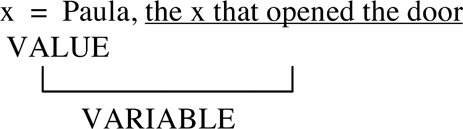
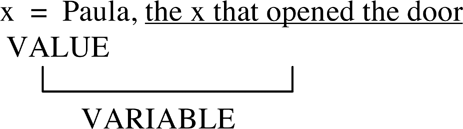
The es in 18 is anaphoric. It refers back to previous text, although the precise nature of the link, that is, that it refers to the implied causer of the event expressed in the first sentence, only becomes clear with the predicative at the end of the second sentence (compare Die Tür ging auf. Es war genau der richtige Moment [The door opened. It was exactly the right moment]).Footnote 9 The es stands for the open proposition ‘the x that caused the door to open'. The predicative Paula supplies the value to that variable. Compare this with a cleft sentence in 19.
(19) Es war Paula, die die Tür aufmachte.
'It was Paula that/who opened the door.
The only difference in the status of the es is that it relates cataphorically to the relative clause. It is better defined than the es in 18, as the relative clause itself is an open proposition, while the open proposition in 18 has to be reconstructed from the previous sentence and the situation. Anaphoric and cataphoric elements are not entirely symmetrical: while the es in 18 can be associated with (some) content at the time of reception, the es in 19 anticipates a yet to be defined content and is thus empty at the time of reception. The semantic structure of 19 is thus:
Semantic structure of es-cleft (see 19).
How does the es of cleft sentences relate to other anticipatory elements? Can it be classed as a correlate?
- (20)
a. Es fällt auf, dass Paula immer Orangensaft trinkt.
'It is obvious that Paula always drinks orange juice.'
b. Dass Paula immer Orangensaft trinkt, fällt auf.
'That Paula always drinks orange juice is obvious.'
c. ?Die die Tür aufmachte, war Paula.
'*Who opened the door was Paula.'
While anticipatory correlates allow actual substitution with the subordinate clause, this is only marginally possible in the case of cleft clauses, together with the anticipatory es of marked complement clauses that are also reluctant to allow substitution:
- (21)
a. Paul hasst es, wenn Paula Orangensaft trinkt.
'Paul hates it when Paula drinks orange juice.'
b. ?Paul hasst, wenn Paula Orangensaft trinkt.
'Paul hates when Paula drinks orange juice.'
The it of English clefts is clearly classed as an anticipatory it in Quirk et al. (Reference Quirk, Sidney, Geoffrey and Jan1985:349, 1383–1385) and Carter/McCarthy (Reference Carter and Michael2006:393, 785), albeit not in the sections on clefts. Eisenberg (Reference Eisenberg2006:329–330) puts the es of German clefts in a separate category from correlates, presumably one with cataphoric power. An uncertainty about the link is also noticeable in Huddleston & Pullum's (Reference Huddleston and Geoffrey K.2002:1416) cautious assessement:
The it in subject function can be thought of as a place-holder for the variable, which is defined in a relative clause that is not syntactically part of the subject.
My analysis of es/it clarifies the place of the subordinate (relative) clause in the construction by implication: it is a subject clause in disguise that supplies the content for the subject position; that is, it supplies the open proposition. Therefore it does not form a constituent with the element it relativises, even though it attaches to it intonationally, akin to a restrictive relative clause. Clefts thus contain a type of subordinate (relative) clause sui generis.Footnote 10
To sum up: to class the es/it of cleft sentences as an anticipatory element is only problematic if full exchange with the anticipated expression is required. However the es/it is classed, its anticipatory relationship to the subordinate (relative) clause of the cleft construction should be acknowledged.
6. Cleft Sentences in Translation
The use of translations for comparative purposes has obvious advantages: text type, subject matter, and register are (or should be) identical. The disadvantages are the double dangers of negative interference from the source language and, less often mentioned, of 'divergent translation', of overcompensating for fear of negative interference. If the chosen translations are communicative, that is, form a natural text in the target language, and feature each language as source and target language, the disadvantages should be minimised.Footnote 11
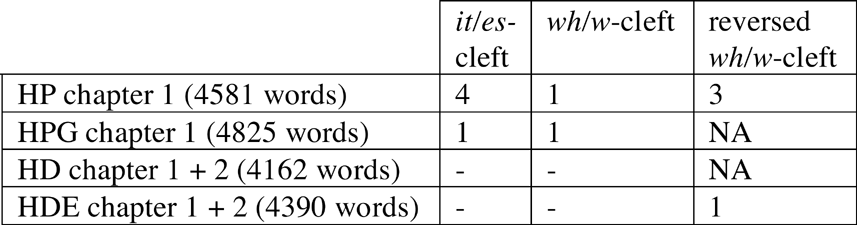
Durrell's first claim that clefts are more frequent in English than in German is supported by a number of studies using translation corpora (for example, Doherty Reference Doherty1999, S. Johansson Reference Johansson2001 for English reversed pseudo-clefts). Although clefts are a frequent occurrence in English, they are largely an optional device (unlike in French) and thus a question of stylistic choice. For a comparison it is important that at least the English source text is relatively rich in clefts. Doherty's study of the discourse effects of English clefts and their German translations is based on an English academic source text that features a bunching of clefts. I have chosen chapter 1 of J. K. Rowling's Harry Potter and the Philosopher's Stone (HP) for the same reason.Footnote 12 As a roughly comparable narrative text the first two chapters of Cornelia Funke's Der Herr der Diebe (HD) may serve. Both texts possess published translations, referred to as HPG and HDE respectively. The distribution of clefts is as in figure 2.
Clefts in Harry Potter, chapter 1 (HP), Herr der Diebe, chapters 1 and 2 (HD), and their translations (HPD and HDE, respectively).
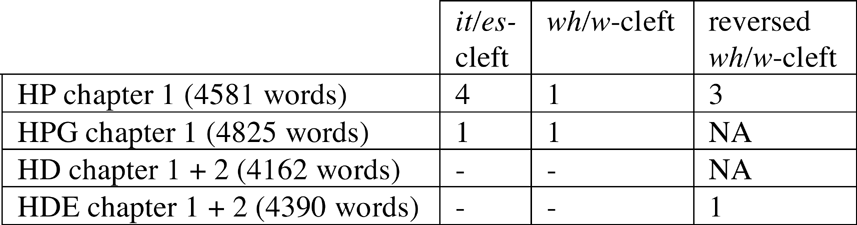
The text basis is far too small to be statistically significant but the findings are in line with Durrell's first claim (9 English vs. 2 German clefts).
I now discuss individual clefts, restricting myself to two it and one es-cleft for reasons of space. I will look in particular at the discourse organising function of clefts, at non-cleft alternatives and at their translation. Doherty (Reference Doherty1999:297) observed that even if the presupposed content of a cleft was not given in the immediate context, it would have been stated in or be inferable from the wider context: “Clefts could thus be taken as instructions to look for an antecedent that can enter into an epistemic relation with the proposition of the cleft.”
To test the acceptability of non-cleft alternatives, I have unclefted the clefts (where possible), introduced additional clefts and presented 16 alternatives, including up to seven sentences of previous text, to five native speakers (three adults, two children). I refer to some of their judgments below.Footnote 13
The first cleft I will look at is prototypical, in that it is one of the two clefts in HP that possess an NP as a focus phrase (both specify the subject slot of the relative clause):
(22) “[…] Experts are unable to explain why the owls have suddenly changed their sleeping pattern. […] Going to be any more showers of owls tonight, Jim?”
“Well, Ted,” said the weatherman, “I don't know about that, but it's not only the owls that have been acting oddly today. […]” (HP: 10; my emphasis).
The presupposed information (“x have been acting oddly today”) is given in the immediate context of the cleft ([…] the owls have suddenly changed their sleeping pattern). The main focus, reinforced by the restrictive focusing modifier only, is on the focus phrase that provides new information, that is, an additional value to fill the presupposed open phrase (something else in addition to owls).
The unclefted alternative but not only the owls have been acting oddly today is grammatical but was judged by three (out of five) native speakers as odd. The reason for this is that the premodification of the NP the owls results in a long subject phrase. Clefting allows this phrase to occur as predicative at the end of the matrix clause. For one cleft (that's why he's gone), no convincing unclefted alternative exists (*therefore he's gone, perhaps: he's gone for that reason). Such cases point to clefts moving towards a grammaticalised structure.
A translator has to decide how to render the English clefts. We will see that each English cleft has to be taken on its own merit. The predicament is that choosing a structure- (and information structure!) preserving translation will often not result in acceptable text: the values of English and German clefts are different for frequency reasons alone, a German cleft running the risk of standing out to a far greater extent than an English cleft does (see section 6). Yet occasionally, a German cleft will be a good solution, as clefts are possible structures in German and as such are obviously used. Choosing a non-cleft translation, on the other hand, will often result in text that is not only structurally flatter, even though particles and other devices can help to preserve at least some of the dialogue function of the original.
The following example shows the only it-cleft that is rendered as an es-cleft in the translation (see 22 above for the English original):
(23) „Nun, Ted“, meinte der Wetteransager, „das kann ich nicht sagen, aber es sind nicht nur die Eulen, die sich heute seltsam verhalten haben“ (HPG: 11; my emphasis).
Arguably, the translation “captures the original mood in a perfect way.”Footnote 14 One reason for the felicity of the German cleft here might lie in the informal context of a spontaneous additional spoken remark. Contrary to English, the unclefted version (aber nicht nur die Eulen haben sich heute seltsam verhalten) is also a possible translation, although the long subject phrase might be perceived as too stilted for spoken language. The focusing modifier nur ensures that, like the cleft, it has a specifying structure with “x haben sich heute seltsam verhalten” as a presup-position. Generally, the use of a focusing modifier is a frequent strategy to render English clefts, even when there is none in the original (compare Doherty Reference Doherty1999:302):
- (24)
a. It is his hesitation that annoys us.
b. Gerade sein Zögern stört uns.
The first cleft in HP is found in 25.
(25) “Little tyke,” chortled Mr Dursley as he left the house. He got into his car and backed out of number four's drive.
It was on the corner of the street that he noticed the first sign of something peculiar—a cat reading a map. (HP: 8; my emphasis)
The cleft starts a new paragraph. In relation to the immediate context, both the focus phrase (on the corner of the street) and the presupposed information in the subordinate clause are new. The information in the focus phrase does not seem particularly important to the progression of the story; rather the cleft is used to create suspense and draw attention to the information in the subordinate clause (compare Schmid Reference Schmid1999:133). The cleft seems to be a typical informative-presupposition cleft where the focus phrase merely provides the topic, not the main focus of the sentence, which is rather on the subordinate clause. The cleft can be seen as an offer to the reader to treat the new information as presupposed and make the reader complicit in the constructed world of the story. It also makes the superior knowledge of the narrator, on which the reader will have to depend, explicit.
If we look at the wider context, the picture gets more complicated. The presupposed information has already been given in approximate form in the first paragraph of the chapter, where the Dursleys are described as the last people one would expect to get involved in anything strange or mysterious. This gives a strong hint that in the course of the story they will. Two further references to mysterious things are made.
This cannot be demonstrated here, but the presupposed information of all clefts in the texts is given in the immediate or wider context apart from one, where the epistemic link to previously given information is very indirect. Thus the clefts in my texts confirm Doherty's observation.
The German translation uses a single clause, in which the focus phrase of 25 occurs in the German topic position:
(26) An der Straβenecke fiel ihm zum ersten Mal etwas Merkwürdiges auf […] (HPD: 6)
As it is an informative-presupposition cleft that is rendered, mere fronting of an der Straβenecke achieves the equivalent effect of the unstressed English focus phrase and no focusing modifier such as genau is needed. The slightly free translation of the first sign of something peculiar preserves the rhythm and stress of the original, helped by preserving the alliteration (sign, something vs. Mal, Merkwürdiges). These features make 26 a good translation. Nevertheless, there is an information-structural difference between the English and German sentences. It lies in the lack of presupposition: sentence 26 is ascriptive; coming across odd things is presented as mere new information. The reader is not invited to treat the new information as presupposed and thus does not receive an explicit pointer to link up this information with the previous discourse (compare Doherty Reference Doherty2001:627). S/he might still do so of his/her own accord, but 26 is less pragmatically explicit as a result of the sentence's different semantic structure compared with 25. Sentence 26 also lacks the strong element of suspense that the cleft construction in 25 creates. The expectation that fronting the adverbial raises (see below) can only partially compensate for this. Although a cleft would be grammatical (Es war an der Straβenecke, dass ihm zum ersten Mal etwas Merkwürdiges auffiel.), and although 26 is not semantically equivalent to 25, 26 is not only an appropriate, but also the preferred, translation.
HD does not contain any clefts, confirming their expendable status in German narrative texts. Furthermore, the story is told relying virtually exclusively on ascriptive sentences. Accordingly, the English translation does the same, containing only one cleft. This may serve as a reminder that English clefts are also optional stylistic devices, and that English narratives do not have to have recourse to them.
How is suspense created in HD? At the clause level, non-subject phrases are frequently topicalised, increasing the distance to the comment and thus suspense:
(27) „[…] Als sie [die Schwester der Sprecherin] vor drei Monaten überraschend starb, haben mein Mann und ich sofort das Sorgerecht für Bo beantragt, da wir selbst leider keine Kinder haben. Seinen gröβeren Bruder konnten wir unmöglich auch noch zu uns nehmen. […]“ (HD: 10; my emphasis)
The English translation does not preserve this information structure:
(28) “[…] But we couldn't possibly have taken on his older brother as well. […]” (HDE: 10: my emphasis)
His older brother is part of the comment of 28, while the adversative aspect of the second sentence in 27 is expressed by the conjunction but. Note that preposing of his older brother without or with clefting is not possible here, as it would require contrastive stress, turning the sentence into a specifying structure, contrary to the original second sentence 27. The translation of German preposed non-subject phrases can be seen as a mirror image to the translation of it-clefts into German: more often than not, such topicalised non-subject phrases are best translated with a change to the German information structure.
HD also creates suspense through complex sentences that super-ficially resemble clefts. Consider the first sentence of HD:
(29) Es war Herbst in der Stadt des Mondes, als Victor zum ersten Mal von Prosper und Bo hörte. (HD: 7)
By putting the event (of Victor hearing about Prosper and Bo for the first time) into the adverbial als-clause, it acquires the status of presupposed information, which, however, is new to the reader. The “adverbial information”, on the other hand, is presented first in the predicative matrix clause. So far, 29 resembles an informative-presupposition cleft, including the concomitant effects of suspense and authoritative narrator presence. But 29 does not have the specifying structure of a cleft: though als creates an open proposition, this is filled by the whole of the matrix clause rather than by the predicative. Accordingly, es does not enter into an anticipatory relationship with the als-clause. The matrix clause is ascriptive, expressing a self-contained scenario. The English translation preserves this structure.
7. The Typological Significance of Clefts
Why are English clefts so much more frequent than German ones? At the outset, we cited a number of possible reasons that are linked up to typological differences between the two languages: restrictions on English fronting as a result of the change to the fixed SV order vs. free fronting as a result of German V2, the wealth of German scalar and modal particles, English restrictions on adverbial modification such as on stressing adverbs, the lack of English pronominal adverbs, and generally the greater degree of configurationality of English in comparison with German. There are also particular reasons relating to clefts, mainly greater restrictions on German focus phrases (It is for this reason that vs. ?Es ist deshalb/aus diesem Grunde, dass) (Doherty Reference Doherty1999:311).Footnote 15
Although all of these constitute valid factors, a sense of puzzlement remains: all but two of the English clefts in my texts have grammatical German counterparts. Why would the translator forego the discourse-structuring advantages of cleft constructions?
All but two of the English clefts have also grammatical and acceptable English non-cleft counterparts. Why would J. K. Rowling so often have opted for the cleft, while Cornelia Funke used no cleft in a comparable stretch of text of the same genre?Footnote 16
The answer might be more banal than the structurally inspired explanations: the most important reason could be the frequent use itself. While English and German clefts have the same grammar, their stylistic value is very different for no other reason than their frequency: the structural typology needs supplementing by a typology of parole.
The far greater popularity of English clefts fits neatly into such a typology: English is a far more verbal language, often favouring subordinate clause constructions over non-clausal alternatives. Clefts are two-clause constructions, their non-cleft German counterparts will usually feature one clause less. In a number of respects, the English verbal constructions are semantically more explicit than their German non-clausal counterparts (Fischer Reference Fischer2007:392–398). As far as clefts are concerned, we established above that they can contain discourse-structuring hints that their non-cleft German counterparts lack. As German speakers have both easy fronting and a host of scalar and modal particles readily at their disposal, there simply seems to be no need to employ a construction that goes against the general preference for a flat verbal structure. That this results in less discourse-structured text will not even enter a speaker's or writer's calculation. The degree of semantic and pragmatic explicitness only becomes an issue when communication breaks down. Speakers have a lot of leeway here. Only when there is a particular need for explicit discourse structuring will German speakers consider clefts.
8. Conclusion
Durrell's initial claims about clefts not only represent a valid description of the German-English contrasts in this area, but they also demonstrate how a contrastive perspective can contribute to the grammatical description of a particular language. I have shown how the discourse-structuring property of clefts is based on their semantic properties (their presup-positional structure), which again is a result of their form. I argued that while the different frequency of clefts in the two languages can be explained by structural differences, once established, the contrast develops a momentum of its own that can not fully be accounted for by the original causes. One effect of this is that grammatical and semantically equivalent translations might be deselected in favour of stylistically more appropriate, that is, easier to process, but not completely semantically equivalent translations. Such contrasts should be covered by a typology of parole that complements structural typology.