Introduction
Patients with mental disorders show an increasing prevalence of medical treatment in general hospitals (Mende et al., Reference Mende, Riegel, Plümer, Olotu, Goetz and Kiefmann2019). These disorders include in particular dementia, delirium, and depression (Hofmann Reference Hofmann2016; Zoremba and Coburn, Reference Zoremba and Coburn2019). Treatment interventions in patients with mental disorders in general hospitals encompass additional psychiatric consultation and pharmacological and psychosocial measures and have a significant influence on essential parameters of treatment, as they increase the length of stay, negatively impact on complication rates, and may worsen the outcome (Bickel et al., Reference Bickel2018; Mende et al., Reference Mende, Riegel, Plümer, Olotu, Goetz and Kiefmann2019; Zoremba and Coburn, Reference Zoremba and Coburn2019).
The acute geriatric treatment in geriatric departments is challenged by a steadily growing proportion of very old multimorbid patients presenting with increasing rates of comorbid neuropsychiatric disorders. Surprisingly, up to now, there are no systematically collected study data investigating the comorbidity in neuropsychiatric disorders, such as dementia, delirium, or depression, occurring in inpatients of acute geriatric departments showing an association with diseases leading to admission or with somatic comorbidities. Furthermore, it is unclear in what way they may give rise to a targeted pharmacological intervention or if demographic or clinical variables influence such correlations.
Our group also addressed the question, to what extent the presence of neuropsychiatric symptoms at time of admission may impact on treatment outcome.
Due to the lack of systematic study data in the literature, the present study has an exploratory design. The above raised questions are examined in this paper, related to the syndromes of dementia, delirium, and depression, which were clinically diagnosed at time of admission to a geriatric hospital department, and compared to a group of mentally healthy geriatric inpatients.
Methods
All between January and July 2018 consecutively admitted inpatients of the Department of Geriatrics (F.R.) at the Elbroich Hospital in Düsseldorf/Germany were included in this study. The routine data of their treatment records were evaluated retrospectively. Because of the retrospective epidemiological character of this study, exclusively including clinical routine data, no informed consent forms had to be signed. The chair of the ethical committee of the Heinrich-Heine-University Düsseldorf/Germany approved this study.
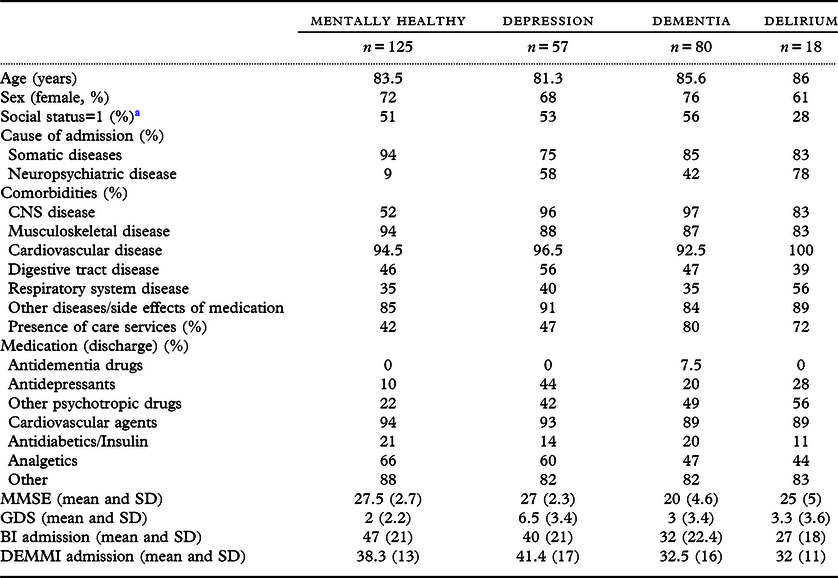
Demographic and clinical variables, diagnosed diseases, and medication were assessed (see Table 1). Social status was scored “1”, if inpatients were living together with family or next of kin and scored “0” if not. Care services referred to already established at-home care, for instance supplying medication or personal hygiene, when admitted. Mildly potent neuroleptics were infrequently administered in small dosages as sleep medication. In addition, some inpatients had a prescription of herbal pills for psychovegetative strengthening already when admitted.
Demographic and clinical variables of the geriatric inpatients (n = 280), divided by the four diagnostic groups of this study

a Social status = 1: living together with family or next of kin.
Furthermore, according to clinical routine assessment, functional parameters were assessed twice, that is, at admission and at discharge. They included the Barthel Index (BI: Mahoney and Barthel, Reference Mahoney and Barthel1965), the Timed Up and Go Test (TUAG), and the Gait and Balance Test of Tinetti (Burckhard and Burger, Reference Burckhardt and Burger2012) as well as the De Morton Mobility Index (DEMMI: De Morton and Lane, Reference De Morton and Lane2010)
At baseline, the presence or absence of dementia, delirium, and depression was determined. The diagnosis of dementia was based on the diagnostic criteria of the ICD-10 ( Dilling and Freyberger, Reference Dilling and Freyberger2013). Likewise, the clinical diagnosis of delirium was determined according to the ICD-10 diagnostic criteria. The presence of depression was assumed when, by clinical judgment, affective symptoms, such as hopelessness, depressed mood, and loss of interest, were arisen and had occurred continuously at least 2 weeks before admission. The data of this study were collected from the inpatients’ records containing clinical routine data. The diagnosis of depression was determined from the information of the medical records; the Geriatric Depression Scale (GDS) was merely supportive in establishing this diagnosis. Lower scores of the GDS may not have excluded the presence of depression.
Apart from the mental disorders of dementia, delirium, and depression, five inpatients presented with sleep disturbances lacking further psychopathological symptoms. These inpatients were included into the group “mentally healthy.”
Further clinical parameters were collected as follows: cognitive symptoms, as measured by the Mini Mental State Examination (MMSE: Folstein et al., Reference Folstein, Fostein and Hugh1975), and affective symptoms, as assessed by the GDS (Yesavage et al., Reference Yesavage1982).
At the time of discharge, the answer concerning clinical improvement or worsening was dichotomized to “improved” and “not improved,” due to the judgment of the clinical physicians, as documented in the inpatients’ records. With respect to inpatients with dementia, improvement was clinically determined by an improvement of behavioral and psychological symptoms and/or of concentration and orientation deficits, while other cognitive symptoms were unlikely to improve within the period of stay.
Statistical analysis was done with the Statistical Package for the Social Science (SPSS, 2014). Demographic and clinical variables are presented descriptively. Analytical calculations were performed among the four predefined diagnostic groups, that is, mentally healthy, dementia, delirium, and depression. Inpatients with more than one neuropsychiatric disorder were assigned to the group whose symptomatology dominated the clinical picture. The neuropsychiatric symptoms of a clinically defined group dominated the clinical picture, if they either determined admission or initiated specific medical treatment at the start of stay or both. For instance, if an inpatient with dementia presented with acute depressive symptoms, this patient was allocated to the group “depression.”
To investigate the question, if certain clinical variables were correlated with these groups, cross tables were formed and χ 2-tests or t-tests were used. Identification of possible confounding variables for correlations given was determined by analyses of variance.
In order to calculate the influence of neuropsychiatric symptoms on treatment outcome, the four predefined diagnostic groups, that is, mentally healthy, dementia, depression, and delirium, were compared with respect to the differences between groups (group) and the change of functional scores within the treatment period (time), by using analyses of variance. Interacting effects were determined. Confounding variables, such as age, sex, social status, degree of care, MMSE score, GDS score, and somatic illness, were investigated, employing regression analyses of the outcome variables on these confounders. We calculated the relationship of these confounders with the outcome variables, that is, BI, DEMMI, TUAG, and Tinetti.
If missing data were present, we used the principle of pairwise deletion to calculate correlations. We did not substitute missing data, for instance by creating additional mean values.
Due to the exploratory nature of this study, no alpha adjustments were calculated; level of significance was defined as p < 0.05.
Results
Demographic and clinical variables
Within the 6 months’ observational period, 280 patients were admitted and included in this study. The 280 inpatients were 84 years of age on average; 71% were female. The average length of stay in our department was 19.5 days, and no inpatient died within the study period. Dementia was present in 29%, depression in 27%, and delirium in 15% of cases.
At admission, the dementia group showed a mean MMSE score of 20/30 points, among them 17% scored less than 15/30 points. The depressed group achieved a mean GDS score of 6.7/15 points at admission; 20% of them scored higher than 9/15 GDS points.
In the majority of cases, the reason for admission to the geriatric department was an acute somatic illness, and in one-third of the sample, there were neuropsychiatric disorders. The simultaneous presence of somatic and mental disease at the time of admission was detected in 20% of cases.
Within the group of mentally healthy (see Table 1), the 9% of cases with neuropsychiatric disease as the cause of admission mainly referred to motor system and sensibility disorders due to post-stroke symptoms, and in some further patients, gait and movement disorders were identified. Cognitive or affective disorders were not present in this group of admitted cases. Therefore, within the group of mentally healthy inpatients, there were no cases with dementia, delirium, or depression.
Furthermore, results show that 52% of mentally healthy inpatients had a neuropsychiatric comorbidity, that is, Central Nervous System (CNS) disease (see Table 1). Here, the underlying diseases encompassed gait and movement disorders, cephalgia, polyneuropathy or other disorders of the peripheral nervous system, cases with spinal stenosis or with pain syndromes derived from sensibility disorders or from diseases of the myoneural junction. Furthermore, the variable CNS disease also included all cases of dementia reported as comorbidity before hospital admission.
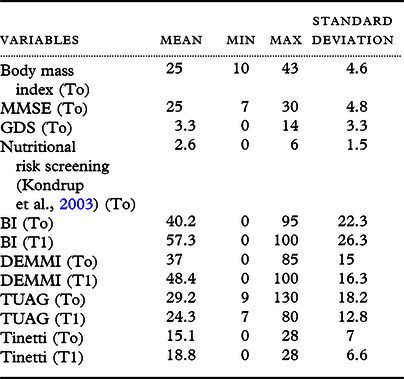
As expected, diseases of the musculoskeletal system and the cardiovascular system occurred in the majority of cases as comorbid disorders. Respectively, the highest number of medication was found among these cases. Table 2 presents the scores of the administered instruments at admission and at discharge yielding an impression of initial severity and change over time (see Table 2).
Scores of assessment instruments of the sample (n = 280) at admission and at discharge

To, time of admission; T1, time of discharge; Tinetti, Gait and Balance Test.
Correlations of clinical variables
In a first step of analysis, there was a significant correlation between the characteristic “mentally healthy” and a higher rate of physical illness leading to admission (χ2 value: 21.4, p < 0.0001). Conversely, the three groups with mental syndromes were associated with a neuropsychiatric disease as the cause for admission (depression: χ 2 value: 22, p < 0.0001; dementia: χ 2 value: 28, p < 0.0001; delirium: χ 2 value: 6, p < 0.01). In addition, mentally ill inpatients showed higher rates of central nervous diseases in their history record. Accordingly, inpatients with a neuropsychiatric disease at admission more frequently demonstrated a history of central nervous disease compared to those without a neuropsychiatric disease at the time of admission (96% vs. 68%, χ2 value: 25.6, p < 0.0001). The statistical analysis also revealed that mentally healthy and depressed inpatients were significantly more likely to suffer from musculoskeletal disorders compared to inpatients with dementia and delirium (96% vs. 87%, χ 2 value: 4.9, p < 0.027).
In addition, the groups with mental syndromes differed from the group of mentally healthy by showing a significantly higher number of somatic comorbidities. Conversely, mentally healthy inpatients had a significantly lower rate of comorbidities. Among them, the number of comorbidities was not associated with the cognitive measure used, that is, the MMSE score, but with the assessed score of the GDS. The higher the GDS score, the more comorbidities were found. This is underlined by the result that depressed inpatients revealed a higher number of comorbidities compared to the remaining inpatient groups (4.7 vs. 4.1, t-value: −3.9, p < 0.0001).
A closer look at the prescribed medication showed that, as expected, depressed inpatients most frequently received antidepressants. In correspondence to this finding, depressed inpatients with an antidepressant medication had significantly higher GDS scores than the remaining inpatients (7.24 vs. 2.72, t-value: 6.8, p < 0.0001). On the other hand, depressed inpatients with and without an antidepressant medication did not differ with respect to their GDS score.
Only the demented inpatients were prescribed antidementia drugs. In contrast to the GDS scores in depressed inpatients, MMSE scores of demented inpatients with antidementia drugs did not differ from the remaining inpatients (MMSE scores: 24.3 vs. 25); their MMSE scores, however, were significantly higher compared to those of demented inpatients without an antidementive medication (MMSE scores: 24.3 vs. 19.4, t-value: 2.6, p < 0.01).
Neuroleptics or benzodiazepines were found most frequently among the mentally ill inpatients. Analgetics were most frequently prescribed not only to mentally healthy but also to depressed inpatients. Further analysis of data revealed that the prescription of analgetics was neither associated with a higher GDS score nor with the number of comorbidities. However, a higher rate of comorbidities was related to a higher frequency in analgetic medication with respect to the group of mentally healthy inpatients (χ 2 value: 11.5, p < 0.02).
Demographic variables, such as age, gender, and social status, did not show any association with the reported relationships between mental and somatic diseases at admission, comorbidity, or polymedication.
Treatment outcome
According to the judgment of the clinicians, there was improvement in 20% of demented inpatients, in 84% of depressed inpatients, and in 100% of inpatients admitted with delirium.
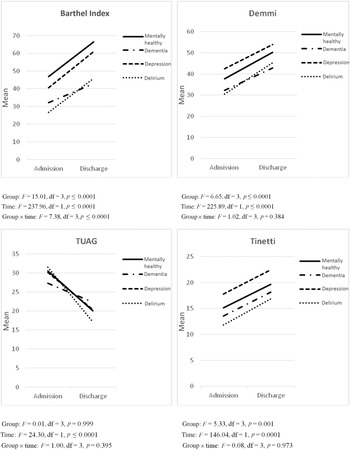
Multivariate analysis of variance revealed that each of the four groups of inpatients clinically improved, as assessed by the four functional instruments used (BI, DEMMI, TUAG, and Tinetti Test) (see Figure 1). The amount of change of scores over the treatment period was consistently significant across the four functional instruments administered. Global score ranges of the instruments revealed substantial though improved dysfunction in each of the assessed abilities. The four score ranges lie beyond the cutoff values determining healthy functioning at admission as well as at discharge. The following missing data were identified from the inpatients’ records: BI admission/discharge, both 0.4%; DEMMI admission 1.4%/discharge 6.4%; TUAG admission 49.6%/discharge 31.1%; Tinetti admission 17.5%/discharge 10.4%.
Comparison of the four diagnostic groups (mentally healthy, dementia, depression, and delirium) in this study, as assessed by functional instruments BI, Demmi, TUAG, and Tinetti.

Each group demonstrated significant change over time and differed from the others, except for the assessment with the TUAG (see Figure 1). Among the group changes over time, the demented group showed the lowest functional scores at baseline and less improvement; however, mean values of this group incremented to the time of discharge across all adopted instruments.
A further step of analysis investigated the question, whether selected covariates impact significantly on the degree of change of functional scores over all groups. Regression analyses were conducted determining the influence of age, sex, social status, degree of care, MMSE score, GDS score, somatic disease, referring to the musculoskeletal and the cardiovascular system, on the different functional outcome parameter. Using different models of calculation, age, degree of care, and MMSE score turned out to be of significant influence. However, each of these covariates was strongly associated with the clinical criteria for establishing the groups and, therefore, could not be considered further.
Next steps of analysis concerning in-between comparisons of groups, by using post hoc Scheffé tests, were not informative.
Discussion
The demographic and clinical characteristics presented from 280 inpatients do not appear unusual for an acute geriatric hospital department with respect to age, preponderance of female sex, the majority of physical acute illness at admission, multimorbidity, and polymedication. This may also be true for the quite considerable proportion of mentally ill inpatients with a rather mild degree of neuropsychiatric symptoms (Bickel et al., Reference Bickel2018; Geriatrie Bundesverband, 2016; Hofmann, Reference Hofmann2016).
Our sample, therefore, may hold some representativeness. At least, compared to the Gemidas (Geriatric Minimum Data Set) – Pro – data, the characteristics of this sample demonstrate high accordance with respect to age, gender, or BI at admission and at discharge (Gemidas – Pro, 2019). The Gemidas-Pro-data are obtained from the largest independent central data register in Germany, containing more than 17,000 analyzable data sets of geriatric inpatient treatment. In addition, with respect to these Gemidas –Pro – data, the distribution of somatic and neuropsychiatric disease causing admission and the prevalence of mentally ill patients in our sample were comparable.
Demographic and clinical variables
Table 1 shows the demographic and clinical variables, related to the four defined diagnostic groups (see Table 1). The group of mentally healthy inpatients represented nearly 45% of the total sample. In all cases with dementia (29%), the syndrome also dominated the clinical picture of the inpatients, and in almost 20% of cases, a depression was the leading clinical syndrome and the syndrome of a delirium in less than 10% of cases. As far as Table 1 shows significant differences between the four groups, they may be explained by the fact that diagnostic criteria for defining groups were different—for instance, in the dementia group, the low MMSE scores, the antidementia medication, or the predominant presence of care degrees; in the depression group, the higher GDS scores or the most common medication with antidepressants. Syndromes of dementia were caused by neurodegenerative and cerebrovascular disease or both, and syndromes of delirium were either postoperative or occurred as a consequence of dehydration or of an acute somatic worsening. Depression syndromes were mostly reactive from a clinical perspective; there were no cases with a history of relapsing episodic depressive illness. One in 10 inpatients revealed two mental disorders at admission; in 2% of admitted cases, all three mental syndromes were present.
Correlations of clinical variables
Among the clinical findings and identified correlations, some deserve closer considerations. Our study has shown that mentally ill geriatric inpatients with a neuropsychiatric disease, causing admission, revealed a history of mental illness more often compared to those inpatients without a neuropsychiatric illness. This finding may lead geriatric clinicians to search for a history of mental illness, if both features are present, that is, neuropsychiatric symptoms leading to admission and being mentally ill. This information may impact on the selection of the most adequate drug treatment. In any case, a history of mental illness usually involves a history of psychopharmacological medication.
Furthermore, this information on medical history may also help in establishing a more accurate diagnostic assignment, for example, for depressive symptoms, such as reactive depression, episodic depression, anxiety disorder, or as an adjustment disorder (Hewer and Thomas, Reference Hewer and Thomas2017).
Another aspect emerged from our study results insofar, as the feature “mentally ill” was associated with a high number of comorbidities. This relationship was already mentioned from the Report of Experts of the Robert Koch Institute Berlin, Germany, on “Health and Illness in Old Age” (Bickel et al., Reference Bickel2018; Böhm et al., Reference Böhm, Tesch-Römer and Ziese2009). For the population of the elderly, this Report of Experts pointed out that more severe stages of dementia were associated with a higher number of somatic comorbidities, being in line with reports of other studies (Hartley et al., Reference Hartley2017; Mukadam and Sampson, Reference Mukadam and Sampson2011). It may be that in our study, the association of progressive dementia with a higher rate of somatic comorbidities could not be confirmed because our sample predominantly included inpatients with very mild to mild dementia. In contrast to this finding in our study, there was a close correlation of higher GDS scores with a higher number of somatic comorbidities.
Closer inspection of data revealed a high proportion of reactive depression among the group of depressed inpatients. A high number of comorbidities, therefore, may constitute a higher disease burden and may lead to reactive depressive symptoms. Thus, treatment of somatic diseases could be beneficial in ameliorating these depressive symptoms, especially if a setting of support and behavioral therapy interventions are available. Even antidepressants may, then, be avoidable in most cases.
These considerations regarding the group of depressed inpatients may also explain another interesting clinical finding of this study. Depressed inpatients with an antidepressant medication did not differ from those without such a prescription, as assessed by the GDS score. If the reactively depressed inpatients showed a reduction of symptoms while their somatic comorbidities were treated successfully, only those inpatients with a history of episodic depression were identified in this study to have antidepressants which were already prescribed before admission. Therefore, symptom characteristics and course decided the prescription, not the mere presence of symptoms. Furthermore, closer inspection of inpatients’ records revealed no additional clinical information, probably because the time period of stay was too short. Likewise, no information of partial improvement in patients already put on an antidepressant was detected in the routine records data, again probably period of stay was too short for a thorough evaluation. While being treated in the geriatric department, no inpatient was newly put on an antidepressant.
The antidementive medication in the demented group was, however, the opposite. Demented inpatients with a respective prescription showed higher MMSE scores. Obviously, clinicians took into account the official treatment guidelines of Germany (DGPPN/DGN, 2010) recommending antidementive drugs rather in mild to moderate than in severe stages of the disease. It may also, however, be true with respect to treatment decisions that clinicians preferred therapeutic interventions mitigating somatic diseases rather than dementia symptoms (Bickel et al., Reference Bickel2018).
Finally, an interesting result of this study may deserve closer consideration. Depressed as well as mentally healthy inpatients demonstrated a significantly higher rate of analgetic medication compared to the dementia and the delirium group. This medication was, however, not associated with higher GDS scores or with a higher number of comorbidities. This may be explained by the fact that within the group of depressed inpatients, the threshold for administering analgetics may have been lower in order to avoid any hampering of improvement that may have been expected. Further data analysis concerning these relationships could at least rule out a higher rate of analgetics among the depressed inpatients was associated with the presence of musculoskeletal disease which is often accompanied by pain symptoms (Fuchs et al., Reference Fuchs, Rabenberg and Scheidt-Nave2013). Reversely, the threshold to prescribe analgetics in demented inpatients might have been quite high, due to less verbally complaining about pain in this group.
Treatment outcome
Considering the clinicians’ judgment of improvement rates, one may be astonished with respect to the demented group. Within the treatment period, 20% of demented inpatients were evaluated to have improved, though dementia syndromes in our sample were almost exclusively caused by degenerative and/or vascular processes. In this study, it may not be ruled out that some dementia syndromes were overlapped by delirium symptoms and, hence, only appeared to have improved. However, the reasons of improvement of demented inpatients in our sample seem to be manifold. First, behavioral and psychological symptoms were reduced by a successful treatment of somatic comorbidities; second, attention and concentration deficits were stabilized by somatic improvement, and third, both of these circumstances enhanced the demented inpatients’ capacity to better comply with the hospital environment and overcome cognitive challenges derived from therapeutic schedules.
Antidementive medication was too rarely prescribed to significantly impact on the rate of improvement.
Closer inspection of data demonstrated that clinical physicians preferred intensive polymedication to reduce acute somatic complications rather than to consider cognitive treatment instead.
The high rate of improvement of the depressed inpatients may be mainly explained by the reactive nature of their depression caused by the acute worsening of somatic symptoms before admission. In all cases of a successful somatic treatment, the degree of depression was reduced. It may further be assumed that in cases of antidepressant medication, the emotionally stabilizing effect contributed positively to the effect of treatment. In addition, some depressed inpatients received small dosages of neuroleptics to gain sleep or comfort. From a non-psychopharmacological perspective, an empathetic and supportive setting of the geriatric department may, moreover, have contributed to the high rate of affective improvement. Formal psychotherapy or behavioral training interventions were not part of the integrated medical treatment concept of this department. Psychiatric consultation was limited to establishing a diagnosis and proposing specific treatment in those cases where geriatricians could not come to a decision, respectively. This range of treatment interventions reflects good clinical practice of geriatric departments in Germany.
It could not be expected that the improvement rate of the inpatients admitted with delirium would rise up to 100% (Hewer and Thomas, Reference Hewer and Thomas2017; Travers et al., Reference Travers, Byrne, Pachana, Klein and Gray2013). The geriatric department of this study, however, continuously trains its personnel since years with respect to the detection and treatment of delirium, especially due to dehydration or to postoperative conditions. Furthermore, clinicians may not have discharged inpatients with a full symptomatology of delirium.
According to the results of analysis of variance, the demented group showed the lowest functional scores and the weakest improvement. The two groups of depressed and of mentally healthy inpatients demonstrated a closely related course. The delirium group showed the most severe impairment at admission, but the strongest improvement within the treatment period.
Surprisingly, each of the four groups improved while treated, as assessed by the four functional parameters, differing from each other, however, concerning the amount of change. Further inspection of clinical routine data, as given by the inpatients’ records, did not, unfortunately, reveal data regarding specific reasons for improvement.
Taking into account the very old age as well as the multimorbidity of inpatients of geriatric hospital departments, these results may not have been expected. Improvement was even seen in the group of demented inpatients.
By undertaking the present data analyses, we were surprised that none of the most frequent somatic comorbidities, that is, musculoskeletal and cardiovascular diseases, significantly impacted on treatment outcome of each of the four groups. Covariates, such as age, degree of care, and MMSE score, were excluded, using regression analysis, due to their close association with the criteria for the group of demented inpatients. They did not demonstrate, however, any significant influence on the differences between groups and the rates of functional improvement across all groups of inpatients over the treatment period.
The present exploratory study with retrospectively collected clinical routine data from inpatients’ records of a geriatric department demonstrated convincing evidence that very old somatically multimorbid and neuropsychiatric ill geriatric inpatients may have the opportunity to benefit considerably from an integrated medical treatment. Future research may put emphasis on the impact of this benefit, that is, concerning quality of life, reduction of burden of caregivers at home or in institutions or prospectively identifying conditions of improving sustainability of treatment results after discharge. Findings of such a scientific approach may lead to optimizing and differentiating clinical treatment and care in geriatric medicine. It may further help not to underestimate the potentials of very old multimorbid patients to benefit from medical interventions. For instance, Laird et al. (Reference Laird2019) convincingly demonstrated considerable resilience potentials of old age depressed and multimorbid individuals improving treatment results.
There are some limitations of the present study, mainly due to its exploratory nature. More precise diagnostic tools and standardized instruments may have achieved a more accurate subgrouping of inpatients as well as a better identification of causal pathogenetic factors contributing to the clinically defined neuropsychiatric groups. More specific implementation of treatment interventions may have contributed to a greater benefit for inpatients of each of the defined groups. However, the given clinical data, as documented in the inpatients’ records, referring to their routine treatment period were already sufficient to at least demonstrate substantial benefit for very old individuals being treated in a geriatric department.
Conflict of interest
Authors declare that there is no conflict of interest. The study was conducted in accordance with national law and in accordance with the Declaration of Helsinki of 1975 (in its current revised version).
Description of authors’ roles
M.H. and F.R. developed the concept of this study, collected the data from the records, and wrote the paper. M.J. carried through the statistical analysis and assisted in interpretation of the data and critical revision of the manuscript.