

Introduction
Internationalisation of the rule of law – using the international arena to export legal institutions, norms, and rules from one domestic jurisdiction to another – has become a standard component of contemporary peacebuilding and statebuilding efforts in the Global South. Presupposing that war-torn countries have failed due to rule of law deficit, the international community has focused largely on restoration or de novo construction of functional legal systems in countries emerging from intra-state armed conflict.Footnote 1 Often regarded as ‘institutionalisation before liberalisation’ or ‘statebuilding as peacebuilding’, this institution-building approach is expected to provide the governance structures needed to manage the inevitable social conflicts that attend political and economic liberalisation implemented in fragile and conflict-affected states.Footnote 2 Moreover, international peace and stability in the past 25 years has become contingent on (re)building the governance capacity of countries that lacked sufficient institutional and technical resources to effectively deal with domestic problems before they become transnational threats.
The empirical record of rule of law promotion, however, consistently indicates that international efforts to restructure domestic jurisdictions have failed to significantly improve governance in war-torn countries.Footnote 3 But while the suboptimal outcomes of legal internationalisation have been extensively analysed, there is still very little scholarly attention to the adverse consequences of more than two decades of international efforts to promote rule of law in war-torn countries. As much of the debate is preoccupied with questions regarding the (in)ability of international actors to achieve good governance goals, there has been far less empirical analysis of the adverse effects of formal institution-building, particularly on local efforts to access justice. Seriously neglected are concerns about how rule of law promotion affects pre-existing social and economic structures that are vital for the survival and livelihood of local populations in war-torn countries.
Based on an historical and comparative case study of Sierra Leone and Liberia, this article contends that rebuilding the rule of law for war-torn countries disproportionately favours actors who have been historically privileged by unequal socio-legal and economic structures at the expense of those who lack the resources to use the state legal system. While the United Nations and bilateral donor agencies often cite these two countries as prototypes of successful international peacebuilding, I argue that internationally supported rule of law promotion is experienced by much of their war-torn societies as reinforcing unequal access to justice. The problem in both Sierra Leone and Liberia is that justice sector reforms that stress the standardisation, legalisation, and formalisation of the administration of justice have entrenched a state-based justice system that is ill-suited for providing affordable, timely, and socially relevant justice for people of low socioeconomic and cultural status. Rather than dismantling the underlying structures of inequality that precipitated armed violence in these conflict-affected states, the UK-funded justice sector development programme in Sierra Leone as well as the US-supported rule of law reforms in Liberia have unduly benefited those who possess wealth, education, and influence to take advantage of legal institutions to maintain their privileged positions following the end of armed conflict.
In making this argument, I draw from the socio-legal literature to differentiate structural, social, and cost-related barriers to justice, which have been reinforced by rule of law development in war-torn countries. Structurally, rebuilding the state system entrenches institutional structures that limit access to justice for disputes related to customary and indigenous legal systems as well as the informal economy that remains the main source of livelihood for the majority population. In terms of social barriers, as rebuilding the rule of law in fragile and conflict-affected states primarily upholds the superior authority of state law, such legal development devalues alternative conceptions of justice in legally pluralistic societies. And for cost-related barriers, increasing formalisation of the administration of justice increases the cost of navigating the state system, especially for poor people who lack the education, influence, and financial resources to access state judicial and law enforcement institutions. By exposing how rule of law promotion reinforces these structural, social, and cost-related inequalities, this article makes a broader claim that purportedly ‘good’ peacebuilding norms do not always deliver benign benefits, but rather often have negative consequences that harm the local constituents that peacebuilders promise to emancipate. Beyond problematising the outcomes of ‘good’ normative peacebuilding efforts, the article helps to bridge the gap between peacebuilding and legal pluralism by reiterating the need for greater sensitivity and responsiveness of international norms to alternative forms of social order that war-torn societies consider vital to their socioeconomic survival and well-being.
The remainder of the article is organised into five parts. In the following section I present critical perspectives that are useful for illuminating the subtle ways contemporary peacebuilding may adversely affect local populations. Next, I examine the assumptions underpinning justice sector reform within the framework of (re)building the rule of law. Then, I present a subnational comparative method that proves useful in capturing the micro-level dynamics of postwar peacebuilding. This method is then used to analyse rule of law development efforts in Sierra Leone and Liberia, situating them within historical, political, and socioeconomic contexts. In conclusion, I reiterate how micro-level analysis can empirically challenge emerging peacebuilding and reconstruction models.
Contesting liberal peacebuilding
Scholars have long been critical of liberal and neoliberal approaches to peacebuilding, calling into question not only their neocolonial and ideological drivers, but also exposing the micro-level technologies and tools through which dominant values are institutionalised in war-torn countries.Footnote 4 This is the cornerstone of Severine Autesserre’s Peaceland, a metaphorical portrait of the standard practices, common rituals, shared habits, and dominant narratives of the transnational community of interveners.Footnote 5 Autesserre argues that the ‘source of ineffectiveness [in aid interventions] is at the very act of imposition of foreign ways of doing and thinking, regardless of the liberal or non-liberal character of the model or program being imposed’.Footnote 6 The problem for Autesserre is that interveners use their ‘material and symbolic resources’ in daily routines to reinforce pervasive power disparity between them and their local hosts. The politics of epistemic authority in Peaceland elevates the thematic expertise of interveners at the expense of local knowledge, competences, and solutions, which in turn undervalue local ownership and authorship.Footnote 7 Focusing on the reconstruction of rule-based technical order, Mark Fathi Massoud refers to these standard practices as ‘mundane technologies – organizational constitutions, employment contracts, staff handbooks, reporting requirements, and accounting systems – which have pervaded the everyday interventions of NGOs and civil society organizations in fragile and conflict-affected states’.Footnote 8
Consistent with these critiques, this article takes issue with statebuilding and peacebuilding practices that obscure issues of structural and social inequality in war-torn countries under the guise of narrow technocracy and legal centrism. Specifically, it calls into question dominant problem-solving approaches that simply seek to restore legal-rational institutional structures in agreement with Roger Mac Ginty, who warns that such emphasis on ‘bureaucratic and technocratic efficiency in war-torn countries can be used to absolve peacebuilders from critical scrutiny’.Footnote 9 Mac Ginty has insisted that beyond the veneer of routine and neutral technocracy, the liberal peacebuilding framework has become ‘highly political, favoring solutions that originate from, and perpetuate, particular ideological stances’.Footnote 10 Similarly, Uma Kothari focuses on development practices to analyse the politics of knowledge and expertise, exposing continuities between colonial and contemporary practices that are increasingly authorised through notions of professionalism.Footnote 11 In addition to invoking colonial forms of rule, development experts and practitioners are also involved in the construction of technical expertise that sustains unequal global relations. Kothari contends that:
The development of tools and techniques designed and controlled by the development expert privilege forms of Western knowledge. Masquerading as universal and neutral, they pose as ‘acceptable’ forms of authority by mobilising overarching discourses of ‘humanitarianism’, ‘philanthropy’ and poverty alleviation, presented in contradistinction to the exploitative colonial projects.Footnote 12
But while these criticisms challenge claims of universality and value-free technocracy in dominant peacebuilding models, this article is particularly concerned about the epistemic and normative biases that occur when these legal-rational values acquire hegemonic status, a phenomenon that James C. Scott had long brought to the attention of social scientists.Footnote 13 In his critique of ‘imperial scientific models’ that are privileged over ‘local practical knowledge’, Scott raised two concerns about what he called the ‘political struggle for institutional hegemony’ in state reconstruction.Footnote 14 First, he cautioned that schematic models of social organisation could never generate a functional community or economy because their emphasis on scientific simplification and legibility ‘suppresses precisely the practical skills that underwrite any complex social activity’.Footnote 15 Second, Scott was concerned that those implementing modern statebuilding projects might take advantage of their epistemic power to dismiss practical knowledge as insignificant at best and as dangerous or superstitious at worse, regardless of their social relevance to local constituents. To illustrate these crucial concerns about the promotion of hegemonic norms, he viewed the removal of underbrushes of fallen trees and branches in a ‘scientific forestry project’ as a metaphor for how local norms and practices are undervalue in state reconstruction projects.Footnote 16
To be sure, these critical analyses are as much about local agency and resistance as they are about the imposition of dominant norms and practices, as Scott himself asked us to keep in mind ‘not just the capacity of state simplification schemes to reorganize the social world but also the capacity of society to modify, subvert, block, or even overturn the categories imposed upon it’.Footnote 17 Apart from exposing the power asymmetry and status-quo bias of liberal peacebuilding, critical scholars have also affirmed that the diffusion of liberal-democratic norms is shaped by the reaction, challenges, and resistance posed by the recipients.Footnote 18 Mac Ginty contends that liberal internationalism is suffering from ‘a crisis of confidence’ and ‘non-compliant local agents are finding ways to subvert, exhaust, renegotiate, and resist liberal peace’.Footnote 19 For Oliver P. Richmond, while the hegemony of liberal peace is in decline, local actors have asserted their agency to contaminate, transgress, and modify global norms, sometimes taking advantage of the resources that accompany liberal peace.Footnote 20 Massoud argues that legal training and practices sometimes carve a space for grassroots social mobilisation and change, whereas Milli Lake discloses that new institutions tend to offer elites an arena to relocate conflict over power from the battlefield to institutional realms.Footnote 21
Bearing in mind that norm diffusion in the Global South may play out in unintended ways and/or produce unanticipated consequences, I argue that the institutions and norms (re)introduced in war-torn countries such as Sierra Leone and Liberia are vulnerable to appropriation by dominant actors outside and within these states who use them to promote their interests, often at the expense of the less privileged classes of people. I contend that postwar reconstruction processes, which are supported by the international community, have not only failed to significantly promote good governance, but also reinforced unequal socio-legal and economic structures which have historically precipitated social grievances in both countries. Supported by the United Nations and each country’s longstanding bilateral partner – the UK in Sierra Leone and the US in Liberia – the peacebuilding agenda have re-established institutional structures that are themselves responsible for the underlying social grievances that peacebuilders aim to address. But before empirically discussing how rule of law promotion reinforces legal and structural inequality in Sierra Leone and Liberia, what follows is an explanation for why peacebuilders prefer rule of law over legal pluralism and other socio-legal approaches to postwar state reconstruction.
Internationalisation of the rule of law
Following a brief hiatus in the Law and Development Movement during the Cold War period, renewed attention to rule of law internationalisation was linked to the UN Agenda for Peace, a broader framework aimed at strengthening and solidifying peace to avoid a relapse into violent conflict.Footnote 22 Whereas development organisations such as the United Nations Development Program (UNDP) and World Bank have always been interested in rule of law promotion, restoration of the rule of law has become an integral element in multidimensional peacekeeping and peacebuilding operations around the world.Footnote 23 Today, 18 out of 28 UN peacekeeping missions currently include an explicit mandate to support rule of law institutions and there have been 13 resolutions by the UN Security Council and 17 reports by the UN Secretary-General on (re)building the rule of law in war-to-peace transitions. Similarly, all official development assistance of member states of the Organization for Economic Cooperation and Development (OECD) now articulate justice and security reform as a central plank in humanitarian interventions.Footnote 24 The channels commonly used for transferring the rule of law norms into these fragile contexts include transitional justice mechanisms (for example, truth commissions and war-crime tribunals), legal reform, justice sector development, and engagement with informal justice systems to make them consistent with international standards.Footnote 25
Further impetus for rule of law promotion came from the post-9/11 security concern about weak states becoming safe haven for global terrorism, refugee flows, and other transnational organised crimes, such as piracy and illicit trafficking in weapons, drugs, and humans. In line with the so-called war against terrorism, most OECD countries have securitised their development aid in conflict-affected countries, linking new international security threats to poverty and structural underdevelopment.Footnote 26 This approach also became known as the security-development nexus, an integrative framework that regarded justice and security as essential prerequisites for development, operationally meshing together, via the rule of law, sectors that were traditionally seen as discrete spheres of external intervention.Footnote 27 At the core of this approach was the expectation that ‘building strong and effective institutions to deliver public services would reduce incentive for violent conflict and strengthen a state’s resilience in the face of possible renewed violence’.Footnote 28 The ‘rationale underpinning the security-development nexus is that well-functioning, disciplined, and democratically controlled security and justice sectors will provide a secure, stable, and predictable environment in which investment and development can occur’.Footnote 29
That promoting the rule of law became central to internationally supported peacebuilding and statebuilding efforts in the past 25 years is understandable, but at the same time it must be underscored that most war-torn countries comprise legally pluralistic societies. Considering the colonial and postcolonial history of state formation in these countries, socio-legal studies have consistently drawn attention to their multiple sources of law, various normative orders, and parallel legal systems, some operating on an unofficial, informal, or extra-legal basis.Footnote 30 Legal development in postcolonial societies, for socio-legal scholars, is not only about settling jurisdictional disputes between legal institutions and functionaries, but is also an expression of the struggle for legal domination in heterogenous settings.Footnote 31 Some legal pluralists have even warned against the superimposition of state law, arguing that normative orderings are poised to clash particularly when their underlying norms, processes, and practices are inconsistent.Footnote 32 Contemporary state- and peacebuilders are not entirely impervious to these warnings but often regard legal pluralism as responsible for discriminatory and patriarchal social structures that need to be fixed by re-establishing the state legal systems and institutions.Footnote 33 While the re-establishment of a single legal framework that conforms to international human rights standards may be driven by well-meaning and progressive intentions, it is important to reiterate two dangers that socio-legal scholars have long associated with modern legal development and modernisation in legally pluralistic societies.
The first is a normative bias when the international community assumes the role of moral enforcer, requiring full compliance with international rule of law norms and standards in war-torn societies. As Deborah Isser notes, this built-in normative bias in statebuilding and peacebuilding practices poses an obvious challenge in legally pluralistic societies where non-state traditional norms and practices are not based on the international ideal rule of law premised on Western liberal democracy.Footnote 34 There is no empirical distinction between state and non-state law; therefore, international efforts that insist on standard norms are ideologically motivated value judgements that privilege the state system over alternative forms of social order.
The second danger relates to the social and practical relevance of institutions in war-torn societies when pre-existing legal systems are restructured to be consistent with international procedural and substantive norms. Recalling criticisms of ethnocentrism and cultural imperialism associated with the Law and Development Movement, Augustine S. J. Park argues that peacebuilders are more interested in transplanting legal institutions from the developed Western countries to less developed countries to promote prescriptive standards and ‘best practices’.Footnote 35 The problem with placing undue premium on international standards at the expense of local concerns and priorities is the creation of a governance vacuum in local settings where the state lacks sufficient capacity to maintain social order countrywide or where state legitimacy remains contested.
These normative and practical concerns are pervasive in contemporary peacebuilding because international security and socio-legal studies are still considered separate fields. As a consequence of this disconnect, peacebuilders who have embraced law in state reconstruction emphasise universal and technocratic principles with little attention to the destabilising tendencies of law in certain social contexts. The principle of complementarity in international criminal justice, for instance, requires a global architecture in which international law and multilateral institutions count on the cooperation of domestic judicial systems to investigate and prosecute war crimes, crimes against humanity, and other grave violations of international criminal law. Preoccupied with processes of cascade, compliance, and localisation of global justice norms, the positive effects of domesticating these norms are often assumed in the peacebuilding scholarship rather than empirically interrogated. But to take socio-legal studies seriously, we must pay attention to the adverse consequences of rebuilding the rule of law in war-torn countries, an issue I now turn to using a subnational comparative method.Footnote 36
Subnational comparative method
Micro-level research in peace and conflict studies seeks to capture ‘processes beyond the international, national, and municipal-based dynamics’.Footnote 37 This turn to micro-level dynamics reflects a realisation that ‘war and peace are made at multiple levels’ and the ‘subnational impacts of international peacebuilding efforts are often distinct from macro-level aggregate outcomes’ usually captured by dominant country-level analysis.Footnote 38 At the same time, micro-level research is prone to the twin dangers of romanticisation and reification of the local space as purely distinct from the (inter)national, formal, and modern.Footnote 39 Thus, to examine peacebuilding in war-torn Sierra Leone and Liberia I adopted a subnational comparative method which Richard Snyder defines as ‘a regionally differentiated perspective that highlights variation across subnational units in a country, making it easier to construct controlled comparison’.Footnote 40
The method fits well with ‘a purposive sampling’ technique that allows one to identify certain characteristics of a phenomenon of interest and then find sites that display different dimensions of that characteristics.Footnote 41 To collect data for an ‘in-depth, contextualized, and fine-grained analysis’ of cases, I conducted six months of fieldwork that included participant observation of formal courts, local courts, and chief barrays (palaver huts) as well as in-depth interviews in postwar Sierra Leone and Liberia.Footnote 42 Undertaken between February and August 2014, I observed the proceedings of two high courts, three magistrate courts, four local courts, six local chief barrays, and conducted approximately 150 in-depth interviews in four regional districts of Sierra Leone and two counties of Liberia.
These sites were selected as a representative sample of important ethno-regional divisions, disparity in economic development, local administrative structure, and concentration of state authority. The capital cities of Freetown and Monrovia represented the seat of central bureaucratic and judicial power. Originally settlements for freed slaves from North America (who became Krios in Freetown and Americo-Liberians in Monrovia), the majority population in these urban centres are now people of indigenous-rural origins who migrated as internally displaced persons or in search of better socioeconomic opportunities. Districts that have historically been neglected due to poor physical conditions and inequitable state policies included Bombali and Kono in northeastern Sierra Leone and Krahn homeland of Grand Geddeh County in Liberia. Such regions tend to be highly traditional with institutions of chieftaincy, secret societies, and spiritual authorities playing a crucial role in maintaining social order. Sierra Leone’s southern district of Moyamba represented districts that are rural yet have been a provincial focal point for state policies.
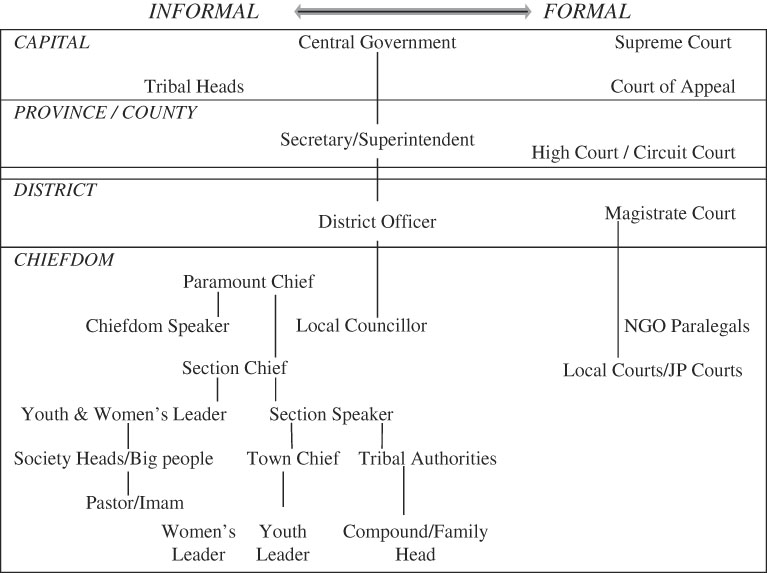
In each district, representatives of each layer of traditional authority – from paramount chiefs, tribal heads, to village heads – were interviewed, totalling 28 paramount chiefs, chiefdom speakers, and tribal heads, 25 section chiefs, 10 town/village heads, and 12 women/youth leaders. As Figure 1 illustrates, the selection of respondents also reflected the dual nature of local administration in that parallel traditional authority structures (linked to precolonial rule) operate alongside the state system. To avoid a dominant local elite perspective, I also interviewed separately at least 15 ordinary residents in each district considering their diverse socioeconomic status and the multiple forums through which they seek justice.
Local authority structure. Source: Adapted from R. E. Manning, World Bank (2009).

For information on formal implementation of justice reform and expert opinion on the justice landscape in Sierra Leone and Liberia, the following policymakers, legal professionals, and practitioners were also interviewed: lawyers, judges and magistrates, human rights activists, customary law officers, local government administrators, local court staff, and representatives of donor agencies. A key source of relevant information on primary justice systems were community-based paralegals of four local NGOs: Timap for Justice, Network Movement for Justice and Development, Center for Democracy and Human Rights, and Justice and Peace Commission. In most cases, respondents would be identified as someone in a formal or informal position of authority (judge, local chief, paralegal). Where participants were initially unknown, it was necessary to use a ‘snowball’ technique, whereby I asked a respondent to identify another source of importance to interview (for example, a paramount chief suggested his speaker or section chief who in turn recommended town/village heads). Interviews were based on a semi-structured questionnaire with open-ended questions so that respondents were at liberty to express themselves without precoded answers.
As a Sierra Leonean, my knowledge of the sociocultural settings and ability to communicate in some local languages proved useful. For instance, while recruitment protocols and forms approved by McGill University’s Research Ethics Board sufficed to access educated elites and urban residents, knowledge of customary protocols and symbols was crucial for interaction in rural communities. My affiliation with the local NGOs that organised regular community dialogue meetings helped to build trust as I was sometimes perceived as working for these organisations, or as an intern. In one such meeting held on 14 May 2014, I volunteered to take minutes of a small gathering to discuss issues related to access to justice in a local chiefdom. Being abroad for a while, there was the tendency to be regarded as a ‘JC’ (just came) in the local setting, an African associated with Western civilisation, wealth, and power. But I guarded against that impression by being in the company of paralegals (who carry with them similar research instruments). Using local dialects, hanging out in attire bases (coffee shops), and commuting via local transportation (for example, poda poda, okada) also helped to make me ‘ordinary’ in the field. The use of multi-methods provides opportunity to triangulate information from different sources, an important procedure to identify and rule out distorted information and biased interpretation.
Justice sector reform in Sierra Leone and Liberia
Sierra Leone and Liberia are appropriate for examining internationalisation of the rule of law, from both historical and contemporary peacebuilding perspectives. Sierra Leone is a former British colony, while Liberia came under the domination of Americo-Liberian settlers. But this different colonial history notwithstanding, these two countries constitute what Adekeye Adebajo calls ‘West Africa’s tragic twins’.Footnote 43 They are among the first in the region to degenerate into brutal civil war in the early 1990s, a conflict caused in part by breakdown in governance structures. Both countries fit Mahmood Mamdani’s concept of the ‘bifurcated state’ as they have maintained dual legal regimes which separate governance at the urban centre from peripheral territories.Footnote 44 While Sierra Leone inherited from indirect rule British common law alongside customary law, a separate legal justice system in Liberia was meant to protect the privileges of minority Americo-Liberian settlers against the indigenous majority population.Footnote 45
More importantly, Sierra Leone and Liberia are widely regarded as a model for successful UN peacekeeping operations as well as a prototype for the international donor community’s new emphasis on postconflict peacebuilding.Footnote 46 Apart from the conventional peacekeeping activities such as monitoring ceasefire agreements and disarming thousands of ex-fighters, the United Nations Mission in Sierra Leone (UNAMSIL) became increasingly instrumental in expanding formal state authority and establishing constitutional order through institutional reforms. Following the May 1999 Lomé Peace Agreement with the Revolutionary United Front (RUF), international attention shifted from emergency postwar recovery to transitional justice through the concomitant establishment of a Special Court for Sierra Leone and Truth and Reconciliation Commission. Donor support in justice reform was spearheaded by Sierra Leone’s longstanding bilateral partner and former colonial power, the UK. As part of the UK’s African Conflict Prevention Pool (ACPP) announced in 2001, the Commonwealth Community Safety and Security Project (CCSSP) was geared towards enhancing the professional capacity of the Sierra Leone Police with British-born Keith Biddle as the country’s first postwar Inspector-General. Later the CCSSP and an earlier Law Development Programme were incorporated into an integrated justice sector-wide strategy, which became known as the Justice Sector Development Program (JSDP).
With a duration lasting from July 2005 to December 2011, JSDP was a £28-million project to ‘support the development of an effective and accountable justice sector that is capable of meeting the needs and interest of poor, marginalized, and vulnerable people’.Footnote 47 In pursuance of this goal, the Justice Sector Coordination Office (JSCO) was established within the Ministry of Justice to coordinate the implementation of the country’s Justice Sector Reform Strategic and Investment Plan (JSRS&IP) 2008–10. Launched in 2007, the plan was intended to refocus justice sector priorities from the formal system to the delivery of primary justice, that is, semi-formal and informal justice systems at the community level. Acknowledging that the formal legal system remains inaccessible to about 70 per cent of the population, the strategy aimed to provide justice at the community level by ensuring that alternative systems of delivering justice were properly functional, in accordance with international standards, and under effective formal oversight.Footnote 48 Succeeding JSDP was the Access of Security and Justice Programme (ASJP), a five-year programme (2011–16) designed to align with the government’s JSRS&IP.Footnote 49
As in neighbouring Sierra Leone, Liberia’s justice reform is supported by donor funding and technical assistance, more so from the United Nations Mission in Liberia (UNMIL) and the US. Reflecting America’s longstanding relations with Liberia, parties to the comprehensive peace agreement (CPA) had requested that the US play a lead role in restructuring the postconflict state of Liberia. This request coincided with growing American interest under the Bush administration to deal with failed states in Africa to prevent the spread of terrorism and other transnational organised crimes.Footnote 50 Following the 2005 election victory of Ellen Johnson-Sirleaf, the US Government launched a broad-based, multifaceted rule of law programme designated to help establish the foundation for rebuilding Liberia’s devastated justice and economic systems.Footnote 51 In general, overall funding in the Liberian rule of law sector was estimated to cost about $13 million annually and the US government on its own contributed approximately half of this amount.Footnote 52 In a 2009 review commissioned by the USAID, it is noted that in a three-year period the US spent $25,545,505 on rule of law programming in areas of advocacy and public awareness, capacity and institution building, and enhancing access to justice.Footnote 53 Funding was channelled through the Department of Justice (which had a Resident Legal Advisor placed within the US Embassy), the Pacific Architects and Engineers (PAE for a team of on-the-ground legal advisors assisting various government institutions), the American Bar Association (ABA working with the Judicial Institute of Liberia), and the Carter Centre (focused on traditional systems).
Technical guidance to most American rule of law programmes came from the Bureau of International Narcotics and Law Enforcement Affairs whose primary objectives are ‘to improve judicial and law enforcement effectiveness, bolster accountability and transparency of criminal justice agencies, and institutionalize respect for human rights and the rule of law’.Footnote 54 Substantially, more programmatic activity was geared towards capacity building of various justice sector institutions and awareness raising on issues related particularly to gender equality and women’s rights.Footnote 55 The Justice Sector Support Project (JSSL), implemented by PAE, created a wide range of training materials which American law fellows utilised in a series of training activities for judicial officers and court administrators. ABA assisted the Supreme Court and Judicial Institute of Liberia to train a new group of judges, lawyers, and court staff on the operation of proper justice systems.Footnote 56
Restoring whose justice system?
Although these legal and justice sector development programmes have been designed to make the state system in Sierra Leone and Liberia relatively functional, the two countries diverge significantly in terms of the drivers of reform and their institutional and legal frameworks. In Sierra Leone, donor partners expressed interest at the very onset in a comprehensive justice reform strategy aimed at rebuilding the capacity of formal institutions to effectively perform their core functions in the areas of security and justice. Perhaps due to the dominant narrative of an ‘agrarian rebellion’, leading international interveners like the UK stressed the institutionalisation of legal-rational principles, often problematising non-state actors including traditional authorities as inhospitable to liberal-democratic values.Footnote 57 A departure from colonial indirect rule, the UK wanted its interventions in Sierra Leone this time to be an example of Prime Minister Tony Blair’s ‘ethical foreign policy’ in Africa, which included initiatives such as the ACPP, Commission for Africa, and the New African Initiative. Based on external pressure on President Tejan Kabbah (1996–2007), most of Sierra Leone’s justice development programmes culminated in laws and policies designed to harmonise the country’s dual justice system within the framework of the rule of law.Footnote 58
In the case of Liberia, justice sector development constituted part of the country’s postwar Governance and Economic Management Assistance Program (GEMAP) rather than the separate sector-focused strategy implemented in Sierra Leone. Although donors showed some commitment to transitional justice in Liberia, the core driver of legal and institutional reforms was to open the country’s economy to global capital under the administration of Madam Ellen Johnson-Sirleaf (2005–18), a Harvard-trained economist and former official of the World Bank. Unlike Sierra Leone, where an internationalised tribunal was established to prosecute warlords, the international community was less interested in criminal accountability in Liberia, even though comparable mass atrocities were committed during its civil war.Footnote 59 Instead, donor-supported reconstruction efforts of particularly the US were intended to restore political stability in the West African subregion and strengthen national institutions to maintain domestic law and order. As rule of law promotion was aimed primarily at enhancing institutional professionalism rather than liberal-democratic values, much of America’s rule of law programmes in Liberia were subcontracted to private agencies and NGOs such as Pacific Architects and Engineers, American Bar Association, and the Carter Centre.
Regardless of these divergent approaches, one striking similarity in the US- and UK-supported justice reform programmes is a deep disconnect between donor-funded projects and where the majority population in both countries turn in search of justice and security.Footnote 60 Arguing that state reconstruction in postwar Sierra Leone has exposed the ‘limits of liberal peacebuilding’, one study notes that ‘most rural Sierra Leoneans, who live under social forms of governance embodied in customary law, continue to have few regular or substantive encounters with formal institutions and agents of the state’.Footnote 61 In terms of access to justice, other studies have found local chiefs’ courts and chiefdom police authorities (whom DFID neglected in their funding and technical support to Sierra Leone) to be precisely far more trusted in resolving disputes than the state justice system.Footnote 62 Although the reasons for the popularity of non-state and informal systems among about 70 per cent of Sierra Leoneans are not extensively discussed in this article, it suffices to mention that my observations of informal courts and interviews with all sixty users are consistent with this response by a lawyer who is based in Freetown.Footnote 63
I am sure a lot of people go to the informal system because they feel the environment is familiar; the language is familiar, they see people of their kind, and they are spoken to directly. These are some of the aspects the formal system can learn to try to be more accessible and friendlier. The environment should be conducive, not threatening and imposing. They say the informal system dispenses justice more quickly to them, so I think the formal system could learn from that.Footnote 64
Evaluation reports on Liberia have consistently echoed similar findings, particularly following the implementation of USAID-funded rule of law programmes. In fact, one study commissioned by the United States Institute of Peace (USIP) revealed a startling problem that raises concerns not only about the functional relevance of rule of law institutions, but also fundamental questions about the nature of justice they promote in war-torn societies.Footnote 65 According to this study, ‘most Liberians would still be unsatisfied with the justice meted out by the formal system, even if it were able to deliver on the basics’.Footnote 66 The USIP study followed a survey conducted by Oxford’s Centre for the Study of African Economics indicating that, despite the devotion of enormous donor resources into the Liberian judiciary, only 3 per cent out of 3,181 civil cases and 2 per cent of 1,877 criminal cases were taken to the formal courts.Footnote 67 As in Sierra Leone, by failing to prioritise access to justice as determined by context-specific socioeconomic realities of most Liberians, donor-supported programmes have further entrenched structural, social, and cost-related barriers in these war-torn countries as I discuss below.
Structural barriers
In Sierra Leone, structural barriers to justice have been historically rooted in the country’s dual legal system, which was codified during British indirect colonial rule and upheld by successive postcolonial regimes as an instrument of ethno-legal elite domination. By reaffirming the superiority of English law and centralising legal power in formal judicial institutions, postwar reconstruction processes have reinforced such ethno-legal inequality including the subordination of customary laws and practices that peacebuilders often dismissed as inconsistent with international human rights standards. Stating that some aspects of customary and religious law contradict basic human rights, the country’s postwar Truth and Reconciliation Commission recommended that ‘traditional rules and customs must be subject to international human rights treaties and the Constitution [of Sierra Leone]’.Footnote 68 New laws such as the 2011 Local Court Act have criminalised the judicial functions of local chiefs and prohibited the application of customary law in Freetown, even though the city’s majority inhabitants are of indigenous-rural origin. As in this comment, seven tribal heads included in this research unanimously perceived the prohibition of customary law in Freetown as superimposition of English law (which historically favoured the Krios and educated elites) on their people.
I see no reason why we have the local court system in the provinces but not in the western area. Is it because the Krios who were very influential in those days thought it fit that only their own kith and kin should have access to the formal justice system and that they should deny us the provincials that right? So, I have always been telling them that they are not doing justice to our people who have been coming from the provinces.Footnote 69
Another issue that structurally hinders access is the re-establishment of a ‘formal system that is too process-oriented’, with 50 per cent of Sierra Leonean lawyers in the study admitting that they ‘spend so much time clinging on to a process not realizing that it is creating injustices and we are not willing to move away from it’. Formalisation in this context refers to complex procedural rules of court that are highly technical and legalistic, ‘known only to court insiders such as judges and lawyers’.Footnote 70 Most progressive lawyers interviewed in this study admitted that such reform programmes have reinforced structure-related barriers that are inherent in judicial and law enforcement procedures (formality, language, views of justice), particularly for people of low socioeconomic status.Footnote 71 As one civil society activist put it, ‘the justice system is centralized in the hands of few elites and legal training is conventional, designed only for people who want to become lawyers’.Footnote 72 In a country whose majority population is largely illiterate and ethnically heterogeneous, this lawyer exposes how an elitist system inhibits access.
The major issue first is about access. We have a very complicated legal system. I have seen in court cases where indigent litigants have had to represent themselves and you have lawyers basically talking down to them, shouting and screaming at them. So, it is such that people feel you must have a lawyer even though you don’t have to if you can ‘competently’ represent yourself. But the system is structured in such a way that lawyers have an unfair advantage over a layman who chooses to represent himself which makes people think that they must have a lawyer.Footnote 73
Among sixty ordinary Sierra Leoneans who participated in this study, there is a perception among those of low socioeconomic status that professionalisation of the administration of justice takes state institutions further away from their day-to-day survival in the informal economy. From artisanal mine workers and small-scale farmers in rural areas to petty traders and quarry workers in sprawling urban centres, these respondents spoke about the issues that concern their well-being, yet are untenable before a formalised justice system. In her interview, one petty businesswoman was thankful for the intervention of her local chief who could retrieve Le 500,000 ($100) from another woman who failed to deliver the items she was asked to purchase on an unregulated business trip.Footnote 74 That amount was this petty trader’s total savings for many years and she stated that it would have been difficult to seek formal redress through the new commercial court in Freetown because her transaction was based only on an interpersonal relationship with no receipt of payment. But while ordinary people question the relevance of formalistic procedures, those who benefit from donor-funded capacity building are the ruling and educated elites as this civil society activist reiterates.
Donor projects have been more about providing training, providing computers, and giving police officers new uniforms, batons, and boots. It is to bureaucratise the system. There is more consistency and predictability because the laws are codified and precedence should be followed. But the trust issue is still a problem. Because of the nature of the state architecture, it is such that the Vice-President is the head of the Police Council, which creates room for the institution to be politicised. What is needed is that critical shift from training and materials to behaviour change.Footnote 75
In the case of Liberia, structure-related barriers originated from the construction of an Americo-Liberian state that historically preserved the interest of Westernised elites while subordinating the customs and traditional practices of indigenous Liberians. Unlike the UK-supported legal reform in Sierra Leone, Liberia has maintained its prewar institutional arrangement including a dual justice system whereby the rules of customary laws are applied separately by traditional chiefs and local government officials alongside the formal justice system that interprets the formal English law. However, by placing a premium on statist reforms, postwar reconstruction has left almost intact the 1905 Rules and Regulations Governing the Hinterland, which placed traditional justice systems under the Ministry of Internal Affairs. Maintaining the application of customary law under the supervision of an executive ministry has been an attempt by peacebuilders to relegate traditional justice practices as an abnormal or inferior form of ‘administrative justice’ in the same way that Americo-Liberian colonialism regarded them as inferior ‘native court practices’ to be civilised by the superior state system. Consequently, the majority of fifty Liberians who participated in this study (particularly those of indigenous and rural origin) perceived the restoration of postconflict state structures as reminiscent of the colonial statebuilding project that protected Americo-Liberian elite interest, as this respondent emphasised:
The reality of what we have is an injustice system – a system that perpetuates injustice. But conventionally they call it a justice system because they have a statute in front of the court building that says ‘let justice be done to all people’. The reality is that there is no justice for the majority of the people because the system does not consider the legal needs of poor and illiterate rural Liberians as deserving serious attention.Footnote 76
Another source of legal subordination is an increasing propensity by rule of law promoters to drastically limit the jurisdiction of traditional justice systems (administered by local chiefs and other customary authorities), despite their indispensability to the dispute resolution needs of most Liberians. The main target of this jurisdictional restriction are traditional institutions of criminal justice, most notably Liberia’s trial by ordeal (TBO) practices, which range from the ingestion of a poisonous concoction (commonly known as Sassywood) to oath taking and swearing to determine a defendant’s guilt or innocence.Footnote 77 In 2008, the Ministries of Internal Affairs and Justice announced that Liberia would no longer permit the use of any ordeal-like judicial procedures, adding that those who permit or administer Sassywood and other TBOs are doing so illegally. With a strong backing from the international community, the Solicitor-General of Liberia spearheaded a widely publicised campaign to end the practice, showcasing exemplary prosecutions of traditional chiefs who violated the blanket prohibition. For rule of law and human rights activists this announcement was a progressive development to remove discriminatory primitive practices that amount to torture from Liberia’s criminal justice system, whereas rural Liberians expressed serious concerns about the creation of a justice vacuum in the absence of accessible judicial and law enforcement institutions. In the remote Grand Geddeh County, residents who are still using non-lethal forms of TBO lamented the blanket ban for undermining vital dispute resolution mechanisms that have proven indispensable in investigating cases considered inadmissible by the formal state system.
As in Sierra Leone, these cases include ‘threatening remarks by native means’, a serious problem affecting local communities but which cannot be investigated by the police or litigated in a formal court.Footnote 78 Citing the rules of court, a local court chairman insisted that such charges must be dismissed as ‘malicious, vexatious, and frivolous’, while those affected said such threats destabilise social and economic interaction.Footnote 79 Tim Kelsall examines this challenge in arguing that the Special Court for Sierra Leone was ill-suited for a society in which the personal is an inextricable blend of human and supernatural forces that cannot be subject to positivist evidential verification.Footnote 80 These informal sectors may seem insignificant to peacebuilders but Scott cautions that the survival of a centrally planned social action is often contingent on practical improvisation ‘either not envisaged or expressly prohibited by the plan’.Footnote 81
Social barriers
It is important to underscore that preference for traditional justice practices is not grounded in abstract notions of ‘tradition’ and ‘culture’, but based on rational consideration of the socioeconomic conditions of most citizens. Liberians who participated in this study subscribed to the view that resolving dispute through the formal justice channel undermines interpersonal relationships and breeds enmity that may affect long-term coexistence, particularly in homogenous communities. From the interviews and observation of local dispute resolution mechanisms, this justice norm reflected the social organisation of most rural communities in Liberia where there is a strong sense of informal reciprocal obligation. In these communities, decision about appropriate redress is shaped by past social interaction as well as consideration of how to minimise harm to long-term kinship relations. In other words, and as the comment below suggests, consideration of what to do about a dispute takes into account social issues that may seem extraneous to the matter in question but which are affected by the way such dispute is eventually resolved.
I remember an incident in which I reported someone to the police. It was about a false allegation made by one neighbour that I am in love with her husband. I took her to court but later I was prevailed upon to remove the matter from court for in-house settlement. I agreed to withdraw that case from the court because of the man’s relationship with my husband. He was a nice man and helpful to my family. When they were looking for Gio people during the Doe era, he was protecting my husband. Also, they brought big people who are in a position to appeal to me and I accepted their plea.Footnote 82
This respondent’s decision to withdraw a case from the police was informed by memory of assistance a neighbour offered her family during the civil war in Liberia that witnessed pro-government Krahn people attacking members of the Gio ethnic group. What further motivated this decision was the instrumentality of ‘big people’ whose reputation in the community could be relied upon as moral guarantor for interpersonal and communal conflict resolution. These people were in a position not only to appeal to this lady, but also to guarantee an end of enmity between both parties. As confirmed by 15 respondents who also withdrew cases from the police or court, most rural Liberians are concerned that punitive actions would undermine informal trust networks upon which the social fabric of their extended family and/or community rests. Characterising this practice as a widely accepted local justice norm, a farmer in Grand Geddeh in fact asserted that:
People prefer to settle their cases out of court because Liberians have a way of thinking. If someone takes you to court for just a minor issue, then he becomes your everlasting enemy. So, you just don’t take someone to court like that.Footnote 83
For Sierra Leone, questions about the social relevance of justice norms emanated from the historical and structural forces discussed above coupled with external interest in using its postwar reconstruction agenda as a model for institutionalising international criminal justice. But the social implications in terms of survival in the informal economy and rural communal settings resemble the experiences of Liberia. For instance, Sierra Leoneans describe matters that violate the national penal codes as ‘blood’ or ‘police’ cases (for example, land disputes, murder, rape, wounding with intent) and all sixty ordinary citizens regarded them as matters for the criminal justice system. However, disputants (about twenty participants had been to the police or formal courts) expressed concerns about the adversarial and punitive nature of the criminal justice system, a norm linked to the common law tradition and reinforced by transitional justice mechanisms like the Special Court, which emphasised individual criminal accountability and punishment. The court was a hybrid mechanism based on the principle of individual moral culpability that holds an individual personally accountable because each rational autonomous person is responsible for his or her action.Footnote 84 This international standard of retributive justice tended to exclude residents in communal settings who wanted redress more oriented towards compensation, reconciliation, and restoration of broken relationships.Footnote 85
Unlike urban centres where interaction is more impersonal, people in communal settings loathe the punitive penalty imposed by the criminal justice system, not just because they are interested in preserving kinship relations, but also to avoid the likelihood of retaliatory consequences in a locally shared space. In such settings, the act of taking someone to the police or formal court is itself an act of enmity, particularly if traditional conflict resolution processes have not been exhausted. One respondent in the northern region of Sierra Leone stated that when you take a neighbour to the police for a minor crime and he is detained for your sake, he ‘would have a deep grudge against you for subjecting him to humiliation’.Footnote 86 A respected ceremonial chief in the southern region echoed this concern, saying, ‘if your brother takes you to the police or court, he intends to give you trouble and to tarnish your character for good’.Footnote 87
This respondent who grew up in the interior but migrated to Freetown noted that his rural community attached some stigma to ‘handcuffs and cells’ to the extent that those released from prison had to be ‘washed’ before reintegration back into society.Footnote 88 This stigmatisation may not be unconnected to the deplorable condition of prison facilities in the country. However, it raises important questions about the legitimacy of the state coercive institutions that international peacebuilders have sought to restore. As historians who study both countries have documented, the modern statebuilding project has been a coercive enterprise for many rural communities since its introduction in the nineteenth century.Footnote 89 Also, the periods of autocratic rule and civil war were characterised by injustices perpetuated by the state apparatus itself, an insight provided by this respondent who was involved in most justice sector reform projects in Sierra Leone.
And because of the injustices we have suffered in the hand of security forces, a lot of people are not prepared to accept formal justice systems. For many of them, formal justice strengthening is just like extension of ruling party or ruling government imperatives into their lives. These are things they are not comfortable with; they do not like the sight of the police; they do not like the sight of a magistrate. It has been a challenge for the entire justice apparatus to rebrand or relaunch itself in a way that becomes believable.Footnote 90
Cost-related barriers
For people with low socioeconomic status in both countries, the impact of building a centralised and bureaucratic system of justice is real in their day-to-day survival. The system requires a legal counsel to ‘competently’ navigate its formal structures, but to date, both countries have very few lawyers, and those practicing law are mostly concentrated in the capital cities and interested in private practice. While the elitist nature of the legal profession in Sierra Leone dates to its historical foundation, transitional justice mechanisms and UK-funded judicial reforms have further heightened this consciousness that law is a lucrative profession connected to influential actors.Footnote 91 A typical example is the employment of foreign lawyers and local experts who were paid salaries based on international standards by the Special Court and DFID, thereby exposing the poor conditions of service of most local judicial officials. As one Sierra Leonean lawyer emphasised in his interview, that exposure created tension between local and internationally contracted staff and reinforced private legal practice for those seeking higher remuneration.
There has been the inclusion of foreign judges to prop up the number at the judiciary and deal with certain cases. Most of that reform was paid for or supported by international institutions like UNDP and DFID. As successful as that was, it created at lot of tensions as well. Foreign judges and some local practitioners who were contracted to serve as judges were receiving pay in a way that was commensurate to experience in other countries and yet Sierra Leonean judges not under contract were paid paltry sums.Footnote 92
Also, concentrating judicial authority in sparsely located and poorly equipped courts has obvious cost implications, including financial expenses for the majority of (poor) people living in remote areas away from urban headquarter towns. Added to these expenses, extremely formal rules of court present a barrier to largely illiterate and uninformed citizens, who are compelled to hire a lawyer to seek redress through the legal state system. As most participants of low economic status complained in their interviews, this businesswoman stated why she is reluctant to take disputes to the criminal justice system:
What I like about the chief court is that you spend less to them compared to what it would have cost you to go to the government court. You may require a lawyer in the magistrate court and you can use money to influence the court. I even prefer the chief court than the local court. When you report to the chief, you don’t have to buy paper and that reduces the amount. This is the difference.Footnote 93
As in this interview, all respondents vent their frustration about the delay and cost of using the state system by contrasting the operation of that system with non-state institutions that perform relatively well. For those in the informal economy, which thrives on interpersonal relationships and daily wage, the cost of dispute resolution also includes problems of frequent adjournments that do not allow people to return to their daily livelihood activities as soon as possible.
Unlike their intervention in Sierra Leone, the donor community have been less interested in institutionalising an international criminal justice norm in Liberia and therefore the transfer of foreign legal experts and resources into the domestic system seemed relatively low. At the same time, most of USAID-supported efforts have concentrated on building state capacity to provide justice instead of increasing access to justice for poor and less-privileged citizens, the same problem in Sierra Leone. For example, Liberia has a public defender system that is supposed to provide free legal representation to people who cannot afford the service of a lawyer, but the few public defenders are concentrated in urban centres and they do not handle customary and civil law cases. Conducted by Oxford’s African Studies Centre, one study on court accessibility for a sample of 176 Liberian villages estimated the average transportation cost for a villager to reach the nearest formal court to be 150 Liberian dollars, taking an average of 3.5 hours. Another found that Liberia’s countryside suffers a ‘sheer lack of qualified judges and lawyers, and an absolute lack of any formal court structures or personnel’.Footnote 94 Referring to the cost of seeking redress through the formal justice system, Liberians of low socioeconomic status emphatically stated in this study that ‘there is no justice for the poor here’, meaning that poor people cannot afford state justice.
These cost-related barriers (financial expenses and time) are a reminder of Marc Galanter’s ‘resource inequality’ thesis, which holds that a party with financial power (the ‘haves’) is likely to obtain a favourable adjudication of disputes.Footnote 95 Chief among the defects that give the stronger party an advantage, according to Galanter, is case overload, which in turn increases delays and trial cost. Although this ‘party capability’ argument is not unique to Sierra Leone and Liberia, the situation is not helped by a grossly inequitable political economy that gives undue advantage to the already dominant class in society, which includes the rich, educated, and influential, as 15 community-based paralegals interviewed unanimously disclosed.Footnote 96 It was Jean-Jacques Rousseau who noted that the ideal court adjudicates impartially, while a real court often favours the rich and powerful.Footnote 97 But whereas this might be a universal principle, justice sector reform programmes should not be implemented to reinforce unequal structures of power in countries that consistently rank at the bottom of the UNDP Human Development Index.
Conclusion
The critical peacebuilding literature has called into question the appropriateness and quality of liberal peacebuilding in war-torn countries in the Global South. To save liberal peace, Roland Paris conceptualised an ‘institutionalisation before liberalisation’ approach to prioritise the structures of law and governance, which would in turn mitigate the risk of social conflicts accompanying liberal reforms.Footnote 98 Resonating with many decision-makers and practitioners, this approach has translated into the ‘statebuilding as peacebuilding’ model in the field of peace and conflict studies and a renewed interest in promoting rule of law institutions and norms to engineer positive social change in war-torn countries. Framed as the security-development nexus, development practitioners in fragile and conflict-affected states have also devoted considerable attention to institutionalising the rule of law via justice and security sector reform programmes.
Drawing from socio-legal and comparative studies, I have argued that while rebuilding the rule of law is useful for the restoration of state authority and opening local economies for liberal-democratic reforms, internationally supported efforts have inhibited access to justice for those historically excluded from the formal state system. Apart from warning of the dangers of ignoring non-state legal orders in legally pluralistic war-torn countries, I have exposed the dominant interests underneath the veneer of narrow technocracy, legal centrism, and formalisation processes in both statebuilding and peacebuilding projects. Specifically, I caution that for the war-torn countries of Sierra Leone and Liberia, international rule of law promotion reinforced structural, social, and cost-related obstacles to justice. Due to these adverse consequences of rebuilding the rule of law in these countries, many of their population have (re)turned to non-state traditional dispute resolution mechanisms for redress, despite enormous financial and technical resources poured into the formal state system by leading donor partners and international organisations.
This article, however, does not make a relativist argument about the cultural incompatibility between global and local justice norms. Unlike legal-anthropologists, I have defined the social relevance of traditional methods and practices in real socioeconomic conditions affecting war-torn societies rather than abstract notions of culture. Although beyond the scope of this article, my emphasis on the rational and instrumental values of local justice norms leaves room for their progressive transformation and sets the scope condition for peacebuilders to meaningfully engage them. For instance, it might be useful to explore the relative salience of rule of law and traditional justice institutions in diverse socioeconomic contexts. Postwar reconstruction in low socioeconomic settings may require greater emphasis on a functionalist approach to justice, using affordable and accessible non-state mechanisms to increase access to justice while ideal-oriented rule of law institutions may be concentrated in economically advanced areas. This context-specific conceptualisation of justice reconstruction may complement Paris’ ‘institutionalisation before liberalisation’ model, which is a general framework still prone to the dangers of one-size-fits-all universalism and cultural imperialism in war-torn countries.
Acknowledgments
The Social Sciences and Humanities Research Council (SSHRC)'s Vanier Canada Graduate Scholarship provided funding support to undertake fieldwork in Sierra Leone and Liberia. The author is grateful to the Journal reviewers and editors who provided thoughtful comments to improve the earlier drafts of this article. My sincere thanks to Catherine Lu, Megan Bradley, Rex Brynen, Vincent Pouliot, Paula Brook, Eric Wiebelhaus-Brahm, Kirsten Ainley, Rebekka Friedman, Chandra Sriram, and Nandini Ramanujam for their constructive feedback and advice. Also appreciated are those who participated in the fieldwork conducted in 2014.
Dr Mohamed Sesay is a postdoctoral fellow with the Research Group on Global Justice of the Yan P. Lin Centre for the Study of Freedom and Global Orders in the Ancient and Modern Worlds, McGill University, Montreal, Canada. He is also a member of the UK Global Challenges Research Fund’s Strategic Network on Justice, Conflict, and Development. Sesay has published articles in International Studies Perspective (2012); Cooperation & Conflict (2012); and African Affairs (forthcoming, 2018). He also contributed to Evaluating Transitional Justice: Accountability and Peacebuilding in Post-conflict Sierra Leone (2015).