

Love hurts. It pierces, wounds, stings. The stylised language that describes the experience of love as acute physical pain has become so commonplace that its impact barely registers. Often, medieval courtly poetry displaced the perceived agent of this suffering by transferring the actions of physical cruelty from the beloved onto the personified, yet abstract, allegorical character of Love. In the above quotation from the Roman de la rose, it is Love – and not the beloved – who wounds and tortures the lover with the arrow he shoots at the lover's heart (although entering through the eye).Footnote 1 But in some poems the lady takes sadistic pleasure in the lover's pain: for example, in Machaut's Balade 38, the lover complains: ‘ma tres douce dame rit et prent deduit en mon tourment et es meschies, ou mes cuers vit’ (‘my most sweet lady laughs at my torment and takes delight in the misfortune in which my heart resides’). In line with the tradition of the grand chant courtois, Machaut's balades in particular (but also his lais and some of his motets) focus on the prolonged physical torment and anguish suffered by the lover at the hands of the lady. In balades 27 and 38, Machaut likens the wounds suffered by the lover to those that result from the poisons of deadly beasts. He invokes animal imagery to depict the lady and her behaviour: she encloses within her being monstrous beasts that repel and repulse the lover, causing him grievous bodily harm.Footnote 2
In the course of both balades the deadly beasts transform into various allegorical characters. One of these characters, Refusal (‘Refus’), emerges as central. Machaut personifies the lady's rejection of the lover's advances (which he makes through words/music) as the courtly vice Refusal. In Balade 27, the lady's sense organs enact this refusal: her ears cannot hear him, her mouth rejects him, and her Look kills him. The rhetoric of persuasion or eloquence available to the poet/musician (words/music) is rendered impotent in the face of this outright refusal to listen.Footnote 3 The visual dominates in this sense world: the Look kills, while the oral/aural is ineffectual. This study traces the centrality of Refusal in the interpretation of these balades. I explore the resonances of Machaut's sadistic and animalistic lady in two spheres: the courtly, where the obvious antecedents for Machaut's imagery are the courtly bestiaries; and the sacred, where I examine the parallels between Refusal and the deadly sins of pride and envy, as suggested by my interpretation of these two balades and some of Machaut's motets, and the links I set forth between these sins, vices and the senses that partake in them.
Poisonous lover, or woman as snake
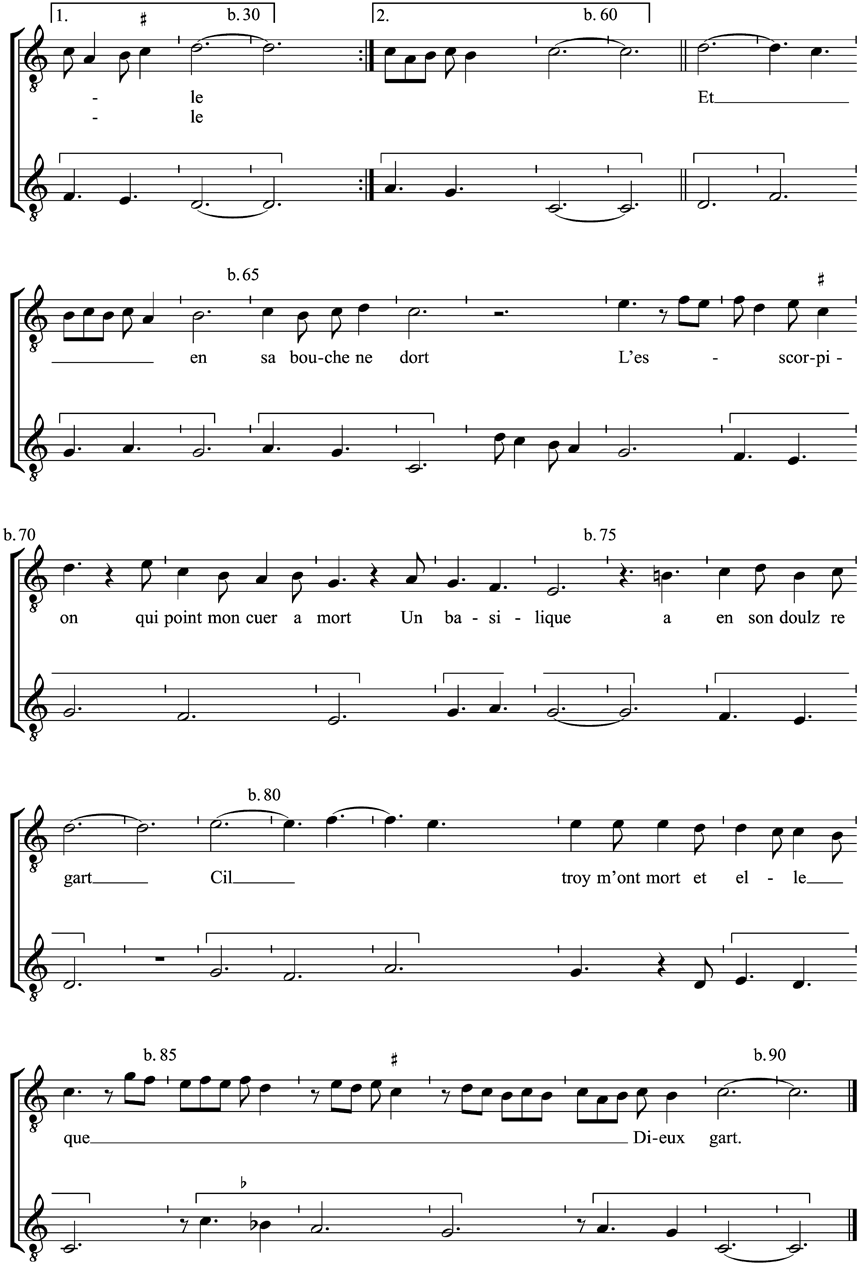
Balade 27 (‘Une vipere en cuer’) survives in eight manuscript sources: text-only versions are in MachWm, MachVg, MachA, MachB, MachD, MachPa, MachM (this manuscript contains two text-only versions), and versions with music in MachVg, MachA, MachB, MachE, MachG, of which four are for two voices (texted voice and tenor) and one a three-voice version (a contratenor is added in MachE).Footnote 4 If we allow the last long of each section a duration equal to two breves, each section contains exactly thirty breves, with each complete stanza lasting ninety breves. The text and translation are as follows (see Appendix 1 for a transcription of the music, following MachVg):Footnote 5

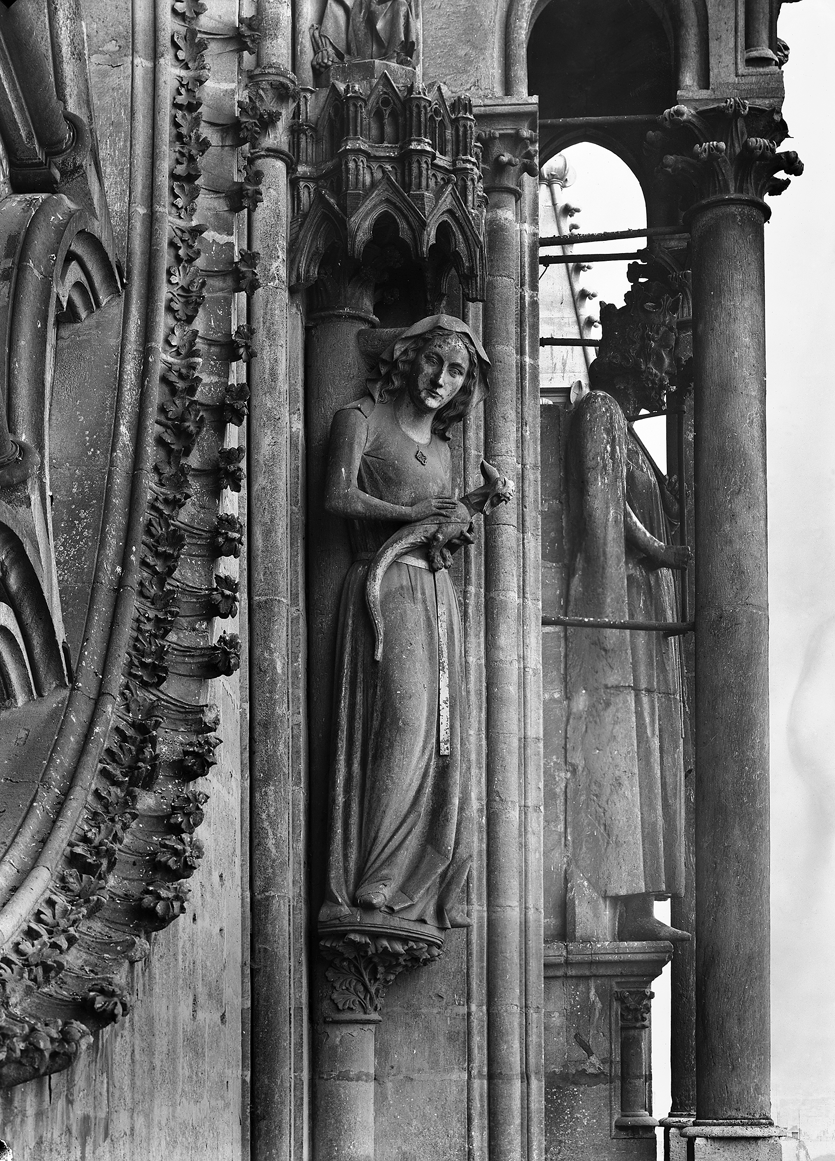
The image of a snake snugly residing within the heart of the lady opens the narrative: ‘Une vipere en cuer ma dame meint’ (‘A viper in her heart my lady keeps’). In the medieval imagination, the snake embodied its threatening nature in its physical form: the undulating body, the quickness and slipperiness of its movement, the shedding of its skin, and its poisonous tongue.Footnote 6 Viewed in ancient cultures as a life-giving force, a symbol of fertility, and as an embodiment of the feminine principle, in the Christian tradition the snake was feared as a demonic destructive force and became a symbol for the evil inherent in all beings.Footnote 7 The first image that leaps to mind upon hearing these opening words – ‘une vipere’ – is the woman–snake relationship of Christian theology and the fact that the serpent in the Garden of Eden chose to tempt the woman, Eve. Medieval writers condemned Eve's loquacity and garrulity, and her apparent willingness to engage with and debate the serpent.Footnote 8 At Reims cathedral, Eve's association with the serpent is depicted in a sculpture on the exterior face of the cathedral, at the side of the north transept rose window. In this thirteenth-century sculpture, which Machaut presumably knew, Eve stands stroking the serpent affectionately; the serpent looks so comfortable in her arms it appears to yawn, like a little lapdog (see Figure 1).Footnote 9 This Eve also ‘keeps’ a serpent: not in her heart, but in her arms.
Eve strokes the serpent. Reims Cathedral, north transept rose window (before 1241).
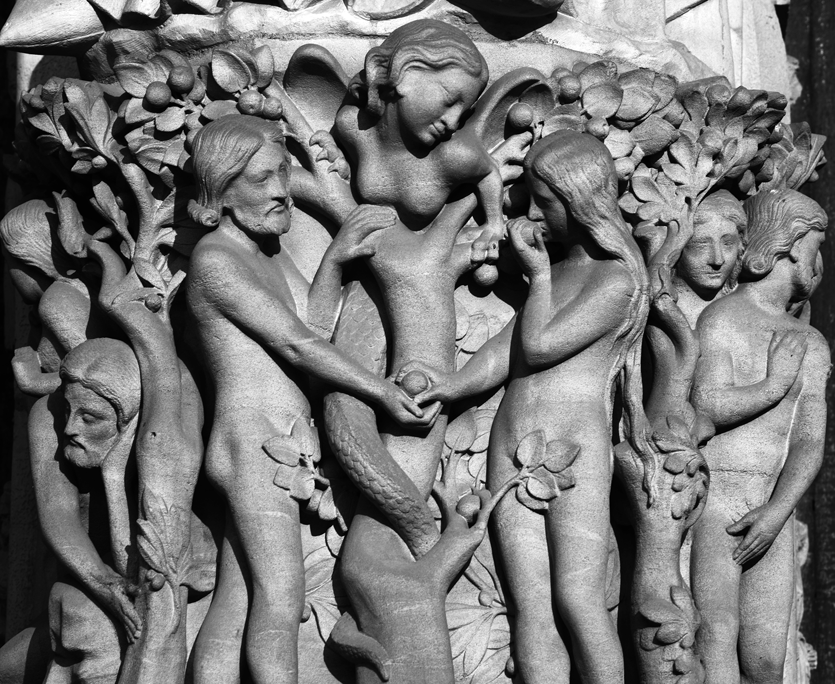
The symbiosis between the Edenic serpent and the female is a popular subject in medieval art and literature. The serpent often assumes a hybridised form: half-woman, half-serpent.Footnote 10 Examples include a thirteenth-century sculpture from Notre Dame Cathedral in Paris, showing Eve conversing with a serpent with a woman's face and breasts (see Figure 2).
Adam, Eve, and serpent. Base of trumeau, left portal (Portal of the Virgin), West façade, Cathedral of Notre Dame, Paris (c. 1210).
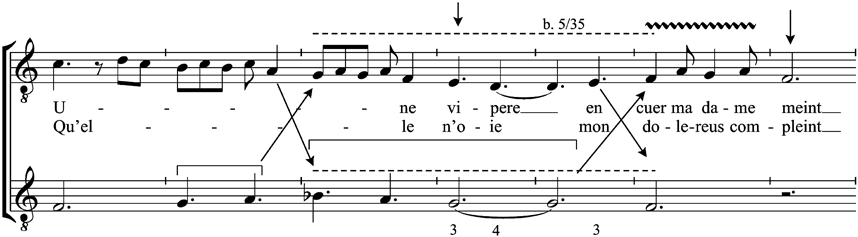
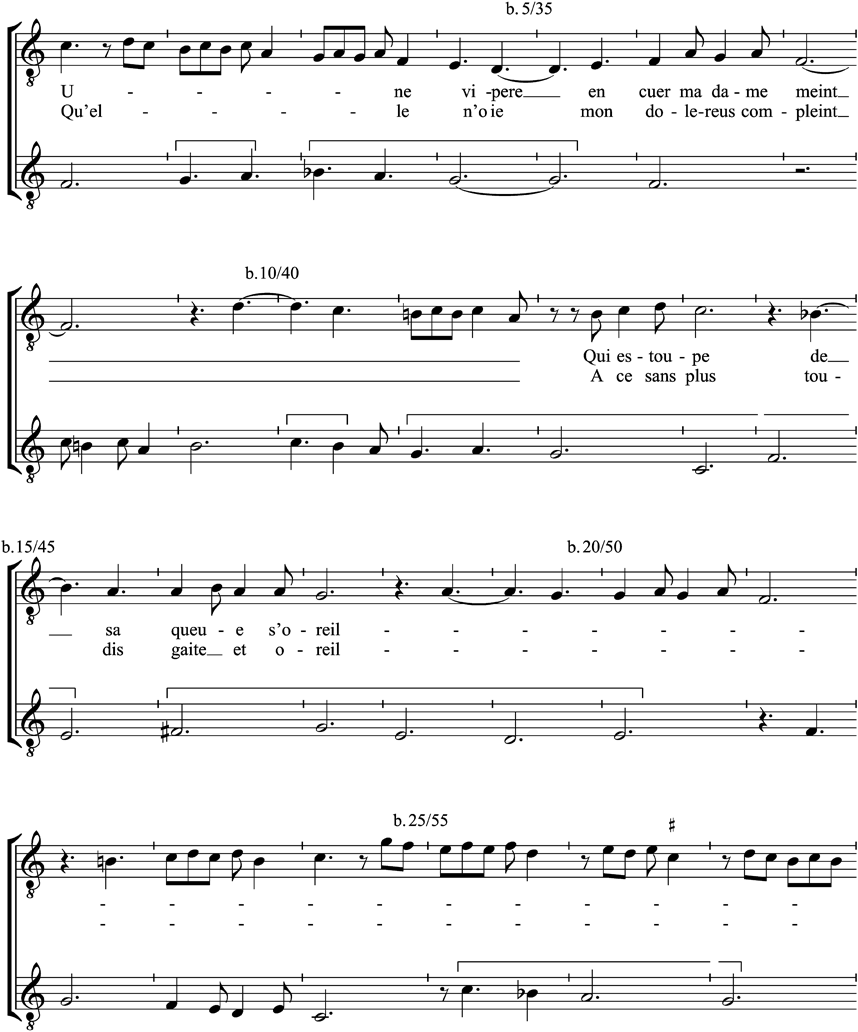
In the opening of Balade 27, Machaut accentuates the semantic parallelism between woman and snake. The melismatic descent of the cantus evokes the downward spiral of the slithering viper (the opening melisma sets the words ‘une vipere’), with its twisting recurrent melodic motif from a pitch of high c (decorated above by d) to a low D (see Example 1). Machaut's poem for the balade he set to music differs from his text-only versions: in most of these the first line reads ‘En cuer ma dame une vipere meint’ (literally ‘In her heart my lady a viper keeps’); the first line of the version set to music has a shift in emphasis, drawing the listener's focus directly to the reptilian creature: ‘Une vipere en cuer ma dame meint’ (‘Aviper in her heart my lady keeps’).Footnote 11 When the A section music is repeated for the second couplet of the first stanza, the slippery melodic descent occurs on the words ‘Qu’elle n'oie’ (‘So she cannot hear’), emphasising the symbiotic relationship between viper and lady (and also the link, which will be explored below, between the viper and hearing).Footnote 12
Balade 27, breves 1–7 (31–7)
The dyad on which the cantus and tenor meet at the end of this descent (at breve 4/34) is an imperfect consonance of E/G (a third), creating a harmonic tension that remains essentially unresolved until breve 7/37. The cantus falls from the E to a low D (the lowest pitch of its ambitus in this balade), holding this note for a full breve, thus creating a perfect fourth with the tenor voice, which sings a G above the cantus (the tenor holds this sustained G for the value of a long). The tension created by the perfect fourth in breves 5/35, coinciding with the declamation of the word ‘vipere’, takes a full three breves to resolve. The two voices do cadence briefly on a unison F at breve 6/36, but this cadence is all too rapidly abandoned by the cantus, which moves on to sing a decorative melodic motif (highlighted by a wavy line in Example 1). A satisfactory resolution is reached at breve 7/37 (although the tenor has dropped out by this point). It is almost as if the two voices are not listening to each other, and the tenor abandons the cadence before the cantus gets there. This overly long dissonant build-up at breves 1–6, followed by the overly light resolution that is misaligned in the two voices, foreshadows the phrase ‘stops up her ear so she cannot hear’.
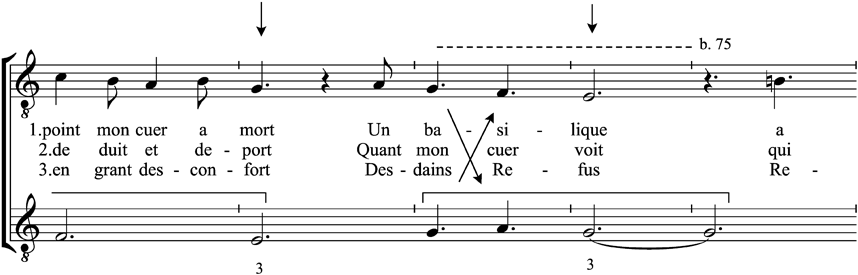
A further element adds to the effectiveness of this opening and draws attention to the ‘vipere’: the voice-crossing that occurs in breve 3/33 and continues through to breve 6/36 (highlighted in Example 1 with arrows, and dotted lines above the crossed parts). In her fascinating study of how voice-crossing acts as a structural element in some of Machaut's motets, Anna Zayaruznaya describes Machaut's use of voice-crossing as ‘a deliberately conceived and executed authorial plan – something as central to the form of the piece as the tenor's color and talea’.Footnote 13 Machaut also uses voice-crossing to highlight important moments in Balade 27 (although perhaps not in the structural fashion that Zayaruznaya found in Motets 12, 13 and 15, but in these two balades more as a technique for declamatory emphasis), as exemplified by this strange opening with its descent into a criss-crossed world, where a lady keeps a viper wrapped around her heart.Footnote 14 Machaut's combination of these three techniques – the low register of the cantus, the extended duration of the low note (that is, an agogic accent) on the imperfect interval, and the voice-crossing – occurs only once more in this balade: on the word ‘basilique’ (‘basilisk’) in the B section (see Example 2 at breve 74). I will return to the significance of this moment presently.
Balade 27, breves 71–5
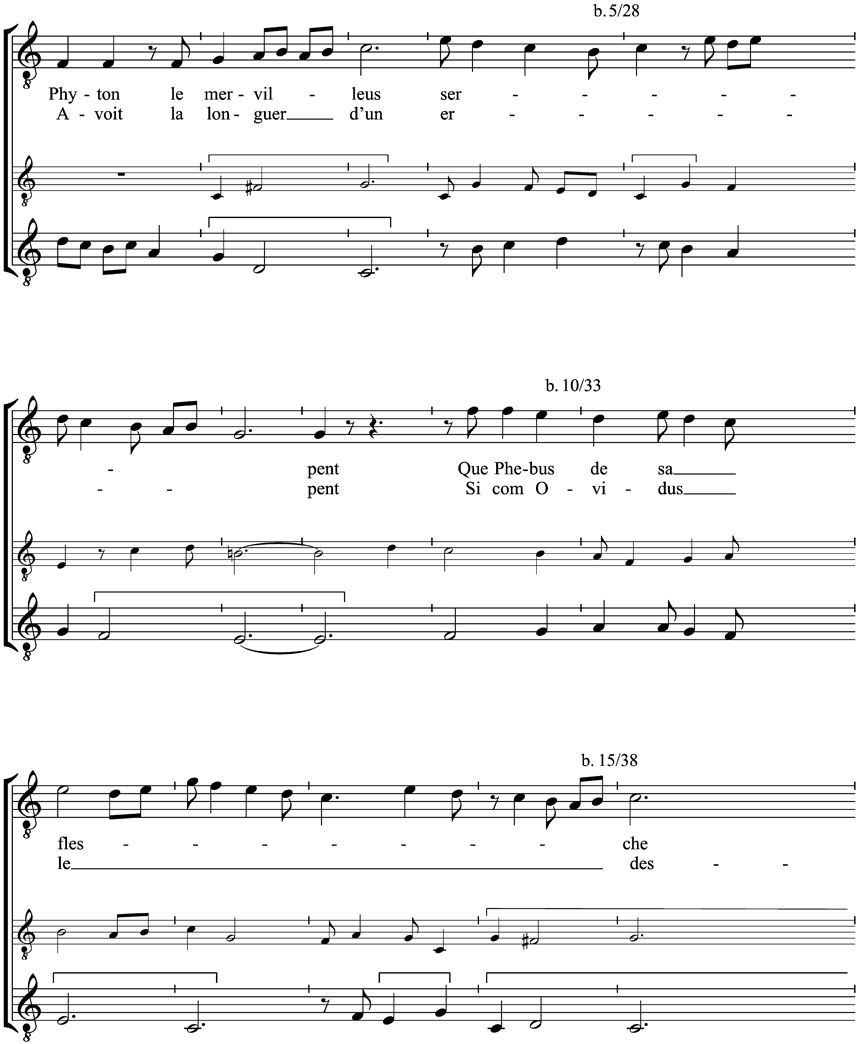
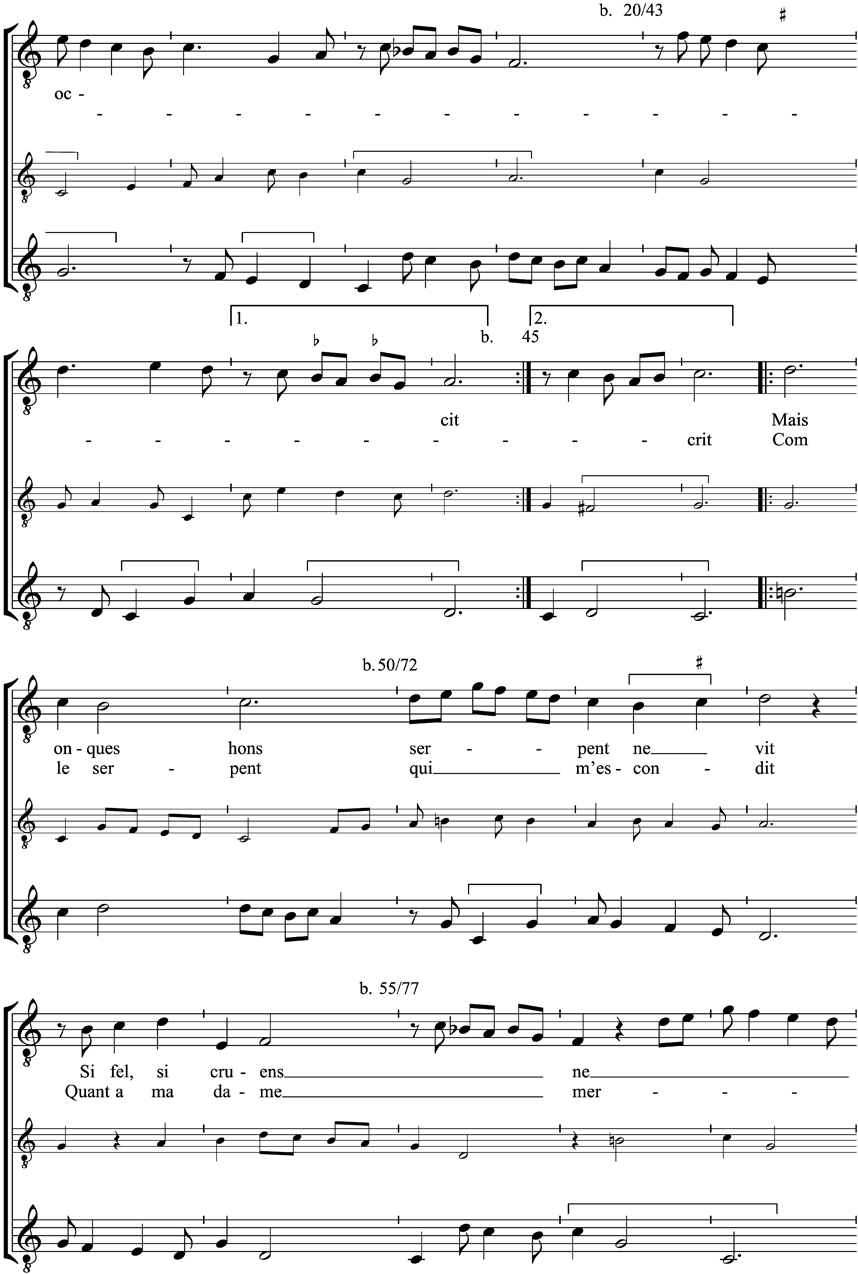
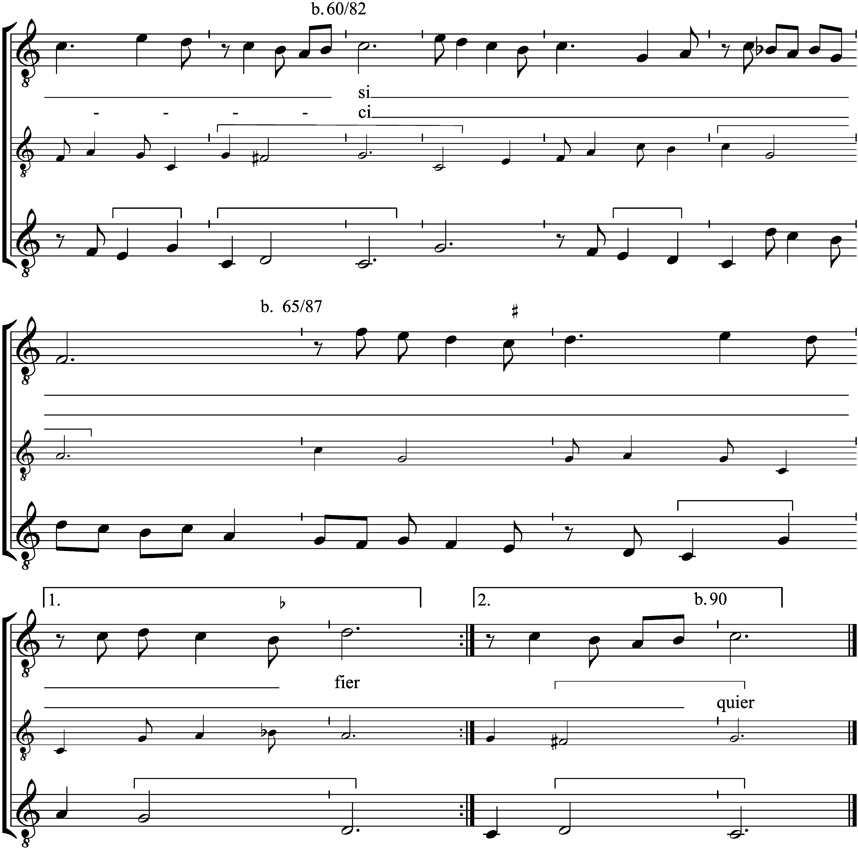
Balade 38 opens with a similar juxtaposition of serpent and lady.Footnote 15 The text and translation are as follows (Appendix 2 contains an edition following MachA):
Each stanza of this balade, like Balade 27, is set to music of ninety breves: A (23 breves) A (23 breves) B (22 breves) B (22 breves). The harmonic sonorities of both pieces are similar, with both balades beginning on F sonorities, closing on D cadences for the ouvert endings and on C cadences for the clos endings.
The first quatrain of Balade 38 recounts the mythic story of the slaying of the giant she-dragon, Python, by Apollo (Phoebus).Footnote 16 Python, a female serpent, and a daughter of Mother Earth (Gaia), resided at Delphi, and it was there that Apollo killed her. Apollo sought to kill Python because she had pursued Apollo's mother Leto while she was pregnant with Apollo and his twin sister Artemis.Footnote 17 Apollo shot a thousand arrows into the she-dragon; she died oozing venom through black wounds. The Homeric Hymn to Apollo was a popular source for the Python story, versions of which were known in the Middle Ages through Ovid's Metamorphoses.Footnote 18 Preceding the story of Python's death, Ovid describes Python's birth. He focuses on the humid, moist, slimy, oozing, and uncontrollable aspects of Mother Earth and Python.Footnote 19 I use the 1922 translation of this passage by Brookes More as it effectively captures the fecund and humid atmosphere (these aspects are highlighted in bold in the English translation):
The most proximate source of this story for Machaut was probably the anonymous fourteenth-century Ovide moralisé. Kevin Brownlee has shown that the opening of Balade 38 actually quotes directly from the Ovide moralisé.Footnote 22 The tale of Python's birth recounted in the Ovide moralisé is as follows:
Python was a fantastical serpent (‘Phiton fu serpens merveilleus’), fierce, and villainous and proud (‘Fiers et felons et orgueilleus’). These attributes are echoed in Machaut's text in line 6 (‘Si fel, si cruens ne si fier’), although he substitutes ‘cruel’ for ‘proud’. The author of the Ovide moralisé follows this passage with a Christian moralisation on the story. Python – ‘serpent orible et redontable’ – is the Devil, and Apollo – ‘dieus de sapience, solas et lumiere du monde’ – is Christ. The Pythian games established in remembrance of the battle between Apollo and Python – a struggle between the forces of light and reason versus the sensual and irrational – are interpreted in the Ovide moralisé as a symbol for man's constant struggle with sin, and in particular, his struggle with pride (orgueil): ‘Mes Phebus, dieus de sapience, solas et lumiere du monde, c'est Christus, ou tous biens habonde, au dyable se combati pour home, et si li abati son orgueil, et de sa prison nous traist, et mist a garison’ (‘But Phoebus, God of wisdom, joy and light of the world, that is, Christ, in whom everything good resides, who for man's sake fought the devil, combated his pride, and dragged us from his prison and placed us under his protection’).Footnote 24
The story of Python's slaying in Metamorphoses is quickly followed by the story of Cupid's piercing of Apollo with love's arrow, and Apollo's subsequent pursuit of Daphne, notable for the bestial manner in which he carries out this pursuit, as if a ‘blood-thirsty hound eager to catch his succulent prey’.Footnote 25 As Cupid, full of envy (‘com enfes plains d'envoiseure’), aims his dart towards Apollo, Apollo questions Cupid's shooting ability, claiming that he (Apollo) would be better to hold such a bow as he has just slain the fierce serpent Python (‘Phiton, le merveilleus serpent, qui tenoit de terre un arpent’).Footnote 26 It is this phrase that Machaut quotes almost exactly as the first two lines of Balade 38: in other words, the text is excerpted from the Daphne story, rather than from the Python birth story (which was quoted in full above). Brownlee suggested that Machaut altered the text of the Ovide moralisé when he quoted it in his balade, whereas in fact, instead of the passage on Python's birth quoted by Brownlee, Machaut appears to have excerpted the quote almost exactly from this subsequent Daphne passage.Footnote 27 This also makes sense in the larger interpretative context of the balade: that is, capturing the lady (who is determined to remain chaste) is a far harder task than slaying the serpent. The first stanza of Balade 38, then, sets up themes of the hunter and the hunted, uncontrollable femininity, animalistic behaviour, sensuality, cruelty, fierceness, monstrosity, rot and rejection. The beast by which the lover is repulsed, when he seeks mercy of his lady, is a beast worse than Python, and a beast that may have been understood, like Python, to embody trangressive femininity.
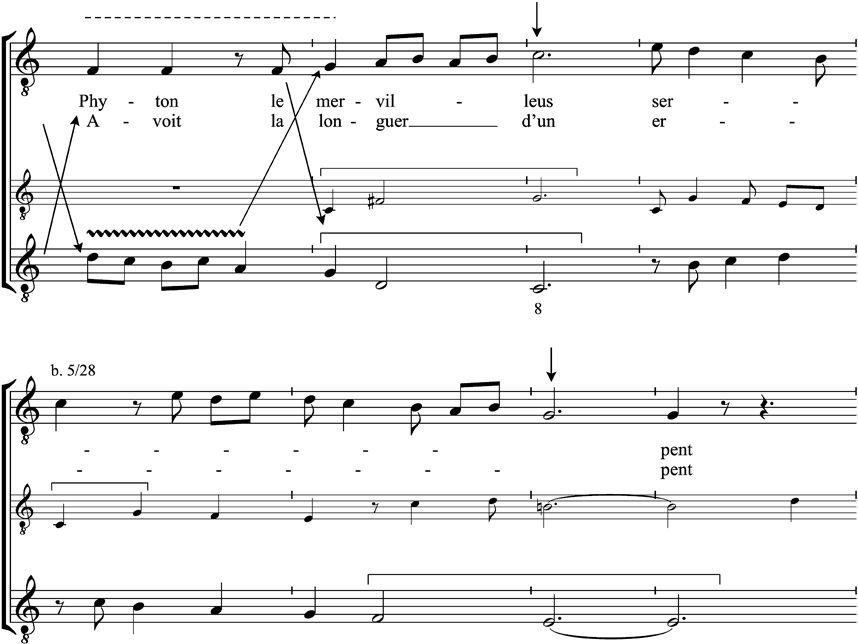
Balade 38 opens with similar sonorities to Balade 27 (the dyad of a fifth between F and c, ornamented with a d), although because the word ‘serpent’ occurs at the end of the first line of text in this poem, the evocative melisma descent on ‘serpent’ is at the end of this musical phrase (unlike ‘vipere’, where the melisma occurs mid-phrase) (see Example 3). In Balade 38, the melisma traverses a narrower interval of a sixth (e down to G), rather than the octave descent of Balade 27. The tenor and cantus voice settle on an imperfect consonance of a third for almost two breves with a G in the cantus and third below on E in the tenor at breves 7–8. The resolution to f only occurs at breve 9. This same uneasy ‘settling’ also occurred in Balade 27 on the same imperfect consonance of E–G (see Example 1 at breve 4). At the opening of Balade 38, the tenor voice begins above the cantus singing a motif (marked with a wavy line in Example 3) that is used as decorative figure prominently throughout the balade (and most often stated in a register that travels above the cantus).Footnote 28
Balade 38, breves 1–8 (24–31)
Three beasts: viper, scorpion, basilisk
While the first stanza of Balade 38 describes a lone beast – the serpent – in the first stanza of Balade 27 Machaut associates three terrifying beasts with the lady. Above we have described some of the associations the pairing of woman and serpent may have brought to the mind of the medieval listener. But perhaps the most immediate source of the imagery for the first stanza of Balade 27, and the one that allows the balade to be interpreted most immediately on its own terms, is the medieval bestiary, where the beast becomes the basis for an allegorical teaching. Two traditions are important here, the Latin bestiaries, which most often derived their source material from the Physiologus and Isidore's Etymologiae, and the courtly bestiaries that began to circulate in the French vernacular from about the twelfth century, the most famous of these being Richard de Fournival's Bestiaire d'amour.
The first beast – a viper – is described as being kept by the lady within her heart; it inhabits her innermost being, perhaps with her consent, as the phrasing ‘the lady keeps’ suggests. The Middle Ages knew the viper as an especially vicious serpent, and famed for the savageness of its mating, described here by Isidore of Seville:
The viper is so named because it is born through force (vi parere), for when their mother's womb is groaning to deliver, the offspring, not waiting for nature's suitable time gnaw at and forcibly tear open their mother's sides, causing her death…. It is said the male spits his seed into the mouth of the female viper, and she, turned from the passion of lust to rage, bites off the head of the male that is in her mouth. Thus it happens that each parent dies; the male when they mate and the female when she gives birth.Footnote 29
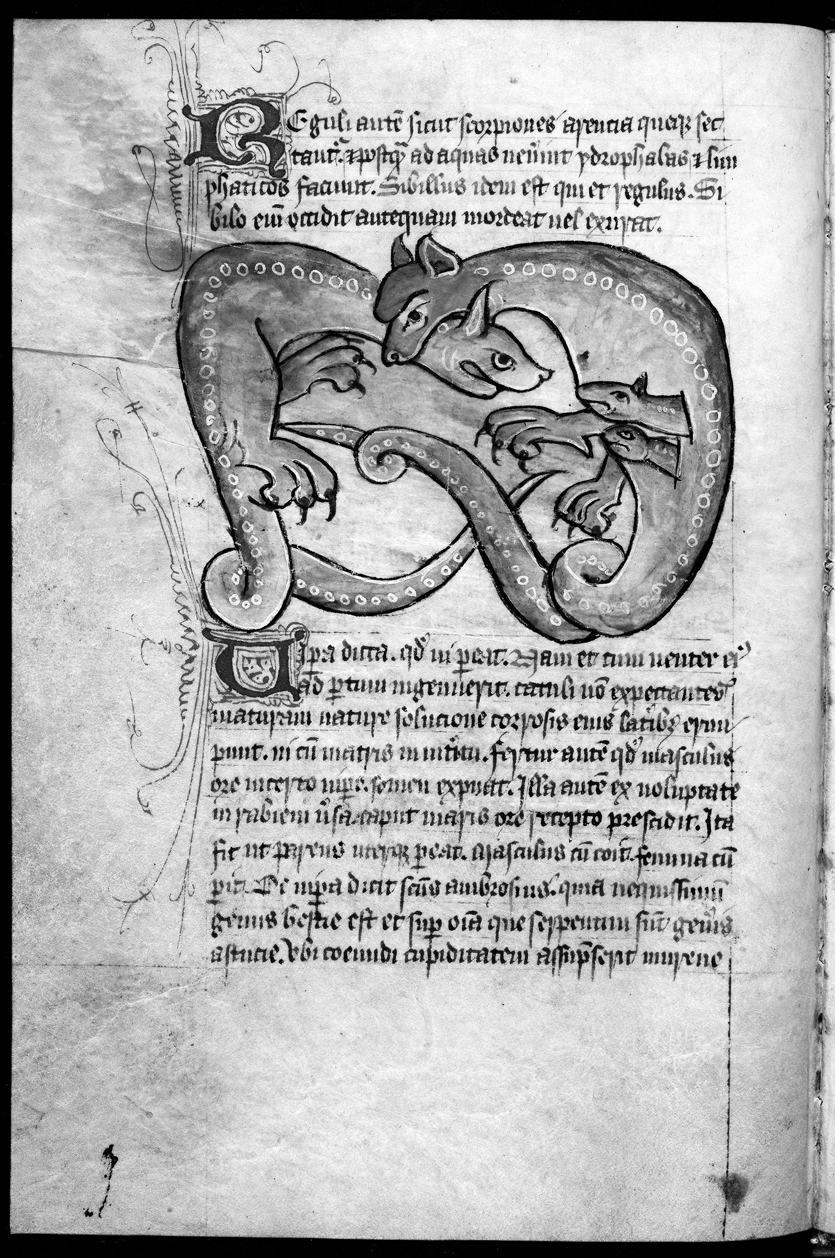
Figure 3 shows an illustration of the mating of the male and female vipers.
The mating and birth of the viper. Copenhagen, Kongelige Bibliotek, GKS 1633 4°, fol. 51v (c. 1400).
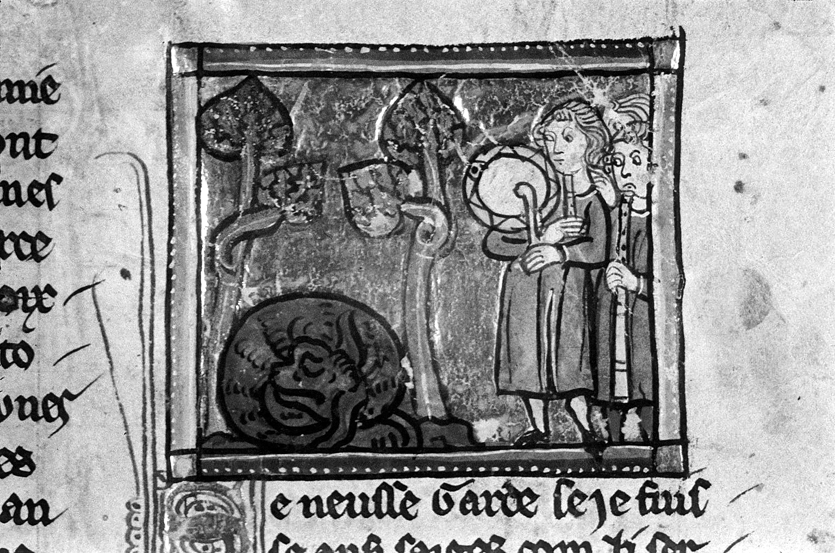
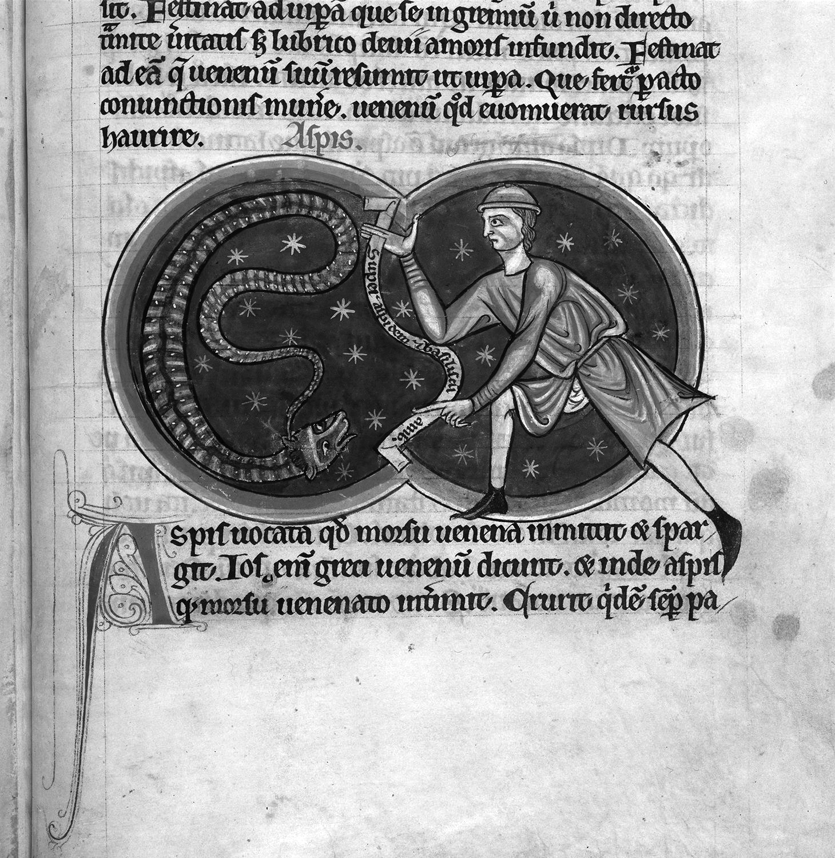
In addition to this allusion to deadly sexual intercourse, the viper in Balade 27 carries further symbolism, for in Machaut's poem not only is the viper settled within his lady's heart, but its tail blocks her ears to the lover's entreaties. Vipers have no external ears, and were often understood as a suitable symbol for deafness.Footnote 30 The thirteenth-century bestiary of Pierre of Beauvais tells of the viper who blocks his ear with his tail (Pierre's bestiary is a prose translation of the Physiologus).Footnote 31Figures 4 and 5 are illustrations of the viper blocking its ear to the charms of music in the former, and to biblical verse in the latter:
Cis serpens garde l'abre dont li baume dégoute; ne ja nus hom n'iert hardis qui en ose prendre tant qu'il veille. Et quant on vielt aler a l'arbre por du baume avoir, si convient il que on l'endorme anchois que on i ose adeser. Et li veneor portent estrumens avec els, de mainte manière, et les font soner por lui endormir; et tantôt qu'il ot le son, il ne li plait ben, il a tant de sens de sa nature meisme que il estoupe l'une de ses oreilles del bout de sa keue, et l'autre front tant à la tere que il l'a emplie tote de boe. Et quant il est ensi asordis, si n'a garde que on l'endorme; car il ne peut oïr la vois de l'encanteor qui le velt endormir.Footnote 32
Asp blocks its ear to the musicians, from Fournival, Bestiare d'Amour. Oxford, Bodleian Library, MS Douce 308, fol. 92r.
The asp blocks its ears to the Psalm verse (Ps. 90 [Vulgate], v. 13). British Library, Harley MS 4751, fol. 61r.
This serpent guards the tree from which the balsam drips down; I have never seen anyone bold enough to dare to take what they so desire from it. And if one wanted to go to the tree to take the balm, it [the serpent] would have to be asleep, otherwise you would not dare to approach it. And so those hunting [the balsam] carry instruments with them, of various kinds, and play them to put the serpent to sleep. And as soon as the serpent hears the sound, this displeases it, and its very nature gives it the idea to stop up one of its ears with the butt of its tail, and to fill the other with mud from the ground. And since it is deafened in this way, it prevents itself being sent to sleep because it can no longer hear the voice of the singer who wants to lull it to sleep.
Pierre's phrase is almost identical to line 2 of Balade 27: ‘il estoupe l'une de ses oreilles del bout de sa keue’ (Pierre) / ‘Qui estoupe de sa queue s'oreille’ (B27). Jeanette Beer suggests that Richard of Fournival probably knew Pierre's bestiary, and Richard indeed repeats this same story of the asp (with a twist) in his Bestiaire d'Amour.Footnote 33Figure 4 is an illustration from the transmission of his work in the manuscript Oxford, Bodleian Library, Douce 308 – a manuscript, whose production, thanks to the research gathered in the recent volume on the manuscript edited by Nancy Regalado and Mireille Chazan, has now been situated in the region of Metz around 1312.Footnote 34 Fournival's Bestiaire d'Amour (written in the mid-thirteenth century) fuses traditional bestiary lore with courtly love literature.Footnote 35 In it, the lover uses the exempla of animals to illustrate the various behaviours and actions of women and men in love (and so, not unlike these balades). In the example of the viper, Fournival's lover wishes that he too had acted like the viper, and had blocked up his ears, so that he would not have been lured and led astray by his beloved's voice, which he likens to a ‘siren's song’.Footnote 36 There are resonances with Scripture in this story: Psalm 57 (Vulgate), verses 4–6, advises (emphasis mine): ‘The wicked are alienated from the womb; they have gone astray from the womb: they have spoken false things. Their madness is according to the likeness of a serpent: like the deaf asp that stoppeth her ears: Which will not hear the voice of the charmers; nor of the wizard that charmeth wisely’ (‘Alienati sunt peccatores a vulva, erraverunt ab utero, locuti sunt falsa. Furor illis secundum similitudinem serpentis sicut aspidis surdae et obturantis aures suas. Quae non exaudiet vocem incantantium et venefici incantantis sapienter’).Footnote 37 The lover's entreaties to the lady in Balade 27 are made through his words, but also directly through his music and the power of his voice, but they are beside the point if they fall on deaf ears. The long decorative melismas of breves 17–30, which fall on the word ‘oreille’ (‘ear’), are perhaps a representation of the traditional power of song and melody to move the soul (the poet/composer as enchanter), but here are a wasted effort, as the lady can hear nothing.Footnote 38
The scorpion, Machaut's second beast in Balade 27, lies unsleeping in the mouth of the lady (‘et en sa bouche ne dort l'escorpion’). The most common characteristic ascribed to the scorpion is its deceitful nature; since its sting is in its tail, it always stings from behind. For medieval Christians, the scorpion was a symbol of the treachery of Judas, and of false, traitorous behaviour. In the Book of the Apocalypse, the locusts have human faces, women's hair, and tails like scorpions. The sting they inflict does not kill immediately but causes its victims to suffer for five months before they succumb to the poison. During this time ‘these people will seek death but will not find it, and they will long to die but death will escape them’ (Revelation 9: 3–10) (not unlike the lover's longing and desire for death).Footnote 39 The Franciscan mystic Ubertino da Casale, commenting on this particular passage from the Apocalypse, elaborates further on the scorpion's nature and appearance, with its agreeable (seductive, alluring) face:
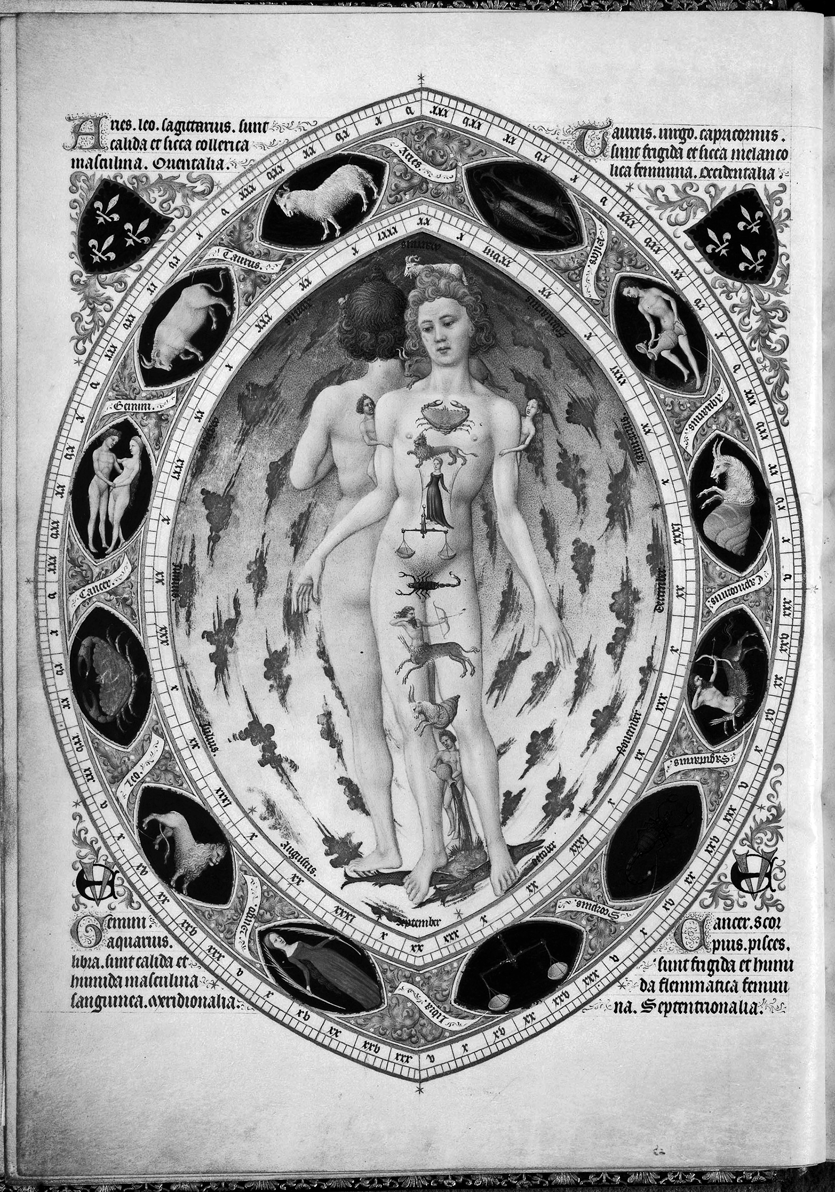
Like the serpent in the Garden of Eden, the scorpion was often described in texts and depicted in medieval art with a woman's face; for example, in the Middle English Ancrene Wisse, the scorpion-like beast has woman's face, and was understood as a symbol of lechery.Footnote 41 Astrological texts employ the scorpion as one of twelve animal symbols for the signs of the zodiac: each sign governs a region of the body, with the scorpion governing the genitals.Footnote 42 The illustration in Figure 6, an example of the ‘Zodiac man’ genre of illustration from the Très Riches Heures of Jean de Berry, places a scorpion over the genitals of the Zodiac man.Footnote 43
Zodiac man. Très Riches Heures of Jean de Berry. Chantilly, Musée Condé, MS 65, fol. 14v (15th c.).
Machaut's third beast, the basilisk, was the most terrifying of medieval monsters since it had the power to cause death with a single glance.Footnote 44 In Machaut's poem the basilisk is in the lady's sweet (!) look (‘Un basilique a en son doulz regart’). The bestiaries describe the basilisk as killing every living thing it passed, causing trees to wither, foliage to burn, and fruit to rot. Every animal in its wake was left writhing in agony. Pliny describes the basilisk in his Natural History:
When it hisses, all the other serpents fly from it: and it does not advance its body, like the others, by a succession of folds, but moves along upright and erect upon the middle. It destroys all shrubs, not only by its contact, but those even that it has breathed upon; it burns up all the grass too, and breaks the stones, so tremendous is its noxious influence.Footnote 45
Medieval bestiaries (including Pierre of Beauvais) relate that the basilisk – a small creature with the upper body of a cock, tail of a snake, and bat-like wings – was generated by the fertilisation by toads of eggs that were laid by old cocks.Footnote 46 Thus the basilisk emerges as a result of an out-of-control hybridisation (crossing both gender and species) that was a fascination of the later Middle Ages. There are thus two levels of association of the basilisk with the lady in Balade 27: the monstrous (in its hybridity) and the deadly. A chimerical monster is in her sweet glance, and will kill.Footnote 47 This deadly and poisonous glance is also understood in direct opposition to the ‘sweet look’ that is the first move in the game of courtly love: the sweet glance exchanged between lady and lover.Footnote 48
In the first stanza of Balade 27, Machaut sets up parallelisms between the beloved's refusal and three of the very worst medieval beasts: the viper, the scorpion and the basilisk. These three beasts mirror the three failed methods of sense communication between the lover and his lady: her deaf ears, her poisonous mouth and her deathly look. The beasts all reside within the lady's interior: she keeps a viper coiled around her heart, a scorpion lies awake in her mouth, and there is a basilisk emitting its poison from her eyes. That these beastly forms exist within the lady implies that her very humanity is in peril. Machaut's description of the beloved's rotten interior, contrasted with her beautiful and sweet (and thus lying and false) exterior, is reminiscent of his descriptions of Lady Fortune in Balade 22, where Fortune is as ‘a monster clothed outside with happiness, [yet] filled with misery’ (‘cest .i. monstre envolope de bon eur plein de maleurte’); and in Motet 8, where she is described as ‘dung wrapped in a fine covering, brilliant without but garbage within. She is an idol with a false face’ (‘C'est fiens couvers de riche couverture, qui dehors luist et dedens est ordure. Une ydole est de fausse portraiture’).Footnote 49 Fortune and Machaut's lady of Balade 27 trade in despair, and turn deaf ears to all entreaties.Footnote 50
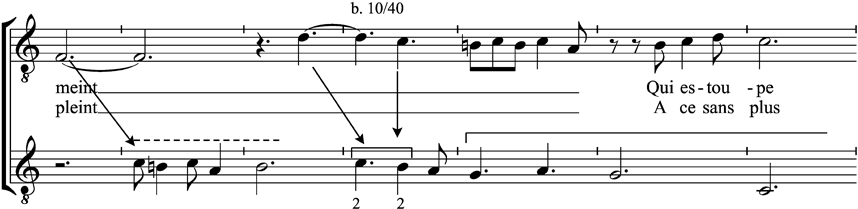
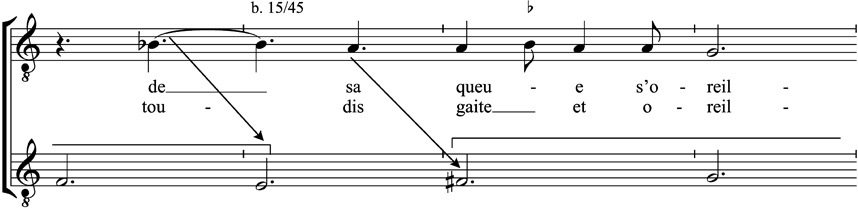
As discussed above, the viper in Balade 27 serves the function of blocking the lady's ears. In the musical setting, Machaut frames the passage that sets the text ‘qui estoupe de sa queue s'oreille’ (‘which, with its tail, stops up her ear’) with passages that exploit both dissonance and suspension (see Examples 4 and 5).Footnote 51Example 4 shows the cantus holding a d for a breve across and into breve 10/40 of the A section, at which moment the tenor enters with a dissonance of a second below the cantus. The tenor and cantus then descend one pitch lower, which creates parallel seconds between the two voices. This tension does not resolve until the octave c/C at breve 13/43. But this release is short-lived, as it is immediately followed at breve 15/45 with a passage that feels even more jarring, when the voices trade off in a diagonal motion of parallel fourths, along with the diminished fifth between the notated b♭ in the cantus held for a breve across breve 15/45 with an E in the tenor (Example 5).Footnote 52
Balade 27, breves 7–13 (37–43)
Balade 27, breves 14–17 (44–7)
It is worth stepping back at this moment to consider the text-setting and overall position of this most uneasy moment. Within the A-clos section (that is, the repeat of this music for the second couplet of each stanza), this moment of dissonance and suspension at breve 45 (the diminished fifth) marks the exact mid-point of the musical setting, which, as mentioned earlier, comprises a total duration of ninety breves. Within the context of the complete poem consisting of three stanzas, the mid-point of the entire musical performance at breve 45 of the second (middle) stanza coincides with the word ‘Refus’.Footnote 53 Furthermore, there are 231 syllables in the entire poem and the word ‘Refus’ encompasses syllables 112–13, which is just prior to the exact textual mid-point at syllables 115–16). The prolonged dissonances emphasising the introduction of the allegorical character ‘Refus’ at the composition's exact mid-point is quite striking: this privileging of ‘Refus’ will be returned to later in this essay.
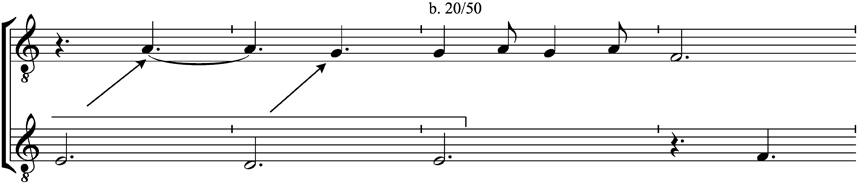
To continue: at breve 18/28, this diagonal exchange of breve suspensions is switched and now begins in the tenor voice, echoed a fourth above in the cantus (Example 6). In all three passages, each voice hears what the other voice is doing, but does not respond in time, and this results in these series of suspensions and dissonances. It seems to depict the phenomenon of hearing but not listening, being deaf and responding too late. These blocks of slowly moving suspended (and sometimes very dissonant) sonorities are followed at breve 20/50 with a more formulaic melismatic passage, the last six breves of which (at breve 25/55), following convention, correspond to the melodic material that also closes the B section (breves 85–90). These melismatic codas make extensive use of a particular melodic motif (see Example 7) that is featured throughout the balade: for example, the opening ‘vipere’ melisma manipulates this motif (cf. Example 1). The overall effect is one of the contrast between the flow of these kinds of conventionally ‘musical’ passages versus the passages that move in staggered blocks of suspended sonorities (that is, between flow and block). If we hear these melismatic, vocalised passages as the musical entreaties of the lover to the lady (his Orpheus moment), then she appreciates nothing of them, as her ears have been blocked by the viper.
Balade 27, breves 18–21 (48–51)
Melodic motif used in Balade 27

For the most part, Machaut forsakes melismas in the ‘B’ section of Balade 27, which is more syllabic than the A section: the sixty breves of the two A sections added together (A ouvert+A clos) convey four lines of text, whereas thirty breves of the B section convey roughly the same amount of text, that is, four lines. The viper is the focus of the entire A section in the first stanza; in the B section Machaut introduces the two other beasts (scorpion, basilisk). When the cantus sings the text about the scorpion at the top of its range, it creates a dramatic contrast as it descends for the setting of ‘basilique’. This passage was mentioned earlier (see Example 2): the cantus part descends into its lowest range, and the cantus and tenor exchange register and their voices cross on this word. The ‘basilique’ is declaimed in sharp relief to the more conventional and sweeter setting that follows for ‘en son doulz regart’ (‘in her sweet look’). The irony is unmistakable, and the voice-crossing serves to emphasise the incongruity of the monstrous basilisk exuding poisonous vapours from within the sweet glance of the lady. In the third stanza, this musical moment sets the word ‘Refus’: an important central concept in this balade (see Example 2).
One more way in which Machaut's music highlights the semantics of the text at this point is through his manipulation of text-setting conventions. Lawrence Earp, following the example of Graham Boone's work with Dufay, has found that Machaut, like Dufay, manipulated certain conventional ways of setting chanson texts to emphasise declamation. When Machaut does not cadence at the fourth syllable as expected, this elision serves to place a declamatory accent on this fourth syllable (or the word of which it is a part).Footnote 54 For example: in Balade 27, on lines 2, 4, 5 and 6, Machaut cadences conventionally on each line's fourth syllable (and on the second syllable for the shortened line 5). But for lines 1 (vi-pere), 3 (n'o-ie), 7 (ba-si-lique) and 8 (mort) the expected cadence is elided, and each time we find that this syllable is set to a sonority encompassing the pitches E–G or G–e (an imperfect consonance realised as either as a third or sixth). These three moments (as ‘vipere’ and ‘noie’ are set to the same music) emerge as three structurally significant points in the balade: the initial tension of the opening ‘vipere’ moment, its recapitulation at ‘basilique’ and the eventual resolution with ‘mort’ (‘death’).
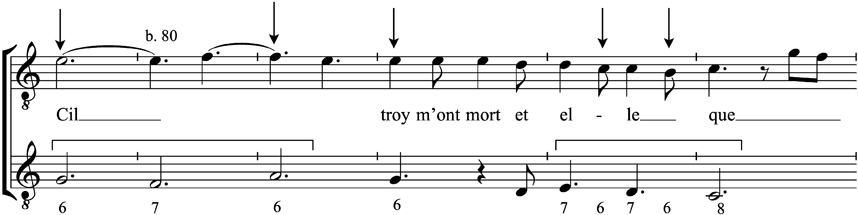
The moment at ‘mort’ is perhaps the most sonorous moment of the song (see Example 8). The full text of this passage is the refrain text: ‘Cil troy m'ont mort et elle que Dieus gart’ (‘These three and she – may God protect her – have killed me’). It recalls those slowly suspended dissonances of the A section, but the effect here with the parallel imperfect consonances of the sixths resolving the parallel sevenths is a final luxuriant resolution at the octave at breve 84 immediately preceding the conventional cadential melisma.
Refrain of Balade 27, breves 79–83
The effect is achieved through a multiplicity of techniques: the sinuous parallel motion of interweaving sixths and sevenths; the lengthened duration of the pitches in the cantus; the use of repeated pitches for declamatory effect in the cantus; the elision of the cadence at the fourth syllable (‘mort’) discussed above, and the high register of the cantus part, which lingers on the highest notes of its ambitus in this balade (save for the high g minims that introduce the melismatic codas of the A and B sections).
A beast with many heads: embodiment of the secular vices
In the second stanza of Balade 27, the three beasts that repel the lover are transformed into allegorical personifications of her behaviour, where the viper (her deaf ears) transforms itself into the personified character Desdains (Disdain); the scorpion (her poisonous mouth) becomes the character Refus (Refusal), and the basilisk (her deathly glance) becomes personified as Regart (Look). These characters, in the tradition of the Roman de la rose and Machaut's own narrative dits, are allegorical personifications of courtly vices, and are contrasted with the three personifications of courtly virtues that the lover seeks out (to no avail) in the third stanza: Amours, Loyauté and Pitez (Love, Loyalty and Pity).Footnote 55 In the first stanza, in the refrain text, Machaut refers to the three beasts that have slain him – viper, scorpion, basilisk – but in stanzas 2 and 3, the three (‘cil troy’) who have killed him are the characters Desdains, Refus and Regart, with Refus privileged by its mid-point position in the composition. These transformations and the senses and sense organs that are alluded to in the text may be outlined as follows:

The characters Refus and Desdains are also featured in Balade 38, as the first two of seven courtly vices personified by Machaut in the second stanza of his poem. When the lover seeks mercy of his lady, a serpent fiercer than Python repulses him. In the second stanza we learn that this serpent has seven heads (like the hydra described in medieval bestiaries, or the seven-headed beast of the Apocalypse). The heads of this serpent do not represent the seven deadly sins, however: Machaut recasts them as seven courtly vices: ‘Ce sont Refus, Desdains, Despit, Honté, Paour, Durté, Dangier’ (‘These are Refusal, Disdain, Spite, Shame, Fear, Harshness and Rebuff’). In both balades, then, the monsters of the first stanza are recast as personified courtly characters in the second.
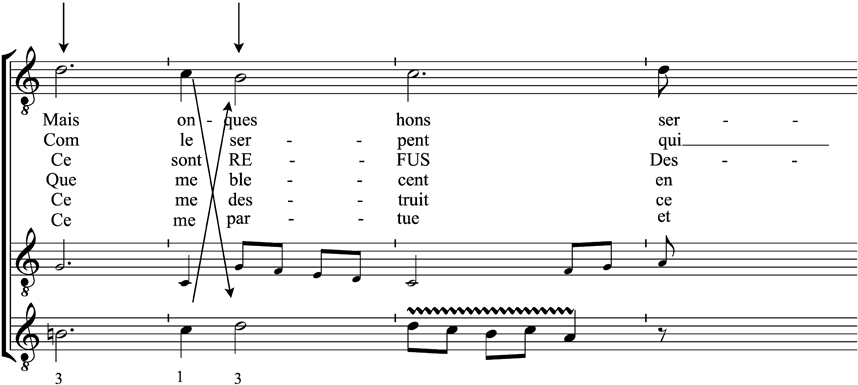
The announcement of the seven courtly vices, and most importantly, the first of them, Refus, is heralded in Balade 38 by several different compositional strategies. This line of the second stanza marks the exact mid-point of the text of the balade, that is, the fifth line of the second stanza, or line 15 of a total of thirty (recall the above discussion for the occurrence of ‘Refus’ at the mid-point of Balade 27). This line also occurs at the mid-point of the musical setting: the music encompasses ninety breves, and because of this balade's musical structure (AABB) this line of poetry occurs at the beginning of the B section of the music, that is, breve 45. The textual declamation slows down considerably here: although syllabically set, the durations lengthen, with the cantus moving in mostly in breves for a duration of three breves. Finally, the cantus and tenor cross briefly at this point, exactly on the word ‘Refus’ (see Example 9, reiterating the sonority of the imperfect consonance (b–d) that they had sung one breve previously, but now with the tenor above the cantus. Example 9 shows this moment and includes the text for all three stanzas of this balade. Each word at this point of voice-crossing is significant to the meaning and interpretation of this poem: ‘onque hons’, ‘serpent’, ‘Refus’, ‘blecent’, ‘destruit’, ‘partue’ (no man, serpent, Refusal, wound, destroy, kill). The melodic motif that marked the opening of the balade, that is, our introduction to Python (marked by a wavy line in the example, and discussed earlier as Example 3), is reiterated at this point.
Balade 38, breves 47–9 (70–2)
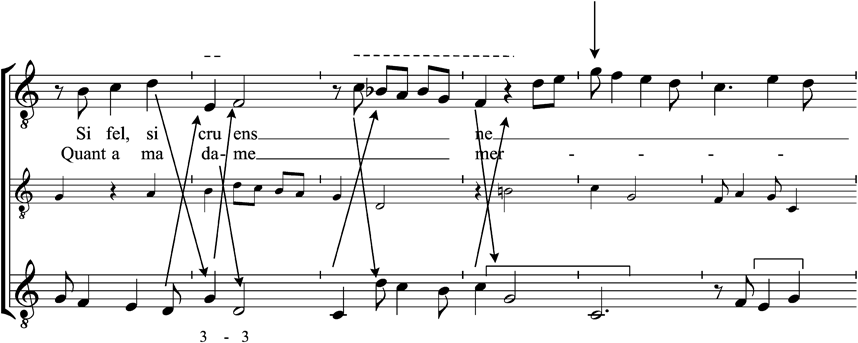
A final moment of semantic parallelism between text and music may be noted here: at breve 54/76 of the B section a striking leap of a seventh occurs on the word ‘cruens’, referring to the Python, and then on the word ‘dame’ in the repeat of this music, again drawing attention to parallels between the serpent and lady (see Example 10). The voices cross, and the cantus and tenor again make the sonority of E–G (an important sonority of irresolution or tension in both of these balades, although held more briefly here than in Balade 27). The cantus and tenor swap voices to continue with parallel thirds to D–F. A brief cadence on c/F at breve 56/78 is somewhat muted because of the effect of the exchanged voices, and clear resolution only achieved at breve 57/79, with the cantus travelling all the way up to the high g that marks the return of the coda music that closes both the A and B sections of this balade.
Balade 38, breves 53–8 (75–80)
Refusal, pride and the fall
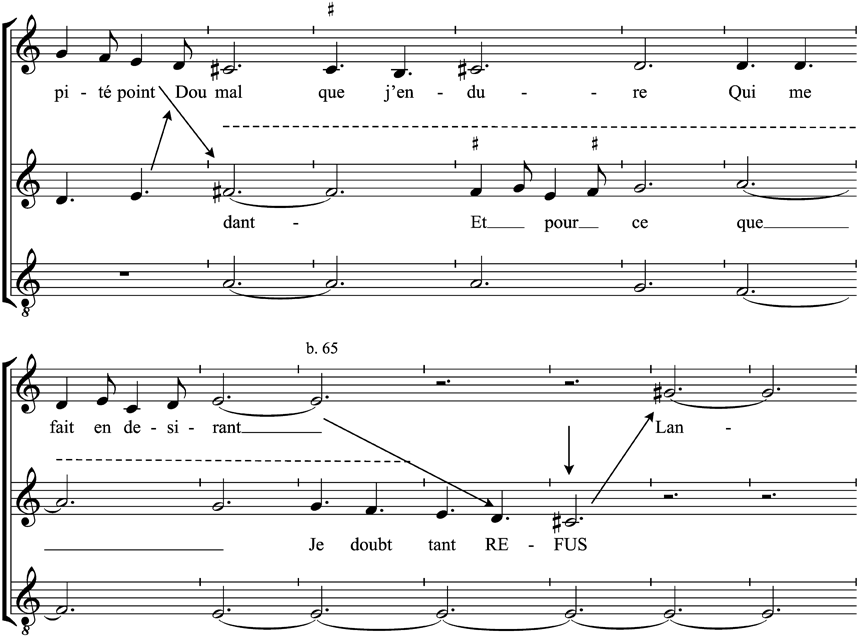
Machaut includes personified secular vices in a number of his motets (M2, M4, M13, M15). The motetus of M2 (Tous corps qui de bien amer/De souspirant/Suspiro) describes the lover's fear of Refus (Refusal) and Dangier (Rebuff). In the poem, Refus is introduced at the beginning of line 8: the exact mid-point syllable of this fourteen-line poem. In the musical setting, the statement of the word ‘Refus’ occurs at breve 67: the exact mid-point of this 134-breve composition (see Example 11). The build-up to the mid-point is preceded by the longest section of voice-crossing in this motet: the motetus voice sings ‘I so much fear Refusal’ ‘je doubt tant Refus’ while the triplum laments the wicked dart (‘male pointure’) she delivered to him, and that ‘she has no pity for the ills I suffer and makes me languish in desire’ (‘Puis que n'a de pité point Dou mal que j'endure, Qui me fait en desirant Languir’).Footnote 56
M2, breves 57–69
The triplum of M4 (De Bon Espoir/Puis qu'en la douce rousée/Speravi) tells of the battle of Bon Espoir, Tres-Dous Souvenir and Tres-Douce Penser (Good Hope, Most Sweet Remembrance and Most Sweet Thought) against Dangier, Durté and Refus (Rebuff, Harshness and Refusal). The reference to Refusal is to ‘proud Refusal’ and occurs at breves 123–5, highlighted in its approach by the longest passage of voice-crossing in this motet (breves 115–25), setting the following text: ‘et que ma dame, à qui je sui rendus, croit à Durté et orguilleus REFUS’ (‘and my lady, to whom I given myself, trusts in Harshness and proud Refusal’).
The triplum of M13 (Tant doucement/Eins que ma dame/Ruina) does not personify ‘refus’, and uses the word as an abstract noun, yet again its text alludes to falseness, treachery and cruelty: ‘Mais pour moy faire mort traire, quant à ce m'eurent mené, com faus traïtour prouvé, furent mi contraire, et d'un refus sans pité, dur et plein de cruaté, D'orguilleus cuer engendré’ (‘But, once they had led me to that point, like false proven traitors they worked against me to cause my death, and with a pitiless refusal, harsh, full of cruelty, and born of a proud heart’).Footnote 57 The traitors who have betrayed the lover in this triplum text are Bel Accueil and Regart (Fair Welcome and Look). In M13 it is ‘Regart’ who is featured at the all-important mid-point and its duplicity is counterpointed in the texts: in the triplum Regart gives the lover smiling assurances, while in the motetus Regart overpowers him with her might and charming smile. Bel Accueil and Regart are described as traitors who have a duplicitous nature: they are enemies who act like friends.Footnote 58
M15 (Amours qui a le pouoir/Faus Samblant m'a deceü/Vidi Dominum) has a long exposition of seven secular virtues – Raison, Droiture, Douçour, Debonnaireté, Franchise, Grace et Pité – and five secular vices – Cruauté, Durté, Refus, Dangiers, Desdains.Footnote 59 In this excerpt from the triplum text of M15, we find the lover resigned to the fact that the seven virtues governed by Love (Amours) hold no sway over the enumerated vices:Footnote 60
These are familiar themes: within a body that from the outside appears adorned with humility dwells a hard heart that encloses vice. The subject of the motetus of Motet 15 is the allegorised character of ‘Faus Semblant’ (False Seeming), who has resonances with Machaut's portrayal of Fortune in many of his works, but also to the beloved as portrayed in Balades 27 and 38 and M13 (and also, as we shall see, to the portrayal of Lucifer in M9): the proud beautiful exterior contradicts the rotten and deceptive and traitorous interior.Footnote 61
One obvious reference for the seven-headed serpent that embodies these courtly vices, and who completely annihilates the lover – wounds him and destroys him – is the dragon of Book 12 of the Apocalypse. And this brings us to Machaut's M9 (Fons totius superbie/O livoris feritas/Fera pessima), which Machaut composed on the tenor Fera pessima (‘Most evil beast’), and which, as Margaret Bent has shown, has links in both subject matter and tenor melody to our last-discussed motet, M15.Footnote 62 Machaut's tenor is from words found twice in Genesis (37:20, 33): ‘Videns Jacobus vestimenta Joseph, scidit vestimenta sua cum fletu, et dixit: Fera pessima devoravit filium meum Joseph’ (‘Jacob, seeing Joseph's clothes, tore his own clothes with weeping, and said: a most evil beast has devoured my son Joseph’), a text that finds its liturgical setting in a Passion Sunday responsory.Footnote 63 In her exegesis of M9, Anne Walters Robertson interprets the motet as a meditation on the sins of pride (‘superbia’) and envy (‘invidia’ or ‘livor’).Footnote 64 Most medieval theologians placed pride and envy at the top of the list of the seven deadly sins.Footnote 65 The triplum of M9 recounts the most famous exemplum of pride – the fall of Satan – and from its first words invokes the sin that caused the fall: ‘Fons totius superbie, Lucifer, et nequicie, qui, mirabilis specie decoratus’ (‘Font of all pride, Lucifer, and all evil, you who, with a marvelous beauty endowed’). The triplum sings these words alone, a single-voice introitus to the motet, and is joined by the motetus and tenor only after these words are uttered.Footnote 66 At this point, the motetus begins singing its invective against envy: ‘O livoris feritas’ (‘O savageness of envy!’). Lucifer's pride caused his fall, and Lucifier's envy of man's goodness, and of God's knowledge, caused man's fall.
In his Summa Theologiae, Thomas Aquinas states the sin of pride was ‘to not submit to a superior when one ought to submit. And so, the first sin of the angel was none other than pride’ (ST q. 63 a. 2).Footnote 67 In a text by Dreux de Hautvilliers, quoted at length by Robertson in reference to M9, we find this description of pride: ‘De homine superbo … nulli defert se cunctis undique prefert’ (‘On the proud man … he defers to no-one, he prefers himself everywhere above all’).Footnote 68 I would suggest that the refusal to submit (or pride) is analogous to the concept of ‘Refus’ that is central (structurally and narratively) to the two balades under discussion here. The lady's refusal is equivalent to the sin of pride and thus comparable to Satan's sin of ‘superbia’.
Now, to Envy. Robertson traces the sources for Machaut's imagery in M9 to several contemporaneous medieval texts probably known to Machaut. One of these, Guillaume de Digulleville's Pelèrinage de la vie humaine, includes this description and personification of Envie: ‘envy was “conceived once by Pride, when Satan, whose daughter [she is] lay by her” … the “wild beast [fera pessima]” … she “spit[s] venom from [her] eyes and poison[s] her neighbors with a single look” … Envy's father told her that she must “show … a fair appearance and a pleasant manner in front and then act like the scorpion, that stings from behind with its tail”’.Footnote 69 Digulleville associates envy both with the serpent that kills with a look (like our basilisk) and the scorpion.Footnote 70
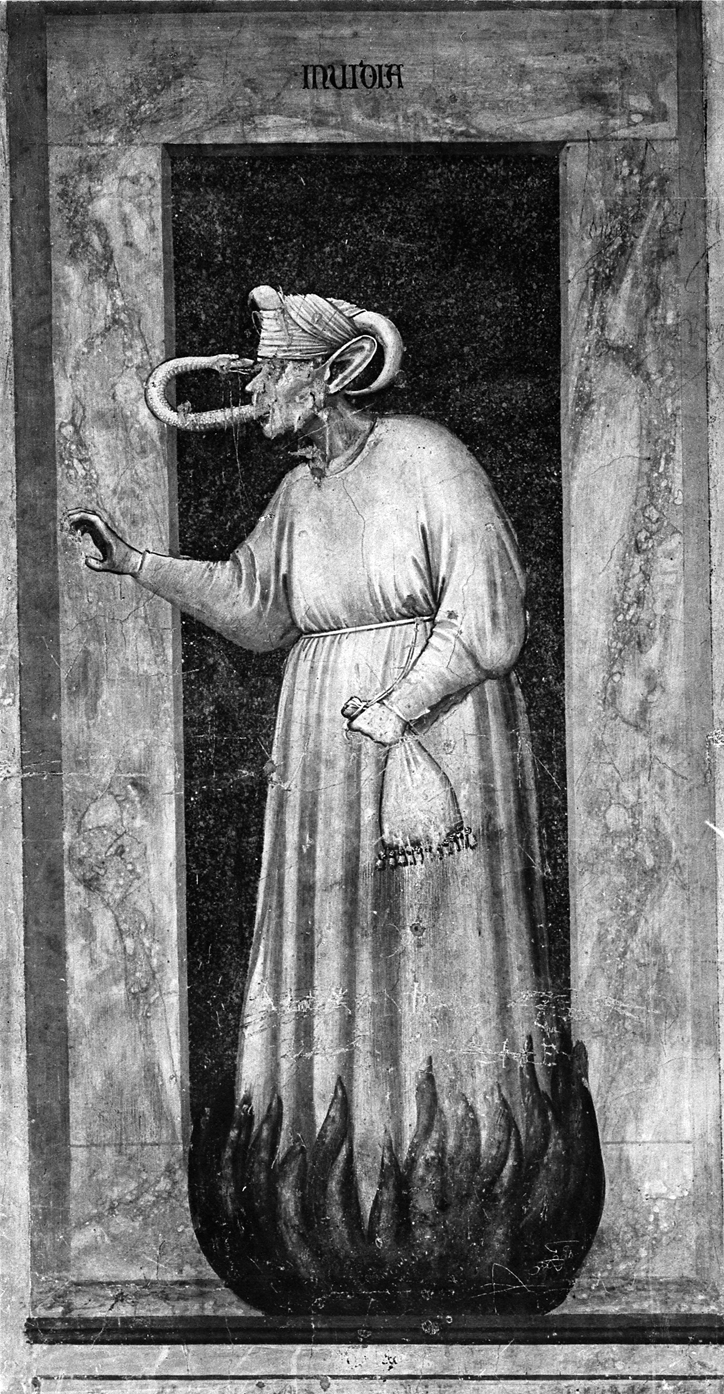
While Digulleville's Envy was beautiful, Ovid's Invidia (Met. 3.760–805), who feasted on the flesh of vipers, reflected her ugly nature in her exterior appearance: ‘pallor in ore sedet, macies in corpore toto. Nusquam recta acies, livent robigine dentes, pectora felle virent, lingua est suffusa veneno’ (‘That face is constantly pallid; her body is totally shriveled; her eyes are both at a squint, while her teeth are decayed and discoloured; her nipples are green with gall and the poison drips from her tongue’) (2.775–8).Footnote 71 The Ovide moralisé uses the word ‘despit’ (the third vice in Balade 38) to describe Envie's poison: ‘plain de venimeuse verdure … la lange a plaine de despis’ (‘full of greenish poison … the tongue full of spite’).Footnote 72 Ovid also describes Invidia's poisonous breath: ‘With the taint of her breath she foully polluted whole peoples, cities and family dwellings’ (‘adflatuque suo populos urbesque domosque polluit’) (Met. 2.793); and also: ‘breathing her noxious poison, she infiltrated her victim's bones and infused the lungs deep down with her pitch-black venom’ (‘inspiratque nocens virus piceumque per ossa dissipat et medio spargit pulmone venenum’) (Met. 2.800–1).Footnote 73 Giotto magnificently captured Envy in a fresco from the early fourteenth century (Figure 7). Note the viper emerging from her mouth.
Invidia as painted by Giotto. Church of S. Maria dell'Arena, Padua.
As we have seen in these examples, Envy was often personified as female. Could the addressee of M9's motetus be similarly gendered as feminine? The full text of Machaut's motetus is as follows:
Machaut highlights the ‘garrulitas’ of envy, who speaks ‘dulcius’ (‘sweetly’).Footnote 75 As Margaret Bent has shown in her analysis of M9, this point in the composition, at the beginning of the second half of the motetus text (‘Retro pungit’), marks a structural join in the motet that is of musical and textual importance. There is a turn in the motetus from the ‘front’ to ‘back’ (from speaking sweetly to puncturing from behind) and ‘high’ to ‘low’ in the triplum (Lucifer's fall from the heights to the depths), and the passage is highlighted with ‘word-puncturing and musically graphic hockets’.Footnote 76 Machaut continues to describe Envy as one who has a false, traitorous appearance, whose real nature lies hidden within (‘latitat interius’). She is like a scorpion, like Judas Iscariot (who betrayed Christ out of envy), with a fair face and a seductive appearance, who stings from behind. We were forewarned of this sort of duplicity in the triplum's introitus, which described Lucifer as endowed with a ‘marvellous beauty’. Lucifer was often characterised as beautiful on the outside but monstrous on the inside. And this embodiment is already familiar to us in Machaut's similar descriptions of the beloved, and Lady Fortune, discussed above.
The connection between Envy and the ‘Evil Eye’ is also important, particularly with respect to the centrality of ‘Regart’ (the basilisk) in Balade 27, and of the ‘look’ in the courtly love exchange. The Latin word ‘invidere’ (‘to envy’) literally means to look at someone (‘videre’ or ‘to see’; ‘in-’ or ‘against’) with an evil intent: the physical manifestation of this emotion is the Evil Eye (‘phthonos’).Footnote 77 In M9 Machaut chose to translate envy as ‘livor’, rather than the more usual ‘invidia’. ‘Livor’ gives a more precise characterisation of envy as embodying the related notions of malice and spitefulness. Envy is not merely an internal turmoil, where one is envious of the situation of another, but rather has a vengeful or vicious action associated with it, like the Evil Eye.Footnote 78
In Balade 38, the third head of the seven-headed monster is Despit: this head is listed after Refus and Desdains (which are also the second and first beasts of Balade 27) and could be analogous with ‘invidia’ or ‘livor’. Since one of the physical actions of Envy is her ability to torture others physically with her evil eye, the third beast of Balade 27 – Basilisk/Regart – is analogous with envy. And so we have the following pairings: ‘livor’ with Despit and ‘invidia’ with Regart. Christian theologians berated Eve – the archetypal envious woman – for her spitefulness, as in this passage from the twelfth-century Fécamp missal (note the Latin ‘livor’ and also the viper): ‘Eve, the mother of the human race, corrupted by the mind of the viper, succumbed to spite, Mary the bearer of the savior of the world, sealed by chastity, threatened his [the viper's] head’ (‘Mater humani generis eva corrupta mente vipereo livori succubit, genetrix salvatoris mundi maria signato pudore caput eius comminuit’).Footnote 79 The mode in which Eve exercised this spite was through her duplicitous eloquence and garrulity.Footnote 80
And what of Disdain (‘Desdains’: the first beast of Balade 27 and the second of Balade 38)? Disdain as an atttribute of behaviour is equated with indifference, snobbery, cruelty, and of setting oneself apart. The stories of Narcissus and Pygmalion, known in the Middle Ages from versions in Ovid's Metamorphoses and the Roman de la Rose, centre on their protagonists' disdain for human touch.Footnote 81 In the Metamorphoses, Ovid describes Narcissus' heart as hard (‘dura’) (Met. 3.354). He, too, is beautiful without, but does not deign to acknowledge the advances of men or women. When Echo finally emerges and throws her arms around him, he responds ‘Hands off! May I die before you enjoy my body’ (Met. 3.389–90) (‘ille fugit fugiensque “manus conplexibus auferant” ait “emoriar, quam sit tibi copia nostri”; rettulit illa nihil nisi “sit tibi copia nostri!”’).Footnote 82 In Machaut's M7, the voice of the motetus is feminine. She compares herself to Narcissus, who did not deign to hear the plea of Echo (‘Qu'onques entendre le depri ne deigna d'Echo’) (lines 8–9). She fears she will die like Narcissus because she too refused her lover. The triplum begins: ‘J'ai tant mon cuer et mon orgueil creü’ (‘I have believed too much in my heart and in my pride’). In the triplum, the central stanza (fifth of nine) begins ‘Now I must pay dearly for my refusal’ (‘Si le m'estuet chierement comparer’). In the Lorris section of the Roman de la Rose, as Kevin Brownlee's analysis of M7 has explored, the Narcissus exemplum is glossed as a warning to ladies not to be obdurate to their lovers.Footnote 83 Lorris writes: ‘Dames, cest essample aprenez, qui vers vos amis mesprenez; car se vox les lessiez morir, Dex le vos savra bien merir’ (‘You lovers, this one's case you should take to heart; for, if you let your loyal sweethearts die, God will know how to give you recompense’).Footnote 84 The Ovide moralisé suggests that Narcissus' pride in his own beauty caused his downfall. He lost the possibility of everlasting life for the sake of a false transitory shadow (‘Qui pert la pardurable gloire / Pour tel faulse ombre transitoire’).Footnote 85 The comparison is to the fallen angel and his pride:
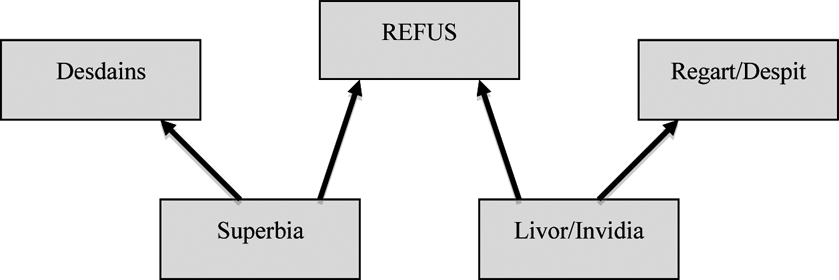
Narcissus, through his refusal of all others (Refus), and his disdain (Desdains) for them, was guilty of the sin of pride. The concepts may be visualised as two intersecting planes, where superbia (orgueil) comprises Desdains and Refus, and livor (Invidia, Despit) encompasses Refus and Regart (see Figure 8).
Deadly sins and courtly vices
The other aspect of the Narcissus exemplum that is relevant to this analysis is the role played by the senses – touch, hearing and sight – in the story. Echo is first condemned to silence for her ‘chattering tongue’ (‘garrula’) (Met. 3.360). Narcissus cannot hear Echo's plaints – in this case, unlike the lady of Balade 27 whose ears have been blocked by the viper, it is not because Narcissus cannot hear, but because Echo has lost her voice (Met. 3.351–406) (or at least the ability to vocalise her thoughts). Narcissus' inability to hear Echo (or any of his admirers) is reminiscent of the story, discussed earlier, of the viper not listening to the musicians who have come to enchant him. Indeed, if we look back at the illustration from Fournival's Bestiaire given in Figure 4, the disdain on the viper's face is evident.Footnote 87 In Balade 27, the viper is associated in the first stanza with hearing and in the second with Disdain. The Narcissus story also references sight: when Narcissus fell in love with his own reflection, Ovid moralises that ‘gazing proved his demise’ (‘perque oculos perit ipse suos’) (Met. 3.440).
I will close with a final, and perhaps somewhat speculative, point on the exegesis of these balades. Psalm 90 (Vulgate), verse 13, lists the beasts over which the Lord will triumph. This is only biblical passage that uses the specific word ‘basiliscus’:Footnote 88
Super aspidem, et basiliscum ambulabis: et conculcabis leonem et draconem.
You will walk over the asp and the basilisk, and you will trample the lion and the dragon.
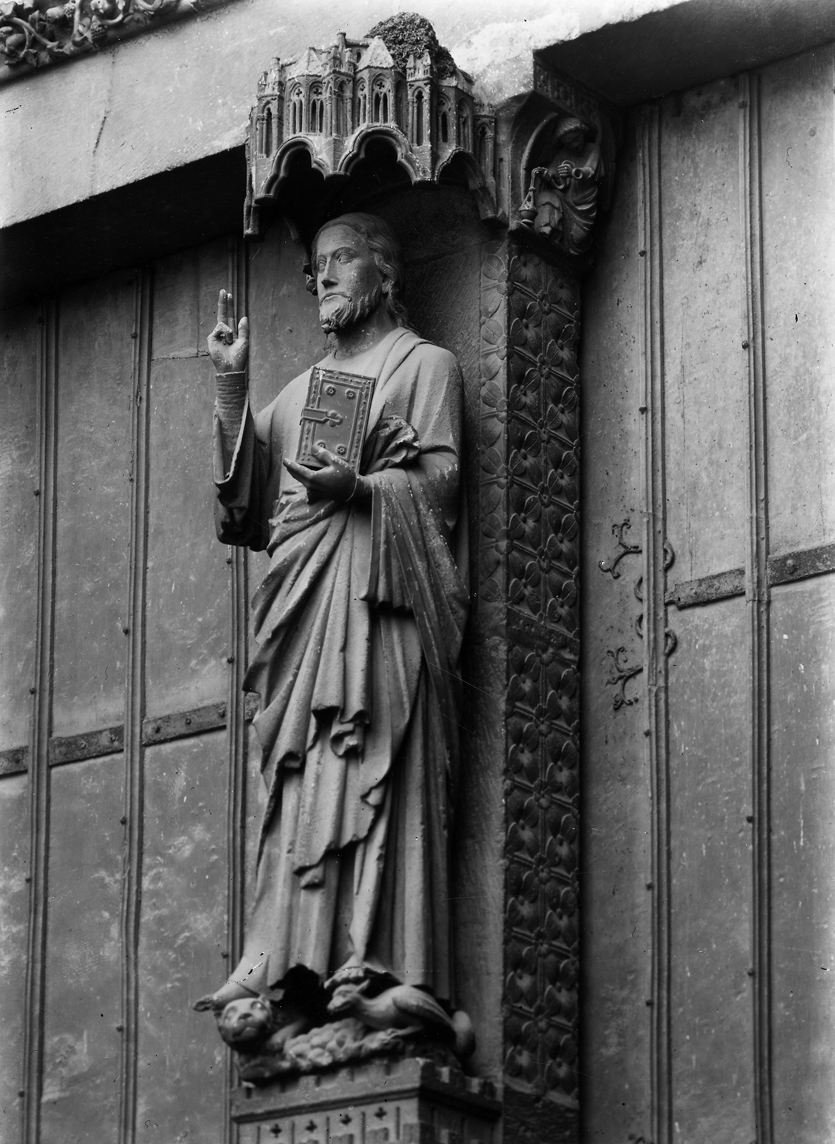
Psalm 90, also known as the Psalm of Protection, was traditionally invoked in times of great hardship (all the propers for the first Sunday in Lent, for example, are taken from Psalm 90).Footnote 89 This particular verse was the origin for the iconography of Christ trampling on the beasts. A famous example of this iconography from the later Middle Ages is the thirteenth-century sculpture of Christ known as the Beau Dieu, on the trumeau of the west façade of Amiens Cathedral, which depicts the four animals beneath Christ's feet (Figure 9).Footnote 90
‘Beau Dieu’ (Christ) trampling the beasts. Trumeau of the west façade of Amiens Cathedral.
In the Temptation of Christ in the Desert episode in the New Testament, the Devil quotes Psalm 90, verses 11–12 (‘for it is written, He shall give his angels charge concerning thee: and in [their] hands they shall bear thee up, lest at any time thou dash thy foot against a stone’ [Matthew 4: 6]) to Jesus, but he breaks off before verse 13, perhaps unwilling to suggest his eventual fate. Bernard of Clairvaux wrote seventeen Lenten sermons on this psalm. In his sermon on verse 13, Bernard says the beasts of verse 13 show the different ways the Devil can do the soul harm through the senses: the asp through its bite (touch), the basilisk through its sight, the lion through its growl (hearing), and the dragon through its breath (smell). He makes the connection between the asp of Psalm 90 and the asp/viper of Psalm 57 (the same psalm discussed above, in which the viper blocks his own ears): ‘Quomodo non illud aspis erat: illa utique de Psalmo aspis surda, et obturans aures suas, ne vocem audiat incantantis? (Ps. 57: 5)’.Footnote 91 The medieval artist of Figure 5 made this same connection: observe the scroll in the hands of the enchanter; it is the incipit of Psalm 90, verse 13 to which the viper blocks his ears.
Bernard warns his brethren: ‘Nolite, obsecro, fratres, nolite obturare aures, nolite aliquando obdurare corda vestra’ (‘Do not, brothers, do not block your ears; do not in any way harden your hearts’).Footnote 92 In this same sermon, Bernard interprets the basilisk as a symbol of envy, and of how we must triumph over it in this life:
At basiliscus, ut aiunt, venenum in oculo gerit, pessimum animal, et prae omnibus exsecrabile. Nosse cupis oculum venenatum, oculum nequam, oculum fascinantem? Invidiam cogitato. Quid vero invidere, nisi malum videre est? Si non esset ille basiliscus, nunquam per ejus invidiam mors intrasset in orbem terrarum. Vae homini misero, quod invidum non praevidit! Superemus et vitium hoc, dum adhuc vivimus, si post mortem volumus ministrum tantae nequitiae non timere.
Since the basilisk, they say, emits its poison from its eyes, worst animal, and accursed above all. Do you not know you desire the poisonous eye, the wicked eye, the evil eye? It is envy of which I am thinking. If it were not for this basilisk, through its envy, death would have never have become part of the earthly world. Alas, I pity the man who does not see beyond this envy. We must conquer this vice, while we live, so that after death, we would not fear this accomplice to evil.Footnote 93
Is it conceivable that the identical breve length of both of these balades (ninety breves) references this psalm number? One might not want to go this far – we do not know if Machaut knew this psalm by this specific number, as medieval numberings of the psalms could differ – but regardless of whether Machaut devised a specific formal structure of numerological significance and allusion, the thematic content of these balades surely contains intertextual references to this psalm. Perhaps both of these compositions (and with echoes in some of Machaut's other compositions explored here) are parallel expressions of the desire of the lover/Christ to vanquish the beloved/Devil (the beasts who reside within our senses), who both resists and is the embodiment of the vice of refusal/pride. The layered interpretation of these compositions suggests an intersection of references to both secular and sacred realms, and resists confinement in, or privileging of, one realm over the other.Footnote 94 Machaut's beloved – beautiful, seductive and alluring in outward appearance, but rotten and monstrous within – physically tortures the lover through her proud and disdainful refusal of his advances, and through her look (‘Regart’), which has been transformed from the courtly lady's ‘sweet look’ into a truly beastly ‘evil eye’.
APPENDIX 1
Balade 27
APPENDIX 2
Balade 38