

Introduction
Every year, the Charities Aid Foundation publishes the results of the ‘World Giving Index’ (WGI), which measures three different forms of giving (money, time and acts of kindness) and provides a straightforward picture of charitable behavior across the globe. Italy ranks only 68th in the WGI: the participation index in charitable giving in the country is 35%, meaning that only one out of three people donated money to any charity, including church, in the last month (Charity Aids Foundation, 2018).
Insights from behavioral economics can help us to understand and improve how people donate and how much they give. This work builds on a growing body of research on charitable giving. The scope of our research is to provide further evidence of the effects of appeals and donation menus on fundraising campaigns. When charities plead for a contribution, a set of possible amounts might be presented: these donation menus can greatly affect, in both directions, compliance rates and average amounts donated. Suggesting high donations might increase the average contribution but decrease engagement. Conversely, suggesting small donations might decrease the average offering but increase engagement. That being the case, the purpose of this research is to further investigate whether different donation menus can influence redemption scales and contribution sizes, and by how much.
We report results of a large randomized controlled trial (RCT) in which a charity based in Italy solicited over 150,000 of its donors by direct mailing. Recipients were randomly assigned to a control group and three treatments: in the first treatment, we included a donation menu suggesting more than the average past donation; in the second treatment, we increased the options on the menu; and in the third treatment, we included additional explanations on how to donate (but no donation menu). Contrary to most of the results found in the previous literature, we provide evidence that higher donation options led to significantly higher average donation amounts compared to the control treatment, but did not significantly affect the probability of donation. On the other hand, introducing additional explanations (hereafter, ‘reminders’ on how to make a payment) significantly increased the probability of donation, but did not have a significant impact on donation amounts. Lastly, we investigated whether the effectiveness of treatments is influenced by individual heterogeneity. Our study is the first of its kind to be carried out in Italy, contributing to country-specific replications of previous research.
Related research and conceptual framework
Charitable giving is an active part of behavioral and experimental economics research and has flourished in the past ten years, with the focus on fundraising recently reaching a fever-pitch (Andreoni, Reference Andreoni2016). This paper contributes to the debate over the advisability for public economists to help fundraisers increase donations (Auerbach et al., Reference Auerbach, Chetty, Feldstein and Saez2013), as well as how reliable behavioral insights are in context. In particular, we focus on how donations to charities are influenced by reference points suggested to individuals through donation menus. While the pertaining marketing and business literature is that of reference pricing and scale design, for behavioral and experimental economics it is that of the anchoring effect (Tversky & Kahneman, Reference Tversky and Kahneman1974; for a comprehensive literature review, see Furnham & Boo, Reference Furnham and Boo2011).
In charitable fundraising, asking for a specific amount to be donated (‘anchoring’ the donor to a set sum) is a common yet not fully disentangled matter. The first systematic assessment of donation menus was done by Weyant and Smith (Reference Weyant and Smith1987). Their work became seminal, even if it was, in some respects, inconclusive due to low response rates. Their field experiments, using direct mailing and controlling for different menu scales serving as exogenous reference points, showed a significant increase in donations.
More recently, three field experiments have taken further steps toward understanding the impacts and limits of the ‘power of asking’. First, De Bruyn and Prokopec (Reference De Bruyn and Prokopec2013) ran a large field experiment on donation menus. Manipulating the first amount on menus and the rate of increase of the other amounts, they found that anchoring had a positive effect on donations, but the donation likelihood was, in some instances, negatively affected. Second, Edwards and List (Reference Edwards and List2014) ran a field experiment in which they prompted prospective donors with a $20 suggestion. This amount turned out to be lower than the average baseline donation, which translated into an increase in the number of subjects donating, as well as a strong treatment effect with donations moving toward the suggested amount. The authors also hypothesized that suggesting higher donation amounts might reduce the likelihood of donation, as is supported by the findings of Warwick (Reference Warwick2003) and Weyant and Smith (Reference Weyant and Smith1987). Third, Goswami and Urminsky (Reference Goswami and Urminsky2016) investigated how defaults (preselecting one option in the menu) affect donations. They found three main effects: a lower-bar effect, in which defaulting a low amount increases the donation likelihood; a scale-back effect, in which low defaults reduce average donations; and a default-distraction effect, in which the mere presence of defaults reduces the influence of external cues, such as positive charity information.
Finally, we would like to clarify that, since the publication of Richard Thaler and Cass Sunstein's book Nudge: Improving Decisions about Health, Wealth and Happiness (Thaler & Sunstein, Reference Thaler and Sunstein2008), the design and contextualization of options has been given the byname of ‘choice architecture’. Therefore, much of the previous experimentation would be classified today as a nudge, but it was not originally published under this term. Authors published their findings using terms such as the effects of appeals scales or price scales, attraction effects and reference price tests. Nevertheless, as the nudge approach has become an established tool for policy-makers and practitioners, it would be desirable to include past findings and present research under the current and accepted umbrella of ‘nudging’.
RCT design and participants
In June 2016, driven by the necessity of counteracting the ‘summer drought’ of donations, a large charitable organization supporting cancer research in Italy decided to implement the principles of choice architecture to nudge over 150,000 of its existing donors. The charity explained that the average donation made to the organization was close to €19 and that their aim was to increase both the number of donations and the average amount donated during the summer months in order to increase the total amount collected over the period. The nudge was embedded in a standard paper-based campaign, where each donor received an envelope containing a two-page letter (in Appendix A, an anonymized version of the letter is provided).
For the purpose of the RCT, the second page, hereafter referred as the ‘donation sheet’, consisted of a pre-cut piece of A4 paper divided into two sections: on the left was the call to action and a donation menu (for the menu treatments), while on the right was the postal payment slip. At the back of the donation sheet were illustrated past projects and results funded by donations, as well as a reminder of the other channels for sending donations (namely credit card, direct bank transfer and recurring monthly donations via direct debit orders).
The research team, in close collaboration with the charity, manipulated the donation sheet. The scope of the intervention was to study the impacts of different appeals and menus on donations. This was particularly meaningful for the charity since they had never included any sort of donation menu in past direct mailing campaigns.
In the control treatment, the donation sheet, consistent with past fundraising campaigns, included a plain recall to the main letter and three pictures of people who had benefited in the past from the charity's work and survived cancer, together with a short quote by one of the beneficiaries and his/her first name. The ‘baseline treatment’ (BT) involved 39,909 donors, who were randomly drawn from the pool of trial subjects. The photographs and statements (included and identical in all treatments) did not link the individual to a specific project or initiative of the charity, but rather were general accounts of people who had fought and survived cancer thanks to the charity.
In line with the charity's specifications, two menus were designed and the suggested amounts were discussed and agreed upon by both the charity and the research team.
The first treatment (low or T1), involved 39,890 subjects, and it was identical to BT, except for the addition of a list of three suggested donation amounts.Footnote 1 The suggested amounts were €25, €50 and €100. These numbers were also recalled in a box on the postal payment slip. The amounts, as stated above, were chosen in agreement with the charity, following their indications and requirements. The lower bound menu option (€25) was chosen because it was above the average past donation (€18.91) and a round figure.
The second treatment (high or T2) involved 39,890 subjects and was identical in all aspects to T1, except for higher suggested donation amounts: €50, €100 and €200. In this case, the lower bound menu option was chosen to be double the lower bound option in T1.
Additionally, the charity expressed the desire to test whether a different approach to payment methods could improve redemption rates. As stated above, on the back of the postal payment slip was fine-printed a reminder of the other possible donation methods (namely credit card, direct bank transfer and recurring monthly donations via direct debit orders). However, some methods were omitted: SisalPay (paying the postal slip at newsagents, coffee bars and tobacconists using the infrastructure of a betting and gaming company), YouPay (an app and web portal for paying the postal slip using a credit card) and banking and home banking options using postal slips. In addition, potential donors were not saliently reminded that, in order to donate using the postal payment slip, one had to physically go to the nearest post office.
For the purpose of responding to the specific request of the charity's practitioners, we drew from the Behavioural Insights Team (BIT) nudging approach. The BIT was established in 2010 by the UK government to apply the lessons of behavioral economics and psychology to public policy-making, but has since then moved toward a broader social purpose, helping charities, non-profits and international organizations. The current framework used by the BIT is the EAST framework (make it Easy, Attractive, Social and Timely). This method stems from the behavioral literature, but has been perfected through the BIT's own field experiments and experience. Of the four principles for influencing behavior, we chose the ‘make it easy’ one: small, seemingly trivial details that reduce a task's friction or costs can make the difference between doing something or postponing it, perhaps indefinitely. Conversely, even minor increases in the effort required can be detrimental. The BIT has done extensive research on donation channels (BIT, 2013), also testing default options and prompted choices. Related to our work, interesting results stemmed from another BIT line of research. They used a simple SMS reminder providing instructions on how to declare a business in order to increase company registration in Mexico. They found that adding trivial but salient information on how to register increased declaration rates by 24% (BIT, 2017).
Given the charity's needs and considering the relevant literature, we designed and tested a message that could increase the ease and convenience of donating. This translated into a third treatment. An additional group, consisting or 39,890 donors, was reached by a donation sheet identical to the one of BT, but with a salient reminder on how to donate to the charity. We called this treatment the ‘Easy Payment’ (T3), and it was trivially, yet saliently, stated that in order to use the postal payment slip one had to go to a post office. In addition, all of the available donation methods were listed.
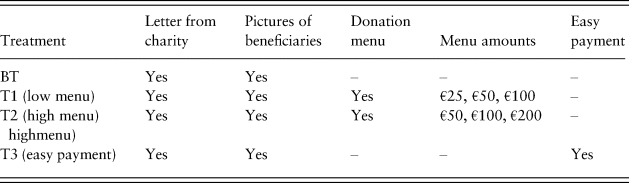
Table 1 summarizes the attributes of each single treatment (in Appendix B, an anonymized version of the donation sheet is provided).
Treatment attributes.

The entire sample consisted of 159,579 subjects, of whom 8081 responded to the call for a summer donation (5.06% overall response rate). Of these, 4143 (51.27%) were female, 3859 (47.75%) were male and the remaining 79 (0.98%) were donors registered as families. Across treatments, the seniority (i.e., how many years the subject had been a benefactor of the charity) was normally distributed, and the average years as a donor was 14.5, with the most senior donors having donated for over 44 years.
Six months after the launch of the campaign, the data were reported back to the research team. The data set included not only the donation amount, but also the response time (i.e., how long it took for the donor to donate after receiving the letter), the number of years the donor has been donating to the charity, the number of past donations, the cumulative sum donated to the charity, the donor's gender and the method of payment.
Behavioral predictions
Our approach to predicting behavior in the RCT assumes that people donate for a variety of reasons (e.g., loyalty to friends or family, support for a social cause, tax benefits), but these can be nudged in order to redirect biases or remove obstacles to action, thus improving the levels of giving (for a comprehensive review on nudges and donor behavior, see Parbhoo et al., Reference Parbhoo, Davis, Reynolds, Piyush, Trewn and Welch2018).
In line with the previous literature, since both donation menus suggest higher amounts than the average donation to the charity (€18.91), we expect to observe a decrease in redemption rates, but an increase in average amounts donated.
Hypothesis 1:
The introduction of a donation menu with options greater than the past average donation should decrease donation likelihood, but increase average donation amount. This effect should be stronger in the high menu compared to the low menu.
This expectation stems from the robustness of the anchoring and reference dependence effects. Fraser et al. (Reference Fraser, Hite and Sauer1988), in a seminal field experiment, observed that response magnitudes can be improved by employing a moderately large but acceptable anchor point request. According to the theory of cognitive reference points, the higher the reference, the greater the donation amount. However, Smith and Berger (Reference Smith and Berger1996) proposed, but did not test, that the magnitude of the anchor would work in different directions: greater suggested donations would yield higher average gifts, while smaller suggested donations would generate higher redemption rates. De Bruyn and Prokopec (Reference De Bruyn and Prokopec2013) reported the results of the first field experiment on the adverse consequences of the anchoring effects on donation likelihood: although anchors increased donation amounts, redemption rates dropped, negatively affecting overall donations.
There is a common saying among fundraisers: ask for too little and you will get what you asked for, ask for too much and you will get nothing (Andreoni, Reference Andreoni2016). This phenomenon is related to the ‘power of the ask’, which has been investigated by Andreoni and Rao (Reference Andreoni and Rao2011). Their research aimed to reconcile prior laboratory findings of subjects exhibiting significant altruism and inequality aversion with real-world behavior, where great levels of inequality are voluntarily counteracted by minimal and insufficient levels of altruism (i.e., charitable giving). The intuition of the authors was that, since giving in the real world occurs in a complex context of social interaction and not in an impersonal setting, the mediation of social cues should be brought back into the laboratory. Social cues and incentives can potentially conceal the altruistic potential of individuals and transform it into real acts of kindness or, alternatively, into selfish behavior.
Using a dictator game and manipulating the possibility of sending a message to the counterpart, Andreoni and Rao (2010) discovered that if no communication – a typical social cue – was allowed, 15% of the endowment was donated, while anytime the recipient spoke, at least 24% of the endowment was passed on. The ‘power of the ask’ experiment also showed that asking for more generally induces greater donations, but with limits. Subjects who asked for more than an equal division of the pie (50% of the endowment) were punished: ‘selfish requests’ led to a mean donation rate that was less than half of the mean in the no-communication condition.
Thanks to the information included in the charity's database, we could also extend the research to some of the individual characteristics of donors. The additional information related to the number of years an individual was an active donor and the total number of donations made during this time. From this information, we inferred the average yearly donation frequency for each donor (number of donations over years as a donor). Generally speaking, donors with a longer history as patrons have been retained by the charity because of overall satisfaction, identification with the cause, a high level of commitment and trust (Sargeant, Reference Sargeant2008). The implication is that mature donors have already given many times in the past and have a stronger internal reference point serving as an anchor. Therefore, we can expect that subjects with a longer donation history would not be affected by the nudge as much as junior donors. In addition, Shang and Croson (Reference Shang and Croson2009) have suggested that social information is more likely to have an effect in ambiguous circumstances, which would be more relevant to inexperienced donors.
Hypothesis 2:
Senior donors and high-frequency donors, holding stronger internal reference points, will be less influenced by donation menus compared to junior donors.
These issues have already been addressed in past studies. For example, Desmet and Feinberg (Reference Desmet and Feinberg2003), De Bruyn and Prokopec (Reference De Bruyn and Prokopec2013) and Lee and Feinberg (Reference Lee and Feinberg2013) looked into donation menus including both internal and external reference points. In particular, Desmet and Feinberg (Reference Desmet and Feinberg2003), retracing the prior literature, hypothesized that donations are based on an internal reference point in relation to the donation menu proposed (external reference point). For example, if a subject intends to donate €20 to the charity (internal reference point) and he or she receives an appeal for €40, they may take one of four possible courses of action in relation to their internal reference point: donate more, donate less, do not donate at all or gift exactly €20.
However, extrapolating internal reference points is not a straightforward exercise in field experiments. Contrary to what happens in laboratory experiments, where beliefs and preferences can be elicited using standardized methods, RCTs cannot rely on the same tools (we could not ask donors to state their gifting intentions before opening the envelope). The previous literature points out that the closest proxy to internal reference points is past behavior. It could be argued that past behavior does not necessarily reflect internal reference points, since they could have been influenced by various factors that might shifted them from the true internal reference point. Furthermore, other previous studies (Rooney et al., Reference Rooney, Steinberg and Schervish2004) have found that donors cannot recall exactly how much they contributed to a cause in the past. In our case, we used past average donation as a reasonable proxy for the internal reference point. We also argue that donation frequency might have an effect on how donation menus perform as nudges.
To sum up, the main purpose of this study was to validate the effects on donation likelihood and average amounts donated of two different manipulations of the donation menu (low and high) of a direct mailing fundraising campaign. An additional goal was to test whether individual donor habits act as moderating factors on nudges. Moreover, we investigated whether formulating trivial yet salient supplementary information on how to donate would increase donation likelihood.
Results
This section is organized as follows: we first briefly describe the overall patterns in the data and then we evaluate our two hypotheses about the effects of menus on donation likelihood and size and the relationship between individual heterogeneity and moderating effects. We then report a number of observations from an exploratory regression analysis. To report our results, we follow the approach of Dickert et al. (Reference Dickert, Sagara and Slovic2001), for which donation decisions are better described by a two-stage process that separates the initial choice as to whether to donate or not (see ‘Redemption rates’ section) and the decision on how much to give (see ‘Average donation’ section).
Description of the data and test of hypothesis
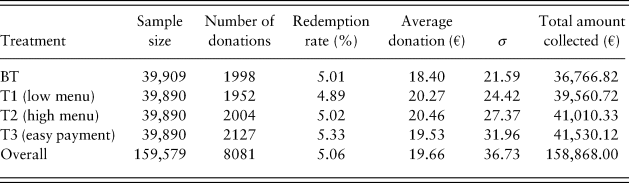
Overall, the summer campaign collected €158,868. The control group (BT) raised €36,766.83, the ‘low menu’ (T1) group raised €39,560.72, the ‘high menu’ (T2) group raised €41,010.33 and the ‘easy payment’ (T3) group raised €41,530.12. Accordingly, the most cost-effective treatment for the charity was ‘easy payment’ (T3) (see Table 2).
General descriptive statistics by treatment.

To test the hypothesis that the samples are from the same population (i.e., that the randomization was effective), we ran the Kruskal–Wallis equality-of-populations rank test on individual past average donations (p > 0.05), confirming that, prior to the RCT, the populations were the same. Furthermore, we compared individual donations between all treatments, running a two-sample Wilcoxon rank-sum test: there is only a statistically significant difference in individual campaign donations between BT and T1 (p < 0.01), while all of the remaining comparisons between treatments bear no significant results (p > 0.05).
Redemption rates
Over 159,000 donors were solicited and 8081 donated (overall redemption rate: 5.06%). In BT, the donation likelihood was 5.01%, in T1 4.89%, in T2 5.02% and in T3 5.22%. The behavioral prediction on redemption rates (Hypothesis 1) stated that, since both T1 and T2 suggested higher amounts than the average, lower compliance rates would be expected compared to the control group. The donation likelihood was lower than the baseline for T1, but it was higher for T2; however, we cannot infer that including donation menus influences in either direction the donation likelihood since the Pearson χ 2 test for independence and the test of proportions were not significant (p > 0.05) for all of the possible comparisons between BT, T1 and T2.
Result 1:
In contrast with previous findings, the introduction of a donation menu did not significantly affect, either positively or negatively, the probability of a donation to the charity.
In other words, and within our framework, the donation likelihood was not significantly affected by the introduction of either low or high menus.
On the other hand, the ‘easy payment’ treatment significantly improved the redemption rates compared to the control group (+6.4%, both Pearson χ 2 test for independence and test of proportions p < 0.05).
Result 2:
The inclusion of additional and salient trivial information on how to donate significantly increased donation likelihood.
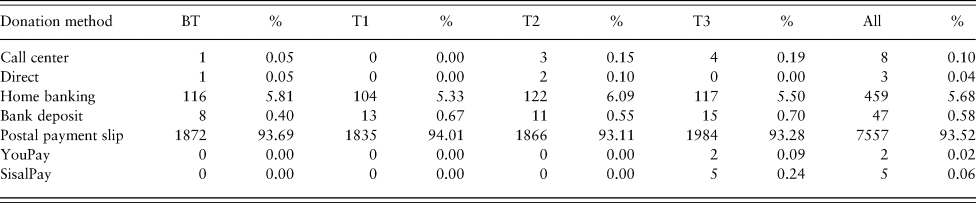
It is worth noting that for donors assigned to the ‘easy payment’ treatment (T3) the use of postal payment slips increased by almost 6% compared to the control group, and they were the only ones using alternative donation methods, namely YouPay and SisalPay (see Table 3).
Donation methods (frequency by treatment).

Average donation
The overall average donation was €19.66, in BT it was €18.40, in T1 it was €20.27, in T2 it reached €20.46 and in T3 it was €19.53.
The sample included all types of donations made, using any type of donation method and of any amount. This might mislead the comparisons between the control group, T1 and T2, since the primary payment method (and host of the nudge) was the postal payment slip. Payments received originated mainly from postal payment slips, but in BT, T1 and T2 there were also 381 payments made via bank transfer, credit card, etc. (see Table 3). In order to refine our findings, we dropped all non-postal slip donations.Footnote 2 The purpose of this filtering was to create a proxy of individuals who opened and read the letter and used the postal payment slip and did not simply make a routine donation: a plausible signal of the donor being exposed to the nudge and acting on the prompted pledge. After the refinement, the average donations were €17.96 (BT), €19.89 (T1), €20.17 (T2) and €19.24 (T3). The only significant difference for average individual donations was between BT and T1 (Wilcoxon rank-sum test p < 0.01). Although the difference between BT and T2 is greater than between BT and T1, the variance in T2 is greater, affecting the test results.
Considering all payment methods, the minimum amount donated was €1, while the maximum donation was €1000. However, the charity expressly required a minimum donation of €10: 648 donations were below this minimum recommended threshold (for a total of €3249.05). We will refer to those subjects who did not give at least €10 as ‘non-achievers’. On the other hand, we also had some outliers who could possibly mislead the analysis toward incorrect conclusions. Only six donations were above €300: we will refer to those subjects who gave more than that as ‘overachievers’.
Disregarding both ‘non-achievers’ and ‘overachievers’, we get a significant difference between BT and T1 (Wilcoxon rank-sum test p < 0.01) and BT and T2 (Wilcoxon rank-sum test p < 0.05). If we further refine the analysis, choosing to look uniquely at postal payments while still excluding ‘non-achievers’ and ‘overachievers’ and therefore focusing on the bracket of donations between €10 and €300, the tests confirm a statistically significant difference between BT and T1 and between BT and T2 (Wilcoxon rank-sum test p < 0.05).
Result 3:
Excluding ‘non-achievers’ and ‘overachievers’, the introduction of any menu, either ‘low’ or ‘high’, significantly increases average individual donation amounts compared to the control group.
Individual moderating factors
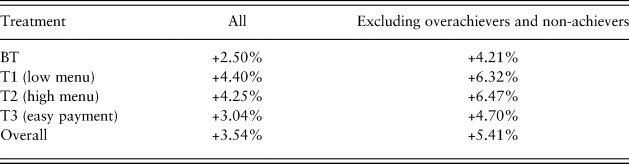
We showed that introducing and manipulating donation menus positively affects the donation amount without significantly reducing the donation likelihood. Despite this interesting result, it is important to also look at how anchors differently affect long- retained donors compared to new ones. To facilitate the comparison, we first report the gifted amount as a deviation from the donor's past average amount (we followed the approach of De Bruyn & Prokopec, Reference De Bruyn and Prokopec2013). A value greater than 1 meant that the donation was pushed above what the charity would expect from that particular donor, and conversely a value less than 1 indicated a gift that was smaller than the average past donation (see Table 4 for percentage variations).
Deviation of donation amounts from past average donations.

On average, donations are 5.4% higher than what would be expected, with some differences existing between treatments.Footnote 3 Overall, the differences between past average donations and the summer campaign donations were highly significant (Paired t-test p < 0.001). However, the effect of menu control on RCT donations compared to past average donations is statistically significant only when comparing BT with T1 (two-sample Wilcoxon rank-sum test p < 0.01).
Moving forward, as stated in the behavioral predictions from Hypothesis 2, seniority and donation frequency might have moderating effects on the tested nudges. We argued that senior donors and donors with a high donation frequency might have built a strong reference point and therefore be less prone to the influence of nudges. For the purpose of this paper, and following the charity's classification, we labeled those who had been registered with the charity for two or fewer years as ‘junior donors’ and all other individuals as ‘senior donors’. In addition, since the average donor gives twice a year, we labeled those who give more than twice a year as ‘high-frequency donors’ and all other individuals as ‘low-frequency donors’. Overall, the number of junior donors was 549 (6.79%), compared to 7532 senior donors (93.21%), while there were 5309 low-frequency donors (65.70%) compared to 2772 high-frequency donors (33.30%) (Table 5).
Individual attributes.

We found that, on average, senior donors gave approximately 2% more than junior donors, but this difference was not statistically significant (Wilcoxon rank-sum test p > 0.05). Additionally, in all treatments, senior donors gave more than junior donors, except for T3, where the relation was inverted. Particularly focusing on the treatment effect on junior and senior donors, we found that the only significant effect was that of T1 on senior donors (p < 0.001).
Controlling for the robustness of the results by removing ‘overachievers’ and ‘non-achievers’, we observed that senior donors gave an extra 13% compared to junior donors, and that this difference was highly significant (Wilcoxon rank-sum test p < 0.01). Additionally, including a ‘low menu’ (T1) significantly boosted donations by almost 23% for senior donors compared to junior donors (Wilcoxon rank-sum test p < 0.05).
Result 4:
Introducing a ‘low menu’ produces a significant and positive deviation from donors’ past average donation compared to the control group, particularly for senior donors.
Regarding Hypothesis 2, we also suggested that a high donation frequency might counterbalance the influence of donation menus, thereby reducing this influence. Low-frequency donors gave on average €21.25, while high-frequency donors gave on average €16.61. Low-frequency donors gave on average almost 28% more than high-frequency donors, and this difference is highly significant within all treatments (Wilcoxon rank-sum test p < 0.01): this simply confirms the intuition that low-frequency donors, despite giving less often, give a greater amount per donation. We can further compare cumulative donations over individuals’ lifetime donations: low-frequency donors gave on average €341 over their lifetime compared to €523 for high-frequency donors, and this difference is, again, highly significant (Wilcoxon rank-sum test p < 0.0001). Therefore, although not directly related to the RCT design, but of great value to practitioners, we found that high-frequency donors contribute more often with smaller mounts, giving more overall than low-frequency donors.
Lastly, menu manipulations T1 and T2 increased donations from low-frequency donors by 16% and 14%, respectively, compared to the control group, but only for T1 was the increase statistically significant (Wilcoxon rank-sum test p < 0.001). The remaining differences between treatments for high-frequency donors were not significant (p > 0.05). These findings offer only partial support for Hypothesis 2.
Regression analysis
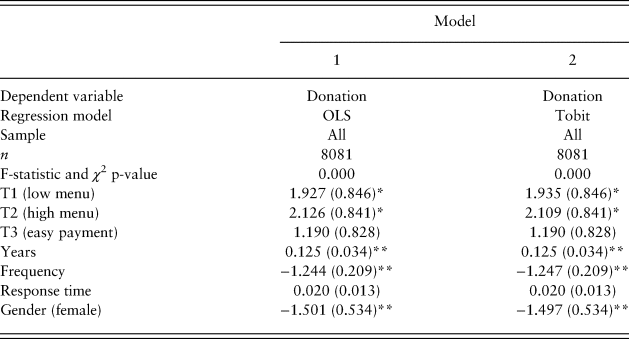
In order to further observe how donations are affected by each treatment and draw comprehensive conclusions from the RCT, we report two models of ordinary least squares and Tobit estimates (Tables 6 and 7). Given the nature of the data, both a linear and a censored model are estimated. The Tobit regression has been chosen in order to account for the censoring of the data, with a lower bound of €1. The dependent variable of the regression is individual donation, and all donations were accounted for (all payment methods of any amount).
Main regression.

Significance level: *p < 0.05; **p < 0.01.
OLS = ordinary least squares.
Donor characteristics regression.

Significance level: *p < 0.05; **p < 0.01.
OLS = ordinary least squares.
In Models 1, 2, 3 and 4, the following fixed explanatory dummy variables were considered:
T1:
low menu treatment (menu quotes €25, €50 and €100)
T2:
high menu treatment (menu quotes of €50, €100 and €200)
T3:
easy payment treatment (no menu quotes, reminder of donation methods)
In Models 1 and 2 (Table 6), we compared how the manipulations of the donation menu affected the donation amounts for the 6083 donors who were assigned to the three treatments and responded to the solicitation. We controlled for the yearly frequency of donations (frequency), the number of years the subject has been a donor (years), how long the donor took before donating (response time) and gender (female). Results are consistent across specifications. In Model 1, both regression analyses show that treatments T1 and T2 significantly boosted the level of donation: T1 increased the donation amounts by €193 (p < 0.05), while T2 increased the donation amount by €2.13 (p < 0.05). The number of years as a donor had a positive and significant, yet small, effect on donations: for every year as a donor, the donation increased by €0.125 (p < 0.01). The donation frequency had a negative and highly significant impact: one more donation a year decreased the donation amount by €1.24 (p < 0.01). This is in line with the intuition discussed previously in the paper that the more frequent the donation, the smaller the donation. In addition, females donated €1.50 less than males (p < 0.01). Lastly, regression Model 1 confirms that notion that reminders on how to donate (T3) do not affect the magnitude of donation. Model 2 confirms the magnitudes, directions and significance of determinants as stated in Model 1.
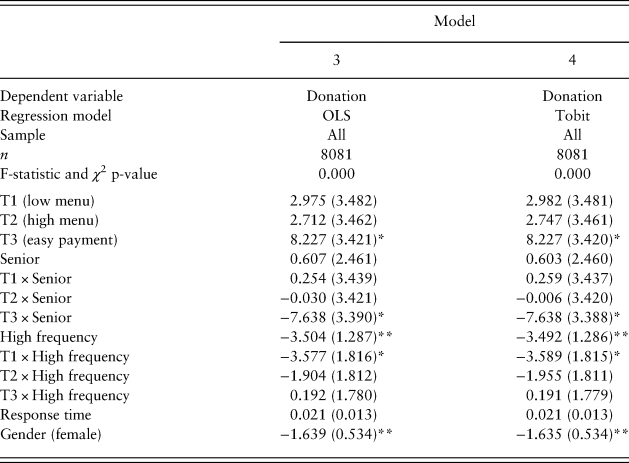
We discussed in the ‘Individual moderating factors’ section how menus impact the likelihood and magnitude of donations depending on donors’ profiles and habits. Therefore, in order to facilitate the understanding of moderating factors, we introduced interactions between treatments and types of donor (senior and junior donors and high- and low-frequency donors). As is shown in Table 7, Models 3 and 4 estimated a linear and a censored model, accounting for individual donor heterogeneity (junior and senior donors and high- and low-frequency donors). Furthermore, Models 3 and 4 controlled for how long the donor took before donating (response time) and gender (female; dummy variable).
Treatment T3 (easy payment) had a negative effect on senior donors: donations were €7.64 lower when donors who had been involved in the charity for more than two years were exposed to this treatment (p < 0.05). Treatment T1 had a dampening effect on the already lower donation levels of high-frequency donors: they were €3.50 less if high-frequency donors received a low menu nudge (p < 0.05). High-frequency donors appeared to be legitimized to give less when exposed to the low menu, linking back to the topic of paltry contributions as an effective technique to increase the likelihood of donation without affecting its magnitude. In our study we found that, for high-frequency donors, the likelihood of donation compared to BT was 5.31% higher in T1, 4.40% higher in T2 and 10.92% higher in T3. However, the Pearson χ 2 test for independence and the test of proportions were not significant (p > 0.05) for all of the possible comparisons between BT, T1, T2 and T3.
These results speak to the importance of targeting nudges in terms of different donor profiles and habits, since not all interventions work well for all groups.
Discussion and conclusions
Including suggested donation amounts is a common occurrence in direct mail fundraising campaigns. Many researchers have investigated the effectiveness of donation menus, but the evidence on the two main dependent variables – the magnitude and likelihood of donation – is somewhat inconsistent. Some works have found that menus affect only the likelihood of donation (Desmet, Reference Desmet1999; Desmet & Feinberg, Reference Desmet and Feinberg2003), while others have found that they affect only the magnitude (Alpizar et al., Reference Alpizar, Carlsson and Johansson-Stenman2007).
We presented a natural field experiment, in collaboration with a large Italian charity supporting cancer research, probing the influence of donation menus and reminders on the contributions of 8081 donors (159,909 donors solicited). The main objective of this study was to draw a clearer picture of the ‘power of the ask’, focusing on identifying the possible limits of ‘asking’ nudges and controlling for individual heterogeneity.
We provided strong evidence that, within the given context, introducing donation menus significantly increased donation amounts without significantly reducing the donation likelihood. By extending the research on donation menus to Italy and accounting for cultural differences in behavior compared to previous studies that were carried out in the USA, the UK and France, we successfully put to the test the ‘asking’ nudge.
In addition, promising results were found regarding the ‘easy payment’ treatment. This was the most cost-effective of all the manipulations tested: donation likelihood was significantly boosted by the inclusion of reminders on how to donate, reducing friction costs and increasing ease and convenience of donations. ‘Make it easy’ is an approach that, at least in Italy, yields higher returns compared to the ‘power of the ask’.
Furthermore, in our research, we observed how donation menus should be tailored to fit the profiles and habits of different segments of donors. In particular, we focused on the seniority of donors (in which senior donors were defined as those who had been actively donating for more than two years and junior donors were defined as those who had been donating for two or fewer years) and the frequency of donation (high-frequency donors were defined as those who had been actively donating more than twice a year and low-frequency donors were defined as those who had been donating twice or less a year). In line with the research conducted by De Bruyn and Prokopec (Reference De Bruyn and Prokopec2013), we found that the effects of donation menus on the likelihood of donation and the individual donation amounts differ across different segments of donors. More specifically, we demonstrated how senior donors were positively influenced by the introduction of a low menu (T1), while low-frequency donors were positively influenced by the introduction of both low and high menus (T1 and T2). On the other hand, high-frequency donors possibly experienced the legitimization of paltry donations: this result opens up new questions on the effectiveness of appeals that are not tailored to specific segments of donors, or even to the individual level.
This field experiment also has some limitations, mainly related to the nature of the available data collected during the RCT and past mailing rallies. The charity database was not, understandably, designed around optimal experimental practice, but rather to meet internal fundraising and administrative needs: it is our hope that further work will include information on the donors who did not donate but were solicited, more specific sociodemographic profiling of subjects (such as age, education, occupation and closeness to the cause sponsored) and a longitudinal panel in order to determine the effects of menus relative to, for example, seasonal trends and donor heterogeneity. In addition, it is important to stress that our results cannot be extended to any donation menu, particularly those suggesting lower or much higher donation amounts.
This study is a further step toward enhancing the understanding of menu options and ‘make it easy’ nudges as viable ways to increase charitable giving. To further this line of research, we plan to run similar field experiments in different contexts, such as online donations and other seasonal campaigns.
Practically, our results emphasize that practitioners wanting to introduce and use donation menus should be more cognizant of donors’ habits and previous donation histories, since idiosyncratic individual factors seem to be more important than has been previously believed (and researched).
Appendix A Charity letter
This section contains the letter sent to donors during the RCT. The document has been translated from Italian to English, and all references to the charity have been omitted out of privacy and anonymity considerations.
Dear <Name>,
Summer is one of the most critical periods for us, due to a drop in available resources. For this reason, now more than ever, I ask you to join other sensible donors that even during this time of the year, luckily, keep on supporting us. Together we can face this emergency by guaranteeing stability to many researchers.
182 projects will close their research periods in December and many of these are close to reaching concrete results that could become innovative therapies, gifting new hope to those who are fighting cancer.
For example, the research carried out by <omitted> in <omitted> that is studying <omitted> .
Or the research of <omitted>, in collaboration with <omitted>, that is perfecting <omitted> .
The results of this research could really change the lives of so many people. This is why, even though being able to count on donors like you all year around is crucial for us, this summer season it is even more important.
Thank you for your support, <omitted> .
A warm greeting and good summer wishes
The president, <omitted>
Appendix B Donation sheets

T3: Identical to BT. On the back of the sheet, the following text was included:
“Against cancer, I stand – you can say it with us by using:”
SISALPAY – presenting this barcode. Find the closest SISALPAY point on the website <name of website>.*
USING THIS BULLETIN – going to your nearest post office or using it with your home banking.*
WITH A BANK TRANSFER – using this current account number <account number>, and also for recurring monthly donations via direct debit orders.
WITH YOUR CREDIT CARD – on YOUPAY website <name of website>* or calling our toll-free number <telephone number>, every day, anytime.
Asterisks denote the options added for T3 that were not given in BT, T1 and T2.