Governments around the world have increasingly militarized law enforcement. Although in the developed world militarization has taken place in the form of police adopting characteristics of the armed forces – as with the proliferation of SWAT teams and the use of military gear in local police departments – in broad parts of the developing world it has also taken the form of constabularized militaries taking on domestic law enforcement roles. The constabularization of the armed forces has become prevalent in many Latin American countries, such as Bolivia, Brazil, Colombia, Ecuador, El Salvador, Guatemala, Honduras, Mexico, Nicaragua, Peru and Venezuela. In all of these examples, the armed forces conduct domestic law enforcement tasks traditionally reserved for civilian police in democratic contexts, including patrolling neighborhoods, staffing checkpoints and conducting arrests.
Although a growing body of research suggests that the constabularization of the armed forces for domestic policing in the developing world is ineffective at best and counterproductive at worst (Flores-Macías and Zarkin Reference Flores-Macías and Zarkin2021a; Lessing Reference Lessing2017; Osorio Reference Osorio2015),Footnote 1 the policy has enjoyed widespread public support in Latin America (Bailey, Parás and Vargas Reference Bailey, Parás and Vargas2013). For example, Flores-Macías (Reference Flores-Macías2018) finds that constabularization is responsible for a 17 per cent increase in Mexico's homicide rate; Pérez-Correa, Silva and Gutiérrez (Reference Pérez-Correa, Silva and Gutiérrez2015) point to a lethality rate – civilians killed per soldier or federal police – at least three times higher for the military; and Magaloni and Rodríguez (Reference Magaloni and Rodríguez2020) find that militarization increases torture by almost 10 percentage points. Yet over 60 per cent of Latin Americans approved of the military participating in law enforcement in 2014 (Americas Barometer 2019).
However, the relationship between constabularization and public opinion remains poorly understood. While some research has begun to explore public attitudes towards the militarization of law enforcement, it has dealt exclusively with the United States and has therefore focused on attitudes towards police becoming more like militaries (for example, Moule, Fox and Parry Reference Moule, Fox and Parry2019). Further, this research has been mostly correlation based or qualitative in nature (for example, Lockwood, Doyle and Comiskey Reference Lockwood, Doyle and Comiskey2018). In contrast to the growing interest in the trend towards ‘tough-on-crime’ policies in American politics and other industrialized democracies (Jennings et al. Reference Jennings2017; Roberts et al. Reference Roberts2003; Wenzelburger Reference Wenzelburger2016), the study of punitive populism – the promise of easy solutions to address complex crime and law enforcement problems (Pratt Reference Pratt2007) – in the developing world has lagged considerably. Scholars have yet to understand the consequences of constabularization in general, and its impact on public opinion in particular. Understanding attitudes towards militarization is important because even if militarization does not contribute to desirable outcomes – and might in fact make things worse – politicians can seize the opportunity to deploy the armed forces, often with disastrous human rights consequences. Further, as Blair and Weintraub (Reference Blair and Weintraub2020) suggest, the deployment of the military itself can contribute to an increased demand for aggressive military policing.
To advance our understanding of constabularization in the developing world, we pre-registered and embedded an image-based conjoint experiment in a nationally representative survey in Mexico in August 2018.Footnote 2 Respondents were presented with two similar images of security personnel. Controlling for relevant factors, including pose, size, facial expression, body and background, these images randomly varied in four attributes: uniform, weapon, gender and skin color. Respondents were then asked to rate each image in terms of perceived effectiveness, respect for civil liberties, proclivity for corruption, and support for that person conducting law enforcement in the respondent's neighborhood.
This study advances the existing literature by (1) evaluating attitudes towards tough-on-crime policies beyond the US context, (2) testing whether visual features of constabularization affect perceptions of law enforcement regarding effectiveness, respect for civil liberties, corruption and support for presence in one's own neighborhood, (3) studying constabularization in combination with other physical attributes that might also shape citizens' perceptions and (4) employing images rather than text to more closely approximate reality.
We find that both military uniforms and military weapons increased perceptions of effectiveness and respect for civil liberties, and that the effect of military uniform is larger in municipalities with a greater military presence. We also find that gender had no effect on perceptions of effectiveness, but females increased perceptions of respect for civil liberties and reduced perceptions of corruption. We did not find an effect for skin color. Further, we find that military weapons increased support for constabularization in the respondent's neighborhood, while male images decreased support. These findings suggest that female security personnel can enhance perceptions of respect for civil liberties and integrity, but also that a key feature of militarization that is associated with higher levels of violence – the use of military weapons – is a central factor contributing to favorable attitudes among the public.
By providing a first step towards understanding the relationship between constabularization and attitudes towards law enforcement, these findings contribute to the literatures on punitive populism, police–society relations and civil–military relations in the developing world. In particular, they shed light on specific attributes that make punitive policies, such as militarization, appealing to civilians regardless of the results, as well as how society perceives and relates to the armed forces and police in the developing world.
This article is organized as follows. The next section presents an overview of the literature that can inform hypotheses about public perceptions regarding the four features investigated in this article (uniform, weapons, gender and skin color). The second section discusses the case selection and research design. The third section presents the results of the image-based conjoint experiment conducted in Mexico. The final section concludes by reviewing the policy implications of the findings.
Punitive Populism and the Popularity of Militarization
A primary form of punitive populism is politicians' favoring tough-on-crime approaches to gain political favor, even when the effectiveness of such policies is in doubt (Flom and Post Reference Flom and Post2016). Punitive populism tends to be politically expedient because punitive approaches resonate among publics in need of solutions to pressing problems. Examples of policies meant to deter crime because of their severity include so-called three-strike laws, mandatory sentences and the militarization of law enforcement.
Most of the literature on punitive populism and public attitudes has focused on incarceration policies in industrialized countries (for example, Jennings et al. Reference Jennings2017; Lerman and Weaver Reference Lerman and Weaver2014), but our understanding of the militarization of law enforcement remains limited even for that part of the world. Research on its prevalence, causes and consequences remains underdeveloped, with a few scholarly studies on attitudes towards militarization focusing on individual-level correlates of support – including respondents' party ID and education – for militarized policing in the developed world (Fox, Moule and Parry Reference Fox, Moule and Parry2018). Further, findings have often been based on convenience samples, such as research by Wyrick (Reference Wyrick2013), who found that the militarization of police is associated with decreased trust in the police among college students. An exception is Mummolo's survey experiment (Reference Mummolo2018), which found that militarized police can inflate perceptions of crime and depress support for police.
Although these US-centered studies have begun to scratch the surface to understand how citizens view the militarization of police, we know even less about attitudes towards the constabularization of the armed forces for domestic policing, especially in the developing world. We still need to understand whether constabularization affects attitudes towards law enforcement, and which factors might shape perceptions favorably. Although the political science literature has made advances regarding democratic policing (Bailey and Dammert Reference Bailey and Dammert2006; González Reference González2020; Moncada Reference Moncada2009), criminal violence (Cruz and Durán-Martínez Reference Cruz and Durán-Martínez2016; Osorio Reference Osorio2015; Rosen and Kassab Reference Rosen and Kassab2020; Snyder and Durán-Martínez Reference Snyder and Durán-Martínez2009; Yashar Reference Yashar2018) and victimization (Bateson Reference Bateson2012; Berens and Dallendörfer Reference Berens and Dallendörfer2019; Zechmeister and Zizumbo-Colunga Reference Zechmeister and Zizumbo-Colunga2013) in Latin America, remarkably little research has been conducted in the developing world on punitive populism in general and public attitudes towards constabularization in particular (Brown and Benedict Reference Brown and Benedict2002).Footnote 3 This is a major oversight, especially given the growing trend towards constabularization of the armed forces in the Global South (Flores-Macías and Zarkin Reference Flores-Macías and Zarkin2021a).
Latin America's Constabularized Militaries
The constabularization of the armed forces for domestic policing has become widespread in Latin America. Not only has the region experienced the generalized trend of police adopting military weapons and tactics, but in several countries soldiers have become permanent fixtures in the daily law enforcement landscape. In Mexico, for example, more than 67,000 troops have participated in widespread policing since 2006 (Ordorica Reference Ordorica2011). In Brazil, the armed forces have increasingly helped state governments regain control of urban areas (The Economist 2017). In Honduras, the government created the Military Police for Public Order in 2013 to combat drug trafficking (Secretaría de Defensa Nacional de Honduras 2013). Even countries that have historically lacked a military, like Costa Rica and Panama, are considering proposals to militarize law enforcement.
Governments have justified the constabularization of the armed forces by pointing to several shortcomings of police, including their ineffectiveness, disregard for civil liberties and corruption, and the popularity of the policy has facilitated its adoption. As Figure 1 shows, a majority of respondents in every Latin American country supports the armed forces becoming involved in law enforcement. This is the case even in countries with historically low levels of crime, such as Chile and Uruguay. The more we understand the logic behind public support for constabularization, the better we can inform the public about the policy's virtues and flaws.
Support for militarization in Latin America
Note: bars indicate support for whether ‘the armed forces should combat crime and violence,’ based on LAPOP's Americas Barometer 2014 wave. The 2012 wave shows similar levels of support.

Appearance as Heuristic for Perceptions
Appearance serves as a low-information heuristic that people rely on to form opinions about others' competence, honesty or trustworthiness (Benjamin and Shapiro Reference Benjamin and Shapiro2009; Zebrowitz et al. Reference Zebrowitz2002). The political science literature has found that an individual's appearance affects others' attitudes and behavior (for example, Lawson et al. Reference Lawson2010; Weaver Reference Weaver2012) even after brief exposure to a visual stimulus, such as a still image. For example, Lawson et al. (Reference Lawson2010, 561) found that even snap judgments – ‘perceptions formed by looking briefly at images of candidates' faces’ – can affect people's support for a particular candidate, and that these perceptions are highly predictive of electoral results.
The criminology literature on public attitudes towards law enforcement similarly documents the role of brief visual stimuli as low-information heuristics. As Zhao and Ren (Reference Zhao and Ren2015) have shown, attitudes towards police are generated from impressions rather than factual knowledge. Criminology research also suggests that citizens' evaluations are anchored in perceived attributes gathered from either personal interactions or while viewing an officer (for example, Frank, Smith and Novak Reference Frank, Smith and Novak2005, 217). Further, as Simpson (Reference Simpson2017) notes, most people's perceptions of law enforcement take shape not as a result of formal interaction or engagement, but rather from passive visualization.
Building on this theoretical framework on how individuals' appearance affects perceptions of law enforcement, we formulate hypotheses as to whether the type of uniform, weapon, gender and skin color influence perceptions regarding effectiveness, respect for civil liberties and proclivity for corruption. From Portland, Oregon to Latin America, debates about the merits of involving the police versus the military have focused on differences in capabilities and professional conduct, emphasizing effectiveness, civil liberties and corruption (for example, Bailey, Parás and Vargas Reference Bailey, Parás and Vargas2013; Hertling Reference Hertling2020). As Sabet (Reference Sabet, Olson, Shrik and Selee2010, 247) highlights in the Mexican case, ‘A brief review of the daily newspapers reveals problems such as (1) corruption and collusion with organized crime, (2) abuses […] in the form of torture, unwarranted search and seizure, violations to due process, and inversion of the presumption of innocence, and (3) ineffectiveness exemplified by the inability to stem the violence.’
Indeed, these police shortcomings are reasons that governments often offer to justify the militarization of law enforcement. As a commissioner of a Mexican state agency (2018) characterized the appointment of a retired general to lead a local police department: ‘[The general's appointment] was based on the assumption that because he was ex-military, he was less corruptible and more effective’.
Beyond effectiveness, civil liberties and corruption, we also evaluate the effect of uniform, weapon, skin color and gender on the degree to which respondents support the individuals in the images conducting law enforcement in their own neighborhood. We consider this a ‘hard test’ of support for militarization, since otherwise respondents may express views of the military in the abstract, rather than in their own communities. Since the literature on these issues in the developing world is even more scarce than research focused on industrialized democracies, we extend the expectations from the literature to these previously unexplored dimensions in the Latin American context with an emphasis on Mexico.
Military Uniform
Clothing communicates different things about the wearer (Harris et al. Reference Harris1983), and uniforms are no exception. Bickman (Reference Bickman1974), for example, finds that people wearing private guard uniforms obtained more compliance with their requests than those who dressed as civilians, in part because the uniform can be a symbol of legitimate authority. Since we are not aware of any studies comparing military uniforms with those of police, we turn to the few studies that compare police with civilian attire. For example, scholars have found differences in public perceptions of police wearing traditional (that is, non-paramilitary) uniforms compared to those in civilian attire. Traditional police uniforms increase perceptions of professionalization and reduce aggression towards officers (Gundersen Reference Gundersen1987; Tenzel, Storms and Sweetwood Reference Tenzel, Storms and Sweetwood1976), inspire trust and induce subordination (Balkin and Houlden Reference Balkin and Houlden1983; Singer and Singer Reference Singer and Singer1985), and increase perceptions of competence (Mauro Reference Mauro1984).
While these studies provide important initial evidence to support the claim that people's perceptions can vary based on differences between police and civilian uniforms, they are less informative for understanding the Latin American context, where soldiers coexist with civilian police in law enforcement and the armed forces are typically better regarded than police (Bailey, Parás and Vargas Reference Bailey, Parás and Vargas2013). According to Americas Barometer (2019), for example, in 2018 trust in the armed forces was greater than that for police in every Latin American country. Mexico is no exception: its armed forces remain one of the country's most trusted institutions.
We therefore expect the military uniform to elicit favorable perceptions across several dimensions: greater effectiveness, less corruption and more support for conducting law enforcement in one's neighborhood. Further, given the tradeoffs between effectiveness in law enforcement and respect for civil liberties (Comey Reference Comey2005), and because of the military's involvement in widespread human rights violations,Footnote 4 we expect the military uniform to increase perceptions of abuse.
Military Weapon
As with the uniform, a ‘weapons effect’ has been documented in the psychology literature, in which the presence of weapons can shape behavior – whether increasing aggression or eliciting obedience (Berkowitz and Lepage Reference Berkowitz and Lepage1967; Boyanowsky and Griffiths Reference Boyanowsky and Griffiths1982). For example, based on a field experiment to study extortion along truck routes in Indonesia, Olken and Barron (Reference Olken and Barron2009) show that truckers offered larger bribes to officers whose weapons were visible, compared to those whose weapons were concealed.
However, the literature on how weapons affect perceptions of law enforcement is scarce and unable to distinguish between the effects of uniform and weapon. In particular, Mauro (Reference Mauro1984) found that police officers with a traditional – that is, non-militarized – uniform and a visible weapon were perceived as more competent and honest than those wearing a civilian-style uniform (blazer) and no visible weapon. However, no attempt was made to distinguish between the effects of the uniform and weapon, which were conflated in the study.
In countries with significant drug-related violence, as in Colombia, El Salvador, Honduras or Mexico, military-grade weapons have become common among law enforcement personnel to counter the weapons employed by organized crime. Since weapons are a symbol of authority (Olken and Barron Reference Olken and Barron2009), we expect a visible military-grade weapon to elicit favorable perceptions regarding several dimensions: greater effectiveness, less corruption and more support for patrolling one's neighborhood. Given the tradeoffs between effectiveness and respect for civil liberties, we expect the assault rifle to increase perceptions of abuse.
Gender
It has been long established that men and women are perceived differently while performing the same job (McKee and Sherriffs Reference McKee and Sherriffs1957). While research on gender-based perceptions has focused on attitudes towards candidates running for office (for example, Huddy and Terkildsen Reference Huddy and Terkildsen1993; Kahn Reference Kahn1992) or in office (Schwindt-Bayer and Reyes-Householder Reference Schwindt-Bayer and Reyes-Householder2017), surprisingly little has been written about state bureaucracies, such as the police or the military. Although prior studies have examined gender and policing, they have emphasized the structural barriers facing policewomen (Brown Reference Brown1998), their attitudes towards gender issues (Page Reference Page2008), and their own views about police duties (Burke and Mikkelsen Reference Burke and Mikkelsen2005).
Research on perceptions of women in the police and military has been sparse and has generated mixed findings. Leger (Reference Leger1997) found in a US study that the majority of respondents do not penalize female officers for their perceived physical ability and competence in policing. However, other US studies have found that women are perceived as less effective than their male counterparts (Breci Reference Breci1997), but also less corrupt (Barnes, Beaulieu and Saxton Reference Barnes, Beaulieu and Saxton2018), less aggressive and friendlier (Simpson Reference Simpson2017). In developing contexts outside the United States, Karim (Reference Karim2019) found that increases in the ratio of women to men in police forces improve trust in Liberia, and Córdova and Kras (Reference Córdova and Kras2019) found that women's police stations in Brazil result in higher levels of perceived legitimacy among women. A similar disparity in perceptions has been found among the armed forces, with women viewed as less suitable for combat roles in the US military (Drake Reference Drake2006). In the developing world, Calderón (Reference Calderón Garrido2010) found through an ethnographic study that women are perceived as fragile and less effective in Ecuador's military. In Mexico, women face comparable stereotypes: Barnes, Beaulieu and Saxton (Reference Barnes, Beaulieu and Saxton2018) documented perceptions that female law enforcement personnel are more trustworthy.
As these studies suggest, stereotypes characterize women as weaker or less authoritative than men (McKee and Sherriffs Reference McKee and Sherriffs1957), which leads us to expect lower perceptions of effectiveness. However, women are also perceived as more caring, honest and less threatening (Barnes, Beaulieu and Saxton Reference Barnes, Beaulieu and Saxton2018), which leads us to expect greater perceptions of respect for civil liberties, less corruption and greater support for their presence in one's neighborhood.
Skin Color
A broad literature has documented how skin color affects perceptions of competence, leading to double standards placed on disadvantaged groups (Foschi Reference Foschi2000). In the context of policing, research has uncovered bias in police behavior towards different ethnic groups (White Reference White2015), but the literature has remained surprisingly silent regarding how law enforcement personnel's own skin color might affect perceptions about them (Nanes Reference Nanes2018).
The few existing studies point to mixed findings. A study of three communities in Washington, DC suggests police were perceived as ‘blue’ rather than through a racial lens (Weitzer Reference Weitzer2000). Yet a study by Cochran and Warren (Reference Cochran and Warren2012) in the United States suggests that an officer's race is an important factor in shaping citizen perceptions of the legitimacy of encounters during traffic stops, particularly for minority citizens; encounters with non-white officers were seen as less legitimate on average. The literature is even more limited outside the United States, where insights about skin color in law enforcement are virtually non-existent. Notable exceptions are Weitzer and Hasisi's (Reference Weitzer and Hasisi2008) study of perceptions of ethno-religious differences among police in one police district in Israel and Nanes' (Reference Nanes2018) research on demographic inclusion in Israel and Iraq. Their results provide some evidence that people prefer officers from their own ethno-religious groups, and that perceptions of police inclusion affect how citizens relate to the state.
Skin color correlates with social hierarchy in Latin America; countries in the region have been referred to as pigmentocracies (Telles Reference Telles2014). Across the region, there is a positive bias associated with whiteness, and discrimination associated with darker skin tones (Aguilar Pariente et al. Reference Aguilar Pariente2015). Not surprisingly, white European-looking soldiers have historically occupied the highest leadership positions in the military, whereas the bulk of the armed forces are darker – mestizo and/or indigenous, depending on the country (Rouquié Reference Rouquié1987, 64).Footnote 5 Even in countries where becoming a military officer has lost appeal for elites, leadership positions tend to be held by lighter-skinned, middle-class individuals (Norden Reference Norden, Mares and Kacowicz2016, 250).
In Mexico, for example, although a large majority of individuals are non-European looking – including those serving in the police and armed forces – the aspirational skin tone is white (Aguilar Pariente Reference Aguilar Pariente2011; Trejo and Altamirano Reference Trejo, Altamirano, Hooker and Tillery2016). Therefore, we expect lighter skin to elicit favorable perceptions across dimensions: greater effectiveness, respect for civil liberties, less corruption and more support for patrolling one's neighborhood.
Case Selection and Research Design
We used an image-based conjoint design to simultaneously test the effect of military uniform, military weapon, gender and skin color on attitudes towards law enforcement personnel. Conjoint analysis is an excellent tool to understand which combination of attributes is favored over others, since it enables researchers to estimate component-specific treatment effects simultaneously (Hainmueller, Hopkins and Yamamoto Reference Hainmueller, Hopkins and Yamamoto2014). Rather than presenting respondents with a text-based list of attributes for each individual, as is commonly found in the political science literature (for example, Carnes and Lupu Reference Carnes and Lupu2016; Hainmueller and Hopkins Reference Hainmueller and Hopkins2015), we conducted an image-based experiment.
We consider this an improvement over text-based experiments because images more closely approximate real-world situations in which respondents encounter security personnel. Although images might remain unable to elicit the same reaction as a real-world encounter would, the image-based approach enhances ecological validity compared to text since most people's encounters with law enforcement are visual, passive, and without any formal interaction or engagement (Simpson Reference Simpson2017).
The image-based conjoint experiment was embedded in a nationally representative omnibus survey in Mexico between August and October 2018. The survey was funded through an open call for proposals by a university's social science experimentation lab and fielded by a Mexican polling firm. Respondents (n = 1,206) were selected based on a nationally representative, probability-based sample. The face-to-face surveys were conducted at the respondents’ homes.
Like many Latin American countries, Mexico has experienced rampant violent crime related to drug-trafficking organizations. The United States' demand for illegal drugs, crackdowns in Colombia and the dramatic influx of high-caliber weapons from the United States intensified drug-related violence in Mexico (Dube, Dube and García-Ponce Reference Dube, Dube and García-Ponce2013). Further, political alternation at the local and federal levels undermined informal networks of cartel protection (Snyder and Durán-Martínez Reference Snyder and Durán-Martínez2009; Trejo and Ley Reference Trejo and Ley2018). Facing increasingly powerful and violent drug trade organizations, in 2006 President Felipe Calderón (2006–2012) declared an all-out war against organized crime (Romero, Magaloni and Díaz-Cayeros Reference Romero, Magaloni and Díaz-Cayeros2016; Shirk Reference Shirk2011). He first sent troops to Michoacán state and eventually launched police–military operations in nearly two-thirds of the Mexican states. The disruptive effect of law enforcement magnified the competition for illicit markets and resulted in an escalation of inter-cartel violence (Osorio Reference Osorio2015), often driven by the government's policy of decapitating drug trafficking organizations (Phillips Reference Phillips2015). Homicides tripled between 2006 and 2011, and more than 100,000 people were killed in Mexico during this period. The militarized approach against drug trafficking continued under Calderon's successors, Enrique Peña Nieto (2012–2018) and Andrés Manuel López Obrador (2018 to present).
We conducted the experiment in Mexico for three main reasons. First, the police and armed forces both regularly perform law enforcement tasks, which is important for the ecological validity of the experiment. More than 60,000 troops have been constabularized across the national territory for this purpose, staffing checkpoints, patrolling urban and rural areas, conducting arrests, and in some municipalities replacing local police departments altogether. Secondly, Mexico is not atypical in this regard. It is one of several Latin American countries in which the armed forces regularly participate in law enforcement, including Colombia, El Salvador, Guatemala and Honduras. Further, like the vast majority of Latin American countries, Mexico's armed forces enjoy greater trust among the population than the police.Footnote 6 Thus Mexico presents a context in which the survey questions are meaningful and where the findings are likely to apply to other countries. Thirdly, perceptions of law enforcement in Mexico have not yet been investigated; therefore this study's findings can shed significant light on uncharted territory.Footnote 7
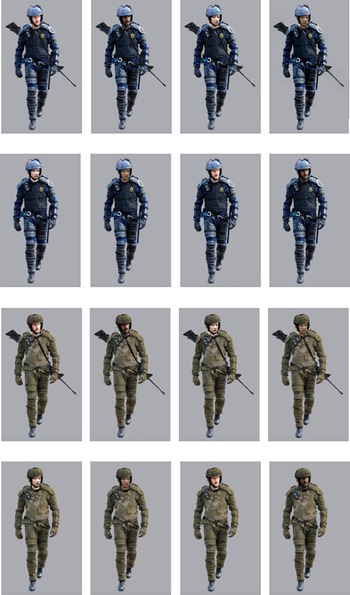
The first part of the questionnaire included a series of pre-treatment questions on baseline measures of interest, including gender, age, income, education, victimization, ideology, party ID and trust in the military. After answering the socioeconomic and demographic questions, respondents were asked to read a short sentence with instructions explaining that they would look at images and then answer some questions about them. Following the statement, respondents were presented with two similar images side by side. The images randomly varied in the four attributes of interest (uniform, weapon, gender, skin color) for a total of sixteen different profiles; other relevant factors remained constant, such as body, pose, size, height, complexion, facial expression and background (see Figure 2). These images were created using Photoshop to ensure that they were identical in every respect except the four attributes of interest.
Images of the 16 profiles

As shown in Figure 2, the four features varied in subtle but important ways. The police version of the uniform included features typically associated with police, such as being all blue in color, showing a police badge on the chest and carrying a police baton on the belt. The military uniform replicates the police uniform in all respects, but is olive green with camouflage, has no badge and carries no baton. Both police and military uniforms include a helmet, but the police uniform has a face shield lifted over the head, whereas the military uniform does not.
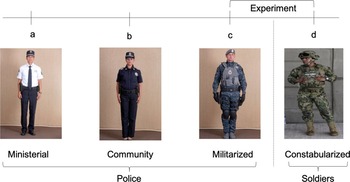
A range of images could be chosen from the law enforcement continuum found in Latin America to evaluate whether constabularization shapes perceptions. We selected these particular images to generate a difficult test to evaluate whether very subtle changes influence perceptions. Whereas there is a broad spectrum of law enforcement personnel in the developing world, from non-militarized police to constabularized armed forces, we focus on images representing the threshold at which law enforcement switches from civilian police to the armed forces. The distance between (c) and (d) in Figure 3 is where law enforcement moves from militarized police – those with many visual attributes of militarization (for example, tactical uniform for combat readiness) but preserving features that typically distinguish them from the armed forces, such as the color blue and a badge – to constabularized armed forces. Crucially, not only does this choice constitute the hardest test for the uniform hypothesis – compared to the much sharper but less interesting contrast between (a) and (d) in Figure 3, for example – but it also allows us to hold most other visual features constant, since the uniforms of militarized police and constabularized military are visually closest.Footnote 8
Visual distance between different types of law enforcement

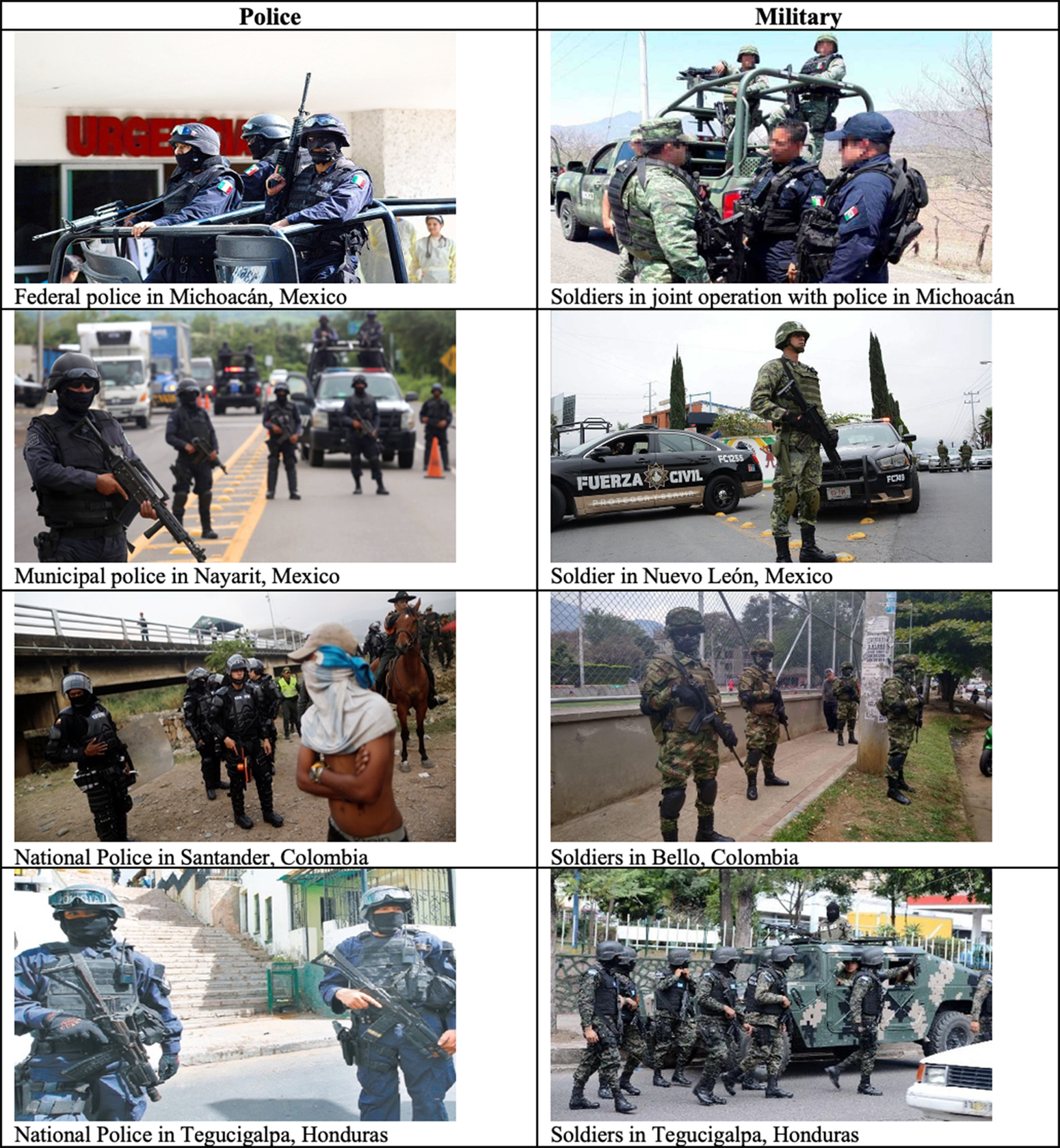
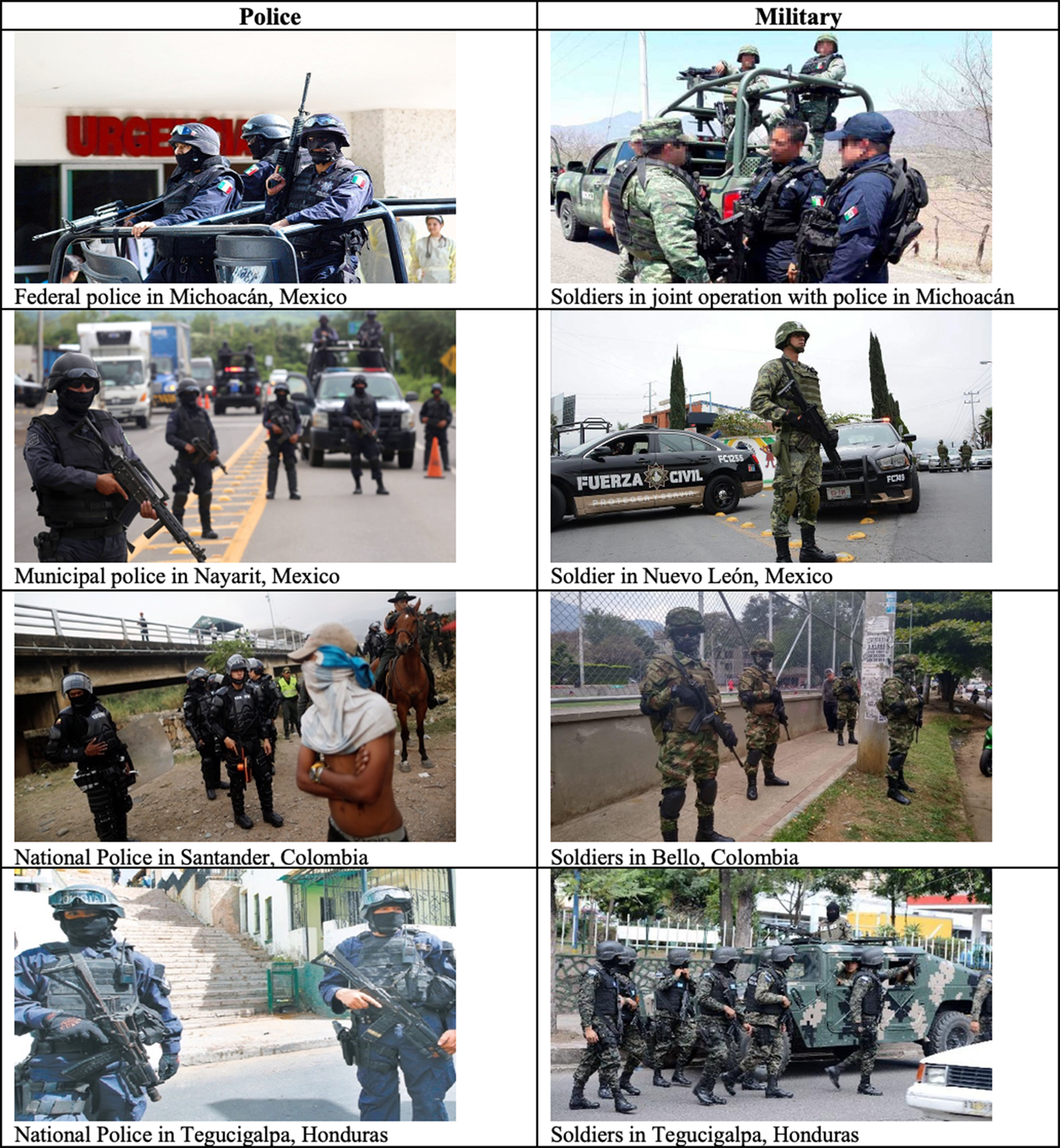
Further, as shown in Figure 4, the images of militarized police and constabularized military shown in the experiment are fairly typical in many Latin American countries. In Mexico, although the exact features of police uniforms vary slightly across levels of government (municipal, state, federal) and function (ministerial, anti-riot, etc.), militarized police typically wear blue uniforms and dark bulletproof vests. Mexico's armed forces also wear slightly different uniforms depending on the mission and military branch, but soldiers involved in domestic operations typically wear the olive green camouflaged uniform. It is also not unusual to find both police and soldiers with long weapons in Mexico (as shown in Figure 4 and in the Appendix). The pictures shown for the experiment reflect these features, which is important to enhance ecological validity. Whereas exploring the use of images in traditional, non-militarized police uniform would also be interesting, given limited resources,Footnote 9 attention to ecological validity, and that this might not generate a conservative effect, we opted for images that would help evaluate whether a subtle change from a militarized police baseline to constabularized armed forces would have a noticeable effect on perceptions.
As with the uniform, the weapon varied in a subtle way as well. Whereas the baseline version shows no rifle, the other version showed parts of a military-grade assault rifle behind the person – the stock is visible over the shoulder and the barrel next to the opposite thigh, but the middle part is hidden behind the person. The partial concealment of the assault rifle would also likely yield a more conservative effect than a prominently displayed weapon.
Variation in skin color is also relatively subtle, since only the face and part of the neck are exposed in the images. One version presents light skin and the other darker skin. The face is the same, but the difference in skin color was generated by modifying the contrast in Photoshop.
For gender, we varied the face but maintained the rest of the image constant, including the body, height and complexion. A woman's face was included in one version, and man's face was included in the other. Both faces have a similar, relatively stern expression. All sixteen images have a plain gray background.
Below each pair of images, respondents were asked about their perceptions of the effectiveness, respect for civil liberties and propensity for corruption of the individuals in the images. They were also asked whether they would support the personnel in the images conducting law enforcement tasks in their own neighborhood. For example, respondents first read: ‘The following are images of two people that work in law enforcement. Please observe both images carefully and answer the following questions.’ This statement was followed by ‘How would you rate their effectiveness?’;Footnote 10 ‘To what extent do you think they respect civil liberties?’; ‘How prone to engaging in corruption do you think they are?’; ‘To what extent would you support or oppose them in your neighborhood?’ The images appeared at the beginning of every question to ease the cognitive burden, rather than having to memorize the profiles.
To identify which components of the images were influential, we followed Hainmueller, Hopkins and Yamamoto's (Reference Hainmueller, Hopkins and Yamamoto2014) non-parametric approach to component-specific treatment effects. Our causal quantity of interest is the average marginal component effect (AMCE). We measured the AMCE with completely independent randomization (that is, no restrictions on the possible attribute combinations) because we are interested in how different values of the l th attribute of the jth profile influence an image's rating. The AMCE represents the marginal effect of attribute l over the joint distribution of the remaining attributes and can be interpreted as the average change in an image's rating when we include certain attribute values instead of the baseline attribute value.
Results
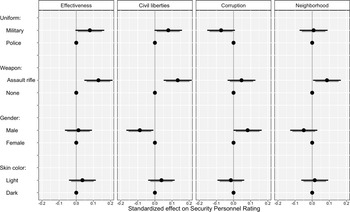
Figure 5 summarizes the effects of weapon, uniform, gender and skin color on the four outcomes of interest. Military weapon and military uniform had a significant effect when respondents were shown a pair of images and asked to rate the effectiveness of each on a 10-point scale (rescaled from 0 to 1), from not at all effective to very effective. On the 0 to 1 scale, individuals with a military weapon receive ratings 0.13 standard deviations higher than those without one, and the effect of wearing a military uniform was about half of that for the military weapon. Additionally, we do not find a significant effect for gender or skin color on perceptions of effectiveness.
Effects of attributes on the rating of security personnel
Note: this plot shows estimates of the effect of randomly assigned attributes (uniform, weapon, gender and skin color) on the rating of a security personnel image, measured in standard deviations. Estimates are based on the benchmark OLS model with robust standard errors clustered by respondent. Black bars represent 95 per cent confidence intervals and gray bars 90 per cent confidence intervals. The points without bars represent the reference category for each attribute. Effectiveness is measured from not at all to very effective; civil liberties is measured from never respects to always respects; corruption is measured from not at all prone to very prone to commit acts of corruption; and neighborhood is measured from strongly oppose to strongly support.

Regarding civil liberties, both weapon and uniform had a significant effect on respondents' views. The assault rifle increased the perception of respect for civil liberties by 0.13 standard deviations. The military uniform increased perceptions of respect for civil liberties by about half the magnitude of the effect of the weapon. Male personnel decreased perceptions of respect for civil liberties by one-tenth of a standard deviation compared to female images. We do not find an effect for lighter skin on perceptions of respect for civil liberties.
Regarding corruption, military uniform decreased perceptions by 0.07 standard deviations. Military weapon increased perceptions of corruption but did not reach statistical significance. Male images increased perceptions of corruption by about a tenth of a standard deviation. Skin color did not shift perceptions of corruption.
For the question of whether respondents would support or oppose the personnel in the images conducting law enforcement in their own neighborhood, military weapon increased support by about a tenth of a standard deviation, but military uniform showed no effect. Male images reduced support, but the estimate falls short of significance at conventional levels. There was no effect for differences in skin color.
Interactions with Contextual and Respondent Characteristics
The baseline results enable us to assess the overall importance of different visual aspects of constabularization on public perceptions of law enforcement. Yet our empirical design and research setting also allow us to test for potential moderators of the component effects described above. One such test is whether the military's past participation in public safety affects perceptions of its involvement in domestic policing. Mexico is an ideal setting in which to explore this question because we can leverage the sub-national variation in military operations to compare respondents’ views across constabularized and non-constabularized municipalities.
Given that most information on the Mexican military is not public, we submitted a right-to-information request to obtain municipal-level data on the military's participation in domestic policing. In response, the Defense Ministry (SEDENA) provided information on the military's confrontations with criminal organizations between January 2007 and February 2018.Footnote 11 Though confrontations are an imperfect measurement of military presence, it serves as a reasonable proxy for constabularization because it provides information on the location and intensity of the military's operations. Further, SEDENA rejects most right-to-information requests related to the military's domestic missions on national security grounds (Storr and López Portillo Vargas Reference Storr and López Portillo Vargas2019), making confrontations data all the more valuable for our purposes.
We aggregated the number of confrontations from January 2007 to February 2018 for each municipality and use this measurement to proxy for the degree of military presence in a respondent's municipality. Specific to the municipalities in our survey sample, accumulated confrontations between the military and criminal organizations range between 0 and 101, and close to 50 per cent of the surveyed individuals resided in municipalities with no military confrontations.
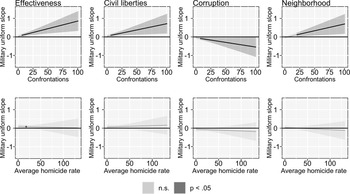
As shown in the top row of Figure 6, compared to the police baseline, we find an increase in the effect of military uniform on people's perceptions as the military presence intensifies. The effect of military uniform on perceptions of effectiveness, respect for civil liberties, corruption and support for conducting law enforcement in one's neighborhood increases with a greater military presence. We did not find differential effects for weapon, gender or skin color. The results are available in the Appendix.
Interaction between military uniform and military presence/violence levels
Note: this figure plots the interaction between confrontations occurring between January 2007 and February 2018 and military uniform in the first row and the interaction between the 5-year average homicide rate and military uniform in the second row. The horizontal axis represents the values of the moderator. On the vertical axis are the values of the slope relating the military uniform attribute to the effectiveness, civil liberties, corruption and neighborhood ratings measured in standard deviations. The gray areas represent 95 per cent confidence intervals, with regions of significance in dark gray.

Since the armed forces are often assigned to the most dangerous areas, we also evaluate whether violent crime, rather than military presence, could be responsible for the observed differences in effects. However, as the bottom row in Figure 6 shows, the conditional effect of military uniform on perceptions of law enforcement personnel is indistinguishable from zero at all values of 5-year average homicide rates. Levels of violence do not appear to shape the effect of military uniform on respondents' views.
Taken together, these results suggest that the military's law enforcement operations further enhance their effect on perceptions. Individuals living in areas where the military conducted public safety operations not only express more favorable views of effectiveness and respect for civil liberties, but are also more supportive of the military policing in their own neighborhoods.
Beyond military presence and levels of violent crime, we also estimated whether causal effects differed by respondent sub-group.Footnote 12 As shown in the Appendix, there are interesting results pertaining to gender, trust in the military and ideology. For example, respondents who report greater trust in the military tend to express more favorable views of law enforcement personnel. A similar pattern holds for more conservative respondents. Also, the results suggest that women tend to have more favorable views of personnel carrying a military-style weapon.
Discussion
The findings suggest that two visual aspects of constabularization, the weapon and uniform, consistently affect public perceptions of law enforcement. Although for both attributes we expected a tradeoff between perceptions of effectiveness and respect for civil liberties, we found no evidence of such tradeoff. Instead, there was an effect in the opposite direction: military uniform and military weapon increased perceptions of respect for civil liberties. This suggests that the perception of authority conveyed by the military uniform and weapon prevails over the human rights scandals the Mexican armed forces have been involved in over the last several years, including accusations of extra-judicial killings, enforced disappearances and torture, including the 2014 disappearance of forty-three students in Ayotzinapa (Human Rights Watch 2019). This might be explained by both a halo effect generated by the more authoritative-looking weapon and the Mexican police's reputation of routinely engaging in human rights violations. However, the term ‘civil liberties’ can be interpreted in different ways by different people – for example, freedom of opinion and protest vs. the right not to be victimized by state forces. Further research should explore whether the effect found for civil liberties is in line with a particular type of understanding.
Although military weapon and military uniform share favorable effects on effectiveness and respect for civil liberties, important differences are worth highlighting. The first is the differentiated effect on perceptions of corruption. Whereas we expected a decline in perceptions of corruption for both military weapon and military uniform because of the armed forces' greater reputation of discipline and integrity, only the uniform generated an effect in line with expectations. This result reflects the prevailing belief in Mexico that police are synonymous with corruption.
The other differentiated effect relates to support for patrolling the respondent's neighborhood. Military uniform fell short of expectations in that it did not shift public attitudes, but the military weapon did. This is ultimately a hard test of support because, rather than asking in the abstract, it brings the prospect of militarization close to home.
Gender also played a role in some cases. Although it did not affect perceptions of effectiveness, male images reduced perceptions of respect for civil liberties, increased perceptions of corruption and reduced support for patrolling the respondent's neighborhood. Whereas the literature on gender and security sector has offered mixed results (for example, Breci Reference Breci1997; Calderón Reference Calderón Garrido2010; Karim Reference Karim2019), we find that women are associated with desirable features – such as being less corrupt and more respectful of civil liberties – and are not perceived as being less effective. This finding suggests that policies to recruit more female officers and increase the sex ratio in security forces might have positive effects on the prevailing sentiment towards security institutions.
The inability to find an effect for skin color was surprising, because Mexico is a fairly hierarchical society along ethnic lines. As Aguilar Pariente (Reference Aguilar Pariente2011) and Trejo and Altamirano (Reference Trejo, Altamirano, Hooker and Tillery2016) have pointed out, greater discrimination occurs with darker skin color. Although there is a slight change in perceptions of images with lighter skin color as more effective, more respectful of human rights, less corrupt and enjoying greater support for patrolling the respondent's neighborhood, this change is very small and not significant. One reason could be that in the context of Mexico's public safety landscape, skin color becomes overshadowed by other attributes of law enforcement personnel, which is consistent with Weitzer's (Reference Weitzer2000) findings in the United States.
The interactions with military presence and levels of crime suggest that the effect of the uniform is exacerbated by a greater military presence in a municipality. Our finding that the effect is not affected by levels of crime suggests that respondents' perceptions might be driven not by frustration with levels of insecurity, but by the sustained presence of the armed forces themselves, regardless of effectiveness.
The effects discussed above would likely be larger if the treatments were less subtle. For example, a more prominently displayed assault rifle could generate larger effects. The same can be said for the difference between military uniform and traditional police uniform, instead of the militarized tactical police uniform shown in the images as the reference category.
Finally, a common challenge for experimental work is ecological validity, or the extent to which it can approximate real-world conditions. Although images are not quite as realistic as videos or actual interactions, they improve on the text-based or vignette-style experiments that have dominated the conjoint experiment literature in political science to date. Since most people's interactions with law enforcement personnel are visual, passive, and without any formal dialogue or engagement, the visualization of images is not far removed from the type of distant visualization that takes place for the vast majority of the population (Simpson Reference Simpson2017).
Conclusion
This study's findings make several important contributions to theory and policy. While public opinion surveys have pointed to the broad popularity of militarization, our results are the first to shed light on how the armed forces' constabularization affects perceptions of law enforcement in the developing world.
In particular, we show that both military weapons and uniforms elicit perceptions of greater effectiveness and respect for civil liberties among the public, and that weapons have a greater effect than uniforms. However, whereas a military weapon led to greater support for operating in one's neighborhood, a military uniform reduced perceptions of a propensity for corruption. The effects found for military uniform were exacerbated in municipalities with a greater armed forces presence, regardless of the policy's effectiveness in reducing levels of crime. As for the other visual features, although we did not find an effect for skin color, female personnel can generate greater support for patrolling the respondent's neighborhood, as well as higher perceptions of respect for civil liberties and integrity.
The results suggest a conundrum: the feature that elicits the most favorable attitudes towards law enforcement – the use of military-grade weapons – is also the very aspect that has been most associated with greater levels of violence resulting from militarization more broadly. A number of studies have found that the use of military weapons for policing purposes results in more suspects wounded or killed by police (for example, Lawson Reference Lawson2019; Pérez-Correa, Silva and Gutiérrez Reference Pérez-Correa, Silva and Gutiérrez2015).Footnote 13 Employing military weapons can make law enforcement personnel feel like they are in a conflict scenario where greater violence should be used (Doherty Reference Doherty2016, 446).
Further, because of the considerable leeway involved in policing (Mastrofski Reference Mastrofski2004), the more potentially damaging the weapon at hand, the more severe the violence that will result from encounters with suspects. While there are protocols guiding police action, decisions on the ground must often be made in split-second calculations, without continuous supervision, following ambiguous regulations or laws and under considerable stress. Operational discretion is even greater in the developing world, where standard operating procedures are less developed and legal uncertainty is prevalent (Sabet Reference Sabet, Olson, Shrik and Selee2010). In short, one of the aspects identified as contributing to greater violence from constabularization in the number of people wounded or killed is also a key main driver of favorable attitudes.
In addition to advancing the scholarship on attitudes towards punitive populism in Mexico, this study's findings contribute to the literature on why citizens support ineffective policies or those that run counter to their own interests (Caplan Reference Caplan2007). This article begins to make sense of the reasons behind this disconnect using evidence from Mexico. Although Mexico shares relevant factors with other Latin American countries – such as the armed forces conducting domestic policing, higher trust in the military than police, white skin as the aspirational skin tone and stereotypes about women as less effective but more caring – further research should evaluate whether the findings travel to other developing countries.
The findings also have important implications for policy makers and international organizations concerned with good governance reforms in the security sector, as well as strategies to improve people's opinions of security forces worldwide. The findings suggest that, in line with the literature on women in policing and peacekeeping (Barnes, Beaulieu, and Saxton Reference Barnes, Beaulieu and Saxton2018; Karim Reference Karim2019), relying on women for law enforcement can elicit desirable perceptions – including greater integrity and respect for civil liberties. These favorable perceptions lend support to some police departments' efforts to design ambitious strategies to recruit female personnel, such as in Morelia, Mexico. Doing so is bound to not only improve perceptions, but also bring positive institutional change from within.
Supplementary material
Online appendices are available at https://doi.org/10.1017/S0007123421000259.
Data availability statement
Replication data for this paper can be found in Harvard Dataverse at: https://doi.org/10.7910/DVN/UMUEOK.
Acknowledgments
We received helpful feedback from presentations at Australia National University's School of Politics and International Relations, Princeton University's State Capacity and Public Goods Conference, and Syracuse University's Workshop on Emerging Trends in Latin American Politics, as well the American Political Science Association's 2019 annual meeting. We are especially grateful to John Bailey, CIDE's Social Science Experimentation Unit, Eduardo Clark, Matthew Cleary, Juan Fernando Ibarra del Cueto, Matthew Ingram, Sarah Kreps, Pablo Parás, Tom Pepinsky, Lucía Tiscornia, Erik Wibbels, Richard and Maritza Williamson, Daniel Zizumbo-Colunga and anonymous reviewers for their comments.
Financial support
This work was supported by the Centro de Investigación y Docencia Económicas' (CIDE) Social Science Experimentation Unit's Lab through an open call for proposals for its 2018 Experimental Omnibus Survey.
Conflicts of interest
None.
Ethical standards
This study's protocol [#1803007838] was granted exemption from IRB review according to Cornell IRB policy and under paragraph(s) 2 of the Department of Health and Human Services Code of Federal Regulations 45CFR46.101(b).