

Unethical behaviors continue to be a concern in the workplace. Despite many research has been conducted to study the antecedents of unethical behavior, much of the behavioral ethics literature has focused on individual characteristics, moral issue characteristics, and organizational culture/climate (for a quantitative summary, see Kish-Gephart, Harrison, & Trevino, Reference Kish-Gephart, Harrison and Trevino2010). More recently, behavioral ethics researchers have begun to pay attention to the role of affect in unethical behavior (Trevino, den Nieuwenboer, & Kish-Gephart, 2014). However, the literature on affect and ethics is generally silent about what happens when employees engage in emotional labor. In this study, we call attention to the organizational costs of “service with a smile.” We contend that affective display rules imposed by organizations are likely to motivate employees to behave unethically, producing negative results that are contrary to the organization’s intent.
Many organizations—especially those in industries that involve interaction with customers—have clear expectations regarding affective displays (Brotheridge & Grandey, Reference Brotheridge and Grandey2002; Groth, Hennig-Thurau, & Walsh, Reference Groth, Hennig-Thurau and Walsh2009; VanMaanen & Kunda, Reference VanMaanen and Kunda1989). Typically, these expectations, or “display rules,” signal that employees should display positive affect and avoid displaying negative affect (Diefendorff, Croyle, & Gosserand, Reference Diefendorff, Croyle and Gosserand2005). However, employees experience a broad range of affective states (Weiss & Cropanzano, Reference Weiss and Cropanzano1996), which may often conflict with display rules. Employees may attempt to address the gap between their experienced and displayed affect through emotional labor (Hochschild, Reference Hochschild1979, Reference Hochschild1983), specifically through either surface acting or deep acting. With surface acting, one seeks to change affective displays without altering underlying feelings, whereas deep acting entails an effort to change genuine feelings to conform to required displays (Scott & Barnes, Reference Scott and Barnes2011: 116; see also Grandey, Reference Grandey2000, and Gross, Reference Gross1998).
Although emotional labor, and in particular surface acting, has been linked to detrimental outcomes such as emotional exhaustion (e.g., Hulsheger & Schewe, Reference Hulsheger and Schewe2011), strain (Wagner, Barnes, & Scott, Reference Wagner, Barnes and Scott2014), and work withdrawal (Scott & Barnes, Reference Scott and Barnes2011), it remains unclear whether managing one’s emotions can lead to more active forms of negative behavior that may do direct harm to others. The emotional labor literature has to date not only failed to examine unethical behavior as an outcome, but it also has implicitly assumed that the negative effects of emotional labor (especially surface acting) reside solely in the employee. We challenge this assumption and show how emotional labor (especially surface acting) has implications beyond the well-being of the employee.
Accordingly, the purpose of this article is to extend the behavioral ethics literature by integrating theory and research on emotional labor and the slippery slope effect. We test these predictions in three separate studies.
THEORETICAL DEVELOPMENT
Surface Acting, Emotional Inauthenticity, and Unethical Behavior
In her seminal work The Managed Heart, Hochschild (Reference Hochschild1983) drew attention to the requirement of sustaining a certain affective display for employees in the service sector and defined emotional labor as the process of managing one’s emotions for fulfilling emotional display rules. When there is a discrepancy between experienced emotions and those required by display rules, there are two primary actions that employees can take in order to close the gap. They may either alter their emotions by reappraising the situation or hide their emotions by faking their facial expression – the two strategies commonly known as deep acting and surface acting (Grandey, Reference Grandey2000, Reference Grandey2003). Surface acting entails displaying affect that is different from what one is actually experiencing, whereas deep acting entails changing one’s underlying affective experience. Early research on emotional labor viewed it as individual-difference tendency to engage in one strategy or another. More recently, Beal, Trougakos, Weiss, and Green (Reference Beal, Trougakos, Weiss and Green2006) and Scott, Barnes, and Wagner (Reference Scott, Barnes and Wagner2012) noted that emotional labor is an episodic and dynamic process that varies over time, such that people may engage in surface acting at one point in time, deep acting at another point in time, and no emotional labor at all at other points in a given day. In this sense, unlike a trait that is relative stable over time, emotional labor is a specific process that an employee can engage in a given moment.
As noted, surface acting involves displaying a positive emotion despite feeling otherwise. Emotional inauthenticity is defined as a psychological state in which individuals experience conflicting tension between felt emotion and displayed emotion (Grandey, Reference Grandey2003). Accordingly, surface acting is an act of inauthenticity, threatening one’s honest expression of the self (Gardner, Fischer, & Hunt, Reference Gardner, Fischer and Hunt2009; Hochschild, Reference Hochschild1983; Humphrey, Reference Humphrey2012; Pugh, Groth, & Hennig-Thurau, Reference Pugh, Groth and Hennig-Thurau2011). Indeed, it is hard to imagine feeling like one is authentic when one has plastered on a fake smile.
Simpson and Stroh (2004: 717) argued that one important reason that surface acting creates feelings of inauthenticity is that the display of unfelt emotions is contrary to a general social contract that is “linked to forthright and open communication of emotional states.” Thus, employees are typically aware of the gap between their expressed and felt emotions and see this as a violation of norms of honesty; this is especially noticeable for those who value the authentic expression of emotion (Pugh et al., Reference Pugh, Groth and Hennig-Thurau2011). Such concerns may be well founded, as research has shown that observers are adept at detecting inauthenticity as a result of surface acting (Grandey, Fisk, Mattila, Jansen, & Sideman, Reference Grandey, Fisk and Steiner2005; Groth, Hennig-Thurau, & Walsh, Reference Groth, Hennig-Thurau and Walsh2009).
Thus, we expect that surface acting will positively influence experiences of emotional inauthenticity. Previous research provides indirect support for this contention. Brotheridge and Lee (Reference Brotheridge and Lee2003) found that surface acting was positively associated with emotion suppression, a behavior that is consistent with emotional inauthenticity. Mesmer-Magnus, DeChurch, and Wax (Reference Mesmer-Magnus, DeChurch and Wax2012) went so far as to combine surface acting, emotion suppression, and emotional inauthenticity into a single category which they labeled “discordant emotional states.” More directly, in a cross-sectional study examining between-person effects, Glomb and Tews (Reference Glomb and Tews2004) found a positive relationship between surface acting and emotional inauthenticity, and within-person effects of emotional labor have often been consistent with between-person effects (c.f., Scott et al., Reference Scott, Barnes and Wagner2012). Accordingly, Hypothesis 1 states that within individuals, surface acting will positively influence experiences of emotional inauthenticity.
Hypothesis 1. Surface acting is positively associated with experiences of emotional inauthenticity.
The conflicting tension involved in emotional inauthenticity essentially is a key to why individuals engage in unethical behavior. To resolve this tension, individuals typically change their attitudes or behavior (Pugh et al., Reference Pugh, Groth and Hennig-Thurau2011). One way to change attitude is through justifying emotional inauthenticity (i.e., it is okay to lie about my feeling because my authority told me to do so). Recent research on the slippery-slope effect highlights how rationalizing small transgressions such as emotional inauthenticity can lead to a gradual decline of ethicality and ultimately increase unethical behavior. Welsh, Ordonez, Snyder, and Christian (Reference Welsh, Ordonez, Snyder and Christian2015) contend that people may be prone to small ethical transgressions, particularly those that involve a minimal amount of harm, because they can be easily justified. Empirical evidence supports this argument, showing a negative association between severity of an ethical transgression and the likelihood that an individual engages in it (Kish-Gephart et al., Reference Kish-Gephart, Harrison and Trevino2010). For example, Mazar, Amir, and Ariely (Reference Mazar, Amir and Ariely2008) found that participants were more likely to cheat in order to obtain $0.40 than they were to obtain $2.50. However, Welsh and colleagues (2015) further contend that through engaging in small ethical transgressions, individuals may become more accepting of unethical behavior, making them more prone to engage in future unethical behavior. This gradual decline of unethicality is referred to as the slippery-slope effect. Indeed, in a set of two experiments, Welsh et al. (Reference Welsh, Ordonez, Snyder and Christian2015) demonstrated that participants were more likely to cheat when given the chance to start with small levels of cheating than when abruptly given the chance to cheat.
More specifically applying the slippery-slope framework to emotional labor, we contend that emotional inauthenticity is an important first step along the slippery slope. Emotional inauthenticity is a form of dishonesty, violating general norms for honesty in a manner analogous to lying on a relatively small scale. By engaging in this small lie, employees become more accepting of unethical behavior, enabling subsequent ethical transgressions that they would otherwise avoid. Similarly, people are more likely to engage in fraud when they feel fraud (Gino, Norton, & Ariely, Reference Gino, Norton and Ariely2010). In a series of laboratory experiments, Gino et al. (Reference Gino, Norton and Ariely2010) showed that participants who wore counterfeit sunglasses (as opposed to authentically-branded sunglasses) felt more fake and inauthentic, which led to more cheating behaviors. In other words, a minimal form of inauthenticity—wearing counterfeit sunglasses —was enough to increase the odds that participants would engage in unethical behavior. These findings are consistent with our contention that emotional inauthenticity, which we consider to be a form of dishonesty that is similar to wearing counterfeit sunglasses, will enable subsequent unethical behavior. Accordingly, we predict that emotional inauthenticity is positively related to unethical behavior.
Hypothesis 2. Emotional inauthenticity is positively associated with unethical behavior.
Integrating Hypotheses 1 and 2, and drawing from the logic denoted above, we propose that emotional inauthenticity positively influences unethical behavior and that emotional inauthenticity mediates the effect of surface acting on unethical behavior. Hypotheses 3 and 4 highlight these expectations.
Hypothesis 3. Surface acting is positively associated with unethical behavior.
Hypothesis 4. Emotional inauthenticity mediates the effect of surface acting on unethical behavior.
Deep Acting, Emotional Inauthenticity, and Unethical Behavior
Deep acting involves actively changing experienced affect in order to bring it into alignment with display rules. As noted by Grandey (Reference Grandey2000), this may involve individuals deploying attention elsewhere by focusing on thoughts to elicit desired affective states, or changing their cognitive perspective by reappraising their situation. There is some disagreement in the emotional labor literature regarding whether or not this leads to emotional inauthenticity; therefore, we derive competing predictions that can be tested in order to shape emotional labor theory in a more parsimonious and accurate manner (c.f. Leavitt, Mitchell, & Peterson, Reference Leavitt, Mitchell and Peterson2010).
From the perspective of experienced emotion, deep acting can be seen as an authentic display of emotion that lowers any possibility of emotional inauthenticity. As the emotional labor literature notes, the purpose of deep acting is to actually change one’s underlying affective experience. Specifically, Brotheridge and Lee (2003) and Lee and Brotheridge (Reference Lee and Brotheridge2011) argued that deep acting should reduce emotional inauthenticity by closing the gap between display rules and experienced emotion. Phillipp and Schupbach (Reference Phillipp and Schupbach2010) similarly argued that after deep acting, displayed affect, and experienced affect are brought into authentic alignment, preventing emotional inauthenticity. Hulsheger and Schewe (Reference Hulsheger and Schewe2011) argued that with deep acting, emotional inauthenticity is irrelevant because there is no gap between experienced and displayed affect. Mesmer-Magnus et al. (Reference Mesmer-Magnus, DeChurch and Wax2012) went so far as to categorize deep acting and emotional consonance together in a higher-order category of emotional congruence, implicitly agreeing with deep acting as an emotional labor strategy that is low in emotional inauthenticity. Also consistent with these contentions is research by Scott and Barnes (Reference Scott and Barnes2011), which found that deep acting was positively associated with state positive affect; their data suggest that for their participants, deep acting was successful in shrinking the gap between experienced affect and positive display rules. Thus, one hypothesis is that deep acting will negatively influence emotional authenticity.
Hypothesis 5. Deep acting is negatively related to experiences of emotional inauthenticity.
However, a counterargument is that this view treats naturally occurring expressions of affect as equivalent to the product of deep acting. Deliberately changing a naturally occurring emotional experience in order to try to shift to another affective experience could be seen as overriding authentic expression with an inauthentic manipulation of mood. Although research does indicate that deep acting improves the mood of employees (Scott & Barnes, Reference Scott and Barnes2011), it is through an artificial process that participants may view as inauthentic (Ashforth & Humphrey, Reference Ashforth and Humphrey1993), including distraction from stimuli that produce affect inconsistent with one’s goal, and reappraisal of events to try to produce the desired affective state. If one were experiencing negative affect due to a sad event such as a death in the family, distracting one’s self from sadness may be not viewed as authentic. Similarly, reappraising the situation to try to find the silver lining may also be viewed as inauthentic.
On this point, Scott et al. (Reference Scott, Barnes and Wagner2012) argued that over time, discrete episodes of deep acting may become harmful, distorting the experience of emotion and producing feelings of self-alienation and inauthenticity. Ashforth and Humphrey (Reference Ashforth and Humphrey1993) made a similar argument that deep acting distorts and blunts one’s natural emotional reactions, impairing one’s sense of self, as well as one’s ability to recognize and experience genuine emotion. Ashforth and Humphrey illustrated this point by describing a prostitute interviewed in another study who speaks of distracting herself from her real emotions while on the job, but having a hard time becoming emotionally authentic again while off the job (Terkel, Reference Terkel1974). Indeed, meta-analytic data indicates that deep acting has negative relationships with many well-being related constructs (Hulsheger & Schewe, Reference Hulsheger and Schewe2011). Thus, it is reasonable to expect that deep acting may lead to emotional inauthenticity as well.
Drawing from the logic above, we test competing hypotheses that deep acting will positively/negatively influence emotional inauthenticity. Hypotheses 5 and 6 represent these competing predictions.
Hypothesis 6. Deep acting is positively related to experiences of emotional inauthenticity.
As noted in Hypothesis 2, we expect emotional inauthenticity to positively influence unethical behavior. Inauthenticity violates a norm of honesty, essentially serving as a small scale lie. We contend that, consistent with the slippery-slope effect noted by Gino and Bazerman (Reference Gino and Bazerman2009) and Welsh et al. (Reference Welsh, Ordonez, Snyder and Christian2015), a dishonest expression of emotion will promote other forms of unethical behavior. Gino et al. (Reference Gino, Norton and Ariely2010) find clear links between experienced inauthenticity and proclivity for unethical behavior.
Our interest in this article is the influence of emotional labor on unethical behavior. As noted in Hypotheses 5 and 6, we have competing hypotheses for the effects of deep acting on emotional inauthenticity. Drawing from these, as well as Hypothesis 2, we form competing hypotheses for the effects of deep acting on unethical behavior. One such set of hypotheses is that deep acting will negatively influence emotional inauthenticity, which will in turn positively influence unethical behavior. The other is that deep acting will positively influence emotional inauthenticity, which will still positively influence unethical behavior. Hypotheses 7-10 reflect these expectations.
Hypothesis 7. Deep acting is negatively related to unethical behavior.
Hypothesis 8. Emotional inauthenticity mediates the negative effect of deep acting on unethical behavior.
Hypothesis 9. Deep acting is positively related to unethical behavior.
Hypothesis 10. Emotional inauthenticity mediates the positive effect of deep acting on unethical behavior.
Overview of Studies
To test our hypotheses, we conducted three separate studies to examine the relationship between emotional labor and unethical behaviors. Studies 1 and 2 used an experience sampling method (ESM) research design to capture the dynamic of the within-person changes. Study 3 used a two-wave research design to examine between-person changes.
STUDY 1 METHOD
Sample and Procedure
We recruited 300 participants through Amazon’s Mechanical Turk (MTurk). Recent comparison studies have demonstrated that data collection through MTurk can be as reliable as those collected through traditional methods (Buhrmester, Kwang, & Gosling, Reference Buhrmester, Kwang and Gosling2011) and samples drawn from MTurk are more representative of the US population than convenience samples (Berinsky, Huber, & Lenz, 2012). These studies provide support for the value of MTurk for conducting empirical research.
Our sample was composed of participants who had full-time employment outside of MTurk. The recruitment notice indicated that full-time employment was a requirement for participation. To confirm their full-time work status, participants were asked to indicate “yes” or “no” to the question, “Do you hold a job that requires you to work at least 40 hours a week?” Moreover, in order to hold constant the effects of language and culture, we only recruited participants from the United States. A total of 282 of the 300 recruited participants completed the entry survey. The conceptual model tested by this study requires an examination of participants over time. Thus, participants who completed less than two of the five daily surveys were removed from the analyses, leaving a final sample of 123 participants who completed a total of 494 daily surveys. Our final sample included 46 males and 77 females. In terms of age, 13.7 % were between 18 and 21, 17.1 % were between 22 and 25, 19.8% were between 26 and 30, 24.7 % were between 30 and 39, and 22.9% were older than 40. In terms of ethnicity, 73.7% of participants reported as Caucasian, 10.6% as African-American, 9.9% as Asian, 2.7% as Hispanic, and the remainder chose “other.”
The data were collected using ESM over a one-week period. A week prior to the ESM portion of the study, participants were recruited by completing an online entry survey which consisted of questions that aimed to validate their full-time work status. Upon meeting the full-time work status requirement, participants were asked to provide their demographic information (gender, age, and ethnicity) and their email for us to send them the daily survey. On each workday of the following week (five workdays total), participants received an email with the link to the daily survey near the end of their work shifts. The daily survey asked participants to describe their engagement in emotional labor (i.e., surface acting/deep acting) and affective states (i.e., NA/PA), the extent to which they suppress their emotion at work (i.e., emotional inauthenticity), and report their behaviors at work (i.e., unethical behaviors). To ensure that participants completed their daily surveys after or near the end of their work shifts, daily surveys were sent to participants at 3:00 pm and automatically set to expire at 11:00 pm. A reminder email was sent to those who had not completed the daily survey at 7:00 pm. Participants received $0.25 USD for each survey they completed.
Measures
Items for all main measures in the study are provided in the Appendix.
Surface acting. Surface acting was measured with the five items developed by Brotheridge and Lee (Reference Brotheridge and Lee2003) and Grandey (Reference Grandey2003), and further refined for use in day-level experience sampling method designs by Scott and Barnes (Reference Scott and Barnes2011). Responses were given on a scale ranging from 1 (very slightly or not at all) to 5 (very much). The coefficient alpha of this measure, averaged across days, was .94.
Deep acting. Deep acting was measured with three items developed by Brotheridge and Lee (Reference Brotheridge and Lee2003) and Grandey (Reference Grandey2003), and further refined for use in day-level experience sampling method designs by Scott and Barnes (Reference Scott and Barnes2011). Items referenced behavior in that given day, with responses on a 5-point Likert scale. The coefficient alpha of this measure, averaged across days, was .90.
Emotional inauthenticity. We adapted the four-item scale used in Diestel and Schmidt (Reference Diestel and Schmidt2011). The response format of this scale ranged from 1 (never) to 5 (very often). The coefficient alpha of this measure, averaged across days, was .92.
Unethical behavior. Unethical behavior was measured by using five items from Akaah’s (1992) scale of unethical behavior at work, adapted for daily use by Barnes, Schaubroeck, Huth, and Ghumman (Reference Barnes, Schaubroeck, Huth and Ghumman2011). The response format of this scale ranged from 1 (never) to 8 (daily). The coefficient alpha of this measure, averaged across days, was .73.
Control variables. Given that affect may drive emotional labor, and that affect has been linked to unethical behavior (Christian & Ellis, Reference Christian and Ellis2011), we included measures of positive affect and negative affect drawn from the short version of the Positive and Negative Affect Schedule (PANAS). Specifically, we used the ten items (5 each for positive affect and negative affect) provided by MacKinnon, Jorm, Christensen, Korten, Jacomb, and Rodgers (1999). Responses were rated from 1 (very slightly or not at all) to 5 (very much). Including this control allowed us to separate the otherwise-entangled constructs of experienced emotion and emotional labor. Coefficient alphas for positive affect and negative affect, averaged across days, were .90 and .92, respectively.
Analysis
Study 1 focuses on daily experiences of employees. This means that the daily data are nested within individuals, which violates the independence assumption of OLS regression. Accordingly, we conducted our analyses in a multilevel framework using hierarchical linear modeling (HLM). This approach allowed us to analyze daily fluctuations in the constructs of interest while effectively removing between-person variance in these constructs. All of the variables in our model are at the within-person level of analysis (level 1); there were no substantive variables at the person-level of analysis (level 2). Thus, level 2 was included only to parse out between-individual effects, eliminating concerns about non-independence of observations. To test mediation effects, we followed the procedure recommended by Krull and MacKinnon (Reference Krull and MacKinnon2001) for testing multilevel mediation models. A significant mediation exists when the mediator is included in the regression equation, the effect of the independent variable is reduced while the effect of the mediator remains significant. The Sobel test was used to determine whether the reduction in the effect of the independent variable was significant.
STUDY 1 RESULTS
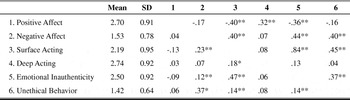
Prior to testing our hypotheses, we investigate the amount of variance in unethical behavior that was between- versus within-person. Consistent with a dynamic view of unethical behavior, 37% of the variance was within individuals. This provides empirical justification for examining within-person variance in our outcome of interest. Table 1 shows the means, standard deviations, and correlations. Of note is that although the within-person correlation between surface acting and emotional inauthenticity was moderately strong (r = .47), the between-person correlation between surface acting and emotional inauthenticity was considerably higher (r = .84). The between-person correlation is likely inflated due to aggregation bias (James, Reference James1982), and the between-person relationship between surface acting and emotional labor lies outside of the scope of our model. However, we conducted a between-person confirmatory factor analysis to assess the discriminant validity of surface acting and emotional inauthenticity. A one-factor structure (χ 2 [27] = 242.04, p = .00, CFI = 0.916, RMSEA = 0.267) including all nine surface acting and emotional inauthenticity items fit the data significantly worse than a two-factor structure (χ 2 [26] = 45.56, p =.01, CFI = 0.992, RMSEA = 0.082) that distinguished between surface acting and emotional inauthenticity (Δχ 2 = 196.48, p < .001). Thus, even between individuals these constructs are distinct, with that distinction considerably greater within individuals (r = .47).
Descriptive Statistics and Correlations in Study 1

Note. Within-person correlations are below the diagonal (n = 494), and between-person correlations are above the diagonal (n = 123). *p < .05; **p < .01.
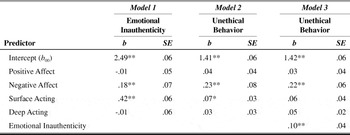
Hypothesis 1 stated that surface acting will be positively related to experiences of emotional inauthenticity. The regression results can be found in Table 2. As shown in Model 1, surface acting had a positive and statistically significant relationship with emotional inauthenticity (b = .42, p < .01). Hypothesis 2 stated that emotional inauthenticity will be positively related with influence unethical behavior. As indicated by Model 3, emotional inauthenticity had a positive and statistically significant relationship with unethical behavior (b = .10, p < .01). Hypothesis 3 stated that surface acting will be positively associated with unethical behavior. There was a positive and statistically significant relationship between surface acting and unethical behavior (b = .07, p < .05). Hypothesis 4 stated that emotional inauthenticity will mediate the effect of surface acting on unethical behavior. Mediator analysis indicates a positive and significant indirect effect (b = .04, Z = 2.45, p < .05). Thus, Hypotheses 1-4 were supported.
Regression Analyses in Study 1

Note. All level-1 predictors were centered at individuals’ means (n = 123). All level-2 predictors were grand-mean centered (n = 494). b = unstandardized regression coefficient obtained in HLM. *p < .05; **p < .01.
Hypotheses 5 and 6 offered competing predictions for the relationship between deep acting and emotional inauthenticity. Hypothesis 5 stated that deep acting will be negatively related to experiences of emotional inauthenticity. Hypothesis 6 stated that deep acting will be positively related to experiences of emotional inauthenticity. As shown in Model 1, deep acting had no effect on emotional inauthenticity (b = -.01, n.s.), failing to support either Hypothesis 5 or 6.
Hypotheses 7 and 9 offered competing predictions about the relationship between deep acting and unethical behavior, with Hypotheses 8 and 10 suggesting emotional inauthenticity as the mediator of these competing predictions. As shown in Model 2, deep acting did not have a significant relationship with unethical behavior (b = .03, n.s.), failing to support either Hypothesis 7 or 9. Moreover, given that there was not a significant relationship between deep acting and emotional inauthenticity, there is no empirical support for emotional inauthenticity as a mediator of the relationship between daily deep acting and daily unethical behavior. This fails to support either Hypothesis 8 or 10. Footnote 1
STUDY 1 DISCUSSION
Consistent with expectations, surface acting had a positive relationship with unethical behavior. Moreover, this relationship was mediated by emotional inauthenticity. Thus, it appears that even if surface acting might have the possibility of leading to more pleasant social exchanges for customers, it has the clear downside to the organization in that it is associated with higher levels of unethical behavior.
With regard to deep acting, the results were not consistent with our predictions. Drawing from the extant literature, we derived competing predictions about the relationships between deep acting and both emotional inauthenticity and unethical behavior. However, there were null effects of deep acting on emotional inauthenticity and unethical behavior. It is possible that the competing effects noted in our hypotheses offset each other to produce null effects, or that deep acting is simply not relevant in determining emotional inauthenticity and unethical behavior.
An important limitation is that self-report measures of the constructs in our model may raise concerns about common method variance, although the use of ESM can lessen this concern. One of the methodological advantages of using ESM is that it provides a “representative sampling of immediate experiences in one’s natural environment” (Beal, Reference Beal2015: 4), which helps reduce memory recall bias (Beal, Reference Beal2015). Our model was a within-person model that examined daily variance in these constructs. By person-mean centering, our analyses controlled for individual-level variance that would be associated with response biases (Beal, Reference Beal2015). Moreover, we also controlled for the effects of positive and negative affect, statistically eliminating artifactual effects they may have.
In addition, self-report measures of unethical behavior may raise concerns that participants will be unwilling to admit their own unethical behavior. However, the daily self-report measure we used was also used by Barnes et al. (Reference Barnes, Schaubroeck, Huth and Ghumman2011), whose finding that sleep predicted unethical behavior was replicated across multiple study designs, including supervisor-rated unethical behavior and objective unethical behavior as measured in a laboratory context (Christian & Ellis, Reference Christian and Ellis2011; Welsh, Ellis, Christian, & Mai, Reference Welsh, Ellis, Christian and Mai2014). Similarly, the effect of ethical leadership on unethical behavior holds when measuring unethical behavior through self-report (Schaubroeck et al., Reference Schaubroeck, Hannah, Avolio, Kozlowski, Lord, Treviño and Peng2012) or objectively (Detert, Trevino, Burris, & Andiappan, Reference Detert, Treviño, Burris and Andiappan2007). Thus, although self-report measures of unethical behavior may not include all unethical behavior, they do appear to elicit similar relationships to other constructs as objective measures of unethical behavior and supervisor ratings of unethical behavior.
A final limitation is that although two weeks is a common length of observation time for experience sampling studies conducted for organizational research, Study 1 was only one week in length. This may limit our ability to detect the effects noted in our hypotheses, in part by limiting the amount of within-person variance that could be observed in that period.
In order to address the limitations of the sample and time length restriction, and in an attempt to replicate the results from Study 1, we conducted a second study with a different sample and a longer time frame. Moreover, conducting a second study allowed us to empirically examine the ambiguous null effects of deep acting, helping us to rule out sampling error as a reason we did not detect any significant relationships involving deep acting.
STUDY 2 METHOD
Sample and Procedure
We recruited 216 full-time employees through a sample provided by students of a university. Consistent with the procedure used in Study 1, participants who did not complete the entry survey or at least two daily surveys were removed from our sample. Out of 216 participants, 48 who did not complete the entry survey were removed, and 51 were dropped because they did not complete at least two daily surveys. Our final sample consists of 117 (54.2%) participants with a total of 791 daily surveys. Among the participants, 53 were male and 64 were female. In terms of age, 24.1% were between 18 and 21, 20.3% were between 22 and 29, 3.2% were between 30 and 39, 13% were between 40 and 49, and 39.4% were older than 50. With respect to ethnicity, 76.4% reported as Caucasian, 12% as Asian, 4.2% as African-American, 4.2% as Hispanic, and the remainder chose “other.”
The initial recruitment email was circulated to approximately 800 students enrolled in a management class at a large public university. The study was limited to students with a full-time job, and those without a full-time job were asked to invite a family member or friend with a full-time job to participate. The students received course credit in return for completing this task. To confirm participants’ full-time work status, we asked participants to provide their work email address. Participants who preferred using their personal emails were asked to provide the name of their company and their work phone number for verification purposes.
Similar to the procedure used in Study 1, participants were asked to complete an online entry survey, which asked participants to report their demographic information (gender, ethnicity, and age), one week prior to the ESM portion of the study. On each workday of the following two weeks (10 workdays total), participants received an email containing a link to the daily survey. Therefore, there were 10 possible daily surveys for each participant to complete. Similar to Study 1, the daily survey asked participants to describe their workday (surface/deep acting) and affective states (NA/PA), the extent to which they suppress their emotions at work emotional inauthenticity), and report their work behaviors (unethical behaviors). The daily surveys were sent to participants at 3:00 pm, and set to expire at 11:00 pm. A reminder email was sent to participants who had not completed their daily survey by 7:00 pm.
Measures
Surface acting. Surface acting was measured with the same scale utilized in Study 1. The coefficient alpha of this measure, averaged across days, was .94.
Deep acting. Deep acting was measured with the same scale utilized in Study 1. The coefficient alpha of this measure, averaged across days, was .93.
Emotional inauthenticity. Emotional inauthenticity was measured with the same scale utilized in Study 1. The coefficient alpha of this measure, averaged across days, was .94.
Unethical behavior. Unethical behavior was measured with the same scale utilized in Study 1. The coefficient alpha of this measure, averaged across days, was .84.
Control variables. Parallel to Study 1, we included measures of positive affect and negative affect using the same scales. The coefficient alpha of positive affect, averaged across days, was .90. The coefficient alpha of negative affect, averaged across days, was .87.
STUDY 2 RESULTS
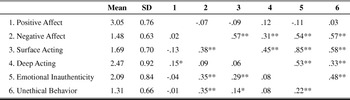
Prior to testing our hypotheses, we analyze the amount of variance in unethical behavior that was between- versus within-person. Consistent with a dynamic view of unethical behavior, 31% of the variance was within-person. This provides empirical justification for examining within-person variance in our outcome of interest. Means, standard deviations, and correlations are provided in Table 3.
Descriptive Statistics and Correlations in Study 2

Note. Within-person correlations are below the diagonal (n = 791), and between-person correlations are above the diagonal (n = 117). *p < .05; **p < .01.
As in Study 1, the between-person correlation between surface acting and emotional inauthenticity was considerably high (r = .85). Thus, we again conducted a between-person confirmatory factor analysis to assess the discriminant validity of surface acting and emotion inauthenticity. A one-factor structure (χ 2 [27] = 329.96, p = .00, CFI = .896, RMSEA = .305) including all nine surface acting and emotional inauthenticity items fit the data significantly worse than a two-factor structure (χ 2 [26] = 103.69, p = .00, CFI = .973, RMSEA = .157) that distinguished between surface acting and emotional inauthenticity (Δχ 2 = 226.27, p < .001). As with Study 1, these constructs are distinct between individuals, with that distinction considerably greater within individuals (r = .29).
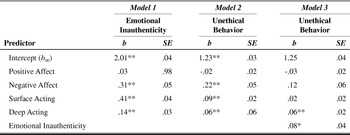
Hypothesis 1 predicted that surface acting is positively associated with experiences of emotional inauthenticity. The regression results can be found in Table 4. As shown in Model 1, surface acting had a positive and statistically significant relationship with emotional inauthenticity (b = .41, p < .01). Hypothesis 2 predicted that emotional inauthenticity is positively associated with unethical behavior. As indicated by Model 3, emotional inauthenticity had a positive and statistically significant relationship with unethical behavior (b = .08, p < .05). Hypothesis 3 stated that surface acting is positively associated with unethical behavior. As indicated in Model 2, there was a positive and significant relationship between surface acting and unethical behavior (b = .09, p < .01). Hypothesis 4 stated that within individuals, emotional inauthenticity mediates the effect of surface acting on unethical behavior. The result of the Sobel test indicated the indirect effect was positive and significant (b = .08, Z = 2.25, p < .05). Thus, Hypotheses 1-4 were supported.
Regression Analyses in Study 2

Note. All level-1 predictors were centered at individuals’ means (n = 117). All level-2 predictors were grand-mean centered (n = 791). b = unstandardized regression coefficient obtained in HLM. * p < .05; ** p < .01.
Hypotheses 5 and 6 offered competing predictions for the relationship between deep acting and emotional inauthenticity. Hypothesis 5 stated that deep acting will be negatively related with experiences of emotional inauthenticity. Hypothesis 6 stated that deep acting will be positively related with experiences of emotional inauthenticity. As indicated by Table 4, deep acting had a positive and statistically significant relationship with emotional inauthenticity (b = .14, p < .01), providing support for Hypothesis 6 rather than Hypothesis 5.
Hypotheses 7 and 9 noted competing predictions for the relationship between deep acting and unethical behavior, with Hypotheses 8 and 10 noting emotional inauthenticity as the mediator of these competing predictions. As indicated by Model 2, deep acting had a positive and significant relationship with unethical behavior (b = .06, p < .01), providing support for Hypothesis 9 rather than Hypothesis 7. The result of the Sobel test showed the mediating effect through emotional inauthenticity was significant (b = .08, Z = 2.08, p < .05), providing support for Hypothesis 10 rather than Hypothesis 8. Footnote 2
STUDY 2 DISCUSSION
Study 2 generally replicated the results from Study 1 with respect to the relationship between surface acting and unethical behavior, with emotional inauthenticity playing a mediating role. In contrast to Study 1, in Study 2 deep acting had a significant positive relationship with unethical behavior and an indirect effect through emotional inauthenticity.
Study 2 involved a sample quite different from that used in Study 1, avoiding some of the limitations from Study 1 involved in drawing from an MTurk pool. In addition, Study 2 had the benefit of examining a longer period of time. It is possible that this allowed us to detect significant direct effects of deep acting on unethical behavior that we were unable to detect in Study 1. Alternatively, sampling error may have played a role in the differential effects across studies, although we note that all of the results were consistent across the two studies with the exception of those pertaining to deep acting.
Perception of Fairness as a Moderator
In Study 1 and 2, we tested the relationships between emotional labor and emotional inauthenticity. It is also important to examine whether emotional labor invariably leads to emotional inauthenticity. Emotional labor research suggests that people vary in how they view display rules. Grandey and Fisk (Reference Grandey, Fisk, Ganster and Perrew2004) found that some employees in the service industry view the display rule as fair, but others did not. Similarly, Pugh, Groth, and Hennig-Thurau (Reference Pugh, Groth and Hennig-Thurau2011) found that not all employees value the importance of expressing authentic emotions to customers. Those employees did not appear to feel inauthenticity and reported experiencing less job strain and dissatisfaction when performing emotional labor.
Indeed, one of the assumptions of emotional labor is that “emotions are bought and sold as an aspect of labor power” (Hochschild, Reference Hochschild1983: 569), so organizations treating employees’ feelings as a commodity can be seen as inherently unfair. However, recent work in emotional labor has shown that when employees are fairly compensated for emotional labor, their job satisfaction increases (Grandey, Chi, & Diamond, Reference Grandey, Chi and Diamond2013). This suggests that employees’ perceptions of fairness can reduce the negative psychological impact associated with emotional labor. In addition, robust research evidence in the organizational justice literature has shown that employees’ perceptions of fairness has a profound impact on their attitudes and behaviors. High perceived fairness has been found to be effective in coping with psychological stress (Judge & Colquitt, Reference Judge and Colquitt2004), fostering work engagement (Cropanzano & Mitchell, Reference Cropanzano and Mitchell2005), and promoting desirable behaviors (Trevino & Weaver, 2001). Thus, we expect that employees’ perceptions of fairness will affect their experiences of emotional inauthenticity from emotional labor. Employees’ perceptions of fairness are fostered when they have greater autonomy over performing emotional labor; for example, some organizations do not strictly impose the display rule, allowing employees to “be yourself” (Goldberg & Grandey, Reference Goldberg and Grandey2007). Morris and Feldman’s (1996) also argued that job autonomy is negatively associated with emotional dissonance because employees are more likely to violate such rule when it conflicts with their felt emotions. Thus, employees who have more control over their emotional expression are less likely to experience emotional inauthenticity from emotional labor. Hence, we hypothesized that employees’ perceptions of fairness moderates the effect of emotional labor on emotional inauthenticity and subsequent unethical behavior:
Hypothesis 11a. The positive relationship between surface acting and unethical behavior via emotional inauthenticity is moderated by perceived fairness, such that the relationship is weaker for employees with high perceived fairness.
Hypothesis 11b. The positive relationship between deep acting and unethical behavior via emotional inauthenticity is moderated by perceived fairness, such that the relationship is weaker for employees with high perceived fairness.
STUDY 3 METHOD
Sample and Procedure
We recruited 138 full-time employees in the service industry through a sample provided by Qualtrics. Our sample is comprised of 66 males (47.8%) and 72 females (52.2%), with an average age of 42.36 (SD = 11.60) and an average tenure of 7.28 years (SD = 5.8). A majority of the participants (73.9%) reported their ethnicity as Caucasian, 13% as Hispanic, 9.4% as African-American, 1.4% as Asian, and the remainder as “other.” Regarding education level, over 53% of the participants reported having completed a college degree and above.
The study was sent to Qualtrics panel members listed as employees in the service sector. We underscored that participation is voluntary, and all information they provide would remain anonymous. In an effort to minimize the risk of common method variance, we followed the procedure recommendation by Podsakoff, MacKenzie, and Podsakoff (Reference Podsakoff, MacKenzie and Podsakoff2012) and collected the data by using a two-wave design. At Time 1 (T1), potential participants first completed a set of screening questions. Participants who indicated that they work full-time and spend at least 50% of their work time engaging in face-to-face interactions with customers daily were directed to complete the independent (surface/deep acting), mediator (inauthenticity), and moderator (perception of fairness) variables, while those who indicated otherwise were directed to take part in a different study. Participants completing the first survey were asked to complete the second survey consisted of the dependent (unethical behavior) and control (social desirability and demographic information) variables one week later at Time 2 (T2).
In the first survey, participants were asked to to report their engagement in emotional labor (surface/deep acting) and their experience at work (inauthenticity), and rate their perceived fairness of the organization as a whole. To ensure that participants had read the questions carefully, we included three attention-check items at random points in each survey (e.g., “This is an attention check item. Please select ‘never.’”) The survey was terminated if participants responded incorrectly to any of the attention check items.
Measures
Items for each measure described below are shown in the Appendix.
Surface acting. Surface acting was measured at T1 with five items developed by Brotheridge and Lee (Reference Brotheridge and Lee2003) and Grandey (Reference Grandey2003). The response format of this scale ranged from 1 (never) to 5 (always). The coefficient alpha of this measure was .94.
Deep acting. Deep acting was measured at T1 with three items developed by Brotheridge and Lee (Reference Brotheridge and Lee2003) and Grandey (Reference Grandey2003). The response format of this scale ranged from 1 (never) to 5 (always). The coefficient alpha of this measure was .87.
Emotional inauthenticity. Emotional inauthenticity was measured at T1 with four items used by Wood, Linley, Maltby, Baliousis, and Joseph (Reference Wood, Linley, Maltby, Baliousis and Joseph2008). Participants were asked to consider how they feel at their job in general and assess the degree to which they agreed with each statement) The response format of this scale ranged from 1 (not at all) to 6 (very much). The coefficient alpha of this measure was .94.
Perception of fairness. Perceived fairness was measured at T1 using six-item scale developed by Ambrose and Schminke (Reference Ambrose and Schminke2009). Three items were used to determine the employee’s own personal experience and three items to assess the fairness of the organization in general. The response format of this scale ranged from 1 (totally disagree) to 7 (totally agree). The alpha reliability coefficient was .96.
Unethical behavior. Unethical behavior was measured at T2 with the scale used in Barsky (Reference Barsky2011). The original scale consisted of 12 items; items that were irrelevant to the context of our study were removed before data collection (e.g., report financial data inappropriately), leaving a final scale consisting of six items. The response format of this scale ranged from 1 (never) to 5 (always). The coefficient alpha of this measure was .96.
Control variables. Social desirability could be a potential problem in business ethics research, particularly in self-reported results (O’Fallon & Butterfield, Reference O’Fallon and Butterfield2005; Randall & Fernandes, Reference Randall and Fernandes1991). The ten-item Marlowe-Crowne Social Desirability Scale was included in the analysis as a control (Strahn & Gerbasi, 1972). Sample items include “I always try to practice what I preach” and “I never resent being asked to return a favor.” The coefficient alpha of this scale was .85. Participants were also asked to provide their age, gender, and job tenure.
STUDY 3 RESULTS
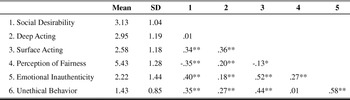
Table 5 presents descriptive statistics and correlations. As shown in the table, social desirability had a significant positive correlation with with surface acting (r = .34, p < .01) and a positive correlation with unethical behavior (r = .35, p < .01). Therefore, we controlled for social desirability in the analyses. Footnote 3 Deep acting had a positive and significant correlation with surface acting and emotional inauthenticity; however, the low correlations indicate that multicollinearity is not a concern in our model. Footnote 4
Descriptive Statistics and Correlations in Study 2

Note. n = 136. * p < .05; ** p < .01.
Unlike Studies 1 and 2, which are multi-level studies, Study 3 is a two-wave design that examines between-person differences. Therefore, as recommended by Preacher, Rucker, and Hayes (Reference Preacher, Rucker and Hayes2007), we estimate the mediating effect by using the PROCESS macro for SPSS (Hayes, Reference Hayes2012) and tested the mediating effects by using 95% bias corrected bootstrapped confidence intervals (CI) based on 5,000 samples. The bootstrap analysis estimates the mediating effect by re-sampling it in a large sample (e.g., n = 5000), and estimate the 95% confidence intervals for the population value of the indirect path. If zero is not in the 95% confidence interval, we can conclude that the mediation is statistically significant. The bootstrap analysis is more powerful than the Sobel test for testing mediation because it does not assume normality of the sampling distribution, which can produce biased results when the assumption is violated (Hayes, Reference Hayes2012).
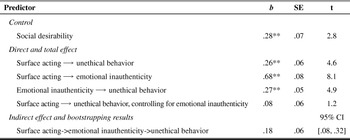
Regression results for the hypotheses with respect to surface acting are presented in Table 6. Hypothesis 1 stated that surface acting is positively associated with emotional inauthenticity. Surface acting had a positive and statistically significant relationship with emotional inauthenticity (b = .68, p < .01). Hypothesis 2 stated that emotional inauthenticity is positively related to unethical behavior. Emotional inauthenticity had a positive and statistically significant relationship with unethical behavior (b = .27, p < .01). Hypothesis 3 stated that surface acting is positively related to unethical behavior. There was a positive and significant relationship between surface acting and unethical behavior (b = .26, p < .01). Hypothesis 4 stated that emotional inauthenticity mediates the effect of surface acting on unethical behavior. The result of the bootstrap analysis showed a positive and significant relationship between surface acting and unethical behavior mediated through emotional inauthenticity (b = .18, CI = [.08, .32]). Thus, Hypotheses 1-4 are supported.
Regression Results for Surface Acting Hypotheses

Note. b = unstandardized regressions coefficients. CI = confidence interval. Bootstrap sample size = 5,000. **p < .01.
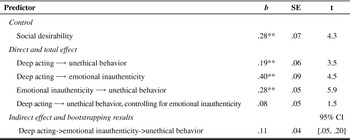
Hypotheses 5 and 6 offered competing predictions for the relationship between deep acting and emotional inauthenticity. As indicated in Table 7, deep acting had a positive and statistically significant relationship with emotional inauthenticity (b = .40, p < .01), providing support for Hypothesis 6 rather than Hypothesis 5.
Regression Results for Deep Acting Hypotheses

Note. b = unstandardized regressions coefficients. CI = confidence interval. Bootstrap sample size = 5,000. **p < .01.
Hypotheses 7 and 9 offered competing predictions for the relationship between deep acting and unethical behavior, with Hypotheses 8 and 10 noting emotional inauthenticity as the mediator of these competing predictions. As indicated in Table 7, deep acting had a positive and significant relationship with unethical behavior (b = .19, p < .01), providing support for Hypothesis 9 rather than Hypothesis 7. The result of the bootstrap analysis showed that the indirect effect through emotional inauthenticity was significant (b = .11, CI = [.05, .20]), supporting Hypothesis 10 rather than Hypothesis 8.
Next, we test the moderating role of perceived fairness. We hypothesize that perceived fairness operates as a moderator of the relationship between emotional labor and emotional inauthenticity (i.e., first-stage moderated-mediation). A significant moderated-mediation effect is indicated by a significant interaction between emotional labor and perceived fairness predicting emotional inauthenticity and an exclusion of 0 from the 95% CI at different values of the moderator (Preacher et al., Reference Preacher, Rucker and Hayes2007).
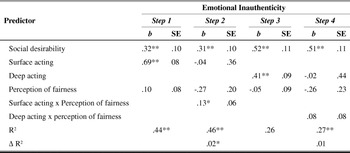
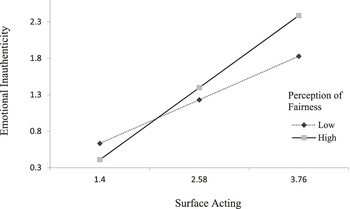
Regression results of the moderated-mediation model are presented in Table 8. Hypothesis 11 predicted that perceived fairness weakens the positive effect of emotional labor on unethical behavior via emotional inauthenticity. As show in Table 8, the interaction between surface acting and perceived fairness predicting emotional inauthenticity was positive and significant (b = .13, p < .05). The result of the bootstrap analysis also showed that the indirect effect of surface acting on unethical behavior through emotional inauthenticity was significantly different at two values of perceived fairness: one standard deviation above the mean of perceived fairness (b = .21, CI = [.09, .36]) and one standard deviation below the mean of perceived fairness (b = .13, CI = [.05, .24]). As shown in Figure 1, while performing surface acting, those with high perceptions of fairness reported experiencing higher level of inauthenticity, and in turn, reported engaging in more unethical behavior than those with low perception of fairness. Thus, in contrast to our prediction, we found the opposite effect: employees’ perceived fairness strengthens the positive effect of surface acting on emotional inauthenticity, and subsequently, unethical behavior. For deep acting, we did not find perceived fairness to have a significant moderating effect on the relationship between deep acting and unethical behavior thorough emotional inauthenticity (b = -.02, CI = [-.07, .013]).
Regression Results for Testing Moderation of Perception of Fairness

Note. b = Unstandardized regressions coefficients. *p < .05; **p < .01.
Interaction of Perception of Fairness and Surface Acting Predicting Emotional Inauthenticity

STUDY 3 DISCUSSION
The first purpose of Study 3 was to provide a clearer understanding of the role of deep acting on inauthenticity. Consistent with Studies 1 and 2, surface acting had a positive relationship with unethical behavior, and this relationship was mediated by emotional inauthenticity. In addition, we found that deep acting had a significant positive relationship with unethical behavior, with emotional inauthenticity playing a mediating role in this relationship. This finding suggests that even though deep acting may be a more authentic expression of emotion compare with surface acting, the process of deep acting can still cause one to feel inauthentic The second purpose of Study 3 was to study the phenomena in a more robust manner by using a different research design and different measures of emotional inauthenticity and unethical behavior. Results of Study 3 corroborated the findings in Studies 1 and 2: surface acting and deep acting were each positively related to unethical behavior via emotional inauthenticity, with surface acting having a stronger effect on emotional inauthenticity and unethical behavior. The third purpose of Study 3 was to expand our theoretical model to examine perceived fairness as a moderator. Surprisingly, we found that surface acting had a stronger positive effect on emotional inauthenticity, and in turn, unethical behavior, when perceived fairness was high (vs. low). One possible explanation may be that employees who choose to engage in surface acting, even when they have the autonomy not to do so, experience the highest level of emotional inauthenticity. Another possibility is that those employees view surface acting as a fair practice, and are less concerned with aligning their felt emotion with the displayed emotion. More research in this area is needed.
GENERAL DISCUSSION AND CONCLUSION
Emotional labor theory has begun to consider emotional labor as an unfair labor practice, with some proposing that organizations should abandon such display rules and use more humanistic practices that foster a positive and authentic workforce (Fulmer, Barry, & Long, Reference Fulmer, Barry and Long2009; Grandey, Rupp, & Brice, Reference Grandey, Rupp and Brice2015). Our study is consistent with this view, in that we empirically demonstrate that emotional labor can lead to unethical behavior. This provides some rationale for why organizations might be better off abandoning emotional display rules.
Our findings have important theoretical implications for the emotional labor literature, which to date has focused primarily on beneficial outcomes for organizations (e.g., Groth et al., Reference Groth, Hennig-Thurau and Walsh2009). We extend this literature to show that emotional labor can be directly harmful to organizations as well, specifically in the form of unethical behavior. This collateral damage is something that managers should be aware of when they instruct employees to provide “service with a smile.”
Our findings were clear with respect to surface acting. In all studies, surface acting created emotional inauthenticity, which was associated with an increase in unethical behavior. Our findings for deep acting and unethical behavior were consistent across Studies 2 and 3: deep acting was positively related to emotional inauthenticity, suggesting that even though deep acting may be a more authentic expression of emotion compared with surface acting, the process of deep acting can still cause one to feel inauthentic. However, the null relationship between deep acting and emotional inauthenticity found in Study 1 warrants further investigation in future research. Alternatively, perhaps there is conceptual distinction between emotional labor process and emotional labor outcome. Nevertheless, our findings do help advance theory by moving it away from the view of deep acting as enhancing emotional authenticity.
We conducted a third study not only for the purposes of replication, but also to examine perceived fairness as a moderator. In Study 3, we were able to replicate all of our results from Study 2. We found perceived fairness strengthens the positive relationship between surface acting and unethical behavior through inauthenticity, suggesting that employees perceiving surface acting to be fair are more likely to engage in it, which enhances, rather than undermines, the experience of emotional inauthenticity.
Future research should examine ways to mitigate the effects of emotional labor on unethical behavior. It is possible that affirmations of other forms of authenticity in the employee will undermine feelings of inauthenticity that lead to unethical behavior. For example, Didonato and Krueger (Reference Didonato and Krueger2010) discuss an interpersonal affirmation that may increase self-authenticity. It may be that such an affirmation would restore authenticity in a manner that would offset the effects of emotional labor.
Emotional cultural differences could potentially moderate the model in this study. Research on emotional labor has shown that the negative effect of emotional labor on job satisfaction depends on the emotional culture. For example, Grandey, Fisk, and Steiner (Reference Grandey, Fisk and Steiner2005) showed that the negative effect of emotional labor on job satisfaction was weaker for French employees because, in France, employees have more freedom over emotional expressions than US employees. Future studies should investigate cultural differences in emotional labor and seek to replicate our findings using a more diverse sample.
APPENDIX: MEASUREMENT ITEMS
STUDIES 1 AND 2
Emotional Labor
Please indicate to what extent each of these described you at work today:
Surface Acting
-
1. Today, I put on an act in order to deal with others in an appropriate way
-
2. Today, I faked a good mood
-
3. Today, I put on a “show” or “performance”
-
4. Today, I just pretended to have the emotions I need to display for my job
-
5. Today, I put on a “mask” in order to display the emotions I need to display for my job
Deep Acting
-
1. Today, I made an effort to actually feel the emotions that I needed to display toward others
-
2. Today, I worked hard to feel the emotions that I needed to show to others
-
3. Today, I tried to actually experience the emotions I must show
Emotional Inauthenticity
-
1. How often do you have to show feelings at work that you do not really feel today?
-
2. How often do you need to display emotions which did not correspond to inner feelings today?
-
3. How often do you need to displayed positive emotion while feeling indifferent today?
-
4. How often do you need to forced yourself to show certain feelings today?
Unethical Behavior
Please indicate the extent to which you had engaged in each of the following behaviors today:
-
1. Dragged out work in order to get overtime
-
2. Gave gifts/favors in exchange for preferential treatment
-
3. Concealed my errors
-
4. Passed blame for errors to an innocent coworker
-
5. Claimed credit for someone else’s work
STUDY 3
Emotional Labor
In order to be effective in your job, how much are you required to do each of the following:
Surface Acting:
-
1. I put on a “mask” in order to display the emotions I need to display to customers for my job
-
2. I faked a good mood to customers
-
3. I put on an act in order to deal with customers in an appropriate way
-
4. I just pretended to have the emotions I needed to display to customers on the job
-
5. I put on a “show” or “performance” for customers
Deep Acting:
-
1. I worked hard to feel the emotions that I needed to show to customers
-
2. I tried to actually experience the emotions I must show to customers
-
3. I make an effort to actually feel the emotions that I need to display towards customers
Emotional Inauthenticity
Please indicate the extent to which you agree with each of the following:
-
1. At work, I don’t know how I really feel inside
-
2. At work, I feel as if I don’t know myself very well
-
3. At work, I feel out of touch with the ‘real me’
-
4. At work, I feel alienated from myself
Perceived Fairness
Please rate the extent to which you agree with each of the following:
-
1. Overall, I’m treated fairly by my organization
-
2. In general, I can count on this organization to be fair
-
3. In general, the treatment I receive around here is fair
-
4. Usually, the way things work in this organization are not fair*
-
5. For the most part, this organization treats its employees fairly
-
6. Most of the people who work here would say they are often treated unfairly*
-
* reversed-score items.
Unethical Behavior
Please indicate how often you have performed each behavior at work in the past two weeks:
-
1. Conceal information from your supervisor that might be detrimental to your performance
-
2. Withhold negative information about your product or service from customers
-
3. Exaggerate the truth about your company’s products or services to customers
-
4. Fail to inform customers of important changes to your products or services
-
5. Misrepresent information about your company’s products or services to your customers
-
6. Misrepresent the truth to your supervisor to help you look good