Implications
Assessing the effect of heat on lactating doe performance is crucial before defining the best strategies regarding management and selection practices to alleviate the negative impact of this factor on animal welfare and production. This study evaluates lactation performance of two groups of does that were raised and reproduced either under circadian cycle of temperature emulating the Mediterranean summer or under constant comfort temperature conditions. We show that rabbit does were able to adapt to moderate heat stress by decreasing feed intake, and thus live weight, but preserving milk yield and composition to ensure litter survival.
Introduction
Livability and growth of kits up to 21 days of age depend mainly on their mother’s milk production and composition Maertens et al. (Reference Maertens, Lebas and Szendro2006). The lactation period represents around 45% of the length of the meat rabbit’s life. Therefore, factors affecting doe performance during lactation will affect pre- and post-weaning growth and survival of the kits, and consequently meat production and profit of commercial farms.
High temperature impairs productive and reproductive performances of animals in rabbit and other species (Marai et al., Reference Marai, Habeeb and Gad2002; Renaudeau et al., Reference Renaudeau, Collin, Yahav, de Basilio, Gourdine and Collier2012). Its effect on milk yield and composition has also been shown under constant ambient temperature in climatic chambers (Szendrö et al., Reference Szendrö, Papp and Kustos1998; Fernández-Carmona et al., Reference Fernández-Carmona, Alqedra, Cervera, Moya and Pascual2003). However, under natural housing, the impact of heat stress on doe performance could be reduced because there is seasonality and varying temperature between day and night, with minimal temperatures early in the morning and during the night, when rabbits eat most of the feed consumed daily. Two studies consider the effect of heat stress on milk yield under natural conditions (Maertens and De Groote, Reference Maertens and De Groote1990; Pascual et al., Reference Pascual, Cervera, Blas and Fernandez-Carmona1996). However, it was not estimated from the data of contemporary animals but from data obtained of the same group of animals, collected in different seasons and in different reproductive periods (Maertens and De Groote, Reference Maertens and De Groote1990). Only Savietto et al. (Reference Savietto, Blas, Cervera, Baselga, Friggens, Larsen and Pascual2012, Reference Savietto, Cervera, Blas, Baselga, Larsen, Friggens and Pascual2013 and Reference Savietto, Cervera, Ródenas, Martínez-Paredes, Baselga, García-Diego, Larsen, Friggens and Pascual2014) have estimated the effect of a heat pattern, similar to that from a hot-climate country, on doe and kit performance using animals in the same season. This was carried out by comparing animals housed under heat conditions to others in comfort conditions, but this comparison was carried out avoiding any possibility of adaptation to the environment. Thus, the importance of those effects remains unclear when females reach sexual maturity and produce under the same environmental conditions (EC).
Material and methods
Experimental design
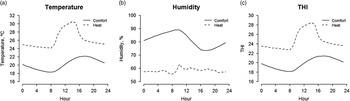
The research protocol was approved by the animal care and use committee of the Institut de Recerca i Tecnologia Agroalimentàries (IRTA). Rabbits were randomly allocated to either a comfort room (C) with the temperature kept constantly within the limits of the thermo-neutral zone (between 18°C and 22°C) or a heat room (H), where the environmental temperature pattern mimics the daily temperature cycles that are characteristic of the summer in Mediterranean countries. Daily temperature cycle in room H had the following pattern: at 0800 the temperature was around 24°C and was increased until it reached 29°C around 1100 h; it was maintained high (29°C to 31°C) for 4 h approximately and decreased to about 26°C around 1700 h; and it remained between 24°C and 26°C until 0800 h of the following day. There was no regulation on the environmental humidity, and temperature and humidity were automatically recorded every 5 min in a data logger (Tinytag, Gemini Data Loggers, Chichester, United Kingdom). Figure 1 shows the change in the average of temperature, humidity and the temperature–humidity index (THI, Marai et al., Reference Marai, Askar and Bahgat2006), respectively, in each room during the 24-h period.
Average (a) temperature (°C), (b) humidity (%) and (c) temperature–humidity index (THI) during the 24-h period in comfort (C) and heat (H) rooms.

Animals and data
At 2 months of age, 80 does of the Caldes line (Gómez et al., Reference Gómez, Rafel and Ramon2002) were randomly allocated into individual cages in either the comfort or the heat room. Thirty extra does were also allocated in the same conditions to replace the ones in the experiment for possible deaths or culling due to sanitary reasons. Does were individually housed and fed ad libitum with a commercial concentrate-pelleted diet containing 15.5% CP, 18.7% crude fiber, 3.8% ether extract and 8.5% ash. Water was always available. At the beginning of the reproductive period (4 months of age), does were placed in standard wired cages (40×98×38 cm) and fed ad libitum with the same commercial diet.
Females followed a semi-intensive reproductive rhythm during the experimental period: first artificial insemination (AI) at ~4.5 months of age, with subsequent 42-day reproductive cycles. At 48 h before AI, all females were treated with 15 IU eCG (subcutaneously; Foligon, Intervet International B.V., Booxmeer, Holland). Ovulation was induced immediately after AI with 0.02 mg of Gonadorelin (intramuscularly; Fertagyl, Intervet International B.V.). Males used to inseminate the does were kept under the same EC as their corresponding mates, and males began the reproductive period at 5 months of age.
At parturition, the number of kits born alive, the litter weight and the doe’s body live weight (DW, g) were recorded. No cross-fostering of kits was applied. The number of kits alive and the litter weight were recorded once a week from birth to weaning (at 32 days). Individual weaning weight (IWW, g) was also recorded.
Survival rate (SR) during lactation was calculated for each litter as the ratio between the number of kits alive at weaning and the number of kits born alive. Doe feed and water consumptions were recorded weekly during the whole lactation period (32 days). The water was supplied through a graduated plastic cylinder (2 l) connected to the drinker. Identical cylinders were placed in the rooms to determine the amount of water evaporated, and the data were corrected by subtracting evaporation from water consumption weekly. Average daily feed intake (ADFI, g/day) and average daily water intake (ADWI, ml/day) were calculated each week accordingly.
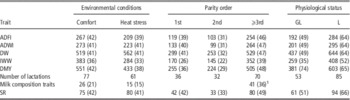
Daily milk yield (DMY, g/day) was recorded three times per week until 21 days of lactation as the difference in BW of the doe before and after suckling (Lebas, Reference Lebas1968; Szendrö et al., Reference Szendrö, Papp and Kustos1998). All measurements were taken after 24 h of separation of the doe from the kits, in order to avoid free suckling by the kits (Maertens et al., Reference Maertens, Lebas and Szendro2006). There were a total of 984 records corresponding to 138 lactations and 80 does. At 10 days of lactation, a total of 41 milk samples were obtained from 36 multiparous does. Milk samples (20 ml) were obtained after oxytocine injection (5 IU) by gentle manual pushing of the mammary gland. Subsequently, samples were weighed and stored at −80°C until further chemical analyses. Milk samples were lyophilized (Liodelta Telstar, Terrassa, Spain) and weighed after lyophilization. Following that, samples were analyzed for dry matter (DM; 3 h at 50°C), CP (Dumas method, Simonne et al., Reference Simonne, Simonne, Eitenmiller, Mills and Cresman1997) and gross energy (GE) with an adiabatic calorimeter (IKA C-2000 basic; IKA®-Werke GmbH & Co. KG, Staufen, Germany). Table 1 shows the number of records and does for each analyzed trait.
Number of data and number of does (in brackets) for average daily feed intake (ADFI), average daily water intake (ADWI), doe weight (DW), individual weaning weight (IWW), daily milk yield (DMY), milk composition traits and survival rate (SR)

GL=gestating–lactating does; L=lactating does.
1 Number of milk composition data was 16, 14 and 11 for 3rd, 4th and 5th parity, respectively.
Statistical analysis
Mixed models were fitted to data with repeated measurements using lmer function from lme4 package (Bates and Maechler, Reference Bates and Maechler2010) of R (R Core Team, 2012). Linear models were fitted to data without repeated measurements using the lm function of R (R Core Team, 2012). A detailed definition of the models used for the analysis of every trait can be found in the Supplementary Material S1. Supplementary Table S1 provides a summary of the factors included in the models used for the analyses of the traits.
ADFI and ADWI models included the EC, parity order (PO) and their interaction with EC, gestation–lactation overlapping, the number of suckling kits, the lactation week and the permanent effects of doe and lactation within doe.
The DW model included the EC, gestation–lactation overlapping, the age of the doe and its interaction with EC and the doe age nested within doe (i.e. the effect of age for each doe, which describes its specific pattern of growth).
The IWW model included the EC, PO and its interaction with EC, gestation–lactation overlapping, the number of suckling kits and the common litter effect.
The DMY model included the EC, PO and its interaction with EC, gestation–lactation overlapping class and its interaction with EC, the quadratic polynomial regressions of days in milk, a quadratic polynomial regression of number of suckling kits, a random doe effect including quadratic polynomial random regressions of days in milk within parity and quadratic polynomial random regressions of days in milk across lactations. A second model including the interaction between EC and the quadratic polynomial regression on days in milk was also considered in order to assess whether there were differences between EC in the shape of the lactation curve. Notice that the number of suckling kits was included in the models for the analysis of DMY, ADFI, ADWI and IWW, to consider the possible differences in prolificacy between the two types of EC. Thus, the effects of EC for these traits are independent of those occurring during gestation, which would affect prolificacy at birth.
Models for the analyses of the major components of milk (DM, CP and GE) included the EC, PO and their interaction. The SR model included the EC, PO and its interaction with environmental conditions, gestation–lactation overlapping and the permanent effect of the doe.
Results
Results are presented as least square means (LSM)±standard error (s.e.).
Doe feed and water intake
Does’ ADFI increased with weeks of lactation. Differences between lactation weeks were significant (P<0.05). The 2nd, 3rd and the 4th week of lactation had 40.6, 86.0 and 156.4 g/day higher ADFI than the first week, respectively. The phenotypic correlation between feed consumption during lactation period and milk yield was 0.5. Heat conditions had a negative and significant effect (P<0.05) on ADFI of does during lactation. The ADFI was about 36 g/day (9.4%) higher for does under the C conditions (383.11±7.17 g/day) than that of does under H conditions (347.26±7.59 g/day). The effects of PO and the interaction between EC and PO were not significant (P=0.25 and 0.19, respectively).
Water consumption was not different between the first 2 weeks of lactation. However, the differences in ADWI between the 3rd and the 1st week and between the 4th and the 1st week were 58.73±24.00 and 196.33±24.16 ml/day, respectively. The phenotypic correlation between ADWI and DMY was low and positive (0.16). The difference in ADWI between the two ECs was very small and not significant (−7.60±60.0 ml/day) as well as PO effect and the interaction between these two factors.
Milk yield and composition
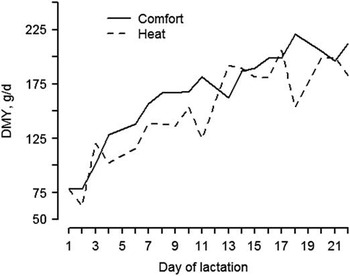
The crude mean of the data corresponding to average daily milk yield during the first 22 days of lactation under comfort and heat stress ECs is presented in Figure 2. It can be observed that both trajectories were similar, and there was greater fluctuation in average DMY of does under heat conditions than that of does under comfort conditions. The interaction between the EC and the three terms of the polynomial regression of DMY on days in milk was not significant (P=0.13). Therefore, it seems that there was no difference in the shape of the lactation curve of the does under different EC. The estimated regression coefficients were as follows: 13.78±0.87 for the linear term, and −0.33±0.04 for the quadratic term. According to formulas shown by Casado et al. (Reference Casado, Piquer, Cervera and Pascual2006), the peak lactation day was at 21 days of lactation and the production at the peak was 207.6 g/day. Despite the clearly distinct temperature pattern, no significant difference in DMY between does housed in C and H rooms was observed (LSM were 172.24±5.24 and 172.14±5.30, respectively). The effect of the interaction between PO and EC was significant (P=0.05). The LSM were 161.6±4.6, 181.3±7.1 and 174.3±7.4 for the first, second and third level of PO, respectively, under comfort conditions, and were 177.5±5.7, 172.1±6.3 and 161.0±6.9 under heat conditions, respectively.
Average daily milk yield (g/day) along the lactation period (22 days) under comfort and heat environmental conditions.

There was no difference between C and H conditions in rabbit milk composition at 10 days of lactation. LSM were 34.02±0.80, 13.37±0.30 and 9.07±0.29 for DM, CP and GE, respectively, under C conditions, and were 35.22±1.05, 13.65±0.41 and 9.50±0.38 for the same components under H conditions, respectively. The interaction between levels of the PO (3rd, 4th and 5th parity) and the EC was also not significant.
Weight and survival rate
The effect of EC on DW was 308 g favorable to does in C conditions (4947±84 v. 4639±85 g), and this effect was independent of the age of the females because the interaction between the EC and doe age was not significant (P=0.89). The IWW at 32 days was 49.26 g higher in comfort condition than under heat conditions (P=0.018). There was no significant interaction between the EC and PO (P=0.63). The SRs in C and H rooms were 0.66 and 0.64, respectively, and the contrast between them was no significantly different from zero. Similarly, the interaction between environmental conditions and PO did not show any significant effect.
Discussion
Doe feed and water intake
Regarding ADFI, the highest value corresponded to the 4th week when feed is consumed by the mother and the kits, which start solid intake at about 18 to 21 days of age (Maertens and De Groote, Reference Maertens and De Groote1990). Feed consumption during the lactation period seems to be related with milk yield, as ADFI increased as milk yield increased.
Heat stress had a negative effect on ADFI of does during the lactation period of about −9.4% of the value under C conditions. This effect is in agreement with the reduced dry matter and digestible energy intake encountered for rabbit does of three different genetic types subjected to heat conditions after first parturition (Savietto et al., Reference Savietto, Blas, Cervera, Baselga, Friggens, Larsen and Pascual2012 and Reference Savietto, Cervera, Blas, Baselga, Larsen, Friggens and Pascual2013). Authors mentioned that does of these studies were allocated under heat stress conditions right after the first partum and needed to cope with the same litter sizes as the control ones, because litters were standardized at partum. However, differences in dry matter and digestible energy intake between heat-stressed does and controls were less noticeable in posterior lactations where heat conditions were also present during pregnancy. Mousa-Balabel (Reference Mousa-Balabel2004) suggested that when rabbits are exposed to high air temperature there is an inhibition of the hypothalamic appetite center, and hence feed intake is reduced in order to diminish body heat production. The same phenomenon has also been described in other livestock species (reviewed by Renaudeau et al., Reference Renaudeau, Collin, Yahav, de Basilio, Gourdine and Collier2012). Thus, the difference in ADFI observed here is close to that obtained by Maertens and De Groote (Reference Maertens and De Groote1990), who reported that daily feed intake of does kept in farm conditions at high ambient temperature (27°C to 31°C during daytime and 21°C to 25°C during the night) was 11% lower than that of the same batch of does when they were reared at 14°C to 19°C in a previous time period. However, in other studies (Szendrö et al., Reference Szendrö, Papp and Kustos1998; Mousa-Balabel Reference Mousa-Balabel2004), feed intake of does in climatic chambers and constant temperature (30°C to 33°C) was 23% to 33% lower than that of does housed under normal environmental temperature (18°C to 20°C). Maertens and De Groote (Reference Maertens and De Groote1990) suggested that the circadian variation in temperature probably increased the does’ tolerance to heat, which resulted in a higher milk yield and feed consumption than at constant temperature in climatic chambers. Rabbits eat mainly during the night and early in the morning (Prud'hon, Reference Prud’hon1975), when the temperature is closer to the thermo-neutral zone even in the warmest season. Thus, a reduction in heat during this period of the day would allow animals to recover their activity and feed properly, alleviating the heat effect.
Water consumption increased slightly until the 3rd week and then showed a big increase between the 3rd and the 4th week, when the kits start to eat solid feed and drink water from the same dish as the mother; moreover, as it has been indicated, milk yield reached its maximum. The phenotypic correlation between ADWI and DMY was low and positive, which means that, although part of the important increase in ADWI during the last part of the lactation is due to the high milk yield of the doe, the main reason for this high water consumption is probably because of the water consumption of the kits. The difference between ADWI under C and H EC was very small and not significant. This result was surprising and it seems not to be in agreement with other previous studies. Water consumption of does maintained at high temperature (30°C to 33°C) was increased by 30% to 45% relative to that of rabbits under normal condition, 18°C to 20°C (Mousa-Balabel, Reference Mousa-Balabel2004). In addition, in growing rabbits, Manzano and Torres (Reference Manzano and Torres2005) found a 30% higher water consumption in rabbits housed under 30°C with respect to those housed under 18°C. To our knowledge, only Szendrö et al. (Reference Szendrö, Papp and Kustos1998) found 16.5% lower water consumption during the lactation period in does kept at 30°C compared with does kept at 15°C. Panting, defined as rapid and shallow breathing, appears in rabbits submitted to very high temperature conditions as a way for the animal’s heat loss by water respiratory vaporization (Marai et al., Reference Marai, Habeeb and Gad2002). These water losses need to be compensated by drinking more water, which would explain the results obtained by others authors (Mousa-Balabel, Reference Mousa-Balabel2004; Manzano and Torres, Reference Manzano and Torres2005). However, a previous study that analyzed animal behavior measurements by video-recording of does from our experiment found no differences between C and H pregnant does in drinking behavior, and no panting behavior was observed (de Lima et al., Reference de Lima, Piles, Rafel, López-Béjar, Ramón, Velarde and Dalmau2013). The authors suggested that in a constant thermal cycle, as those applied in this study, animals could compensate behaviorally the heat-treatment stress by resting for longer and in a prostrate position, reducing some secondary behaviors, such exploration or sitting, but with few differences in other important behaviors of the animals, such as grooming, feeding or drinking. The lack of panting is also seen as a confirmation that the applied thermal stress was not excessive. The hypothesis of adaptation of the animals to heat conditions might explain this unexpected result. The correlation between feed and water consumption was small, which could indicate that, at least under the present conditions, it would not be advisable to implement feed restriction by controlling the access to water.
Milk yield and composition
The lactation curves obtained here were similar to the ones described by other studies. Gomez-Ramos et al. (Reference Gomez-Ramos, Ortiz-Rodríguez, Becerril-Pérez, Román-Bravo and Herrera Camacho2011) found that the peak of milk production was at the end of the third week. However, El-Maghawry et al. (Reference El-Maghawry, Soliman and Khalil1993) observed that the milk production at the peak was about 172.9 g/day and it was produced during the second week for New Zealand White does under Egyptian conditions. Under Spanish conditions, Sabater et al. (Reference Sabater, Tolosa and Cervera1993) found a maximum of 196 g/day on day 16 of lactation, and Savietto et al. (Reference Savietto, Cervera, Blas, Baselga, Larsen, Friggens and Pascual2013) observed a maximum value in the 3rd week of lactation in two prolific rabbit lines, with an average milk yield ranging from 170 to 150 g/day.
Despite the fact that temperatures and THI inside the two rooms were clearly distinct and the temperature in room H was above the thermo-neutral zone at any time of day (Cervera and Fernández-Carmona, Reference Cervera and Fernández-Carmona2010), the difference in DMY between the two rooms was very small and not significant. This result contradicted with other studies, where a decrease in milk yield was observed under high temperature conditions in rabbits (Maertens et al., Reference Maertens, Lebas and Szendro2006; Savietto et al., Reference Savietto, Cervera, Blas, Baselga, Larsen, Friggens and Pascual2013) and in other livestock species (reviewed by Renaudeau et al. Reference Renaudeau, Collin, Yahav, de Basilio, Gourdine and Collier2012). Maertens and De Groote (Reference Maertens and De Groote1990) showed that DMY of does was nearly 10% lower during the hot period (27°C to 31°C during daytime and 21°C to 25°C during the night), but they also noted that this difference was about 50% of the expected value from previous results obtained in climatic chambers at constant temperature (Wittorff et al., Reference Wittorff, Heird, Rakes and Johnson1988). Fernández-Carmona et al. (Reference Fernández-Carmona, Cervera, Sabater and Blas1995) found a difference of 36 g/day in the average milk yield during the 3rd week of lactation between does under farm conditions and does in a climatic chamber at constant 30°C. Szendrö et al. (Reference Szendrö, Papp and Kustos1998) observed a decreasing trend in DMY with high environmental temperature (5°C, 15°C, 23°C and 30°C), especially during the third week of lactation. Animals in these experiments were maintained under farm conditions or in a climatic chamber at constant temperature at the beginning of the reproduction period (about 5 months of age) or just after kindling. However, in our experiment, animals were allocated to the two rooms at 2 months of age, when they were still growing up. It may be possible that animals in room H became adapted to these EC. This hypothesis should be confirmed by further studies.
Fernández-Carmona et al. (Reference Fernández-Carmona, Alqedra, Cervera, Moya and Pascual2003) found that does in their second lactation produced more milk (+14 g/day) than primiparous does under normal environmental temperature (11 to 25°C), with litters standardized to the same number of kits. This difference was reduced to +8 g/day for does under constant environmental temperature of 30°C, suggesting that there could be an interaction between EC and PO. This was confirmed under the EC of our experiment, with an important daily range of temperature, as we found no difference between milk yield of primiparous and second lactation does under heat conditions, but this was 20 g/day greater for the last ones under comfort conditions.
The obtained values for the three milk components were within normal ranges of milk composition in rabbits (Maertens et al., Reference Maertens, Lebas and Szendro2006). No differences were found in milk composition under the two studied temperature conditions. This result is in agreement with the results obtained by Kustos et al. (Reference Kustos, Papp, Szendró and Bálint1998), which is the only published information about the effect of high temperature on rabbit’s milk composition, to the best of the author’s knowledge.
Weight and survival rate
There was a marked difference between IWW of kits under the two different ECs, which means that this factor is an important source of variation for this trait. The effects of H on IWW could be explained by lower milk availability (or/and poorer milk composition) in late lactation and, particularly, lower litter feed intake before weaning. Thus, although no differences were found in milk yield and composition at day 10 of lactation, relevant differences were observed in IWW.
In this experiment, no differences in SR during the lactation period depending on ECs were found. However, in other studies, an important effect of high temperature environmental conditions on pre-weaning mortality was found (reviewed by Marai et al., Reference Marai, Habeeb and Gad2002). Similarly, smaller litter sizes were seen in does of a line selected by litter size at weaning, housed in high temperature environment. Moreover, this reduction differed between generations of selection, indicating that selection to increase litter size at weaning led to increased female reproductive robustness, possibly due to a change in resource allocation strategies (Savietto et al., Reference Savietto, Cervera, Ródenas, Martínez-Paredes, Baselga, García-Diego, Larsen, Friggens and Pascual2014).
In our study, the difference in doe weight between EC along its productive life was about 300 g favorable to does in C conditions, and this effect was constant throughout the life of the females, as the interaction between EC and age was not significant. This reduction in DW is a consequence of the decrease in ADFI in order to reduce body heat production under high environmental temperature conditions. Fernández-Carmona et al. (Reference Fernández-Carmona, Cervera, Sabater and Blas1995) found a negative effect of high environmental temperature (30°C) on DW relative to that of does reared under comfort conditions (18°C to 21°C). Marai et al. (Reference Marai, Ayyat and Abd El-Monem2001) found lower doe BW at 17 weeks of age in summer than in winter. A reduction in doe weight due to high environmental temperature after the second lactation was seen by Savietto et al. (Reference Savietto, Cervera, Blas, Baselga, Larsen, Friggens and Pascual2013).
Conclusions
When animals were kept from early stages of development under a constant circadian cycle of temperature emulating the Mediterranean summer, ADFI during lactation and live weight of rabbit does were reduced, as well as individual weaning weight of the kits, compared with animals kept permanently under temperatures within the limits of the thermo-neutral zone (between 18°C and 22°C). Daily milk yield and lactation curve, milk composition at 10 days of lactation and survival rate of kits seemed not to be affected by these EC. The average daily water intake was not affected, which could indicate that water consumption may not be the animal’s main mechanisms to overcome this adverse situation. The pattern of temperature applied in this study only caused moderate stress in does, which was overcome by reducing feed intake and live weight, among other adaptive mechanism, in order to preserve milk yield and composition for assuring kit survival.
Acknowledgments
This project was supported by INIA-RTA2008-00070-C02. The authors acknowledge the staff of IRTA-Cunicultura for their contribution to the experimental work, Professor Manel López-Béjar (Universitat Autònoma de Barcelona, Bellaterra, Spain), Dr Yu-Mei Chang (University of London, UK) for their comments and suggestions, and Dr Eva Armero (University of Cartagena, Spain) for English reviews of the manuscript and to one of the anonymous referees for the detailed revision and suggestions that greatly enriched the discussion of this study.
Supplementary material
To view Supplementary materials for this article, please visit http://dx.doi.org/10.1017/S1751731114003310