Introduction
Phase change materials (PCMs) with different melting point levels can be widely used in various thermal energy storage applications such as solar energy utilization, heat exchanger, building energy-saving, etc.[Reference AlAbidi, Mat, Sopian, Sulaiman and Lim1–Reference Dincer and Rosen12] When the phase transition occurs in PCMs, they can store and release large amounts of latent heat of fusion. Hence, using PCMs to store and retrieve thermal energy is one of the most important techniques to improve the energy efficiency.[Reference Li, Zhou, Nian and Ren5, Reference Sarı, Biçer, Karaipekli, Alkan and Karadag13–Reference Raoux and Wuttig15] Inorganic PCMs are receiving a lot of attention for thermal energy storage applications because of their high latent heat of fusion, relatively high-thermal conductivity, low flammability, and low costs compared with the organic materials. Calcium chloride hexahydrate (CaCl2·6H2O) with a melting point of 27 °C is an essential material for various low-temperature thermal energy storage applications.[Reference Li, Zhou, Nian and Ren5, Reference Chiu, Martin and Setterwall16–Reference Liu and Xu23]
Heat transfer in materials occurs by phonons, which are the energy quanta of lattice waves.[24, Reference Zhang25] Therefore, nanomaterials can increase the effective thermal conductivity of the matrix material based on the percolation theory.[Reference Bunde and Kantelhardt26] The enhanced thermal conductivity of the material can improve the system thermal transport performance.[Reference Abolghasemi, Keshavarz and Ali Mehrabian27] The thermal conductivity values of typical nanomaterials, such as Al2O3, TiO2, and CuO nanoparticles, are usually not very high. In order to efficiently improve the heat transfer performance of the matrix material, boron nitride nanoparticles (BNNPs) have been studied here due to their extremely high-thermal conductivity value. High-thermal conductivity and temperature resistance of BNNPs make them more applicable under harsh conditions.[Reference He, Wang, Liu and Liu28–Reference Meziani, Song, Wang, Lu, Hou, Anderson, Maimaiti and Sun33] They can be applied in different areas, such as electronic devices, nanofillers, isolated nano-space, etc., to optimize the heat dissipation.
In this research, we have applied BNNPs in CaCl2·6H2O/barium carbonate (BaCO3) (PCM/nucleating agent) to form a novel composite for efficient thermal conductivity enhancement of CaCl2·6H2O. Since there was a lack of literature regarding the thermal properties of CaCl2·6H2O with a BNNP composite, the objectives of this work are to characterize the thermal properties, including thermal conductivity, latent heat of fusion, and specific heat, of the nano-PCM composite, and investigate the enhanced heat transfer mechanism leading to efficient thermal energy storage. Although the current research is focusing on low-temperature PCM applications, it is an early-stage study, which will open a new window for the studies on the thermal performance of BNNP-based composites. The results from this research can be extended to the high-temperature PCM applications in the future.
Experimental methods
Materials
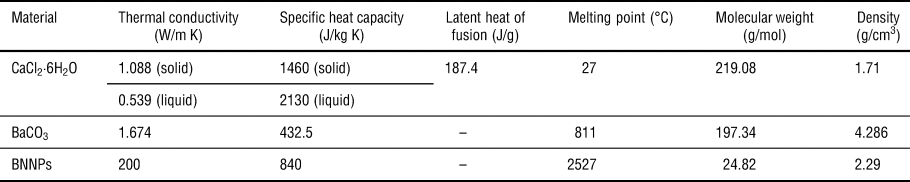
CaCl2·6H2O (Sigma-Aldrich) inorganic salt was used as a latent heat storage material. BNNPs (Lower Friction) were added for thermal conductivity enhancement. Because hydrate salts have severe supercooling problem, a nucleate agent is required to suspend the supercooling phenomenon. BaCO3 (Sigma-Aldrich) was considered as the nucleating agent to solve the supercooling problem of CaCl2·6H2O. Table I displays the thermal properties of the PCM, nucleating agent, and BNNPs applied in the experiment.
Thermal properties of CaCl2·6H2O, BaCO3, and BNNPs[Reference Samanta, Roy and Barman34–38]

Nano-PCM preparation
The Nano-PCM composite contained 0.5 wt% BNNP and 1.2 wt% BaCO3 as the nucleate agent. Figure 1 shows the nano-PCM preparation device. CaCl2·6H2O, BaCO3, and BNNPs were mixed by using a sonication microprobe at 40,000 Hz with 20% of maximum vibrating amplitude (±240 µm) for 15 min while the mixing sample was placed in a water bath to avoid temperature increase during the sonication process.
Nano-PCM preparation using the sonication probe.

Thermal conductivity measurement method
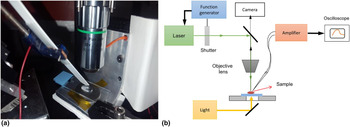
The thermal conductivity was characterized by using the thermocouple-laser shining method[Reference Shrestha, Lee, Chang, Kim, Rhee and Choi39, Reference Jeong, Lee, Shrestha, Horne, Das, Choi, Kim and Choi40] as shown in Fig. 2(a). The setup for this experiment included a fine-tip (50 µm diameter) K-type thermocouple measuring the sample temperature and a nanosecond laser shining the green laser beam at 300 μW with the beam diameter of 532 nm on the sample to produce transient temperature profiles.
(a) Thermocouple-laser shining method experimental setup for thermal conductivity characterization. (b) Schematic of experimental setup showing the instruments and optics arrangement to attain laser irradiation at the sensor tip in the sample.
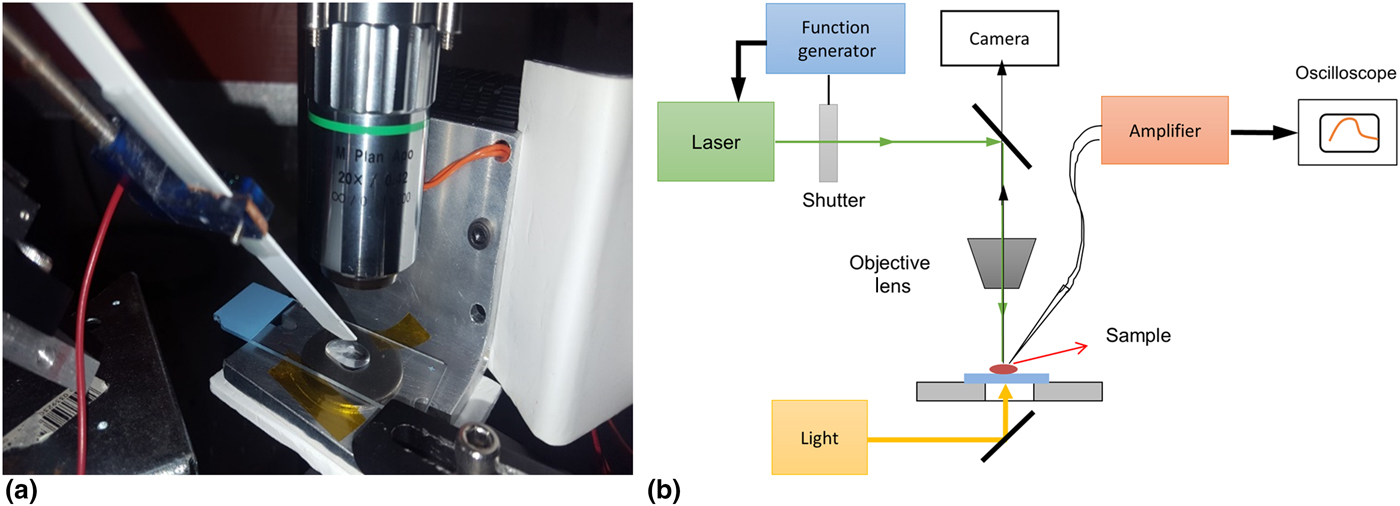
As shown in Fig. 2(b), the laser beam was generated and adjusted by using the function generator (SRS DG535), the laser source, and the shutter (Uniblitz, NS15B). The thermocouple was connected to an amplifier (SRS560) which outputted the temperature signals to an oscilloscope (Tektronix TDS 3054B). Moreover, a light source was placed under the sample to take good quality photos using a CCD camera. The transmitted data were recorded and stored in a computer in a text file for post data processing.
The temperature data obtained from the thermocouple-laser shining experiment will be matched with the numerical simulation results for the setup to determine the thermal conductivity value of the nano-PCM. The simulation was conducted using COMSOL Multiphysics through the transient heat transfer model in solid or stationary fluid. Hence, the governing equation (heat diffusion equation) of the model is expressed in Eq. (1):
 $$\rho C_{\rm P}\displaystyle{{\partial T} \over {\partial t}} + \nabla \cdot q = Q$$
where q is conduction heat flux calculated via the Fourier's Law [Eq. (2)]:
 $$q = -k\nabla T$$
and Q is the heat source from the laser beam. The boundary conditions of the model include the natural convection heat transfer around the thermocouple and on the top surface of the sample by surrounding air, and negligible heat loss at the bottom and sides of the sample (the insulated boundary conditions).
Latent heat of fusion and specific heat measurement method
The latent heat of fusion and specific heat of the nano-PCM composite were measured by a differential scanning calorimetry (DSC 4000, PerkinElmer). Five-repeated melting/freezing cycles were conducted for the sample to characterize its heat capacities. The measurement cycle was controlled between 0 and 40 °C at the heating/cooling rate of 2 °C/min.
Results and discussion
Thermal conductivity
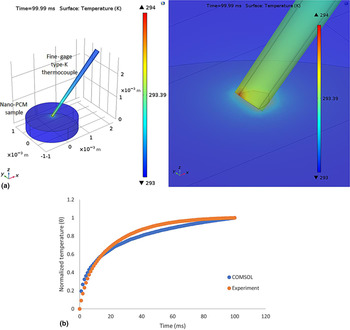
Figure 3(a) shows the 3D model and the temperature profile for the nano-PCM sample based on the transient heat diffusion simulation using the COMSOL Multiphysics software package. The highest temperature is at the tip of the thermocouple because the laser beam was shined at the contact point between the sample surface and the thermocouple tip.
(a) 3D model and the temperature profile of the nano-PCM sample based on the transient heat diffusion simulation. (b) Comparison of experimental measurement and COMSOL simulation for nano-PCM thermal conductivity determination. (Normalized temperature: θ = ((T − T min)/(T max − T min)); T min and T max are the initial (lowest) and final (highest) temperatures of the sample during the laser shining process, respectively; the temperature data were from the thermocouple measurements.)
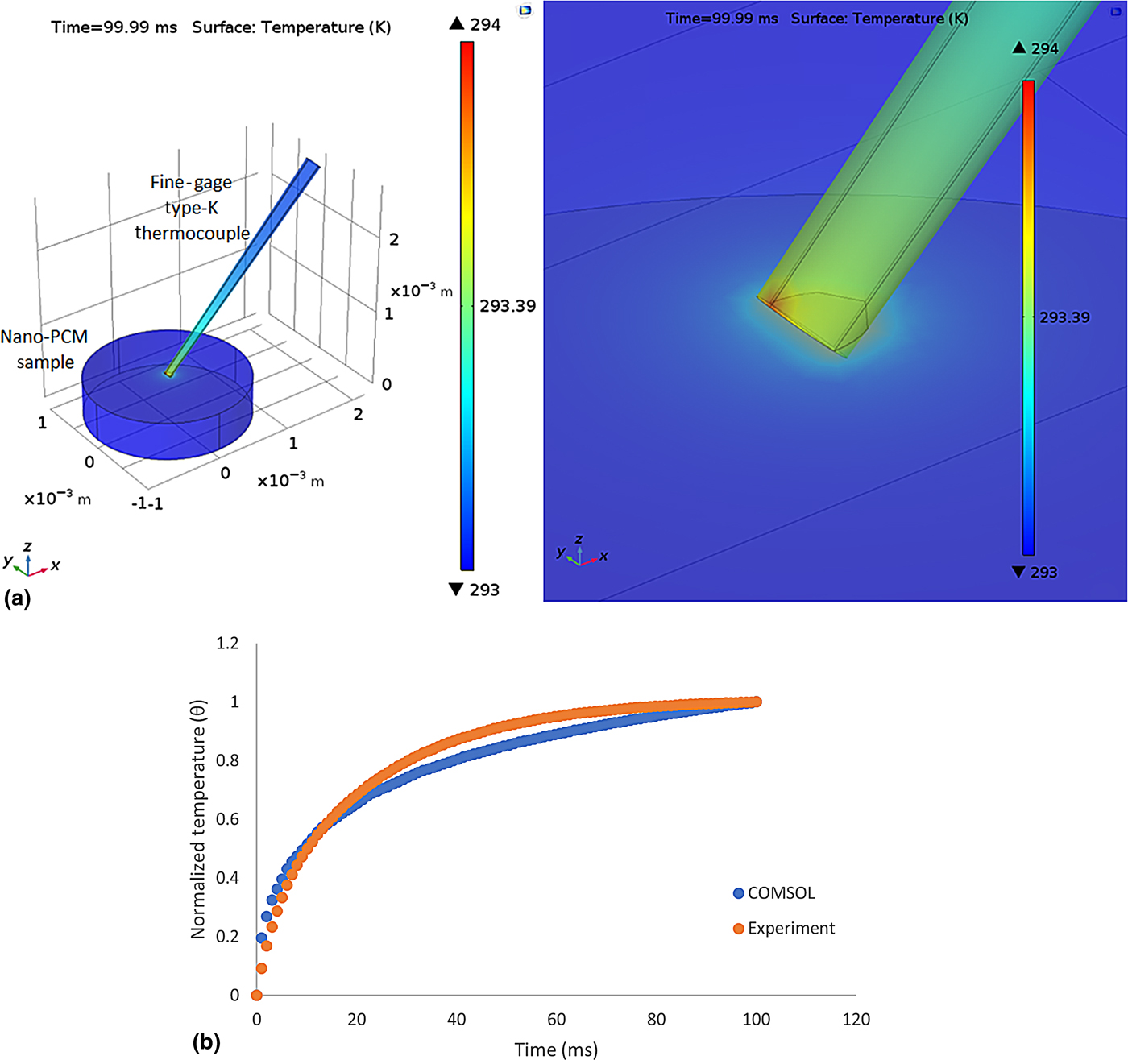
Figure 3(b) displays the comparison of the experiment and simulation, which shows a good agreement between the experimental measurement and simulation result. As seen from Fig. 3(b), the temperature increases non-linearly with the time in both experiment and simulation cases. The effective thermal conductivity of the nano-PCM (k eff) used in the numerical simulation was calculated via Eq. (3). The calculation result was 1.867 W/m K based on the solid state PCM. The simulated temperature profile using the calculated thermal conductivity value matched with the experimental measurement. Therefore, the thermal conductivity of the nano-PCM can be determined based on the comparison results in Fig. 3(b). Because the combination of nanoparticles and PCM can be considered as the porous solid, Eq. (3) gives an appropriate prediction for the thermal conductivity of the nano-PCM composite[Reference Smith, Alzina, Bourret and Nait-Ali41–Reference Sundén and Yuan43]:
 $$k_{{\rm eff}} = (k \times v\% )_{{\rm CaC}{\rm l}_{\rm 2}\cdot {\rm 6}{\rm H}_{\rm 2}{\rm O}} + (k \times v\% )_{{\rm BNNP}} + (k \times v\% )_{{\rm BaC}{\rm O}_{\rm 3}}$$
where v% is the molecular volume percentage or volume fraction of each component.
The thermal conductivity enhancement of the nano-PCM was calculated using Eq. (4):
 $${\rm Enhancement}\;{\rm (}\% ) = (k_{{\rm eff}}-k_{{\rm PCM}}) \times 100/k_{{\rm PCM}}$$
where k eff and k PCM are the thermal conductivities of nano-PCM and PCM, respectively.
Therefore, by adding BNNPs, 71.9% increase of thermal conductivity in PCM was obtained.
Latent heat of fusion and specific heat
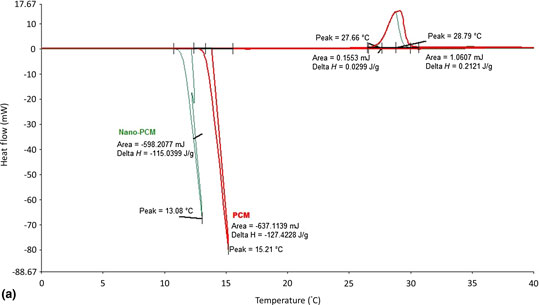
Five melting–solidification cycles were repeated in DSC for measuring latent heat of fusion and specific heat of the PCM with and without BNNPs. The results were repeatable. The comparisons of latent heat of fusion and specific heat versus temperature between CaCl2·6H2O/BaCO3 and CaCl2·6H2O/BaCO3/BNNPs are shown in Figs. 4(a) and 4(b), respectively. The measured latent heat was 114.90 ± 0.57 and 129.31 ± 6.39 J/g for nano-PCM and PCM, respectively, based on the five melting–solidification cycle measurements. The reduction in the latent heat of fusion for nano-PCM was 11.1%. The specific heats of nano-PCM and PCM were also obtained from the DSC measurements around 0.43 (430) and 1.10 J/g °C (1100 J/kg K), respectively, at 24 °C (solid state). The reduction in the specific heat capacity of nano-PCM was thus observed to be around 60.9% compared with that of PCM. It was noticed that the measured latent heat and specific heat capacities of CaCl2·6H2O were lower than the literature values as shown in Table I. It is because there was a nucleate agent (BaCO3) added into the PCM to mitigate the hydrate salt supercooling issue. This kind of impurity could cause the reduction of the latent heat and specific heat values for CaCl2·6H2O.
(a) The comparison of latent heat of fusion between CaCl2·6H2O/BaCO3 and CaCl2·6H2O/BaCO3/BNNPs through DSC measurement (one melting–solidification cycle). (b) Comparison of specific heat between CaCl2·6H2O/BaCO3 and CaCl2·6H2O/BaCO3/BNNPs through DSC measurements.

Table II summarizes the experimental measurement results for the thermal properties of pure PCM and nano-PCM. The thermal conductivity of PCM can be enhanced by adding nanoparticles due to the instinct high-thermal conductivity of BNNPs.
Experimental measurement results for the thermal properties of PCM and nano-PCM.

a Thermal conductivity of solid state PCM/nano-PCM at room temperature.
b Specific heat capacity of solid state PCM/nano-PCM at 24 °C.
Conclusion
In conclusion, the thermal properties of CaCl2·6H2O (PCM) and the mixture of PCM with 0.5% weight of BNNPs (70 nm) were analyzed in this research. The BNNPs enhanced the thermal conductivity of PCM by 71.9% compared with that before adding BNNPs. The BNNPs could reduce the latent heat of fusion and specific heat of pure PCM by 11.1% and 60.9%, respectively, due to the lower heat capacity of BNNPs compared with that of CaCl2·6H2O. Boron nitride nanomaterials have their unique characteristics, including very high-thermal conductivity values compared with other nanoparticles, thermal and chemical stability, etc. Therefore, BNNPs can help significantly increase the effective thermal conductivity of PCM for efficient thermal management. This research is unique since this kind of nano-PCM has not been studied before in the thermal management area. We could achieve considerable thermal transport properties’ enhancement by using only 0.5 wt% of BNNPs in the matrix material, much less amount compared with other nanoparticles applied in other literatures.[Reference He, Wang, Liu and Liu28, Reference Zhi, Bando and Golberg37, Reference Shahbaz, Alnashef, Lin, Hashim, Mjalli and Farid44]
Nomenclature
- C P
Specific heat (J/kg K)
- k
Thermal conductivity (W/m K)
- k eff
Effective thermal conductivity of nano-PCM (W/m K)
- k PCM
Thermal conductivity of phase change material (W/m K)
- T
Temperature (K)
- T max
The final temperature of the sample (K)
- T min
The initial temperature of the sample (K)
- t
Time (s)
- Q
Heat source generated from the laser beam (W/m3)
- q
Heat flux (W/m2)
- v%
Molecular volume percentage or volume fraction (%)
Greek symbol
- θ
Normalized temperature
- ρ
Density (g/cm3)
Subscripts
- BaCO3
Nucleate agent component
- BNNP
BNNP component
- CaCl2·6H2O
PCM component
Abbreviations
- BNNP
Boron nitride nanoparticles
- DSC
Differential scanning calorimetry
- PCM
Phase change material
Acknowledgments
This work was supported by the University of North Texas Faculty Startup Fund. The authors also appreciate the help from Mr. Ramesh Shresta for the thermal conductivity measurement of this work in Dr. Tae-Youl Choi's lab in the Mechanical and Energy Engineering Department at the University of North Texas.