INTRODUCTION
Across the tropics, vast expanses of forest have been converted into pastures and agricultural fields and subsequently abandoned (Brown & Lugo Reference BROWN and LUGO1990, Chapman & Chapman Reference CHAPMAN and CHAPMAN1999). In such tropical forest clearings, seed arrival has been shown to be a critical limitation to forest recovery, with most seeds dispersed close to the forest edge; post-dispersal seed predation and seedling herbivory after germination also inhibit regeneration (Aide & Cavelier Reference AIDE and CAVELIER1994, Cubiña & Aide Reference CUBIÑA and AIDE2001, Holl Reference HOLL1999, McClanahan & Wolfe Reference MCCLANAHAN and WOLFE1993, Uhl Reference UHL1987, Willson & Crome Reference WILLSON and CROME1989). Existing vegetation such as remnant trees and shrubs may facilitate regeneration (Duncan & Chapman Reference DUNCAN and CHAPMAN1999, Galindo-Gonzalez et al. Reference GALINDO-GONZALEZ, GUEVARA and SOSA2000, Guevara et al. Reference GUEVARA, LABORDE and SÁNCHEZ-RIOS2004, Holl Reference HOLL2002, Willson & Crome Reference WILLSON and CROME1989) whereas grasses and ferns may impede tree regeneration (Aide et al. Reference AIDE, ZIMMERMAN, HERRERA, ROSARIO and SERRANO1995, Holl Reference HOLL1998, Slocum et al. Reference SLOCUM, AIDE, ZIMMERMAN and NAVARRO2004). Abiotic factors such as low concentrations of soil nutrients due to several years of cultivation, and harsh microclimatic conditions compared to adjoining forest, can further impede tree regeneration (Aide & Cavelier Reference AIDE and CAVELIER1994, Holl Reference HOLL1999, Uhl Reference UHL1987).
In tropical moist and wet forests, over 80% of tree species are vertebrate-dispersed (Ganesh & Davidar Reference GANESH and DAVIDAR2001, Howe & Smallwood Reference HOWE and SMALLWOOD1982, Vieira & Scariot Reference VIEIRA and SCARIOT2006), and their dispersal is adversely affected by forest fragmentation, since animals are less likely to traverse open habitats (Aide & Cavelier Reference AIDE and CAVELIER1994, Cubiña & Aide Reference CUBIÑA and AIDE2001, Holl Reference HOLL1999). In seasonally dry tropical environments, however, more than a third of all tree species are wind-dispersed (Justiniano & Fredericksen Reference JUSTINIANO and FREDERICKSEN2000, Kahn & Lawrie Reference KAHN, LAWRIE, Werren and Kershaw1987, Parthasarathy & Karthikeyan Reference PARTHASARATHY and KARTHIKEYAN1997), and seed dispersal is likely to be somewhat less affected by fragmentation and opening-up of habitats (Gillespie Reference GILLESPIE1999, Vieira & Scariot Reference VIEIRA and SCARIOT2006).
Studies of forest recovery in abandoned pastures and agricultural fields have been conducted mostly in the humid tropics, with few studies carried out in the dry and seasonally dry tropics (Janzen Reference JANZEN1988, Khurana & Singh Reference KHURANA and SINGH2001, Sanchez-Azofeifa et al. Reference SANCHEZ-AZOFEIFA, KALACSKA, QUESADA, CALVO-ALVARADO, NASSAR and RODRIGUEZ2005, Vieira & Scariot Reference VIEIRA and SCARIOT2006). In fact, only 3% of all tropical forest restoration studies over the last 20 y have been on dry forests (Meli Reference MELI2003). We investigated patterns of seed arrival and regeneration of forest tree species in abandoned agricultural clearings within a seasonally dry tropical forest in South India. We also investigated seed arrival of Chromolaena odorata (Linn.) King & Robinson (Asteraceae), an invasive herbaceous perennial. We hypothesized that: (1) seed rain declines exponentially with distance from the forest-field edge for both vertebrate- and wind-dispersed species, with the pattern of decline in seed numbers for the latter being determined by seed size and weight, (2) regeneration in clearings declines with distance from forest-field edge, and (3) patterns of species composition and abundance in regenerating vegetation correspond to these patterns in seed arrival.
METHODS
Study area
Bhadra Tiger Reserve (hereafter, Bhadra, 13°22′–13°47′N, 75°29′–75°47′S) is a 493-km2 reserve located in the Western Ghats biodiversity hotspot (Myers et al. Reference MYERS, MITTERMEIER, MITTERMEIER, DA FONSECA and KENT2000). See Teegalapalli et al. (Reference TEEGALAPALLI, HIREMATH and JATHANNA2009) for a map of the study area.
The monthly mean temperature in Bhadra ranges from 10 °C to 32 °C and the relatively high annual rainfall of 2000–2540 mm is largely concentrated between June and September, followed by a pronounced dry period from October to May (Karanth Reference KARANTH1982). The reserve is predominantly covered by southern tropical moist deciduous forest, which gradually merges with southern tropical dry deciduous forest towards its north-eastern edge (forest types sensu Champion & Seth Reference CHAMPION and SETH1968). The upper canopy of the moist deciduous forest is composed of species such as Dalbergia latifolia, Terminalia bellerica and Pterocarpus marsupium, whereas the mid-canopy is composed of species such as Cassia fistula Linn. (Leguminosae), Ziziphus xylopyrus and Phyllanthus emblica Linn. (Euphorbiaceae). Hydnocarpus pentandra Gaertn. (Flacourtiaceae), Elaeocarpus tuberculatus and Trewia polycarpa characterize the riverine semi-evergreen patches within the reserve (Karthik Reference KARTHIK2006).
Bhadra has a diverse mammalian fauna with a herbivore assemblage that includes species such as the Asian elephant (Elephas maximus Zimmerman), gaur (Bos gaurus Smith), sambar (Cervus unicolor Linn.), chital (Axis axis Erxleben), muntjac (Muntiacus muntjak Zimmerman) and wild pig (Sus scrofa Zimmerman) (Jathanna et al. Reference JATHANNA, KARANTH and JOHNSINGH2003). These herbivore species were frequently observed in the clearings formed after villages were relocated from within the reserve (K. Teegalapalli, pers. obs.).
In the year 2002, 457 families from 11 villages were voluntarily relocated from within Bhadra. This resulted in about 130 ha of abandoned agricultural clearings, which had formerly been under rice (Oryza sativa Linn.) cultivation (Karanth Reference KARANTH2007). The present study was carried out in the abandoned village sites of Madla, Vadihaddi, Hipla, Kesavé and Karvani.
Seed rain
In each of the five clearings, five points, separated by at least 50 m, were marked at random along the forest-field edge. At each point, a transect was established perpendicular to the forest edge for recording seed rain. Seven traps were set up along these transects at distances of 0, 2, 4, 8, 16, 32 and 64 m from the forest edge, and one trap was set up at a distance of 20 m inside the forest. Since raised traps were destroyed by elephants within days of being set up, we used pits (1 × 1 m and 0.1 m deep) as seed traps, instead. The pits were lined with cloth to facilitate detection of small seeds. Seeds of tree species were collected from the seed traps in numbered bags every fortnight for a total of seven visits between 1 March and 31 May 2006. This period coincided with the season during which most trees in southern Indian deciduous forests flower and fruit (Sundarapandian et al. Reference SUNDARAPANDIAN, CHANDRASEKHARAN and SWAMY2005). We distinguished between wind- and bird-dispersed seeds and separately recorded numbers of C. odorata seeds collected in these traps.
Since mammals were likely to avoid approaching the pit-traps, mammal-dispersed seeds were collected from 1 × 1-m plots offset by 5 m from each of the pit-traps. Seeds were collected monthly, for three collections between 1 March and 31 May 2006. Chances of underestimation of seed numbers due to seed predation or secondary dispersal is likely to be low since seeds observed at the first collection were present in these clearings throughout the study period (K. Teegalapalli, pers. obs.).
We examined patterns of seed arrival in the clearings as a function of distance from the forest-field edge. Sites were considered replicates and seed rain data from transects within each site were pooled for analysis. Seed rain density was log-transformed to remove heteroscedasticity in the data. Using distance to the forest-field edge as the predictor variable and log-transformed seed rain as the response variable we fitted linear, quadratic, cubic and exponential functions to the data and used R 2 to assess the fit of the models to the data. The model that best described the process underlying the data was determined using Akaike's Information Criterion, corrected for small samples (AICC, Burnham & Anderson Reference BURNHAM and ANDERSON1998). The effect of distance from the forest edge on mammal-dispersed seeds was investigated by fitting a linear model and examining the slope parameter and R 2. We also used linear models to compare seed rain density and species richness values between seed traps in clearings and in the forest.
Vegetation composition and cover
Vegetation composition was recorded from nested plots along five belt transects that were laid adjacent to seed-rain transects in each clearing. Each belt transect was divided into 10 × 10-m quadrats, with eight quadrats located in the clearing, and two reference quadrats located in the adjoining forest. Seedlings (individuals < 25 cm tall) and saplings (individuals 25–100 cm tall) were recorded from 250 5 × 5-m plots nested within these quadrats. In addition, per cent grass cover, shrub cover, weed (C. odorata) cover and bare-ground cover were visually estimated in 1 × 1-m plots nested within each of the 5 × 5-m plots.
We expected available soil moisture to vary with distance from the forest edge, and to have a strong effect on regeneration. Soil samples (cores 5 cm in diameter and 10 cm deep) were collected from each of the 10 × 10-m quadrats along two vegetation transects per site for a total of 100 cores and soil moisture was estimated gravimetrically.
We used generalized linear models (GLMs; McCullagh & Nelder Reference MCCULLAGH and NELDER1989) to examine factors that potentially affect regeneration in the clearings. The response variable was seedling and sapling density, and the predictor variables were distance from the forest-field edge, per cent native shrub cover, per cent grass cover, per cent exotic weed cover, and per cent soil moisture, singly and in combination. We tested for multicollinearity among the potential predictor variables and ensured that variables with significant correlations were not used together as predictors in the same model. The model that best described the observed data was selected based on the lowest AICC value, and summed AICC weights were used to assess the role of individual predictors (Burnham & Anderson Reference BURNHAM and ANDERSON1998).
RESULTS
Wind-dispersed seeds
The seed rain density in the traps in the forest was four times higher than that in clearings, averaged over all distances. However, when we fitted a linear model to the data, seed rain density did not differ considerably between forest and clearings (slope parameter = 62.4; SE = 49.3). The density of C. odorata seeds arriving in the traps was over seven times higher than that of native tree species (146 ± 35.5 vs. 19.2 ± 19.4 seeds per 14 wk m−2, averaged over all distances).
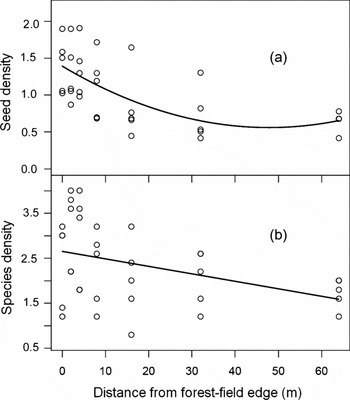
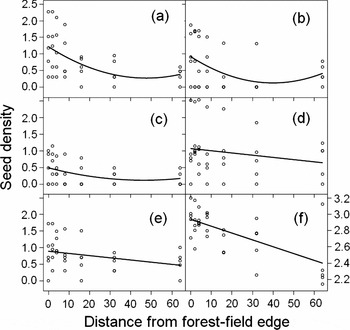
The natural logarithm of seed rain declined with increasing distance from the forest edge and this pattern was best described by a quadratic function, based on comparison of AICC values for different models (Figure 1a, AICC weight = 0.41). Of the five most abundant species in seed rain, the seed-rain pattern of the larger-seeded species (Pterocarpus marsupium, Terminalia paniculata and T. alata) was best described by quadratic functions, which mirrored the overall pattern of seed rain. For the smaller-seeded species (Lagerstroemia lanceolata and Dalbergia latifolia) the seed-rain pattern was best described by linear functions (Figure 2).
Decline in seed numbers and species richness with distance from the forest edge in five abandoned clearings within Bhadra, showing seed density (log ((seeds per 14 wk m−2) + 1)) (a), and species density (species per 14 wk m−2) (b), of wind-dispersed seeds. Lines indicate functions that best describe the patterns of decline in seed density (quadratic function: y = 0.0004×2 − 0.035x + 1.39, R 2 = 0.41) and species density (linear function: y = −0.02 x + 2.65, R 2 = 0.16). Each point denotes the average seed rain across five transects within each site, over a period of 14 wk.

Seed density (log ((seeds per 14 wk m−2) + 1)) of the five most abundant wind-dispersed tree species as a function of distance from the forest edge in five abandoned clearings within Bhadra. Lines indicate functions that best describe the pattern of decline of seed numbers ((a) Terminalia paniculata: y = 0.0004×2 − 0.04x + 1.22, R 2 = 0.27; (b) Terminalia alata: y = 0.0005×2 − 0.04x + 0.92, R 2 = 0.15; (c) Pterocarpus marsupium: y = 0.0002×2 − 0.02x + 0.49, R 2 = 0.13; (d) Lagerstroemia lanceolata: y = −0.007 x + 1.07, R 2 = 0.04; (e) Dalbergia latifolia: y = −0.0065 x + 0.89, R 2 = 0.1). Also included is the pattern of seed arrival of the invasive herb, Chromolaena odorata (y = −0.008x + 2.94, R 2 = 0.39) (f). Note that the ordinate is scaled differently in the C. odorata panel to accommodate the greater seed rain of that species.

The mean species density of seeds arriving in the clearing, averaged over all distances, in species per 14 wk m−2 of wind-dispersed seeds was considerably higher in the forest than in the clearings (slope parameter = 1.4, SE = 0.2). The decline in species density with distance from the forest edge was best described by a linear function (Figure 1b, AICC weight = 0.45).
Vertebrate-dispersed seeds
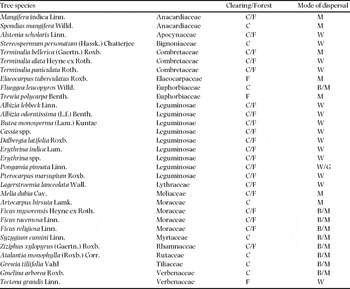
Mammal-dispersed seeds that arrived in the clearings were mostly (about 95%) of two species: Melia dubia and T. bellerica (Appendix 1). Although these seeds arrived in low densities (about 4 seeds per 14 wk m−2), we observed no pattern in seed numbers with distance from the forest. This is indicated by the extremely low R 2 (0.031, n = 35) and slope parameter (0.003) obtained when a linear model was fitted to the data. Densities of mammal-dispersed seeds, averaged over all distances, did not show clear differences between the clearing and the forest (slope parameter = 1.7, SE = 4.3). This was also the case with species density of mammal-dispersed seeds (slope parameter = 0.2, SE = 0.2). The few bird-dispersed seeds collected (about 1 seed per 14 wk m−2) were largely from a single genus Ficus. Thus, we use vertebrate-dispersed seeds only to refer to mammal-dispersed seeds, hereafter.
Vegetation composition and cover
A total of 447 seedlings and saplings of 47 tree species were recorded in the 250 5 × 5-m plots. Across all sites, the mean number of individuals recorded per plot in the forest was considerably higher than in the clearings (slope parameter = 24.3, SE = 5.6). The number of individuals per plot in the clearings declined with increasing distance from the forest-field edge.
There was a marked increase in grass cover as a function of increasing distance from the forest edge. Weed cover in the clearings, specifically C. odorata cover, was highest at the forest-field edge and declined with distance from the edge, both into the adjoining forest and into the clearings. Litter cover ceased within 10 m from the forest-field edge due to the near-absence of trees in the clearings, and native shrub cover was unaffected by distance from the forest edge. Contrary to our expectation, soil moisture was also unaffected by distance from the forest-field edge (Pearson's r = 0.115, P = 0.24, n = 40).
Of the potential predictors of seedling and sapling densities, distance from the forest-field edge and per cent grass cover were correlated (Pearson's r = 0.52, P = 0.001, n = 40) and were therefore never included in the same model. Distance from the forest-field edge (summed AICC weight = 0.39) was the strongest determinant of mean seedling and sapling density amongst the predictors examined, followed by per cent shrub cover and per cent weed cover (0.17 in both cases), per cent soil moisture (0.16) and per cent grass cover (0.10).
Species composition of seeds and seedlings
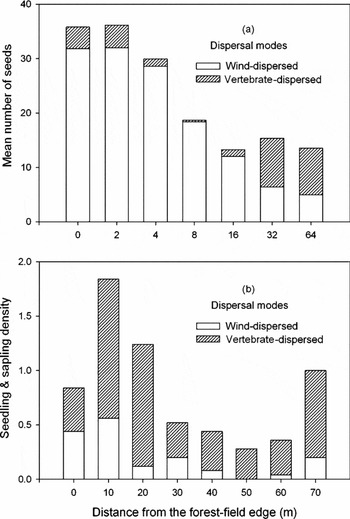
Wind-dispersed seeds, compared to vertebrate-dispersed seeds, dominated the seed rain in clearings, However, vertebrate-dispersed species were predominant among seedlings and saplings (Figure 3) (0.66 ± 0.48 vs. 0.2 ± 0.1).
Comparison of seed numbers and seedling and saplings densities at different distances from the forest edge recorded from clearings in Bhadra, showing mean number of wind- and vertebrate-dispersed seeds per 14 wk m−2 (a), and seedling and sapling densities (individuals per 25 m2) of wind-, and vertebrate-dispersed species (b).

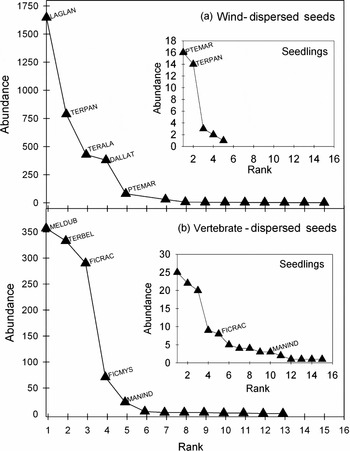
Overall, we encountered seeds of 14 wind-dispersed species across the clearings, but only five wind-dispersed species in the regenerating vegetation. Of the five most abundant wind-dispersed species in the seed rain, two were also the most abundant species in the regeneration (Figure 4). The one wind-dispersed species found in the regenerating vegetation (Bauhinia malabarica) that was not amongst the seeds recorded in seed rain most likely fruited after our study period (Mishra et al. Reference MISHRA, UPADHYAY, BAL, MOHAPATRA and MOHANTY2006).
Rank-abundance curves for seeds and seedlings of wind- and vertebrate-dispersed species recorded from clearings in Bhadra over a period of 14 wk. Panels denote seeds of wind-dispersed species (seedlings, inset) (a), and seeds of vertebrate-dispersed species (seedlings, inset) (b). Labels indicate the five most abundant species in the seed rain, and their relative position as seedlings. (LAGLAN = Lagerstroemia lanceolata, TERPAN = Terminalia paniculata, TERALA = Terminalia alata, DALLAT = Dalbergia latifolia, PTEMAR = Pterocarpus marsupium, MELDUB = Melia dubia, TERBEL = Terminalia bellerica, FICRAC = Ficus racemosa, FICMYS = Ficus mysorensis, MANIND = Mangifera indica.)

In the case of vertebrate-dispersed species, we encountered 13 species as seeds, but 15 as seedlings and saplings. Of the five most dominant species in the seed rain, only two also occurred as seedlings, and only one of these was amongst the five most abundant species in the regeneration (Figure 4). Seedlings of some vertebrate-dispersed species we recorded (e.g. Psidium guajava, Mangifera indica) are likely a legacy of past human settlements in these clearings.
DISCUSSION
Seed rain and regeneration in clearings
As expected, wind-dispersed seeds showed an exponential decline with distance from the forest edge, and a quadratic equation best described the pattern of seed arrival. Most seeds (~90%) arrived within 30 m from the forest, and only very few seeds (~8%) occurred as far as 64 m into the clearings. As expected, seed size and weight influenced the distance to which seeds dispersed, with a more rapid decline in number of heavier seeds compared to lighter seeds, with distance. Other studies also report short-distance dispersal of wind-dispersed seeds. Seeds found farther into clearings tend often to be seeds dispersed from remnant trees in abandoned pastures (Cubiña & Aide Reference CUBIÑA and AIDE2001, Holl Reference HOLL1999).
Vertebrate-dispersed seeds are also reported to be found close to adjoining forest; in pastures adjoining neotropical forests, most vertebrate-dispersed seeds were restricted to about 10 m from the forest (Aide & Cavelier Reference AIDE and CAVELIER1994, Cubiña & Aide Reference CUBIÑA and AIDE2001, Holl Reference HOLL1999). In contrast to this, and contrary to our expectations, we found no clear effect of distance on the arrival of vertebrate-dispersed seeds. This is most likely due to the difference in faunal composition between our study site and the neotropical forests of most other studies. A large proportion of seeds (about 95%) that we recorded were the relatively large seeds of M. dubia and T. bellerica. These are eaten by large ungulates like sambar and chital which do not occur in the neotropics. These mammals take refuge in forest clearings, which afford them better visibility to avoid predation by large carnivores such as the tiger (Karanth & Sunquist Reference KARANTH and SUNQUIST1992, Schaller Reference SCHALLER1967).
Harsh micro-climatic conditions could be a barrier to seed germination and seedling survival and the effect of harsh micro-climatic conditions in clearings may be mitigated closer to the forest (Duncan & Duncan Reference DUNCAN and DUNCAN2000). We also found that distance from forest edge was the most important determinant of regeneration in clearings, with numbers of seedlings and saplings declining with distance from the edge. Per cent shrub and weed cover were other variables that were negatively correlated with seedling and sapling density. Chromolaena odorata, especially, can form dense stands, preventing regeneration of native species and promoting fires when dry (Yadav & Tripathi Reference YADAV and TRIPATHI1981). Others have found a similar effect of grasses and ferns in inhibiting regeneration (Aide et al. Reference AIDE, ZIMMERMAN, HERRERA, ROSARIO and SERRANO1995, Holl Reference HOLL1998, Slocum et al. Reference SLOCUM, AIDE, ZIMMERMAN and NAVARRO2004).
Actual and effective dispersal
Contrary to our expectation, there were marked differences between patterns of actual seed dispersal (i.e. seeds arriving in clearings) and effective seed dispersal (seedlings recorded in clearings) (Cain et al. Reference CAIN, MILLIGAN and STRAND2000), both with distance from forest edge (Figure 3) and in terms of species composition (Figure 4). Especially in the case of wind-dispersed seeds arriving in the clearings, there appears to be strong recruitment limitation, with very few species occurring in regenerating vegetation. This could be due to one of several post-dispersal factors limiting regeneration, e.g. lack of suitable microsites, or seed predation or mortality (Münzbergová & Herben Reference MÜNZBERGOVÁ and HERBEN2005). In our study, wind-dispersed species accounted for only 25% of total seedlings encountered. This is in contrast to findings from abandoned pastures in a dry forest in Costa Rica, where almost 90% of regeneration was composed of wind-dispersed species (Janzen Reference JANZEN1988). This difference could be attributed to the difference in spatial extent of the Costa Rican pastures (which ranged from less than 1 ha to several km2 in area) compared with the clearings in Bhadra (15–95 ha), as well as to differences in vertebrate frugivore assemblages in Bhadra, compared with Costa Rica.
Our findings are similar to those of Ingle (Reference INGLE2003) who also found that in a 5-y-old fallow following slash-and-burn agriculture in montane rain forest of the Philippines, vertebrate-dispersed species exceeded wind-dispersed species in regenerating vegetation, even though wind-dispersed species far outnumbered vertebrate-dispersed species in terms of seed arrival. The predominance of seedlings of vertebrate-dispersed species could be due to one of several factors, for example, directed dispersal (Wenny Reference WENNY2001), through increased dormancy (Willson Reference WILLSON1993), or through the protection afforded to seeds by their being deposited in faecal matter (Traveset Reference TRAVESET1998) or in clumps (Howe Reference HOWE1989). We did not, however, observe seedlings of M. dubia or T. bellerica, the two species that were dispersed in clumps in sambar and chital dung in our study.
Implications for vegetation recovery
In Bhadra, although seed arrival is limited farther into clearings, regeneration is proceeding relatively rapidly in comparison with regeneration in abandoned or degraded land in other parts of the world. Our findings also indicate that, overall, seed arrival may not be the principal limitation to vegetation recovery and that other factors, such as existing vegetation, may play a significant role in limiting recruitment. Experiments involving seed or seedling addition and habitat manipulation are required to clearly ascertain dispersal and recruitment limitation (Münzbergová & Herben Reference MÜNZBERGOVÁ and HERBEN2005, Nathan & Muller-Landau Reference NATHAN and MULLER-LANDAU2000).
In the future, regeneration in the clearings we studied is also likely to be increasingly inhibited by the invasion of C. odorata. The large number of C. odorata seeds collected in seed traps, regardless of distance from the edge, and the negative effect of weed cover on regeneration that we observed, are both indicative of this. Invasion by C. odorata in other sites across the state of Karnataka in India has been dealt with by uprooting, or cutting and burning (Doddamani et al. Reference DODDAMANI, MUMMIGATTI, NADAGOUDAR, CHETTI, Sankaran, Murphy and Evans2001). Continued monitoring of these changes in the clearings, with or without management interventions, will prove to be invaluable in understanding the dynamics of forest recovery in seasonally dry tropical forests.
ACKNOWLEDGEMENTS
The Rhino and Tiger Conservation Fund of the U.S. Fish & Wildlife Service, U.S. Department of Interior, funded our study. Wildlife Conservation Society – India Program, National Centre for Biological Sciences and Center for Wildlife Studies, Bangalore provided crucial support for the work. We thank the Karnataka Forest Department for permission to work in Bhadra and for logistical support at the field site. Mr N. Samba Kumar, Mr D.V. Girish, K.R. Aravind, Dr Ajith Kumar and Dr Jagdish Krishnaswamy provided valuable guidance. We thank Shankara and Ganesh Babu for assistance with identification of plants and seeds, Prasad, Pradeep and Subash for assistance in the field, and Nibedita Mukherjee and Vimala T. for assistance with the soil analysis.
List of native tree species, seeds of which were collected from seeds traps in this study in Bhadra. Also given are the locations where seeds of each species were encountered (C = in clearings; F = in the adjoining forests), and the species dispersal mode (B/M = bird/mammal dispersed, W/G = wind/gravity dispersed).