Introduction
The African weaver ant (AWA) Oecophylla longinoda Latreille (Hymenoptera: Formicidae) is an effective agent in Tanzania for the biocontrol of sap-sucking pests in coconut (Varela, Reference Varela1992; Seguni, Reference Seguni1997) and cashew (Olotu et al., Reference Olotu, du Plessis, Seguni and Maniania2012). It also effectively controls pests of mango in Bénin (Van Mele et al., Reference Van Mele, Vayssières, Van Tellingen and Vrolijks2007) and of cashew in Ghana (Dwomoh et al., Reference Dwomoh, Afun, Ackonor and Agene2009). In East Africa, AWA occurs naturally in more than 80 species of shrubs as well as in wild and cultivated trees along the coastal area of Kenya and Tanzania (Varela, Reference Varela1992). In agro-ecosystems such as cashew, their abundance has been reported to vary with the season; more established AWA colonies were observed during cashew on-seasons than during off-seasons (M. I. Olotu, personal observation). The abundance of AWA was also reported to build up during the on-seasons, which coincided with the occurrence of the sap-sucking pests Helopeltis anacardii Miller, H. schoutedeni Reuter (Hemiptera: Miridae) and Pseudotheraptus wayi Brown (Hemiptera: Coreidae) (Olotu et al., Reference Olotu, du Plessis, Seguni and Maniania2012). Apart from the effect of cashew seasonality, AWA abundance has also been reported to be affected by the presence of dominant competing ant species especially the inimical ant Pheidole megacephala Fabricius (Hymenoptera: Formicidae) that can displace it (Way and Khoo, Reference Way and Khoo1992).
For an effective programme to manage sap-sucking pests in cashew with AWA, strategies to enhance their abundance need to be developed and promoted. Synthetic chemical insecticides have been used to control competing ants to allow natural increase in Oecophylla spp. populations (Way and Khoo, Reference Way and Khoo1992). For example, the hydramethylnon ant bait (Amdro®) has been used successfully in controlling P. megacephala in East Africa (Varela, Reference Varela1992; Zerhusen and Rashid, Reference Zerhusen and Rashid1992; Seguni, Reference Seguni1997), where the ant is a major competitor of AWA (Way, Reference Way1953). Olotu et al. (Reference Olotu, du Plessis, Seguni and Maniania2012) also used hydramethylnon ant bait to obtain stable AWA colonies in cashew orchards in Tanzania. Initially, the hydramethylnon ant bait was developed to control the red imported fire ant Solenopsis invicta Buren (Hymenoptera: Formicidae) in the USA (Williams et al., Reference Williams, Lofgren, Banks, Stringer and Plumley1980) and was later used to control P. megacephala in pineapple in Hawaii (Su et al., Reference Su, Beardsley and McEwen1980) and in citrus orchards in South Africa (Samways, Reference Samways1981).
As ants prefer food high in protein for larval nourishment (Hölldobler and Wilson, Reference Hölldobler and Wilson1990; Haack et al., Reference Haack, Vinson and Olson1995; Blüthgen and Fiedler, Reference Blüthgen and Fiedler2004), their enhancement and conservation can be accomplished by supplementing their diets with rich sources of protein when food is scarce (Van Mele and Cuc, Reference Van Mele and Cuc2007; Peng et al., Reference Peng, Christian and Reilly2009). Ants are also known to invest more energy searching for high protein food resources during scarcity (Kay, Reference Kay2002), and this may reduce their prey efficacy. The use of fish-based bait has been reported to strengthen colonies of the green tree ants Oecophylla smaragdina Fabricius (Hymenoptera: Formicidae) (Lim, Reference Lim2007; Offenberg and Wiwatwitaya, Reference Offenberg and Wiwatwitaya2010). Similarly, dried fish has also been used in Africa to supplement the diet of AWA during the food-scarce seasons (Van Mele and Cuc, Reference Van Mele and Cuc2007). In addition to fish-based baits, cultural practices such as the maintenance of ground vegetation by regular slashing (Seguni, Reference Seguni1997) and intercropping (Way and Khoo, Reference Way and Khoo1991; Peng et al., Reference Peng, Christian and Gibb1997; Van Mele and Van Lenteren, Reference Van Mele and Van Lenteren2002) have also been reported to be effective in strengthening AWA colonies. The aim of this study was, therefore, to evaluate strategies for the conservation of AWA colonies during cashew off-seasons for the sustainable management of sap-sucking insect pests in orchards.
Materials and methods
Experimental sites
Experiments were conducted in cashew orchards at Bagamoyo (S 06°49.3′, E 38°54.8′, 53.43 masl) and Mkuranga (S 07°3.5′, E 39°15′, 90.53 masl), Coast region of Tanzania. The experiment was conducted during two cashew off-seasons, January–June 2011 and 2012, when there were no shoot flushes or blooms. The 12-year-old trees at Bagamoyo were planted in monoculture and mostly well separated from one another. The 15-year-old trees at Mkuranga were irregularly intercropped with mango, coconut and citrus.
Fish- and hydramethylnon-based baits
Fresh discarded fish intestines were collected from a fish market in Dar-es-Salaam. These were placed in cups made from plastic water bottles (70 mm diameter and 60 mm height), which were suspended from main branches at 2 m above soil level using manila thread and provided to AWA workers at the rate of 15 g/tree. Granules of hydramethylnon ant bait, Amdro® (BASF East Africa Ltd, manufactured by BASF AG, Agricultural Centre, Limburgerhof, Germany), were sprinkled round the bases of test trees at the rate of 3 g/tree to suppress P. megacephala.
Cashew trees (10 per treatment) were selected at random and assigned the following treatments: (i) with fresh fish intestines alone; (ii) with hydramethylnon alone; (iii) with both baits and (iv) without baits, as control. Detailed information such as date, tree number and type of treatment was recorded on labels tied to the trunks of selected trees. The two baits were provided every month for 6 months.
Quantification of AWA
The abundance of AWA was determined once before application of the treatments and monthly for 4 months. It is expressed as the number of leaf nests/tree and the number of trails on the main branches. Leaf nests were counted using binoculars and the total number of main branches/tree with trails was also recorded. More than 10 AWA walking along a main branch were recorded as one trail. Quantification of abundance/tree was performed according to the method described by Peng and Christian (Reference Peng and Christian2006). The percentage of AWA colonization was calculated as follows:
(i) (Number of main branches with a trail in a tree)/(number of main branches in the tree) × 100.
(ii) The mean colonization level, based on trails/treatment, was calculated as the average of AWA colonization.
AWA on a tree were considered ‘abundant’ when more than 50% of the main branches had trails, or ‘fewer’ when less than 50% had trails.
Repeated-measures analysis of variance was used to analyse the effect of the baits on the number of leaf nests and percentage colonization over time using STATISTICA version 11 (Statsoft, Inc., 2012).
Results
AWA leaf nests
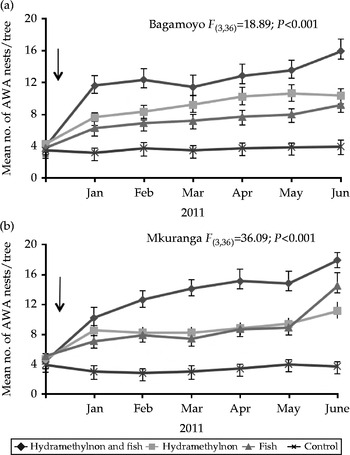
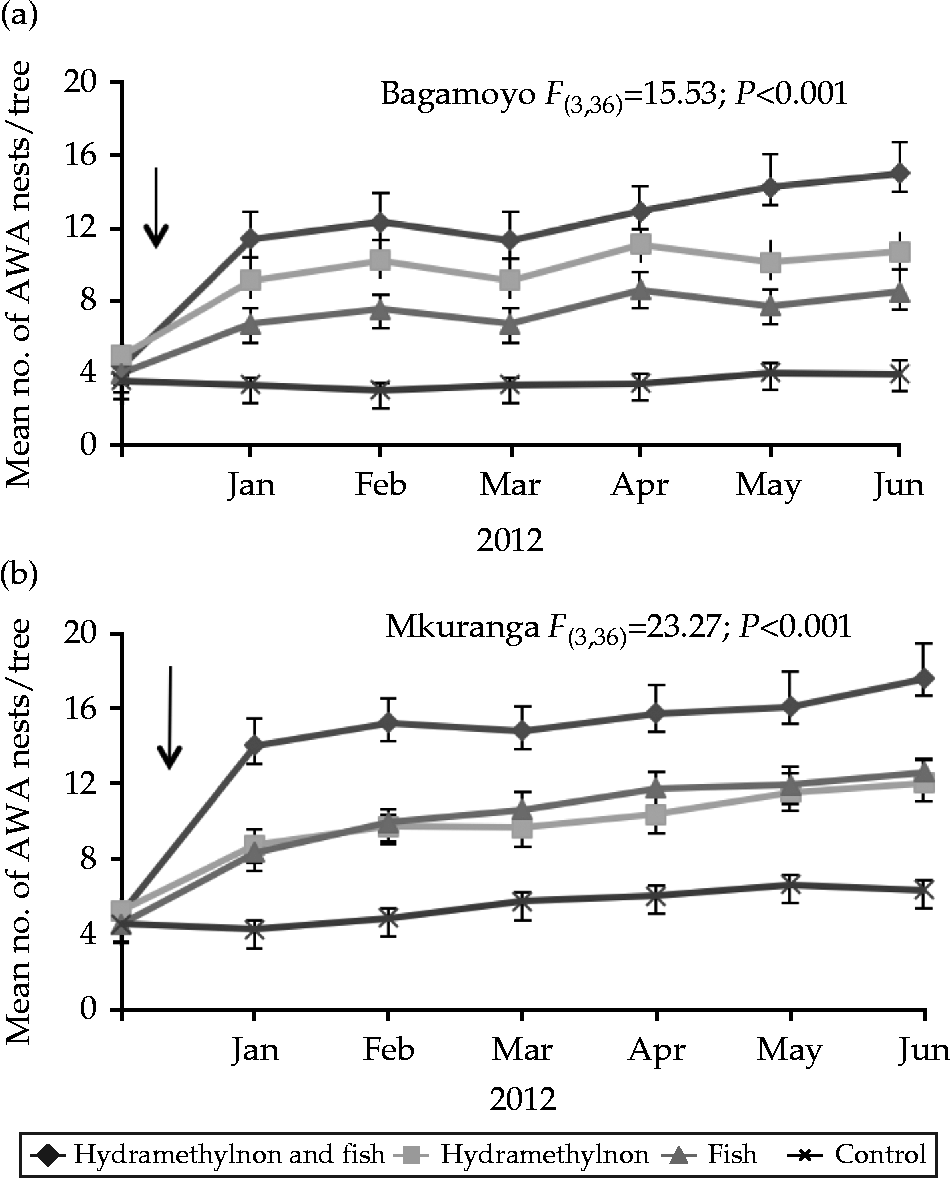
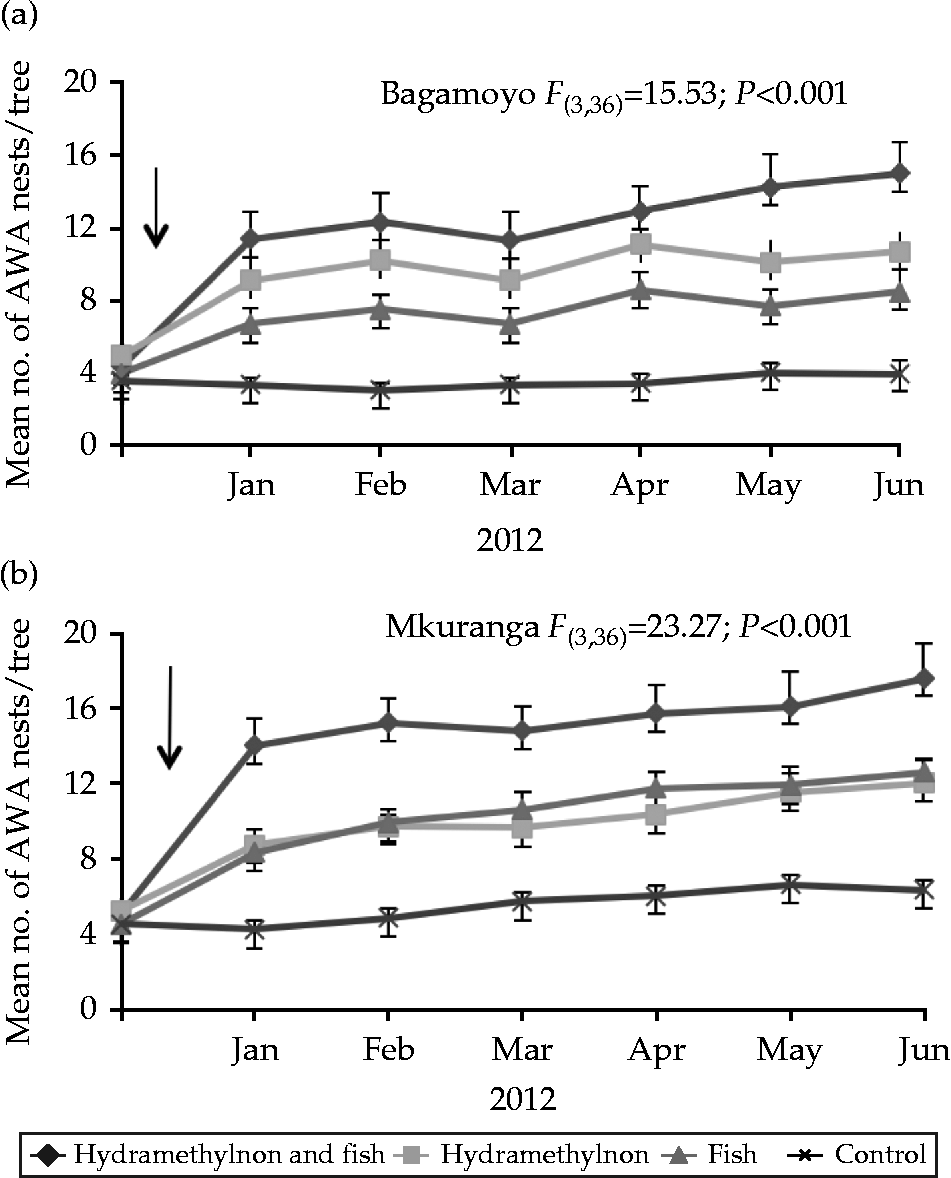
The number of leaf nests/tree recorded before application of the treatments was not significantly different at both sites and in both seasons (Figs 1 and 2) and ranged between 3.5 and 5.1 (2011) and from 3.6 to 6.6 (2012). Following provision of the baits, the number of leaf nests generally remained similar in the control throughout the experimental period but increased significantly in all the treatments at Bagamoyo (F (3,36)= 18.89; P< 0.001) in 2011. However, there were significant differences between the different treatments (Figs 1 and 2). A similar trend was observed in 2012. No significant differences in the number of leaf nests were observed in treatments where fish and hydramethylnon were used alone at Mkuranga in 2011. However, the number of leaf nests was higher in treatments combining both baits (F (3,36)= 36.09; P< 0.001) (Fig. 1).
Mean number of AWA leaf nests in the trees baited with hydramethylnon and fish, hydramethylnon alone, fish alone and control in the cashew orchards at (a) Bagamoyo and (b) Mkuranga in 2011. The arrow denotes the beginning of the baiting. Bars indicate SE.

Mean number of AWA leaf nests in the trees baited with hydramethylnon and fish, hydramethylnon alone, fish alone and control in the cashew orchards at (a) Bagamoyo and (b) Mkuranga in 2012. The arrow denotes the beginning of the baiting. Bars indicate SE.
AWA trails colonization
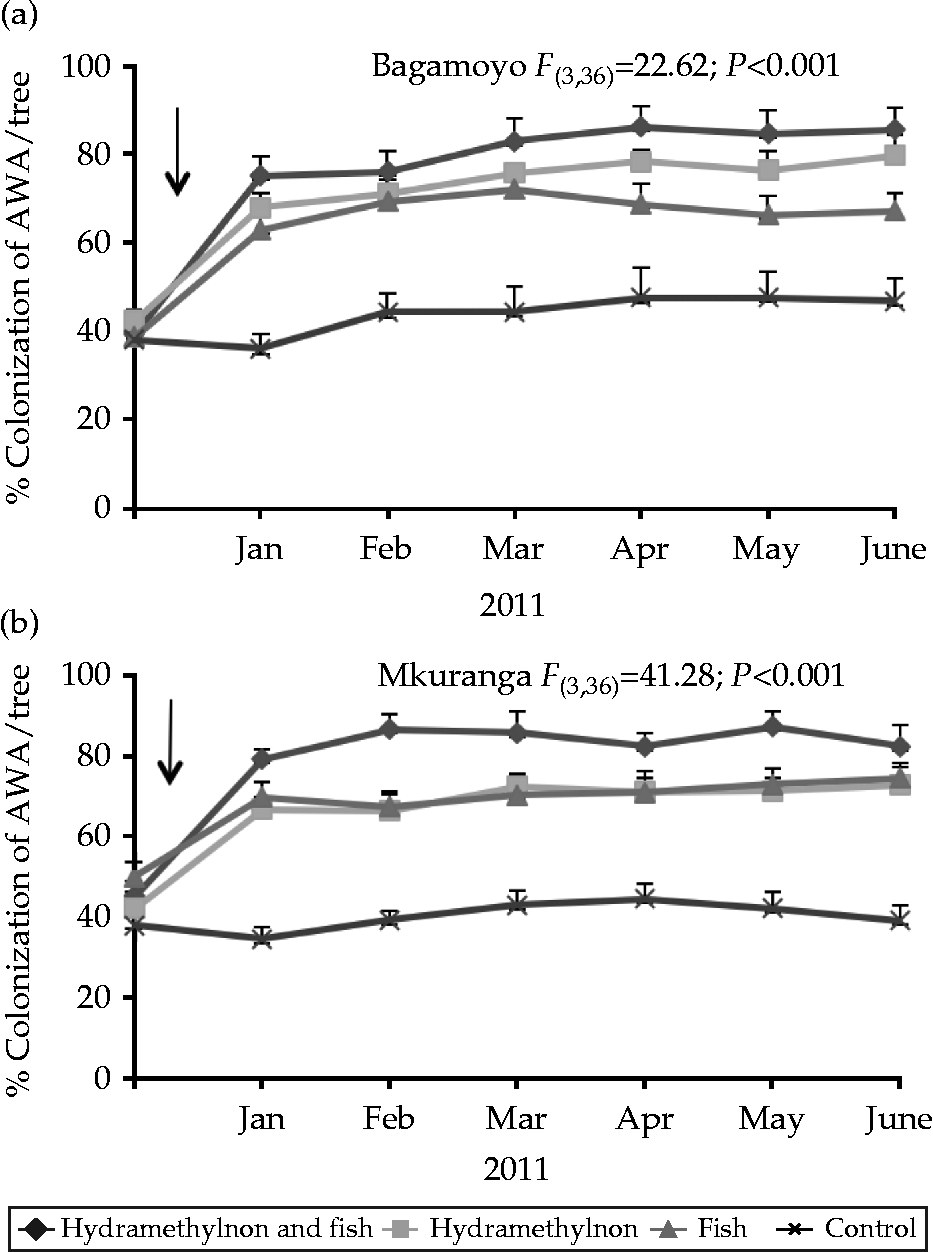
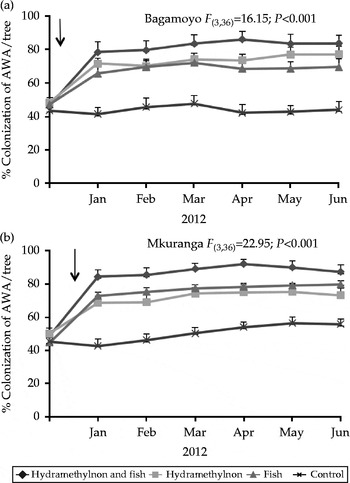
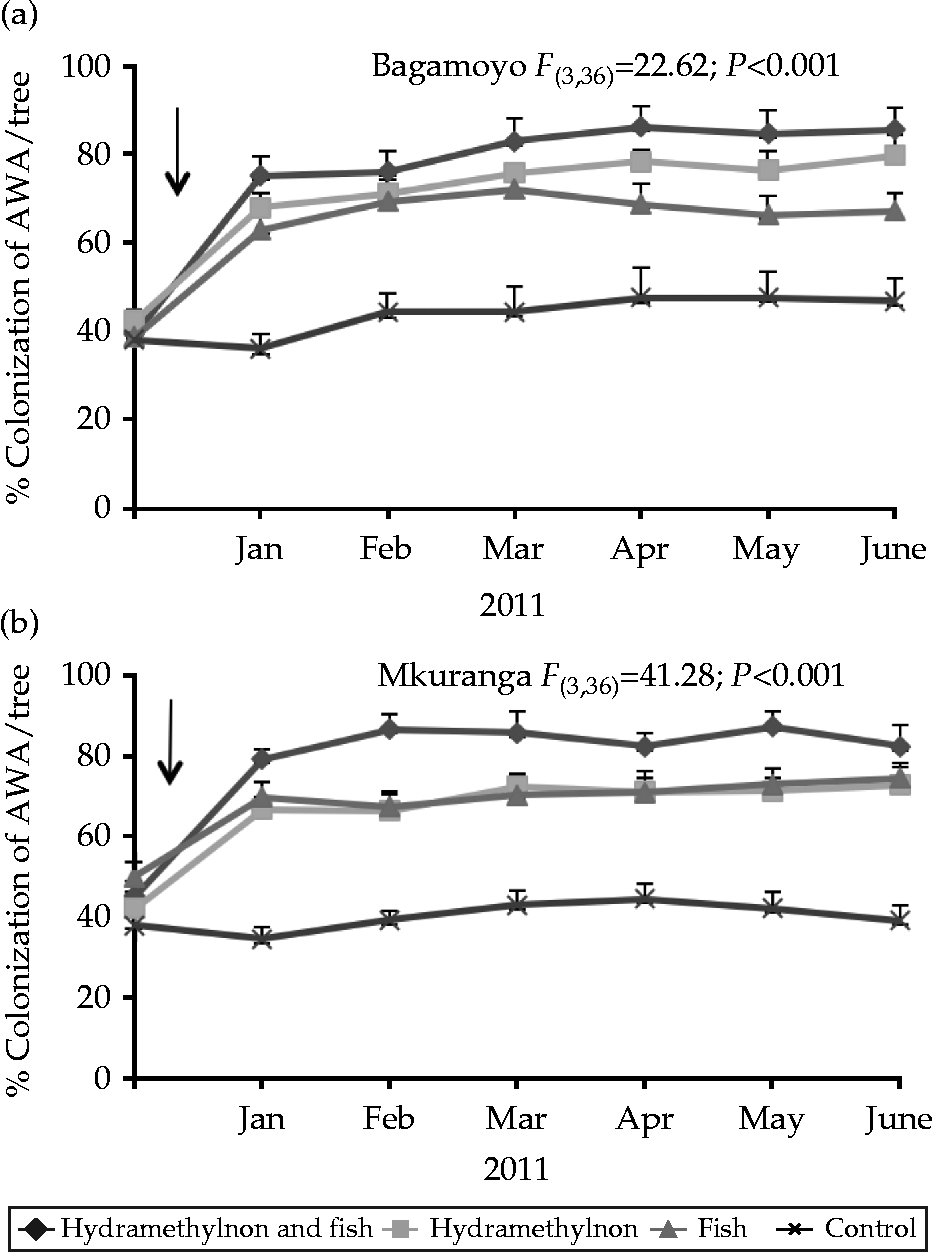
Similarly, the percentage of colonization trails recorded before the application of treatments was not significantly different at both sites and in both seasons (Figs 3 and 4). At Mkuranga, there were no significant differences in the percentage of colonization trails in treatments where fish and hydramethylnon were used alone in both seasons (Figs 3 and 4). However, the percentage was higher in combined treatments (F (3,36)= 41.28; P< 0.001) (Fig. 3).
Percentage of AWA trails colonization in the trees baited with hydramethylnon and fish, hydramethylnon alone, fish alone and control in the cashew orchards at (a) Bagamoyo and (b) Mkuranga in 2011. The arrow denotes the beginning of the baiting. Bars indicate SE.
Percentage of AWA trails colonization in the trees baited with hydramethylnon and fish, hydramethylnon alone, fish alone and control in the cashew orchards at (a) Bagamoyo and (b) Mkuranga in 2012. The arrow denotes the beginning of the baiting. Bars indicate SE.

A similar trend was observed in 2012. No significant differences in the percentage of colonization trails were observed in treatments where fish and hydramethylnon were used alone at Mkuranga in 2011. However, the percentage of colonization trails was higher in combined treatments (F (3,36)= 36.09; P< 0.001) (Fig. 1). At Bagamoyo, there were significant differences in the percentage of colonization trails in all treatments in both seasons (Figs 3 and 4).
Discussion
High colonization levels of AWA in terms of both leaf nests/tree and trails on main branches were recorded after the provision of different baits at the two sites during the 2011 and 2012 cashew off-seasons. This could be attributed to the efficacy of the two baits in promoting and enhancing the conservation of AWA during these periods. The provision of fish-based bait alone was as effective as hydramethylnon used alone and it could therefore be considered as an alternative source of food for AWA during cashew off-seasons. Fish-based bait has been successfully used for the conservation of AWA in forests in Bénin (Van Mele and Cuc, Reference Van Mele and Cuc2007) and of O. smaragdina in Australia (Peng et al., Reference Peng, Christian and Reilly2009). In Malaysia, the provision of food bait has been proven to augment populations of O. smaragdina in a mahogany plantation (Lim, Reference Lim2007). Supplementing the diet for AWA with fish-based bait resulted in maintaining and strengthening colonies within the cashew orchards, which would have moved out of the fields in search for food. Application of hydramethylnon ant bait was also successful in maintaining a high number of leaf nests/tree and stable colonization of AWA trails during cashew off-seasons, and so confirms previous reports (Varela, Reference Varela1992; Seguni, Reference Seguni1997; Olotu et al., Reference Olotu, du Plessis, Seguni and Maniania2012). Workers of AWA were observed foraging on other host plants in the absence of P. megacephala and can also co-exist with P. megacephala under suitable ground vegetation in citrus orchards (Seguni et al., Reference Seguni, Way and Van Mele2011). Generally, there were no significant differences between the results from the two baits when applied alone.
The provision of both baits can effectively contribute to the conservation of AWA during cashew off-seasons. However, farmers would need to buy hydramethylnon and sometimes the insecticide may not even be available. On the other hand, fish intestine is a waste product and is available in any fish market throughout the year. This fish intestine can therefore be used as an alternative diet for AWA during the cashew off-season but there will be the need to create awareness among farmers of this cheap technology.
Acknowledgements
This work was funded by the German Federal Ministry for Economic Cooperation and Development (BMZ). The authors wish to acknowledge the International Centre of Insect Physiology and Ecology (icipe), the African Regional Postgraduate Programme in Insect Science (ARPPIS) and Mikocheni Agricultural Research Institute (MARI) for assistance during this study. They also thank C. Materu, G. Mwingira J. Ambrosy, M. George, V. Nyange and B. Mruma for their technical assistance. They are also grateful to Mr and Mrs Ponzi and M. Chimela for providing experimental sites and farm facilities.