


Background
Everyone, at some point in their lives, face the inevitable suffering associated with the loss of someone significant. Psychological intervention in grief has been a controversial issue considering its effectiveness and side-effects. However, known risks related to traumatic stress on crisis narrative interventions (Barbosa, Sá and Rocha, Reference Barbosa, Sá and Rocha2013) and the variability of time after loss sustain the need for evidence about crisis interventions to prevent emotional problems related to bereavement. A meta-analysis on complicated grief interventions has shown that there is a difference between the short term and long term effects of preventive and treatment strategies, in favour of the latter (Wittouck, Autreve, Jaegere, Portzky and Heeringen, Reference Wittouck, Van Autreve, De Jaegere, Portzky and Van Heeringen2011). However, it has been generally accepted by researchers that psychological interventions help to reduce the intensity of the mourning, promote greater resilience in the process of adjustment after the loss (Wittouck et al., Reference Wittouck, Van Autreve, De Jaegere, Portzky and Van Heeringen2011), and to intervene in complicated bereavement is more effective than not doing so (Currier, Neimeyer and Berman, Reference Currier, Neimeyer and Berman2008). It is extremely important to understand that each person grieves in a unique way: for example, some individuals can take years dealing with loss, leading to changes in psychosocial functioning; some may experience a high intensity of symptoms, while others might attempt to mask their pain. Therefore the treatment protocols applied in a certain case need to be adaptable to the individual needs (Wittouck et al., Reference Wittouck, Van Autreve, De Jaegere, Portzky and Van Heeringen2011). Grief work is a concept essential at some point in our lives; it is crucial to pay attention to the significance of changing of thoughts and emotions, to clearly see all the benefits of seeking help, as well as to recognize that mourning doesn't pass with the “cure of time” (Barbosa et al., Reference Barbosa, Sá and Rocha2013). Based on the negative results of the debriefing (Mayou, Ehlers and Hobbs, Reference Mayou, Ehlers and Hobbs2000) and on the positive results with cognitive-narrative therapy (Currier et al., Reference Currier, Neimeyer and Berman2008), the question formulated is whether psychologists at primary health care can help to prevent bereavement problems. In order to answer this question we developed a randomized controlled trial of an intervention manual with the following main goals: a) as primary outcome, to prevent depression symptoms, and secondarily to prevent psychotraumatic symptoms in the bereaved; b) to promote the participation in the program in order to help those in need; and c) to implement a brief intervention that can be adjusted to the primary healthcare with the consideration of cost-benefits for the patients and the healthcare facilities.
Method
Trial design
This study is a longitudinal randomized controlled clinical trial and respects CONSORT guidelines (Schulz et al., Reference Schulz, Altman and Moher2010). Repeated measures, including BDI and IES-R, were used. The primary outcome variable is depression and the secondary is traumatic stress. The study had as its objective to prevent depression and psychotraumatic symptoms and consisted of the following sequential phases: (1) participants were recruited by medical staff of a Primary Health Care Unit; (2) clients were contacted by phone to book the first session; (3) participants sign informed consent; (4) eligible participants were randomly sequentially allocated to the control (treatment as usual group type) and to experimental groups; (5) both groups were subjected to a semi-structured interview (SDQ) and to two instruments – BDI and IES-R – one month after the loss, baseline assessment at the first time it was given (referred as T1); (6) finally, 6 months after the loss, the evaluation was repeated in the same conditions as the first one, follow-up assessment at the second time the study was given (T2). The experimental group had additionally a cognitive narrative manualized intervention.
Intervention: manualized cognitive narrative program for complicated grief
To achieve the main goals, it is crucial to consider the robustness of the treatment based on an intervention manual, which is descriptive of the techniques (Jané-Llopis, Hosman, Jenkins and Anderson, Reference Jané-Llopis, Hosman, Jenkins and Anderson2003). Thus this manual is based on Gonçalves, Machado and Rosas (Reference Gonçalves, Machado and Rosas1997) and Barbosa et al. (Reference Barbosa, Sá and Rocha2013) and is a constructivist approach that focuses on narrative work aiming to improve diversity of meaning, coherence and complexity, more than enabling exposure.
The process was designed in four weekly sessions of 60 minutes and the objectives and therapeutic techniques used during the sessions were the recall, the cognitive and emotional subjectification, the metaphorizing, and the projection. The experimental group completed a checklist in order to evaluate the acceptability of the program.
Therapists
The therapist was subjected to training on the manualized intervention, in order to have a direct experience of the characteristics and requirements of the task.
Outcome measures
Depressive symptoms
The instrument used to assess depression was the BDI, adapted for the Portuguese population, with the main goal of distinguishing the non-depressed and the depressed persons.
Psychotraumatic symptoms
The IES-R is the most frequently used instrument for assessing bereavement traumatic reactions. The IES-R included 22 items, which were distributed among the three scales, namely the subscale avoidance (8 items), the subscale intrusion (8 items) and subscale hypervigilance (with 6 items). In addition, a fourth factor became known as subscale of emotional numbing.
Sample size
Fifty-two recently bereaved (less than one month after loss) persons were initially contacted and sequentially randomized - 15 for the intervention group and 37 for the control group. In the experimental group, four participants failed to enrol in the intervention, reporting that they did not consider it was relevant to participate. In the control group, 19 were lost after declining the second assessment, citing transportation difficulties and low-level symptoms considered not relevant to follow-up assessment.
Randomization
The selected sample is composed of 29 participants. These participants were randomly sequentially allocated to two groups: a control group and an experimental group. Both the control group (n = 18) and experimental group (n = 11) experienced recent bereavement and had social-demographic and clinical similarities.
Analysis of attrition rates in sample
The values of attrition rates for IG considered were the following: (a) number of contacted individuals (n = 15); (b) number of participants in the intervention (n = 11); (c) number of participants who completed the interventions (n = 11); and (d) number of participants who completed the last evaluation (n = 11). During the four sessions of the program, participation of the clients was 100%, i.e. 0% attrition. This result might be additionally explained by the flexibility afforded the clients by a therapist in terms of booked dates and timetables.
However, the high attrition verified on enrolment is mainly due to the high inclusiveness of eligibility criteria, that is, including participants with both low and high symptoms on a preventative trial. Also, baseline results at T1 do not evidence significant differences on the outcome measures, suggesting low-bias risk.
Statistical methods
To assess the differences between the groups, during both periods of analysis, Tl and, T2, at the level of the depression and the psychotraumatic symptoms we performed a t-test and size-effects. Considering the small sample, the main focus is on describing and analysing effect size values. A published meta-analysis (Jané-Llopis et al., Reference Jané-Llopis, Hosman, Jenkins and Anderson2003) for the different types of programs for the prevention of depression found a weighted mean effect size of 0.22 (95% CI 0.14–0.30). In this study, we used the value of Hedges (g), since this is more conservative and the most suitable for the size of the sample.
Results
Analysis for depressive symptoms: comparisons between the control group and experimental group
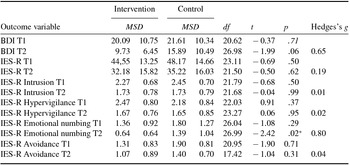
The BDI values obtained for both groups, in baseline and follow-up (FU), do not have a statistically significant difference (p > .05). However, considering effect-sizes analysis on the second evaluation, there is a medium to a high value on lowering depressive symptoms (g = 0.65), comparing control and intervention groups (see Table 1).
Depressive symptoms (BDI) and traumatic symptoms (IES-R): comparison between the IG and controls at T1 and T2

* p < 0.05
Traumatic stress symptoms: comparisons between the control group and experimental group
Through a descriptive analysis of the indicators of psychotraumatic symptoms (Table 1) the mean decreased proportionally in both groups with the exception of IES-R Intrusion, which maintain values. Comparing both groups, a significant positive difference is also observed in Emotional Numbing for the experimental group. Effect-size values range between 0.01 and 0.8, with 0.80 for Emotional Numbing (confidence interval 95% between 0.02 and 1.58), as shown in Table 1.
Discussion
This randomized controlled trial evaluates the effectiveness of a four-session cognitive narrative intervention to reduce depressive and traumatic symptoms in the recently bereaved and examines differences between the two groups at baseline and 6 months after the loss.
Indicators of depression and traumatic stress were compared in the experimental group at 6 months. Most relevant were the results for psychotraumatic symptoms, due to known negative results on short crisis interventions, where we found no negative evolutions and very positive improvements on emotional numbing. Evidence of efficacy of preventive bereavement interventions are scarce or even negative (Wittouck et al., Reference Wittouck, Van Autreve, De Jaegere, Portzky and Van Heeringen2011).
The effect sizes results allow us to compare this intervention with other published studies; for instance, considering specifically for complicated grief preventive interventions, the Wittouck et al. (Reference Wittouck, Van Autreve, De Jaegere, Portzky and Van Heeringen2011) meta-analysis showed a negative evolution mean effect size of 0.13. This important synthesized evidence generated a negative appraisal for preventive crisis interventions, which sustains our effort to develop new interventions targeting and controlling psychotraumatic symptoms. Also, Jané-Llopis et al.’s (Reference Jané-Llopis, Hosman, Jenkins and Anderson2003) extensive meta-analysis of depression prevention programs found a mean size-effect of 0.22.
These positive results on such a small scale study may be explained by some careful manualization details, as the level of emotional activation, specifically the exclusion of sensorial work of episodic memories (objectivation). This aspect has positive implications on future bereavement or crisis interventions concerning the management of the optimal level of activation. These results confirm the importance metaphor construction by patients as part of a coherent episodic narrative providing a functional structure to work with emotions and thoughts, and can be used to understand the changes in relation to the perception of bereavement and to provide new perspectives for life and new meaningful memories. This intervention seems to accelerate this process; however, the process itself does not occur in sessions. It opens a way for contextual narrative production with very high level of creativity and coherence.
However, the limitation of the sample used is a very relevant aspect concerning generalization and possible bias from attrition or from randomization. Analysing possible bias on differences at baseline and of risk factors between groups show that (1) there are not relevant differences at baseline; (2) the attrition rates on control group was considerable; however, comparing the included participants’ characteristics at baseline in both groups, the differences are minimal and the theoretical trends indicate a negative bias for experimental group (i.e. less education and less social support perception). Nevertheless, the pilot nature of this randomized trial means that in future research this sample should be expanded to provide more robust evidence of efficacy.
Acknowledgements
Conflict of interest: The authors have no conflicts of interest with respect to this publication.
Supplementary material
An extended version is also available online under the Brief Clinical Report Supplementary Materials tab in the table of contents. Please visit http://dx.doi.org/10.1017/S1352465816000345.




Comments
No Comments have been published for this article.