Introduction
Smoking is a major preventable cause of morbidity and mortality worldwide (Lim et al., Reference Lim, Vos, Flaxman, Danaei, Shibuya, Adair-Rohani and Aryee2013). According to the Canadian Tobacco Use Monitoring Survey Data there were approximately 4.7 million smokers (16.7% of the population) in Canada in 2010 (Reid, Hammond, Burkhalter, & Ahmed, Reference Reid, Hammond, Burkhalter and Ahmed2012). It was estimated that there were 37,000 tobacco-attributable deaths and CAD $17 billion of tobacco-attributable costs in 2002 (Rehm et al., Reference Rehm, Gnam, Popova, Baliunas, Brochu, Fischer and Taylor2007).
The majority (60.2%) of smokers in Canada surveyed in 2010 considered quitting smoking within the next 6 months and almost half of them (27.3% of the population) wanted to quit within the next month (Reid et al., Reference Reid, Hammond, Burkhalter and Ahmed2012). Unassisted cessation has been described as the most successful method of quitting smoking, in part because of its reach (theoretically, universal) and because the majority of former smokers have quit without formal evidence-based psychosocial or pharmacological intervention (Doran, Valenti, Robinson, Britt, & Mattick, Reference Doran, Valenti, Robinson, Britt and Mattick2006); (Hammond, McDonald, Fong, & Borland, Reference Hammond, McDonald, Fong and Borland2004); (Zhu, Melcer, J., Rosbrook, & Pierce, Reference Zhu, Melcer, Rosbrook and Pierce2000).
While natural recovery is common in addictions and in nicotine dependence in particular (Doran et al., Reference Doran, Valenti, Robinson, Britt and Mattick2006; Klingemann, Sobell, & Sobell, Reference Klingemann, Sobell and Sobell2009), recent data indicate that approximately 60% of smokers who are currently trying to quit will use some form of cessation assistance (Reid et al., Reference Reid, Hammond, Burkhalter and Ahmed2012). There are a number of evidence-based approaches to smoking cessation such as nicotine replacement therapy (Stead et al., Reference Stead, Perera, Bullen, Mant, Hartmann-Boyce, Cahill and Lancaster2012), pharmacotherapy such as bupropion (Hughes, Stead, & Lancaster, Reference Hughes, Stead and Lancaster2007) or varenicline (Cahill, Stead, & Lancaster, Reference Cahill, Stead and Lancaster2012; Coe, Rollema, & O'Neill, Reference Coe, Rollema and O'Neill2009), and various forms of behavioural interventions (Cummins, Bailey, Campbell, Koon-Kirby, & Zhu, Reference Cummins, Bailey, Campbell, Koon-Kirby and Zhu2007; Stead & Lancaster, Reference Stead and Lancaster2012). Despite the natural recovery phenomenon and an abundance of effective smoking cessation aids only 10% of those who try to quit are able to maintain abstinence for one year (Reid et al., Reference Reid, Hammond, Burkhalter and Ahmed2012).
A proportion of smokers seek treatment in specialized smoking cessation clinics. While this group is comprised of individuals with mixed levels of dependence, smoking patterns and other clinical characteristics, smokers seeking help may differ from smokers in the general population since those who have been successful at quitting unassisted or without specialised assistance would not seek help at a smoking cessation clinic. Thus, the subpopulation of smokers seeking help in specialised cessation clinics may include larger numbers of smokers who unsuccessfully tried to quit before admission and are likely to possess features associated with smoking cessation failure in the past and, theoretically, in the future. There is a consensus across the literature that treatment programmes should be matched to their respective clientele in order to provide support adequate to their needs (Abrams et al., Reference Abrams, Orleans, Niaura, Goldstein, Prochaska and Velicer1996; Niaura & Abrams, Reference Niaura and Abrams2002; Prochaska & Goldstein, Reference Prochaska and Goldstein1991). For example, heavier dependence and daily cigarette consumption are associated with lower cessation rates (Fagerström, Russ, Yu, Yunis, & Foulds, Reference Fagerström, Russ, Yu, Yunis and Foulds2012) and thus level of nicotine dependence should be taken into consideration when providing treatment. Despite the potential implications for clinical practice, few data are available on the characteristics of smokers who seek professional help at specialised smoking cessation clinics, and this group of smokers is poorly described clinically. Therefore, the goal of this study was to describe the subpopulation of smokers who seek treatment in specialised smoking cessation clinics in comparison to smokers in general population.
Material and methods
Subjects
In this study we compared three groups of smokers. The first group consisted of smokers attending the Centre for Addiction and Mental Health Nicotine Dependence Clinic (NDC, n = 796) who were admitted between May 2008 and July 2010. The clinic is located in Toronto, Ontario, Canada. The coverage of NDC includes mostly clients from Toronto and the Greater Toronto Area with a population of approximately 5.5 million people (40% of population of Ontario). The clinic is specialised in delivering smoking cessation services to clients of all levels of complexity, including those with multiple comorbidities, the prevalence of which is typically high, e.g. 26.9% of the study sample had cardiovascular disorders, 30.2% had respiratory disorders, 42.1% had some form of depressive disorder, 37.8% have history of alcohol use disorder etc.). Services provided by the clinic are designed to address the complex medical and social needs of the clients and include psychosocial counselling, medical assessments and interventions such as nicotine replacement therapy (NRT), bupropion and varenicline. Almost all clients are assessed by physicians and are either referred to corresponding specialists at CAMH or other hospitals or treated by addictions specialists or psychiatrists at the clinic (e.g. mood and anxiety disorders, other addictions etc.). The medical services are free of charge in Canada. At the time of data collection patients with financial difficulties received subsidised NRT products via one of the NDC's research programmes. Medications are covered by select drug plans (some private insurance plans and Ontario Drug Benefit programme). All smokers seeking help included in our study were residents of the Greater Toronto Area.
Two groups of smokers in the general population were obtained for comparison purposes from two large Ontario surveys. The first group was obtained from participants in the Ontario Tobacco Study (OTS) and second group was obtained from participants in the Centre for Addiction and Mental Health Monitor survey (CM). For the purposes of our study, only OTS and CM respondents from the Greater Toronto Area were included (OTS, n = 898 and CM, n = 457).
Data collection process
Data on NDC smokers were collected via a comprehensive chart review. The timeframe of data collection was dictated by availability of structured clinical records and availability of a follow-up period of at least one year. The study was approved by the CAMH Research Ethics Board. The chart review was carried out by three trained research assistants.
The Ontario Tobacco Survey (OTS) is a population-representative survey of 4,504 smokers and 3,001 non-smokers from Ontario. The cross-sectional survey component of the OTS consists of a set of six random digit dialling telephone surveys of Ontario adults (18 years of age and over), stratified by region (Eastern, Greater Toronto Area, South Western, and Northern based on telephone area code) and smoking status (any smoking in the past six months). Data collection for the first baseline survey began in July 2005; collection of the final baseline study was completed in June 2008. Overall, the OTS has an adjusted response rate of 57% (ineligible and estimated ineligible respondents were removed from the denominator); the smoker and non-smoker response rates were 61% and 51%, respectively. Additional details on the study can be found in (Diemert, Victor, Chaiton, & Bondy, Reference Diemert, Victor, Chaiton and Bondy2010) or online (www.otru.org). There were 898 smokers from the Greater Toronto Area included in this comparison.
Since data from the OTS predate the data from the NDC sample (2005–08 vs. 2008–10), we also included data for comparison purposes from the second general population survey (CM) which included information from a time period contemporaneous with the NDC sample. The CM is an ongoing repeated cross-sectional telephone survey of Ontario adults (18 and over), conducted for the Centre for Addiction and Mental Health by the Institute for Social Research, York University.The survey is conducted using list-assisted random-digit-dialling (RDD) methods via Computer Assisted Telephone Interviewing (CATI). Each annual cycle includes about 3,000 interviews annually. The design employs a stratified (by six regional area codes) two-stage (telephone number; respondent) rolling trimonthly probability selection procedure. Households are selected at random. Within selected households, one respondent aged 18 or older who could complete the interview in English is selected at random. To obtain equal precision of estimates within different areas of Ontario, the sample is equally allocated among six regional strata based on area code. For purposes of the current study, a merged dataset based on the aggregation of three cycles (2008 to 2010) of the CAMH Monitor was used.The response rate for the three cycles varied from 51% to 53%. The data were weighted to adjust for selection probabilities, regional representation and a final post-stratification adjustment to restore the age by gender distribution based on the most recently available census data. The weighted sample is considered representative for the Ontario general adult population. Further details about the survey can be found in (lalomiteanu & Adlaf, Reference Ialomiteanu and Adlaf2012).
Measures
The data extracted during the NDC chart review included socio-demographic characteristics (age, gender, education and income level, presence and smoking status of partner) and smoking variables (including number of cigarettes smoked per day (CPD), age when the first cigarette was smoked, age when subjects became regular smokers, number of years of regular smoking, number of quit attempts, previously used smoking cessation aids). Severity of smoking was assessed with the use of the Fagerström Test for Nicotine Dependence (FTND, (Heatherton, Kozlowski, Frecker, & Fagerström, Reference Heatherton, Kozlowski, Frecker and Fagerström1991) and the Heaviness of Smoking Index (HSI, (Heatherton, Kozlowski, Frecker, Rickert, & Robinson, Reference Heatherton, Kozlowski, Frecker, Rickert and Robinson1989). Motivation to quit smoking was assessed using readiness to quit, importance of current quit attempt and confidence in quitting success scales (Bertholet, Gaume, Faouzi, Gmel, & Daeppen, Reference Bertholet, Gaume, Faouzi, Gmel and Daeppen2012; Miller & Rollnick, Reference Miller and Rollnick2002).
The NDC data were compared to homologous variables obtained from the Greater Toronto Area respondents of the OTS and CM. Further details on measures included in OTS and CM are available elsewhere (Diemert et al., Reference Diemert, Victor, Chaiton and Bondy2010; Ialomiteanu & Adlaf, Reference Ialomiteanu and Adlaf2012).
Data analysis
We used χ2 tests to compare non-parametric data and independent-measures t-tests to compare parametric data between the three samples.
Results
Sociodemographic parameters
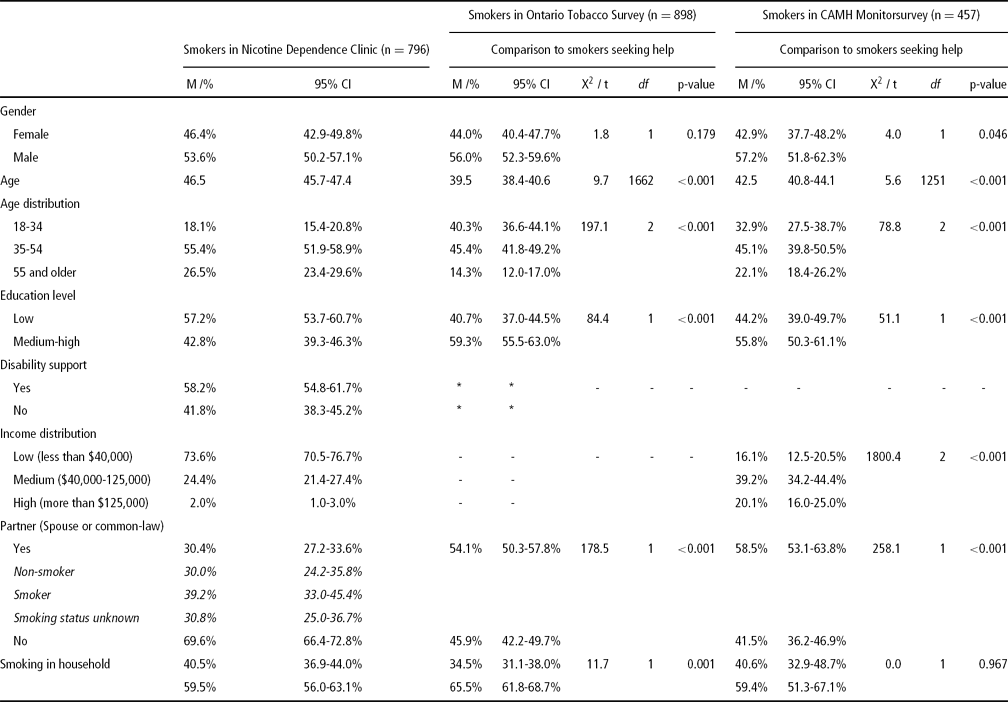
Gender distribution was similar in the three groups of smokers. All three groups tended to have more males than females (53.6% vs. 46.4% in NDC, 56.0% vs. 44.0% in OTS and 57.2% vs. 42.9% in CM smokers, see Table 1), although the preponderance of males was significantly less in the NDC compared to the CM samples. NDC smokers were significantly older than smokers in OTS and CM, by 7 and 4 years, respectively. Smokers older than 35 years were most common in the NDC sample, whereas the population survey samples had more younger (18–34 years) respondents.
Comparison of sociodemographic characteristics of smokers seeking help in Nicotine Dependence Clinic to smokers in Ontario Tobacco Survey and smokers in CAMH Monitor survey.

* The data on disability in Ontario Tobacco Survey were not reportable
NDC smokers had the highest proportion of subjects with low education level – 57.2% vs. 40.7% in OTS and 44.2% in CM. More than a half (58.2%) of NDC smokers were receiving disability support (no smokers reported receiving disability in the OTS) and almost three quarters of them had low income compared to 16.1% of CM smokers with low income. NDC smokers were less likely to report a spouse or common-law partner – 30.4% of them had a spouse or common-law partner compared to 54.1% and 58.8% in OTS and CM, respectively. Interestingly, 39.2% of partners of NDC smokers were smokers themselves.
Smoking parameters
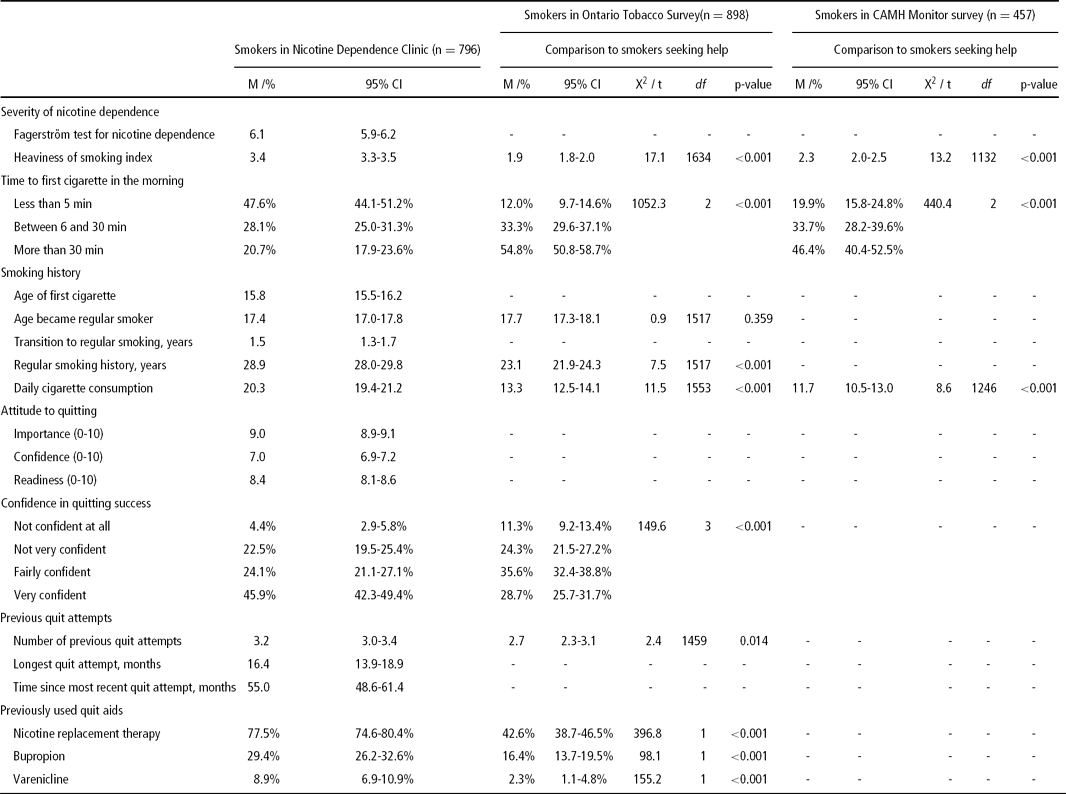
The average Fagerström Test for Nicotine Dependence score in the NDC sample was 6.1, which corresponds to severe dependence. The Heaviness of Smoking Index (HSI) is one of the most reliable indicators of severity of nicotine dependence and was available for all three samples. The average HSI score was significantly higher in NDC smokers (3.4) compared to smokers in the OTS (1.9) and CM (2.3) samples (see Table 2). The distributions of its two items (time to first cigarette after waking up in the morning and number of cigarettes smoked per day) differed over the samples. Almost half (47.6%) of NDC smokers would have their first cigarette within the first 5 minutes), while only 12.0% and 19.9% of OTS and CM smokers respectively would do so. Approximately half of the smokers in both surveys would have their first cigarette more than 30 minutes after waking up.
Comparison of smoking variables in smokers seeking help in Nicotine Dependence Clinic to smokers in Ontario Tobacco Survey and smokers in CAMH Monitor survey.
There was also a significant difference in average cigarette consumption, with OTS smokers reporting on average 13.3 CPD and NDC smokers reported a pre-treatment consumption of 20.3 CPD. NDC smokers reported having had their first cigarette at around 16 years of age (15.8). The age of becoming a regular smoker did not differ significantly between the NDC sample (17.4 years) and the OTS sample (17.7 years). However, the NDC smokers had a longer history of daily smoking compared to OTS smokers (28.9 vs. 23.7 years).
Data on motivation to quit were available only for NDC smokers. Average importance level was very close to the maximum of the scale, at 9.0. Levels of confidence and readiness were also very high, at 7.0 and 8.4, respectively. The only parameter that could be compared was confidence in quitting success which was also available in the OTS dataset. Interestingly, confidence to quit appeared higher in clinic attendees. There were almost no people who were not confident at all in NDC sample (4.4% compared to 11.3% in OTS), while a much higher proportion of NDC smokers compared to OTS smokers were very confident in the success of their quitting attempt (45.9% vs. 38.7%).
Smoking cessation history
NDC smokers on average reported having made twice as many quit attempts, in their lifetime, compared to OTS smokers (3.2 vs. 1.6 attempts). Average time since the most recent quit attempt in NDC sample exceeded four and a half years (55.0 months) and average duration of the longest quit attempt was more than one year (16.4 months). The majority of NDC clients also had an extensive history of smoking cessation aids use. The most commonly used smoking cessation aid was nicotine replacement therapy. About twice as many NDC smokers used various forms of nicotine replacement therapy in the past compared to OTS smokers (77.5% vs. 42.6%). Similarly, NDC smokers were more likely to report a previous history of bupropion use (29.4% of NDC smokers had used it before admission compared to 16.4% of OTS smokers) and varenicline use (8.9% vs. 2.3%).
Discussion
The effectiveness of Interventions to support cessation are well-supported by clinical trials (Cahill et al., Reference Cahill, Stead and Lancaster2012; Hughes et al., Reference Hughes, Stead and Lancaster2007; Stead & Lancaster, Reference Stead and Lancaster2012; Stead et al., Reference Stead, Perera, Bullen, Mant, Hartmann-Boyce, Cahill and Lancaster2012). However, proper cessation programme delivery needs to be guided by considerations such as matching the form and intention of treatment to the characteristics of the sample, and ensuring that those clients who have the most difficulty quitting obtain support that is consistent with their needs (Abrams et al., Reference Abrams, Orleans, Niaura, Goldstein, Prochaska and Velicer1996; Niaura & Abrams, Reference Niaura and Abrams2002; Prochaska & Goldstein, Reference Prochaska and Goldstein1991). This study is unique in being able to describe a sample of clients of a publicly-funded smoking cessation programme and examine the differences between this sample of smokers seeking help and population based samples of smokers not seeking help.
The characteristic features of the smokers who sought help at a specialised cessation clinic
As expected, smokers who sought help at the NDC were significantly different from smokers in general population – while becoming regular smokers at approximately the same age they tended to be older at the time of admission and had a longer history of regular smoking. They smoked twice as many cigarettes on a daily basis, were more heavily dependent than smokers in the general population and tended to have an extensive history of both smoking cessation attempts and previous use of various smoking cessation aids. Almost all the clinic sampled had previously tried to use NRT at some point and they were much more likely to have previously tried smoking cessation medications than smokers in the general population. This supports our hypothesis that smokers who seek the most specialised help have unsuccessfully tried to quit in the past, both on their own and with assistance.
Smokers who sought treatment at the specialised nicotine dependence clinic also had lower income and educational levels attainment than smokers in the comparison samples. This is consistent with the hypothesis that the poorest socio-economic groups have lower odds of quitting and suffer more from the consequences of tobacco use (Bobak, Jha, Nguyen, & Jarvis, Reference Bobak, Jha, Nguyen and Jarvis2000). More than half of smokers seeking help received disability support and were less likely to have a life partner and, thus, may lack the additional motivation and support for their quitting attempt that a partner can provide. However, over one third of the partners of the clinic attendees were also smokers. This is higher than the prevalence of smoking in Canada, similar to previously published data on smoking patterns in partners of low socioeconomic status smokers and is also associated with lower cessation rates (Okechukwu, Nguyen, & Hickman, Reference Okechukwu, Nguyen and Hickman2010).
Implications for clinical practice
The heavier smoking and higher dependence levels observed in this sample of smokers seeking help in specialised treatment centres are associated with significantly lower cessation rates and higher chances of relapse (Fagerström et al., Reference Fagerström, Russ, Yu, Yunis and Foulds2012). Also, though there was no direct comparison made to smokers in the general population in terms of prevalence of somatic and mental comorbidities, clients seeking help in a smoking cessation clinic demonstrate a high prevalence of cardiovascular and respiratory disorders, mood and anxiety disorders and other addictive behaviours, which can be interpreted in several ways. On the one hand, smoking is associated with multiple somatic comorbidities and their high prevalence might be an indicator of severity of dependence and heavy smoking prior to attendance. Persistent health problems are also likely to affect smokers’ motivation to quit (McCaul et al., Reference McCaul, Hockemeyer, Johnson, Zetocha, Quinlan and Glasgow2006). On the other hand, mental comorbidities, such as bipolar affective disorder or schizophrenia are associated with very heavy smoking and poor treatment outcomes (Selby, Voci, Zawertailo, George, & Brands, Reference Selby, Voci, Zawertailo, George and Brands2010); (Williams & Ziedonis, Reference Williams and Ziedonis2004). Thus, smokers’ health state and amnaesic data should be taken into consideration when developing a treatment plan.
In addition to clinical characteristics associated with worse outcomes, socioeconomic features of the smokers who attend specialised treatment such as low income and education level might pose additional barriers to treatment due to cost of medications or nicotine replacement therapy products (if they are not covered by health insurance), transportation costs etc. These data support implementation of subsidised or fully covered treatment programmes for smokers with low income. Such programmes are shown to be effective for these populations (Woolacott et al., Reference Woolacott, Jones, Forbes, Mather, Sowden, Song and Barton2002). At the same time we must acknowledge the fact that the NDC provides subsidised treatment to those who require it. While subsidisation of treatment might have increased, the incentives for people of low socio-economic to seek treatment have not; in general in the Canadian health care system access to care is better among those of higher socio-economic status (Bulter-Jones, Reference Bulter-Jones2008). Also, higher socio-economic status individuals may be able to draw on other financial and social resources to quit smoking without specialised medical help. The prevalence of smoking is known to be higher in lower socio-economic strata (Bobak et al., Reference Bobak, Jha, Nguyen and Jarvis2000), and combined with a high incidence of smoking partners or other smokers in household, lower SES smokers may have higher relapse risk due to additional exposure to smoking cues, peer pressure and readily available tobacco products.
Study limitations
The study has two major limitations need to be considered when interpreting the results. First, the data collection process differed between the NDC sample and the population surveys. We must note that NDC clinicians, however, use standardised data collection procedures which incorporate many of the questions asked in the surveys. Also, most of the questions involved straightforward demographic information (e.g., age, gender) for which we would not expect significant bias due to the difference in study designs. Second, as noted, there is a difference in the time of data collection between the NDC sample (2008–2010) and the OTS sample (2005–2008) and so there might be changes in some variables over time. However, we believe that the relatively small temporal difference of three years is not likely to result in substantial differences between the NDC and OTS samples. Also, inclusion of the CM sample collected at the same time as the NDC sample, and the observation of substantial similarity between the CM and OTS samples further suggested that any temporally-related differences between the OTS and NDC samples are likely to be minimal and do not reach statistical significance.
Conclusions
Smokers who seek treatment in specialised smoking cessation clinics differ in important ways from smokers in the general population. They are more heavily dependent, smoke more cigarettes on a daily basis, are older and have a longer history of smoking and greater number of unsuccessful smoking cessation attempts. They have less education and lower income, may have less social support for quitting, and are likely to live with other smokers. These characteristics are associated with lower chances for successful smoking cessation and sustained abstinence and should be taken into consideration during clinical assessment and treatment planning.
Acknowledgements
We would like to acknowledge the work of Ms. Emma Mauti, Ms. Lisa Rebello and Ms. Kelsey Watts who performed extraction of clinical data for this study.
Financial support
The work of research assistants performing data extraction in the Nicotine Dependence Clinic was funded through student support funds provided by Ontario Tobacco Research Unit. Researchers affiliated with the Centre for Addiction and Mental Health received their salary support from the Ontario Ministry of Health and Long-Term Care. There is no additional funding supporting this study.
Conflict of interest
None
Ethical standards
The study is observational in nature and did not involve human or animal experimentation. The study was approved by the institutional ethics review board.