


[T]he descent from that ingenious automaton, Detective Dupin, to such a prince of duffers and dullards as Sherlock Holmes …
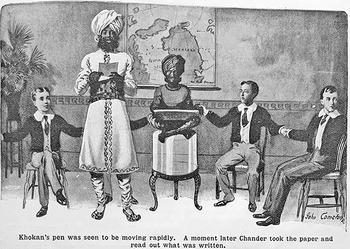
Eight years after the death of Queen Victoria, the prolific but now largely forgotten magazine author Brinsley Moore began a six-part short-story series, Chander Rao, Criminal Expert.1 Throughout the series, Rao (a middle-aged Indian twice denied a Bachelor of Arts by the University of Calcutta) uncovers various minor criminals through the sleights of hand that his celebrated travelling exhibition of “Eastern Magic” enables.2 While this initially entertaining central conceit quickly risks becoming predictably repetitive, the third story in the series – “The Automaton Detective” – introduces a new element by infusing Rao’s occult performance with a bravado display of mechanical science.3 In an effort to identify a boarding school thief, Rao agrees to perform at the school’s graduation ceremony, where he unveils the latest addition to his theatrical repertoire: the automaton Khokan, “an almost life-size representation of an Indian fakir,” supposedly endowed with not just reason and intelligence but second sight (see Figure 9.1).4 While Khokan appears to locate the thief during his pseudo-séance performance, Moore’s series consistently rejects melodrama and the supernatural in favor of realism and logic (“Where common sense baffles crime,” declares an American title page);5 and Rao ends this instalment by confiding in the series’ narrator: “Why, surely you must see for yourself that a clockwork thing like that could discover nothing. Khokan is but the outward means adopted to cover my methods. It was I who found that miserable, dishonest youngster.”6
Simon Schaffer has written of automata’s centrality to the various discourses working to conceal global capitalism’s subaltern labor.7 Here, though, in a remarkably powerful symbolic moment, Rao becomes not a passively exploited colonial victim but rather the master of his own automaton doppelgänger and exoticized persona. Indeed, Rao begins his performance by introducing himself as “a humble citizen of the British Empire,” having “exactly gauged what was required of him” and “the tricks” necessary to appeal to his audience.8 In so doing, Moore’s story reinforces its essential retrospection, subverting as it does Maelzel’s Chess-Playing Turk and the many works of fiction that real-life hoax automata inspired over the course of the long nineteenth century.
Rao and his automaton-double, Khokan

Yet Moore’s story – with its eccentric genius detective and its reliably dull doctor-narrator – also looks back to Moore’s literary precursors and the history of detective fiction more broadly. Today, the journal in which Moore’s story first appeared (The Royal Magazine) is primarily remembered as one of The Strand’s many imitators9 – as an outlet for detective fiction that introduced the world to Baroness Orczy’s vaguely Holmesian detective “The Old Man in the Corner” (1901–5) and, in 1927, Agatha Christie’s Miss Marple. Early detective fiction’s anxious obsession with constructing a respectable canonical lineage ensured that texts in the genre are typically both explicit and repetitive in their intertextual referencing, and early detective fiction stories tend to link themselves back to a fairly limited set of precursor texts and tropes.10 As this chapter will argue, the automaton became one of detective fiction’s central recurring symbols in the Victorian period, a contested figure lying at the heart of a struggle over the genre and the worldview that it contained.
Poe’s Ingenious Automaton
As John T. Irwin has noted, scholars frequently point to Edgar Allan Poe’s 1836 essay “Maelzel’s Chess-Player” as “a prefiguration of the analytical method of the Dupin stories and a trial run of Dupin’s ‘voice’.”11 In highlighting the influence of this essay’s ratiocinating rhetoric on detective fiction, however, this scholarship typically overlooks the extent to which the thematic subject of Poe’s essay – automata – also came to shape the burgeoning genre. Poe famously begins “The Murders in the Rue Morgue” (1841) with a densely philosophical rumination on the nature of “analytical power” and its superiority to mere “calculation,” before claiming that the story which follows will act as an illustration of this juxtaposition.12 By this stage, however, Poe has already illustrated this juxtaposition by way of another analogous example, differentiating the merely “attentive” and “calculating” abilities required to play chess from the true observational analysis honed by playing draughts and whist.13
In part, the strangely vitriolic tone of Poe’s opposition to “the elaborate frivolity of chess” – “in nine cases out of ten,” Poe scoffs, “it is the more concentrative rather than the more acute player who conquers”14 – suggests a somewhat petty ego-biographical motive may have made its way into Poe’s story. Beyond this, however, the philosophical mini-treatise that begins “The Murders in the Rue Morgue” replicates a structure that was established in “Maelzel’s Chess Player” and that will appear again in Poe’s subsequent fiction: that of an ontologically exalted human using observational analysis to uncover what Paul Grimstad has called the “non-reasoning creatures” that populate Poe’s writing, whether “the blindly calculating automaton, the motiveless ape, [or] the bird that speaks by rote.”15 In this, then, Poe seems to be positioning his proto-detective in opposition to the figure of the automaton. Yet, as John Tresch has noted, in debunking Maelzel’s chess player, Poe “used machinelike logic to prove that a machine could not think”;16 and, as would become typical of much nineteenth-century detective fiction, the fictional investigator’s true relationship with mechanicity is more complex and ambivalent than this initial reading might suggest.
One of the key attributes Poe ascribes to machines, in his 1836 essay, is their dependence on action-reaction determinism:
Certain data being given, certain results necessarily and inevitably follow. These results have dependence upon nothing, and are influenced by nothing but the data originally given. And the question to be solved proceeds, or should proceed, to its final determination, by a succession of unerring steps liable to no change, and subject to no modification. This being the case, we can without difficulty conceive the possibility of so arranging a piece of mechanism, that upon starting it in accordance with the data of the question to be solved, it should continue its movements regularly, progressively, and undeviatingly towards the required solution, since these movements, however complex, are never imagined than to be otherwise than finite and determinate.17
Five years later, when Poe’s detective famously follows the train of his silent narrator’s thoughts, Dupin becomes remarkably reminiscent of the “pure machine” outlined in Poe’s earlier essay, unerringly moving from one unspoken thought to the next. Indeed, in moments such as this, Poe’s “frigid and abstract”18 protagonist really does seem to be what George Bernard Shaw called an “ingenious automaton”: a “superperceiver” (to use Struan Sinclair’s term) “who sees – and knows – all,”19 never failing, just as Poe reasons that a true chess-playing machine “would always win.”20
The Doll and its Maker
While Holmes’ similarity to Dupin has been discussed ad nauseam, by Doyle scholars and fans alike, relatively little attention has been paid to the specificity of those moments in which Doyle explicitly foregrounds this literary influence. Within the Holmes canon, the two main references to Dupin both center upon the just-noted silent thought-following scene in “The Murders in the Rue Morgue.” Upon being told that he reminds Watson of Dupin, soon after they first meet in A Study in Scarlet (1887), Holmes declares Dupin “a very inferior fellow. That trick of his of breaking in on his friends’ thoughts with an apropos remark after a quarter of an hour’s silence is really very showy and superficial.”21 Six years later, though, in “The Adventure of the Cardboard Box” (1893), Doyle gaslights the reader with a bizarre rewriting of this scene:
“You remember,” said [Holmes], “that some little time ago when I read you the passage in one of Poe’s sketches in which a close reasoner follows the unspoken thoughts of his companion, you were inclined to treat the matter as a mere tour-de-force of the author. On my remarking that I was constantly in the habit of doing the same thing you expressed incredulity.” “Oh no!” “Perhaps not with your tongue, my dear Watson, but certainly with your eyebrows. So when I saw you throw down your paper and enter upon a train of thought, I was very happy to have the opportunity of reading it off, and eventually of breaking into it, as a proof that I had been in rapport with you.”22
One might speculate as to the changing authorial psychology that produced these strikingly different accounts of a single fictional moment: the earlier account produced by a then-unknown Doyle, anxiously attempting initial product differentiation; the later account created by a now-commercially proven Doyle, increasingly enmeshed in the cyclical self-cannibalizing logic of never-ending sequels in which innovation means only revision.23 Regardless of motivation, however, the combined effect of these opposing accounts is, once again, duality and ambivalence: are we to emphasize Holmes’ initial rejection of Dupin’s mechanical philosophy, or are we to trust Holmes’ subsequent demonstration of a worldview in which not only Holmes’ “rapport” with Watson but the entire cosmos resembles a pre-wound clockwork automaton?
Even twenty years later, the figure of the automaton continued to haunt how Doyle publicly negotiated his relationship with Poe. In 1912, the American humorist Arthur Guiterman wrote a comic poem for Life magazine in which he critiqued both Doyle’s much earlier defense of Britain’s imperial forces in South Africa and Holmes’ impoliteness towards Emile Gaboriau’s detective Lecoq, before conceding that Doyle’s harmless writing was at least morally preferable to that of the Decadents and early modernists. Wedged within Guiterman’s forty-eight-line poem was a two-line objection to Holmes’ initial dismissal of Dupin as “very inferior.”24 In response, Doyle – completely ignoring the content of the poem’s other forty-six lines (some of which was surely far more consequential!) – wrote a comic poem of his own for London Opinion, “To the Undiscerning Critic,” in which he sought to differentiate himself from his literary creation:
These lines are frequently quoted in (one would hope) unnecessary popular reminders that Holmes was, indeed, a fictional character rather than an actual person.26 What these open-barn-door-rushers also rush past, however, is the specificity of Doyle’s rhetoric in these lines. For, here, Doyle again seems unable to resist a metaphoric lexicon tying Holmes and Dupin’s chain of influence to equally uncanny reembodiments of the automaton: to the doll and the puppet.
The Logical Machine and “The Automaton Detective”
This metaphoric lexicon became increasingly overt in early detective fiction. “You really are an automaton,” declares Watson in Doyle’s 1890 novel The Sign of the Four, when Holmes ignores the beauty of Mary Morstan, Watson’s future wife.27 “He was,” reflects Watson the following year, at the beginning of “A Scandal in Bohemia,” “the most perfect reasoning and observing machine that the world has seen.”28 Ronald Thomas and others have emphasized the latter analogy, relating Holmes to nineteenth-century developments in photography and Holmes’ now-metonymic magnifying glass.29 However, Holmes can also be read alongside Victorian-era mechanical innovations that might remind latter-day readers of the “extended mind” theory articulated by Andy Clarke and David J. Chalmers a century later: in other words, of the idea that the external world plays “an active role … in driving cognitive processes.”30 In the later Victorian period, a number of attempts were made to create actual reasoning machines.31 At the time, perhaps the most widely discussed of these contraptions was the “logical machine” built by William Stanley Jevons in 1869 and described by Jevons in a speech to the Royal Society in 1870. Through a system of pins, rods, levers, and a “key board,”32 the machine, Jevons claimed, embodied “the proper condition of a mind exempt from mistake,” and showed “that mechanism is capable of replacing for the most part the action of thought required in the performance of logical deduction.”33
In the decades that followed, the logic machine became a touchstone in a much broader debate about the nature of industrialized humanity. In 1888, the Oxford tutor Bernard Bosanquet emphasized the ontological hybridity of logic machines, reminding readers that “in any logical engine … we have to make the conclusion.”34 Somewhat less subtly, in 1890, The Speaker dismissed Jevons’ invention, comparing it to “an ingenious contrivance for spreading butter on bread by steam or electricity: when we have got the bread and the butter, we can do that for ourselves without artificial aid.”35 In 1898, however, the American psychiatrist Joseph T. O’Connor went beyond even Jevons’ claims for his invention, suggesting that the machine modelled how “brain cells … digest information and attendant propositions brought into them, and [then] present to consciousness results that are practically mechanical solutions of problems.”36
While early detective fiction clearly operates within this broader (Huxley-inflected) milieu, the genre’s references to automata also remain very specific in their remarkably narrow and consistent intertextuality. Thus, when the American author Jacques Futrelle created “The Thinking Machine,” in his 1905 story “The Mystery of Cell 13,”37 we hear echoes of O’Connor’s language of brain cells digesting information in the detective’s brainy efforts to first be admitted into and then break out of a prison cell. More than this, though, the backstory that Futrelle provides his unusually sobriquet-ed detective is strikingly familiar:
The world at large had heard vaguely of Professor Van Dusen as The Thinking Machine. It was a newspaper catch-phrase applied to him at the time of a remarkable exhibition at chess; he had demonstrated that a stranger to the game might, by the force of inevitable logic, defeat a champion who had devoted a lifetime to its study. The Thinking Machine! Perhaps that more neatly described him than all his honorary initials, for he spent week after week, month after month, in the seclusion of his small laboratory from which had gone forth thoughts that staggered scientific associates and deeply stirred the world at large.38
Again, then, we return to detective fiction’s relentlessly self-fashioned origin story – to Poe, and Maelzel’s chess-playing automaton. Indeed, Futrelle even underlines his self-conscious participation in a tradition of set texts by echoing Doyle’s rewriting, presenting readers with this scene not once but twice: three years later, the second collection of “Thinking Machine” stories will begin with a sketch, entitled simply “The Thinking Machine,” in which the foundational chess game is renarrated.39
On first reading, Futrelle’s stories seem like immoderate outliers in their extreme insistence on Van Dusen’s cold mechanicity and in their apparent jettisoning of representational ambivalence. However, Futrelle’s stories are also imbued throughout with an air of self-parody: a number of the Thinking Machine stories revolve around the “Hotel Teutonic,” and the first “Thinking Machine” collection of 1907 bore the faintly absurd title The Thinking Machine: Being a True and Complete Statement of Several Intricate Mysteries which came under the Observation of Professor Augustus S. F. X. Van Dusen, PH.D., LL.D., F.R.S, M.D., etc. These stories, then, can be seen as early twentieth-century reflections on the nineteenth-century tradition that they flow out of, self-consciously playing with both the discourse surrounding material Victorian contraptions and detective fiction’s early tropes.
And perhaps this is also how we should read the Brinsley Moore story with which this chapter began, “The Automaton Detective” – a title that itself contains hints of metatextual retrospection. In one of the John Cameron illustrations accompanying this story (see Figure 9.1), the automaton Khokan sits cross-legged on top of a tall glass cylinder, which in turn sits on top of a small, cabriole-legged, timber table. By the time Moore’s story was first published, in 1909, the “royal illusionists and anti-spiritualists” Maskelyne and Cooke had spent three and a half decades exhibiting a much-publicized real-life hoax automaton of their own that bore an uncanny resemblance to the automaton in Cameron’s image.40 “Psycho,” the turbaned “Hindoo whist-player,” also spent performances sitting cross-legged, on top of a pointedly transparent glass cylinder, which in turn sat on top of a long-legged timber table.41 Indeed, before identifying the schoolboy thief, Psycho performs displays of complex arithmetic – an ability Psycho also routinely used in his warm-up act.42
Of course, Moore’s story reworks this performative structure – most pointedly, by shifting from a diminutive Indian automaton controlled by a white European to a diminutive Indian automaton controlled by an Indian man (a shift redolent of a new kind of colonial agency).43 Through Maskelyne’s whist-playing machine, however, Moore’s story also draws an oblique reference back to that story so often cast, in the nineteenth century, as the origin of the detective fiction genre: Poe’s “The Murders in the Rue Morgue.” While “the best chess-player in Christendom may be little more than the best player of chess,” declares Poe in the introduction to this story, “proficiency in whist implies capacity for success in all those more important undertakings where mind struggles with mind.”44 Even if Moore’s protagonist does ultimately work to dispel the idea of an automaton detective suggested by Moore’s title, the materio-literary network of references that hovers behind Moore’s story again introduces an element of ambivalence about how Rao and Khokan should be seen.
Conclusion
Reflecting on Holmes, in his 1924 autobiography, Doyle explained that he
did not wish to be ungrateful to Holmes, who has been a good friend to me in many ways. If I have sometimes been inclined to weary of him it is because his character admits of no light or shade. He is a calculating machine, and anything you add to that simply weakens the effect.45
This chapter has explored the curious ambivalence with which early detective fiction related its protagonists to automata. We would suggest the inconsistency in the genre’s characterization stems from the genre’s dual imperatives. On the one hand, detective fiction seemed to require a clockwork world, in which clues can be traced back with absolute hermeneutic certainty through linear historical moments. At the same time, however, there was an assumption that the genre’s readers (and even writers) required protagonists who were “friends” rather than simply coldly “calculating machines” if their interest was to be sustained.
In attempting to reconcile these dual imperatives, early detective fiction also reworked a broader paradigm. Automata typically inhabit Victorian literature as agents of death, chaos, and destruction.46 The automaton detective amplifies a very different set of symbolic resonances by building on the clockwork automaton’s inherent ties to ideas of time, order, fate, memento mori, and divine retribution. These associations were largely lost in the twentieth-century shift to the computer-chipped and electronically circuited robot – a figure with a strikingly distinct range of cultural registers. As a result of this – and, as Maurizio Ascari points out, of the twentieth century’s two cataclysmic, technology-fueled, world wars47 – much detective fiction from the 1920s onwards creates a very different relationship with notions of mechanicity and automation, by privileging instead (often gendered) displays of domestic intuition and emotional intelligence. After the Victorians, creating an automaton-like detective would become the opposite of automatic.

 Open access