Natural disasters have direct detrimental effects on individuals including the loss of property, essential services, and personal injury.Reference Bourque, Siegel, Kano and Wood1 Furthermore, disaster exposure increases rates of distress in the year after initial exposure.Reference Kaniasty and Norris2, Reference Norris and Kaniasty3 However, several key protective factors have been identified as buffers against the onset of mental health distress, such as social support.Reference Kaniasty and Norris2, Reference Norris and Kaniasty3 Social support can refer to the relationship between individuals (ie, social support) or the relationship between an individual and a larger community (ie, community support).
The function of social support in the aftermath of a disaster has been primarily understood through the conservation of resources model.Reference Hobfoll4 This model posits that distress arises from the loss of valued possessions, efficacy, societal roles, or energies. When loss is substantial, as in the case of a natural disaster, the potential for suffering to occur is high. This distress can be mitigated by reappraising the losses or obtaining new resources. Social relationships facilitate this process by placing the losses in perspective and addressing challenges caused by the disaster. For example, individuals who lose their personal vehicle may turn to friends or family in the area for transportation needs.
The protective effect of social support on mental health after a natural disaster has been demonstrated across several studies. Norris and KaniastyReference Norris and Kaniasty3 demonstrated that increased perceived support from social networks reduced the long-term effects of disaster exposure on mental health in a sample of hurricane survivors. Similarly, increased social support was associated with reduced symptoms of posttraumatic stress disorder (PTSD), depression, and generalized anxiety disorder in adults who were exposed to Hurricane Andrew.Reference Acierno, Ruggiero and Galea5 Social support also was found to be related to measures of general distress in a sample of individuals exposed to Hurricane Katrina.Reference Weems, Taylor and Cannon6
Community support reduces distress across an entire community through the theorized constructs of community resilience and community coherence.Reference Cutter, Burton and Emrich7-Reference Norris, Stevens, Pfefferbaum, Wyche and Pfefferbaum9 Community resilience refers to the connections that individuals feel to their broader community as well as the ability of the community to adapt to the needs of the individual. Similar to the conservation of resources model, communities with increased resilience and coherence are able to protect against loss by offering substitute resources after a disaster, which attenuates mental health distress in the broader group. However, data are limited with regard to the relationship between community support and postdisaster mental health.
Recent work has highlighted that disasters that disrupt a community through displacement or loss of life can have a strong negative impact on mental health recovery.Reference Hawkins and Maurer10 A population-based study of disaster victims exposed to Hurricane Hugo found that social support varied across different communities.Reference Kaniasty and Norris2 In that study, ethnic minorities received less help than other groups, and as a result experienced greater levels of distress. Yet the association between community support and mental health was not explicitly examined. A second study with victims of Hurricane Andrew suggested that ethnic minorities had elevated levels of distress that were correlated with increased trauma at the neighborhood level.Reference Perilla, Norris and Lavizzo11 Increased neighborhood trauma was indicative of poorer community resilience; however, no measure of community support was used. The authors of these studies highlighted the role of community factors as predictors of emotional distress after a trauma in that they disrupt the availability of resources on a macro-level. For example, displacement can remove long established social bonds, destroy settings that promote mental well-being (eg, homes), and alter the environment in a manner that depletes tangible resources (eg, loss of a grocery store or inability to have clean clothing).
In spite of such associations, little speculation has been given to how the relationship between community support and postdisaster mental health may differ as a function of where people reside (eg, rural vs urban communities, region of the country). Community support may function differently in urban and nonurban areas after a disaster given the likely differences in resources across these areas. The US Census Bureau defines urban locations as territories encompassing 2500 or more persons. Urban areas have a greater density of resources that support a more rapid response, and they are less vulnerable to long-term disruption in the aftermath of a disaster. Heightened access to these resources in urban areas may improve the mental health trajectories of individuals who do not have strong community support networks. In contrast, residents of nonurban areas may rely more heavily on community support to provide services and resources after a disaster. Those with weak community support may be more vulnerable to psychological distress. Indeed, recent work has shown that loss of services is related to mental health distress in nonurban areas.Reference Gros, Price, Gros, Paul, McCauley and Ruggiero12 However, to our knowledge, no studies to date have examined the differential effect of community support on the relationship between disaster exposure and mental health outcomes across urban and nonurban regions.
The current study examined the association of community support on the relationship between disaster exposure and mental health outcomes across urban and nonurban areas. Data were collected as part of a larger study on victims of Hurricane Ike who resided in Galveston and Chambers counties, Texas.Reference Ruggiero, Gros and McCauley13 Hurricane Ike was a strong category 2 storm that hit Galveston, Texas, in 2008. It was the third costliest hurricane in US history, and resulted in 84 American deaths (CDC, 2009).14 Of the 871 people included in the study, 157 resided in classified urban areas and 714 resided in classified nonurban areas. It was hypothesized that increased community support would moderate the association between mental health symptoms and disaster exposure in nonurban areas but not in urban areas.
Methods
Data for the current study were obtained from a larger study on the use of a web-based intervention to address mental health symptoms after a disaster.Reference Ruggiero, Resnick and Paul15 All procedures were approved by the Medical University of South Carolina Institutional Review Board.
Participants
Participants were 871 adults residing in the Galveston and Chambers counties in Texas during Hurricane Ike's landfall. Participants were equally distributed across genders owing to targeted enrollment. The sample's average age was 48.99 years (SD = 17.05) and self-reported race/ethnicity was 80.0% White, 11.0% Black, 4.5% Hispanic, 1.5% Asian, 1.0% American Indian/Alaska Native, 0.8% Native Hawaiian/Pacific Islander, and 0.6% other. Approximately 60% reported completing some college education, and the majority of the sample had an annual income between $40 000 and $80 000 (29.5%). As an inclusion criterion for the study, all participants reported having consistently reliable Internet access in their homes. The majority of the sample resided in a nonurban area (83.2%).
Measures
Participants completed a structured telephone interview assessing demographics, impact of exposure to Hurricane Ike, and mental health symptoms.
Disaster Exposure
Questions about hurricane exposure were modified from previous research with adults affected by Hurricane HugoReference Freedy, Saladin, Kilpatrick, Resnick and Saunders16 and the 2004 Florida hurricanes.Reference Acierno, Ruggiero and Galea5 Hurricane disaster exposure was assessed with 23 binary items across 3 primary domains: interpersonal impact, damage to property, and loss of basic services. Domains were created from a review of earlier disaster exposure literature, classifications consistent with the Federal Emergency Management Agency, and consensus among the authors and other expert consultants on the project.
Items assessing interpersonal impact included whether persons feared for their own safety, feared for the safety of loved ones, were present for the hurricane, and lost their job as a result of the hurricane. The property domain assessed damage caused by the hurricane to the person's home, vehicle, property, and personal items. The loss of basic services domain measured whether the person was without basic services including water, electricity, clean clothing, food, shelter, transport, spending money, and displaced from their home for a period longer than 1 week. Responses for each domain were summed and used as predictors. This methodology has been shown to be highly effective at classifying disaster exposure in hurricane victims.Reference Price, Gros, McCauley, Gros and Ruggiero17, Reference Price, Davidson, Andrews and Ruggiero18
Mental Health Measures
Items assessing mental health included self-report measures of PTSD, the PTSD Checklist—civilian version (PCL-C),Reference Weathers, Litz, Huska and Keane19 and depression, the Center for Epidemiologic Studies Depressed Mood Scale 10 (CESD-10).Reference Radloff20 The PCL-C is a 17-item instrument that assesses Diagnostic and Statistical Manual of Mental Disorders (Fourth Edition) criteria B, C, and D for PTSD. Five response options (range of possible scores = 17–85) constitute each item on the PCL-C. Previous work has documented strong psychometric properties of the PCL, including internal consistency, test-retest reliability, convergent validity, discriminant validity, and sensitivity and specificity. Internal consistency for the current sample was excellent (α = 0.92).Reference Ruggiero, Ben, Scotti and Rabalais21
The CESD-10 was developed from the original 20-item CES-D measure as a 10-item instrument designed to identify persons at risk for clinical depression.Reference Andresen, Malmgren, Carter and Patrick22 It has been validated in various populations with high internal consistency, satisfactory test-retest correlations, and strong concurrent validity, discriminant validity, and sensitivity to change. The CESD-10 is widely used and has good predictive accuracy when compared to the full-length CES-D scale. Internal consistency for the current sample was good (α = 0.85).
Urban and Nonurban Measures
Urban or nonurban residence was assessed through participants’ self-reported zip code. Investigators measured the zip codes against the US Census Bureau's definition of urban territories (encompassing 2500 or more persons) to categorize each participant as a resident of either an urban or nonurban area.
Community Support
Community support was assessed with a 5-item scale of neighborhood social cohesion.Reference Sampson, Raudenbush and Earls23 Questions assessed if the neighborhood was close-knit, participants felt they could rely on the help of others for support, and if neighbors can be trusted. Items were scored on a 5-point Likert scale, with higher scores indicating less neighborhood cohesion. Internal consistency for community support was adequate (α = 0.74).
Procedures
Interviewers used random-digit dial methodology to contact disaster-affected adults in Galveston and Chambers counties. The present study used data from the final wave of data collection from a larger longitudinal study assessing the feasibility of implementing a web-based intervention in a disaster sample. These data were collected approximately 1 year after Hurricane Ike's landfall. Community support was only measured in the final wave. Mental health data from previous waves were not included in the current study. The sample was representative of the broader area with regard to income and ethnic background; the exception was those of Hispanic origin. The reduced proportion of those of Hispanic origin in this study was likely due to the interview only being available in English.
Survey data were weighted by age to maintain consistency with 2008 census estimates of the populations in these counties. Eligible participants were 18 years or older, had a landline telephone, and reported having consistently reliable home Internet access. After contacting an eligible household, interviewers used the most recent birthday method to select a survey participant. Gender quotas also were in place to ensure that the gender distribution in the sample was comparable to that in the population. The most recent birthday method is common and accepted and has been demonstrated to be technically equivalent or superior to other respondent selection techniques while involving less respondent burden.Reference Gaziano24
Data Analytic Plan
An initial omnibus regression was first used to identify differences in the association between disaster exposure and mental health symptoms across urban and nonurban areas, controlling for demographic variables. To evaluate the effects of community support on the association between disaster exposure and mental health symptoms, separate hierarchical regressions were used for the urban and nonurban samples. Mental health variables, (PTSD, depression) were the outcome variables. Age, gender, and income level were entered as covariates. Disaster exposure (loss, interpersonal, property) and community support were entered as the primary variables of interest. Interaction terms between centered variables for disaster exposure and community support were used to evaluate the conditional effects of these variables on mental health outcomes. To account for the bias introduced by multiple tests, P < .025 was used as the criteria for significance. Data analyses were conducted with SPSS 20.
Results
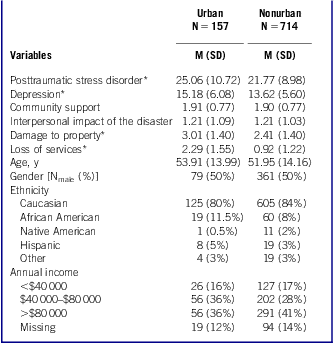
Demographic data for the urban and nonurban samples are presented in Table 1. Initial comparisons suggested that nonurban participants reported lower depression (M = 13.62, SD = 5.60) than urban participants (M = 15.18, SD = 6.08), F (1, 868) = 9.30, P = .02. Similar findings were observed for PTSD, in that nonurban participants (M = 21.77, SD = 8.98) reported lower symptoms than urban participants (M = 25.06, SD = 10.72), F (1, 868) = 16.09, P < .01. However, community support did not differ across nonurban (M = 1.90, SD = 0.77) and urban samples (M = 1.91, SD = 0.77), F (1, 868) = 0.03, P = .87.
Descriptive Statistics for the Urban and Nonurban Samples

*P < .05.
With regard to the impact of the disaster, those in nonurban (M = 2.41, SD = 1.40) settings reported experiencing significantly less damage to property than urban participants (M = 3.01, SD = 1.40), F (1, 868) = 204.86, P < .01. Those in nonurban (M = 0.92, SD = 1.22) settings reported being without fewer essential services than those in urban settings (M = 2.29, SD = 1.55), F (1, 868) = 203.08, P < .01. However, there were no significant differences among the urban (M = 1.21, SD = 1.09) and nonurban (M = 1.21, SD = 1.03) participants with respect to their interpersonal experience of the disaster, F (1, 868) = 0.23, P = .68.
Differences in the association between disaster exposure and PTSD and depression across location were first identified with a regression model that included demographic factors (age, gender, income), the disaster aggregate scores (interpersonal impact, property damage, loss of services), a dichotomous variable identifying those in an urban area and a nonurban area, and interaction terms between disaster aggregates and area. For PTSD, a significant interaction was seen in the association between location and the interpersonal impact of the disaster (β = 0.16, P < .01), property damage (β = 0.25, P < .01), and loss of services (β = -0.25, P < .01).
For depression, a significant interaction was noted between location and property damage (β = 0.21, P = .01) and loss of services (β = −0.24, P = .01). Although no significant interaction was found between depression and the interpersonal impact of the disaster (β = 0.07, P = .14), the main effect for this factor was significant, suggesting that this relation did not vary across location (β = 0.21, P = .01). These findings suggested that the association between disaster impact and PTSD symptoms consistently varied across location, and the association between loss of services, property damage, and depression varied across location after controlling for demographics.
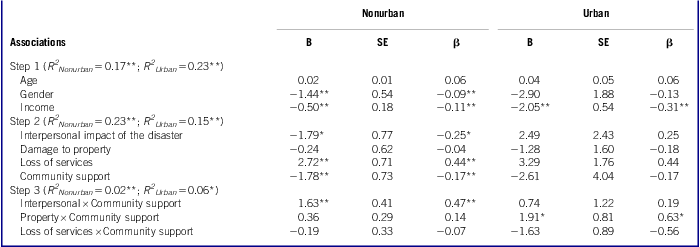
Regressions were used to evaluate the moderating effect of community support on the association between PTSD and depression symptoms and disaster exposure. Separate models were used for the urban and nonurban samples. For the nonurban sample, there were significant main effects for the interpersonal impact of the disaster (β = 0.16, P < .01), property damage (β = 0.07, P < .05), and loss of services (β = 0.42, P < .01) on PTSD (R 2Change Step 2 = 0.23). When interaction terms were added to the model, the association between interpersonal impact of the disaster and PTSD was conditional on the level of community support (β = 0.47, P < .01) (Table 2; Figure 1). Probing the interaction at 1 SD above and below the mean on community support suggested that the association between the interpersonal impact of the disaster and PTSD symptoms was stronger at lower levels of community support. That is, those with low levels of community support and elevated levels of interpersonal disaster exposure reported the highest PTSD symptoms.
Regression Model Examining the Association Between Disaster Exposure and Posttraumatic Stress Disorder Symptoms Across Nonurban and Urban Participants
*P < .05; **P < .01. Coefficients reported are from the third step that included all predictors in the model.
Interaction Between Community Support and Interpersonal Disaster Impact in the Nonurban Sample and Community Support and Property Damange in the Urban Sample on Symptoms of Posttraumatic Stress Disorder. PLC-C Score, Posttraumatic Stress Disorder Checklist—civilian version.
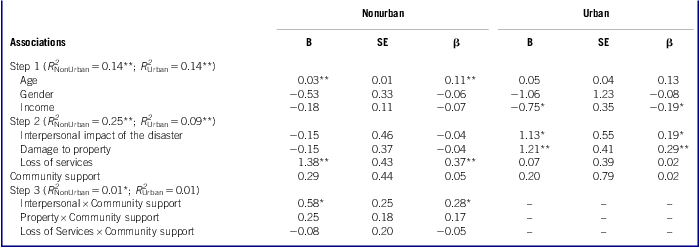
For depression, a similar pattern of results was observed (Table 3). Main effects were reported for the interpersonal impact of the disaster (β = 0.21, P < .01), property damage (β = 0.09, P < .05), loss of services (β = 0.35, P < .01), and community support (β = 0.20, P < .01) (R 2Change Step 2 = 0.23). When interaction terms were included in the model, the association between interpersonal impact of the disaster was conditional on the level of community support (β = 0.28, P < .05; R 2Change Step 3 = 0.01) (Table 3). Specifically, at low levels of community support the association between the interpersonal disaster and depression symptoms was stronger than at higher levels of community support (Figure 2).
Regression Model Examining the Association Between Disaster Exposure and Depression Symptoms Across Nonurban and Urban Participants
*P < .05; **P < .01. Coefficients reported are from the final step that included all predictors in the model.
Interaction Between Community Support and Interpersonal Disaster Impact on Symptoms of Depression for the Nonurban Sample. CESD-10, Center for Epidemiologic Studies Depressed Mood Scale 10.
For the urban sample, PTSD symptoms were significantly associated with increased property damage (β = 0.33, P < .01) and an increased interpersonal impact of the disaster (β = 0.32, P < .01). The disaster variables accounted for R 2Change Step 2 = 0.15 (15%) of the variability in PTSD symptoms for the urban sample. A significant moderating effect of community support was observed on the association between property damage and PTSD symptoms (β = 19.91, P < .05) (Table 2; Figure 2). Probing the interaction at 1 SD above and below the mean on community support suggested that the association between the property damage and PTSD symptoms became significant at lower levels of community support. Those who reported the greatest PTSD symptoms also reported low levels of community support and elevated property damage.
With regard to depression, a significant association was found between increased property damage (β = 0.29, P < .01) and increased interpersonal impact of the disaster (β = 0.19, P < .05) in the urban sample (Table 3). None of the other variables were significantly related to depression. The disaster variables accounted for (R 2Change Step 2 = 0.09) 9.0% of the variability in depression symptoms in the urban sample.
Discussion
The results of the current study were consistent with previous work on the association between disaster exposure and psychological distress.Reference Gros, Price, Gros, Paul, McCauley and Ruggiero12, Reference Kaiser, Sattler, Bellack and Dersin25 Specifically, those who were more interpersonally affected by the disaster and had greater property damage reported elevated PTSD and depression. However, loss of services was only related to PTSD and depression symptoms in nonurban participants. These findings were consistent with the conservation of resources model, in that greater losses increase mental health distress. In addition, loss of services may be especially relevant to nonurban areas.
The current study demonstrated that community support can buffer against mental health distress, but that it appears to function differently across urban and nonurban areas. Higher levels of community support consistently reduced the association between interpersonal losses and mental health distress (PTSD, depression) in nonurban areas. Such findings were consistent with previous research, and empirical reviews have shown that elevated support can facilitate recovery to a trauma.Reference Andrews, Brewin and Rose26–Reference Price, Gros, Strachan, Ruggiero and Acierno28 The focus on community support in the current study, however, demonstrates the potential for broader communities to provide needed support for those with interpersonal effects of the disaster as opposed to those who lost tangible services.
However, such a buffering effect was not observed in the urban sample, which is consistent with work done on urban disasters.Reference Nandi, Galea, Ahern and Vlahov29 The lack of an association may be attributed to a broader social network for those in urban areas. That is, those residing in urban areas may have access to social support from their place of employment or from social clubs that are not considered part of their direct community. These social outlets may provide comparable protective effects. The close proximity of social networks beyond residential areas is a potential strength of urban areas and warrants more study.
Alternatively, support provided by the community may be more protective against the loss of tangible items, as evidenced by the moderating effect of community support and property damage against PTSD in the urban sample. Additional work is needed to more fully evaluate support from multiple sources including that obtained from the community, family, and extended support via technology-facilitated networks.
Contrary to the hypothesized relationship, elevated community support did not reduce mental health distress associated with loss of services in the nonurban sample. This nonsignificant finding was likely due to the floor effect observed in the nonurban sample. It could have been attributed to the scope that service loss is experienced in a community after a disaster controlling for other types of disaster exposure. Consistent with theoretical models, loss of services deplete resources for all, as opposed to a single individual. For example, entire communities lose power and that may have limited the extent to which individuals can assist one another with electric needs.
Conclusions
These results have several implications for disaster preparedness and response in nonurban communities. Disaster response plans in nonurban communities may benefit from identifying key stakeholders in the community and involving them in response efforts—especially for those who have lost a loved one or experienced an injury due to the disaster. In addition, response agencies may reduce the mental health impact of disaster exposure in nonurban areas through incorporating community members in the disaster response. Collaboration between community members and disaster response agencies could result in the best allocation and improvement of mental health outcomes. New methods of communication (eg, telehealth and mobile phones) can capitalize on disaster response efforts for those in a nonurban setting.
Limitations
Several limitations were noted for this study. First, there were substantially more participants from nonurban than urban areas. The analyses with the urban sample may have lacked sufficient power to detect significant interactions between community support and disaster exposure. Second, we were unable to differentiate participants in suburban and rural areas. The association of community support, disaster exposure, and mental health outcomes may further vary across these locations. Additional work is needed to parse the effects of individual, community, and other sources of support in suburban and rural areas.
Third, the study also used self-report data for mental health symptoms and community support. Future work should also use epidemiologic data to better assess the influence of community-level variables on disaster response and mental health outcomes.Reference Sampson, Raudenbush and Earls23 Moreover, the current study used cross-sectional data from a single time point, which prevents firm conclusions from being drawn regarding the directionality of the relationship of community support. Previous work that has used this methodology has suggested that support has the strongest effect on immediate mental health symptoms.Reference Norris and Kaniasty3, Reference Immel, Jones and Smith30 That is, social support at a given time is most closely related to mental health symptoms at a nearby time as opposed to later on. However, few studies have explored this relationship prospectively,Reference La Greca, Silverman, Lai and Jaccard31 and it may be that significant mental health symptoms limit the extent that community-based resources are used after a disaster.
Additional longitudinal research is needed to further understand the directionality of these results, especially given that perceptions of support and disaster exposure may be susceptible to recall bias. Such research would benefit from the inclusion of assessments of predisaster mental health functioning as well. Fourth, the current study relied on reports of mental health symptoms after the disaster. In spite of evidence indicating that mental health symptoms decline in the aftermath of a disaster,Reference Norris, Friedman and Watson32 the extent that the observed mental health symptoms were caused by disaster exposure was unclear.
Also, all participants had access to landline telephones and home Internet, were predominately White, and reported an increased level of income. In spite of the fact that approximately 3 in 4 households in the United States have Internet access and a landline telephone33 and demographics are consistent with the location from which they were sampled,34, 35 the results may not generalize to other groups, including economically disadvantaged communities. Future research should use quota sampling stratified across income level to ensure that an adequate proportion of participants across all income brackets are selected. As such, the findings of the current study should be considered preliminary until replicated across more diverse communities in other locations.
Last, the current study did not obtain a measure of existing resources in the affected areas. Disaster researchers should partner with epidemiologists and behavioral economists to develop resource maps that can identify preexisting services in a given area and determine how well such resources are used in disaster response. Such knowledge can guide further research on disaster response and mental health outcomes at the individual and community levels.
In spite of its limitations, we believe that this study holds promising implications for future developments in disaster response preparedness. By identifying the differences between services needed in urban and nonurban areas, disaster response efforts can be more effectively targeted to serve in different regions.
Funding and Support
This study is supported by the National Institutes of Mental Health Grant R34MH77149 (Dr Ruggiero). Dr. Price is supported by T32MH018869.
Acknowledgments
The authors would like to thank the many victims of Hurricane Ike who participated in this project.