INTRODUCTION
Language aptitude has been one of the most fertile grounds for research on the impact of learners’ cognitive abilities on their second language development or attainment. The proliferation of aptitude studies is attributable to the explanatory power of cognitive aptitudes for second language acquisition (SLA), the availability of measures with strong predictive validity (although they have been criticized for lack of construct validity), and the relevance of the research findings for second language (L2) pedagogy. Carroll (Reference Carroll, Parry and Stansfield1990) stated that aptitude as measured by the MLAT (Modern Language Aptitude Test) is distinct from other individual difference variables, not subject to training effects, and predictive of L2 achievement. The construct of language aptitude, therefore, entails its content, characteristics, and associations with covariates and with the criterion variable—L2 achievement. This study aims to examine the validity of the construct of language aptitude by conducting a meta-analysis of the empirical data reported in the primary research that is couched in Carroll’s framework.
Such a study is warranted on two accounts. First, over the past five decades there has been a considerable volume of research on language aptitude, but to date there has been no attempt to systematically synthesize the quantitative results that have been accumulated and verify the theoretical claims about the construct. Carroll, Sapon, Reed, and Stansfield (Reference Carroll, Sapon, Reed and Stansfield2010) commented that the results of the large amount of aptitude research “seem [emphasis added] to offer strong support for the major claims about the nature of language aptitude” (p. 19). However, the theoretical claims need to be tested through aggregation of the quantitative results rather than impressionistic judgments. Also, there is much heterogeneity in the findings of the primary studies that has not been accounted for in previous reviews. For example, a preview of the data of this meta-analysis shows that the correlations between motivation and aptitude ranged from r = -.20 to r = .32, and the MLAT Manual (Carroll & Sapon Reference Carroll and Sapon2002) reports that the correlations between foreign language learners’ MLAT scores and their course grades ranged from r = .13 to r = .83. A meta-analysis can not only provide precise numeric estimates about the construct but also identify the variables that account for the variation of the findings across the sampled populations. Second, the traditional conceptualization of aptitude and the tests used to measure it have received much criticism, and there has therefore been a call to revamp the construct and update the tests (Robinson, Reference Robinson2001; Skehan, Reference Skehan and Robinson2002). However, the weaknesses of existing theoretical claims and aptitude measures cannot be assumed, and changes and revisions must be based on what has been demonstrated about the construct in empirical research. It is hoped that the meta-analytic findings of this study contribute to the accurate understanding of traditional aptitude and afford empirical justification for future developments. It must be further pointed out that the objective of this meta-analysis is to provide an inductive review of what has been found about traditional aptitude by aggregating the quantitative data contributed by the primary studies, rather than prove or disprove any existing theories or claims about the construct.
THE CONSTRUCT OF LANGUAGE APTITUDE
Cronbach and Meehl defined a construct as “some postulated attribute of people, assumed to be reflected in test performance” (1955, p. 283). A construct is a concept and is operationalized as a specific measure that may consist of items gauging the multiple dimensions of what is termed a latent variable, which is not directly observable. The validity of a construct involves the “theoretical knowledge of the trait and ability being measured, knowledge of other related variables, hypothesis testing, and statements regarding the relationship of the test variable to a network of other variables that have been investigated” (Groth-Marnat, Reference Groth-Marnat2003, p. 22). In the following, an overview of the construct of aptitude is provided including its nature and components and how it has been measured and validated.
The Nature, Content, and Measurement of the Construct
Perhaps the best way to start this section is to point out that aptitude has been defined and conceptualized in different ways in different disciplines. For example, Snow (Reference Snow1991), a pioneer in aptitude research in the field of educational psychology who proposed the ATI (aptitude-treatment interaction) approach, argued that aptitude refers to any person characteristic that is important to achieving a learning goal including affective (feelings and emotions) and conative (goal setting and determination) processes such as anxiety and motivation as well as cognitive abilities such as analytic ability and memory. In SLA, aptitude is generally considered as a cognitive variable, but the way aptitude is conceptualized and operationalized in the research is far from homogeneous, which is evidenced by the existence of a variety of aptitude tests developed for various purposes (see the following text for a discussion of different aptitude measures).
Characteristics
Carroll (Reference Carroll and Diller1981) claimed that language aptitude is (1) distinct from other individual difference variables such as motivation, anxiety, and intelligence; (2) impervious to external influence; (3) predictive of L2 learning rate; (4) drawn upon in formal instruction where learners make “a deliberate effort to learn a foreign language” (p. 83); and (5) the “initial state of readiness” (p. 86) for learning a foreign language. These claims have the following implications. First, aptitude, as measured by Carroll’s seminal test—the MLAT—and other tests based on Carroll’s views, is a cognitive variable distinguished from the variables in the affective and conative domains. Second, language aptitude is domain specific in the sense that it relates only to language learning and is different from abilities for other academic subjects such as intelligence. Third, aptitude is not affected by previous language learning experience, not subject to training, and remains stable for a relatively long period of time during one’s life span. Fourth, it concerns the ease and speed with which one learns a foreign language in comparison with peers during a certain period, and therefore it is not intended to predict ultimate L2 success. Fifth, it is hypothesized to be implicated in instructed SLA, and it was uncertain to Carroll whether it is important in nontutored or naturalistic settings, where learning often happens unconsciously through exposure to a large amount of linguistic input. Sixth, it is a set of abilities that are of central importance in the preliminary stages of L2 development, and the extent to which it affects advanced levels of learning is not known. To be clear, these are Carroll’s views on the characteristics of aptitude, some of which have not been followed in the research. For example, although the aptitude that Carroll conceptualized is intended to be predictive of learning rate in instructed contexts, there has been a body of research examining its role in affecting ultimate learning success in naturalistic settings (e.g., Abrahamsson & Hyltenstam, Reference Abrahamsson and Hyltenstam2008; DeKeyser, Reference DeKeyser2000; Granena & Long, Reference Granena and Long2013).
Components
Carroll (Reference Carroll and Diller1981) posited four fundamental abilities for language learning: phonetic coding, grammatical sensitivity, inductive learning, and rote learning, which jointly underlie a latent, second-order variable labeled as language aptitude. Grammatical sensitivity and inductive learning relate to the analytic aspects of aptitude and can therefore be unified as language analytic ability (Skehan, Reference Skehan and Robinson2002), which led to a more parsimonious, tripartite structure. Although Carroll stated that aptitude was componential, he saw it as a unitary concept represented by a composite score that is predictive of course grades in his validation research and in his comments on the validity of the construct (Carroll et al., Reference Carroll, Sapon, Reed and Stansfield2010). Related to this issue is a need for transparency over what is meant by the term aptitude, and in fact the confusion may have been a source of misinterpretation of research findings and theoretical claims (Granena & Long, Reference Granena and Long2013). For example, Krashen (Reference Krashen and Diller1981), in his criticism of the concept of language aptitude, referred to aptitude as grammatical sensitivity, considered phonetic coding as irrelevant, and ignored rote learning. Both Abrahamsson and Hyltenstam (Reference Abrahamsson and Hyltenstam2008) and DeKeyser (Reference DeKeyser2000) examined the relationship between aptitude and age, but in the former a composite aptitude score representing all three components was used while in the latter aptitude was operationalized as grammatical sensitivity. This discrepancy may have been partly responsible for the different results between the two studies regarding whether aptitude is correlated with child SLA.
Despite its strong predictive power for L2 learning rate, traditional aptitude has been challenged on the grounds that it consists of a set of abilities that are only important for preliminary L2 learning but not advanced SLA, for learning language as discrete items rather than learning that happens in context, for explicit learning instead of implicit learning, and for learning the formal aspects as opposed to the pragmatic aspects of a language (Li, Reference Li2015; Robinson, Reference Robinson2001; Skehan, Reference Skehan, Gass and Mackey2012). However, it must be recognized that some of the criticisms are only justifiable on theoretical grounds and have not been empirically verified. For example, although traditional aptitude components have been assumed to be only relevant for preliminary L2 learning, primary studies seeking to identify abilities relevant for advanced learning are few and far between. Recently a research unit led by Catherine Doughty at the University of Maryland (see Linck et al., Reference Linck2013) developed an aptitude battery called the Hi-LAB which is composed of 12 measures of seven cognitive abilities. The tests were administered to 476 government employees and military personnel in the United States, with a view to discovering abilities predictive of high attainment operationalized as either learners’ outstanding performance on a standardized test (Defence Language Proficiency Test) or high-level job performance in one or more foreign languages. Logistic regression analyses showed that measures of phonological short-term memory (PSTM), implicit learning, and rote memory were significant predictors of high attainment.
One feature that stands out about the Hi-LAB is the inclusion of six measures of the executive and storage functions of working memory, which demonstrates the researchers’ emphasis of its importance for advanced learning. Working memory is a cognitive device that performs the dual function of information storage and processing. It has been argued that working memory is where all three components of aptitude (phonetic coding, language analytic ability, and memory) converge (Miyake & Friedman, Reference Miyake, Friedman, Healy and Bourne1998) and that the traditional rote memory component does not fit the kind of learning that happens in instructional contexts where more emphasis is placed on exposure to authentic language use and incidental learning. Although some state-of-the-art reviews (DeKeyser & Koeth, Reference DeKeyser, Koeth and Hinkel2011; Skehan, Reference Skehan, Gass and Mackey2012) have included working memory as a component of aptitude, there needs to be more theoretical elaboration and empirical exploration of how working memory relates to traditional aptitude and aptitude components. One objective of this meta-analysis is to draw on existing data to map the relationship between traditional aptitude and working memory.
Another breakthrough of Linck et al.’s validation study is the inclusion of a measure of implicit aptitude, an initiative that constitutes a departure from, and a significant complement to, the paradigm of traditional aptitude, which comprises of a set of abilities that are likely more correlated with conscious L2 learning. This initiative heralds a vibrant stream of aptitude research in search of implicit learning abilities and validating the measures of these abilities, echoing the currently live debate on the mechanism and measurement of implicit learning in SLA research (e.g., Ellis, Reference Ellis2005; Suzuki & DeKeyser, Reference Suzuki and DeKeyser2015; Williams, Reference Williams, Ritchie and Bhatia2009). A good example study is Granena (Reference Granena2015), who found a separation between learners’ performance on the LLAMA test—a measure of explicit aptitude—and their performance on a serial reaction time test—a measure of implicit aptitude. The two types of aptitude were found to be significantly, but distinctly, correlated with two different cognitive styles: rational-analytical and experiential-intuitive, with the former representing a propensity for explicit learning and the later implicit learning.
Grigorenko, Sternberg, and Ehrman (Reference Grigorenko, Sternberg and Ehrman2000) sought to identify abilities important for contextualized learning and proposed a model based on a cognitive theory of knowledge acquisition, which posits a central role for abilities to cope with novelty and ambiguity. The test battery (CANAL-F) gauging the abilities includes tasks involving the learning of the vocabulary and morphosyntax of an artificial language called Ursulu. Vocabulary is learned through tasks requiring learners to infer the meanings of Ursulu words embedded in English texts as well as paired-associate tasks that tap rote memory. Morphosyntax is learned by means of an inductive task (sentence inference) where learners are provided with Ursulu sentences and their English translations, encouraged to make inferences about the morphosyntactic aspects of the language, and then tested through multiple-choice items. The aptitude battery also includes a deductive task where learners are presented with rules about how Ursulu works and later apply the knowledge when answering multiple-choice questions. In addition to tasks relating to the lexical and syntactic aspects of language learning, the test also consists of comprehension tasks that engage learners in semantic processing.
Measurement
The most frequently used and comprehensive test batteries of traditional aptitude are the MLAT and the PLAB (Pimsleur, Reference Pimsleur1966), and the MLAT “seems to be the best overall instrument for predicting language learning success” (Parry & Child, Reference Parry, Child, Thomas and Stansfield1990, p. 52). The popularity of the MLAT and PLAB is largely attributable to their strong predictive validity that is established based on the data contributed by large samples (5,000 learners for the MLAT and 6,000 for the PLAB) from a large number of foreign language classes at different levels of L2 development. Although Carroll (Reference Carroll and Diller1981) claimed that the MLAT and the PLAB measure somewhat similar abilities and are comparable in validity, there are appreciable differences between them in that the PLAB, which is intended for high school students, includes sections for GPA and motivation, and leaves out rote learning. Other subsequently developed tests include the DLAB, which targets high-aptitude learners (Petersen & Al-Haik, Reference Petersen and Al-Haik1976); the VORD, which is intended for the learning of challenging languages (Child, Reference Child1998); and the LLAMA (Merea, Reference Meara2005), a free computerized test modeled on the MLAT. Notwithstanding slight differences between these tests, they are based on Carroll’s views about the nature and characteristics of aptitude. These are developed for L1 English speakers (except for the LLAMA, which is language neutral), used for predictive purposes, and validated following the tradition of psychometric testing.
As previously discussed, more recent developments in aptitude testing seeking to address the limitations of the MLAT and similar tests include the CANAL-F (Grigorenko et al., Reference Grigorenko, Sternberg and Ehrman2000) and the Hi-LAB (Linck et al., Reference Linck2013). The CANAL-F is theory based and consists of a number of inductive and deductive tasks that replicate classroom tasks and mirror the process of instructed language learning that involves the processing of linguistic materials from the word level to the sentence level and from form to meaning. However, the learning tasks are heavily form oriented and seem to tap primarily into explicit aptitudes. The test has not been widely used in aptitude research, and more information is in order about its validity and reliability (but see Thompson, Reference Thompson2013).The Hi-LAB is innovative in a number of aspects, but the generalizability of the findings of the validation study is subject to caveats relating to the way proficiency was operationalized (job performance or scores of listening and reading on a proficiency test) and the fact that only rote memory was included in the battery, leaving one wonder whether including other components of traditional aptitude such as language analytic ability and phonetic coding would have changed the results. Furthermore, despite the originality of the concept of implicit aptitude, which is a central component of the Hi-LAB, there has been only weak empirical evidence for the validity of the construct. For example, Granena (Reference Granena2015) only observed a weak, marginally significant correlation between a measure of implicit aptitude and a measure of implicit cognitive learning style. Also, even if one predictor variable is found to overlap or covary with another predictor variable with a similar mechanism, which constitutes evidence for convergent validity, evidence needs to be collated for its predictive validity, that is, whether it is correlated with the criterion variable, which is implicit learning in this case.
Validation of the Construct
A Tripartite versus Unitary View of Validity
Traditionally, validity in educational assessment is a tripartite concept comprising content validity, criterion-oriented validity, and construct validity (Cronbach & Meehl, Reference Cronbach and Meehl1955). Content validity, usually evaluated through expert opinions, refers to the extent to which test items represent the skills and knowledge of the substantive domain or whether the tasks included in a test mirror what happens in the real world. Criterion-oriented validity concerns how the test scores correlate with a criterion measure. There are two types of criterion-oriented validity: one is concurrent validity, in which case the test for the predictor variable and that for the criterion variable are administered at the same time and the purpose is to see whether one can replace the other; the other is called predictive validity, which refers to whether one’s test performance forecasts one’s performance on another test that is administered later. In aptitude research, predictive validity has been of primary interest, as demonstrated by Carroll and Sapon’s (Reference Carroll and Sapon1959) validation research in which aptitude scores were obtained at the beginning of the training (e.g., a semester) and correlated with scores for the criterion variable (e.g., course grades) obtained at the end of the training. However, in many subsequent aptitude studies, aptitude and criterion tests are administered at the same time, in which case the term predictive needs to be understood in a logical sense, that is, aptitude has an influence on L2 learning outcome, but not the other way round. Finally, in traditional testing theories, construct validity indicates whether the theoretical claims relating to the concept are warranted and whether the hypothesized/postulated relationships are corroborated by empirical evidence.
Notwithstanding the theoretically plausible distinction between the three types of validity, they are interrelated and difficult to disentangle (Popham, Reference Popham2000). Consequently, different from the traditional tripartite view, current testing theories hold that validity is a unitary concept in which construct validity is an overarching term for all three types of validity; under this view, content and criterion-related validity are considered aspects of construct validity. Validation of a construct involves the collation of different types of empirical evidence to evaluate the appropriateness of the inferences associated with the test performance (Messick, Reference Messick and Linn1989). In the case of language aptitude, validation of the construct entails drawing on existing research findings to examine the concept in terms of its relationships with other individual difference variables (such as motivation, anxiety, and intelligence) and with the criterion variable—L2 attainment.
Aptitude and L2 Learning
Most aptitude research has investigated the relationship between language aptitude and L2 achievement. The research falls into two broad categories informed by different theoretical approaches, the fundamental difference lying in whether aptitude is perceived as a trait that affects L2 outcome—a predictive approach, or L2 process—an interactionist approach. Carroll (Reference Carroll and Diller1981) argued that the primary function of aptitude is predictive, and the purpose is to investigate the association between aptitude and L2 attainment. In a typical predictive study, the researcher obtains two sets of scores: one for aptitude or an aptitude component and one for L2 attainment in the form of course grades or scores on a proficiency test, and learners take the tests in one sitting. Analyses of a correlational nature (including multiple regression analysis) are then conducted to determine whether aptitude is a significant predictor. Some predictive studies also investigated the predictive power of aptitude in comparison to other variables, such as motivation (Bialystok & Fröhlich, Reference Bialystok and Fröhlich1978; Gordon, Reference Gordon1980), anxiety (Bell & McCallum, Reference Bell and McCallum2012; Sparks, Patton, Ganschow, & Humbach, Reference Sparks, Patton, Ganschow and Humbach2009), and intelligence (Bond, Reference Bond2011; Sparks, Patton, Ganschow, Humbach, & Javorsky, Reference Sparks, Patton, Ganschow, Humbach and Javorsky2006).
Within the interactionist paradigm, researchers (Robinson, Reference Robinson and Robinson2002, Reference Robinson2005) contended that instead of viewing aptitude as a determinant of L2 success, it is better to treat it as a dynamic construct, that is, its role varies as a function of the processing demands of different learning conditions. In a typical interactionist study (e.g., de Graaff, Reference de Graaff1997; Sheen, Reference Sheen and Mackey2007), the learners take an aptitude test, receive some type of instructional treatment (implicit vs. explicit, inductive vs. deductive, etc.) that focuses on the learning of a particular linguistic structure, and then take a posttest (and often also a pretest prior to the treatment) as a measure of their learning gains after the treatment. The data are then analyzed to explore whether aptitude or aptitude components are drawn on differently in different treatment conditions. A meta-analysis of the interactionist studies showed that aptitude was more likely to be involved in explicit treatments than implicit treatments (Li, Reference Li2015). The studies on how aptitude interfaces with inductive versus deductive instruction seem to show that aptitude was more likely to be implicated in inductive approaches that favored high-aptitude learners, and that it was either unimportant or less important in deductive approaches (Erlam, Reference Erlam2005; Hauptman, Reference Hauptman1971; Hwu & Sun, Reference Hwu and Sun2012). However, these findings must be treated circumspectively because of the different ways the inductive-deductive distinction is operationalized and the different aptitude tests used in the studies, and there is an obvious need for more studies in this line of research before firm conclusions can be reached.
The Nature and Characteristics of Aptitude
While there has been copious research on how aptitude is correlated with L2 learning outcomes, there have been fewer studies investigating its nature and characteristics such as whether it is malleable or affected by learning experience and how it relates to other affective and cognitive variables such as motivation, anxiety, and intelligence. The question of whether experience leads to improvement in aptitude can be examined in three ways. One is to use a between-group design where learners with less language learning experience are compared with those that have more experience in terms of their aptitude scores. The second option is to employ a within-group design where the same learners are given an aptitude test before and after exposure to a foreign language to see if their aptitude scores change over time. The third and best way is to investigate both between- and within-group differences—a mixed design that overcomes the weaknesses of the first two approaches by showing that (1) the higher scores of those with more experience are not due to their higher aptitude (as in a between-group study), and (2) the chronological improvement in the same learners’ aptitude scores is only attributable to study experience instead of maturation effects (as in a within-group study). Previous studies using either a between-group (Eisenstein, Reference Eisenstein1980; Harley & Hart, Reference Harley and Hart1997) or within-group (Ganschow & Sparks, Reference Ganschow and Sparks1995) design have produced mixed results. The only mixed design study is by Sáfár and Kormos (Reference Sáfár and Kormos2008) who found that (1) bilingual students that received intensive language instruction scored higher on an aptitude test than those at a regular school who received less language instruction and (2) both groups’ aptitude scores were also significantly higher after one academic year than their initial scores. The findings of Sáfár and Kormos appear to suggest that aptitude is malleable, but there is a lack of experimental research investigating the impact of carefully designed training/treatment on subjects’ aptitude scores. Also, it remains to be seen whether improved aptitude is transferrable into learning efficiency, as Carroll and Sapon (Reference Carroll and Sapon2002) suspected.
The relationship between aptitude and other individual difference variables entails two dimensions: one is the predictive power of aptitude for L2 achievements in comparison with other variables and the other is the interrelationship between aptitude and other predictor variables. With regard to the former, by and large aptitude has been found to be the most consistent predictor of the criterion variable when examined together with other cognitive and affective variables (Bell & McCallum, Reference Bell and McCallum2012; Cochran, McCallum, & Bell, Reference Cochran, McCallum and Bell2010; Granena, Reference Granena2012; Sparks et al., Reference Sparks, Patton, Ganschow and Humbach2009). The other dimension, which is the focus of this meta-analysis, concerns the associations between aptitude, on one hand, and motivation, anxiety, and intelligence, on the other. Although how aptitude relates to other individual difference variables is critical to the validity of the construct, it has not been the focus of the primary research. However, when examining the comparative effects of aptitude and other variables such as motivation in affecting L2 learning (e.g., Bialystok & Fohlich, Reference Bialystok and Fröhlich1978; Hsieh, Reference Hsieh2004), some researchers also reported the correlations among the predictors. The additional data from these studies can therefore be utilized to zero in on the link between aptitude and other individual difference factors.
This Study
This study is part of a large-scale meta-analytic project that examines various aspects of language aptitude by synthesizing the quantitative data available in primary research. The data relating to the relationship between aptitude and L2 grammar acquisition were reported in another study (Li, Reference Li2015). Footnote 1 It was found that aptitude showed an overall moderate association with grammar acquisition, r = .31, 95% CI = .25 /.36. A subsequent moderator analysis demonstrated that aptitude was more correlated with explicit treatments than implicit treatments and that age was a negative predictor in predictive studies but a positive predictor in interactionist studies. This meta-analysis will include studies taking a predictive approach, and the purpose is to examine other aspects of the construct by testing the claims made by Carroll (1973, 1981, 1990; Carroll & Sapon, Reference Carroll and Sapon1959; Carroll et al., Reference Carroll, Sapon, Reed and Stansfield2010), who pioneered aptitude research and developed the most influential aptitude test that has dominated this research domain. The claims to be subjected to empirical investigation, which are represented in the three research questions in the following text, relate to its associations with other cognitive and affective variables and with the criterion variable including general L2 proficiency, L2 knowledge (grammar and vocabulary), and L2 skills (listening, speaking, reading, and writing).
The significance of this study is as follows. First, this meta-analysis constitutes the first attempt to comprehensively synthesize the empirical research on language aptitude to examine the attributes of this construct and how it relates to learning as well as other individual difference variables. The retrospective synthesis of past research also benefits future initiatives of reexamining the concept and developing new measures for the construct. Second, the meta-analysis goes beyond the focus of the primary research and examines not only how aptitude relates to L2 proficiency in general but also its associations with specific aspects of L2 learning and the factors that may moderate such associations; it not only shows how aptitude predicts L2 attainment but also how it relates to other individual difference variables. Third, it includes both published articles and unpublished PhD dissertations and MA theses reporting data relating to the research questions and constitutes the most comprehensive synthesis of aptitude research.
This meta-analysis was guided by the following research questions:
-
1. What is the relationship between language aptitude and other individual difference variables such as motivation, anxiety, and intelligence? Footnote 2
-
2. What is the relationship between aptitude and working memory, a possible component of aptitude?
-
3. What is the relationship between aptitude and L2 achievement?
-
3.1 How do aptitude and aptitude components relate to general L2 proficiency?
-
3.2 How do aptitude and aptitude components relate to specific aspects of L2 learning such as L2 knowledge (grammar and vocabulary) and L2 skills (listening, speaking, reading, and writing)?
-
The first question seeks to verify Carroll’s claim that aptitude is distinct from other individual difference variables. The second question aims to map the relationship between working memory Footnote 3 and traditional aptitude and explore the viability of including working memory as an aptitude component, as suggested by experts in aptitude research (DeKeyser & Koeth, Reference DeKeyser, Koeth and Hinkel2011; Robinson, Reference Robinson2001; Skehan, Reference Skehan, Gass and Mackey2012). The third question subsumes two subquestions relating to the predictive power of aptitude and aptitude components for general L2 proficiency and for different aspects of L2 learning.
METHOD
Study Retrieval
The methods used to search for related primary studies include (1) ancestry chasing—tracing the references in primary research, (2) computer search—searching electronic databases and academic journals, (3) browsing—checking bookshelves in the library, and (4) consultation—consulting experts in the academic field. The searched databases, which were selected based on the findings of synthetic reviews of SLA meta-analyses (In’nami & Koizumi, Reference In’nami and Koizumi2010; Li, Shintani, & Ellis, Reference Li, Shintani and Ellis2012; Oswald & Plonsky, Reference Oswald and Plonsky2010), include LLBA, ERIC, PsycINFO, PsycARTICLES, MLA International Bibliography, and ProQuest Dissertations and Theses; Google Scholar was searched as a complement to the domain-related databases. The primary studies were identified by using keywords relating to (1) the concept and components of aptitude such as language aptitude, phonetic coding, language analytic ability, and rote learning (memory), and (2) the names of the test batteries such as MLAT, PLAB, DLAB, VORD, CANAL-F, LLAMA, and so forth and their subtests such as Number Learning (MLAT 1) and Sound-Symbol Association (PLAB 6). In addition to the predictor variable—language aptitude, keywords relating to other individual difference variables (motivation, anxiety, and intelligence), working memory, and the outcome variable (second language learning) were also used during the search for related primary studies. Upon the completion of the study search, the retrieved articles were sieved and selected based on the research questions and defined research domain.
Inclusion/Exclusion Criteria
This meta-analysis included any study that reported data that can be synthesized to address any or all of the research questions, including studies reporting (1) correlations between aptitude and other individual difference variables such as motivation, anxiety, and intelligence (to address the first research question); (2) correlations between aptitude working memory (RQ 2); and (3) correlations between aptitude/aptitude components and L2 achievements (RQ 3). In addition to research articles, another important source of data is the MLAT Manual (Carroll & Sapon, Reference Carroll and Sapon2002), from which the extracted data included correlation coefficients between foreign language learners’ aptitude scores and course grades. The data reported in the manual were collected by the test developers to establish the predictive validity and percentile norms of the test batteries but have not been aggregated using meta-analytic procedures. To take full advantage of the data reported in the primary studies and seek alternative explanations for the results (see Discussion section), descriptive statistics (means and standard deviations) of the learners’ aptitude scores were also extracted. To minimize publication bias, that is, studies that obtained significant results are more likely to be published, this meta-analysis included both published studies and unpublished PhD dissertations and MA theses. Furthermore, to be included in the meta-analysis, a study had to be published prior to May 2014, the closing time for data collection.
The following exclusion criteria were formulated. First, this meta-analysis is a synthesis of predictive studies which are motivated by Carroll’s (Reference Carroll, Parry and Stansfield1990) claims about the characteristics of aptitude; therefore, interactionist studies (the results for which were reported in a different study) that examined the contingent relationships between aptitude and different types of instructional treatment were excluded from the data in answering the third research question, which concerns the predictive validity of aptitude. This is because predictive and interactionist studies are based on different theoretical assumptions and are conducted in different ways; mixing the two types of studies would have led to the classical apples and oranges problem of meta-analysis (Lipsey & Wilson, Reference Lipsey and Wilson2001; Plonsky & Brown, Reference Plonsky and Brown2015). However, a few studies in the interactionist paradigm (e.g., Carpenter, Reference Carpenter2008; Lado, Reference Lado2008; Robinson, Reference Robinson and Robinson2002; Sachs, Reference Sachs2010) reported data that could be used to address the research questions (e.g., the correlations between aptitude and working memory) and were therefore included for that reason. Second, a study was excluded if the aptitude test deviates from traditional aptitude measures, such as Ranta (Reference Ranta and Robinson2002) who used an L1 error correction test as a measure of language analytic ability. Third, if two studies by the same author reported data based on the same sample (e.g., Robinson, Reference Robinson and Robinson2002, Reference Robinson2005; Sparks et al., Reference Sparks, Patton, Ganschow, Humbach and Javorsky2006, Reference Sparks, Patton, Ganschow and Humbach2009), only one was kept in the dataset, to prevent effect size inflation and Type I error. Fourth, due to logistic constraints, no attempt was made to find studies published in other languages or unpublished manuscripts “tucked away in the researchers’ file drawers.”
Coding
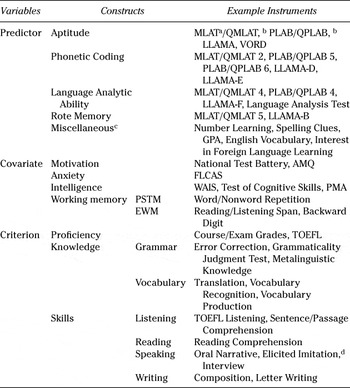
The coding protocol of this meta-analysis involves a description of how information from the primary studies was recorded and categorized pertaining to the measures of (1) aptitude—the predictor variable; (2) the covariates or other individual difference variables—motivation, anxiety, and intelligence; (3) working memory—a possible aptitude component; and (4) L2 achievement or the criterion variable. Table 1 provides an overview of the coding scheme, including the constructs and the instruments used to measure them. For the convenience of analysis and for the purpose of obtaining a clear picture about the results for different aptitude measures and the underlying constructs, the measures of aptitude were coded in two ways: in terms of the names of the tests (MLAT, PLAB, etc.) and their subtests (MLAT 1 Number Learning, PLAB 4 Language Analysis, etc.), and in terms of the underlying construct, that is, aptitude and aptitude components, including phonetic coding, language analytic ability, and rote memory. Information about the matching between constructs and the frequently used tests is presented in Table 1. Specifically, whole test batteries were referred to as aptitude; MLAT 2, PLAB 5, PLAB 6, LLAMA-D, and LLAMA-E as phonetic coding; MLAT 4, PLAB 4, and LLAMA-F as language analytic ability; and MLAT 5 as rote memory. Where there is no clear correspondence between a subtest and an aptitude component, such as in the case of MLAT 1 Number Learning and MLAT 3 Spelling Clues, the name of the subtest was retained and no further coding was pursued. The preceding labels for the MLAT and the PLAB also apply to the adapted versions of the two tests in other languages such as the HUNLAT, LABJ, and so forth.
Coding protocol for the variables

a Whole test batteries of aptitude.
b Quasi-MLAT/PLAB: versions of the MLAT and the PLAB in other languages (e.g., the HUNLAT is the Hungarian version of the MLAT).
c GPA, English Vocabulary, and Interest in Foreign Language Learning were not included in the analyses.
d Elicited imitation was a validated measure of implicit knowledge that is drawn on in oral production (Ellis, Reference Ellis2005; Erlam, Reference Erlam2006).
With respect to the coding of the covariates (Table 1), motivation, anxiety, and intelligence were coded as unitary constructs although they may consist of multiple dimensions, because most of the primary studies only reported the correlations between aptitude and those variables as holistic constructs. In the coding of working memory, a distinction was made between PSTM and executive working memory (EWM) (Wen, Reference Wen, Wen, Mailce and McNeill2015), the former referring to the storage component of short-term memory and the latter to one’s ability to store and process information simultaneously. Measures such as word/nonword repetition and digit span where learners are presented with, and required to recall, sets of unrelated items were coded as PSTM, while measures such as listening and reading span tests where learners performed the dual task of information storage and processing were coded as EWM. The distinction between PSTM and EWM is important given the current call to include working memory as an aptitude component, which necessitates a fine-grained examination of the connections between aptitude and the two distinct types of short-term memory.
The coding of L2 attainment, the criterion variable, is based on three sets of measures tapping into (1) general proficiency, (2) knowledge of specific aspects of the L2 such as grammar and vocabulary, and (3) language skills such as listening, speaking, reading, and writing. The criterion variable was coded as general proficiency if it was assessed through course or exam grades (e.g., Bain, McCallum, Bell, Cochran, & Sawyer, Reference Bain, McCallum, Bell, Cochran and Sawyer2010; Sparks et al., Reference Sparks, Patton, Ganschow and Humbach2009), standardized proficiency tests such as TOEFL (Ross, Yoshinaga, & Sasaki, Reference Ross, Yoshinaga, Sasaki and Robinson2002), and cloze tests (Harley & Hart, Reference Harley and Hart1997). Footnote 4 As with general proficiency, L2 knowledge and skills were gauged through a variety of measures in the included studies, and the overarching principle followed in coding these measures was to retain the original labels for the constructs reported in the included studies. For example, a test was labeled vocabulary if it was claimed to measure learners’ vocabulary knowledge. A hybrid test that measured more than one construct, such as a test of both grammar and vocabulary (Sáfár & Kormos, Reference Sáfár and Kormos2008), was coded as such and subsequently excluded from the analysis for the predictive validity of aptitude for either grammar or vocabulary.
Analysis
Three sets of analyses were performed to address the research questions respectively. The first set involved aggregation of the correlation coefficients for the associations between aptitude and other cognitive and affective variables, including motivation, anxiety, and intelligence. The second set aimed to examine how aptitude relates to working memory (EWM and PSTM). The third set of analyses pertains to the predictive validity of aptitude, that is, whether learners’ aptitude scores could be used to forecast their L2 attainment. The analyses include effect size aggregation for the predictive validities of aptitude and aptitude components for general L2 proficiency and the specific aspects of L2 learning including the learning of L2 knowledge (grammar and vocabulary) and L2 skills (listening, speaking, reading, and writing). A moderator analysis was performed using a Q b test to probe whether aptitude had differential predictive validities for high school and university language learners—the two groups of learners that were most investigated in the included studies.
A confidence interval was calculated for each mean effect size. A narrow interval indicates a robust effect, and an interval that includes zero means that the effect is statistically nonsignificant (p > .05) or that the possibility that there is a null effect in the population cannot be ruled out. Publication/availability bias was assessed for the results on aptitude-learning associations through a funnel plot that displays the distribution of effect sizes, in combination with a trim-and-fill analysis that shows the missing studies and adjusted mean effect size as well as a Fail-Safe N analysis that identifies the total number of studies needed to nullify the observed effect or to increase the p value above .05. Publication bias refers to the fact that studies that report significant effects and large effect sizes are more likely to be published (due to the space limit, the results of the analysis are placed in supplementary material).
A meta-analysis can be performed using a random-effects model, which allows the population effect to vary across studies, or a fixed-effects model, which is premised on the assumption that the included studies share a common effect size. Following Borenstein, Hedges, Higgins, and Rothstein’s (Reference Borenstein, Hedges, Higgins and Rothstein2009) recommendation, this meta-analysis used a mixed-effects model where within-group effects were computed using a random-effects model because of the methodological heterogeneity of the included studies. Between-group effects were examined through a fixed-effects model to test whether the effect size variations could be explained by the systematic influence of substantive features of the primary research (also see Fischer & Boer, Reference Fischer and Boer2011). Results of heterogeneity tests (Q within ) may serve as basis for decisions regarding model selection and moderator analysis, but such tests typically have low statistical power (Cross, Copping, & Campbell, Reference Cross, Copping and Campbell2011; Oswald & Plonsky, Reference Oswald and Plonsky2010) and were therefore not conducted in this meta-analysis.
The following steps were taken to ensure the robustness of the results and minimize the potential limitations of meta-analysis. First, each effect size was weighted proportional to its sample size (Norris & Ortega, Reference Norris and Ortega2000) so that those relating to smaller samples carried less weight. Second, an analysis was not performed if the number of studies was lower than three, although theoretically meta-analysis can be applied to as few as two studies because other forms of synthesis “are less transparent and/or are less likely to be valid” (Valentine, Pigott, & Rothstein, Reference Valentine, Pigott and Rothstein2010, p. 215). Second, in order to prevent the oranges and apples problem, that is, mixing effect sizes relating to different constructs, hybrid measures of aptitude (e.g., MLAT 1 + MLAT 5) and of L2 achievements (vocabulary + grammar) were not amalgamated with measures with transparent underlying constructs. Third, with regard to the interpretations of effect sizes, most meta-analyses have followed Cohen’s (Reference Cohen1988) criteria for small (r = .10), medium (r = .30), and large (r = .50) effects, but Plonsky and Oswald (Reference Plonsky and Oswald2014) pointed out that effect sizes in SLA tend to be inflated, and they recommended more conservative benchmarks (.25, .40, and .60 for small, medium, and large effects, respectively). In this meta-analysis, both criteria were considered, and the interpretations of the results were also discussed in comparison with the mean effect sizes of other meta-analyses in SLA and cognitive psychology. Finally, in the analysis for aptitude-learning associations, Fischer Z was used as the unit of analysis due to its better statistical properties such as normal distribution and stable variance, but it was transformed back to r when the results were reported.
RESULTS
Methodological Features of the Primary Research
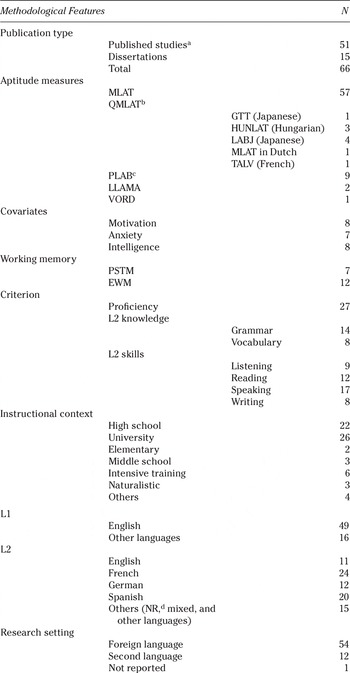
The whole dataset consisted of 66 studies that reported data contributed by 109 unique samples (including 34 samples from the MLAT Manual), and the sampled population consisted of 13,035 L2 learners. Table 2 provides a summary of the methodological information of the included studies, and the details of the studies, which were coded for 10 methodological features, are available in the online supplementary material that accompanies this article. As Table 2 shows, among the 66 retrieved studies, 47 (including the MLAT Manual) are published, and 19 are PhD and MA dissertations. The MLAT and its adapted versions in other languages (QMLAT) were used in 57 of the included studies, and the PLAB appeared in nine studies; other aptitude measures used in the primary research include VORD, LLAMA, and the Language Analysis Test (a measure of language analytic ability). The number of studies examining the relationships between aptitude, on one hand, and other individual difference variables and working memory, on the other, ranges from 7 to 12. As regards the criterion variable, 27 studies investigated how general L2 proficiency was correlated with aptitude and aptitude components, 22 explored the learning of L2 knowledge (n = 14 for grammar and n = 8 for vocabulary), and 46 related to the learning of different L2 skills (n = 17, 12, 9, and 8 for speaking, reading, listening, and writing, respectively). In terms of the instructional context, most of the studies were carried out in high school (n = 22) or university (n = 26) language programs, and only a small number of studies were conducted in other contexts. Finally, it can be seen that the majority of the studies (n = 49) were conducted with L1 English speakers who were learners of French (n = 24), Spanish (n = 20), and German (n = 12), and the studies were primarily undertaken in foreign language settings (n = 53) where the target language is not the language spoken in the community, rather than in second language settings (n = 10) in which the target language is also the language of the community.
Characteristics of the retrieved studies
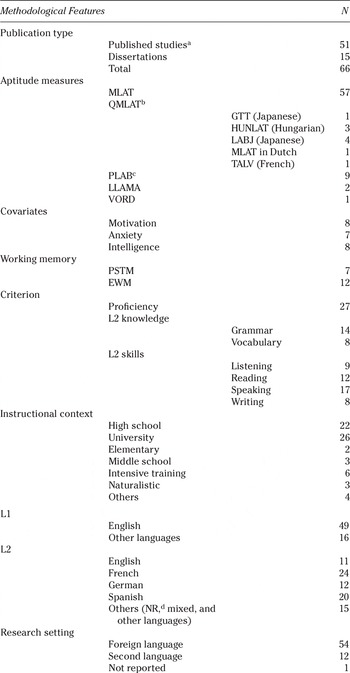
a The MLAT Manual was coded as one study although it contributed data based on multiple samples.
b Adapted MLAT and subtests.
c Adapted PLAB and subtests.
d Not reported.
Meta-Analytic Results
The Relationship between Aptitude and the Covariates
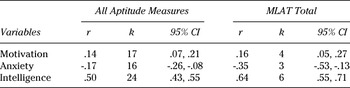
The first research question concerns the validity of the construct of language aptitude as manifested through its associations with other individual difference variables such as motivation, anxiety, and intelligence. The results are presented in Table 3, including the mean effect sizes, the number of effect sizes for each analysis (k), and the 95% confidence interval for each mean effect size. For each covariate, the analysis was conducted for all aptitude measures, including whole test batteries, subtests, and different combinations of subtests (e.g., MLAT 1 + MLAT 5 in Winke [2013]Reference WinkeWinke [2013]W []), and for the MLAT (total scores) only, to determine whether similar results and patterns were obtainable for different aptitude measures.
The correlations between aptitude and other variables

The analyses showed the following results. First, the associations between aptitude and motivation were weak: r = .14, 95% CI = .07/.21, for all aptitude measures including whole aptitude tests and subtests; r = .16, 95% CI = .05/.27, for the MLAT. Second, there was a negative correlation between aptitude and anxiety, and the MLAT showed a larger mean effect size, r = -.35, 95% CI = -.53/-.13, than mixed aptitude measures, r = -.17, 95% CI = -.26/-.08. Third, aptitude was strongly correlated with intelligence, and the result was found for both mixed aptitude measures, r = .50, 95% CI = .43/.55, and the MLAT, which showed a larger effect size, r = .64, 95% CI = .55/.71.
The Relationship between Aptitude and Working Memory
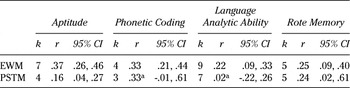
The second research question investigates the links between language aptitude and working memory. Based on the available data, analyses were conducted for aptitude as a holistic construct measured by whole test batteries and for the three components of aptitude (phonetic coding, language analytic ability, and rote memory) measured using the related subtests. The results, which are reported in Table 4, show that EWM was moderately correlated with aptitude as a whole, r = .37, 95% CI = .26/.46, and with phonetic coding ability, r = .33, 95% CI = .21/.44; it had weaker associations with language analytic ability, r = .22, 95% CI = .09/.33, and with rote memory, r = .25,95% CI = .09/.40. Overall, PSTM showed either weak (r = .16, 95% CI = .04/.27 for aptitude as a whole, and r = .24,95% CI = .02/.61 for rote memory) or nonsignificant correlations (r = .33, 95% CI = -.01/.61 for phonetic coding, and r = .02, 95% CI = -.22/.26 for language analytic ability) with language aptitude and its components.
The relationship between aptitude and working memory

a The confidence interval for the effect size crosses zero and is therefore statistically nonsignificant.
Aptitude and L2 Learning
The final research question seeks to explore the predictive validity of aptitude, that is, how L2 learners’ aptitude scores can be used to predict their learning achievement. The results are reported according to whether the studies examined the relationships between aptitude and general L2 proficiency or between aptitude and specific aspects of L2 learning, which were further categorized as L2 knowledge (grammar and vocabulary) and L2 skills (listening, speaking, reading, and writing). With respect to general L2 proficiency, effect sizes were aggregated for all measures of a construct as well as particular measures (MLAT, QMLAT, PLAB), if there were more than three effect sizes for a particular measure, for the purpose of examining whether different aptitude measures had similar or different predictive validity. However, due to the limited amount of research on the associations between aptitude/aptitude components and the learning of L2 knowledge and skills, effect size aggregation was only conducted for the constructs (aptitude and its components), not for different measures of the constructs.
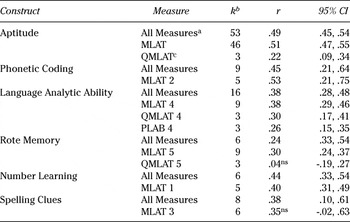
Table 5 displays the results for the relationship between aptitude/aptitude components and general L2 proficiency. As can be seen, overall aptitude as measured by whole test batteries was a strong predictor for L2 learning, r = .49, 95% CI = .45/.54, and this constitutes a robust finding given the large number of effect sizes (n = 53) involved in the analysis. Among the three aptitude components, phonetic coding ability appeared to be a stronger predictor than the other two components, and rote memory was the weakest predictor. The two subtests of the MLAT and Quasi-MLATs—Number Learning and Spelling Clues—were also significant predictors of L2 proficiency, although theoretically there is no transparent matchup between these two subtests and the three aptitude components. The results also showed that aptitude measures other than the MLAT, such as the QMLATs, showed lower predictive validities, and the disparity was more evident for overall aptitude and rote memory. Furthermore, in light of the fact that most of the studies were conducted with either high school or university foreign language learners, a post hoc analysis was performed to compare the mean effect sizes associated with the two instructional settings. The Q test showed a significant difference, Q b = 10.05, p < .001; the mean effect size for high school learners (k = 24, r = .54, 95% CI = .47/.60) was larger than that for university learners (k = 21, r = .40, 95% CI = .35/.45).
Aptitude and L2 proficiency

Note. ns: The effect size is statistically nonsignificant.
a All aptitude measures.
b Analysis was not performed for variables with less than three effect sizes.
c Quasi-MLAT: adapted MLAT in other languages.
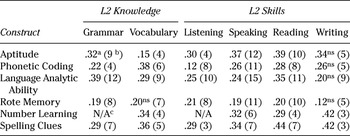
The results for the role of aptitude and different aptitude components in the learning of L2 knowledge and skills are presented in Table 6, which can be inspected in two ways. One is to examine the effect sizes horizontally, that is, to compare the effect sizes in each row to identify whether a construct or predictor variable (aptitude and aptitude components) is correlated with each outcome variable (L2 knowledge and skills) in different ways. Another way is to view the effect sizes vertically, that is, to compare the effect sizes in each column to determine whether an outcome/criterion variable is associated with each predictor in different ways. A horizontal inspection of the results shows that (1) aptitude measured through whole test batteries showed moderate associations with the criterion variables (with r values above .30) except for a rather weak association with vocabulary learning (r = .15) and a nonsignificant correlation with L2 writing; (2) phonetic coding showed a stronger correlation with vocabulary (r = .38) than with other outcome variables, and it had a weak correlation with listening comprehension (r = .12); (3) language analytic ability was a stronger predictor for grammar learning (r = .39) and reading comprehension (r = .35) than for other forms of achievement; (4) in comparison with other constructs, rote memory was not a strong (with effect sizes around or below .20) or consistent (two of the effect sizes were nonsignificant) predictor for L2 knowledge and skills; and (5) with regard to the two miscellaneous aptitude components, number learning demonstrated a higher correlation with L2 writing than with other outcome variables, and spelling clues was more strongly correlated with reading comprehension and writing.
Aptitude and the learning of L2 knowledge and skills

Note. ns: The effect size is nonsignificant, that is, the confidence interval includes zero or p > .05.
a Correlation coefficient (r).
b Number of effect sizes (k).
c N/A: analysis not performed because the number of effect sizes is below three (k < 3).
Examining the results in Table 6 vertically from the perspective of the outcome variable reveals the following patterns: (1) grammar learning was better predicted by language analytic ability than by other aptitude components; (2) for vocabulary learning, phonetic coding, number learning, and spelling clues were stronger predictors and overall aptitude was the weakest predictor; (3) the weakest predictor for listening comprehension was phonetic coding; (4) speaking showed the strongest correlation with overall aptitude among all the predictor variables, followed by the two miscellaneous components; (5) reading comprehension was more correlated with overall aptitude, language analytic ability, and spelling clues than with other components; and (6) the effect sizes for writing were statistically nonsignificant and mostly small except for those relating to number learning and spelling clues—the two miscellaneous aptitude components.
DISCUSSION
This study was undertaken to provide a comprehensive picture of the construct of language aptitude in Carroll’s conceptualization by synthesizing all empirical studies reporting data about its associations with other cognitive and affective variables and with different aspects of L2 learning; also under investigation is the associations between aptitude and a possible aptitude component—working memory. Language aptitude was found to be largely separate from motivation, negatively correlated with anxiety, and strongly associated with intelligence. EWM, which performs the dual task of information storage and processing, had stronger links with aptitude than PSTM, which is only responsible for the temporary storage of information. Regarding its predictive validity, aptitude measured by whole test batteries was a strong predictor of L2 learning, but its predictive power varied across instructional contexts and outcome variables. This section discusses how the results facilitate our understanding about the construct of aptitude.
How Does Aptitude Relate to Other Individual Difference Variables?
Motivation
The correlation between aptitude and motivation is weak and negligible (r = .14, .16, for all aptitude measures and the MLAT, respectively), which suggests that they are relatively separate constructs. The result corroborates the finding of several factor analytic studies (Clément & Kruidenier, Reference Clément and Kruidenier1985; Gardner, Tremblay, & Masgoret, Reference Gardner, Tremblay and Masgoret1997; Gordon, Reference Gordon1980; Sparks, Patton, Ganschow, & Humbach, Reference Sparks, Patton, Ganschow and Humbach2011), namely that L2 learners’ aptitude scores and their responses to motivation surveys cluster around different factors. The finding undermines the speculation that aptitude may have a positive influence on motivation, that is, learners with higher aptitude may be more motivated in learning a second language. The fact that aptitude and motivation are relatively separate constructs also suggests that the two variables may account for unique variance in L2 learning. This hypothesis seems to have been confirmed in several studies, which showed that motivation was a significant predictor of L2 learning (Garcia, Reference Garcia1996; Sparks et al., Reference Sparks, Patton, Ganschow and Humbach2009), although it was less predictive than aptitude. Masgoret and Gardner (Reference Masgoret and Gardner2003) conducted a meta-analysis of the empirical studies that used the attitude/motivation test battery and found that motivation was significantly correlated with course grades, r = .37. However, the meta-analysis did not take into account the variance explained by other variables, so the unique amount of variance attributable to motivation in these studies is unclear. Notwithstanding the need for more research on the comparative effects of the two variables, it would seem justified to claim, based on existing evidence, that motivation is distinct from aptitude, and that it explains a significant amount of variance of L2 learning. However, it remains to be seen whether ultimate L2 success is still achievable with more motivation in the event of a deficiency of aptitude.
One caveat is that in most of the studies motivation is measured by means of Gardner’s (Reference Gardner1985) Attitude/Motivation Test Battery (AMTB), which emphasizes the general orientation to language learning such as integrative and instrumental motives and attaches less importance to the motives relating to the process of learning. The field of motivation has moved forward, new theories have been proposed, and new instruments have been developed. It would be interesting to ascertain how aptitude relates to the more recently proposed L2 motivational systems such as Dörnyei’s (Reference Dörnyei2005) L2 Self system.
Anxiety
The negative correlation between aptitude and anxiety suggests that learners with high aptitude have low anxiety, and vice versa. The finding was consistent across the related studies: all three effect sizes for the MLAT total and 14 out of the 16 for hybrid aptitude measures were in the negative direction, with the only two positive effect sizes being close to zero (leaning toward the negative side). The negative correlation is consistent with what previous research has shown about their opposite relationships with L2 learning: while aptitude has been found to be facilitative, anxiety has consistently been found to be negatively correlated with achievement (Dörnyei, Reference Dörnyei2005; Horwitz, Reference Horwitz2001). A plausible explanation for the different roles of anxiety and aptitude in affecting L2 development is that the debilitating effect of anxiety occurs through cognitive interference, in that learners with high anxiety allocate more attentional resources to task-irrelevant demands associated with apprehension about negative evaluation, tension, and so forth, whereas those with low anxiety are able to appropriate more resources to task-relevant demands (Tobias, Reference Tobias1985). The functioning of language aptitude, however, requires the use of attentional resources, which are depleted by anxiety. It is also possible, as Sparks and Patton (Reference Sparks and Patton2013) argued, that anxiety is a consequence, rather than cause, of low aptitude. Sparks and associates (e.g., Sparks et al., Reference Sparks, Patton, Ganschow and Humbach2009, Reference Sparks, Patton, Ganschow and Humbach2011) found that language learning anxiety as measured by the FLCAS questionnaire (Horwitz, Reference Horwitz2001) was predictive of L2 aptitude, L1 skills, and L2 achievements. They speculated that (1) the FLCAS is a measure of learners’ perceptions of their language learning skills and an indirect measure of L2 proficiency, and (2) anxiety is a consequence of the deficiency in language aptitude rather than a determinant of L2 learning success. A compromise between these two different perspectives would lead to the hypothesis that there may exist a reciprocal relationship between aptitude and anxiety, that is, anxiety disrupts the functioning of aptitude and low aptitude causes anxiety.
One possibility, which is related to the “cognitive interference” interpretation, is that the negative correlation between aptitude and anxiety is partly due to test anxiety, that is, those who were more anxious about test taking scored lower on aptitude tests. Horwitz (Reference Horwitz2001) argued that language learning anxiety is separate from test anxiety because there was only a moderate correlation between them (r = .53, p = .001). However, the correlation coefficient referred to as moderate would be considered large by Cohen’s standards (1988). Also, at least two of the items in the FLCAS, which has been the predominant measure of foreign language anxiety in the research, are directly related to test anxiety. Therefore, whether the negative correlation between aptitude and anxiety has to do with test anxiety is yet to be clarified. Finally, noteworthy is the fact that to date most studies have only investigated the correlations between aptitude and anxiety, which prevents us from making claims about the causal relationships between the two variables.
Intelligence
The strong, positive correlations (r = .64, .50 for the MLAT and hybrid aptitude measures, respectively) between aptitude and intelligence suggest a large overlap between the two constructs. Factor analytic studies also failed to find a clear separation between the two variables. For example, Granena (Reference Granena2012, Reference Granena2013) found that L2 Spanish learners’ scores on a test of general intelligence called GAMA loaded on the same factor as their scores on three subtests (sections B, E, F) of the LLAMA aptitude battery; intelligence and the three LLAMA components were therefore collectively called “explicit aptitude.” Sparks et al. (Reference Sparks, Patton, Ganschow and Humbach2011) reported that MLAT 5 (Rote Learning) clustered with intelligence measured through the Test of Cognitive Skills. In Wesche, Edwards, and Well’s (Reference Wesche, Edwards and Wells1982) study, a factor was generated that included MLAT 3 (Spelling Clues) and the Verbal Meaning section of the PMA (Primary Mental Abilities) intelligence test. Sasaki (Reference Sasaki1996) performed a structural equation modeling analysis showing that the model with the best fit with the data was one where aptitude measured through the LABJ and intelligence measured using the Kyoto University New NX-15 underlay one second-order general cognitive factor, which in turn significantly predicted second language proficiency. These studies, together with this meta-analysis, show that aptitude and intelligence are not entirely separate, and one of the main reasons for this overlap is likely due to some similar components between intelligence and aptitude measures. For example, most intelligence tests consist of subtests of vocabulary and memory, which are also included in traditional aptitude measures.
Despite the large overlap, aptitude and intelligence do not seem to be identical constructs, as the correlations between them, albeit strong, did not approach 1.0—a perfect correlation suggesting an isomorphic relationship (Ackermen, Beier, & Boyle, Reference Ackermen, Beier and Boyle2005)—or exceed the .75 threshold that would make it questionable to consider two related variables as distinct (Zikmund, Babin, Carr, & Griffin, Reference Zikmund, Babin, Carr and Griffin2013). Another reason for aptitude to be considered as a variable independent of intelligence or abilities for general academic learning is that the former is likely a stronger predictor of L2 learning, and there has been some empirical evidence for this argument. For example, Sparks et al. (Reference Sparks, Patton, Ganschow and Humbach2009) found that intelligence was only a weak predictor for L2 word decoding, whereas aptitude was a strong predictor for all L2 skills and for general L2 proficiency. Theoretically, what distinguishes aptitude from intelligence, according to Carroll and Sapon (Reference Carroll and Sapon2002), are the “special abilities” (p. 24) for language learning: phonetic coding measured by MLAT 2 and language analytic ability by MLAT 4. However, as Carroll and Sapon agreed, given the overlap between the two constructs, it might be necessary to consider both aptitude and intelligence when making pedagogical decisions related to selection, guidance, and placement.
One issue of this stream of research is the diverse measures of intelligence that have been used, which partly reflects the uncertainty over what intelligence entails. As Wasserman (Reference Wasserman, Flanagan and Harrison2012) pointed out in his account of the historical development of the research on intelligence, after nearly a century of research, a consensus has yet to be reached on the definition of the construct. To exacerbate the problem, most of the related studies in aptitude research treated intelligence as a single construct, lumping together a cluster of cognitive abilities including verbal and nonverbal intelligence as well as fluid (reasoning) and crystallized (knowledge) intelligence, some of which may have little to do with language learning. There is therefore a need for fine-tuned, in-depth investigation of the correlations between specific aspects of intelligence and aptitude.
How Does Aptitude Relate to Working Memory?
The extent to which working memory should be included as an aptitude component can be explored by identifying the relationship between the two constructs and the contribution of working memory to L2 achievement. As for the relationship between aptitude and working memory, this meta-analysis showed significant, consistent correlations between aptitude and EWM, but weak and/or nonsignificant correlations between aptitude and phonological working memory. In terms of the predictive power of the two types of working memory, in a meta-analysis by Linck, Osthus, Koeth, and Bunting (Reference Linck, Osthus, Koeth and Bunting2014), complex tasks that were used to measure EWM were found to be better predictors of L2 proficiency than simple tasks that were used to measure PSTM. The stronger correlations between EWM and traditional aptitude and its stronger associations with L2 achievement seem to suggest that it is a more promising aptitude component than PSTM.
However, it seems premature and simplistic to jump to conclusions about which of the two types of short-term memory is more predictive of L2 achievement. In Linck et al.’s meta-analysis (2014), proficiency is a hybrid criterion variable consisting of both composite measures of general proficiency and discrete measures of specific aspects of learning such as L2 knowledge and L2 skills. It is possible that the two types of short-term memory may have differential predictive validity for different aspects of L2 learning. For example, PSTM has been postulated and found to be an especially useful device for vocabulary learning (Baddeley, Gathercole, & Papagno, Reference Baddeley, Gathercole and Papagno1998), and EWM is more useful in reading and listening comprehension where the ability to simultaneously store and process incoming stimuli is essential (Daneman & Merikle, Reference Daneman and Merikle1996). There is also evidence that PSTM may be critical to the acquisition of implicit knowledge while EWM is more likely to be called upon in the learning of explicit knowledge (Révész, Reference Révész2012).Therefore, there seems to be a need for more fine-grained empirical and/or meta-analytic research that affords a detailed picture of the links between different memory types and specific aspects of L2 learning as well as general proficiency. Footnote 5
How Predictive Is Aptitude?
Aptitude and General L2 Proficiency
There was a strong association (r = .49) between aptitude as a whole construct measured through full-length tests and general L2 proficiency operationalized as learners’ course/exam grades or scores on standardized tests such as TOEFL. A correlation of .49 means approximately 25% of the variance of L2 learning is accounted for by language aptitude. The correlation is considered strong based on Cohen’s (Reference Cohen1988) benchmarks (close to strong by Plonsky and Oswald’s [Reference Plonsky and Oswald2014] standards) and in comparison with the predictive power of other individual difference variables in SLA and other fields. For example, L2 achievement was found to be correlated with motivation at .37 (Masgoret & Gardner, Reference Masgoret and Gardner2003) and with working memory at .25 (Linck et al., Reference Linck, Osthus, Koeth and Bunting2014); the correlation between intelligence and academic performance was approximately .5 (Neisser et al., Reference Neisser, Boodoo, Bouchard, Boykin, Brody, Ceci and Urbina1996). However, the strong predictive validity of aptitude should be interpreted in relation to the instructional contexts of the related studies. Among the 53 samples that contributed data for the correlations between overall aptitude and general L2 proficiency, 34 are from the MLAT Manual where the reported data were based on audiolingual classes popular in the 1950s, and 39 are based on studies conducted before the 1990s when communicative/task-based instruction was not widely implemented; 50 are from foreign language classes in North America (48 in the United States) and only three from contexts outside of North America (Gordon, Reference Gordon1980; Keigtes, Reference Keitges1986; Sáfár & Kormos, Reference Sáfár and Kormos2008). Furthermore, all data are from foreign language settings where the target language is not the primary language outside of class and none from second language settings where the target language is the primary language of the community. It remains to be seen whether the same results can be obtained in other contexts and with learners receiving more communicative instruction. Unfortunately, due to a lack of research conducted in different instructional settings, it was impossible to perform a moderator analysis that investigates how aptitude relates to achievement in contexts other than audiolingual classes that fit the mechanism of traditional aptitude.
The results also showed that aptitude was more strongly correlated with high school learners’ general L2 proficiency than university learners’ general L2 proficiency. This may indicate that traditional aptitude is more sensitive to initial stages than later stages of L2 learning as learners usually have had some foreign language instruction when they start to study at a university. However, it is also possible that the correlations for university learners were attenuated by their more homogeneous aptitude scores. An analysis of the learners’ MLAT scores reported in the primary studies indicated that this was indeed the case: university foreign language learners’ aptitude scores showed lower within-group variance, Q w = 98.56, compared with high school learners’ scores, Q w = 145.78. The homogeneity of university learners’ aptitude scores is perhaps related to the fact that they were likely a more select group than high school learners. It must be pointed out that although aptitude had a weaker association with university learners’ L2 proficiency, the effect size was significant and moderate in magnitude (r = .40). Therefore, more primary research is needed to test the hypothesis that aptitude is implicated differently at different stages of learning.
As to the predictive power of individual aptitude components, several findings are noteworthy. First, phonetic coding as measured by MLAT 2 Phonetic Script and its equivalents seems to show strong associations with general L2 proficiency and with vocabulary learning. Phonetic coding, the ability to identify sounds and to form and retain sound-symbol associations (Carroll, Reference Carroll and Diller1981), therefore, appears to be important in beginning foreign language classes from which most of the data of this study are derived. This hypothesis receives some indirect support from Natelson’s (Reference Natelson1975) large-scale study (N = 819) on the interaction between aptitude and learner experience, where MLAT 2 Phonetic Script was found to be the strongest predictor for the speaking scores of learners with little language learning experience; for learners with substantial experience, MLAT 1 Number Learning was the strongest predictor. Second, language analytic ability, for which there were 16 effect sizes, was the most studied, probably because of the assumption that the ability to “recognize the grammatical functions of words” (Carroll, Reference Carroll and Diller1981, p. 105) and to induce grammar rules is of special importance in learning a foreign language. However, in comparison with other subtests of the MLAT, MLAT 4 Words in Sentences, which is the predominant measure of language analytic ability, did not show substantially superior predictive validity for general L2 proficiency. Third, among the three aptitude components, rote memory was least predictive of L2 proficiency. However, we cannot lose sight of the fact that although less predictive than other components, rote memory was a significant predictor with an effect size of moderate magnitude. As reported earlier, even in Linck et al.’s (Reference Linck2013) validation study for the Hi-LAB, an aptitude battery developed for advanced L2 proficiency, rote memory was found to be a significant predictor. Fourth, the two remaining subtests of the MLAT, MLAT 1 Number Learning, and MLAT 3 Spelling Clues, which do not correspond with any of the three aptitude components and were therefore coded by retaining the names of the subtests, also proved to be significant predictors of L2 proficiency. Although Carroll (Reference Carroll and Diller1981) was not sure what the two subtests measured, he speculated that they each tapped into several abilities: MLAT 1 may measure sound alertness, memory, and inductive learning ability, and MLAT 3 gauges phonetic coding and L1 vocabulary knowledge. The versatility of these subtests probably contributed to their predictive power, although this constitutes a weakness of traditional aptitude tests because of their emphasis on predictive validity at the cost of meaningful interpretations for the related findings.
Aptitude and Specific Aspects of L2 Learning
In terms of the associations between aptitude and the learning of L2 knowledge, the following findings stood out. First, language analytic ability was the strongest predictor of grammar learning, which confirms the hypothesized link between this aptitude component and the learning of the morphosyntactic aspects of a second language. However, it is not clear whether language analytic ability has differential associations with the learning of explicit and implicit grammatical knowledge. Although none of the primary studies made a distinction between the two knowledge types, it appeared that the item-based written grammar tests in most of the studies encouraged or allowed the use of conscious knowledge, which traditional aptitude measures were sensitive to (Granena & Long, Reference Granena and Long2013). Second, aptitude as a whole showed the weakest correlation with learners’ vocabulary scores (r = .15) among all criterion variables. The result invites the speculation that compared with other aspects of L2 learning, aptitude is likely not critical for vocabulary learning. The speculation remains to be confirmed in further research because of the following two caveats: (1) among the four effect sizes, two are based on QMLATs, which had consistently lower validity than the MLAT, and (2) despite the weak predictive validities of overall aptitude and rote memory for vocabulary learning, phonetic coding, language analytic ability, and the two miscellaneous subtests of the MLAT all showed moderate correlations with vocabulary learning. Furthermore, it is also possible that vocabulary learning requires abilities other than those measured in traditional aptitude tests, such as PSTM, which has been found to be a consistent predictor of vocabulary learning (e.g., Engel de Abreu & Gathercole, Reference Engel de Abreu and Gathercole2012; Hummel, Reference Hummel2009; Speciale, Ellis, & Bywater, Reference Speciale, Ellis and Bywater2004).
Equally challenging is to interpret the results for the role of aptitude in learning the four L2 skills. To begin with, among the three aptitude components, phonetic coding was the weakest predictor for listening comprehension. This is somewhat unexpected given the importance of the ability to recognize sounds and establish sound-symbol associations in processing auditory stimuli. One possible explanation is that in listening comprehension, learners tend to prioritize meaning over form, and therefore the ability for top-down processing that involves the use of schematic knowledge and contextual clues is perhaps more important than phonetic coding, which plays a central role in bottom-up processing that relies more on the ability to decode sounds or segments of sounds. As pointed out by Juffs and Harrington (Reference Juffs and Harrington2012), compared with native speakers, nonnative speakers are more likely to resort to top-down processing to compensate for their linguistic deficiency.
Moving on to speaking, the finding that overall aptitude was a stronger predictor has two implications: (1) although aptitude tests do not include measures of production skills, they are predictive of oral production; and (2) language aptitude is likely also important in the acquisition of implicit knowledge that is capitalized on in learners’ performance of oral tasks (Ellis, Reference Ellis2005; Erlam, Reference Erlam2006), although this claim needs to be further investigated in carefully designed studies where implicit and explicit knowledge are properly conceputalized/measured. Another interesting finding is that phonetic coding ability did not show superior predictive power for speaking, which is somewhat surprising given its hypothesized link with the ability for mimicry (Carroll & Sapon, Reference Carroll and Sapon2002), which is in turn a predictor of foreign accent (Piske, MacKay, & Flege, Reference Piske, MacKay and Flege2001). The finding may be interpreted as proof for the dissociation between phonetic coding and mimicry because the former involves sound comprehension while the latter relates to sound production. It is also possible that the ability for mimicry is not important for oral performance, which is often evaluated holistically instead of merely on the basis of accurate articulation of sounds.
Next, overall aptitude, language analytic ability, and spelling clues appeared to be better predictors of reading comprehension than phonetic coding, rote memory, and number learning. What is common about the less predictive variables is that the cognitive skills they measure (auditory alertness, phonetic sensitivity, and rote memory) do not implicate the functions of the central executive that are responsible for semantic processing during reading comprehension; in contrast, these functions have stronger presence in overall aptitude and language analytic ability. The predictive power of spelling clues might be attributable to its importance in vocabulary learning, which in turn facilitates reading comprehension.
One conspicuous finding is that aptitude and its three components were nonsignificant and weak predictors for L2 writing, indicating that writing may require a different set of skills from those measured in traditional aptitude tests. The importance of content and organization in evaluating learners’ written performance may account for the low predictive validity of traditional aptitude tests for this aspect of L2 learning. However, because most studies did not report how L2 writing was evaluated, this explanation is speculative. Also, in light of the important role played by aptitude in learning the linguistic aspects of L2 competence, which are also important in the evaluation of written performance, the claim that language aptitude is dissociated from L2 writing competence cannot be theoretically justified. This, along with the fact that the number learning and spelling clues subtests were significant predictors of L2 writing, is justification for more research into the unique and comparative effects of traditional aptitude and skill-specific abilities on L2 written performance.
Finally, two common patterns that emerged across all outcome variables need to be discussed. One is that rote memory was almost invariably the weakest predictor among all aptitude components/subtests. This contributes to the rationale for considering working memory an alternative for rote memory as an aptitude component. However, there needs to be more theoretical elaboration of the relationship between working memory and traditional aptitude components and more empirical research into the predictive power of working memory in comparison with rote memory and other aptitude components. If both working memory (EWM and/or PSTM) and rote memory explain a unique portion of the variance of SLA or they contribute to the learning of different aspects of SLA, it is advisable to include both as aptitude components. The other noteworthy pattern is the heterogeneity of aptitude measures (MLAT, QMLATs, PLAB, LLAMA, VORD, etc.) used in the primary research to examine how aptitude relates to the learning of L2 knowledge and L2 skills. Compared with the findings for general L2 proficiency, which are predominantly based on the MLAT, those for the specific aspects of L2 learning are likely less robust. Notwithstanding, a summative, synthetic review of all related empirical research on the same topic affords a more objective, holistic picture of the population effect of the construct under investigation.
CONCLUSION
Using meta-analytic techniques, this study has investigated the theoretical claims about traditional language aptitude by synthesizing the empirical findings of the research that has been conducted over the past five decades since the publication of the most influential aptitude test, the MLAT (Carroll & Sapon, Reference Carroll and Sapon1959). This study is apposite given that interest in cognitive aptitudes in SLA research is growing and there is a need to reexamine the construct and reorient the research. The study obtained the following findings. First, aptitude was found to be a relatively distinct construct: it is different from motivation that would appear to make a unique contribution to achievement (Bialystok & Fröhlich, Reference Bialystok and Fröhlich1978; Garcia, Reference Garcia1996; Keitges, Reference Keitges1986); it has a negative correlation with anxiety, which may be attributable to the cognitive interference of anxiety and the possibility that low aptitude causes high anxiety (MacIntyre, Reference MacIntyre1995); and it has a large overlap and yet is not isomorphic with intelligence, which has proven less predictive for language learning (Granena, Reference Granena2012; Sparks et al., Reference Sparks, Patton, Ganschow and Humbach2009). Second, EWM that taps both the storage and processing functions of short-term memory seems to be a more viable component of aptitude than PSTM because the former is more beneficial for L2 attainment (Linck et al., Reference Linck, Osthus, Koeth and Bunting2014) and bears stronger associations with aptitude and its components. However, this statement is subject to whether PSTM has superior predictive validity for certain aspects of L2 learning such as the learning of implicit knowledge, which has not received sufficient attention in the research. Third, aptitude as a whole is strongly predictive of L2 proficiency and is more predictive of high school students’ L2 achievements than university students’ L2 achievements. Overall aptitude is also a consistent predictor for the learning of L2 knowledge and L2 skills, except for vocabulary learning and L2 writing. Fourth, as regards the predictiveness of different aptitude components, language analytic ability is a good predictor for grammar learning; phonetic coding is unimportant for listening comprehension and speaking; and rote memory is consistently less predictive than other aptitude components.
This research synthesis also indicates that there are issues to be addressed in future empirical research. First, as mentioned earlier, the majority of the primary studies are conducted in the United States with beginning foreign language learners who received form-oriented instruction, and there is a lack of research on the relevance of aptitude for advanced learners and for the learning that happens in more communicative classes. Second, traditional aptitudes are relevant in instructed L2 learning which favors explicit learning, and there is a need to develop measures or include components that are sensitive to implicit learning that tends to occur in nontutored settings (Granena, Reference Granena2015). Third, existing aptitude measures demonstrated differential predictive validities, and it is necessary to cross-validate the tests to determine to what extent they tap the same construct. Fourth, previous research prioritized the predictive validity of aptitude, and there is a relative lack of more fine-grained, theory-guided research on how aptitude and clusters of cognitive abilities are implicated at different stages of SLA (Skehan, Reference Skehan, Gass and Mackey2012) and under different learning conditions (Robinson, Reference Robinson2005). Fifth, although there appears to be a large amount of research on aptitude as a research domain, there is insufficient research on the relationships between aptitude and specific aspects of learning. The scattering of studies among subareas of a research domain may partly be driven by the desire to be different from previous research or to be original, but from the perspective of research synthesis, the value of replication research cannot be exaggerated in order for robust conclusions to be reached about a certain construct. To the extent that there has been insufficient research and that there is theoretical and empirical basis for the differential predictive power of aptitude and aptitude components for different aspects of L2 learning, the researcher makes a call for more research in this regard. Sixth, similar to aptitude—the predictor variable, the criterion variables, and covariates are also measured or operationalized in different ways in the primary research. For example, the measures used to assess general L2 proficiency include course grades, exam scores, multiple-choice tests, and standardized tests (such as TOEFL, the Michigan Test, etc.). The extent to which the results on these measures are comparable is unknown. It is also uncertain whether some of the measures are accurate reflections of learners’ language proficiency. Course grades, for example, may include students’ attendance and in-class participation, and the percentage they account for in the final grade varies considerably across classes and schools.
Finally, it must be pointed out that aptitude is purported to predict learning rate, which refers to the amount of learning one achieves within a certain period of time in comparison with peers under the same learning condition while holding previous knowledge constant (i.e., gains from time A to time B). However, in most predictive studies, the criterion variable is learners’ attainment measured at fixed time points without considering previous knowledge and the duration of study (i.e., gains observed at time B). There are several ways to address this issue. In Carroll’s validation research (Carroll & Sapon, Reference Carroll and Sapon2002), learners with previous L2 knowledge/experience were excluded, so mid-term or final exam grades were an indicator of learning rate. However, given that it is not always possible to recruit learners who have not received any language instruction or have no prior exposure to a foreign language, a more realistic approach is to account for the effect of previous knowledge by using gain scores as the dependent variable, or by including pretest scores as a predictor or covariate to determine the amount of variance explained by aptitude over and above that explained by learners’ prior knowledge.
SUPPLEMENTARY MATERIAL
To view supplementary material for this article, please visit http://dx.doi.org/S027226311500042X.