Introduction
Cannabis use has been implicated as a risk factor for psychotic symptoms, ranging from subclinical psychotic-like experiences (PLEs) to clinically defined schizophrenia (Andreasson et al. Reference Andreasson, Allebeck, Engstrom and Rydberg1987; Arseneault et al. Reference Arseneault, Cannon, Poulton, Murray, Caspi and Moffitt2002; van Os et al. Reference van Os, Bak, Hanssen, Bijl, de Graaf and Verdoux2002; Fergusson et al. Reference Fergusson, Horwood and Swain-Campbell2003; Henquet et al. Reference Henquet, Murray, Linszen and van Os2005; Moore et al. Reference Moore, Zammit, Lingford-Hughes, Barnes, Jones, Burke and Lewis2007; Schubart et al. Reference Schubart, van Gastel, Breetvelt, Beetz, Ophoff, Sommer, Kahn and Boks2011; van Gastel et al. Reference van Gastel, Wigman, Monshouwer, Kahn, van Os, Boks and Vollebergh2012b). There is evidence of a dose–response effect: heavy and long-term cannabis use and an initiation of use before the age of 16 years are associated with an elevated rate of PLEs (Arseneault et al. Reference Arseneault, Cannon, Poulton, Murray, Caspi and Moffitt2002; Monshouwer et al. Reference Monshouwer, van Dorsselaer, Verdurmen, Bogt, de Graaf and Vollebergh2006; Schubart et al. Reference Schubart, van Gastel, Breetvelt, Beetz, Ophoff, Sommer, Kahn and Boks2011; van Gastel et al. Reference van Gastel, Tempelaar, Bun, Schubart, Kahn, Plevier and Boks2012a). Moreover, the onset of psychosis is earlier in cannabis-using patients (Large et al. Reference Large, Sharma, Compton, Slade and Nielssen2011) and cannabis use may exacerbate symptoms in patients with established psychosis (Mullin et al. Reference Mullin, Gupta, Compton, Nielssen, Harris and Large2012).
Although the association between cannabis use and psychotic symptoms is firmly established, the nature of the relationship remains subject to debate (Murray et al. Reference Murray, Morrison, Henquet and Di Forti2007). Several underlying mechanisms have been proposed, such as the persistence of normally transient cannabis-induced psychotic symptoms (Cougnard et al. Reference Cougnard, Marcelis, Myin-Germeys, de Graaf, Vollebergh, Krabbendam, Lieb, Wittchen, Henquet, Spauwen and van Os2007), an adverse impact on the developing endo-cannabinoid and/or dopaminergic system (Caspi et al. Reference Caspi, Moffitt, Cannon, McClay, Murray, Harrington, Taylor, Arseneault, Williams, Braithwaite, Poulton and Craig2005; Henquet et al. Reference Henquet, Rosa, Krabbendam, Papiol, Fananas, Drukker, Ramaekers and van Os2006; Bossong & Niesink, Reference Bossong and Niesink2010; Costas et al. Reference Costas, Sanjuan, Ramos-Rios, Paz, Agra, Tolosa, Paramo, Brenlla and Arrojo2011) and reverse causality, whereby individuals with PLEs are more likely to start using cannabis in an attempt to ‘self-medicate’ their distress (Henquet et al. Reference Henquet, Murray, Linszen and van Os2005; Macleod et al. Reference Macleod, Davey, Hickman and Egger2007). A further possibility is that the association between cannabis consumption and psychotic symptoms could arise through confounding (Macleod & Hickman, Reference Macleod and Hickman2006; Macleod et al. Reference Macleod, Davey, Hickman and Egger2007; van Gastel et al. Reference van Gastel, Tempelaar, Bun, Schubart, Kahn, Plevier and Boks2012a). A substantial overlap exists between risk factors for cannabis use and mental health problems in young adolescents (van Gastel et al. Reference van Gastel, Tempelaar, Bun, Schubart, Kahn, Plevier and Boks2012a), and in many studies the association between cannabis use and mental health problems is diminished following adjustment for confounders (e.g. Macleod et al. Reference Macleod, Oakes, Copello, Crome, Egger, Hickman, Oppenkowski, Stokes-Lampard and Davey2004; Monshouwer et al. Reference Monshouwer, van Dorsselaer, Verdurmen, Bogt, de Graaf and Vollebergh2006; van Gastel et al. Reference van Gastel, Wigman, Monshouwer, Kahn, van Os, Boks and Vollebergh2012b).
Tobacco smoking may be such a confounder. Nicotine dependency is associated with psychotic symptoms: two longitudinal studies found a dose–response relationship between cigarette smoking in adolescence and later psychotic symptoms in the general population (Weiser et al. Reference Weiser, Reichenberg, Grotto, Yasvitzky, Rabinowitz, Lubin, Nahon, Knobler and Davidson2004; Sørensen et al. Reference Sørensen, Mortensen, Reinisch and Mednick2011). Furthermore, two cross-sectional studies found an association between cigarette smoking and psychotic symptoms (Degenhardt & Hall, Reference Degenhardt and Hall2001; Wiles et al. Reference Wiles, Zammit, Bebbington, Singleton, Meltzer and Lewis2006) and the majority (70–85%) of patients with schizophrenia smoke cigarettes (Lasser et al. Reference Lasser, Boyd, Woolhandler, Himmelstein, McCormick and Bor2000; Ziedonis et al. Reference Ziedonis, Hitsman, Beckham, Zvolensky, Adler, udrain-McGovern, Breslau, Brown, George, Williams, Calhoun and Riley2008). Additionally, cannabis use and cigarette smoking are strongly correlated (Agrawal et al. Reference Agrawal, Budney and Lynskey2012) and, in most European countries, cannabis is usually consumed in combination with tobacco. Thus, the question arises as to what extent the relationship between cannabis use and PLEs is influenced by cigarette smoking. In a large cross-sectional sample we addressed this issue by comparing two elaborately adjusted models of the association between cannabis use and frequency of PLEs and associated distress, both with and without adjustment for cigarette smoking.
Method
Participants
The data were collected in The Netherlands over the period from August 2006 to April 2011 using a research website designed for this purpose (Vreeker et al. Reference Vreeker, Schubart, van Gastel, Kahn and Boks2013). Participants were recruited through advertisements on websites, chat clients, college intranet sites, during college introduction periods and in ‘coffee shops’ (licensed retailers of cannabis products). On the website it was explained that the aim of the study was to investigate the potential effect of cannabis use on strange experiences. As an incentive, participants had a chance of winning a prize, ranging from a Hawaiian garland and credit for online shopping to a parachute jump or a laptop computer. Web-based questionnaires covered sociodemographic characteristics, lifestyle, social environment and psychosocial functioning. To detect random answering and automated answers by internet robots, verification items were included. All participants gave informed consent online and the study was approved by the ethics committee of the University Medical Center Utrecht.
Measurements
PLEs
The Community Assessment of Psychic Experiences (CAPE) was used to assess lifetime PLEs (Stefanis et al. Reference Stefanis, Hanssen, Smirnis, Avramopoulos, Evdokimidis, Stefanis, Verdoux and van Os2002; Konings et al. Reference Konings, Bak, Hanssen, van Os and Krabbendam2006). The CAPE has discriminative validity in community samples (Stefanis et al. Reference Stefanis, Hanssen, Smirnis, Avramopoulos, Evdokimidis, Stefanis, Verdoux and van Os2002; Konings et al. Reference Konings, Bak, Hanssen, van Os and Krabbendam2006). Each item measures the frequency and associated distress of psychotic experiences, each rated on a four-point scale ranging from ‘never’/‘not distressed’ (1) to ‘nearly always’/‘very distressed’ (4). If the frequency was ‘never’, distress was not inquired about and was automatically set to zero. The scores were rescaled by subtracting the minimum score [as suggested for the Positive and Negative Syndrome Scale (PANSS) instrument by Obermeier et al. (Reference Obermeier, Mayr, Schennach-Wolff, Seemuller, Moller and Riedel2010)], such that a person reporting no psychotic symptoms scored zero. Scores on the Frequency and Distress scales were used as outcome measures and a post-hoc analysis was performed on the Positive, Negative and Depressive subscales. The subscales comprise the frequency of experiences in these symptoms dimensions (but not associated distress).
Cannabis use
Individuals who reported that they had ever used cannabis on a monthly basis were classified as cannabis users; ever use of cannabis at least weekly was coded as heavy use. Subjects were also asked at what age they started using cannabis.
Cigarette smoking
Cigarette smoking was defined as daily smoking for at least 1 month during the past year.
Other covariates
Heavy alcohol use was defined as > 21 drinks/week for men and > 14 for women, according to the Dutch directive for alcohol consumption (de Beer & van de Glind, Reference de Beer and van de Glind2009). Lifetime use of any other illicit substances was recorded. Nationality was based on the country of birth of the grandparents; subjects with two or more grandparents born outside The Netherlands were defined as non-native. Education was coded according to the three educational tracks in Dutch secondary schools and higher education: vocational, polytechnic and scientific. Treatment of one or both parents for a mental disorder, including addiction, psychotic and affective symptoms, was also included. Participants were asked whether a parent was ever treated for a mental disorder, either with medication, hospitalization or another form of professional care.
Data analysis
All analyses were carried out with SPSS version 20.0 (SPSS Inc., USA). Listwise exclusion was applied for missing values. Linear regressions were carried out, with the CAPE Frequency and Distress scores as outcome measures after verification of statistical assumptions using scatterplots of the residuals. The association between cannabis use and CAPE Frequency and Distress was assessed, first in a crude model and second in a model adjusting for confounders age and gender, plus other potential confounders that were associated with cannabis use and the outcome measures at p < 0.05. Third, cigarette smoking was added to both crude and fully adjusted models. The interaction between cannabis use and smoking was also investigated. Lastly, post-hoc analyses were performed with the Positive, Negative and Depressive subscales as outcome measures, and the effect of frequency of cannabis use was explored.
Results
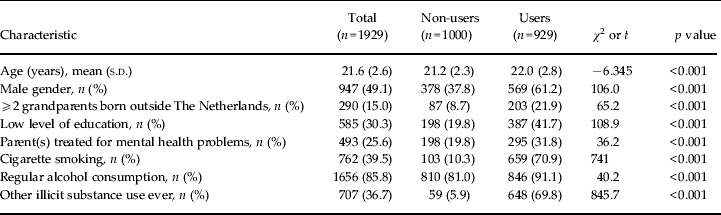
There were 27 missing values for ethnicity, 22 for mental disorder of parents and eight for educational track. Listwise exclusion of these resulted in a sample of 1929 adolescents aged 18–30 years, 947 (49.1%) male. Table 1 lists sample characteristics, stratified by monthly cannabis use: non-users had used cannabis never or infrequently, users had consumed cannabis at least monthly at some point in their lives. Groups differed significantly on all characteristics. About one-third of the total sample (36.5%) had never used cannabis, another 9.3% less than yearly. Among cannabis users, 50.3% started using between the ages of 15 and 17 years; 30.3% of them started using before the age of 15. The proportion of daily cigarette smokers was 39% overall, and was 70.9% among cannabis users.
Sample characteristics of the total study sample (n = 1929), stratified by cannabis use

Association between cannabis use and PLEs
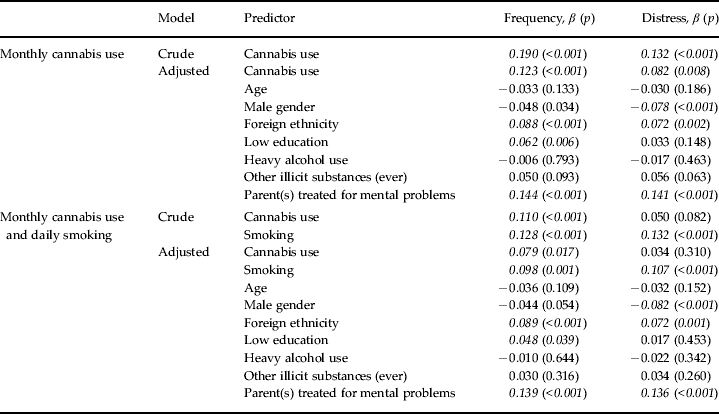
The regression coefficients (β) and p values for the association between cannabis use and psychotic experiences, as measured by the CAPE Frequency and Distress scores, are shown in Table 2. The results show that cannabis use was related to the CAPE Frequency and Distress scores, even when an elaborate set of confounders was taken into account (β = 0.123, p < 0.001 and β = 0.082, p < 0.05 respectively).
Standardized regression coefficients (β) and p values for the association between monthly cannabis use, daily smoking and Community Assessment of Psychic Experiences (CAPE) scores for crude and adjusted models. For the adjusted models, associations between all factors and CAPE scores are also displayed. βs with a p value below 0.05 are shown in italics
Association between cannabis use, smoking and PLEs
The association between cannabis use, smoking and frequency of PLEs, as measured by the CAPE, is shown in Table 2. Both cannabis use and smoking were associated with frequency of PLEs, in a crude (β = 0.110 and β = 0.128 respectively, p < 0.001) and also in a fully adjusted model (β = 0.079, p < 0.05 and β = 0.098, p < 0.01 respectively). No significant interaction effects were found for cannabis and smoking, although we had limited power to find such an effect.
Association between cannabis use, smoking and distress from PLEs
The association between cannabis use, smoking and distress from PLEs, as measured by the CAPE, is also shown in Table 2. Cigarette smoking was significantly associated with distress from PLEs, in both a crude (β = 0.132, p < 0.001) and a fully adjusted model (β = 0.107, p < 0.001). Cannabis use was not significantly associated with distress from PLEs when cigarette smoking was included as a covariate, either in a crude or in a fully adjusted model. Again, no significant interaction effects were found for cannabis and smoking, although we had limited power to find such an effect.
Association between cannabis use, smoking and CAPE Positive, Negative and Depressive subscales
Cannabis use and smoking were significantly associated with the score on the CAPE Positive subscale, in a crude (β = 0.135, p < 0.001 and β = 0.107, p < 0.001 respectively) and in an adjusted model (β = 0.117, p < 0.001 and β = 0.082, p < 0.01 respectively). For the score on the CAPE Negative subscale, the association with cannabis use was only significant in a crude model alongside smoking (β = 0.102, p < 0.001), whereas smoking remained significantly associated in the fully adjusted model (β = 0.096, p < 0.01 crude and β = 0.080, p < 0.01 adjusted). Cannabis use was only associated with the score on the CAPE Depressive subscale in a crude model without smoking (β = 0.088, p < 0.001); smoking remained significantly associated in the adjusted model (β = 0.129, p < 0.001 crude and β = 0.086, p < 0.01 adjusted).
Frequency of cannabis use
For heavy cannabis use, the association with frequency of PLEs was the same as for monthly cannabis use: heavy cannabis use was associated with frequency of PLEs in a crude model without cigarette smoking (β = 0.198, p < 0.001), alongside cigarette smoking (β = 0.124, p < 0.001) and in a fully adjusted model (β = 0.100, p < 0.01). Smoking was associated with frequency of PLEs in a crude model with only heavy cannabis use (β = 0.122, p < 0.001), and also in a fully adjusted model (β = 0.093, p < 0.01).
For distress, however, heavy cannabis use was only significantly associated with the outcome in a crude model (β = 0.144, p < 0.001) without smoking, but not in the models adjusting for (1) cigarette smoking and (2) other confounders (at p < 0.025). Smoking remained associated with distress from PLEs alongside heavy cannabis use (β = 0.125, p < 0.001 crude and β = 0.100, p < 0.01 adjusted).
Discussion
In a large sample of young adults aged 18 to 30 years, we found that cigarette smoking was as strongly associated as cannabis use with frequency of PLEs, and even more strongly with distress from PLEs. When cigarette and cannabis smoking were included in the same model, cigarette but not cannabis smoking was associated with distress from psychotic symptoms. This suggests that the relationship between cannabis use and distress from PLEs is confounded by cigarette smoking. Weekly cannabis use, however, was associated with distress from PLEs alongside cigarette smoking in a crude model, suggesting that, at higher frequencies of cannabis use, the confounding by cigarette smoking is less pronounced.
Cigarette smoking and PLEs
The associations we found for cigarette smoking echo previous studies. Degenhardt & Hall (Reference Degenhardt and Hall2001) found that both cannabis use and cigarette smoking are associated with a range of mental health problems, including psychosis. Saha et al. (Reference Saha, Scott, Varghese, Degenhardt, Slade and McGrath2011) showed that individuals who smoke cigarettes were more likely to endorse delusional-like experiences, as were those who had been diagnosed with cannabis dependence or those who had started cannabis use before the age of 16 years. In parallel with our findings, they also showed that the association between daily smoking and delusional-like experiences persisted after adjustment for other risk factors whereas the association with cannabis use dependence did not.
The implications of our findings with respect to clinical psychosis remain unknown. Distress has been found to be an important predictive factor of transition from subclinical psychotic experiences to clinical psychosis (Krabbendam et al. Reference Krabbendam, Myin-Germeys, Bak and van Os2005; Fusar-Poli et al. Reference Fusar-Poli, Borgwardt, Bechdolf, Addington, Riecher-Rossler, Schultze-Lutter, Keshavan, Wood, Ruhrmann, Seidman, Valmaggia, Cannon, Velthorst, de Haan, Cornblatt, Bonoldi, Birchwood, McGlashan, Carpenter, McGorry, Klosterkotter, McGuire and Yung2012). In the absence of further data we can only speculate whether the association of distress from PLEs with smoking signifies a causal relationship or whether this risk factor merely identifies those who are at risk.
The association between cigarette smoking and PLEs can be explained in several ways. First, cigarette smoking could increase the risk for PLEs through a biological mechanism. In support of this, Brody et al. (Reference Brody, Olmstead, London, Farahi, Meyer, Grossman, Lee, Huang, Hahn and Mandelkern2004) showed that smoking causes acute dopamine release in the ventral striatum and nicotinergic cholinergic neurotransmission was reported to be related to schizophrenia (Dean et al. Reference Dean, Bymaster and Scarr2003; Ripoll et al. Reference Ripoll, Bronnec and Bourin2004).
A second possibility is that nicotine is taken in an attempt to alleviate psychotic-like symptoms. There is some evidence that nicotine may alleviate symptoms associated with psychotic disorders (Punnoose & Belgamwar, Reference Punnoose and Belgamwar2006) as it improves negative symptoms in psychotic patients and cognitive functioning in both healthy subjects and psychotic patients (Dalack et al. Reference Dalack, Healy and Meador-Woodruff1998; Lyon, Reference Lyon1999; Barr et al. Reference Barr, Culhane, Jubelt, Mufti, Dyer, Weiss, Deckersbach, Kelly, Freudenreich, Goff and Evins2008; Jubelt et al. Reference Jubelt, Barr, Goff, Logvinenko, Weiss and Evins2008; Wignall & de Wit, Reference Wignall and de Wit2011). However, research in patients with schizophrenia has shown an association between nicotine dependence and worse psychotic symptoms (Kelly & McCreadie, Reference Kelly and McCreadie1999; Krishnadas et al. Reference Krishnadas, Jauhar, Telfer, Shivashankar and McCreadie2012). A third (slightly more remote) possibility is that PLEs result from nicotine withdrawal effects, as this has been observed in cases of psychotic patients (Dalack & Meador-Woodruff, Reference Dalack and Meador-Woodruff1996).
A fourth possibility is that the association between cigarette smoking and PLEs could be due to confounding by one or more other factors. In other words, individuals who are prone to PLEs are also prone to smoke cigarettes. Psychosocial stress increases the risk of PLEs and stress reduction is a frequent reason to smoke (Mobascher & Winterer, Reference Mobascher and Winterer2008; Compton et al. Reference Compton, Kelley, Ramsay, Pringle, Goulding, Esterberg, Stewart and Walker2009). This explanation is supported by our finding of a significant association between cigarette smoking and distress associated with PLEs.
Cannabis use and PLEs
Cannabis use has received much attention as a potential cause of PLEs and psychotic disorders (Macleod et al. Reference Macleod, Oakes, Copello, Crome, Egger, Hickman, Oppenkowski, Stokes-Lampard and Davey2004; Moore et al. Reference Moore, Zammit, Lingford-Hughes, Barnes, Jones, Burke and Lewis2007). Regarding the association between moderate cannabis use and frequency of PLEs, our findings are equivocal. Cannabis use was associated with frequency scores, also in a fully adjusted model. This shows that cannabis use is independently associated with frequency of PLEs and a causal relationship is a possibility. However, our finding that monthly cannabis use and cigarette smoking were equally strongly associated with frequency scores argues against a specific causative effect of moderate cannabis use on PLEs. Although it remains possible that nicotine and cannabis are causally related to PLEs, the non-specificity of the associations does suggest that reverse causation or confounding is at play.
Furthermore, regarding distress from PLEs, our findings are not supportive of the view of cannabis use as a cause of psychotic experiences. Theoretically, cannabis and tobacco could specifically reduce the distress associated with cannabis-induced PLEs. Cannabis would then still be causally related to PLEs but the associated distress would be countered through other pathways by the addition of tobacco. If cannabis were to cause highly distressing PLEs, however, the association would persist even after complete adjustment for confounding. However, even with inevitable residual confounding at play, monthly cannabis use was not significantly associated with distress from PLEs when combined with smoking in crude and adjusted models. This implies that the association between highly distressing PLEs and cannabis use is confounded by cigarette smoking, and possibly other confounders. Regarding the effect of residual confounding on the relationship between early cannabis use and psychosis-related outcomes, McGrath et al. (Reference McGrath, Welham, Scott, Varghese, Degenhardt, Hayatbakhsh, Alati, Williams, Bor and Najman2010) showed that this is unlikely to be the explanation of this relationship altogether, by applying sibling-pair analyses.
Of note, a recent meta-analysis (Myles et al. Reference Myles, Newall, Nielssen and Large2012) concluded that tobacco smoking does not contribute to an earlier age at onset of psychosis, and hence should not be viewed as a confounding factor for the relationship between cannabis use and an earlier age at onset of psychosis. There are several possible explanations for these seemingly contradictory results. First, our study focused on subclinical psychotic symptoms, as opposed to clinical psychosis. Second, because of the limited number of studies examining the impact of both substances in the same population, Myles et al. (Reference Myles, Newall, Nielssen and Large2012) were unable to establish the relative impact of the co-consumption of tobacco and cannabis. In our sample, we were able to compare the association between both substances and PLEs. Third, in the current study we investigated lifetime moderate (monthly) cannabis use whereas in the meta-analysis by Myles et al. (Reference Myles, Newall, Nielssen and Large2012), studies were included with varying thresholds of use, from ‘past or current use’ to a current cannabis use disorder.
Overall, our findings fit the hypothesis that individuals who are prone to PLEs, particularly if associated with high distress, are more inclined to use cannabis. If this is the case, moderate cannabis use, like cigarette smoking, could be viewed as a mere indicator of risk for PLEs, and thus for mental health problems in general (Johns & van Os, Reference Johns and van Os2001; Yung et al. Reference Yung, Phillips, Yuen, Francey, McFarlane, Hallgren and McGorry2003; Hanssen et al. Reference Hanssen, Bak, Bijl, Vollebergh and van Os2005), instead of a causative factor. This view is consistent with the accumulation of risk factors in the group of subjects using cannabis at least monthly, including foreign ethnicity (van Gastel et al. Reference van Gastel, Wigman, Monshouwer, Kahn, van Os, Boks and Vollebergh2012b), low educational level (Ruhrmann et al. Reference Ruhrmann, Schultze-Lutter, Salokangas, Heinimaa, Linszen, Dingemans, Birchwood, Patterson, Juckel, Heinz, Morrison, Lewis, von Reventlow and Klosterkotter2010) and family history of a mental disorder (Mortensen et al. Reference Mortensen, Pedersen, Westergaard, Wohlfahrt, Ewald, Mors, Andersen and Melbye1999; Mattejat & Remschmidt, Reference Mattejat and Remschmidt2008).
In contrast to monthly cannabis use, the association between weekly cannabis use and distress from PLEs did persist alongside cigarette smoking in a crude model. This shows that frequency of use might play a key role in the mechanism underlying the association and that a causal relationship between cannabis use and PLEs may exist for higher frequencies of use. This is in line with the meta-analysis by Myles et al. (Reference Myles, Newall, Nielssen and Large2012). Our findings are consistent with a model in which the tendency to use cannabis is associated with increased levels of PLEs, and heavy use of cannabis leads to additionally increased psychosis proneness.
Limitations
A major limitation is that our study is cross-sectional, precluding firm conclusions regarding causality. Nonetheless, the results are in line with longitudinal studies linking both cannabis use (Arseneault et al. Reference Arseneault, Cannon, Poulton, Murray, Caspi and Moffitt2002; van Os et al. Reference van Os, Bak, Hanssen, Bijl, de Graaf and Verdoux2002; Henquet et al. Reference Henquet, Murray, Linszen and van Os2005; Rossler et al. Reference Rossler, Hengartner, Angst and Ajdacic-Gross2012) and cigarette smoking to (subclinical) psychotic symptoms (Degenhardt & Hall, Reference Degenhardt and Hall2001; Weiser et al. Reference Weiser, Reichenberg, Grotto, Yasvitzky, Rabinowitz, Lubin, Nahon, Knobler and Davidson2004; Wiles et al. Reference Wiles, Zammit, Bebbington, Singleton, Meltzer and Lewis2006; Sorensen et al. Reference Sørensen, Mortensen, Reinisch and Mednick2011). Furthermore, our data were gathered by self-report on the internet, possibly leading to either over- or under-reporting of undesirable behaviour such as cannabis use. However, studies comparing psychometric and biometric measures of cannabis use (including urine and hair tests) show good reliability of self-report measures (Ledgerwood et al. Reference Ledgerwood, Goldberger, Risk, Lewis and Price2008; Zaldivar et al. Reference Zaldivar, Garcia Montes, Flores, Sanchez, Lopez and Molina2009). In addition, advertisements with cannabis use mentioned as the topic of the study may have attracted a selection of the population. Although recent studies have shown that the internet is a suitable instrument for scientific research (Meyerson & Tryon, Reference Meyerson and Tryon2003; Gosling et al. Reference Gosling, Vazire, Srivastava and John2004; Balter et al. Reference Balter, Balter, Fondell and Lagerros2005; Ekman et al. Reference Ekman, Dickman, Klint, Weiderpass and Litton2006; M. Vleeschouwer et al., unpublished observations) and potential bias is unlikely to be systematic, we cannot rule out that our sample is in some way not representative of the general population.
The CAPE questionnaire inquires after lifetime psychotic experiences and these may be difficult to distinguish from acute intoxication effects of cannabis. There is, however, some evidence that high CAPE scores associated with acute cannabis intoxication are also a reflection of psychosis proneness (Kahn et al. Reference Kahn, Linszen, van Os, Wiersma, Bruggeman, Cahn, de Haan, Krabbendam and Myin-Germeys2011). In addition, the time of the last cigarette on the day of participation was not assessed. Furthermore, whereas the time frame for cannabis use was the same as for the CAPE questionnaire (i.e. lifetime), that of smoking was the past year, possibly resulting in an underestimation of the number of smokers.
As in other studies, there was a large overlap between smoking and cannabis use in our sample (Lynskey et al. Reference Lynskey, Fergusson and Horwood1998; Degenhardt & Hall, Reference Degenhardt and Hall2001). Moreover, cannabis is usually consumed in combination with tobacco in The Netherlands. Even so, nearly a third of cannabis users in this study were non-smokers of cigarettes. As the threshold for cannabis use was set to at least once a month ever, the subjects who did not smoke cigarettes as such had a relatively low intake of tobacco. In combination with the large sample size, this did allow us to tease out the relative importance of these risk factors to a large extent. The consistency of the findings in unadjusted and adjusted models suggests that these findings are stable.
Because we assessed lifetime use of cannabis in this study, we were unable to distinguish between current and past users. Previous research did find evidence for a persisting association between past cannabis use and current PLEs in adolescents (van Gastel, Reference van Gastel, Tempelaar, Bun, Schubart, Kahn, Plevier and Boks2012a). In addition, the way in which cannabis was consumed was not investigated directly in this study. Finally, unknown sources of confounding may remain; although measures of demographic factors and substance use were available, residual confounding by extensive behavioural and psychopathological factors such as attention-deficit hyperactivity disorder, externalizing behaviour and conduct disorder (Monshouwer et al. Reference Monshouwer, van Dorsselaer, Verdurmen, Bogt, de Graaf and Vollebergh2006; Karatekin et al. Reference Karatekin, White and Bingham2010; Lee et al. Reference Lee, Humphreys, Flory, Liu and Glass2011; Malcolm et al. Reference Malcolm, Picchioni, DiForti, Sugranyes, Cooke, Joseph, McQueen, Paparelli, Stilo, O'Connor, Morgan, Murray and Hodgins2011) cannot be ruled out. Factors that may play a role, but that were not measured, are age at onset of cigarette smoking (Saha et al. Reference Saha, Scott, Varghese, Degenhardt, Slade and McGrath2011), urbanicity, socio-economic status, social support and household composition (van Gastel et al. Reference van Gastel, Wigman, Monshouwer, Kahn, van Os, Boks and Vollebergh2012b).
Despite its limitations, the present study is an important addition to the existing literature because it demonstrates that smoking is equally strongly associated with PLEs as cannabis use. Moreover, the association between monthly cannabis use and distress from PLEs is strongly influenced by cigarette smoking. Our findings are consistent with a model in which individuals who are prone to PLEs are more inclined to smoke cigarettes and use cannabis, and in which heavy use of cannabis leads to additionally increased psychosis proneness.
Acknowledgements
This work was supported by a grant from the Netherlands Organization for Scientific Research (NOW): ZonMW TOP grant no. 91207039.
Declaration of Interest
None.