It is well established that exposure to childhood maltreatment and other adverse experiences undermine adaptive developmental outcomes in children (Appleyard, Egeland, van Dulmen, & Sroufe, Reference Appleyard, Egeland, van Dulmen and Sroufe2005; Sameroff, Seifer, Baldwin, & Baldwin, Reference Sameroff, Seifer, Baldwin and Baldwin1993). Early adversity impairs affective, behavioral, cognitive, and interpersonal functioning, and increases risk for psychiatric conditions, including depressive, anxiety, and substance-use disorders (Brown & Anderson, Reference Brown and Anderson1991; Bryer, Nelson, Miller, & Krol, Reference Bryer, Nelson, Miller and Krol1987; Burns et al., Reference Burns, Phillips, Wagner, Barth, Kolko and Campbell2004). There is now increasing recognition that early environment also modifies risk for the development of several medical conditions, including hypertension, obesity, diabetes, heart disease, and pain syndromes (Price, Kao, Burgers, Carpenter, & Tyrka, Reference Price, Kao, Burgers, Carpenter and Tyrka2013; Shonkoff & Garner, Reference Shonkoff and Garner2012). Early stress appears to increase risk for early mortality, with one recent study showing that adults with six or more adverse experiences in childhood died nearly 20 years earlier than those without adversity (Brown et al., Reference Brown, Anda, Tiemeier, Felitti, Edwards and Croft2009).
Children in poverty are disproportionately exposed to adverse circumstances through direct and indirect mechanisms embedded within several levels of the environment, including families, neighborhoods and communities, and the larger culture (Bronfenbrenner, Reference Bronfenbrenner1977; Cicchetti & Lynch, Reference Cicchetti and Lynch1993). Lack of resources directly impacts the physical environment, including the availability, stability, and quality of nourishment, shelter, neighborhood environment, and schooling. Poverty also influences the social environment directly and indirectly, through effects on emotional stability and availability of caregivers and others in the community. Within families, children in poverty may be exposed to harsh or neglectful parenting and maltreatment, and parental mental illness, substance use, and incarceration. Within the immediate communities in which they live, children in poverty face neighborhood violence, a lack of employment options for their caregivers, low-quality childcare, and underfunded educational systems. The early-life health consequences of developing in poverty are well documented. For example, chronic diseases such as asthma and diabetes have long been known to be more prevalent and have disparate morbidity among impoverished individuals (Gaskin et al., Reference Gaskin, Thorpe, McGinty, Bower, Rohde and Young2013; Koinis-Mitchell et al., Reference Koinis-Mitchell, McQuaid, Seifer, Kopel, Esteban and Canino2007). These wide-ranging effects of early adversity may result in part from constitutional changes in the inflammatory system.
Acute Stress Response and Inflammation
Exposure to acute stress or trauma initiates the inflammatory response, which involves increases in pro-inflammatory cytokines, as well as chemokines, adhesion molecules, and acute phase reactants. Cytokines are a large and diverse group of messenger proteins that act through intercellular signaling to regulate immune responses (Lacy & Stow, Reference Lacy and Stow2011; Robles, Glaser, & Kiecolt-Glaser, Reference Robles, Glaser and Kiecolt-Glaser2005). Pro-inflammatory cytokines play a vital role in mobilizing the immune response to infectious agents and injuries, and it is now clear that cytokines are also activated in response to acute psychological stress. Inflammatory proteins serve as part of an adaptive response that serves to minimize injury and promote healing in response to acute toxins, threats, or injuries. However, excessive inflammation with prolonged and persistent elevation of pro-inflammatory cytokine levels is associated with major depressive disorder (MDD) and posttraumatic stress disorder (PTSD) in addition to other psychiatric and other medical conditions.
Inflammation and psychopathology
A wealth of literature describes findings from clinical and epidemiologic samples showing that adults with MDD have elevated inflammatory responses or peripheral concentrations of cytokines, most commonly interleukin (IL)-6, IL-1β, and tumor necrosis factor (TNF)-α, as well as the acute phase protein C-reactive protein (CRP). Meta-analyses have confirmed these associations (Dowlati et al., Reference Dowlati, Herrmann, Swardfager, Liu, Sham and Reim2010; Hiles, Baker, de Malmanche, & Attia, Reference Hiles, Baker, de Malmanche and Attia2012; Liu, Ho, & Mak, Reference Liu, Ho and Mak2012). There is now also substantial evidence in adults that PTSD is associated with inflammation (Baker, Nievergelt, & O'Connor, Reference Baker, Nievergelt and O'Connor2012; Gola et al., Reference Gola, Engler, Sommershof, Adenauer, Kolassa and Schedlowski2013; O'Donovan et al., Reference O'Donovan, Sun, Cole, Rempel, Lenoci and Pulliam2011; Pace et al., Reference Pace, Wingenfeld, Schmidt, Meinlschmidt, Hellhammer and Heim2012). Few studies of children with psychiatric disorders have been conducted. The findings from a small number of studies of adolescent depression have been mixed (Mills, Scott, Wray, Cohen-Woods, & Baune, Reference Mills, Scott, Wray, Cohen-Woods and Baune2013); however, a recent large study found that externalizing behavior at age 8 predicted elevated CRP at age 10, and age 8 internalizing and externalizing behaviors predicted elevated IL-6 at age 10 (Slopen, Kubzansky, & Koenen, Reference Slopen, Kubzansky and Koenen2013).
Several lines of evidence implicate cytokine activity as a mechanism of these disorders. A recent meta-analysis found that IL-6 and CRP concentrations were significant predictors of the subsequent development of depressive symptoms (Valkanova, Ebmeier, & Allan, Reference Valkanova, Ebmeier and Allan2013). Inflammation is associated with decrements in learning and memory (e.g., Krishnadas et al., Reference Krishnadas, McLean, Batty, Burns, Deans and Ford2013; Nikas, Reference Nikas2013; Phillips et al., Reference Phillips, Batty, van Zanten, Mortensen, Deary and Calvin2011; Teunissen et al., Reference Teunissen, van Boxtel, Bosma, Bosmans, Delanghe and De Bruijn2003; Wright et al., Reference Wright, Sacco, Rundek, Delman, Rabbani and Elkind2006; Yaffe et al., Reference Yaffe, Lindquist, Penninx, Simonsick, Pahor and Kritchevsky2003), and therapeutic use of interferon for hepatitis C can cause depression (Udina et al., Reference Udina, Castellvi, Moreno-Espana, Navines, Valdes and Forns2012). Animal models show that peripheral administration of endotoxin or cytokines elicits “sickness behavior,” including social withdrawal and reduction of food intake and other activities (Dantzer, Reference Dantzer2009). Cytokines do not passively cross the blood–brain barrier, but several direct and indirect routes for cytokines to act on the brain have been documented (Dantzer, Reference Dantzer2009; Mills et al., Reference Mills, Scott, Wray, Cohen-Woods and Baune2013).
Role of inflammatory cytokines in neuroplasticity
Further evidence supports a role for cytokine activity on the growth and development of neurons (Kohman & Rhodes, Reference Kohman and Rhodes2013). As with many physiological systems, there is some evidence that low levels of inflammatory cytokines may have salutary effects, while high levels may be deleterious. A number of studies have examined effects of cytokine exposure on neural progenitor cells. At relatively low concentrations, IL-6, IL-1β, and TNF-α induce neuronal differentiation and proliferation; but at high concentrations, pro-inflammatory cytokines reduce neurogenesis and cell survival (Araujo & Cotman, Reference Araujo and Cotman1995; Barkho et al., Reference Barkho, Song, Aimone, Smrt, Kuwabara and Nakashima2006; Bernardino et al., Reference Bernardino, Agasse, Silva, Ferreira, Grade and Malva2008; Cacci, Claasen, & Kokaia, Reference Cacci, Claasen and Kokaia2005; Monje, Toda, & Palmer, Reference Monje, Toda and Palmer2003; Zunszain et al., Reference Zunszain, Anacker, Cattaneo, Choudhury, Musaelyan and Myint2012). IL-1β may play a particularly important role in the brain (Dantzer, Reference Dantzer2009). In animal models, central administration of IL-1β activates the hypothalamic–pituitary–adrenal axis, reduces hippocampal brain-derived neurotrophic factor, and impairs hippocampal-dependent learning (Koo & Duman, Reference Koo and Duman2008). Furthermore, there is evidence from animal models that activation of the IL-1β receptor is necessary for stress to impair neurogenesis (Koo & Duman, Reference Koo and Duman2008).
Childhood adversity and inflammation
There is currently a great deal of interest in the hypothesis that early stress exposure may lead to chronic inflammation. Several studies have shown that childhood adversity is linked to higher peripheral levels of inflammatory cytokines in adults with MDD; and there is some evidence for an effect of early stress in other conditions such as drug abuse, schizophrenia, and migraine (for a review, see Coelho, Viola, Walss-Bass, Brietzke, & Grassi-Oliveira, Reference Coelho, Viola, Walss-Bass, Brietzke and Grassi-Oliveira2013).
Other work has examined associations of early experience with inflammatory markers in healthy subjects or those recruited from the community. This is a relatively new area of research, and published findings are limited. Most of the studies on this topic have examined CRP in peripheral blood samples. CRP is an acute phase reactant produced by the liver in response to cytokines. In a large longitudinal birth cohort study, Danese, Pariante, Caspi, Taylor, and Poulton (Reference Danese, Pariante, Caspi, Taylor and Poulton2007) found that childhood maltreatment was predictive of significantly higher plasma CRP levels in adulthood. Depression was associated with significantly elevated levels of CRP, but childhood maltreatment accounted for much of this effect, and those with depression and maltreatment had the highest CRP levels (Danese et al., Reference Danese, Moffitt, Pariante, Ambler, Poulton and Caspi2008). Additional large studies of adults have confirmed associations of childhood adversity or socioeconomic status and CRP (Appleton et al., Reference Appleton, Buka, McCormick, Koenen, Loucks and Kubzansky2012; Matthews, Chang, Thurston, & Bromberger, Reference Matthews, Chang, Thurston and Bromberger2013; Pollitt et al., Reference Pollitt, Kaufman, Rose, Diez-Roux, Zeng and Heiss2007) and CRP and IL-6 (Bertone-Johnson, Whitcomb, Missmer, Karlson, & Rich-Edwards, Reference Bertone-Johnson, Whitcomb, Missmer, Karlson and Rich-Edwards2012; Rooks, Veledar, Goldberg, Bremner, & Vaccarino, Reference Rooks, Veledar, Goldberg, Bremner and Vaccarino2012); however, two small studies of healthy adults did not find an effect of early stress on CRP levels (Carpenter, Gawuga, Tyrka, & Price, Reference Carpenter, Gawuga, Tyrka and Price2012; Hartwell et al., Reference Hartwell, Moran-Santa Maria, Twal, Shaftman, DeSantis and McRae-Clark2013).
Several studies have measured CRP in childhood and found positive associations with either adverse events (Slopen, Kubzansky, McLaughlin, & Koenen, Reference Slopen, Kubzansky, McLaughlin and Koenen2013) or socioeconomic adversity (Broyles et al., Reference Broyles, Staiano, Drazba, Gupta, Sothern and Katzmarzyk2012; Dowd, Zajacova, & Aiello, Reference Dowd, Zajacova and Aiello2010; Howe et al., Reference Howe, Galobardes, Sattar, Hingorani, Deanfield and Ness2010; McDade et al., Reference McDade, Leonard, Burhop, Reyes-Garcia, Vadez and Huanca2005; Murasko, Reference Murasko2008). However, one study found that the link between CRP and adversity varied as a function of chronic interpersonal stress (Marin, Martin, Blackwell, Stetler, & Miller, Reference Marin, Martin, Blackwell, Stetler and Miller2007), another found an association of high socioeconomic and high CRP when those with very high CRP were included (Thomas, Cooper, Williams, Baker, & Davies, Reference Thomas, Cooper, Williams, Baker and Davies2005), and other studies found no association of CRP with childhood economic status (Cook et al., Reference Cook, Mendall, Whincup, Carey, Ballam and Morris2000; Gimeno et al., Reference Gimeno, Ferrie, Elovainio, Pulkki-Raback, Keltikangas-Jarvinen and Eklund2008). Thus, it appears that the effect of childhood adversity that is seen on elevated levels of CRP in adulthood is more variable in studies of childhood CRP.
Only a few investigations have examined associations of early adversity with basal or induced cytokine levels in healthy participants. Stressful life events were associated with higher levels of plasma IL-6 in 10-year-old children (Slopen, Kubzansky, McLaughlin, et al., Reference Slopen, Kubzansky, McLaughlin and Koenen2013) and TNF-α in children ages 5–10 (Dixon, Meng, Goldberg, Schneiderman, & Delamater, Reference Dixon, Meng, Goldberg, Schneiderman and Delamater2009), while parental divorce or separation was linked to higher IL-4 levels (Herberth et al., Reference Herberth, Weber, Roder, Elvers, Kramer and Schins2008). Miller and Chen (Reference Miller and Chen2010) studied 135 female adolescents longitudinally over 1.5 years and found that those with harsh families had increasingly higher IL-6 responses to immune challenge, but there was no effect on circulating IL-6 levels. In a study of adults, those with lower childhood socioeconomic had higher in vitro IL-6 responses to stimulation (Miller et al., Reference Miller, Chen, Fok, Walker, Lim and Nicholls2009). Our group found that IL-6 response to a standardized psychosocial challenge task was greater in healthy adults with a history of childhood maltreatment, although no difference in baseline IL-6 was observed (Carpenter et al., Reference Carpenter, Gawuga, Tyrka, Lee, Anderson and Price2010). In a recent small study of healthy adults, Hartwell et al. (Reference Hartwell, Moran-Santa Maria, Twal, Shaftman, DeSantis and McRae-Clark2013) found that reports of early trauma were correlated with basal levels of serum TNF-α, IL-6, and IL-1β.
Other than this small study of adults by Hartwell et al., no studies have examined the relationship between childhood adversity and IL-1β concentrations, despite the important role of this cytokine in the inflammatory cascade and evidence that it is implicated in the pathophysiology of MDD possibly due to inhibitory effects on neuroplasticity. Animal models of stress exposure show increases in IL-1β (e.g., Bailey, Kinsey, Padgett, Sheridan, & Leblebicioglu, Reference Bailey, Kinsey, Padgett, Sheridan and Leblebicioglu2009; Caso, Moro, Lorenzo, Lizasoain, & Leza, Reference Caso, Moro, Lorenzo, Lizasoain and Leza2007; Nguyen et al., Reference Nguyen, Deak, Owens, Kohno, Fleshner and Watkins1998; Porterfield, Gabella, Simmons, & Johnson, Reference Porterfield, Gabella, Simmons and Johnson2012; You et al., Reference You, Luo, Zhang, Chen, He and Zhao2011), and in humans, there is evidence that IL-1β increases acutely in response to stress challenge, including cognitive, social, and sleep-deprivation paradigms (Brydon et al., Reference Brydon, Edwards, Jia, Mohamed-Ali, Zachary and Martin2005; Mastrolonardo, Alicino, Zefferino, Pasquini, & Picardi, Reference Mastrolonardo, Alicino, Zefferino, Pasquini and Picardi2007; Steptoe, Hamer, & Chida, Reference Steptoe, Hamer and Chida2007; Yamakawa et al., Reference Yamakawa, Matsunaga, Isowa, Kimura, Kasugai and Yoneda2009).
None of the prior studies on this topic focused on the preschool period, so it is not known whether stress-induced inflammation might begin during this early developmental stage. Blood sampling is very difficult with young children, and recent research has begun to examine inflammatory markers in saliva. Salivary cytokines are produced locally in the oral mucosa; however, some studies have documented correlations of IL-1β and CRP in saliva and peripheral blood (Byrne et al., Reference Byrne, O'Brien-Simpson, Reynolds, Walsh, Laughton and Waloszek2013; Megson, Fitzsimmons, Dharmapatni, & Bartold, Reference Megson, Fitzsimmons, Dharmapatni and Bartold2010; Ouellet-Morin, Danese, Williams, & Arseneault, Reference Ouellet-Morin, Danese, Williams and Arseneault2011; Riis et al., Reference Riis, Out, Dorn, Beal, Denson and Pabst2013). One study found that salivary IL-1β increased in response to psychosocial stress challenge (Mastrolonardo et al., Reference Mastrolonardo, Alicino, Zefferino, Pasquini and Picardi2007).
In the present study, we examined the hypothesis that salivary IL-1β and CRP would be elevated in association with stress exposure in a sample of preschool-aged children.
Methods
Participants
Forty families who were enrolled in a larger study of child maltreatment and other adversities participated in this study. All families consented to examination of child welfare records to determine maltreatment status. Families with a maltreated child who remained at home with the caregiver (n = 18) were identified from the local child welfare agency and an emergency maltreatment assessment service via record review as described below. Families with no documented episodes of maltreatment (n = 22) were recruited at a low-income pediatric medical clinic during a well-child visit and at childcare centers.
Children ranged in age from 3 to 5 years (M = 50 months; SD = 9.6 months), they were racially and ethnically diverse (15 White non-Hispanic, 11 Hispanic, 6 Black, 8 other races), and 22 were male. Most caregivers (n = 36) were biological mothers. Nine caregivers had less than a high school degree, 15 completed high school, 11 some postsecondary education, and 5 had a bachelor's degree. Twenty-one caregivers were unemployed and 38 of the families qualified for public assistance. Based on review of available medical records and parent report, children with chronic illness, medication use, obesity, and failure to thrive were excluded. Those with acute illness or medication use were included no less than 2 weeks following resolution of illness and medication use.
Child maltreatment status
Trained research staff coded child welfare records using the System for Coding Subtype and Severity of Maltreatment in Child Protective Records (Barnett, Manly, & Cicchetti, Reference Barnett, Manly, Cicchetti, Cicchetti and Toth1993). Five maltreatment subtypes and severity scores ranging from 1 (least severe) to 5 (most severe) were derived, and children with a case of moderate to severe levels of maltreatment (score of 3–5) within the prior 6 months were eligible for participation. Four children had substantiated cases of physical abuse, 4 sexual abuse, 4 physical neglect/failure to provide, 4 physical neglect/lack of supervision, and 10 emotional maltreatment.
Procedure
Families completed a series of two home visits and a battery of questionnaires in between visits. During the first visit, caregivers completed interviews on child stress exposure and symptoms of child psychopathology. The second home visit occurred in the afternoon. After a 15-min period of free play, a baseline prechallenge saliva sample was collected with a Salimetrics Children's Swab (State College, PA). Children then participated in four emotion-eliciting tasks from the Laboratory Temperament Assessment Battery (Lab-TAB), including two 1-min fear episodes (stranger approach and scary mask), a 2-min frustration episode (attractive toy in a transparent box), and a 1-min exuberance episode (pop-up snakes). After another period of free play, a postchallenge saliva sample was collected at the end of the visit, approximately 30 min after completion of the Lab-TAB.
Measures
Socioeconomic adversity
Three indicators of low socioeconomic status were obtained via questionnaire (parental education ≤ high school degree, parental unemployment, and single parenthood) and summed to create a socioeconomic adversity variable.
Contextual stress interview
Caregivers completed a semistructured interview developed in our laboratory to assess the child's experience of contextual stressors in the past month and in the child's lifetime. Categories were death of a caregiver, separation from a caregiver, frequent change of residence or homelessness, inadequate food or clothing, and other events including witnessing neighborhood violence or parental arrest. Each domain was scored positive if at least one episode occurred, and domains were summed for past month and lifetime.
Traumatic life events and child symptoms
The Diagnostic Infant and Preschool Assessment (Scheeringa & Haslett, Reference Scheeringa and Haslett2010) interview was conducted with caregivers to assess child experiences of traumatic life events and symptoms of PTSD and MDD. Interviews were conducted by trained clinical social workers and a PhD-level psychologist, reviewed in a group supervision format, and scored based upon group consensus. Traumatic events in each domain were dichotomized (no trauma vs. ≥1 trauma), then summed to create a scale for number of types of traumas experienced in the child's lifetime. Physical and sexual abuse were not included because they were assessed as maltreatment (above). Possible scores ranged from 0 to 8.
Symptoms of PTSD and MDD experienced within the past month were summed. None of the children met DSM-IV criteria for PTSD or MDD, and only two children met research diagnostic criteria for PTSD; thus, diagnostic status was not considered.
Parenting stress
Caregivers completed the 36-item Parenting Stress Index—Short Form (Abidin, Reference Abidin1995), and the total score was used to assess stress associated with parenting.
Inflammatory markers
The baseline saliva sample was assayed for IL-1β and CRP. IL-1β was also assayed in the postchallenge saliva sample (given evidence that it may increase in response to stress). Saliva samples were assayed in duplicate at the Salimetrics Laboratory (State College, PA) using high-sensitivity enzyme immunoassays. For IL-1β the intraassay coefficient of variation was <3% and the interassay coefficient of variation was <5%. For CRP, the intra-assay coefficient of variation was <3.9% and the interassay coefficient of variation was <7.5%. Values were log transformed and Winsorized prior to data analysis to adjust for skewed distributions and outliers.
Results
Preliminary analyses
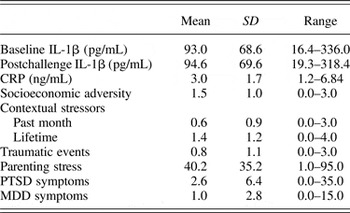
Descriptive statistics are displayed in Table 1. Child age, gender, race, and ethnicity were not associated with IL-1β at baseline, IL-1β following the challenge task, or CRP, and were considered no further. A repeated measures general linear model (GLM) tested the change in IL-1β over the challenge task. There was not a significant effect of time on IL-1β, F (1, 39) = 0.06, ns.
Descriptive statistics

Note: n = 40.
Associations of adversity variables with IL-1β
Associations of each adversity variable with IL-1β were tested with repeated measures GLMs. The number of contextual stressors in the past month, F (1, 38) = 6.07, p = .018, and in the child's lifetime, F (1, 38) = 4.67, p = .037, and the number of traumas, F (1, 38) = 4.73, p = .036, each exerted a significant between-subjects effect on IL-1β. The socioeconomic adversity variable showed a trend-level main effect, F (1, 38) = 3.29, p = .078. There were no between-subjects effects of child maltreatment status, F (1, 38) = 0.48, ns, or parenting stress, F (1, 38) = 0.10, ns. None of the adversity measures showed within-subjects effects.
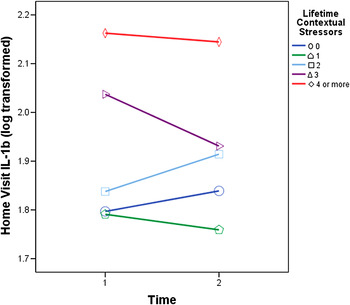
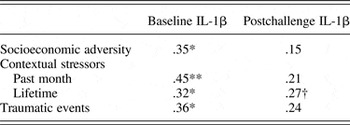
Correlations were used to examine the effects of the significant adversity measures on IL-1β at each time point. As shown in Table 2, baseline IL-1β was positively associated with each of the significant main-effect adversities. Postchallenge IL-1β showed positive correlations with each adversity variable, but these did not reach significance. Figure 1 depicts the mean IL-1β values for each time point according to the number of lifetime contextual stressors.
(Color online) The mean IL-1β values for each time point according to the number of lifetime contextual stressors.

Correlations of continuous adversity variables and IL-1β

Note: n = 40.
†p < .10. *p < .05. **p < .01.
Post hoc analysis of differences in IL-1β based upon specific stress experiences
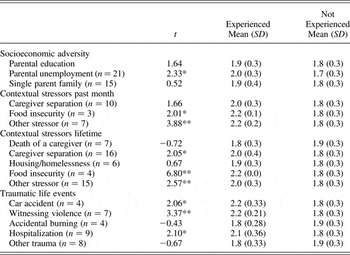
In exploratory post hoc analyses, several individual stressors were found to be associated with higher levels of baseline IL-1β at each time point (Table 3).
Baseline IL-1β (log transformed) and individual adversity variables

Note: Parental education was dichotomized; n = 24 had a high school degree or less education.
*p < .05. **p < .01.
IL-1β and child symptoms
Repeated measures GLM was used to test for effects of child symptoms of PTSD and MDD on IL-1β over time. There were no between- or within-subjects effects.
CRP, contextual stressors, and child symptoms
There were no associations of CRP at the single time point with any of the adversity variables or symptom measures.
Discussion
These findings indicate that salivary IL-1β is increased in association with adverse experiences in early childhood. To our knowledge, this is the first study to show an association of this important pro-inflammatory cytokine with stress exposure in children, and the first to examine any inflammatory markers in relation to stress exposure in children of preschool age. As discussed above, evidence from animal and human studies supports a role of inflammatory cytokines in the development of MDD and PTSD as well as the broad-ranging health effects of stress-induced inflammation. Exposure to stress increases IL-1β in several brain regions, including the hippocampus, and administration of IL-1β in the brain activates the hypothalamic–pituitary–adrenal axis, reduces hippocampal brain-derived neurotrophic factor, and impairs hippocampal-dependent learning, suggesting important effects on neuroplasticity (Kohman & Rhodes, Reference Kohman and Rhodes2013; Koo & Duman, Reference Koo and Duman2008). Consistent with the hypothesis that IL-1β and other inflammatory proteins are involved in the neuropathology of psychiatric conditions, a study of adolescent suicides found increased activity of IL-1β, IL-6, and TNF-α in the prefrontal cortex (Pandey et al., Reference Pandey, Rizavi, Ren, Fareed, Hoppensteadt and Roberts2012).
To our knowledge, this is the first study to examine childhood adversity in relation to salivary cytokine levels. Salivary cytokines are produced by oral mucosal cells and may not be indicative of systemic inflammation. However, some evidence indicates that there are at least modest correlations of some inflammatory proteins in saliva and peripheral blood in adolescents (Byrne et al., Reference Byrne, O'Brien-Simpson, Reynolds, Walsh, Laughton and Waloszek2013; Riis et al., Reference Riis, Out, Dorn, Beal, Denson and Pabst2013), including IL-1β (Riis et al., Reference Riis, Out, Dorn, Beal, Denson and Pabst2013), and in adults (Ouellet-Morin et al., Reference Ouellet-Morin, Danese, Williams and Arseneault2011; Out, Hall, Granger, Page, & Woods, Reference Out, Hall, Granger, Page and Woods2012; Williamson, Munro, Pickler, Grap, & Elswick, Reference Williamson, Munro, Pickler, Grap and Elswick2012). That IL-1β increased acutely in response to a psychosocial stress challenge (Mastrolonardo et al., Reference Mastrolonardo, Alicino, Zefferino, Pasquini and Picardi2007) indicates that this cytokine can be responsive to central nervous system activation and does not simply reflect the oral mucosal response to local infection or injury. Our findings of an association with childhood adversity provide further support for a brain–saliva connection. Unfortunately, we did not have a measure of oral hygiene, so it is possible that the association with stress exposure is due to an effect of stress on oral hygiene and associated dental caries. However, that exposure to stressors was linked to salivary IL-1β in a sample in which nearly all families qualified for public assistance suggests that the findings are unlikely to be explained by an effect of poverty overall on oral hygiene. Tooth eruption has also been linked to elevations of salivary cytokines; however, most children have a full set of primary teeth by age 3 (American Dental Association, 2005) and permanent teeth do not begin to erupt until age 6–7 (American Dental Association, 2006), so this is unlikely to explain our findings.
Given the association of IL-1β with other adversities, it is somewhat surprising that we did not find an effect of documented childhood maltreatment in this preliminary study. In this sample, nonmaltreated children were exposed to significant economic and other adversity, so effects of maltreatment may have been obscured by these other influences. In addition, the maltreated children included in this study remained in the home with their primary caregiver. This occurs when it is determined by the local child welfare agency that the environment can be made safe for the child, either by preventing further contact with the perpetrator or by providing services to a caregiver who is considered to be able to maintain a safe and nurturing environment. Thus, the most severe and chronic forms of maltreatment would not be included in this study. In addition, the maltreated children were exposed to different types of abuse and neglect, and the nature of these experiences may be determinants of the biological sequelae (Cicchetti, Reference Cicchetti2013). Due to the small numbers of children with each maltreatment type, we were not able to assess this in this preliminary study. In addition, because the sample as a whole was impoverished and exposed to a variety of contextual stressors, it is also possible that undocumented cases of maltreatment, such as neglect, may have occurred in the nonmaltreated group.
It is noteworthy that, although stress exposure was linked to IL-1β, neither IL-1β nor CRP was linked to psychiatric symptoms in this modest-sized sample. It is possible that IL-1β will be predictive of the future development of mood or anxiety symptoms. A study by Miller and Cole (Reference Miller and Cole2012) revealed that among subjects with childhood adversity, but not those without adversity, high IL-6 forecasted depression 6 months later. We also did not see an increase in salivary IL-1β over our sampling period. In healthy adults, Mastrolonardo et al. (Reference Mastrolonardo, Alicino, Zefferino, Pasquini and Picardi2007) observed increases in salivary IL-1β from baseline to 10 min following a psychosocial stress test. In the present study, it is possible that the second saliva sample was not taken early enough to detect a rise in this cytokine or that the Lab-TAB vignettes were not sufficiently challenging to arouse a cytokine stress response.
Salivary CRP was not associated with adversity in our sample of preschool-aged children. This is in contrast to findings of elevated plasma or serum CRP in recent large studies of older children and adults with a history of childhood adversity or maltreatment, although findings for CRP in children are mixed, with some showing no association as reviewed above. The effect in positive studies tends to be modest in size, so that larger sample sizes may be required. In addition, some evidence indicates that elevated CRP in association with early stress may be highest, or may only be evident, in those who also have depression (Danese et al., Reference Danese, Moffitt, Pariante, Ambler, Poulton and Caspi2008, Reference Danese, Caspi, Williams, Ambler, Sugden and Mika2011; Miller & Cole, Reference Miller and Cole2012) or behavioral or affect dysregulation (Appleton et al., Reference Appleton, Buka, McCormick, Koenen, Loucks and Kubzansky2012). The association of CRP with childhood adversity has been reported exclusively in plasma or serum, so it is possible that salivary CRP is not elevated in association with early stress; however, recent work suggests at least modest correlations between blood and saliva measures of CRP (Byrne et al., Reference Byrne, O'Brien-Simpson, Reynolds, Walsh, Laughton and Waloszek2013; Ouellet-Morin et al., Reference Ouellet-Morin, Danese, Williams and Arseneault2011). Alternatively, given that findings on the effects of adversity on CRP measured in childhood have been variable, it is possible that consistent basal elevations of CRP do not occur until later in childhood.
The limitations of our study include the modest sample size and the lack of a contemporaneous blood sample to validate our findings with systemic measures of inflammation. In addition, poverty and early adversity have both been linked to obesity, and adipocytes are one source of peripheral cytokines. Associations of BMI with childhood adversity account for at least some of the effects for CRP and TNF-α in peripheral blood (Dixon et al., Reference Dixon, Meng, Goldberg, Schneiderman and Delamater2009; Matthews et al., Reference Matthews, Chang, Thurston and Bromberger2013; Slopen, Kubzansky, McLaughlin, et al., Reference Slopen, Kubzansky, McLaughlin and Koenen2013). It is not clear whether obesity influences inflammatory proteins in saliva, however. We excluded obesity and failure to thrive when identified in the records or by caregivers during screening. Body mass index, available from chart review for 24 children, was not associated with salivary IL-1β or CRP in this study (data not shown), so this is unlikely to account for our findings. However, future work with larger samples is needed to determine whether obesity or adiposity influences saliva cytokines or CRP.
Strengths of this study include the careful measurement of adverse experiences, including documented evidence of maltreatment from child welfare records, in-home assessments, and a standardized challenge protocol, and the use of an at-risk, impoverished sample. In addition, we examined IL-1β over time during a stress challenge, but did not find stress-induced changes. Finally, we carefully excluded children with chronic illness and medications in order to avoid these confounds, and children with acute illness or medications were studied after resolution of the condition.
It is important to note that our findings occurred in the context of poverty, and that among other stressors, unemployment and food insecurity were linked to increased levels of IL-1β. However, poor health outcomes among impoverished children are neither universal nor impervious to change. The majority of children developing in poverty do not have identifiable health problems during childhood or early adulthood. In addition to differential exposure to stressors, protective processes play a role. For example, Brody et al. (Reference Brody, Yu, Chen, Kogan, Evans and Windle2013) found that among individuals developing in poverty during childhood, those with the least supportive environments have the highest allostatic load (as indexed by blood pressure, catecholamine levels, and body mass index) in late adolescence. Chen, Miller, Kobor, and Cole (Reference Chen, Miller, Kobor and Cole2011) found that among adults with a history of low childhood socioeconomic status, those who reported high maternal warmth during childhood had lower inflammatory responses to immune challenge, suggesting that these negative effects of environment may be buffered by supportive family environments.
Finally, interventions may produce change. For example, there is evidence that providing opportunities for individuals living in poverty to move to better neighborhoods reduces the risk of obesity (Ludwig et al., Reference Ludwig, Sanbonmatsu, Gennetian, Adam, Duncan and Katz2011). Although we are not aware of similar data regarding change in inflammatory markers, given the effects of stress on inflammation, improvements in social environments are likely to be beneficial. Medications that target inflammation, including nonsteroidal anti-inflammatory drugs, TNF-α antagonists, and antibiotics, are being examined as possible treatments for mood disorders (Tyrka, Burgers, Philip, Price, & Carpenter, Reference Tyrka, Burgers, Philip, Price and Carpenter2013). Emerging data indicate that exercise, weight loss, yoga, and meditation may have anti-inflammatory effects (e.g., Bhasin et al., Reference Bhasin, Dusek, Chang, Joseph, Denninger and Fricchione2013; Rosenkranz et al., Reference Rosenkranz, Davidson, Maccoon, Sheridan, Kalin and Lutz2013); these approaches may be particularly appropriate components of an intervention for children exposed to adversity.