Introduction
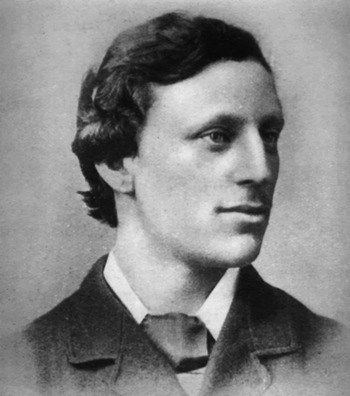
Joseph Toynbee (1815–1866; Figure 1) is considered one of the fathers of modern otology.Reference Guthrie1, Reference Simpson2 He spent his whole life in London, studying and describing the anatomy and pathology of the main diseases of the ear.
Joseph Toynbee.

In 1856, Toynbee wrote, ‘When I turned my attention to the study of the diseases of the ear, I resolved, in the first place, to prosecute laboriously researches into the pathology of the organ’.Reference Toynbee3 Beginning in 1841, he published numerous articles on his research into the pathology of the ear. The contents of his research were eventually compiled in 1857 as A Descriptive Catalogue of Preparations Illustrative of the Diseases of the Ear.Reference Toynbee4 In the introduction of this treatise, Toynbee stated:
When, in the year 1839, I entered upon a systematic study of the diseases of the ear, the conviction was soon forced upon me, that its pathology had been almost entirely neglected. This conviction induced me to commence a series of dissections of that organ.Reference Toynbee4
The catalogue of Toynbee's work was completed, in 1860, by his masterpiece The Diseases of the Ear: Their Nature, Diagnosis, and Treatment.Reference Toynbee5
In one of his obituaries, published after his accidental death on 7 July 1866, it was written:
‘I'll rescue aural surgery from the hands of the quacks,’ he [Toynbee] said to a friend and he kept his word. On another occasion, when told by an eminent member of the profession that he would make nothing of aural surgery, he said, ‘I will work at it for ten years, and then if nothing can be made of it I will tell you why.6
This paper aims to examine why Toynbee decided to engage in his research of the ear. During the late 1830s, Toynbee seems to have conducted a crusade against those he perceived as ‘quack aurists’. He himself wrote almost nothing about his reasons for devoting his life to the study of the ear; however, his motivations for venturing into the specialty are indicated by several letters published under the signature ‘J. T.’ in The Lancet between 1838 and 1839, just before he began his systematic otological work. Two main observations arise from these letters: the correspondence between Toynbee and the quack aurist John Harrison Curtis (1778–1860), and the letters commenting upon Alexander Turnbull's (1794/5–1881) otological quackery practice. These will be presented, placed in context and commented upon.
Toynbee and Curtis
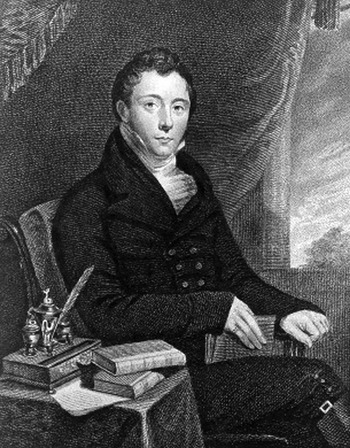
On 24 November 1838, Curtis (Figure 2) published an article in The Lancet on the use of creosote in deafness. Curtis began his text as follows:
I am induced to trouble you with the present communication, detailing the results of my experience with a remedy which has been introduced into practice within the last few years, and which has been found to be very useful in the treatment of several diseases; I allude to creosote, which, in a diluted state, I have employed with considerable advantage in cases of deafness arising from deficient secretion […] from a want of action of the ceruminous glands.Reference Curtis7
John Harrison Curlis line 50–51.

Curtis inserted creosote mixed with oil of almonds ‘into the meatus, night and morning, with a camel-hair brush’. He presented five cases to support his results. Creosote (or pitch oil), listed today as a toxic product, began to be used in medicine in the mid-1830s in Germany, in the forms of pills or liquorice juice, to treat various pathological states, such as pulmonary consumption, uterine carcinoma and chronic exanthemata.8 Its indications were then progressively expanded to include other pathologies.
Two weeks after publication of Curtis's article, Toynbee discussed it in a letter to The Lancet. Toynbee did not agree with Curtis's claim that ‘one of the principal, and most common causes of deafness, is a deficiency of the secretion from a want of action of the ceruminous glands’.Reference Toynbee9 At the end of his letter, Toynbee wrote:
To set this question at rest, let Mr. Curtis come forward and authenticate his cases, and I will instantly do the same with mine; and should it, by this means, be proved that Mr. C. is entitled to the credit and honour of the valuable discovery, which the paragraphs of the daily papers attach to him, then, Sir, no one will be more happy to join with the community in rendering to Mr. Curtis his desert than your obedient servant.Reference Toynbee9
Curtis responded to Toynbee three weeks later, ‘I am much better occupied in attending to the duties of my profession than in replying to the objections of an anonymous writer [… .] I must decline the invitation of your correspondent’.Reference Curtis10
Two weeks later, Toynbee reacted, writing, ‘I endeavoured to prove that deafness was never produced by a deficiency in the secretion of the ear’.Reference Toynbee11 He added:
Authority, facts, and reason being in opposition to the views contained in these statements, had they emanated from a Herschell I should have disbelieved them; but when they have their source from one who (judging from the works having his name attached to them), displays the most profound ignorance of the subjects which he treats, then, indeed, am I loath to give them credence.Reference Toynbee11
To support this statement, Toynbee referred to the sixth edition of Curtis's Treatise on the Physiology and Pathology of the Ear, published in 1836.Reference Curtis12 From it, Toynbee quoted, ‘All the small bones of the ear may be removed without causing deafness; but the stapes is the only one that prevents the escape of sound from the internal ear’. Toynbee added a second quotation from the book's preface, stating that the first object of the author was ‘…to do all the good in his power to suffering humanity; and, in the next, to advance science in his peculiar department to the utmost of his ability’.
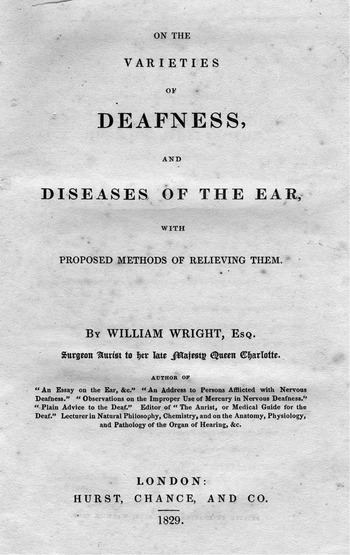
Another quack aurist, William Wright (1773–1860), also discussed Curtis's paper and the correspondence it engendered. Notably, he wrote, ‘If Mr. Curtis cannot give a reasonable and satisfactory answer to this question I will endeavour to do so’.Reference Wright13 Concerning Toynbee, Wright added: ‘I have noticed J. T., but think that a person who can write so to the point need not be ashamed to give his name, without which he cannot expect a reply from Mr. Curtis, or any other person’. In 1829, Wright had published On the Varieties of Deafness, and Diseases of the Ear (Figure 3), in which he had supported Curtis's opinion:
One fact however is certainly undeniable, namely, that in almost every case of deafness, when there is no disease existing in the ear, and when the cause of the malady is not evident either from actual examination, or the symptoms which present themselves, except that this secretion is in a viscid, or filmy state, or totally deficient, it is an indication of returning healthy action to the auditory functions, as soon as the cerumen is exuded from these small glands in a sufficient quantity, and proper consistenc[y].Reference Wright14
Wright's title book line 98.

In a new letter, published four weeks later, Toynbee wrote:
I conclude, as must every one who reads your Journal, that Mr. Curtis cannot authenticate his cases [… .] By remaining silent, Mr. Curtis belies his principles; he does the greatest injury to “suffering humanity,” and, instead of “advancing science to the utmost of his ability,” he stands forward a determined impediment to its progress.Reference Toynbee15
Toynbee also reacted to Wright's comment:
To Mr. Wright's advice that I should give my name, I reply that my object is not to advertise myself. If by writing these lines I do ever so little towards the upholding of truth and the stifling of quackery, I am satisfied.Reference Toynbee15
Toynbee finished his letter, and his dispute with Curtis, as follows:
Sir, I must, in common with the medical profession, express my regret that aural surgery is in so degraded a state in this country, that hundreds of deaf persons prefer remaining as they are, to placing themselves under the hands of aurists; and let me assure Mr. Curtis, and the numerous advertising gentlemen of his fraternity, that they, by their ignorance and cupidity, have brought the present odium upon one of the most interesting and important branches of surgery; and that they, instead of “relieving suffering humanity,” have produced more misery than any other class of persons now living. To prove the worthlessness of such men; to expose them as a disgrace to society, and to the profession to which they pretend to belong; and, lastly, to endeavour to render aural surgery a scientific pursuit, instead of one calculated to bring discredit upon its followers, shall always continue to be the object of your obedient servant.Reference Toynbee15
These letters, and Toynbee's debate with Curtis, are indications of Toynbee's growing interest in otology.
Toynbee and Turnbull
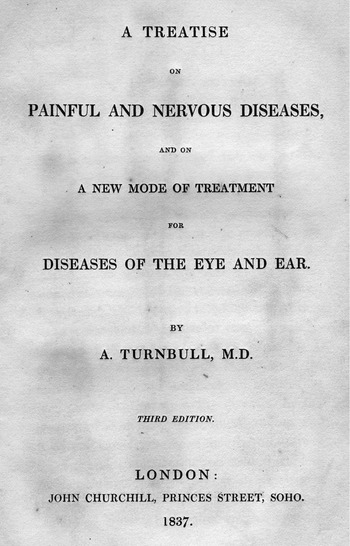
In April 1839, Toynbee wrote to the editor of the Lancet ‘…to call the attention of your readers to a paragraphic advertisement which has appeared in most of the daily papers of this week, from Dr. Turnbull, who states that he can cure any case of deafness, not arising from organic disease, by the application of a peculiar remedy’.Reference Toynbee16 Turnbull advised local application to the ear of the alkaloid veratria, extracted from the seeds of Veratrum sabadilla or the root of Veratrum album (white hellbore);Reference Turner17 both are considered poisonous today. This treatment is described in Turnbull's book A Treatise on Painful and Nervous Diseases, and on a New Mode of Treatment for Diseases of the Eye and Ear, published in 1837 (Figure 4), as follows:
I was induced to begin a series of experiments in diseases of the Ears by rubbing Veratria in front and behind the ear, and was pleased to find a decided improvement take place in the hearing of the patients [… .] I was led in some obstinate cases of deafness to attempt to apply the remedy nearer to the seat of the disease. I dissolved a grain of one of the alkaloids in two drachms of rectified spirit, and dropped from three to five drops into the ear […] and I was gratified to find that the effects of this mode of administrating these alkaloids was much more effective than the external application.Reference Turnbull18
Turnbull's title book line 142

Notably, this book had already been discussed in the Lancet, in 1837, in the following words:
The facts alluded to, though ill-defined, and poorly attested, are sufficiently interesting to excite the attention of practitioners, and demand from them an impartial investigation, either for the corroboration or the extinction of the therapeutic principles attempted to be found thereon. The author has contributed, by his obtrusive pertinacity, to irritate the ears of the public. This is a labour of no merit.Reference Turnbull19
Two years later, in the same journal, Toynbee wrote:
Dr. Turnbull assert[s], that by means of his application he can cure deafness arising from chronic inflammation, with obstruction of the Eustachian tube, closure of the latter by enlarged tonsils, or by mucus, from inflammation of the mucous membrane of the cavity of the tympanum, or from a host of other causes [… .] Dr. Turnbull has no greater knowledge upon the diseases of the ear, than the ignorant whom I have before exposed by means of your pages [… .] But as long as the public is as unwise as it [is] now, it is to be feared that there will be found Turnbulls, with applications; Cronins, Curtises, and hosts of others, with ear drops.Reference Toynbee16
Three months later, a coroner's inquest investigated the death of two of Turnbull's patients, particularly a young man aged 18, after the injection of air into the cavity of the tympanum through a eustachian catheter.20 Injection of air or other remedies into the tympanic cavity, with the help of a curved catheter inserted into the nose and normally placed at the nasal entrance of the eustachian tube, was a method widely used by the main aurists of the time to treat eustachian tube obstruction or to remove liquid found inside the middle ear.21 Again, Toynbee quickly reacted. He discussed several technical points, notably the way to connect the catheter and the air condenser ‘…so loosely […] that there may be room for air to regurgitate’, and the manner in which to introduce ‘…in a gentle and continued stream’ the air into the tympanic cavity. He ended his letter as follows:
No one ought to undertake the performance of the operation who is not acquainted with anatomy, and who has not attained considerable dexterity and tact by the passage of instruments.Reference Toynbee22
The story of this young man's death at the hands of Turnbull was widely discussed in the medical literature.Reference Lynch23–Reference Dunglison25
Historical perspective
In 1838, George Pilcher (1801–1855) published A Treatise on the Structure, Economy, and Diseases of the Ear, one of the first serious British otological books of that era, which was awarded the gold medal of the Medical Society of London.Reference Pilcher26 In his introduction, Pilcher well captured the context of aural surgery in Great Britain at the time:
It happens that even at the present time, in this country at least, Aural Surgery is either almost entirely neglected, or for the most part is left in the hands of the ignorant empiric. In consequence, therefore, of what must be considered a dereliction of duty on the part of English surgeons, the unfortunate sufferers from these distressing maladies, are, in many instances, abandoned to their fate, or compelled to seek relief from the employment of nostrums which it would be but too charitable to regard as being merely harmless in their operation.Reference Pilcher26
This was the context within which Toynbee pursued his work. On 26 October 1839, Toynbee read a paper at the Westminster Medical Society, ‘…the chief object of which was to demonstrate to the profession the present very degraded state of aural surgery; the practice of which had, through its neglect by legitimate practitioners, become synonymous with charlatanism’.27 Toynbee ‘concluded by exhorting the members, and the profession in general, to gain a knowledge of diseases of the ear, and the means for treating them on scientific principles’.27
Toynbee was then 24 years old, and had finished his medical studies in a year at St George's and University College Medical School, in parallel with his medical activities at the Westminster General Dispensary. His conviction to systematically study the diseases of the ear was closely related to the general contemporaneous ignorance of the fundamental aspects of the ear,Reference Wilde28 as demonstrated by the works of Curtis, Wright and Turnbull.
Toynbee was not alone in fighting quackery. The surgeon Samuel Cooper (1781–1848), known by the pseudonym Chirurgus,29 wrote in The Lancet in 1839:
If it were not that thorough-paced quacks may do incalculable injury among the unfortunate deaf, I should say, let quack aurists and their systems die a natural death [… .] It is high time that the public should be enlightened on the subject.30
Following Toynbee's various Lancet correspondences of 1838 and 1839, he published only the results of his otological research, and never returned to letter correspondence.
In 1838, he was appointed a member of the London College of Surgeons, and also the Assistant Curator at the Hunterian Museum. Toynbee published his first paper on pathological and surgical observations on ear diseases in 1841.Reference Toynbee31 In 1842, he became a Fellow of the Royal Society, in 1843 a Surgeon at St James' and St George's Dispensary, and in 1844 he began his independent otological practice.
Throughout his career, Toynbee followed his stated conviction:
I feel that the surest way for a medical man to support his own dignity and that of his profession, is to search perseveringly after the truth, turning neither to the right hand nor to the left, but laying the results of his labours before competent medical or scientific tribunals. I have always endeavoured to pursue this course; and, when urged to expose the fallacy of some nostrum, or the absurdity of some novel procedure in reference to the diseases of the ear, I have declined to do so, from the conviction, that the most effectual mode to extinguish error, is not so much by attacking it, as to throw upon it the light of truth, under which it must inevitably wither and die.Reference Toynbee32
Conclusion
The years 1838 and 1839 were certainly two of the most important in Toynbee's career. It was during this period that Toynbee decided to study the pathology of the ear, with the extraordinary results we know today. His motivation to pursue this career path correlated with the poor state of aural surgery in Great Britain at the time, and with his disputes with several notable quack aurists, especially Curtis, Turnbull and Wright.
Toynbee's conviction was certainly in the same spirit as that expressed in 1839 by Henry Savage, a London lecturer on anatomy:
If ignorance respecting those subjects which are made the very turning points of the whole quack machinery, be the great cause of empiricism [… then] that deficiency ought to be supplied by the requisite information. The diffusion of knowledge on many points […] would diminish the number of those who now fall into the hands of the charlatan from ignorance.Reference Savage33
It would still take many years for otology to find its place in British medicine as a scientifically based specialty. Toynbee's contribution to the formation of the field was immense, and established him as one of the leading otologists of his time.
Toynbee's Irish colleague William Wilde (1815–1876) wrote of him in 1853:
The labours and investigations of Mr. Toynbee have effected more for aural pathology than those of all his predecessors either in England or on the Continent. He commenced at the right end, and has travelled in the proper direction. He has brought to bear upon the subject the true principles of science [… .] He has accumulated a mass of facts upon the morbid anatomy of the organs of hearing that must lay the foundation for a more rational mode of treating the diseases of those parts than has heretofore been resorted to.Reference Wilde34
Acknowledgement
The author thanks Jaipreet Virdi for her kind rereading of the text and her useful comments.