INTRODUCTION
“Youth have played a prominent role in political violence throughout recorded history and the existence of a ‘youth bulge’ has historically been associated with times of political crises.”
(Goldstone Reference Goldstone, Diehl and Gleditsch2001, 95)“The Middle East is facing a demographic bulge in which youth aged fifteen to twenty-nine comprise the largest proportion of the population. These young people, frustrated with the lack of jobs, have been at the forefront of anti-government protests.”
(Assaad 2011)Footnote 1In December 2010, a Tunisian vegetable peddler burned himself to death as a protest after his cart was taken away by police. This incident created a spillover effect of violent and non-violent protests in many Middle Eastern countries and initiated the Arab Spring. So far, the Arab Spring successfully toppled dictators in Tunisia, Egypt, and Libya while the protests in Syria transformed into a bloody civil war. Both academics and policy makers are wondering about the causes of these ongoing protests and the cycle of violence in the Middle East. While some scholars argue that unfavorable socio-economic and political conditions such as state repression, poverty, and unemployment are driving violence in the Muslim world, others emphasize the influence of religion in fostering violence (Dalacoura Reference Dalacoura2011; Fish, Jensenius, and Michel Reference Fish, Jensenius and Michel2010; Hafez Reference Hafez2003; Huntington Reference Huntington1996; Karakaya Reference Karakaya2015; Toft Reference Toft2007; Zaidise, Canetti-Nisim, and Pedahzur Reference Zaidise, Canetti-Nisim and Pedahzur2007).
This article explores conditions under which ethno-political organizations in the Middle East prefer violent strategies to achieve their goals. Ethno-political organizations are politically active communal groups. Gurr (Reference Gurr1993, 161) defines communal groups as “cultural and religious identity groups that do not have recognized states or institutionalized political status.” While ethno-political organizations usually have ethnic-based identity claims, ethnic and religious motivations for collective action can coexist or commingle. Indeed, religious cleavages are not clearly distinguishable from ethnic grievances in some cases (Appleby Reference Appleby2000; Philpott Reference Philpott2007). Ethno-political organizations may have religious claims or motivations, but the reverse could also be the case. For example, Appleby (Reference Appleby2000) points out that the exact role of religion and ethnicity in the Bosnian war (1992–1995) is not clear. Similarly, it is not exactly clear whether the Chechen fighters in Russia and the Palestinians (e.g., Hamas in Gaza) are motivated by religion or nationalism. Therefore, investigating the role of religion in ethno-political organizations' decision to use violence may be a challenging research agenda.
The review of the literature suggests that ethno-political organizations' decision to use violence is influenced by religion, existence of grievances, political opportunity structures, resource mobilization, and organizational structure. Some scholars (Fox Reference Fox2007; Toft et al. Reference Toft, Philpott and Shah2011) criticize the tendency to under-estimate the impact of religion in fostering violence by emphasizing social and economic factors, whereas others (Asal et al. Reference Asal, Schulzke and Pate2014b; Canetti et al. Reference Canetti, Hobfoll, Pedahzur and Zaidise2010; Fish, Jensenius, and Michel Reference Fish, Jensenius and Michel2010 Reference Fish, Jensenius and Michel2010; Karakaya Reference Karakaya2015) are more skeptical about the impact of religion. Toft et al. (Reference Toft, Philpott and Shah2011, 219) argue that “religion is a basic driver of politics in its own right.” On the other hand, Canetti et al. (Reference Canetti, Hobfoll, Pedahzur and Zaidise2010) and Zaidis, Canetti-Nisim, and Pedahzur (Reference Zaidise, Canetti-Nisim and Pedahzur2007) emphasize the role of socio-economic deprivation as a mitigating factor between political violence and religion (see Karakaya Reference Karakaya2015). This article sheds light on the religion-conflict debate by quantitatively analyzing factors that affect the decision to use violence by ethno-political organizations in the Middle East. I argue that socio-economic factors and political opportunities and constraints, rather than religion, better explain the decision to resort to violence. Specifically, the existence of youth bulges in a society increases the probability of adopting violent strategies by ethno-political organizations.
Frustrated young males living under repressive and authoritarian regimes tend to be recruits for violent organizations. Indeed, youth have played a significant role during the recent uprisings in the Middle East. I utilize the Minorities at Risk Organizational Behavior (MAROB) dataset to test my hypotheses (Asal, Pate, and Wilkenfeld Reference Asal, Pate and Wilkenfeld2008). The dataset includes 118 organizations in 16 countries of the Middle East and North Africa, operating between 1980 and 2004. The empirical findings confirm that youth bulges, state repression, organizational fractionalization, external support for the organization, and economic grievances positively affect the adoption of violent strategies by ethno-political organizations, whereas an increasing gross domestic product (GDP) growth rate has a pacifying impact. Unlike popular belief, ethno-political organizations that have a religious/Islamist ideology are no more conflict-prone than other organizations.
This article is organized as follows. First, I review the literature on contentious politics, social movements, and radicalization and derive a testable hypothesis. Next, I describe the data, methods, and the research design. Then, I discuss the empirical findings. Finally, I provide a brief conclusion in which I discuss implications of these findings as well as the limitations of this research.
CONTENTIOUS POLITICS
While some ethno-political organizations prefer to use conventional means to advance their interests, such as participation in elections, others engage in either non-violent protest or violent resistance. Tilly and Tarrow (Reference Tilly and Tarrow2007) use the concept of “contentious politics” to refer to both violent and non-violent strategies used by organizations, such as protest and rebellion. Contentious politics is defined as “interactions in which actors make claims bearing on someone else's interests, leading to coordinated efforts on behalf of shared interests or programs in which governments are involved as targets, initiators of claims, or third parties” (Tilly and Tarrow Reference Tilly and Tarrow2007, 4). Stephan and Chenoweth (Reference Stephan and Chenoweth2008) find that non-violent campaigns are actually more successful than violent campaigns in achieving political goals. However, violence is regarded as a viable option and used by many ethno-political organizations. Why do some ethno-political organizations choose violence rather than conventional politics or protest, which are less risky, less costly, and tend to be more successful in achieving political goals? What factors influence ethno-political groups' choice of violent versus non-violent strategies? Previous studies show that religious motivations, grievances, resources, political opportunity structures, and organizational factors have the potential to promote violence. In addition to these factors, I argue that ethno-political organizations, which are active in societies with a large youth population, tend to be more violence-prone. Below, I first review these concepts and point out the weaknesses of existing literature. Then, I explain how youth bulges may foster the use of violence by ethno-political organizations and conclude this section with my testable hypothesis.
RELIGION
Does religion have an independent effect on conflicts regardless of socio-economic conditions or does it act as a catalyst under certain circumstances? Are religious organizations more violence-prone than others? These questions are yet to be answered, but the empirical evidence on the religion-conflict nexus is mixed. Some scholars argue that violent conflict is encouraged in Abrahamic religions, where indivisibility of religious doctrines and the promise of martyrdom prevent bargaining and deterrence while spiritual incentives such as paradise motivate violent actions (Toft Reference Toft2007; Horowitz Reference Horowitz2009; Svensson and Harding Reference Svensson and Harding2011; Svensson Reference Svensson2007; Wiktorowicz and Kaltenthaler Reference Wiktorowicz and Kaltenthaler2006). Juergensmeyer (Reference Juergensmeyer2003) argues that religious organizations tend to be more violent since they believe that God is their primary audience and they see the enemy as evil. Religious diversity such as religious fractionalization, polarization, and dominance also has the potential to incite violence by increasing opportunities for mobilization. It is argued that religious diversity and the overlap of ethnic-religious identities help to overcome collective action problems (Basedau, Pfeiffer, and Vüllers Reference Basedau, Pfeiffer and Vüllers2014).
On the other hand, Karakaya (Reference Karakaya2015) argues that seemingly religious behaviors cannot be explained by religious affiliation alone, since religious goals usually mix with non-religious goals in many conflicts, and religious texts can easily be manipulated by people. While some studies find that religion, particularly Islam, is associated with higher rates of conflict (Fox Reference Fox2007; Toft Reference Toft2007); more recent studies show that religion may foster violence only under certain circumstances. Therefore, socio-economic conditions and institutional context are as important as — or perhaps more important than — religious motivations. After all, religion has the potential to encourage both peace and conflict, depending on the context (Basedau et al. Reference Basedau, Strüvera, Vüllersa and Wegenastab2011; Henne Reference Henne2012; Karakaya Reference Karakaya2015).
Henne (Reference Henne2012) observes that inter-state disputes between religious and secular states tend to be more severe than others. By drawing on resource mobilization theory, Basedau et al. (Reference Basedau, Strüvera, Vüllersa and Wegenastab2011) find that overlaps between religious and ethnic identities, religious discrimination, and religious dominance increases the risk of armed conflict in Africa. While Fox and Akbaba (Reference Fox and Akbaba2015) find that Muslims suffer from higher levels of discrimination compared to other religious minorities, Basedau et al. (Reference Basedau, Fox, Pierskalla, Strüver and Vüllers2015) point out that unlike theoretical expectations, grievances or discrimination have no impact on religious groups' decision to use violence in developing countries. On the other hand, Karakaya (Reference Karakaya2015) finds that while civil wars are indeed more prevalent in Muslim-majority states, the significance of Islam in driving civil wars disappears when controls for socio-economic and political factors are included in the analysis. Similarly, Asal et al. (Reference Asal, Conrad and White2014a) examine ethno-political organizations in the Middle East and find that religious ideology decreases the likelihood of protest, while having no significant impact on the probability of transnational violent activity by ethno-political organizations. Moreover, Asal et al. (Reference Asal, Schulzke and Pate2014b) argue that organizational characteristics and goals of organizations, rather than religious ideology, determine the decision to use violence. Their findings confirm that organizational characteristics such as gender exclusion, social service provision, and an organization's goal are better predictors of the decision to use violence than religion. In sum, the exact role of religion in promoting violence is not clear. This article intends to shed light on the religion-conflict debate by quantitatively examining the role of religious, socio-economic, political, and organizational factors in promoting violence at the group level.
GRIEVANCES
According to Gurr's (Reference Gurr1970) relative deprivation hypothesis, grievances, which stem from inequalities — either subjective or objective — lead to frustration and motivate collective violence. In other words, the difference between the expectations of an individual and what the individual actually possesses leads to discontent and eventually incites violence. Indeed, globalization and ready access to information have increased awareness of inequalities and expectations, consequently deepening the feelings of frustration. Regan (Reference Regan2009) confirms that grievances that stem from poverty, inequality, and discrimination lead to violence. Canetti et al. (Reference Canetti, Hobfoll, Pedahzur and Zaidise2010) use individual surveys conducted among Muslims and Jews living in Israel to explore the relationship between support for political violence, deprivation, and religious affiliation. Their findings indicate that objective and subjective deprivation mediates between support for political violence and religious affiliation.
The literature on social movements also focuses on grievances and the structural and psychological causes of mass mobilization. It is argued that structural factors such as modernization (rapid economic liberalization and industrialization) or economic crises disrupt social life and create a sense of despair and anxiety, which in turn makes joining social movements attractive. Likewise, Islamic activism is explained by grievances as support for Islamist movements increased since autocratic regimes and secular modernization projects failed to promote economic development (Ayoob Reference Ayoob2005; Moghadam Reference Moghadam2009; Wiktorowicz Reference Wiktorowicz2004). While the corrupt, authoritarian regimes in many Muslim countries fail to provide social services, Islamists fill this vacuum through charity organizations. Islamist parties, which are very popular in many Muslim countries, are regarded as being less corrupt than other parties. It is argued that rapid structural and demographic dislocations during the postcolonial period also contributed to a sense of relative deprivation and alienation. While literacy rates and education increased, these educated new elites could not find employment or they were under-employed. Moreover, the modernization process increased expectations among people (Hafez Reference Hafez2003). In addition to these domestic grievances, global surveys show that Muslims are dissatisfied with the international status quo, especially with United States foreign policy. The United States support of Israel and the Iraq war in 2003 are among the commonly cited political grievances (Ayoob Reference Ayoob2005; Harrigan and El-Said Reference Harrigan and el-Said2011).
While social movement theory focuses on groups as the unit of analysis and provides group-level explanations of political violence, the literature on terrorism is insightful in providing individual-level explanations for radicalization and the decision to use violence. Even though unfavorable socio-economic conditions, such as poverty and low levels of education, are sometimes associated with terrorism, Krueger and Maleckova (Reference Krueger and Malečková2003) and Russel and Miller (Reference Russell and Miller1983) suggest that poverty and lack of education do not necessarily lead to higher rates of terrorism. Russel and Miller (Reference Russell and Miller1983) examine the profile of 350 terrorists from revolutionary groups and find that the majority of these terrorists were in fact well educated and come from middle or upper-middle classes. Therefore, perceived inequalities and injustices are deemed to be more influential than poverty in driving violent extremism (El-Said and Barret Reference El-Said, Barrett, Harrigan and El-Said2011).
Still some scholars are skeptical about the impact of grievances in fostering violence; they argue that such discontent exists in all societies (Hafez Reference Hafez2003; Wiktorowicz Reference Wiktorowicz2004). Existing studies provide mixed evidence regarding the impact of grievances in promoting violence. Gurr (Reference Gurr1993) observes that political grievances such as the historical loss of autonomy and differential political status increase the probability of rebellion but severe political discrimination and cultural grievances decrease it. In contrast, Regan and Norton (Reference Regan and Norton2005) find that political discrimination increases the risk of rebellion and civil war. Cederman, Weidmann, and Gleditsch (Reference Cederman, Weidmann and Gleditsch2011) find that the probability of ethnic conflict increases if leaders of an ethnic group are excluded from central executive power or if they are under-represented. On the other hand, Gurr and Moore (Reference Gurr and Moore1997) find that grievances do not have a direct impact on rebellion but increase the mobilization capacity of ethno-political organizations, which in turn increases the risk of rebellion. Muchlinski (Reference Muchlinski2014) also argues that a lack of political opportunities, such as in weak regimes, are more influential than grievances in driving religious violence.
RESOURCE MOBILIZATION THEORY
Resource mobilization theory, which is based on rational choice perspective, emerged as a major challenge to the relative deprivation approach (Brush Reference Brush1996). The resource mobilization theory emphasizes the ability of social movements to gain resources of power, to organize, recruit members, and provide individual incentives or coercion in motivating participation in social movement activities. According to resource mobilization theory, movements are rational, organizational manifestations of collective action. Collective action depends on members' shared interests as well as organization and opportunities (Tilly Reference Tilly1978, 55). The relative deprivation approach is criticized for ignoring the resources required to mobilize and to maintain insurgency (Muller Reference Muller1985). It is important to note that Ted Gurr also incorporated resource mobilization into his models starting from 1993.
Tilly (Reference Tilly1978) argues that collective violence occurs when individuals believe that collective action will be successful and the expected benefits exceed the costs rather than when individuals have grievances. In other words, frustration is not sufficient for mobilization; groups need resources to translate individual frustration into group mobilization. Grievances exist in all societies and can easily be produced by the mobilizing efforts of movement entrepreneurs (McCarthy and Zald Reference McCarthy and Zald1977). Hafez (Reference Hafez2003) criticizes the relative deprivation hypothesis for ignoring the possibility that deprived individuals could also seek to advance their interests through the use of non-violent strategies.
Weinstein (Reference Weinstein2006) finds that rebel groups that emerge in natural resource-rich regions or those that have external support use higher levels of violence whereas movements that emerge in poor nations use violence selectively. Dalton, Van Sickle, and Weldon (Reference Dalton, Van Sickle and Weldon2010) use the World Value Survey to test the influence of relative deprivation and the availability of resources in driving protest. They find that protest increases not because of increasing grievances such as dissatisfaction with government, but because of the availability of resources. Similarly, Muller (Reference Muller1985) examines the relationship between income inequality, which is used to measure grievances, and collective political violence from 1958 to 1977 and finds only a weak correlation between inequality and the number of deaths stemming from political violence. Muller (Reference Muller1985) concludes that discontent in general is weakly related to political violence whereas resources play a more significant role. In sum, it is argued that both external and internal resources, which facilitate mobilization, are more crucial than grievances in driving collective violence (McCarthy and Zald Reference McCarthy and Zald1977).
POLITICAL PROCESS APPROACH
The political process approach, originally developed by McAdam (Reference McAdam1982), could be regarded as a modified version of resource mobilization theory. According to a political process approach, collective action is limited by external opportunities and constraints. Therefore, the decision to use violence by a group is influenced by the broader political context (Hafez Reference Hafez2003; McAdam Reference McAdam1982; Tarrow Reference Tarrow1998; Wiktorowicz Reference Wiktorowicz2004). McAdam (Reference McAdam1982) points out three important factors that influence the organizations' collective action: the level of organization within the group, the group's belief in the probability of success of collective action, and the political opportunities available to achieve the goals. While “political process” is a very broad concept, which can be a catch-all term, the characteristics of the state and regime type are two key factors in shaping opportunities and constraints for organizations or movements.
In democratic and inclusive regimes, organizations have the option of participating in elections or protest rather than rebellion to realize their rights. Therefore, they will be less likely to adopt un-conventional, risky, and violent strategies. On the other hand, exclusive and repressive regimes legitimize the use of violence since conventional political participation is not available (Hafez Reference Hafez2003; Wiktorowicz Reference Wiktorowicz2004). Tilly and Tarrow (Reference Tilly and Tarrow2007) argue that violent rebellion is more likely to occur in low-capacity and non-democratic regimes. Similarly, Goodwin (Reference Goodwin2001) examines revolutionary movements between 1945 and 1991 and concludes that revolutionary movements do not occur just because of economic inequality but rather are due to political oppression. Goodwin argues that revolutions are most likely to occur in authoritarian, exclusive, repressive, organizationally incoherent, and militarily weak states. In other words, revolutions occur when “there is no other way out” (Trotsky Reference Trotsky1961; cited in Goodwin Reference Goodwin2001, 26).
State repression is another important factor in shaping political constraints and driving violence. Case studies of the Muslim Brotherhood in Egypt and Islamic Salvation Front in Algeria lend support to the idea that state repression leads to radicalization of Islamist movements (Ghadbian Reference Ghadbian2000). Most recently, brutal suppression of peaceful protestors in Syria contributed to the outbreak of civil war in 2011. However, existing studies about the influence of state repression on dissent and rebellion provide inconsistent findings (Davenport Reference Davenport2007; Davenport and Inman Reference Davenport and Inman2012; Gupta, Singh, and Sprague Reference Gupta, Singh and Sprague1993; Jakobsen and De Soysa Reference Jakobsen and De Soysa2009; Lichbach Reference Lichbach1987; Moore Reference Moore2000; Regan and Norton Reference Regan and Norton2005; Young Reference Young2012). Regan and Norton (Reference Regan and Norton2005) find that repression decreases protest but increases both rebellion and civil war. Lichbach (Reference Lichbach1987) argues that dissidents switch between violent and non-violent protest depending on the government response. If the government responds to one type of protest with violence, the dissidents will switch to another type. Lichbach also argues that consistent government accommodative or repressive policies reduce dissent; inconsistent policies increase dissent. Gupta, Singh, and Sprague (Reference Gupta, Singh and Sprague1993) find that repression breeds both violent and non-violent protests in democracies whereas there is a curvilinear relationship between repression and violent/non-violent protests in non-democracies. Gurr (Reference Gurr1970) and Muller (Reference Muller1985) also confirm that there is a curvilinear relationship between repression and the probability of rebellion.
ORGANIZATIONAL FACTORS
While external factors such as state institutions, resources, and grievances are influential in motivating the adoption of violent strategies, internal factors such as organizational structure and ideology are also important in promoting violence. Inter-group or intra-group competition and group fractionalization foster violence (Borum Reference Borum2011; Dalacoura Reference Dalacoura2011). According to the theory of outbidding, competing groups tend to radicalize and resort to violence to increase their support and to out-bid other groups (Bloom Reference Bloom2004; Lawrence Reference Lawrence2010). Similarly, group fractionalization and intra-group competition lead less-motivated members to leave the group and thus increase group radicalization (Borum Reference Borum2011).
In sum, the review of the literature suggests that all of the concepts discussed above — religion, grievances, resources, political opportunities and constraints, and organizational structure — have the potential to promote violence. Numerous studies have tested the impact of these factors. There are contradictory arguments regarding the impact of religion and other factors in triggering violence. This article intends to explore conditions under which religion may motivate violence by ethno-political organizations in the Middle East. Moreover, this article examines the role of youth bulges in driving group-level violence, which has been ignored by existing studies. I argue that the existence of large youth cohorts also increases the probability for the adoption of violence by ethno-political organizations.
Youth bulges lead to competition and scarcity in labor markets and educational systems, which in turn increases grievances and the potential for violence (Urdal Reference Urdal2004). Furthermore, large youth cohorts provide an excellent human resource for violent organizations. The opportunity cost of joining insurgency movements is usually lower for young people since they have less to lose (Collier Reference Collier, Mats and Malone2000). Thus, a youth bulge has the potential to increase both grievances and available resources. Indeed, the youth population has historically been associated with political violence (Goldstone Reference Goldstone, Diehl and Gleditsch2001; Moller Reference Moller1968). Well-educated youth are specifically more prone to political violence since they have higher economic and political expectations. Resorting to violence becomes very likely if these educated youth are unemployed or underemployed and live in authoritarian countries in which conventional means of expressing frustration and political demands are usually unavailable (Goldstone Reference Goldstone, Diehl and Gleditsch2001).
Youth bulges create instability in a society when social infrastructure is weak and the demands of these youth are not met. Young people will be more prone to radical ideologies if they feel desperate and see few opportunities in the future. For poor, young people, participation in violent organizations provides sources of power and prestige, decreases feelings of insecurity and helplessness and offers a sense of identity (Dalacoura Reference Dalacoura2011; Fuller Reference Fuller2003, cited in Karakaya Reference Karakaya2015). Some evidence shows that rising youth population increases support for Islamist movements (Dalacoura Reference Dalacoura2011; Moghadam Reference Moghadam2009; Urdal Reference Urdal2004).
The Middle Eastern region has the highest proportion of youth population in the world: the average percentage of youth population — those under age of 30 — is around 60% compared to only 30% in North America (Hoffman and Jamal Reference Hoffman and Jamal2012). Moreover, the unemployment rate is also the highest in the Middle East; the average youth (ages 15–24) unemployment rate in the Middle East is 25% compared to 12% in the rest of the world as of 2010.Footnote 2 Not surprisingly, young people has played a significant role during Arab Spring (Al-Momani Reference Al-Momani2011).
In sum, even though youth bulges is a theoretically significant concept, which has the potential to increase political violence, none of the existing studies quantitatively tested the impact of youth bulges in fostering violence at the group-level. This article fills this gap in the literature by examining the role of youth bulges in motivating the adoption of violent strategies by ethno-political organizations. I hypothesize the following:
Hypothesis: Ethno-political organizations that are active in countries in which there are large youth cohorts will be more likely to resort to violence.
DATA, METHODS, AND RESEARCH DESIGN
I examine the causal factors that increase ethno-political organizations' probability of the use of violence. A time-series cross-sectional dataset, which includes all active ethno-political organizations in the Middle East and North Africa, is used to empirically test the hypothesis. The Minorities at Risk Organizational Behavior (MAROB) project is a subsidiary of the Minorities at Risk project. The dataset includes 118 organizations representing the interests of all 22 ethno-political groups in 16 countries of the Middle East and North Africa, operating between 1980 and 2004. This includes unbalanced panel data in an organization year format with 1,789 observations. The MAROB data provides information about ideology, motivations, and strategies (both violent and non-violent) of organizations as well as the state behavior (repressive or tolerant toward the organization). In order to be included in the dataset, an organization should meet the following criteria:
-
1. The organization makes explicit claims to represent the interests of one or more ethnic groups and/or the organization's members are primarily members of a specific ethnic minority.
-
2. The organization is political in its goals and activities.
-
3. The organization is active at a regional and/or national level.
-
4. The organization was not created by a government.
-
5. The organization is active for at least three consecutive years between 1980 and 2006.
-
6. Umbrella organizations (coalitions/alliances) are NOT coded. Instead, member organizations are coded (MAROB codebook 2008).
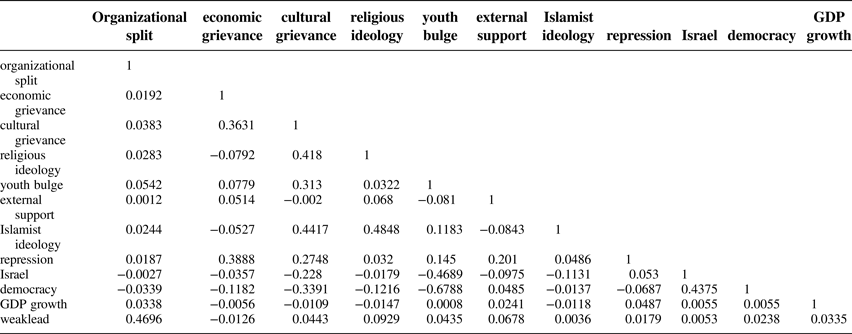
The dependent variable is dichotomous; coded as 1 for the years during which the organization used violence as a strategy and coded as 0 otherwise. The dependent variable is a dummy variable, so I use a logit regression statistical estimator to test my hypothesis, with robust standard errors clustered by country and organization. I also run the analysis with a random-effects model as a robustness test. Since the results were mostly similar, I report logit regression results. I use two ordinal variables from MAROB data to create the dependent variable.Footnote 3 These variables code the frequency of use of violence by organizations as a strategy. Since I am interested in whether the organization adopts a violent strategy or not rather than frequency of use of violence, I recoded these variables. Thus, organizations that use violence either to target domestic or transnational entities are coded as 1. In total, organizations used violence in 30.3% of all organization years. I also include the correlation matrices in Table 1 to document multicollinearity and show that there is no multicollinearity problem.
Correlation of variables

INDEPENDENT VARIABLE AND CONTROL VARIABLES
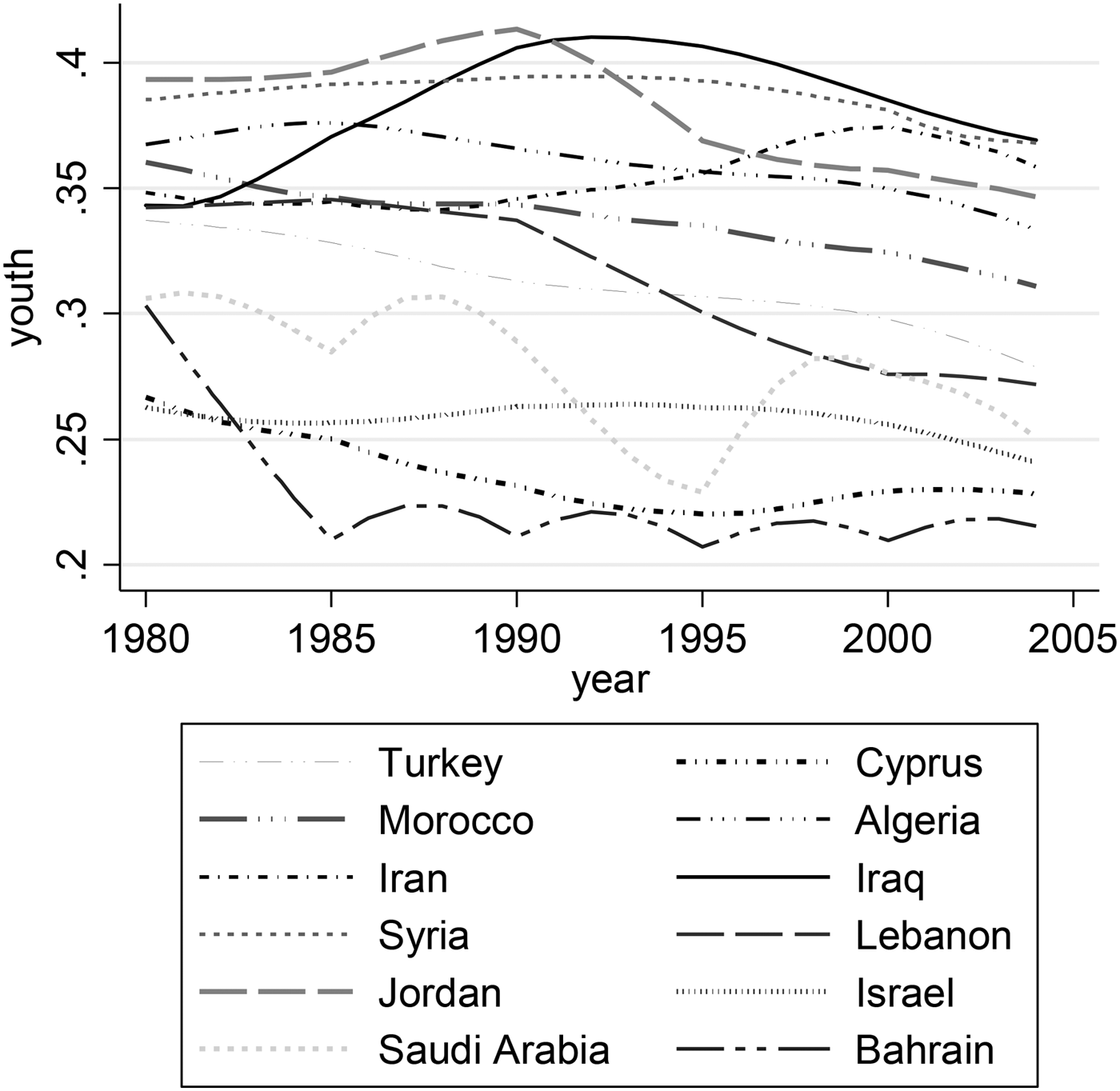
My primary independent variable is the existence of youth bulges in a society. Urdal (Reference Urdal2006) points out that youth bulge is operationalized as either the proportion of young males (ages 15–24 or 15–29) to total population or proportion of young males to total adult male population. Urdal (Reference Urdal2006) suggests using the second method since youth bulges in countries with continued high fertility rates will be under-estimated if the first method is used. Following Urdal's (Reference Urdal2006) suggestion, I operationalize youth bulges as the proportion of young males between the age of 15 and 24 to total adult male population. Data is from the United Nations World Population Prospects data (The United Nations 2010). Figure 1 shows varying youth populations across the countries included in the analysis. Not surprisingly, the proportion of youth population is highest in Iraq where domestic violence by ethno-political organizations is observed among 45% of country-years. In contrast, Bahrain has the lowest youth population and domestic violence ratio; where domestic violence occurred only among 2% of the country-year observations. I also control for the following variables in the empirical analysis since existing literature suggests that these variables have the potential to affect the likelihood of resorting to violence by organizations: religious/Islamist ideology, democracy, state repression, political, economic, and cultural grievances, external support for organization, organizational popularity, organizational split, leadership type, a dichotomous variable for organizations that operate in Israel, and GDP growth rate.
Proportion of youth population across countries.

I use two variables to control for religion. First, is a dichotomous variable, which is coded as one for organizations that have a religious ideology and zero otherwise. For robustness and to test the impact of Islamist ideology specifically, I create a second dummy variable for organizations that focus on establishing an Islamist state by using the text description found in the other political grievances category.
Regime type and state repression intend to test the impact of political opportunity structure on the probability of violence by ethno-political organizations. Ethno-political organizations that are active in democratic countries are expected to be less violence-prone since other non-violent strategies available could be less risky, less costly and hence more attractive. I use the polity 2 score from the Polity IV project to control for regime type (Marshall, Jaggers and Gurr Reference Marshall, Jaggers and Gurr2011). I create a dichotomous variable for democracies by coding countries with Polity scores greater than five as one. Repression is like a double-edged sword; it can either deter or foster rebellion. Some scholars suggest that there is a curvilinear relationship between repression and dissidents' probability of use of violence. While lower levels of repression may foster violence by increasing grievances, extreme repression can deter insurgency since collective action becomes very costly (Muller Reference Muller1985). Unfortunately, it is not possible to test the curvilinear relationship between state repression and use of violence with MAROB data since the variable that measures state repression is an ordinal variable with only three categories. Therefore, I simply expect to find a positive correlation between state repression and political violence. The state violence measures whether the state uses lethal violence against the organization and ranges from one (no repression) to three (high repression). I create a dummy variable by combining the second (periodic lethal violence against the organization) and third (consistently high lethal repression of the organization) categories. The repression is lagged one year to avoid problems in inferring causal direction.
Even though the empirical evidence is mixed, grievances have the potential to motivate violence. Therefore, I control for grievances in the empirical analysis. Economic grievance, cultural grievance, and political grievance data are taken from the MAROB data. Economic grievance is an ordinal measure for the dominant economic grievance; zero denotes that there is no expressed economic grievance; one means that eliminating economic discrimination is a major goal, and two means that the organization focuses on creating or strengthening remedial policies. Cultural grievances are also measured by an ordinal variable with three categories. All of the ethno-political organizations included in the MAROB dataset have some sort of political grievances, which make it hard to test the impact of political grievances. The dominant political grievance of the organization in the original MAROB data is coded as the following:
-
1. Major organizational goals focused on eliminating discrimination;
-
2. Major organizational goals focused on creating or increasing remedial policies;
-
3. Major organizational goals focused on creating or strengthening autonomous status for group;
-
4. Major organizational goals focused on creating a separate state for the group or revanchist change in border of state;
-
5. -88 Other.
There are 703 (out of 1775) observations in the other category with text description of these grievances such as “Palestinian independence,” “Establishing an Islamist state,” “regime change” etc. To avoid dropping 703 observations in the other category, a close reading of each case description was done by the author and each of the independence movements was coded as a four. In other words, a dichotomous variable, which takes the value of one for independence or separationist movements, called “high political grievance” is created. Organizations that focus on gaining independence and/or establishing a separate state are expected to be more violence-prone. Alternatively, I create another dummy for only separationist organizations by coding category number four above as one (it is called autonomy in the regressions below).
The variables that measure external support for organization and organizational popularity are included to test the resource mobilization theory. An organization's ability to mobilize people and engage in collective action depends on the existence of external and internal support for the organization. To measure external support for the organization, four dummy variables from the MAROB data are used. The organizations that received support (financial support, human support, or political support) from diasporas, from foreign states, from international governmental organizations, from international non-governmental organizations, or from other non-state actors are coded as one. There is an ordinal variable (ranges from one to three) that measures organizational popularity among the group that the organization represents. I create a dichotomous variable for highly popular, dominant organizations to test the impact of domestic support.Footnote 4
I use two dichotomous variables from MAROB data, which measure intra-group competition, in order to test the impact of organizational structure (the theory of out-bidding). There is a dichotomous variable coded as one if there is an organizational split during the year of observation. I also create a dummy for organizations with factionalized/competing leaders by using the leadership type variable in MAROB data. Ethno-political organizations that are fractionalized and/or have a weak/competing leadership are expected to be more violence-prone.
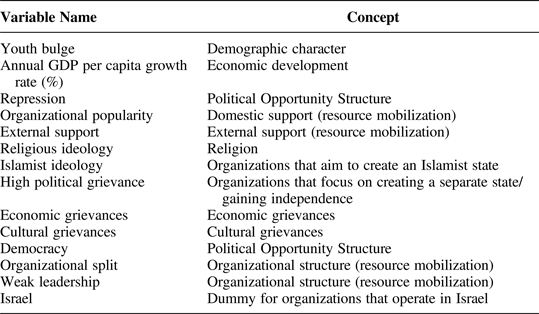
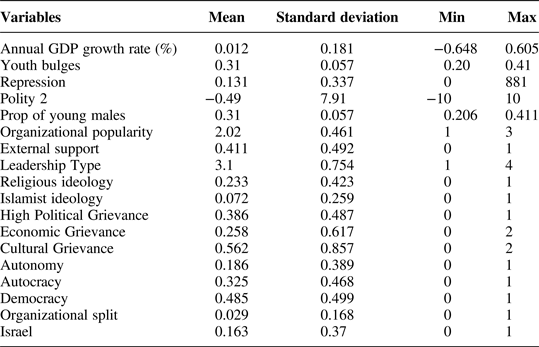
Finally, I control for economic development and organizations that are active in Israel. Israel is an outlier in the Middle East; it is a democratic, wealthy country with a long history of conflict with the Palestinians. I use annual GDP per capita growth rate to control for economic development. Purchasing power parity converted GDP per capita (constant in 2005 international dollars) data come from The Penn World Tables (Heston, Summers, and Aten Reference Heston, Summers and Aten2011). Table 2 summarizes the list of variables used in the empirical analysis and how the concepts are operationalized whereas Table 3 summarizes descriptive statistics of variables.
Summary of variables

Descriptive statistics

FINDINGS
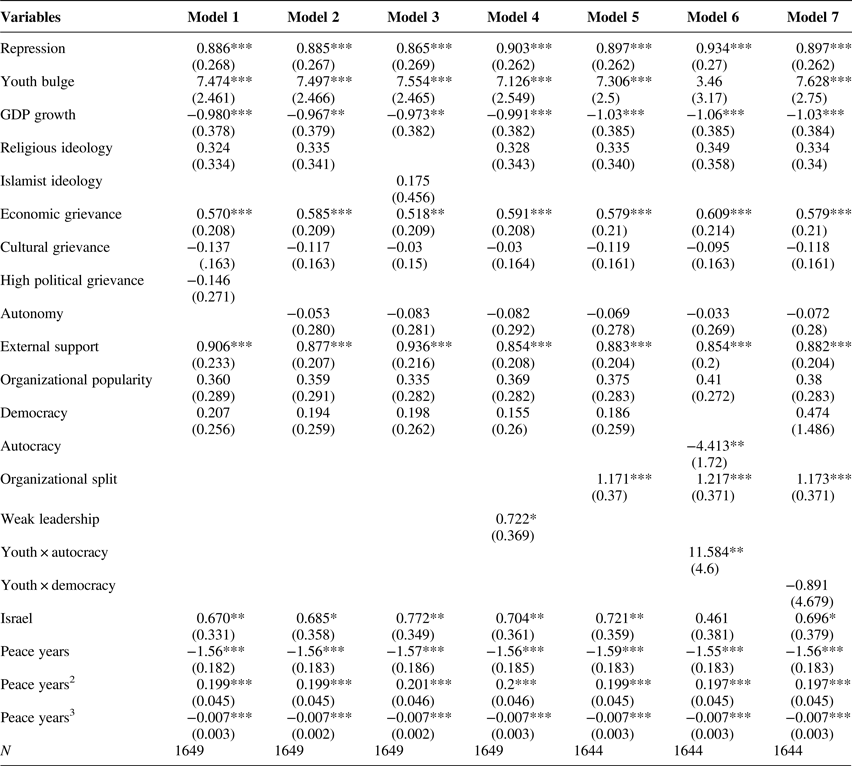
In Model 1, I include annual GDP per capita growth rate, a dummy for democracy, youth bulges, state repression, organizational popularity, external support, high political grievances, economic grievances, cultural grievances, a dummy for organizations that have a religious ideology, and a dummy for organizations located in Israel. Youth bulge is positive and significant, which supports my hypothesis. Contrary to popular belief, religious ideology has no significant impact on inciting violence. State repression positively affects the likelihood of adopting violent strategies by ethno-political organizations, whereas democracy is insignificant; these findings indicate that there is partial support for the political opportunity structure argument. However, caution is warranted in interpreting the insignificance of regime type; the analysis is limited to the Middle East, which is predominantly non-democratic. There is not enough variation in this explanatory variable, which may be the reason for the insignificant results. Economic grievances increase the probability of use of violent strategies. Interestingly, the high political grievance dummy is insignificant; organizations that focus on gaining independence or establishing a separate state are no more violence-prone than others. Therefore, the relative deprivation argument is partially supported. Likewise, there is partial support for the resource mobilization argument; external support is positive and significant but organizational popularity, which intends to proxy domestic support for organization, is insignificant. The Israeli dummy is positive and significant; ethno-political organizations that are active in Israel are indeed more violence-prone. In line with previous findings, increasing GDP growth rate has a pacifying effect.
In Model 2, I drop the high political grievance dummy and replace it with an autonomy dummy, which is coded as one for separationist organizations (4th category of the dominant political grievance variable in the original data). While autonomy is insignificant, much like high political grievance, the impact of all other variables is similar to the previous model.
In Model 3, I drop the religious ideology dummy and replace it with a dummy for organizations that focus on creating an Islamist state as a robustness check. As with religious ideology, an Islamist state dummy is insignificant; thus, there is no support for the argument that religious or Islamist organizations are more violence-prone than non-religious ones. Before dismissing the impact of religion, as a further robustness test I add interactions of religious ideology with youth bulge, external support, and economic grievance to the model one at a time. While interactions of religious ideology with youth bulge and external support fail to reach statistical significance, contrary to expectations, the religious ideology-economic grievance interaction variable has a negative and significant impact on the dependent variable. This finding suggests that organizations with a religious-based ideological component and economic grievances are actually less violence-prone than others. Perhaps, those organizations with economic grievances lack economic resources to mobilize and engage in violent action, which provides indirect support for resource mobilization theory.Footnote 5
I add organizational split and weak leadership dummies in Models 4 and 5, respectively, to examine the impact of organizational structure.Footnote 6 According to the theory of out-bidding, both inter-group and intra-group competition cause more radicalization, thus increase the probability of violent strategies. I can only examine the impact of intra-group competition since there is no variable that measures inter-group competition in the MAROB dataset.Footnote 7 I use organizational split and leadership type (weak/competing leaders indicate existence of intra-group competition) to proxy intra-group competition. The findings indicate that fractionalized organizations and organizations with competing/weak leadership are indeed more violence-prone than other ethno-political organizations. Youth bulge is positive and significant in Model 4 and Model 5, as in previous models; one can conclude that the significance of youth bulge is robust with respect to alternative model specifications.
While the empirical analysis above confirms that youth bulges foster violence, exploring the underlying causal mechanisms of the youth-violence relationship and moderating variables marks another interesting research question. Those scholars who argue that youth bulges are more prone to violence generally argue that such violence-proneness is conditional on other socio-economic and political factors. High unemployment rate, state repression, and autocracy are among the commonly cited factors that act like a catalyst between violence and youth bulges. I interact autocracy and youth bulges and democracy and youth bulges in Model 6 and Model 7, respectively, to see if the existence of youth bulges creates more problems in autocracies. The interaction of youth bulge and autocracy is positive and significant, whereas the youth-democracy interaction is insignificant. This finding suggests that youth bulges in autocratic regimes tend to be more violence-prone than youth bulges in democratic regimes. Young people in democracies can express their frustration or dissatisfaction through non-violent means, whereas such conventional strategies usually do not exist in autocracies, which makes resorting to violence the only viable option.
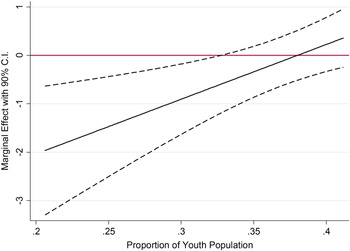
The graph in Figure 2 shows the marginal effects for the autocracy variable on the dependent variable at different levels of young male proportion. The changes on the y-axis indicate changes in the marginal effects for the autocracy dummy on the probability of violence. Unlike the common assumption, autocracies are not more likely to experience domestic violence than non-autocracies. In fact, when the size of youth in the population is small, autocracies are less likely to have domestic violence than non-autocracies. However, as the size of youth population increases, so does the probability of domestic violence in autocracies. When the youth population exceeds about 38% of the total population, autocracies have a higher chance of domestic violence than non-autocracies; although, their chances of having domestic violence are not distinguishable from one another in a statistically meaningful way. Therefore, the effect of regime type on the probability of domestic violence is conditioned by the size of youth population.
Conditional impact of autocracy on political violence.

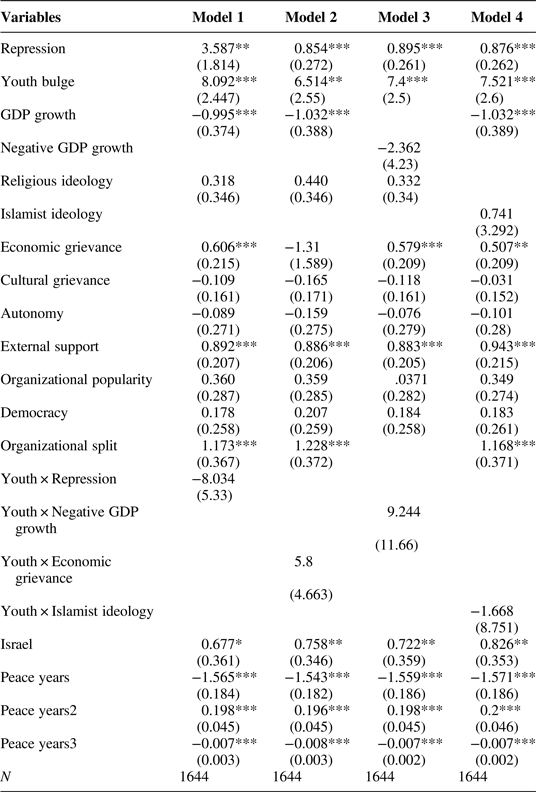
I also interact youth bulges with state repression, negative GDP growth rate,Footnote 8 economic grievances, and Islamist ideology in order to find out whether youth bulges foster violence when coupled with any of these factors. I add these interacted variables one at a time to the model. None of the interactions was significant.Footnote 9 I suspect that the insignificance of the interaction terms might be due to the use of crude proxies to measure the theoretically relevant concepts, or alternatively, limitations in the structure of the data. For example, economic grievance is an ordinal variable with only three categories whereas repression is a dichotomous variable. Overall, while the empirical analysis above suggests that the existence of youth bulges in general increases likelihood of political violence at group-level, the insignificance of most of the interaction terms is a theoretical puzzle that requires further research. Table 4 summarizes the regression analysis.
Logistic regression on use of violence by ethno-political organizations (1980–2004)

Note: Standard errors are in parentheses. Asterisks (*, **, ***) indicate significance at the 10%, 5%, and 1% level, respectively. All regressions include an intercept (not reported).
Alternative model specifications

Note: Standard errors are in parentheses. Asterisks (*, **, ***) indicate significance at the 10%, 5% and 1% level, respectively. All regressions include an intercept (not reported).
Finally, I calculate the predicted probabilities to show the substantive importance of the explanatory variables by using Models 4, 5, and 6. The predicted probability of an organizations' use of violence is 5.7% when all continuous variables are held at their mean values and dummy variables are set to 0. The probability of use of violence increases from 2% to 10% as the proportion of young males shifts from 21% to about 40%. In other words, the probability of use of violence by ethno-political organizations increases by 400%.
The probability of use of violence increases from 5.7% to 13% when repression shifts from 0 to 1 while all continuous variables are held at their mean values and dummy variables are set to 0. In other words, the predicted probability of use of violence increases by 131%. Similarly, the probability of violence increases 100% when the weak leadership dummy shifts from 0 to 1. Shifting external support from 0 to 1 also leads to a 115% increase in the probability of violence. A shift in economic grievance from the lowest to highest value (0 to 2) leads to a 191% increase in the probability of violence. The impact of GDP growth rate is relatively small; shifting GDP growth rate from 10th to 90th percentile leads to only a 20% decline in the probability of violence. Shifting organizational split dummy from 0 to 1 leads to 188% increase in the dependent variable. Finally, a shift in youth × autocracy interaction from 0 to 0.39 (90th percentile of youth bulge) leads to a 78% increase in the probability of violence.
All in all, these findings indicate that youth bulges, economic grievances, external support for organization, state repression, organizational split, and fractionalized leadership all increase probability of use of violent strategies by ethno-political organizations whereas increasing GDP growth rate has a negative impact. Youth bulges especially foster violence in autocratic regimes.
CONCLUSION
The Tunisian vegetable peddler, who burned himself to death after his cart was confiscated by police, illustrates how a spillover effect of protests can emerge in many Middle Eastern countries with profound consequences, in this case, initiating the Arab Spring. Some scholars describe the recent uprisings in the Middle East as youth revolutions: young people, dissatisfied with their oppressive regimes and frustrated with unemployment, rebelling against their governments (Hoffman and Jamal Reference Hoffman and Jamal2012; Al-Momani Reference Al-Momani2011). The findings of this article confirm that existence of youth bulges indeed trigger use of violent strategies by ethno-political organizations in the Middle East.
In addition to youth bulges, other internal and external factors also influence the decision to resort to violence, whereas religious factors do not seem to foster violence by ethno-political organizations. Religious/Islamist ideology and its interaction with other explanatory variables fail to reach statistical significance (except the religion × economic grievance interaction, which is negative and significant) in all of the models. These findings refute the argument that religious organizations are more violence-prone than others. In fact, religious organizations with economic grievances appear even less violence-prone than others.
Economic grievances and state repression foster violence whereas increasing GDP growth rate has a negative impact. While political grievances are found to be insignificant; this finding should be interpreted with caution. All of the organizations included in the MAROB dataset have political grievances, which makes it difficult to explore role of political grievances. Organizational factors such as fractionalization and competing leadership increase the likelihood of resorting to violence, which confirms the theory of outbidding. External support for the organization has a positive impact but domestic support (measured by organizational popularity) is insignificant; there is partial support for resource mobilization theory. In conclusion, socio-economic and political factors such as youth bulge, economic development, and state repression, as well as internal factors such as organizational structure, are crucial in the decision to resort to violence.
Finally, it is important to note some of the limitations of this research. The analysis is limited to MENA region, which introduces a selection bias problem and prevents making broader generalizations. The analysis is limited to MENA due to limitations in data availability. Future research may test the generalizability of these findings if cross-national data become available.
APPENDIX: DESCRIPTION OF VARIABLES (FROM MAROB CODEBOOK)
Dependent Variable
DOMORGVIOLENCE : To what degree is the organization using violence domestically as a strategy?
0 = Organization is not using violence as a strategy
1 = Organization is using violence as occasional strategy but is not specifically targeting persons.
2 = Organization is using violence regularly as a strategy but is targeting security personnel (including state security personnel and nonstate armed militias) and not government nonsecurity personnel or civilians
3 = Organization is using violence regularly as a strategy but is targeting security personnel (including state security personnel and nonstate armed militias) and/or government nonsecurity personnel, but not civilians
4 = Organization is occasionally targeting civilians but most of its violent acts target security
5 = Organization is targeting civilians regularly
TRANSVIOLTARG: To what degree is the organization using violence to target transnational entities as a strategy? (The classification is the same as domorgviolence, ranges from 0 to 5)
Independent Variables
ORGPOLGR Dominant political grievance of the organization
Value Label
1 = Major organizational goals focused on eliminating discrimination
2 = Major organizational goals focused on creating or increasing remedial policies
3 = Major organizational goals focused on creating or strengthening autonomous status for group
4 = Major organizational goals focused on creating a separate state for the group or revanchist change in border of state
−88 Other: goal described in ORGPOLGRDES
−99 Missing Value/No basis for judgment
ORGECGR Dominant economic grievance of the organization
Value Label
0 = No expressed economic grievances
1 = Economic grievances focused on elimination of discrimination
2 = Economic grievances focused on creating or strengthening economic remedial policies
−99 Missing Value/No basis for judgment
ORGCULTGR Code the dominant cultural grievance of the organization
Value Label
0 = No expressed cultural grievances
1 = Cultural grievances focused on elimination of discrimination
2 = Cultural grievances focused on creating or strengthening economic remedial policies (i.e., establishing or increasing state funding for cultural protection and/or promotion)
−99 Missing Value/No basis for judgment
ORGSPLIT Did the organization split this year?
Value Label
0 = No split
1 = Split
−99 Unclear
LEAD Type of leadership for organization
Value Label
1 = Factionalized/competing leaders
2 = Weak or decentralized leadership
3 = Strong ruling council
4 = Strong single leader
−99 Missing Value/No basis for judgment
ORGPOP Popularity of organization
Value Label
1 = Fringe- no evidence of support from group
2 = One of several organizations with support from group
3 = Dominant organization
−99 Missing Value/No basis for judgment
RELORG Does the organization advocate policies that incorporate religion into
public life?
Value Label
0 = No (non-religious)
1 = Yes
−99 Missing Value/No basis for judgment
DIASUP Has org. received support from diaspora in year being coded?
Value Label
0 = No
1 = Yes
−99 Missing Value/No basis for judgment
FORSTSUP Has org. received support from foreign state in year being coded?
Value Label
0 = No
1 = Yes
−99 Missing Value/No basis for judgment
IGOSUP Has org. received support from international governmental organization in year being coded?
Value Label
0 = No
1 = Yes
−99 Missing Value/No basis for judgment
INGOSUP Has org. received support from international non-governmental organization or other non-state actor?
Value Label
0 = No
1 = Yes
−99 Missing Value/No basis for judgment
STATEVIOLENCE
Does the state use violence against the organization?
Value Label
1 = State is not using lethal violence against the organization
2 = State is using periodic lethal violence against the organization
3 = State is using consistent lethal violence against the organization