Introduction
Allergic rhinitis is the most common allergic disease, and is associated with decreased work productivity and reduced quality of life. Its prevalence has increased in developed countries, particularly in the past two decades.Reference Parikh and Scadding1 Effective therapy for allergic rhinitis requires evaluation of the various inflammatory mechanisms involved,Reference Quraishi, Davies and Craig2 in order to understand the pathophysiology of the disease.
The pathogenesis of allergic rhinitis is related to the interaction of specific antigen–immunoglobulin E complexes at the surface of mast cells, leading to mast cell degranulation, release of chemical mediators and production of clinical allergic symptoms. The clinical phase can be subdivided into early and late phase responses. The early phase of inflammatory response is initiated within minutes of allergen exposure, and is primarily caused by the mast cell release of mediators such as histamine, tryptase, cysteinyl leukotrienes, cytokines (i.e. interleukins four, five and six), tumour necrosis factor-alpha (TNF-α), chemotactic factors and enzymes.Reference White3–Reference Varga, Jacobson, Masuyama, Rak, Till and Darby6 In contrast, the late phase of inflammatory response begins 2–4 hours after allergen exposure and is essentially a cellular event. Activation of inflammatory cells and release of their mediators promote local oedema and tissue damage, perpetuating the inflammatory process.Reference White3, Reference Naclerio4
Nasal mucosa is innervated by sensory, sympathetic and parasympathetic nerve fibres. During the allergic and inflammatory reactions,Reference Pipkorn7, Reference Heppt, Thai Dihn, Cryer, Zweng, Noga and Peiser8 neuroendocrine and immune cells stimulate these nerve fibres, leading to the release of neurotransmitters (noradrenaline and acetylcholine) and diverse neuropeptides (neuropeptide Y, neuropeptide tyrosine, calcitonin gene related peptide, substance P and vasoactive intestinal peptide (VIP)). Neuropeptides affect the function of smooth muscle and microvascular and secretory cells, and are potent stimuli of the mast cell, lymphocyte and other leukocyte contributions to such reactions. The specific role of neuropeptides in neuroregulation of immunity and hypersensitivityReference Quraishi, Davies and Craig2 may reveal novel pathogenetic mechanisms and, eventually, new therapeutic approaches to allergic rhinitis.
Vasoactive intestinal peptide is a neurotransmitter in the postganglionic parasympathetic neurons that enter the mucosa via the posterior nasal nerves and innervate the submucosal glands, arterioles and venules.Reference Fang and Shen9, Reference Fischer, Wussow, Cryer, Schmeck, Noga and Zweng10 Postganglionic cholinergic neurons contain VIP, a peptide containing histidine and methionine, choline acetyltransferase and acetylcholinesterase, which indicate the presence of acetylcholine.Reference Baraniuk, Lundgren, Okayama, Mullolo, Merida and Shelhamer11 Stimulation of parasympathetic neurons leads to the release of acetylcholine, which acts upon muscarinic receptors on submucosal glands and possibly on vessels.Reference Baraniuk, Lundgren, Okayama, Mullolo, Merida and Shelhamer11–Reference Malm, Sundler and Uddman13 Since VIP is released along with acetylcholine by parasympathetic nerves, it may play an important role in regulating nasal responses.Reference Baraniuk, Lundgren, Okayama, Mullolo, Merida and Shelhamer11 Furthermore, VIP may activate lymphocytes and granulocytes to release enzymes and other active proteins, in order to initiate inflammatory and immunological responses together with tissue oedema.Reference Fang and Shen9, Reference Fischer, Wussow, Cryer, Schmeck, Noga and Zweng10
The sensory nerves involved belong to a subset of afferent nerves often termed nociceptors, because they are activated by mediators associated with tissue damage and inflammation. Substance P is a neuropeptide present in the upper respiratory tract. Its function is to facilitate vasodilatation and extravasation of proteins. Activation of nociceptive C-fibres within the nasal mucosa results in local release of substance P and related neuropeptides at the site of inflammation; these then contribute to the inflammatory reaction via a process known as neurogenic inflammation.Reference Fajac and Frossard14, Reference Myers, Kajekar and Undem15 After nasal allergen challenge in patients with allergic rhinitis, substance P is locally released and induces nasal obstruction.Reference Fajac and Frossard14, Reference Myers, Kajekar and Undem15
Heat shock proteins are a group of proteins induced by stress and are essential for cell survival under stressful conditions (e.g. infection, inflammation and ischaemia). They are also expressed under non-stress conditions and play an essential role in protein metabolism, including such functions as protein folding, membrane translocation and degradation of misfolded proteins. Different families of heat shock proteins can be differentiated on the basis of their molecular weight. Heat shock protein 70 protects cells and tissues against TNF-α, reactive oxygen species and apoptosis. It has been demonstrated that heat shock protein 70 is more intense in the peripheral lymphocytes of patients with allergic rhinitis than in those of control subjects.Reference Jin, Nakayama, Shmyhlo, Inoue, Kondo and Ikezawa16–Reference Liu, Xiao, Zhang, Cheng, Wang and Wu18
The aim of this study was to investigate the presence of substance P, VIP and heat shock protein 70 in the nasal mucosa cellular smears of patients with seasonal allergic rhinitis, using an immunocytochemical method, in order to evaluate the potential role of these factors in the pathophysiology of seasonal allergic rhinitis.
Materials and methods
Patients
Fifty-four patients (25 males and 29 females) with a mean age of 36 years (range 14 to 68 years) suffering from seasonal allergic rhinitis were included. All patients underwent a complete ENT examination (i.e. intranasal examination, inspection of oral cavity and pharynx, otoscopy and indirect laryngoscopy). All patients fulfilled the following: (1) no exposure to any professional irritants, such as formaldehyde, ammonia, wood dust, paints or other chemicals; (2) alcohol consumption less than one drink per day; (3) no respiratory infections over the previous three months; (4) no evident pathology; (5) no previous surgery of the nasal cavity or paranasal sinuses; and (6) no use of systemic or local allergic rhinitis treatments over the last three months. All the participants gave their informed consent. Table I shows clinical data for the included patients.
Subjects' Clinical Data

M = Male; F = female; yr = years; Hx = history; +ve = positive
All the seasonal allergic rhinitis patients had typical allergic symptoms and signs, such as: watery rhinorrhoea; sneezing; nasal itching; boggy turbinates; and positive reactions to skin prick tests for one or more of a panel of aeroallergens (i.e. house dust mite, grasses, cat, dog and moulds) (Soluprick; ALK-Abello, Horsholm, Denmark). All the patients' allergy histories matched their skin prick test findings.
Twelve healthy individuals with no history of allergy (i.e. negative skin prick tests), who fulfilled the above selective criteria, served as the control group.
Smears were taken when the seasonal allergic rhinitis patients presented with symptoms of at least two weeks' duration.
Cytological sampling
The nasal cavity was first washed with a saline solution (NaCl 0.9 per cent). Mucosal epithelial cells were sampled by using a head light source and a nasal speculum, to prevent any accidental contact with the squamous epithelium of the nasal vestibule. Specimen collection was painless, although tearing and sneezing was observed in a few cases. Sampling from both sides of the middle third of the inferior nasal turbinate was performed using a cytobrush (Rovers Oss, ??, The Netherlands). The brush head with sampled cells was either cut from or removed from its handle, immersed directly into a vial containing 15 ml preservative PapSpin collection fluid (comprising isopropyl alcohol 10–30 per cent, methyl alcohol 7–13 per cent, ethylene glycol 5–10 per cent and formaldehyde 0.1–1 per cent; Thermo Shandon, Pittsburg, Pennsylvania, USA) and sent to the cytology laboratory. When the vials arrived at the laboratory, red blood cells were lysed and the mucus liquefied within the transport medium.
The PapSpin system (Thermo Shandon, Pittsburg, Pennsylvania, USA) was used to prepare cytological slides. The first step was to Vortex the vial with the specimen for about 30 seconds at 500 rpm. The consistency of the cells in the vial was measured using the Shandon CytoCheck system. This determined the appropriate volume of specimen required to be immersed in the Shandon EZ Megafunnel (a specially designed cytocentrifuge tube which enabled deposition of a randomised sample of cells onto a glass slide by cytocentrifugation). At this point, 1 ml of PapSpin collection fluid was also added to the EZ Megafunnel.
Each EZ Megafunnel assembly was placed in the Shandon Cytospin cytocentrifuge and centrifuged for 5 minutes at 1250 rpm with high acceleration. This generated slides with a rectangular, 22 × 14.75 mm sample spot, ready for conventional cytological screening using Giemsa staining, Papanicolaou method and immunostaining.
Immunocytochemistry
All smears were air-dried, fixed for 20 minutes in formaldehyde 4 per cent and then stored at −70° C until used. Immunocytochemical staining was performed by the alkaline phosphatase antialkaline phosphatase method.Reference Cordell, Falini, Erber, Ghosh, Abdulaziz and MacDonald19 Smears were incubated for 45 minutes with normal rabbit serum (Biogenex, San Ramon, California, USA), diluted 1/50 in phosphate-buffered saline and then rinsed in three changes of phosphate-buffered saline for 5 minutes.
Primary antibodies to substance P (Biogenex), VIP (Novacasta, Newcastle, UK), and heat shock protein 70 (Novacasta) were applied in dilutions of 1/50, 1/100 and 1/50, respectively. The smears were incubated overnight. After washing in phosphate-buffered saline, smears were incubated in immune complexes of alkaline phosphatase and antialkaline phosphatase for 30 min.
Visualisation was achieved by a final incubation in naphthol AS-B1 phosphatate and hexazotised new fuchsin in phosphate-buffered saline for 10 minutes. Finally, the smears were washed, counterstained with Mayer's haematoxylin and covered with aqueous mounting medium.
Negative control studies were performed using normal rabbit serum instead of the primary antibodies. Smears of known positive controls were also used. For each slide, two observers counted a total of 500–1000 cells, by surveying five to 10 fields, in order to determine the proportion of positively stained cells.
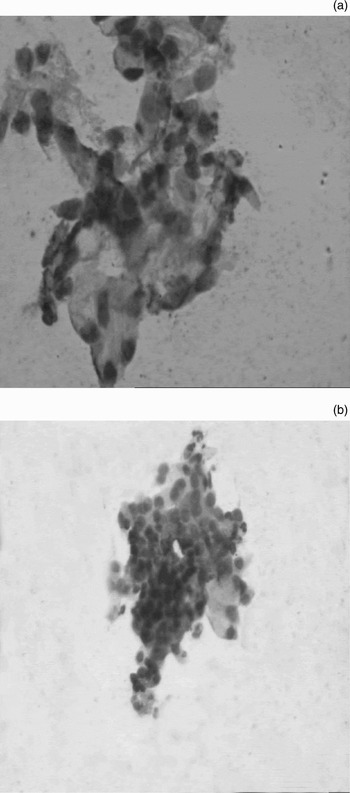
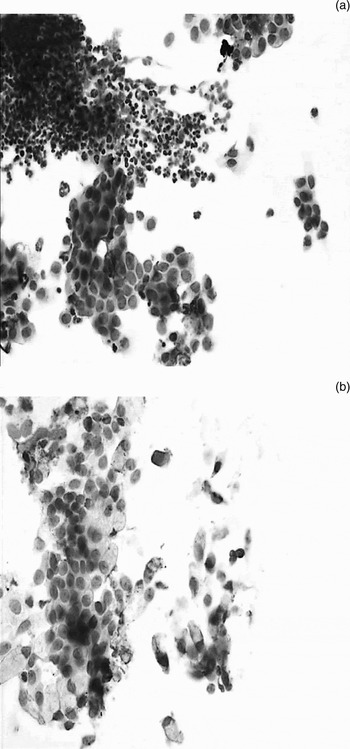
Staining intensity was scored on a three point scale: zero = no or weak staining in <20 per cent of cells; one = moderate intensity staining; and two = strong intensity staining. Only slides scoring one or two were considered positive, regardless of the number of cells stained (Figures 1 and 2).
Photomicrographs showing positive cytoplasmatic immunostaining reactions to the neuropeptides (a) substance P and (b) vasoactive intestinal peptide, in groups of cells from the nasal mucosa of allergic rhinitis patients (Magnification ×500).

(a) Photomicrograph showing an acinar of columnar nasal cells combined with many polymorphonuclear cells (Giemsa; × 500). (b) Photomicrograph showing positive cytoplasmatic immunostaining reaction for heat shock protein 70 in a group of goblet nasal mucosal cells from a patient with allergic rhinitis (Magnification ×500).

Statistics
Fisher's exact test was used to compare the expression (i.e. negative versus positive) of substance P, VIP and heat shock protein 70. Pearson's chi-square test was also used to compare the expression (i.e. all negative, one or two positive, and all positive) of all markers studied (i.e. substance P, VIP and heat shock protein 70). Ninety-five per cent confidence intervals were calculated. Logistic regression was used to confirm the results, using the three markers studied as independent variables and the two groups of interest (allergic subjects and controls) as dependent variables. All analysis was conducted using the Statistical Package for the Social Sciences version 14.0 software (SPSS Inc, Chicago, Illinois, USA) and using a 5 per cent level of significance.
Results and analysis
On examination of conventional cytological smears prepared using Giemsa staining and the Papanicolaou method, an increased number of goblet cells were observed, as well as enough (30%) bare, oval, enlarged nuclei (probably from goblet cells) with prominent nucleoli and coarse chromatin. In addition, we also found a moderate number of polymorphonuclear, basophilic and eosinophilic cells, against a background of an increased amount of mucus (Figure 2b).
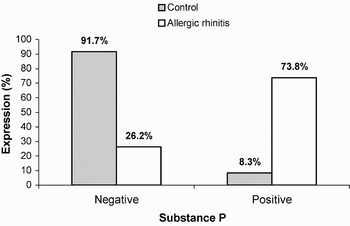
Positive immunoreactivity for substance P was observed in the slides of 31 (73.8.5 per cent) allergic rhinitis patients, compared with one (8.3 per cent) control subject (p < 0.0001) (Figure 3). The sensitivity of substance P immunoreactivity was 73.8 per cent and the specificity was 91.7 per cent.
Expression of substance P in nasal mucosal smears of patients with allergic rhinitis.

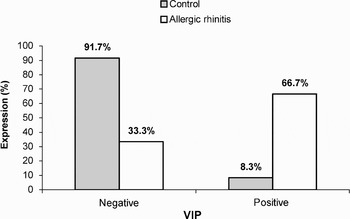
Positive immunoreactivity for VIP was observed in the slides of 28 (66.7 per cent) allergic rhinitis patients, compared with one (8.3 per cent) control subject (p < 0.003) (Figure 4). The sensitivity of VIP immunoreactivity was 66.7 per cent and the specificity was 91.7 per cent.
Expression of vasoactive intestinal peptide (VIP) in nasal mucosal smears of patients with allergic rhinitis.

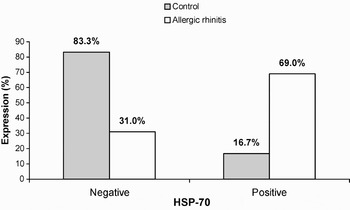
Positive immunoreactivity for heat shock protein 70 was observed in the slides of 29 (69.0 per cent) allergic rhinitis patients, compared with two (16.7 per cent) control subjects (p < 0.001) (Figure 5). The sensitivity of heat shock protein 70 immunoreactivity was 69.0 per cent and the specificity was 83.3 per cent.
Expression of heat shock protein 70 (HSP-70) in nasal mucosal cell smears of patients with allergic rhinitis.

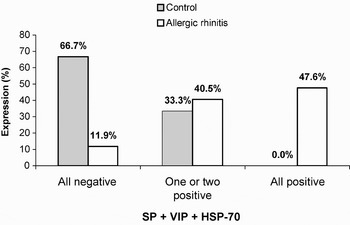
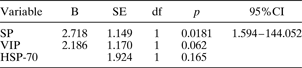
Figure 6 shows the multivariable analysis (Pearson chi-square test) for all the markers studied. A positive immunoreaction for one or two markers was observed in 40.3 per cent of all studied smears (p < 0.0001). Combined positive reactivity for the three markers was 47.6 per cent. Furthermore, multivariable analysis revealed that substance P (p = 0.018) and VIP (p = 0.062) had borderline significance as the only prognosticators in our samples, while heat shock protein 70 had no significant independent prognostic capacity (p = 0.165) (Table II).
Combined expression of substance P (SP), vasoactive intestinal peptide (VIP) and heat shock protein 70 (HSP-70) in nasal mucosal cell smears of all allergic rhinitis patients studied.

Logistic Regression Model Analysis

B = coefficient; SE = standard error; df = degrees of freedom; CI = confidence intervals; SP = substance P; VIP = vasoactive intestinal peptide; HSP-70 = heat shock protein 70
Discussion
Sensory airway innervation has recently been demonstrated to participate in airway inflammatory changes.Reference Heppt, Thai Dihn, Cryer, Zweng, Noga and Peiser8 Neuropeptides are present in nerves of nasal mucosa, which increased in allergic rhinitis, by precursors of allergen exposure and may be released in response to allergen exposure.Reference Fang and Shen9 Neuropeptides can induce vasodilatation, thus causing nasal congestion.Reference Myers, Kajekar and Undem15 However, little is known about the phenotype and physiology of the neurons which produce neuropeptides in response to inflammation.
Substance P is a neuropeptide present in the upper respiratory tract around blood vessels and glands and between muscle fibres and epithelial cells. It leads to vasodilatation and extravasation of proteins. Substance P has been detected in the nasal secretions of humans with allergic rhinitis.Reference Heppt, Thai Dihn, Cryer, Zweng, Noga and Peiser8, Reference Mosimman, White and Hohman20, Reference Rayan21 In particular, Heppt et al. Reference Heppt, Thai Dihn, Cryer, Zweng, Noga and Peiser8 reported an increase in substance P immunoreactivity in persons with seasonal allergic rhinitis, compared with control subjects [2.84 vs 1.75 respectively (staining intensity was evaluated by a score 1–4); p < 0.005]. In the present study, 73.8 per cent immunopositivity for substance P was observed in the smears of seasonal allergic rhinitis patients. The immunopathological role of substance P in this condition has been suggested but as yet not conclusively determined. The elevated level of substance P in allergic rhinitis patients may be explained by activation of sensory nerves, resulting in an axonal reflex which leads to activation of substance P-containing nerve fibres that innervate to numerous effector cell types.Reference Heppt, Thai Dihn, Cryer, Zweng, Noga and Peiser8 The accumulated data also suggest that neuropeptides are biologically involved in direct interaction between immune cells, independent of sensory nerves.Reference Lambrecht22
Vasoactive intestinal peptide is present within immune microenvironments and inflammatory pulmonary lesions. It modulates a number of T lymphocyte functions. Macrophages and lymphocytes themselves produce VIP; it also alters glandular secretions by augmenting the flow of electrolytes and fluids from salivary glands.Reference Kaltreider, Ichikawa, Byrd, Ingram, Kishiyama and Sreedharan23–Reference Lundberg, Anggard and Fahrenbrug25 It is now accepted that VIP may regulate acetylcholine release and augment the glandular secretory response. Furthermore, VIP is able to activate lymphocytes and granulocytes to release enzymes and proteins and thereby initiate immunological responses.Reference Baraniuk and Kaliner26, Reference Payan and Goetzl27 Increased VIP immunohistochemical staining in nasal mucosa has been reported in patients with an allergic diathesis and symptoms of paroxysmal nasal obstruction.Reference Kurian, Blank and Shepard28 In allergic rhinitis, VIP expression has been predominantly noted around vessels, and a high concentration of VIP with a significant increase in the number of VIP positive fibres has been also described.Reference Fang and Shen9 According to Fang and Shen,Reference Fang and Shen9 the immunoreactivity of VIP is higher in allergic rhinitis patients than in control subjects [5.35 vs 2.01, respectively (quantitative data were expressed as the proportion of the positive staining area compared to the entired area of the section); p < 0.01]. The highest expression of VIP positivity in our study (66.7 per cent) was observed amongst allergic rhinitis patients, compared with 8.3 per cent immunopositivity in the control group.
• This paper investigated the role of various neuropeptides in the mediation of seasonal allergic rhinitis
• Nasal epithelium smears derived from 42 patients with seasonal allergic rhinitis were studied
• High levels of the neuropeptides substance P and vasoactive intestinal peptide were found, suggesting a role in the neuroregulation of immunity in allergic rhinitis
Heat shock proteins are a class of proteins induced in order to protect cells from stressors such as infection, inflammation and environmental factors. Many reports indicate that antibodies against different members of the heat shock protein family exist in patients with certain autoimmune diseases.Reference Kaufmann29–Reference Kindas-Mugge, Steiner and Smolen31 Jin et al. Reference Jin, Nakayama, Shmyhlo, Inoue, Kondo and Ikezawa16 observed elevated levels of heat shock protein 70 antibodies associated with atopic dermatitis caused by allergic reaction to metals. The present study assessed whether the expression of heat shock protein 70 is related to allergic rhinitis. We found significantly greater immunopositivity for heat shock protein 70 (69.0 per cent) in smears from allergic rhinitis patients, compared with smears from control subjects. These results suggest that overexpression of heat shock protein 70 is associated with allergic rhinitis, but further research is needed to investigate the exact mechanism.
Finally, there was a statistically significant, positive correlation between the combined immunopositivity of two or three of the markers studied in allergic rhinitis patients (p < 0.001).
In the present study, it is notable that immunocytochemistry was combined with a new, liquid-based cytology techniqueReference Weynand, Berliene, Haumont, Massart, Pourvoyeur and Bernard32 to prepared smears. This prevented bias caused by split samples, because cytology and immunocytochemistry were performed on the same sample.
Conclusion
Our preliminary data indicate a positive relationship between seasonal allergic rhinitis and the expression of substance P, VIP and heat shock protein 70, assessed from cytological nasal epithelial preparations of patients with this disease. It is not yet clear if the impact of allergic rhinitis is mediated via direct cellular impairment alone or also via stress. Further studies are required to implicate heat shock protein 70 and other neuropeptides in the development of allergic rhinitis. Furthermore, we believe that cytology, and especially immunocytochemistry, may play a critical role in investigating the pathogenesis of allergic rhinitis.
Acknowledgements
We would like to acknowledge A Dervos – G Dimitrakopoulos & Co OE for their scientific and technical support.