Japan is currently the world's second largest market for pharmaceuticals after the United States (1). After previous attempts in 1992 and in 1999, the Japanese authorities have announced a plan to introduce a health technology assessment (HTA) system on a pilot basis in 2016. Japan introduced its current universal health coverage model (kaihoken) in 1961 and has been highly acclaimed for its performance in terms of delivering the world's longest average life expectancy for relatively low cost (2–Reference Ikegami5). However, in recent years, Japan has been struggling with rising healthcare costs. In particular, the “super ageing” of the population is putting increasing pressure on healthcare finances (Reference Muramatsu and Akiyama6).
Therefore, the total health spending in Japan is increasing not only in absolute numbers but also relative to the gross domestic product (GDP). In 2012, it accounted for 10.3 percent of the GDP in Japan, up from 8.6 percent in 2008, and is now closer to European countries with similar health insurance systems and above the Organization for Economic Co-operation and Development (OECD) average of 9.3 percent (7). The OECD also reported that Japan has experienced continued growth in pharmaceutical spending after the financial crisis of 2007 while other countries witnessed a slowdown or even a reduction in pharmaceutical spending. As the public sector is the main source of health funding and accounts for 82 percent of health spending in Japan (OECD average 72 percent), overall healthcare and pharmaceutical spending is a rising concern for Japanese policy makers. For this reason, the introduction of a new HTA system is a tempting instrument to flatten future cost increases as Japan's health policy-makers’ fondness of HTA is primarily driven by the desire to reduce healthcare spending.
The history of the Japanese HTA discourse shows a strong link to concerns about the severe outlook for social security finances accompanying the rapid advance of Japan's decreasing birthrate and aging population (Reference Kamae8). However, this discussion ignores that the intention of HTA is not necessarily to reduce healthcare expenditures but rather to achieve an optimal allocation of scarce resources. To expect significant savings through the introduction of HTA might also be misleading, because Japan currently does not have a free pricing system but rather practices its own Japanese style HTA scheme that provides early access for patients at reasonable costs, with built-in cost-containment mechanisms, and relatively high co-payment (30 percent standard, 10 percent for elderly). Moreover, a recent forecast of the Japanese drug market anticipated that, due to patent expirations and faster generic penetration, the pharmaceutical market growth will only be 1 percent within the next 10 years, which indicates a trend break in pharmaceutical spending (9). In this context, a move toward a new HTA system does not necessarily suggest lower prices.
The goal of this study was to analyze if and to what degree a new HTA system would affect Japanese drug prices. We used the antivirologic drug simeprevir as an example to compare current Japanese prices with hypothetical prices that might occur if a UK or German style HTA assessment were in place. We chose those two countries because they represent two different methods of conducting health economic evaluations, The United Kingdom applies a cost-utility-analysis (CUA), which has been widely adopted in a broad set of countries such as Australia, Canada, Korea, and Thailand. In a CUA framework, costs are measured in monetary units’ benefits are expressed in quality-adjusted life-years (QALYs). Germany's efficiency frontier method can be classified as a cost-effectiveness-analysis where costs are stated in monetary units as well but benefits are measured in clinical outcomes and vary across different diseases. For that reason, unlike the CUA, this method cannot provide recommendations for resource allocation across different therapeutic areas.
METHODS
We used the antiviral drug simeprevir as a case study to analyze how different pricing rules would affect its Japanese price. The protease inhibitor simeprevir is a direct-acting antiviral agent that is used in combination with pegylated interferon (PR) for the treatment of genotype 1 chronic hepatitis C virus infection. It received marketing authorization in September 2013 in Japan and was reimbursed 2 months later. Simeprevir has better efficacy than PR alone (Reference Kumada, Toyota and Okanoue10;Reference Hayashi, Izumi and Kumada11) and better than first-generation protease inhibitors, such as telaprevir (Reference Quigley, Bryden, Scott, Kuwabara and Cerri12). Efficacy for hepatitis C indication is measured as a sustained virological response (SVR). The SVR is defined as aviremia usually 24 weeks after completion of antiviral therapy. The effective treatment of hepatitis C reduces the risk of disease progression. Without treatment, many hepatitis C patients develop decompensated cirrhosis or hepatocellular carcinoma, which ultimately results in costly liver transplants and other interventions (Reference Sangiovanni, Prati and Fasani13;Reference Roche and Samuel14).
Cost Utility Analysis
To calculate the hypothetical price of simeprevir under the cost utility method, we defined a threshold value for the incremental cost-effectiveness ratio (ICER) where QALYs are used as outcomes. We decided to take the value of one Japanese gross domestic product (GDP) per capita, which is the ICER threshold that the World Health Organization (WHO) recommends for a drug to meet the definition of being “highly cost effective.” The threshold of “cost effectiveness” may suggest an ICER between one and three times the GDP per capita according to the WHO definition. If the ICER exceeds the value of more than three times the GDP per capita, the WHO consider this intervention as not cost-effective (15).
GDP data from 2014 (487,990 trillion Japanese yen [JPY]) were obtained from the Japanese Cabinet office (16). This value was then divided by the Japanese population of 127 million (17) to define the threshold value of 3.84 million JPY or 31,890 U.S. dollars (USD) (exchange rate as of April 2015).
The cost-effectiveness analysis was based on a Japanese model for simeprevir (Reference Kuwabara, Westerhout and Treur18) that took a payer perspective. The published version only reported life-years as outcomes, because QALYs are not well accepted in Japan. However, the model included unreported QALYs, which we used for our cost utility analysis. Based on this model, we calculated the unit costs of simeprevir that are associated with an ICER of 3.84 million JPY. The model we used consists of a Markov chain with a lifetime horizon. A discount rate of 3 percent was used. Comparators in the model were pegylated ribavirin (dual therapy) and telaprevir in combination with pegylated ribavirin (triple therapy).
Efficiency Frontier
While cost utility analysis is a standard method that is even mandatory in several countries, the efficiency frontier method is only applied in Germany. Even in Germany, it is only optional in case price negotiations between the pharmaceutical company and the head association of the statutory health insurance do not lead to a mutual agreement (Reference Henschke, Sundmacher and Busse19). The idea of the efficiency frontier is to present the cost and benefit information of one or more therapeutic options in an efficiency plot with costs on the horizontal axis and benefits on the vertical axis (Reference Caro, Nord and Siebert20). The benefit is measured as a patient relevant endpoint, in our case as SVR. Empirical application of the efficiency frontier is rather scarce; however, a recent study investigated the cost-effectiveness of interferon-free therapy for hepatitis C in Germany using this method (Reference Gissl, Götz, Mahlich and Rapp21).
RESULTS
Current Japanese System for Setting the Price of New Drugs
Medical fees including drug prices are set by the Ministry of Health Labour and Welfare (MHLW) (Kōsei-rōdō-shō), which is advised by the Chuo Shakai Hoken Iryo Kyogi Kai (Central Social Insurance Medical Council), abbreviated to Chuikyo. The twenty-six Chuikyo members are selected by the MHLW from academia and various interest groups, such as the Japan Medical Association that represents the Japanese physicians or the Japan Pharmaceutical Association, which is the interest group of the Japanese pharmacists. Representatives of the labor unions (Rengo) and employers (Keidanren) are also among the members.
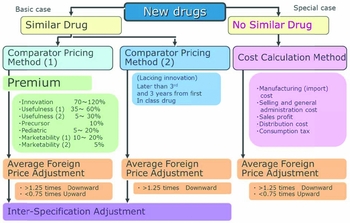
The basic pricing rule in Japan uses the comparator method where the daily price of a new drug is based on the reimbursement price of a comparator. The comparator is selected among the most recent similar drugs listed by the National Health Insurance (NHI) with respect to the indication, pharmacological mechanism of action, chemical structural formulae, and finally the formulation and administration. Premiums are applied for “innovation” or “usefulness.” An innovation premium (70–120 percent) is granted when all three following conditions are all satisfied: (i) new and clinically relevant mechanism of action, (ii) higher efficacy or safety, and (iii) improvement of the treatment. Premiums for usefulness (35–60 percent), type I, are applied if two of the above conditions are satisfied. Another premium for usefulness (5–30 percent), type II, is applied if one of four conditions is satisfied, that is, (i–iii) plus (iv) higher medical usefulness resulting from ingenuity in drug formulation. The Chuikyo approved a new scoring rule for price premium rates in April 2014 after simeprevir was launched. This rule attempts to specify the price premiums based on a scoring algorism and make premiums more rule based. This scoring rule was proposed to the Chuikyo by an ad hoc analysis and needs to be evaluated further.
Orphan drugs and drugs for pediatric use are eligible for the pediatric and marketability price premiums that are both in the range of 5–20 percent. If there are no similar drugs in the NHI list, the cost calculation method is used as a special rule. Under this rule, the price is determined based on manufacturing and research and development costs, pharmacovigilance, and a standard profit ratio. After applying the rules on price premiums, an external reference price system is used that is based on a basket of four countries, namely France, Germany, the United Kingdom, and the United States. If the foreign average price is greater than 25 percent higher than the calculated price, the Japanese price will be adjusted upward applying the following formula for the Japanese price: average foreign price × ((1/3) × calculated price/average foreign price + (5/6)). The same logic applies in the opposite direction when foreign prices are less than 75 percent of the Japanese price. In that case, the following formula will be applied: average foreign price × ((1/3) × calculated price/average foreign price + (1/2)).
Figure 1 summarizes the drug pricing system in Japan for newly launched drugs as of April 2014 to March 2016.
Pricing rule for new drugs. Source: JPMA (33).

The pricing system is very strict in that price premiums are the exception and, if granted, they are only rarely above 5 percent. Between 2012 and 2013, 100 new drugs were launched in Japan. Of these, ninety-one were not awarded any premium, six received a 5 percent usefulness premium, and one a usefulness premium of 20 percent. The cost calculation method rule was applied for two new drugs (22).
The simeprevir price was decided using the comparator pricing method with telaprevir as an appropriate comparator. A usefulness premium of 5 percent was added to the daily price of telaprevir of 12,509.1 JPY for the following reason: “Telaprevir (TELAVIC®) was recognized as a treatment to require special attention because high frequencies of skin disorder has been observed and some of the cases were severe compared with the PR + RBV combination therapy. However, simeprevir (SOVRIAD®) has been evaluated with relatively low risk of severe rash compared with PR. Additionally; the Japan Society of Hepatology recognizes in their guidelines the tolerability of TELAVIC® as a problem for the treatment. Based on these conditions, it was judged that hepatitis C treatment is objectively improved with SOVRIAD® and application of usefulness premium (type II) with 5 percent is appropriate” (23). Accordingly, the NHI price of simeprevir at first listing was set at 13,134.6 JPY in November 2013 and was slightly lowered afterward to 13,122 JPY.
Cost-Effectiveness Analysis
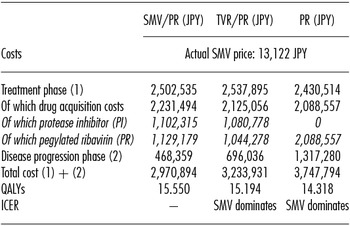
This section reports the results of the cost-effectiveness analysis. The outcomes of the model were reported based on the current Japanese unit price of 13,122 JPY per day (Table 1).
Total Costs per Patient of Different Treatment Options (Current Prices)

Source: Kuwabara et al. (Reference Kuwabara, Westerhout and Treur18).
As shown in Table 1, at current prices the treatment with simeprevir is both cheaper as well as more effective compared with telaprevir or PR; in health economic terms, simeprevir strongly dominates the two alternative treatment strategies.
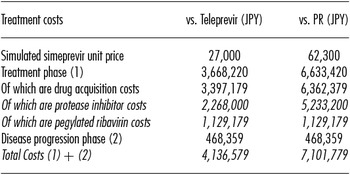
The simeprevir price was set so its ICER equaled 3.84 million JPY, equivalent to one GDP per capita in Japan, and the respective prices and costs for the simeprevir regimen are shown in Table 2. Depending on the comparator, simeprevir prices would be significantly higher compared with the base case scenario. Against telaprevir, the unit costs of simeprevir could be up to 27,000 JPY while a comparison against PR would increase the unit costs up to 62,300 yen.
Total Costs of Treatment with Simulated Simeprevir Prices when Incremental Cost-Effectiveness Ratio Is Set to One Gross Domestic Product per Capita (3.84 million JPY)

Source: own calculations.
PR, pegylated ribavirin; JPY, Japanese Yen.
A higher simeprevir unit price would also increase the total treatment costs up to 4.1 million and 7.1 million JPY compared with telaprevir and PR, respectively.
Efficiency Frontier with SVR as Patient Relevant Outcome
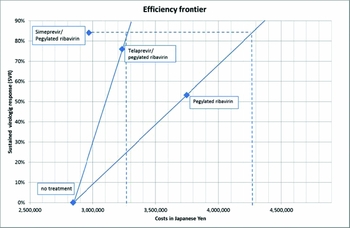
The results of the German efficiency frontier method are shown in Figure 2. The option “no treatment” serves as an anchor of the efficiency frontier that is a straight line between the “no treatment” option and the comparator. The idea behind the efficiency frontier method is that it graphically links interventions that are not dominated and extrapolates the straight line that links the last two interventions. All cost/outcome combinations on and above this line are considered cost-effective, whereas combinations below this line are not cost-effective. This method ensures that the ICER of a new drug is not higher than that of next effective drug (Reference Gandjour, Gafni and Schlander24).
German efficiency frontier method. All cost-effectiveness combinations that are on or above the efficiency frontiers are considered to be cost effective. The graph shows how much the price of simeprevir/pegylated ribavirin needs to increase to be just on the efficiency frontier.

For the sake of simplicity, we did not perform any sensitivity analyses that have recently been outlined conceptually (Reference Stollenwerk, Lhachimi and Briggs25) and that were applied to a simeprevir cost-effectiveness study for Germany (Reference Gissl, Götz, Mahlich and Rapp21). The German Federal Joint Committee has defined either dual therapy (PR) or triple therapy with a first-generation protease inhibitor as the appropriate standard of care (26). Therefore, we compared the efficacy of simeprevir against both dual and triple therapy and plotted all three efficacy-cost combinations into the diagram.
Figure 2 shows that in the baseline case simeprevir is graphically located above the efficiency frontier and can be considered to be cost-efficient both in comparison to telaprevir and PR. The position of simeprevir on the efficiency plane is somewhat exceptional in that it lies not only above the established treatments but also on the left hand side, which indicates strong dominance in health economic terms. In addition, telaprevir dominates PR according to this analysis.
Regarding the slope of the straight line connecting “no treatment” and PR in Figure 2, we found that an additional 10,000 JPY of treatment costs would be considered cost-effective if the associated increase of the SVR rate was 0.6 percent or higher. Alternatively, a 1 percent increase in SVR is worth 16,666 (10,000/0.6) JPY. Thus, the observed improvement of 31 percent for simeprevir in comparison to PR in Figure 2 would be worth 516,666 (31 × 16,666) additional JPY for the simeprevir/PR treatment. Adding this value to the PR costs of 3,747,794 JPY (Table 1) results in an accepted overall treatment cost of 4,244,460 JPY. To calculate the acceptable simeprevir unit price, the costs of PR (1,129,179 JPY) are subtracted as part of the simeprevir/PR regimen. The final acceptable simeprevir acquisition cost is 3,135,281 JPY. This amount corresponds to a daily unit cost (84 simeprevir treatment days) of 37,325 (= 3,135,281/84) JPY per day.
Similarly, we can calculate the cost-efficient price for simeprevir when compared against telaprevir. In this case, the slope of the straight line between “no-treatment” and telaprevir/PR indicates that an additional 10,000 JPY of treatment costs would require an increase of 2 percent in SVR to be considered cost-effective. Following this reasoning, a 1 percent increase in SVR is worth 5,000 (= 10,000/2) JPY. The observed better performance of 8.12 percent in SVR against telaprevir/PR gives rise to accepted treatment costs of 40,600 JPY in addition to the treatment cost for the telaprevir-based regimen (3,233,931 JPY). This would result in overall treatment costs of 3,274,531 (= 3,233,931 + 40,600) JPY. Subtracting 1,129,179 JPY for the PR component results in 2,145,352 JPY for simeprevir. Therefore, the simeprevir unit costs could be as high as 25,540 (= 2,145,352/84) JPY per day when compared with telaprevir.
In summary, depending on the comparator and the approach used, simeprevir prices might increase more than four times higher than under the current Japanese pricing scheme that resulted in a simeprevir price of 13,122 JPY. The highest prices would be achieved under a cost utility-based pricing regimen with PR as a comparator (62,300 JPY). The lowest price would be with telaprevir as a comparator, using the efficiency frontier method (25,540 JPY), which is still almost twice the current actual price in Japan.
DISCUSSION
The current discussion about the introduction of a new HTA system in Japan 2016 is primarily motivated by the Japanese Ministry of Finance that considers HTA as an instrument to reduce healthcare spending. This reasoning is familiar in many European countries. For example, the main motivation to pass the AMNOG (Arzneimittelmarkt-Neuordnungsgesetz; English translation, Pharmaceuticals Market Reorganization Act) bill, which introduced a German HTA system in 2011, was the expectation of reducing pharmaceutical spending by 2 billion Euros annually. At that time, the German statutory health insurance had a huge deficit and policy makers called for significant cost reductions to strengthen its financial situation (Reference Eger and Mahlich27;Reference Höhle-Pasques, Hankowitz and Oberender28). Unfortunately, we are not aware of any study that has empirically analyzed what degree of estimated savings has been accomplished in reality.
In Japan, no specific estimates are available regarding the potential financial impact of a new HTA system. Although based on only one drug, our analysis suggests that it would be misleading for Japanese policy makers to expect high cost savings as a result of the introduction of alternative HTA methods. According to our results, prices for simeprevir could be up to more than four times higher than under the current Japanese pricing scheme. Furthermore, this result is a conservative estimate because it is based on an ICER threshold of 1 GDP per capita. The WHO considers ICER threshold values up to three times the GDP per capita as an upper limit of cost-effectiveness. If the higher limit of the threshold value was applied, potential prices would increase even more.
A recent cost utility analysis of sofosbuvir for genotype 2 hepatitis C virus infection underlines this case (Reference Igarashi, Tang and Cure29). In that model, the Japanese price was based on the average price of the four reference countries in Europe. Sofosbuvir was dominant to no-treatment for the interferon-unsuitable patients while the calculated ICER was up to 1.5 million JPY when PR was used as a comparator for the interferon-suitable patient population. Although those results would be considered cost-effective by any standard, the NHI price granted to sofosbuvir in 2015 was below the lowest price in France, even after applying a very rare innovation premium of 100 percent (30).
The reason why a new HTA system might only have modest effects on Japanese prices is that, in Japan, pharmaceutical prices are already highly regulated. As a consequence, the Japanese price level of prescription drugs is lower than in other industrialized countries (Reference Iyengar, Tay-Teo and Vogler31). It is questionable whether a change of the current regulatory drug pricing system would result in lower drug prices and an overall reduction of healthcare expenditures. Of course, a validation of our results with a variety of other drugs from different therapeutic areas would be highly desirable to substantiate these findings.
To accept the high value of innovative drugs, the assessment of the magnitude of an ICER alone is not sufficient; however, decision makers must also consider the budget impact brought by the reimbursement of high-value drugs. The general consensus would be that, if a certain amount of budget increase is allowed, a higher estimate of ICER beyond an upper limit of the threshold might be acceptable within the limit of budget increase, considering the population size of the target patients (Reference Kamae, Yamabe and Sugimoto32). Furthermore, the balance between listing of high-value drugs and delisting of “not cost-effective” drugs in the National Formulary would be necessary to sustain the current universal health insurance in Japan. However, the science and methods for such issues are challenges for the future.
Another issue in the Japanese context is that the infrastructure for a new HTA system has not been established yet. In Germany for instance, the IQWIG institute (Institut fuer Qualität und Wirtschaftlichkeit im Gesundheitswesen; English translation, Institute for Quality and Economic Efficiency in Health Care) was established for 6 years before the AMNOG legislation took effect. For Japan, it seems unrealistic to start with a new HTA system without a dedicated agency in place that has the capabilities and capacity to handle the submissions.
This study had some limitations, including that it was based on only one drug, which is not necessarily representative of the Japanese market. Another limitation is the assumption that prices are entirely based on cost-effectiveness, which will probably not happen. Rather, the HTA is expected to play a complementary role within the current Japanese pricing system. How HTA will fit into the current pricing system and to what degree the current system will be changed due to the HTA will certainly carefully monitored in the years to come.
This discussion should also include the question to what degree high co-payments and HTA are compatible as the rational of HTA is to improve the resource allocation in malfunctioning markets that are characterized by asymmetric information and moral hazards as a result of full insurance coverage. Moral hazard in this context means that the patient would not consider the economic consequences of his behavior because, under a free care plan, his marginal costs of healthcare usage is zero, which increases the demand for medical care to a nonoptimal level (Reference Arrow34). This is the major rationale for the regulation of healthcare markets, including pharmaceuticals. Co-payments on the other hand reduce those disincentives and establish a higher price sensitivity of demand (Reference Hafner and Mahlich35). This leads to the question if the presence of significant co-payments sufficiently restores market forces, or whether additional mandatory regulatory measures are necessary to achieve an efficient allocation of resources. Not denying the virtues of HTA in ensuring payers receiving good value for money, the question is if HTA needs to be organized at a mandatory and central level in systems without full insurance coverage.
CONCLUSION
Although our simulation comprised only one drug due to data availability, we demonstrated that prices for the antiviral drug simeprevir might be considerably higher under any other system than the current Japanese pricing system. Thus, it is not clear, whether a new HTA system would reduce public health care expenditure in Japan.
CONFLICTS OF INTEREST
J.M. is employed at Janssen KK. B.R. is employed at Bayer Yakuhin, Ltd. and leads the Medical Economic Evaluation Group of the European Federation of Pharmaceutical Industries and Associations (EFPIA) in Japan. IK declares that he has no conflict of interest.