Numerous studies show that young musicians often experience music performance anxiety (MPA) when asked to perform in public (Nusseck, Zander, & Spahn, Reference NUSSECK, ZANDER and SPAHN2015; Patston & Osborne, Reference PATSTON and OSBORNE2016). Research suggests that the student/teacher relationship impacts anxiety (Liu, Reference LIU2016), making it crucial that teachers provide proper MPA support to young musicians. While many MPA intervention studies conclude with suggestions for music teachers (MacAfee & Comeau, Reference MACAFEE and COMEAU2020a; Osborne & Kenny, Reference OSBORNE and KENNY2008), few studies examine whether teachers are implementing researcher suggestions (Jordan, Reference JORDAN2016; Sieger, Reference SIEGER2017). Therefore, the current study explores MPA from a music teacher perspective and has two aims: to identify common coping strategies music teachers use to support students with MPA and to explore how music teachers describe common coping strategies used in their teaching practice.
Music performance anxiety in young musicians
Kenny (Reference KENNY2011) comprehensively defines MPA as:
The experience of marked and persistent anxious apprehension related to musical performance that has arisen through underlying biological and/or psychological vulnerabilities and/or specific anxiety-conditioning experiences. It is manifested through combinations of affective, cognitive, somatic, and behavioural symptoms. It may occur in a range of performance settings, but is usually more severe in settings involving high ego investment, evaluative threat (audience), and fear of failure. It may be focal (i.e. focused only on music performance), or occur comorbidly with other anxiety disorders, in particular social phobia. It affects musicians across the lifespan and is at least partially independent of years of training, practice, and level of musical accomplishment. It may or may not impair the quality of performance. (p. 61)
Musicians with MPA can present a variety of cognitive, somatic and behavioural symptoms including worry, memory problems, shaking, increased heart rate, changes in breathing and avoidance behaviours (Hallam, Cross, & Thaut, Reference HALLAM, CROSS and THAUT2009; Kenny, Reference KENNY2011; Kesselring, Reference KESSELRING, Altenmüller, Wiesendanger and Kesselring2006). Researchers suggest that musicians of all ages experience MPA (Boucher & Ryan, Reference BOUCHER and RYAN2011; Casanova, Zarza, & Orejudo, Reference CASANOVA, ZARZA and OREJUDO2018; Thomas & Nettelbeck, Reference THOMAS and NETTELBECK2014), and unaddressed MPA in young musicians can result in the early termination of music education (Orejudo, Zarza-Alzugaray, & Casanova, Reference OREJUDO, ZARZA-ALZUGARAY and CASANOVA2018). Several factors may influence MPA, including gender (Coşkun-Şentürk and Çırakoğlu (Reference COŞKUN-ŞENTÜRK and ÇIRAKOĞLU2017); Ryan, Reference RYAN2005), perfectionism (Kenny, Davis, & Oates, Reference KENNY, DAVIS and OATES2004; Patston & Osborne, Reference PATSTON and OSBORNE2016), self-efficacy (Hendricks, Smith, & Legutki, Reference HENDRICKS, SMITH and LEGUTKI2015; McPherson & McCormick, Reference MCPHERSON and MCCORMICK2006) and age (Dempsey & Comeau, Reference DEMPSEY and COMEAU2019; Patston & Osborne, Reference PATSTON and OSBORNE2016). With regard to age, Dempsey and Comeau, as well as Patston and Osborne, found that self-report MPA increased with age in 7-17-year-olds. The progression of MPA from childhood to adolescence coupled with the potential risk that MPA may cause students to end their music education early indicates that young musicians may benefit from learning effective MPA coping strategies.
Many researchers have investigated different interventions designed to reduce MPA. For example, researchers tested the efficacy of cognitive behavioural therapy (Braden, Osborne, & Wilson, Reference BRADEN, OSBORNE and WILSON2015; Osborne, Kenny, & Cooksey, Reference OSBORNE, KENNY and COOKSEY2007), yoga and meditation (Blyskal, Reference BLYSKAL2018; Stern, Khalsa, & Hofmann, Reference STERN, KHALSA and HOFMANN2012) and modelling (MacAfee & Comeau, Reference MACAFEE and COMEAU2020a; Moody, Reference MOODY2014) and found that participating musicians reported positive MPA effects following intervention. These results provide music teachers with potential strategies to diminish MPA in students. Additionally, many non-intervention MPA studies end with recommendations to music educators (Atlas, Taggart, & Goodell, Reference ATLAS, TAGGART and GOODELL2004; Mitchell, Reference MITCHELL2011; Osborne & Kenny, Reference OSBORNE and KENNY2008). Patston (Reference PATSTON2014) reviewed MPA literature and concluded with advice for teachers on how to help students cope with MPA throughout their developmental trajectory. Similarly, Slocumb’s (Reference SLOCUMB2009) review of literature ends with a list of strategies music educators can use to teach brass players how to manage various MPA symptoms. In both studies, researchers recognise the need to provide teachers, and indirectly students, with MPA coping skills. However, despite the suggestions available to music teachers, few researchers have examined whether teachers are implementing literature findings in their everyday teaching practice.
Teacher perspective on MPA
Teachers often work closely with young musicians, specifically in the context of private music teaching, and can act as a front-line defense against MPA (Liu, Reference LIU2016). However, few scientific studies explore MPA from a teacher perspective. Jordan (Reference JORDAN2016) explored teacher perspective in a multiple case study examining how undergraduate music schools address MPA. Interviews with primary instrumental instructors revealed that teachers were the primary resource for addressing student MPA. However, most teachers felt unprepared to help students manage MPA as they lacked formal training and had not been taught MPA coping skills by previous teachers. Similarly, Liu (Reference LIU2016) and Sieger (Reference SIEGER2017) respectively interviewed three university music teachers and three public school instrumental teachers and found that participating teachers did not have formal MPA training. Instead, teachers drew from personal experience to provide students with coping strategies. Even without formal training, teachers intuitively suggested several coping strategies that have been tested in intervention studies, such as exposure therapy (Bissonnette, Dube, Provencher, & Sala, Reference BISSONNETTE, DUBÉ, PROVENCHER and SALA2011; Crawford, Reference CRAWFORD2011), meditation (Blyskal, Reference BLYSKAL2018; Diaz, Reference DIAZ2018) and visualisation (Clark & Williamon, Reference CLARK and WILLIAMON2011; Hoffman & Hanrahan, Reference HOFFMAN and HANRAHAN2012). These studies suggest that music teachers have some tools to help students cope with MPA but could benefit from formal training grounded in scientific, researched-based literature. Recently, researchers have begun to address this issue by providing evidence-based literature on coping with student MPA. One such example is Performance anxiety: A practical guide for music teachers (Daubney & Daubney, Reference DAUBNEY and DAUBNEY2016), which was published as a guide to provide music teachers with practical strategies for helping students manage MPA. Further evidence-based publications may continue to bridge the gap between research and teaching practice, helping music teachers and students alike cope with MPA.
Non-scientific, practice-based literature, in the form of magazine and newsletter articles written by private music teachers, provides further insight into teacher perspective. Many private teachers have written non-scientific articles with the purpose of sharing MPA knowledge with other teachers. While non-scientific articles are typically based on informal observation and grounded in teachers’ personal experience, the information provided often aligns with scientific MPA literature. For example, many teachers observe cognitive, physical and behavioural MPA symptoms in students, such as worry, memory difficulties, dry mouth, shaking hands, increased bodily tension, upset stomach and elevated heart rate (Crappell, Reference CRAPPELL2014; Ginsborg, Reference GINSBORG2019; Thio, Reference THIO2009; Wan, Reference WAN2016), which are also described in scientific literature (Hallam, Cross, & Thaut, Reference HALLAM, CROSS and THAUT2009; Kenny, Reference KENNY2011). Additionally, teachers in non-scientific literature describe self-efficacy (Boyett, Reference BOYETT2019; Petrovich, Reference PETROVICH2003), perfectionism (Knerr, Reference KNERR2009; Nagel, Reference NAGEL2015) and gender (Johnson, Reference JOHNSON2004; Knerr, Reference KNERR2009) as factors that may influence MPA in students. These factors have also been identified in scientific literature as potential variables affecting MPA (self-efficacy: McPherson & McCormick, Reference MCPHERSON and MCCORMICK2006; Robson & Kenny, Reference ROBSON and KENNY2017; perfectionism: Kenny, Davis, & Oates, Reference KENNY, DAVIS and OATES2004; Nielsen et al., Reference NIELSEN, STUDER, HILDEBRANDT and NATER2018; gender: Nusseck et al., Reference NUSSECK, ZANDER and SPAHN2015; Ryan, Reference RYAN2005). Interestingly, when discussing the effects of gender on student MPA, Johnson (Reference JOHNSON2004) admits that while she recognises that boys and girls may need different MPA strategies, she does not know how to provide that for her students. This seems to echo a larger trend in that music teachers are accurately observing symptoms and trends in student MPA based on comparisons to scientific literature but often lack the training needed to help their students effectively manage MPA.
Purpose of the study
To provide teachers with applicable MPA training, it is first helpful to understand what teachers are currently doing to assist students with MPA. The purpose of this study is to explore MPA from music teachers’ perspectives by identifying and describing common coping strategies music teachers use to support students with MPA. The study examines the following research questions: (a) What are the five most common strategies music teachers use to support young musicians with MPA based on a quantitative content analysis of scientific and non-scientific literature?, (b) How do music teachers describe the five most common MPA coping strategies (as identified in the previous question) based on a thematic analysis of scientific and non-scientific literature? and (c) How do piano teachers describe the five most common MPA coping strategies (as identified in the first question) based on a thematic analysis of semi-structured interviews?
The remainder of the paper is presented in three parts. The first part will present the quantitative content analysis of scientific and non-scientific literature. The second part will present the qualitative thematic analysis of scientific and non-scientific literature. The third part will present the thematic analysis of piano teacher interviews, followed by a discussion synthesising the results of parts one, two and three.
Part one: Quantitative content analysis of scientific and non-scientific literature
Method
Sample
A basic quantitative content analysis examined the common strategies in the literature that music teachers use to support young musicians with MPA. The population for the analysis included scientific literature looking at MPA from a teacher’s perspective and non-scientific literature written by music teachers. ProQuest databases and Google Scholar were systematically searched using the keywords ‘music performance anxiety’ combined with ‘teacher’ to identify scientific literature. These searches yielded 374 and 670 results, respectively, and the researcher reviewed titles and abstracts of the first 100 references from each search to determine relevance. Relevant literature included all literature referencing MPA coping strategies used by teachers or teacher perspective on MPA. Twenty scientific sources were identified as potentially relevant and included in the sample. Searches were also conducted in two popular magazines for music teachers, Clavier Companion and American Music Teacher, to identify non-scientific literature. Given that participants in part three were all North American piano teachers, these magazines were chosen for their focus on North American music teaching practices, as well as for their accessibility to the researchers. A different set of keywords was used to identify non-scientific articles written by teachers: anxiety, stage fright, fear and nervous. These searches yielded 32 and 52 results, respectively, and all results were reviewed for relevance. Twenty-three non-scientific sources were included in the sample, for a total of 43 sources.
Data analysis
The identified sample underwent a quantitative content analysis, which is when existing texts are analysed by calculating the frequencies of specific units appearing in the literature. Researchers focused on manifest content only and identified specific meaningful passages of materials as recording units (Drisko & Maschi, Reference DRISKO and MASCHI2015). Recording units for the current analysis were any passages related to MPA coping strategies employed by music teachers, and an MPA strategy was defined as any intervention, method or philosophy a teacher used to reduce student MPA. Thirty-three of the 43 sample sources contained recording units, and each unit was inductively assigned a code related to type of MPA strategy. For example, a recording unit discussing teachers providing low-pressure performance situations to reduce anxiety was coded as ‘exposure to performance’. After coding, a frequency count totalled the amount of times each code appeared in the sample, with each code being counted one time per source. The frequency count determined the five codes appearing most often in the literature.
Results
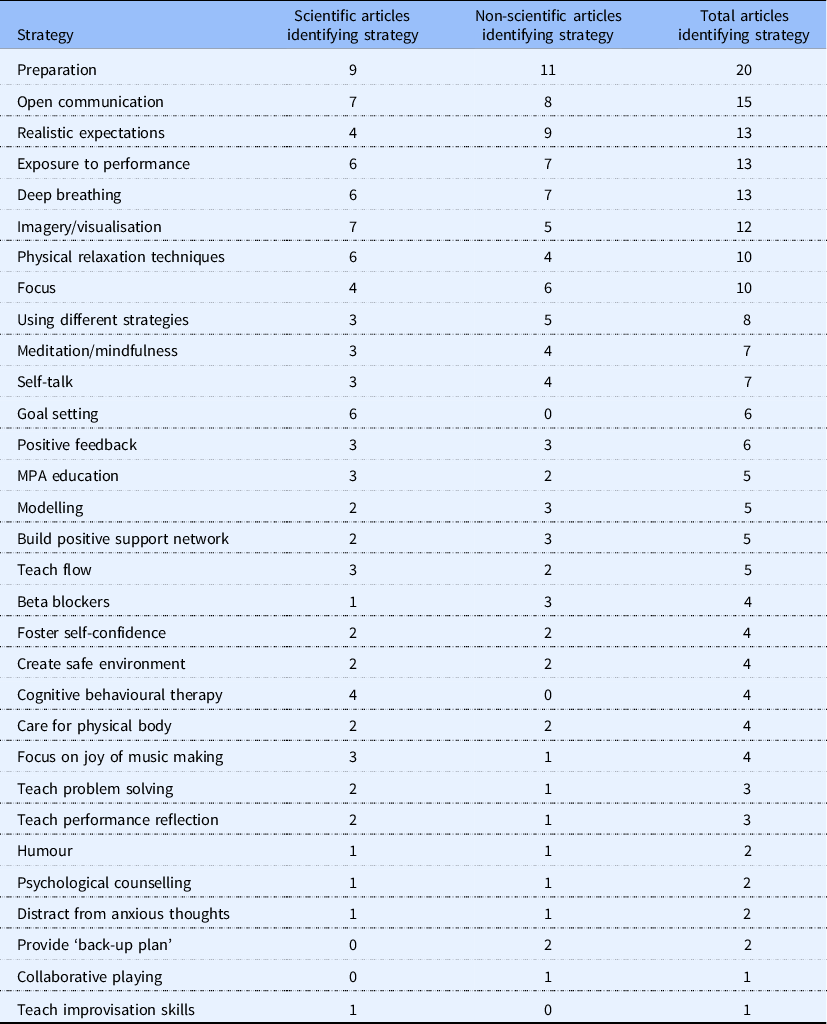
Thirty-one coping strategies were identified during the quantitative content analysis. The five most frequently coded coping strategies are preparation, open communication, realistic expectations, exposure therapy and deep breathing (see Table 1).
MPA coping strategies used by music teachers identified in scientific and non-scientific literature

Note. MPA = music performance anxiety. See Appendix A for full list of scientific and non-scientific articles identifying each coping strategy
Part two: Qualitative thematic analysis of scientific and non-scientific literature
Method
Sample
A qualitative thematic analysis explored how music teachers describe common MPA coping strategies in scientific and non-scientific literature. The sample consisted of all articles identified in part one as related to one of the five frequently coded coping strategies. Eleven scientific and 20 non-scientific articles were included, for a total of 31 sources.
Data analysis
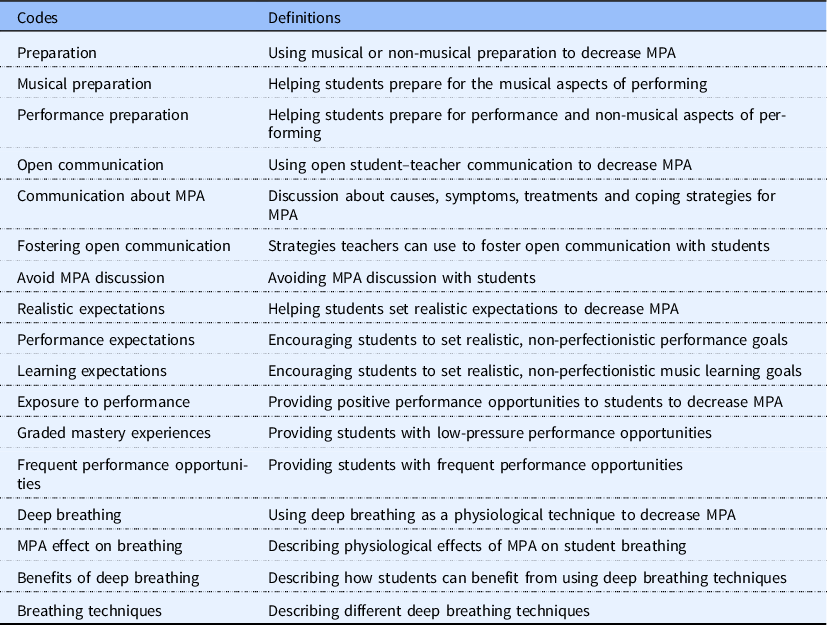
All articles were deductively coded (Braun & Clark, Reference BRAUN and CLARK2006), using the five most frequently coded strategies identified in part one as broad themes. After reviewing the data, the researcher created a list of codes within each theme. Two researchers with qualitative coding and music teaching experience independently coded three articles with the initial coding list. The researchers compared results and achieved high agreement for all codes. After establishing inter-coder agreement, the primary researcher coded the remaining data using the final coding list (see Table 2). While Creswell (Reference CRESWELL2007) suggests remaining open to addition themes, the researchers focused on the five identified themes to limit the scope of the paper.
Coding list and definitions

Results
Thirty-one scientific and non-scientific articles were coded in the qualitative thematic analysis using the five strategies identified in part one (preparation, open communication, realistic expectations, exposure to performance, deep breathing) as broad themes. Since both sources describe similar content, scientific and non-scientific data are presented in combination.
Preparation
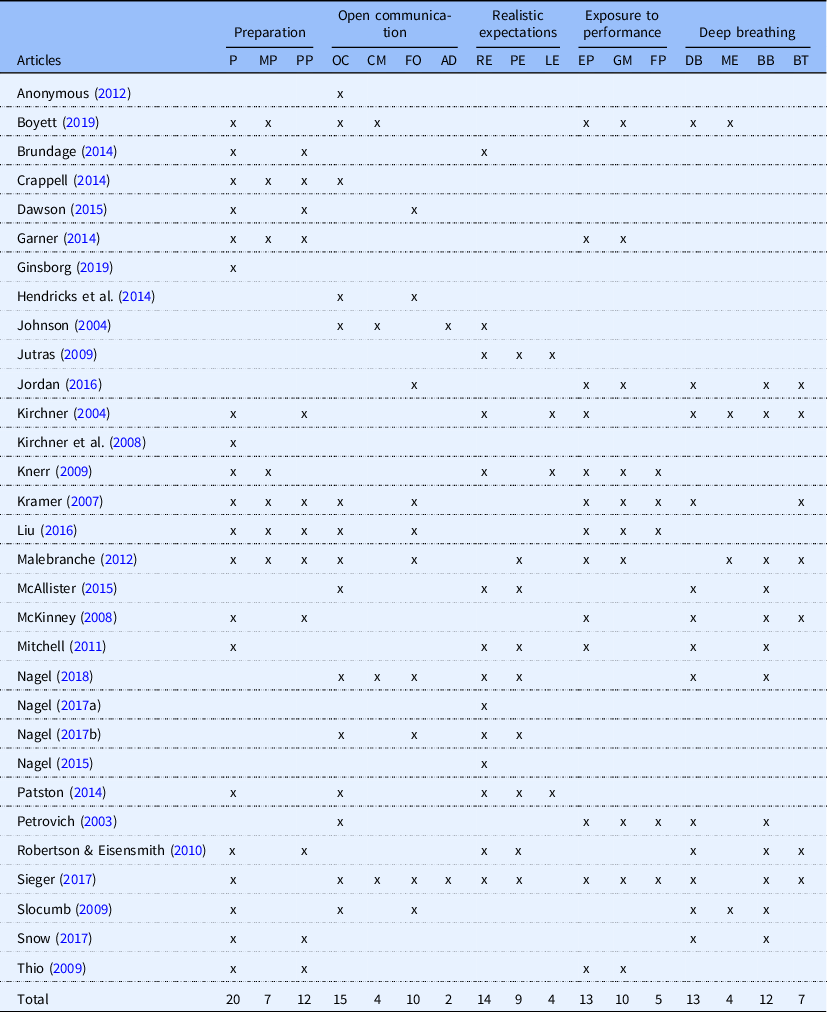
Twenty articles described preparation as an effective MPA coping strategy (see Appendix B). Teachers identified poor preparation as a large contributor to student MPA and propose that ‘one way to cope with anxiety is being well prepared for each aspect of the music: the structure, basic technique, interpretation, memory, and performance’ (Liu, Reference LIU2016, p. 123). Descriptions of preparation fell into two categories: musical and performance preparation. Teachers described musical preparation as helping students learn their pieces well to promote musical security before performing onstage. Several different techniques were used to musically prepare students, such as providing proper practice instructions, using analytical activities to enhance student understanding of the music and teaching proper memorisation. Teachers described performance preparation as helping students prepare for non-musical aspects of performance. This can include teaching students to manage performance malfunctions, providing dress rehearsals and addressing other aspects that can contribute to MPA. Teachers suggest training students to deal with potential performance problems, such as distractions or memory slips. Additionally, dress rehearsals can increase student comfort in the performance space by allowing students to ‘test-run’ their piece and have the added benefit of ensuring that students are musically prepared. Finally, teachers discuss addressing any remaining non-musical aspects, such as shoes and clothing, introductions and bowing, and proper sleep and nutrition. Kirchner (Reference KIRCHNER2004) states that ‘attending to these [non-musical] matters will help reduce any last-minute panic on the day’ (p. 22). While teachers believe that preparation may decrease MPA, they also acknowledge that preparation will not necessarily eradicate MPA.
Open communication
Fifteen articles described open teacher–student communication as an effective strategy to buffer against MPA (see Appendix B). Descriptions of open communication fell into three categories: communication about MPA, fostering open communication and avoiding MPA discussion. Teachers in the literature felt it was their responsibility to discuss MPA symptoms, causes and treatments with students. For example, Johnson (Reference JOHNSON2004) suggests that teachers should proactively discuss MPA as ‘waiting to have the “how to cope” talk after a performance disaster is too little, too late’ (pg. 81). Teachers also describe the importance of creating a safe environment as students are more likely to speak honestly about MPA when they feel comfortable. Suggestions for creating a safe environment include listening, validating fears, sharing personal experience and normalising MPA. While most teachers in the literature prefer proactive MPA communication, several teachers avoided MPA discussion with younger students for fear that ‘it would inadvertently increase the possibility of occurrence’ (Sieger, Reference SIEGER2017, p. 45). Teachers feared that introducing the concept of MPA to students who had not yet experienced symptoms could unintentionally increase MPA.
Realistic expectations
Thirteen articles described setting realistic expectations as an effective strategy to manage MPA (see Appendix B). Descriptions of realistic expectations fell into two categories: performance expectations and learning expectations. Teachers suggest perfectionistic expectations can increase MPA in students and agreed that ‘striving for perfection (versus appreciating competence and playing “as well as you can”) is a ticket to experiencing performance anxiety’ (Nagel, Reference NAGEL2015, p. 46). Teachers combat perfectionism induced MPA by helping students set realistic performance expectations that focus on intrinsic rather than extrinsic goals. Teachers suggest helping students set intrinsic goals such as playing through a piece without stopping or working towards performing expressively rather than perfectly. Johnson (Reference JOHNSON2004) states, ‘It’s really never too soon … to let the student know that one wrong note does not nullify the other 683 beautifully played ones’ (p. 81). Teachers in the literature also describe setting realistic learning goals, as unrealistic expectations, such as assigning a piece that is too challenging, can result in failure experiences and decreased performance self-efficacy. Realistic learning expectations can include choosing appropriate repertoire, setting reasonable learning time frames and setting manageable practice goals.
Exposure to performance
Thirteen articles described exposure to performance as an effective MPA coping strategy (see Appendix B). Descriptions of exposure fell into two categories: graded mastery experiences and frequent performance opportunities. Teachers suggest that exposure to performance can decrease MPA as it helps ‘students to become desensitized to the uniqueness of high-stakes music performance’ (Jordan, Reference JORDAN2016, p. 104). Teachers describe graded mastery experiences, which are when ‘exposure is introduced incrementally beginning with low-intensity performance situations, such as playing for a friend in one’s home, and graduating to higher-intensity experiences, such as playing in a larger venue’ (Garner Reference GARNER2014, p. 57). The positive mastery experience gained from low-intensity performances can increase self-efficacy and decrease MPA for subsequent higher-intensity performances. Teachers stress the importance of providing low-intensity opportunities in supportive settings, as students are less likely to feel anxious performing in a positive environment. Teachers also suggest that students should perform frequently, indicating that on stage comfort typically increases the more often students perform. Frequent exposure also allows students to ‘gradually gain practice coping with negative symptoms associated with anxiety’ (Garner Reference GARNER2014, p. 57), and as students gain more experience performing successfully despite MPA symptoms, their confidence in coping with MPA increases.
Deep breathing
Thirteen articles described deep breathing as an effective strategy to manage MPA (see Appendix B). Descriptions of deep breathing fell into three categories: MPA effect on breathing, benefits of deep breathing and breathing techniques. Teachers in the literature state that MPA can interfere with normal breathing patterns when ‘the sympathetic branch of the autonomic nervous system begins to work harder and cause symptoms such as increased heart rate, respiration, dizziness and muscle tension’ (Boyett, Reference BOYETT2019, p. 11). To combat physiological MPA symptoms, teachers suggest using deep breathing to regulate the autonomic nervous system and promote relaxation. Teachers described deep breathing as a practical strategy because it can be ‘applied in several settings’ (McKinney, Reference MCKINNEY2008, p. 27), and a versatile strategy because it can be combined with other coping skills such as progressive muscle relaxation or visualisation. While practical and versatile, teachers stress that students should practice deep breathing prior to performing, as ‘it will be impossible to execute under pressure unless the student has planned this into his or her performance’ (McKinney, Reference MCKINNEY2008, p. 28). Teachers in the literature described several deep breathing techniques including centred breathing, counting the breath and breath awareness.
Part three: Qualitative thematic analysis of piano teacher interviews
Method
Participants
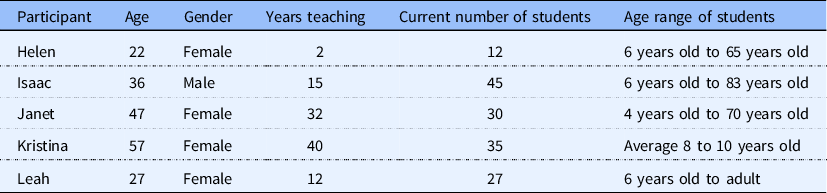
The Research Ethics Board of the researcher’s home institution approved this study. As this study was part of a larger set of studies examining MPA in adolescent pianists (Dempsey & Comeau, Reference DEMPSEY and COMEAU2019; MacAfee & Comeau, Reference MACAFEE and COMEAU2020a, Reference MACAFEE and COMEAU2020b), five private piano teachers between the ages of 22 and 57 participated. Participants were required to have at least 1 year of teaching experience and needed to currently be teaching private piano lessons. All participants belonged to the Ontario Music Teachers Registered Association (ORMTA) and were recruited in person at an ORMTA conference in Ottawa. Additionally, all participants studied under the Royal Conservatory of Music (RCM) curriculum and taught piano lessons at private home studios. Helen was a 24-year-old female who had an RCM elementary piano pedagogy certificate as well as a grade 10 RCM piano performance certificate. She was currently completing a Bachelor of Music. Isaac was a 36-year-old male who had an RCM Associate Diploma (ARCT) certificate in piano performance as well as a Bachelor of Music. Janet was a 47-year-old female who had an RCM ARCT certificate in piano performance and an Associate Teacher’s diploma from Conservatory Canada (CC). Janet also had a Master’s degree in Piano Performance and Pedagogy. Kristina was a 57-year-old female who had an RCM ARCT certificate in piano pedagogy. Finally, Leah was a 27-year-old female who had RCM ARCT certificates in piano performance and piano pedagogy and had a Bachelor of Music in Piano Performance (see Table 3).
Demographic variables for interview participants

Measurements
Semi-structured interviews
The researcher conducted semi-structured interviews to explore which coping strategies participants use to support students with MPA, as well as determine participants’ general MPA knowledge (see Appendix C). Liu’s (Reference LIU2016) pre-existing interview guide provided the basis for the current interview guide. Applicable questions from Lui’s guide were adapted for the study, while several questions not pertaining to the project were removed. As well, several researcher-created questions on coping with MPA were added to fully explore participants’ teaching experiences helping students manage MPA. While the analysis focused on the five strategies identified in part one, the researcher did not ask specific questions related to these strategies. Instead, the interviews consisted of general questions related to MPA knowledge and strategies, which avoided biasing participant responses towards the strategies identified in part one. This allowed the researcher to determine if participants currently used the identified strategies, and if so, explore how they described them.
Procedure
The researcher recruited participants in-person on the first evening of an ORMTA conference. Conference attendants were provided with information on the current study and interested participants were asked to contact the researcher either in-person or via email. Once the researcher was contacted by potential participants, the researcher arranged to meet participants in-person on the second day of the ORMTA conference. The researchers intended to recruit five participants to limit the scope of the paper, and five participants contacted the researcher, so all interested teachers were able to participate. After obtaining informed consent, participants completed semi-structured interviews in the hotel lobby where the conference was held. Interviews lasted between 15 and 25 min and were recorded using a recording programme on the researcher’s cell phone. Following the interviews, audio files were transferred to the researcher’s computer and password protected, and pseudonyms were assigned to protect participant identity.
Data analysis
The researcher transcribed all verbal, non-verbal and background content in the interviews (McLellan, MacQueen, & Neidig, Reference MCLELLAN, MACQUEEN and NEIDIG2003). Upon review, the non-verbal content did not add additional meaning to the verbal content and was excluded from the analysis. The researcher adopted a three-pass-per-tape policy to establish transcription accuracy and performed member checks to establish credibility (Lincoln & Guba, Reference LINCOLN and GUBA1985; McLellan et al., Reference MCLELLAN, MACQUEEN and NEIDIG2003). After transcription, the researcher conducted a qualitative thematic analysis on the five interview transcripts using the method and coding list established in part two (see Table 2). As with part two, the researchers focused on the five identified themes to limit the scope of the paper and did not remain open to exploring additional themes or strategies in the data.
Results
Preparation
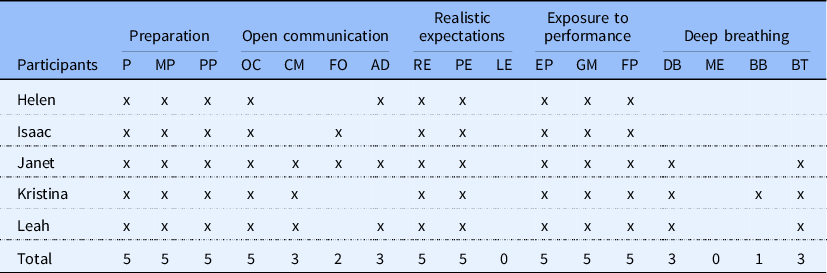
All five interview participants described preparation as an effective MPA coping strategy (see Appendix D). Interviewed teachers reported similar elements as teachers in the literature, such as using musical and performance preparation to reduce student MPA. Teachers described the importance of dress rehearsals and learning how to manage performance malfunctions so that ‘they [students] can do it even if something goes wrong’ (Leah). Interviewed teachers also acknowledged that some students ‘prepare so well, and still things go wrong’ (Janet), suggesting that students may need additional MPA coping strategies.
Open communication
All five interview participants described open teacher–student communication as an effective strategy to buffer against MPA (see Appendix D). Interviewed teachers’ descriptions of open communication differed from literature descriptions. Most participants shared a belief that teachers should discuss MPA with students, but student–teacher MPA communication only occurred if a student was already exhibiting MPA symptoms or if a performance was impacted by MPA. Otherwise, participants avoided MPA discussion with students who did not exhibit MPA symptoms for fear of inadvertently increasing MPA. For example, Helen stated, ‘For students that do get nervous, then I will talk about the nervousness of performance because they already know what it is’, but Leah stated, ‘If the kid is totally happy to go onstage and play, I wouldn’t say, “What if you get nervous?” Because then they might realize that they can get nervous’.
Realistic expectations
All five interview participants described setting realistic expectations as an effective strategy to manage MPA (see Appendix D). Similar to teachers in the literature, interviewed teachers agreed that perfectionistic performance expectations can increase student MPA. However, participants discussed intrinsic versus extrinsic goals more explicitly and acknowledged the practical consequences that can stem from unsuccessful performances. For example, Kristina described how an unsuccessful university entrance audition could mean that a student must put their life on hold for a year. She highlights how intrinsic goals, like performance enjoyment, can help protect self-efficacy against the negative effect of unsuccessful extrinsic evaluations. In contrast to teachers in the literature, interview participants did not discuss realistic learning expectations.
Exposure to performance
All five interview participants described exposure to performance as an effective MPA coping strategy (see Appendix D). Interviewed teachers reported similar elements as teachers in the literature, such as using graded mastery experiences and frequent performance opportunities to help decrease MPA. The teachers highlighted that low-intensity opportunities should be provided in supportive settings to help reduce MPA. For example, Helen’s students gather before studio recitals to play musical games, which helps create a non-threatening atmosphere. Interviewed teachers also agree that performing frequently can help increase student comfort on stage. As Leah states, ‘Exposure is helpful for any fear, right? Just do it, a lot’.
Deep breathing
Three interview participants described deep breathing as an effective strategy to manage MPA (see Appendix D). While teachers in the literature often discussed deep breathing, this coping strategy was only briefly acknowledged by three interviewed teachers. For example, Krista indicated that she instructs students to ‘breathe, relax, and play the piece’. While her comment indicates an awareness that deep breathing can benefit students during performance, the interviewed teachers did not describe how or why students might implement this coping strategy.
Discussion
The current study asked three research questions: (a) What are the five most common strategies music teachers use to support young musicians with MPA based on a quantitative content analysis of scientific and non-scientific literature?, (b) How do music teachers describe the five most common MPA coping strategies (as identified in the previous question) based on a thematic analysis of scientific and non-scientific literature? and (c) How do piano teachers describe the five most common MPA coping strategies (as identified in the first question) based on a thematic analysis of semi-structured interviews?
A quantitative content analysis of scientific and non-scientific literature identified 31 strategies music teachers use to reduce MPA. The results suggest that teachers use a variety of tools to help students manage MPA. Of these strategies, preparation, open communication, realistic expectations, exposure therapy and deep breathing were coded most frequently. Qualitative thematic analyses revealed that preparation was the coping strategy discussed most often by teachers in the literature and interviewed teachers. Teachers from both data sets agreed that poor preparation is a contributor to MPA, and therefore used musical and performance preparation to reduce student MPA. Several study results support the idea that preparation can buffer against MPA (Clark & Williamon, Reference CLARK and WILLIAMON2011; Osborne & Kenny, Reference OSBORNE and KENNY2008), and research also indicates that professional musicians combat MPA with preparation (Dempsey & Comeau, Reference DEMPSEY and COMEAU2017). However, literature and interviewed teachers also suggest that preparation may not alleviate all MPA symptoms, an observation supported by Kenny’s (Reference KENNY2011) definition that MPA is ‘at least partly independent of preparation, experience, or practice’ (p. 60). Since preparation may not eradicate MPA, teachers could consider providing additional coping strategies.
Open student–teacher MPA communication was the second most frequently discussed coping strategy from the quantitative analysis. The qualitative analysis revealed that teachers in the literature believe that proactive MPA discussion can increase student awareness, as well as encourage students to share their MPA experiences honestly with teachers. Literature teachers used tools such as validating fears, listening and normalising MPA to promote open student–teacher communication. In contrast, interviewed teachers avoided MPA discussion with younger students or students who did not exhibit MPA symptoms for fear that introducing the concept of MPA could unintentionally increase MPA. However, this belief could be problematic as comparisons between self-report MPA and observed behavioural anxiety symptoms indicate that self-perceived and observed MPA can differ (Braden et al., Reference BRADEN, OSBORNE and WILSON2015; MacAfee & Comeau, Reference MACAFEE and COMEAU2020a; Spahn, Walther, & Nusseck, Reference SPAHN, WALTHER and NUSSECK2016). Given that teacher observation may not accurately detect MPA, direct communication may be a more effective way for teachers to support students.
Setting realistic expectations was the third most frequently discussed coping strategy from the quantitative analysis, along with exposure therapy and deep breathing. The qualitative analysis suggests that teachers in the literature use realistic performance and learning expectations to help students combat perfectionism induced MPA. Since several study results suggest a positive perfectionism/MPA relationship (Kenny et al., Reference KENNY, DAVIS and OATES2004; Nielsen et al., Reference NIELSEN, STUDER, HILDEBRANDT and NATER2018), setting realistic expectations is a practical strategy teachers can use to address this research finding. In contrast, interviewed teachers discussed realistic performance, but not learning expectations, and were motivated to help students set intrinsic performance goals by the potential consequences of extrinsic evaluations. The differences between literature and interviewed teachers suggest a gap between research knowledge and practical application and indicate a need for methods of communicating research findings to practicing music educators. Evidence-based literature (Daubney & Daubney, Reference DAUBNEY and DAUBNEY2016) designed to provide teachers with practical strategies to help students manage MPA is one way researchers can bridge this potential knowledge gap.
Exposure therapy was the fourth strategy identified in the quantitative analysis. Qualitative analyses suggest that literature and interviewed teachers offer students graded mastery experiences and frequent performance opportunities to increase comfort on stage. Students are more likely to succeed in low-intensity environments, and the resulting positive mastery experiences can increase self-efficacy for subsequent performances (Hendricks et al., Reference HENDRICKS, SMITH and LEGUTKI2015; Royo, Reference ROYO2014). Given findings that indicate a negative self-efficacy/MPA relationship (McPherson & McCormick, Reference MCPHERSON and MCCORMICK2006; Robson & Kenny, Reference ROBSON and KENNY2017), increases in self-efficacy following exposure therapy may also decrease MPA. Exposure therapy can also help students feel more confident in their ability to manage MPA. When students perform successfully despite MPA, the positive mastery experience will likely help them feel more efficacious the next time they have to cope with MPA symptoms (Bandura, Reference BANDURA1993).
Deep breathing was the final strategy identified in the quantitative analysis. A qualitative analysis revealed that teachers in the literature viewed deep breathing as a practical strategy to help regulate physiological MPA symptoms. Literature teachers described several different breathing exercises for students, demonstrating the versatility of the strategy. However, the qualitative analysis of interview transcripts demonstrated that interviewed teachers had minimal awareness that deep breathing could benefit student performance or manage MPA. Again, the differences between literature and interviewed teachers suggest a gap between research knowledge and application when it comes to effectively supporting students with MPA.
Limitations
The sample size of the interviewed participants limits the transferability of the findings to the overall population. Generalisations about all music teachers are not possible in the current study. A second limitation is participant recruitment. Given that potential participants were asked to contact the researcher, it is likely that the teachers who chose to participate were already interested in the topic of MPA. As such, the interview data may not represent the views of teachers who are not interested or are less knowledgeable about the topic. A third limitation is the non-scientific literature sample size. The literature search was limited to two music magazines for the scope of the paper, but a wider range of non-scientific literature may be found in other magazines. The semi-structured interviews are a fourth limitation. The researchers did not ask questions about specific strategies for fear of biasing participant responses. While general interview questions allowed the current study to explore whether teachers are aware of and implementing MPA strategies from the literature, the absence of specified questions means that the interview data may not fully represent participant knowledge on the identified strategies. Additionally, the analysis of interviews was limited to the five identified strategies, meaning that the data presented may not fully represent other potential MPA strategies used by the current participants. Next, the interviews did not explore whether participants have access to journals or research on MPA. As the findings indicate that teachers may not be consistently implementing suggestions from MPA research, a fifth limitation of the study is that it did not explore whether teachers have access to this information. Finally, a sixth limitation is the study location. All interviewed teachers were from Ontario, and teachers from other regions may use different coping strategies. However, despite these limitations, this study offers important exploratory findings that can guide future research on MPA from music teachers’ perspective.
Future research
While the current study focused on five coping strategies, future researchers could investigate other strategies to gain a wider perspective on current MPA teaching practices. Additionally, future researchers could examine strategies used by teachers from different regions and pedagogical backgrounds to further investigate teacher perspective on MPA. Future researchers could also conduct a similar study with more non-scientific review and interview participants to continue to expand the scope of research. Next, future researchers could explore how factors such as student age, skill level or teacher experience can influence student MPA and music teachers’ responses to said MPA. Finally, future researchers could explore whether teachers have access to specialist advice or research journals on MPA. One area for future researchers to consider is how teachers perceive their ability to help students’ cope with MPA, as it may be lack of confidence rather than lack of access that prevents teachers from implementing suggestions from existing MPA literature. However, if researchers find that this information in inaccessible for practicing teachers, one potential solution could be for researchers to use scientific literature to develop MPA training workshops for music teachers.
Conclusion
A quantitative content analysis of scientific and non-scientific literature revealed 31 strategies music teachers use to help students manage MPA, indicating that teachers employ a variety of tools to combat student MPA. Of these strategies, preparation, open communication, realistic expectations, exposure therapy and deep breathing appeared most frequently in the literature. Two qualitative thematic analyses revealed that descriptions of these strategies varied between teachers in the literature and interviewed teachers, which suggests a gap between research knowledge and practical application. Providing teachers with formal training opportunities grounded in MPA research could bridge the knowledge gap and supply music teachers with additional resources to effectively manage student MPA.
Dr. Erin MacAfee completed her Ph.D. at the School of Human Kinetics of the University of Ottawa and has earned degrees in Piano Pedagogy (MA) from the University of Ottawa and Music (BMus) from Brock University. Specialising in music performance anxiety, her research explores the relationships between self-efficacy and anxiety in young musicians and interventions to help students suffering from anxiety. Dr. MacAfee is also the executive director of Lotus Centre for Special Music Education, a Centre that is a leader in increasing access to adapted music education for individuals with special needs.
Director of the Music and Health Research Institute and Director of the Piano Pedagogy Research Laboratory at the University of Ottawa, Gilles Comeau is a member of the Royal Society of Canada. Recognised for his innovative work, he has helped establish piano pedagogy on solid scientific basis. With the creation of a unique research laboratory and ingenious multidisciplinary research, Comeau has opened a new path in research.
Appendix A
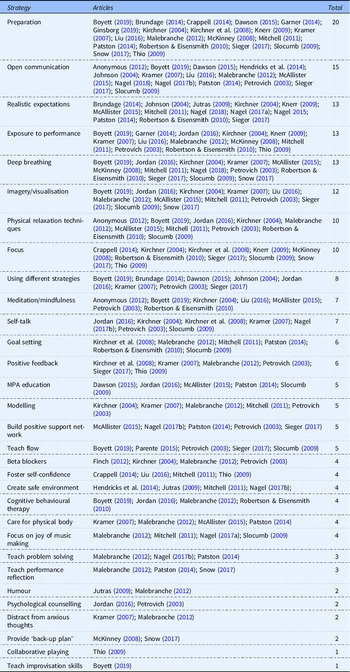
MPA coping strategies used by music teachers identified in individual scientific and non-scientific references

Note. MPA = music performance anxiety. Articles = The scientific and non-scientific articles containing recording units pertaining to the relevant MPA coping strategy. Total articles = total number of articles containing recording units related to the relevant MPA coping strategy
Appendix B
Codes identified in thematic analysis of scientific literature and non-scientific literature

Note. P = preparation, MP = musical preparation, PP = performance preparation, OC = open communication, CM = communication about MPA, FO = fostering open communication, AD = avoid MPA discussion, RE = realistic expectations, PE = realistic performance expectations, LE = realistic learning expectations, EP = exposure to performance, GM = graded mastery experience, FP = frequent performance opportunities, DB = deep breathing, ME = MPA effect on breathing, BB = benefits of deep breathing, BT = breathing techniques. An x indicates which codes were identified in each article.
Appendix C
Semi-structured interview guide
Good morning/afternoon. Thank you for agreeing to participate in this project. Today we will be conducting a short interview to explore your thoughts on performance anxiety. As well, we will also be discussing strategies you use in your teaching practice to help students cope performance anxiety. Are you ready to get started?
Teacher background
-
First, could you describe your teaching background?
-
○ How long have you been teaching?
-
○ How many students do you currently teach?
-
○ How old are your current students?
-
Performance anxiety issues
We’re going to talk a little about what anxiety is and how it presents in your students.
-
How would you define performance anxiety?
-
○ Could you describe any common mental or physical symptoms of anxiety you observe in your students?
-
-
In your opinion, what kinds of situations make students nervous when performing?
-
○ Audience, evaluation, unfamiliar setting, etc.
-
-
Throughout your teaching experiences, what are the effects of anxiety on student performance?
-
○ Are they positive/negative
-
○ What kinds of things do they affect (technique, expression, memorisation, etc.)
-
-
In your experience, are there specific characteristics that might make a student more prone to performance anxiety?
-
○ Males versus females?
-
○ Age (children versus teenagers)?
-
○ If age is a factor influencing anxiety, at what age do you observe that students begin to feel nervous about performing?
-
○ Self-confidence/self-efficacy?
-
Preparing for performances/coping with MPA
Next, we’re going to talk about ways you help your students prepare for performances and cope with MPA leading up to performances.
-
How do you prepare your students to cope with MPA before performing a big concert or competition?
-
○ Could you describe any coping strategies you have found particularly successful in helping ease performance anxiety in young musicians?
-
-
When your students face obstacles or challenges when preparing for performance, how do you try to help them overcome these challenges?
-
○ If they overcome challenges, do you observe an impact on the students’ feelings about the upcoming performance?
-
-
Do you give your students any advice or encouragement leading up to their public performance?
-
○ What kinds of advice/encouragement do you give?
-
-
Some say there is a connection between memorisation and anxiety. Do you observe performance anxiety stemming from memorisation issues/worries in your students?
-
○ If so, how do you help your students deal with anxiety around memorisation?
-
-
Do you ever have students watch videos or recordings of themselves or other musicians leading up to performances?
-
○ Why or why not?
-
○ If yes, what affects, if any, do you observe when your students watch recordings?
-
○ Effects on anxiety?
-
○ Effects on self-efficacy/self-confidence?
-
During performance
-
Do you discuss with your students how to manage performance anxiety that occurs while they are performing (anxiety experienced during performance)?
-
○ What types of strategies do you suggest for your students when they are nervous during a performance?
-
-
Many students indicate that focusing or concentrating on the music during a performance helps them combat performance anxiety. Do you believe this is true?
-
○ If yes, do you have any specific teaching techniques you use to help teach students to focus while onstage?
-
Comments
-
Do you think there is any way to prevent MPA from developing in students?
-
Why or why not?
-
If yes, what can be done to prevent MPA from developing?
-
-
In your opinion, do you think MPA should be addressed at an early on in a student’s musical education?
-
Anything else that you would like to add to this topic?
Appendix D
Codes identified in thematic analysis of interview transcripts

Note. P = preparation, MP = musical preparation, PP = performance preparation, OC = open communication, CM = communication about MPA, FO = fostering open communication, AD = avoid MPA discussion, RE = realistic expectations, PE = realistic performance expectations, LE = realistic learning expectations, EP = exposure to performance, GM = graded mastery experience, FP = frequent performance opportunities, DB = deep breathing, ME = MPA effect on breathing, BB = benefits of deep breathing, BT = breathing techniques. An x indicates which codes were identified in each transcript.