

1. Introduction
Conjoint experiments have become a popular method for studying many central questions in political science and beyond. Recent research has helped clarify what conjoint experiments can and cannot estimate (Acharya et al., Reference Acharya, Blackwell and Sen2018; Ganter, Reference Ganter2021; Abramson et al., Reference Abramson, Kocak and Magazinnik2022; Bansak et al., Reference Kirk, Hainmueller, Hopkins and Yamamoto2022). In this study, we argue that these features of the conjoint experiment are not just limitations but also opportunities to study theoretically important questions for political science, including the question of voters’ choice of political candidates.
We focus on two theories of attitude formation. The first is the idea that people select choice options (e.g., candidates) with certain attributes because they associate these attributes with other attributes that they lack information about. For instance, without information on party affiliation, some voters may prefer women because they associate women with the Democratic Party (Sanbonmatsu and Dolan, Reference Sanbonmatsu and Dolan2009), not because of their gender.
This is a well-established theory often called “masking” (Bansak et al., Reference Kirk, Hainmueller, Hopkins and Yamamoto2021, 55), but it is also described by many other terms in the literature. For example, Brady and Sniderman (Reference Brady and Sniderman1985) refer to masking as “attitude attribution” and Dafoe et al. (Reference Dafoe, Zhang and Caughey2018), 401 call it “information non-equivalence” and note that other terms are “information leakage,” “confounding,” “aliasing,” and violations of “excludability.” Conjoint experiments are designed to reduce the problem of masking because respondents are (typically) asked to choose between two options that are described by a number of attributes. However, there is always a risk that the presented attributes mask the effect of an attribute not presented.
There are many studies attempting to address the masking challenge, but few consider the other theoretical possibility that is the second focus of this study: “lexicographic preferences” (Fishburn, Reference Fishburn1975). This theory says that voters select candidates based on one dominating attribute (e.g., party affiliation), regardless of all other attributes. Only if the voter is asked to choose between two candidates with the same value on the dominating attribute do they consider other attributes such as gender and race (Drakopoulos, Reference Drakopoulos1994).
In many instances, masking and lexicographic preferences would predict the same outcome of a study, even if they point to vastly different psychological processes as explanations. For example, if the effect of candidate gender is larger when the candidate’s party affiliation is absent as opposed to when this information is present, both theories of candidate choice could explain the result.
The theory of masking would predict that respondents are trying to use the available information to predict information they do not have (party affiliation) to make a choice. This leads to a larger effect of gender if the respondent thinks gender predicts the party affiliation of the candidate. Therefore, there may be a smaller effect of gender when information on party affiliation is available; no prediction is needed. The theory of lexicographic preferences would also predict a larger effect of gender on candidate choice, but for different reasons. If there is no information on party affiliation, and this is a lexicographic first-order attribute to the voter, they might assume that available candidates are from the same party. In this case, they will move on to second-order attributes like gender and base their candidate choice on it. In other words, they use gender in its own right without using it to predict other attributes—but only when they think their first-order preference is satisfied or irrelevant.
Much literature studying masking might overlook the plausible explanation of lexicographic preferences. For example, anti-immigrant attitudes may mask the effect of rivaling countries (Wimmer et al., Reference Wimmer, Bonikowski, Crabtree, Zheng, Golder and Tsutsui2024), yet it may also be that country rivalry is a first-order preference. Police discrimination against some socio-demographic groups in Nepal may mask class discrimination (Boittin et al., Reference Boittin, Fisher and Cecilia Hyunjung2024). Yet, it may also conceal that caste is a first-order preference. In contrast, Dill et al. (Reference Dill, Howlett and Müller-Crepon2023) show that political autonomy and territorial integrity are first-order preferences for Ukrainians. Without their research design (which is similar to our proposed test for lexicographic preferences), the preferences regarding fatalities might have been misinterpreted as masking the effect of territorial integrity.
We propose a simple way to distinguish between masking and lexicographic preferences in conjoint experiments that can answer these questions of which explanation is most valid. Measuring lexicographic preferences has been a methodological challenge (Scott, Reference Scott2002), but in a recent study, we show how conjoint experiments can be used to test for lexicographic preferences (Hjortskov and Andersen, Reference Hjortskov and Andersen2024). In the present study, we show that this new way of measuring lexicographic preferences, with the addition of randomizing whether respondents are presented with information on the potential first-order preference, can be used to distinguish between masking and lexicographic preferences.
Our empirical illustrations show—and replicate—that what has been interpreted as a result of masking may at least partly be explained by lexicographic preferences.
2. Masking and lexicographic preferences
Masking is when voters perceive a correlation between a dominating characteristic of the candidate, A (e.g., party affiliation), and another attribute, B (e.g., gender), and information about A is not available. Instead, the voter might use B as a proxy for A when making the choice, making B appear more influential to the choice than it actually is (Bansak et al., Reference Kirk, Hainmueller, Hopkins and Yamamoto2021, 55). Masking is therefore a general methodological challenge that needs to be addressed.
Conjoint experiments are designed to reduce the problem of masking because respondents are (typically) asked to choose between two options that are described by a number of attributes, limiting the need to proxy other attributes. However, there is always a risk that the presented attributes mask the effect of an attribute not presented.
More formally, we define  $\tau_B^{info}$ as the Average Marginal Component Effect (AMCE) of attribute B when there is information about A.
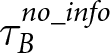 $\tau_B^{no\_info}$ is the AMCE of B when there is no information about A. Bansak et al. (Reference Kirk, Hainmueller, Hopkins and Yamamoto2021) define (traditional) masking as the difference between the two:
 \begin{equation}
\tau_B^{no\_info} - \tau_B^{info}.
\end{equation}
Lexicographic preferences are a type of hierarchical, non-compensatory decision-making that allows a ranking of preferences. People with lexicographic preferences have a dominating preference for one attribute (or one level of an attribute), and only if the choice options all hold the same value on that attribute (or level) will they move on to consider their second-order preference (Fishburn, Reference Fishburn1975; Scott, Reference Scott2002). This view of how decision-makers decide is different from classical rational decision and expected utility theory, where a large enough value of one attribute can compensate for a worse value on another (e.g., a large enough increase in size of a house may compensate for a higher price of that house). Lexicographic preferences imply that if, for instance, party is a first-order attribute, no values of the other attributes (gender, race, experience) can make the voter choose a candidate from the non-preferred party. While lexicographic preferences are not rational in the sense that they are non-compensatory, the information processing that leads to lexicographic preferences could be rational in the sense that the decision-maker considers all available information (all attributes), but the utility function assigns an infinitely high weight on the first-order attribute. Alternatively, and perhaps more realistic, the information processing is boundedly rational, such that the first-order attribute is used as a heuristic: The decision-maker first scans the first-order attribute and use this to make a decision if it is satisfying (if it is possible to choose the preferred party) and only if that is not possible, will the decision-maker move on to consider other attributes (Simon and Newell, Reference Simon and Newell1971; Fishburn, Reference Fishburn1975; Scott, Reference Scott2002; Riedl et al., Reference Riedl, Brandstätter and Roithmayr2008).Footnote 1
We return to a discussion of the information processing models underlying lexicographic preferences. First, we formally define them. Let  $D$ and
 $D'$ be two alternatives defined as two sets of attributes:
 \begin{equation*}\begin{array}{ll}
D = (a,b)\\
D' = (a',b')
\end{array}
\end{equation*}
Following Drakopoulos (Reference Drakopoulos1994), strict lexicographic preferences would, in our two-attribute example, be when D is preferred to  $D'$ if and only if
 \begin{equation*}\begin{array}{ll}
\text{either} & 1)\quad a \gt a' \\
\text{or} & 2)\quad a=a';\quad b \gt b'\\
\end{array}
\end{equation*}
However, instead of thinking of preferences as strictly lexicographic or not (i.e., a binary definition), we propose to define the secondary, lexicographic preferences for attribute B as the difference in preferences for B in choice sets when the values of A are the same ( $a=a'$) and in choice sets when the A values differ (
 $a \neq a'$) (see, e.g., (Scott, Reference Scott2002, 386)).Footnote 2
Let  $\tau_B^{differ}$ be the AMCE of attribute B when there is information about A and the values of A differ between the choice options. Let
 $\tau_B^{same}$ be the AMCE of B when the values of A are the same across the options. We define lexicographic preferences for B as the difference between the two:
 \begin{equation}
\tau_B^{differ} - \tau_B^{same}.
\end{equation}
3. Using conjoint experiments to test for lexicographic preferences
We suggest that conjoint experiments can be used to test the notion of masking against some form of lexicographic preferences. In conjoint experiments, the AMCE of attribute  $B$ is not only identified by averaging the other attributes of the option (in our case, the candidate),
 $D_{-B}$, but also all the attributes of the alternative candidate,
 $D'$, in the same choice task. The AMCE estimates the effect of attributes as an average of all the possible values of the other attributes given the joint distribution of the profile attribute sets (of the two candidate profiles,
 $D$ and
 $D'$, in each choice task). Bansak et al. (Reference Bansak, Hainmueller, Hopkins, Yamamoto, Druckman and Green2021), 31 note: “an important feature of the AMCE as a causal parameter is that it is always defined with respect to the distribution used for the random assignment of the attributes. That is, the true value of the AMCE, as well as its substantive meaning, also changes when one changes the randomization distribution, unless the effect of the attribute has no interaction with other attributes” (see also
Hainmueller et al., Reference Hainmueller, Hopkins and Yamamoto2014, 11).
We use this feature of the AMCE—that it depends on the distribution of other attributes—to separately identify  $\tau_B^{differ}$, i.e., the AMCE of B in conjoint tasks where the parties of the candidates are distributed so that they always differ, and
 $\tau_B^{same}$, i.e., the AMCE of B in conjoint tasks where the candidates are always from the same party.
In conjoint experiments that include information about attribute A, the AMCE for attribute B,  $\tau_B^{info}$, is estimated as a weighted average of the effect in the choice tasks when the values of attribute A differ,
 $\tau_B^{differ}$, and when they are the same,
 $\tau_B^{same}$:
 \begin{equation}
\tau_B^{info} = w\tau_B^{differ} + (1-w)\tau_B^{same}.
\end{equation}
 $w$ is the share of choice tasks where values of A differ. Note that in choice tasks with two candidates from one of two parties (e.g., Republicans and Democrats), respondents will choose between two candidates from the same party in about 50% of the tasks (on average).Footnote 3 Inserting Equation (3) into (1), we see that traditional masking can be decomposed like this:
 \begin{equation}
\tau_B^{no\_info} - \tau_B^{info} = \tau_B^{no\_info} - (w\tau_B^{differ} + (1-w)\tau_B^{same}).
\end{equation}
From Equation (4), we see that what is usually defined as masking is driven by the difference between the no-information condition and both the conditions with variation and without variation on the potentially masked or potentially dominating attribute. Therefore, to obtain what we define as “pure masking,” we propose to only compare the AMCE in the no-information condition,  $\tau_B^{no\_info}$, to the AMCE in the same-values condition:
 \begin{equation}
\tau_B^{no\_info} - \tau_B^{same}.
\end{equation}
The quantity of interest, pure masking, is the difference in the effect when not receiving information about the masked attribute and the effect when receiving information but values are the same. If lexicographic preferences are absent,  $\tau_B^{differ} = \tau_B^{same}$, pure masking equal traditional masking (absent differences in covariate distributions). However, if respondents have lexicographic preferences, pure masking only estimates the effect of receiving information about the masked attribute net of the effect of lexicographic preferences.
Conjoint experiments can be used to distinguish the effects of lexicographic preferences and masking empirically by randomly assigning respondents to three types of choice tasks:
(1) Candidates are from different parties.
(2) Candidates are from the same party.
(3) No information is available about the candidate party.
In type (1) tasks, any second-order lexicographic preferences are dominated because there is variation in the first-order attribute. When two candidates are from the same party, as in type (2) tasks, the effects of second-order preferences are not dominated. No masking effects can influence candidate choice in these two types of choice tasks, since party affiliation is provided in both cases; there is no need to infer it. Masking effects can only occur in choice tasks of type (3) when candidate party affiliation is not provided. If there are pure masking effects that cannot be explained by second-order lexicographic preferences, we should expect to observe larger attribute effects in choice tasks of type (3) than type (2) because these effects combine the effect of non-dominated lexicographic attributes and masking.Footnote 4
Our proposed method can be used to separate the decision strategies of pure masking and lexicographic ordering but does not distinguish between different types of information processing underlying them.Footnote 5 As mentioned, we return to this issue in the discussion.
4. Empirical design
We use data from two different sources to test our method on the case of candidate choice.Footnote 6 First, we use replication data from two candidate conjoint experiments generously made publicly available by Kirkland and Coppock (Reference Kirkland and Coppock2018). One is from a representative sample of US citizens, and one is from a convenience sample. The data from the two experiments have been pooled in the analyses below.
Second, we have preregistered a similar MTurk conjoint experiment to replicate our findings ( $N$ = 1,363). The survey presented respondents with five conjoint choice tasks in which they could choose between two candidates. To test for masking effects, respondents were randomly assigned to a conjoint experiment with either five attributes (gender, race, age, job, and experience) or six attributes (with party affiliation added). For details on the data, see the supplementary material.
5. Results of testing effects of masking vs. lexicographic preferences
We first exploit Kirkland and Coppock (Reference Kirkland and Coppock2018) randomized choice tasks to either present or not present the party affiliation of the candidate. Figure 1 presents the results divided by the respondents’ party affiliation. The first panel shows the results when respondents are informed about the party affiliation of the candidates ( $\tau^{info}$), the second panel shows when they are not informed (
 $\tau^{no\_info}$), and the third when the parties are the same (
 $\tau^{same}$). In all of these panels, there is a positive effect on choosing female candidates for democrats. The estimate of Traditional masking
 $(\tau_B^{no\_info} - \tau_B^{info})$ is presented in the fourth panel, which shows that some of the gender effect may be due to (traditional) masking, since the effect is significantly larger when party is not present than when it is.
However, the fifth panel presents our measure of Pure masking, namely the difference  $\tau_B^{no\_info} - \tau_B^{same}$, and now we see no gender effect. This suggests that what has traditionally been interpreted as a masking effect can be explained by lexicographic preferences.
Marginal causal effects with no party information (masking) and same party (lexicographic). Kirkland and Coppock (Reference Kirkland and Coppock2018) data.

1 Long description
Five dot-and-whisker plots display estimated marginal component effects on the probability of selecting a candidate. The y-axis lists discrete candidate attribute levels grouped by gender (female, male), race (black, Hispanic, Asian, white), age (65, 55, 45, 35), job (stay-at-home dad or mom, electrician, small business owner, police officer, business executive, attorney, educator), experience (school board president, representative in congress, mayor, state legislator, city council member) and party (none, Republican, Democrat, independent, non-partisan). The x-axis is labeled estimated marginal component effects, ranging from minus 0.4 to 0.4 in increments of 0.2. Each plot contains two series of dots with vertical confidence interval lines: one for Republican respondents and one for Democrat respondents. Effects near zero indicate no meaningful change in selection probability; effects where the confidence interval does not cross zero indicate a statistically meaningful departure. The five plots are labeled as follows. The first is labeled party info, showing effects when candidate party affiliation is presented to respondents. Most attribute effects cluster near zero for both groups, with small positive effects of female and black candiates for democratic respondents. The second is labeled no party info, showing effects when party affiliation is not presented. Effects of female and black candidates are larger than frist plot and positive for democrats and negative for republican respondents. The third is labeled same party, showing effects when the candidate and respondent share the same party. Effects of females and black candidates are about the same as in the second plot. The fourth is labeled traditional masking, calculated as no party info minus party info, showing the difference in effects when party information is withheld versus provided. For democrats the difference in effects are positive for females and black candidates. The fifth is labeled pure masking, calculated as no party info minus same party. Effects across most attributes remain close to zero with overlapping confidence intervals for both groups. The legend at the right identifies Republican respondents and Democrat respondents as the two series.
When we look across the other attributes, the results are similar in the sense that there is little evidence of a pure masking effect. Only mayors seem to be more preferred by democratic respondents when they have no party information compared to when they know respondents are from the same party.
5.1. Replicating effects of masking vs. lexicographic preferences
To test more rigorously that there is no pure masking effect, we defined a negligible effect (Rainey, Reference Rainey2014) as less than .05, and preregistered the following hypothesis:
The difference in preferences for (a) female and (b) black candidates when candidates’ party affiliation is excluded and when candidates share party affiliation is less than |.05| (i.e., lower than .05 and higher than  $-$.05, a negligible effect).Footnote 7
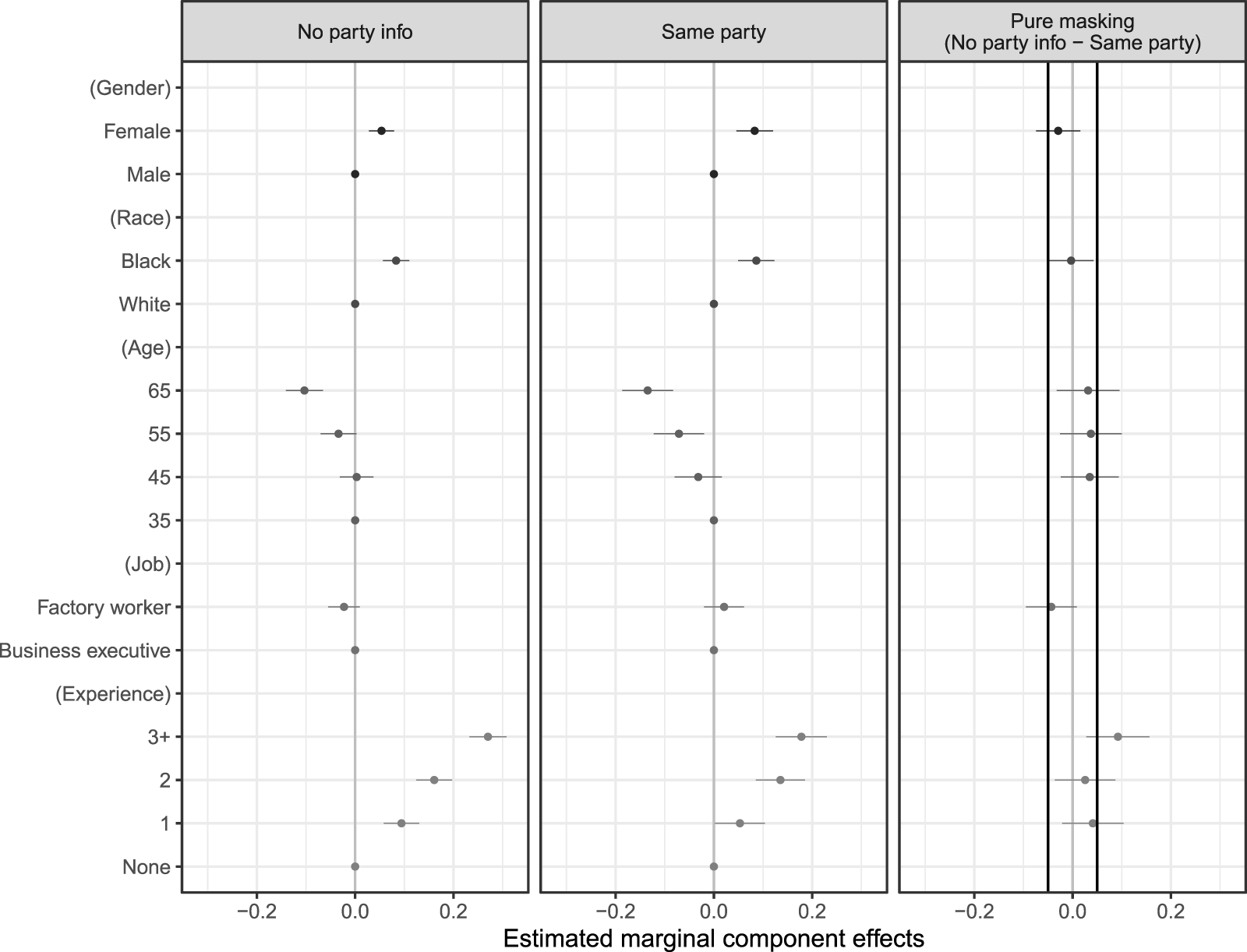
We randomized our respondents to either choice tasks without party information or choice tasks that included party information. The results appear in Figure 2. The figure shows that the effects of both gender and race are very similar in the no-party-information condition (first panel) and the same-party condition (second panel), and the estimate of the pure masking effect in the third panel was, as hypothesized, smaller than 0.05 for both gender and race, as indicated by the black vertical lines in the third panel.
Marginal causal effects with no party information (masking) and same party (lexicographic). Replication data.

Figure 2 Long description
First dot and whisker plot is titled, No party info. The horizontal x-axis label is, Estimated marginal component effects, with tick labels negative 0.2, 0.0 and 0.2. The vertical y-axis lists: left parenthesis Gender right parenthesis with Female and Male; left parenthesis Race right parenthesis with Black and White; left parenthesis Age right parenthesis with 65, 55, 45, 35; left parenthesis Job right parenthesis with Factory worker and Business executive; left parenthesis Experience right parenthesis with 3 plus, 2, 1, None. A vertical reference line is drawn at 0.0. Markers for Female and Black are to the positive side of 0.0, while Male and White are close to 0.0. Age 65 and Age 55 markers are to the negative side of 0.0, while Age 45 and Age 35 are close to 0.0. Factory worker is slightly to the negative side of 0.0 and Business executive is close to 0.0. Experience shows the largest positive markers, with 3 plus farthest to the positive side, 2 and 1 also on the positive side and None close to 0.0. Each marker has a horizontal whisker that spans across a small range around the marker. The second plot showsis titled, Same party. Female and Black markers are to the positive side of 0.0, while Male and White are close to 0.0. Age 65 and Age 55 markers are to the negative side of 0.0, while Age 45 is slightly to the negative side and Age 35 is close to 0.0. Factory worker is slightly to the positive side of 0.0 and Business executive is close to 0.0. Experience markers are on the positive side, with 3 plus farthest to the positive side, followed by 2, then 1 and None close to 0.0. Each marker has a horizontal whisker. The third plot is titled, Pure masking left parenthesis No party info minus Same party right parenthesis. Two vertical reference lines are drawn at minus and plus 0.05 to indicate the neglible effect. Most markers are clustered near 0.0, including Gender, Race and Job rows. Age rows show markers near 0.0 with small shifts around the reference lines. Experience rows show markers slightly to the positive side of 0.0, with 3 plus the farthest among the Experience rows. Each marker has a horizontal whisker.
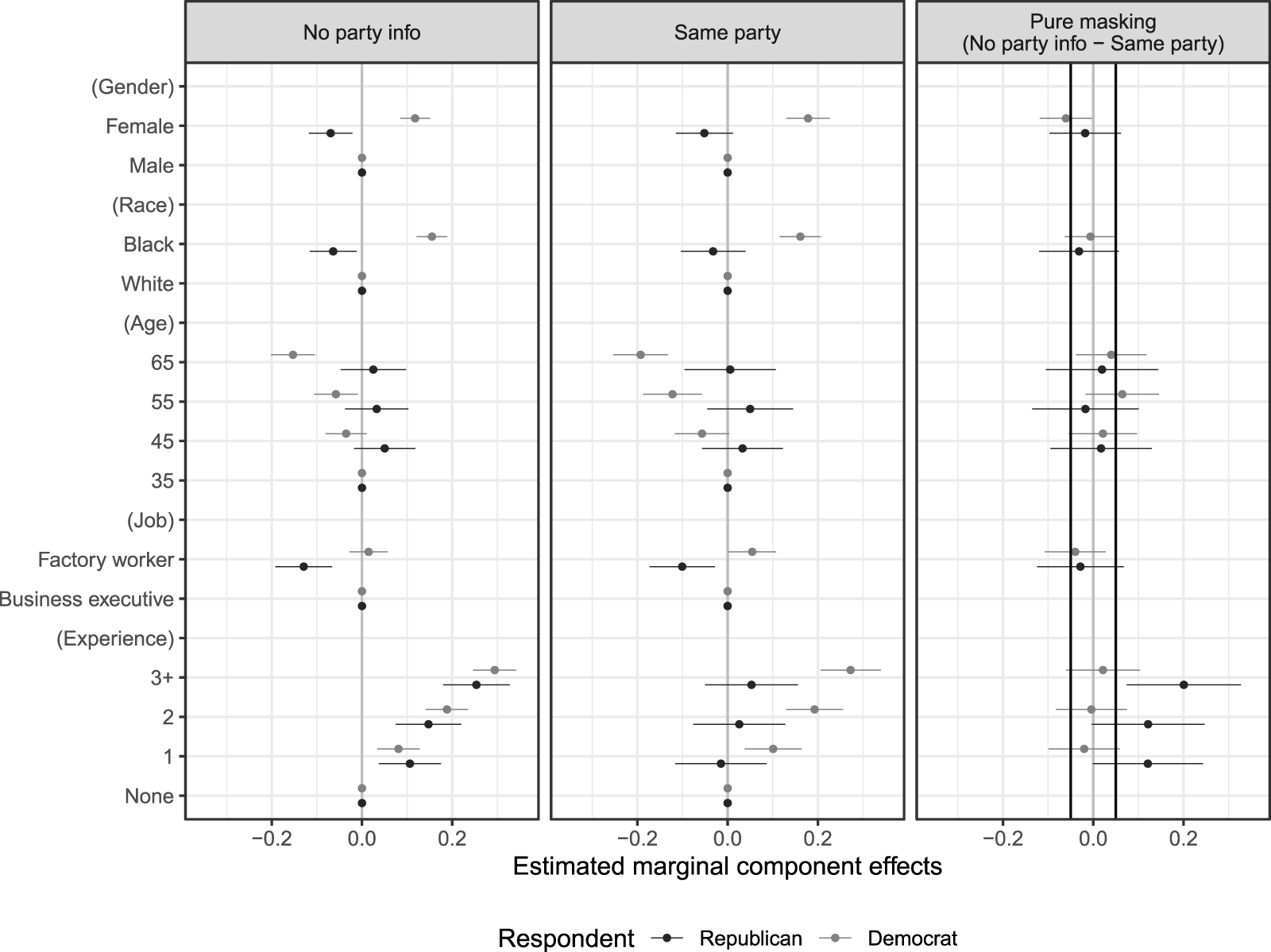
Figure 3 splits the results by Democrats and Republicans. To evaluate whether masking creates effects over and above the effects of lexicographic preferences, it is important to note that effects of female and black candidates are positive for Democratic respondents and negative for Republican respondents. Therefore, if there were significant masking effects, the third panel in Figure 3 should show positive estimates of female and black candidates for Democratic respondents and negative estimates for Republican respondents. However, for Democratic respondents, the estimates in the third panel are actually negative ( $-$.06 for female and
 $-$.01 for black candidates), and the confidence intervals are not above .05 (95% CIs are [
 $-$.12,
 $-$.00] for female and [
 $-$.06, .05] for black candidates). This speaks against effects of masking for Democrats.
Marginal causal effects with no party information and same party—by respondent party. Preregistered MTurk study.

Figure 3 Long description
Party info Same party Pure masking (No party info minus Same party) Three dot and whisker plots share the same horizontal axis label, Estimated marginal component effects. No unit is shown. The horizontal axis has tick labels at minus 0.2, 0.0 and 0.2, with a vertical reference line at 0.0. The vertical axis is a list of candidate attribute levels: (Gender) Female, Male; (Race) Black, White; (Age) 65, 55, 45, 35; (Job) Factory worker, Business executive; (Experience) 3plus, 2, 1, None. Each attribute level has two point estimates with horizontal whiskers, one for Republican and one for Democrat, as indicated by the legend. No party info: Most points for Female, Male, Black, White, ages 65 to 35, Factory worker, Business executive and None are close to 0.0. The Experience rows show the largest positive values, with points for 1, 2 and 3plus positioned to the right of 0.0, reaching roughly between 0.1 and 0.3 on the shared scale. Same party: Most points for Gender, Race, Age, Job and None remain close to 0.0. The Experience rows again show the largest positive values, with points for 1, 2 and 3plus to the right of 0.0, extending to roughly between 0.1 and 0.3. Pure masking (No party info minus Same party): Points for most Gender, Race, Age, Job and None rows cluster near 0.0. The Experience rows show positive differences for 1, 2 and 3plus, with points to the right of 0.0, reaching roughly around 0.1 to 0.2. This plot includes a second vertical line slightly to the right of 0.0.
For Republican respondents, the point estimates are negative but close to 0 ( $-$.02 for female and
 $-$.03 for black candidates). The confidence intervals are broad because of fewer respondents, and they include
 $-$.05 (95% CIs are [
 $-$.10, .06] for female and [
 $-$.12, .06] for black candidates). Therefore, we do not have the statistical power to rule out some modest pure masking above and beyond effects of lexicographic preferences for Republicans. However, all point estimates of the differences are small and less than .05. We also note that for Republican respondents, there seems to be some effect of experience when party information is not provided, which cannot be explained by lexicographic preferences.
5.2. Party inference
We also asked respondents in the no-party group to guess which party the candidates in the fifth scenario belonged to in order to simulate most-likely masking conditions. Not surprisingly, these respondent predictions follow the expected patterns (e.g., women are associated more with the Democrats), and respondents use these predictions to make their choices, indicating masking effects. However, when we consider that respondents often guess the same party for both candidates, we see that this effect might stem from lexicographic preferences as well (see Supplementary Material Figures B3 and B4).
6. Discussion and recommendations
This study has argued that the methodological feature of conjoint experiments that results in regular “ties” on attributes can be used as a theoretically meaningful tool to untangle the effects of masking and lexicographic preferences. Experimentally combining conjoint experiments with and without a certain attribute and actively using the ties can separate pure masking from lexicographic preferences. Through two different candidate studies—one replication and one new—we show that what has so far been interpreted as masking in the candidate choice literature can to a large extent be explained by lexicographic preferences.
We could imagine different information processing models that generate the outcome we interpret as lexicographic preferences. First, it could be that it is not truly lexicographic preferences, but rather compensatory preferences with a very high weight (in contrast to an infinite weight) on the first-order attribute in the utility function. This cannot be tested in our binary example (two parties, two genders, two races). But in other cases, it is a possibility that respondents would be willing to trade-off what seems to be a first-order preference for another attribute, if the value of that other attribute is large enough. Or, relatedly, it could be modified lexicographic preferences, which suggest that beyond a threshold in the first-order attribute, second-order attributes can be considered (Rosenberger et al., Reference Rosenberger, Peterson, Clarke and Brown2003, 64).
Second, even if respondents have true lexicographic preferences, the information processing could, as mentioned, be rational if they consider all attributes, but place infinitely high weight on the first-order attribute in their utility function. Alternatively, the information processing may be boundedly rational—a heuristic—such that respondents only consider the first-order attribute if it satisfies their preferences, and only consider other attributes if it does not. Future research could compare decisions when voters respond to a survey (or other low-stakes decisions) and if they make the same decisions in a high-stakes situation. This may be done by comparing conjoint experiments and real-world occurrences of same-party choices in top-two primaries (Crosson, Reference Crosson2020; Stauffer and Fisk, Reference Stauffer and Fisk2021).
Thirdly, lexicographic preferences may only pertain to one value of the first-order attribute (respondents preferring one party but are indifferent toward other parties), or only to the first-order attribute. But the evaluation of second-order attributes (in case of a tie on the first-order attribute) can be compensatory, as in expected utility theory, or non-compensatory as in, for example, the satisficing, lexicographic, or elimination-by-aspect strategies (Payne et al., Reference Payne, Bettman and Johnson1992; Riedl et al., Reference Riedl, Brandstätter and Roithmayr2008).
Similarly, masking could be the result of a non-rational process in which respondents make arbitrary guesses about any non-disclosed attributes—or it may reflect a rational process in a Bayesian sense in which they use the available information (e.g., that the candidate is female) to update their priors and make posterior beliefs about the party of the candidate (e.g., that it is a democrat, because more female candidates are democrats.)
Finally, we could also imagine that both masking and lexicographic preferences were at play, so that respondents would update their belief about non-disclosed first-order attributes (party) based on information on second-order attributes (gender), and let the inferred first-order attribute dominate their decision. In a Bayesian model, it may even be that they factor in the uncertainty involved in inferring the party based on gender, and therefore add less than infinite weight to the first-order attribute, not because their preferences are not fully lexicographic but because of the uncertainty involved in the inference.
The main recommendation for future research is, however, that studies claiming masking effects should also test for the possibility of a lexicographic explanation by excluding a potential dominating preference and taking same-value conditions into account. This is most straightforward for binary variables. For variables with more than two levels, researchers should consider whether any first-order preferences pertain to all levels or only one of them. In that case, the statistical power and the design of the study should also be considered since, with more levels, a completely random assignment of levels to options would reduce the share of tasks with the same value on both options. Moreover, researchers should consider the share of respondents assigned to a no-information (on the first-order attribute) condition, same information, and different information. For many purposes it may be preferable to make these shares equal in order to have the same statistical power for each of them.
With these recommendations in mind, our suggested method has the potential to be used in many choice and preference situations that lend themselves to the conjoint method, such as choice of education, services, and jobs, as well as attitudes toward different policies, immigration, and discrimination.
Data availability statement
Data and replication code needed for replicating all results in this article are available at Harvard Dataverse at https://dataverse.harvard.edu/dataset.xhtml?persistentId=doi:10.7910/DVN/NA3YBS.
Declaration of interests
The authors declare none.
Funding statement
The project was supported by a grant from the Novo Nordisk Foundation, Grant number: NNFSH210070250.
Supplementary material
The supplementary material for this article can be found at https://doi.org/10.1017/psrm.2026.10125. To obtain replication material for this article, https://url.uk.m.mimecastprotect.com/s/UKfkC0Vqqs262pz8twfPzh9QytL?domain=doi.org.




 Open access

