INTRODUCTION
In recent years, the marine ornamental industry has experienced exponential growth which has created a high demand for many species of fish, corals and crustaceans. The marine ornamental industry relies heavily on wild-collected specimens, mainly from coral reefs. This, combined with the prevalence of destructive harvesting techniques, has increased anthropogenic pressure on these fragile ecosystems (see Rhyne et al., Reference Rhyne, Penha-Lopes and Lin2005 for references).
Along with corals, marine tropical decapod crustaceans are among the most popular invertebrate species in the aquarium trade industry (Calado et al., Reference Calado, Narciso, Morais, Rhyne and Lin2003). In recent years, researchers have begun a worldwide effort to minimize the growing pressure on natural populations of marine ornamental species and to promote the sustainable use of these highly valued resources (Corbin, Reference Corbin2001). Nevertheless, this goal will only be achieved if wild specimen collection is significantly replaced by the artificial rearing of these species (Calado et al., Reference Calado, Narciso, Morais, Rhyne and Lin2003). Aquaculture is thus a viable long-term alternative to wild collection, allowing the aquarium trade's future to become independent from natural resources (Lin & Shi, Reference Lin and Shi2002; Rhyne et al., Reference Rhyne, Penha-Lopes and Lin2005), and minimizing the negative impacts on the natural environment (Lin & Shi, Reference Lin and Shi2002).
Studies on the larval development of decapod crustaceans have received great attention because they provide not only valuable information on the larval morphology that helps in the identification and general classification of larvae and species, but provide knowledge on the effects of environmental factors such as temperature, salinity, water quality, antibiotics, culture systems, feeding, etc. on the larval development of species with biological and/or economic interests (Boschi & Scelzo, Reference Boschi and Scelzo1969; Bolaños, Reference Bolaños1992; Nagaraj, Reference Nagaraj1992; Gonçalves et al., 1995). Raising larvae to juveniles also provides opportunities for detailed studies in physiology, biochemistry, genetics and behaviour (Sastry, Reference Sastry1970).
Early stages of development are the most sensitive phase in the complex life cycle of marine invertebrates, and to maximize their survival, larvae should be reared close to optimal conditions (Zacharia & Kakati, Reference Zacharia and Kakati2004). Defining these optimal conditions for culture of euryhaline marine species is fundamental to develop optimal rearing protocols for these species (Sastry, Reference Sastry1970; Zacharia & Kakati, Reference Zacharia and Kakati2004).
Larval development in Crustacea occurs within a well defined range of environmental conditions characteristic to a species. Of the environmental factors that affect crustacean development, temperature and salinity have received great attention because they significantly affect survival and the extent of larval life (Costlow & Bookhout, Reference Costlow and Bookhout1968; Hicks, Reference Hicks1973; Anger, Reference Anger1983; Gonçalves et al., Reference Gonçalves, Ribeiro and Soares1995; Lárez et al., Reference Lárez, Palazón-Fernández and Bolaños2000; Li & Hong, Reference Li and Hong2007). Differences in tolerance to these factors have been observed depending, in part, on the stage of development, the species and its habitat (Díaz & Bevilacqua, Reference Díaz and Bevilacqua1986).
Within a tolerated range, temperature mostly affects duration of larval stages, and these in turn affect dispersal and gene flow interacting with coastal physical processes (Crisp, Reference Crisp and Newel1976). Salinity influences many physiological functions and is therefore important in regulating the distribution of estuarine and marine organisms (Ehlinger & Tankersley, Reference Ehlinger and Tankersley2004). Larval survival is thus strongly affected by temperature and salinity (Sandifer, Reference Sandifer1973; Paula et al., Reference Paula, Nogueira Mendes, Paci, McLaughlin, Gherardu and Emmerson2001) although each species tolerance will be specific for its degree of adaptation to the environmental gradients of coastal systems (Paula et al., Reference Paula, Nogueira Mendes, Mwaluma, Raedig and Emmerson2003).
In the field, environmental factors such as temperature and salinity frequently affect organisms in an interactive way. Therefore, it is important to investigate responses to the combined effects of temperature and salinity in order to understand, at least in part, the significance of these factors on survival during early larval development and the problems involved in recruitment in the natural environment, as well as the possibility of its successful culture (Mene et al., Reference Mene, Alvarez-Ossorio, González-Gurriarán and Valdés1991; Zacharia & Kakati, Reference Zacharia and Kakati2004).
The arrow crab, Stenorhynchus seticornis (Herbst, 1788) is a common species in eastern Venezuelan coastal waters. It lives in a variety of bottoms—rocks, corals, pebbles, sand, or sand mixed with broken shell, wharf piling and rock jetties—from the intertidal zone to 188 m in depth (Williams, Reference Williams1984) and ranges along the west Atlanctic coasts, from North Carolina to Argentina (Melo, Reference Melo1996). It is commonly associated with sponges, stony corals, soft corals, gorgonians, anemones and echinoderms (Hayes et al., Reference Hayes, Joseph, Gurley and Wong1998). The species is appreciated by aquarists owing to its extremely long legs which resemble those of a spider. As stressed by Rhyne et al. (Reference Rhyne, Penha-Lopes and Lin2005) for the majoid crabs, the abbreviated larval development of the species (two zoeae and one megalopa) should be appealing for commercial culture if high larval survival can be obtained.
Few studies have been conducted on the biology of S. seticornis. Larval development was described by Yang (Reference Yang1976). Quintero (Reference Quintero1986) tested animal and vegetal based diets on larval development; Hernández et al. (Reference Hernández, Bolaños, Hernández and Magán1999) tested the effects of starvation on the larvae; Cobo (Reference Cobo2002) and Okamori & Cobo (Reference Okamori and Cobo2003) studied some reproductive traits.
The purpose of the present work was to determine the effects of various temperature–salinity combinations on the survival and duration of the larval stages of S. seticornis under laboratory conditions.
MATERIALS AND METHODS
Ovigerous females of S. seticornis were collected from El Morro beach, south-east coast of Margarita Island, Venezuela (10°57′15″N 63°48′30″W), and brought to the laboratory in aerated containers with seawater from the site of collection. The animals were maintained in individual aquaria at temperatures of 25–27°C and salinities of 36–38‰, and fed with Artemia, Mysidacea, and/or filamentous green algae.
Five females with eggs near hatching (following the general criteria given by Boschi, Reference Boschi and Boltovskoy1981) were selected, and isolated. After hatching of their eggs, the females were removed from the aquaria, and the larvae were subdivided into groups of 10 and transferred into glass bowls containing 125 ml filtered (5 µm) and UV-irradiated (1.5 l. min−1) seawater at the experimental temperatures and salinities. Only vigorously swimming, apparently healthy larvae were used.
Selected larvae were reared in each of nine temperature (22, 25 and 28°C) and salinity (30, 35 and 40‰) combinations. The ranges of temperature and salinity used were chosen so as to span the ranges found in coastal waters near Margarita Island where the ovigerous females were collected. Each rearing was carried out in six replicates (bowls with 10 larvae) per female. A total of 2700 larvae (540 per female) were used in the experiment. Bowls were covered to reduce evaporation, and/or contamination. All larvae were exposed to a photoperiod of approximately 10 hours light and 14 hours dark. As a precaution against possible thermal shock, larvae were acclimated to the experimental temperatures by gradually reducing or increasing temperatures (approximately 1 degree/hour) within the bowls until the experimental conditions were reached. Experimental temperatures were obtained by placing the experimental bowls in temperature-controlled water baths.
Forty ppt salinity was obtained by mixing locally-obtained seawater with hypersaline water (147‰) from Boca Chica Lagoon, Margarita Island. Both waters were previously filtered, and UV-irradiated. Low salinities were obtained by diluting filtered and UV-irradiated seawater with distilled water.
Larvae were fed daily on newly hatched Artemia nauplii (Great Salt Lake, Utah), (approximately 5 nauplii per ml), as recommended by Quintero (Reference Quintero1986). In order to avoid salinity changes in the experimental bowls, nauplii were previously screened and rinsed with filtered seawater at the experimental salinities. Artemia cysts were decapsulated in a hypochlorite solution (Ortiz et al., Reference Ortiz, Sandoval and Araneda1991).
The number of moults and mortality within each bowl was recorded daily. Remaining larvae were transferred to clean bowls with filtered and UV-treated seawater at the same temperature and salinity, and newly hatched Artemia nauplii were added. The experiment was concluded when all larvae had moulted to the first crag stage or died.
Differences between survival (arcsin-transformed percentages) and duration for each stage and for the complete development were assessed by means of a factorial, model I, analysis of variance (ANOVA) (Sokal & Röhlf, Reference Sokal and Röhlf1981). Females were treated as blocks. In the case of duration of the first zoeae, bowls were considered as a possible source of variation and treated as a nested factor. The Student–Newman–Keuls (SNK) multiple range test was used to contrast means when treatment differences were significant (Sokal & Röhlf, Reference Sokal and Röhlf1981). Percentage survival for each stage was calculated with respect to the number of larvae reaching that stage.
RESULTS
As in other majoids, the early postembryonic development of S. seticornis consists of two zoeal stages before attaining the megalopa. The experimental conditions used in the present work did not affect this pattern of development.
Survival
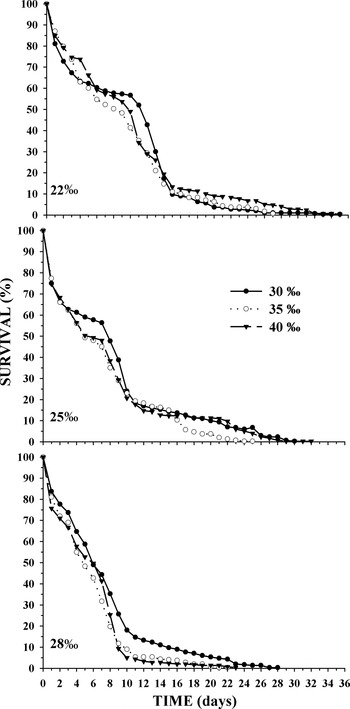
Day to day survival from hatching to the first crab stage at different experimental temperature–salinity combinations is illustrated in Figure 1. The rate of survival shows a steeper decline at 28°C at all salinities.
Percentage of survival from hatching to the first crab stage in Stenorhynchus seticornis larvae reared in different salinities at 22, 25, and 28°C.

Complete larval development occurred in all experimental conditions, except at 28°C, 35‰, even though only 1% of the larvae in the experiment reached the first crab stage. The highest mean survival from hatching to the first crab stage (4.5%) occurred at 25°C; 30‰. At this temperature–salinity combination some recipients showed survivals as high as 26.6%, At 22°C larvae required longer times (27–35 days) to complete development to the first crab (Figure 1).
FIRST ZOEA
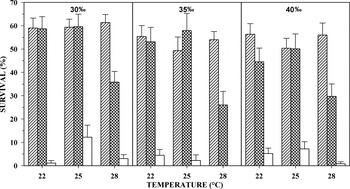
Mean survival at this stage was ≤61% under all experimental conditions, and was influenced by salinity (F = 3.43; P < 0.05), but not by temperature (F = 2.02; P > 0.05). The effect of temperature–salinity interaction was not significant (F = 0.32; P > 0.05) so the effects were considered as independent. Only 30 and 35‰ differed in percentage survival. Highest mean survival (61.3%) occurred at 28°C, 30‰, the lowest survival (49.3%), was at 25°C, 35‰ (Figure 2).
Mean (±SE) percentage survival of zoea and megalopa stages of Stenorhynchus seticornis reared at different salinities and temperatures.  zoea I;
 zoea II;
 megalopa.

SECOND ZOEA
Mean survival at this stage varied from 26% at 28°C, 35‰ to 59.6% at 25°C, 30‰. Analysis of variance showed differences due to different salinities (F = 3.65; P < 0.05), and temperatures (F = 20.55, P < 0.001). The effect of temperature–salinity interaction was not significant (F = 0.59, P > 0.05). The SNK test indicated that there was no difference in percentage survival between 22 and 25°C, which had the highest survival. The observed differences are due to the considerable reduction in survival at the highest temperature (28°C), at all salinities (Figure 2). Only extreme salinities differed in percentage survival. The higher mean survival was observed at 30‰ (Figure 2).
MEGALOPA
This stage showed the highest mortality during the experiment. Percentage survival was lower than 12% under all experimental conditions. No megalopa moulted to the first crab under 28°C, 35‰, and only 1% larvae moulted at 28°C, 40‰. The highest mean survival rate (12.2%) occurred at 25°C, 30‰ (Figure 2).
Percentage survival in megalopae differed significantly within temperatures (F = 4.41; P < 0.05) but not within salinities (F = 1.55; P > 0.05). Interaction between these two parameters was not significant (F = 1.93; P > 0.05). Extreme temperatures (22 and 28°C) resulted in decreased percentage survival.
CUMULATIVE SURVIVAL FROM HATCHING TO THE FIRST CRAB STAGE
Survival was low under all experimental conditions. The highest mean survival (3.0%) occurred at 25°C, 30‰ and the lowest (0%) at 28°C, 35‰.
Analysis of variance showed significant differences due to temperatures only (F = 4.19; P < 0.05). A SNK test indicated differences between 25 and 28°C, which showed the maximum and minimum survival, respectively.
Rate of development
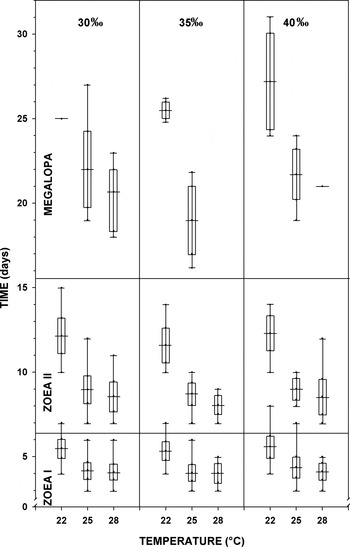
As shown in Figure 3, the duration of the two zoeal stages, the megalopa and total time required for development to the first crab stage were influenced to some extent by different salinities and temperatures, with the effect of temperature being greater. Times of development showed a gradual reduction from low to high temperature.
Comparison of time required for the development from hatching of larvae of Stenorhynchus seticornis reared at different salinities and temperatures. Vertical lines represent total range, blocks represent standard deviation and horizontal lines are mean values.

FIRST ZOEA
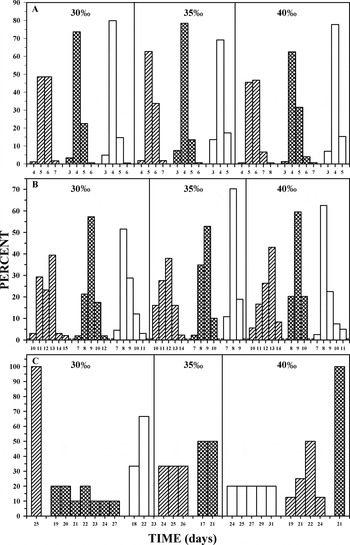
The time required by first zoeae to moult to the second stage varied between 3 and 5 days (Figure 4A). At 25 and 28°C the first moult began at day 3, while at 22°C it began at day 4. At higher temperatures, all larvae completed ecdysis in a three day period while at 22°C it extended to five days. Regardless of salinity, at 25 and 28°C more than 60% of the larvae completed ecdysis during day 4 while at 22°C the percentage of moulting larvae on this day was reduced to <2%.
Comparison of time of moult for (A) first zoeae; (B) second zoeae; (C) megalopae of Stenorhynchus seticornis reared at different salinities and temperatures.  22°C;
 25°C;
 28°C.

Two-way ANOVA showed that temperature (F = 1437.30; P < 0.001) had a considerably greater influence than salinity (F = 12.22; P < 0.001). The temperature–salinity interaction was not significant (F = 2.11; P > 0.05) indicating that the effects of both variables were independent. The rate of development increased with increasing temperature. Mean duration of first zoeae was 5.5 days (range 4–8 days) at 22°C; 4.3 days (range 3–6 days) at 25°C and 4.1 days (range 3–5 days) at 28°C. In relation to salinity, duration was significantly higher at 40‰, while no difference between 30 and 35‰ could be detected.
SECOND ZOEA
Duration of this stage varied between 3 and 6 days (Figure 4B). As in the former stage, the time required by the larvae to moult to the megalopa stage declined with increasing temperatures. Except for those larvae reared at 25°C, 40‰, which started to moult at day 8, at 25, and 28°C, larvae started to moult at day 7. At 22°C ecdysis began at day 10 whereas the majority of the larvae at 25, and 28°C had completed ecdysis.
Analysis of variance showed differences in mean time required to moult between temperatures (F = 255.07; P < 0.001) but not between salinities (F = 2.88; P > 0.05). Temperature–salinity interaction was not significant (F = 0.25; P > 0.05). The SNK test indicated a significant decrease in time for moulting with increasing temperature. On the average, larvae required 6.5 days at 22°C, 4.7 days at 25°C and 4.3 days at 28°C.
MEGALOPA
The persistent lag and the tendency for each moult to require a greater period of time at the lower temperature continued in the megalopae. In all test salinities, larvae reared at 28°C moulted to the first crab stage before those maintained at 22°C began to moult. At 28°C megalopae moulted to the first crab between days 18 and 22 (5 days), but at 22°C they did not begin to moult until day 24, and needed 8 days for all to complete ecdysis. At 25°C, ecdysis began at day 17 and some larvae did not moult until day 27 (Figure 4C).
The ANOVA showed a significant effect of temperature (F = 3.55; P < 0.05), while no effect of salinity (F = 0.06; P > 0.05) was evident. Multiple comparison of means showed a reduction in the duration of the megalopa stage at 25 and 28°C, requiring on the average, 15.0 days at 22°C, 12.2 days at 25°C and 11.9 days at 28°C.
CUMULATIVE RATE OF DEVELOPMENT FROM HATCHING TO THE FIRST CRAB STAGE
Depending on the experimental conditions, S. seticornis required 17 to 31 days to complete development to the first crab. The shortest time required to complete development to the crab stage was, on average, 19.7 days (range 18 to 22 days) at 28°C, 21.0 days (range 17 to 27 days) at 25°C, while at 22°C, the same stage was attained at an average time of 26.9 days (range 24 to 31 days).
The ANOVA indicated a significant effect of temperature only (F = 14.07; P < 0.001). Larvae reared at 22°C showed an increased duration of larval development while no difference between 25 and 28°C could be detected.
DISCUSSION
It is generally recognized that temperature, acting either independently or simultaneously with other environmental factors, is one of the major physical factors affecting survival, duration of stages and growth of decapod larvae (Ong & Costlow, Reference Ong and Costlow1970; Nagaraj, Reference Nagaraj1993; Lárez et al., Reference Lárez, Palazón-Fernández and Bolaños2000; Zacharia & Kakati, Reference Zacharia and Kakati2004). We found evidence that survival and duration of the individual stages and the complete development to the first crab of Stenorhynchus seticornis were affected by the temperatures and salinities used; temperature having a more pronounced effect than salinity.
Survival
The highest survival rates obtained for the first and second zoeae (61.3% and 59.6%, respectively) were high compared with those obtained by Quintero (Reference Quintero1986) (34%, and 50%, respectively) for the same species at 22–24°C; 36–38‰, and similar feeding conditions. This author found a high mortality during the first zoeal stage and stated that during development some stages require better care and/or better quality or a special kind of food. However, those survival rates were lower than that observed by Yang (Reference Yang1976) at 17–29°C; 32–36‰ (ZI: 77.8%, ZII: 64.3%). The differences obtained in both cases may be due to the different temperature–salinity regimes and/or explained according to Costlow (Reference Costlow1967), Quintero (Reference Quintero1986) and Lárez et al. (Reference Lárez, Palazón-Fernández and Bolaños2000) who stated that survival is extremely variable in eggs masses obtained from different female crabs (genetic quality), differences in the natural environment from which the ovigerous females were collected and/or in eggs hatched at different times of the year.
High survival obtained in the zoeal stages could have been favoured, to some extent by: (i) food supply. It is known that the lack of food of proper size and nutritional value during the period when larvae first begin feeding cause extensive mortalities in some species (Sastry, Reference Sastry, Vernberg and Vernberg1983). Larvae of S. seticornis were fed immediately after eclosion as recommended by Hernández et al. (Reference Hernández, Bolaños, Hernández and Magán1999) who tested the effects of starvation on S. seticornis larvae, and found that only larvae fed immediately after eclosion were able to moult to the second zoeal stage; (ii) water quality. All water used in the experiment was previously filtered and UV-irradiated in order to reduce harmful microorganisms such as bacteria and protozoa; (iii) nutritional quality of food and/or the fact that the Artemia cysts were decapsulated using a hypochlorite solution, thus preventing the contamination of the culture media with micro-organisms (New & Singholka, Reference New and Singholka1984); and (iv) the larvae were transferred daily to clean bowls, containing seawater at the same experimental conditions avoiding thermal or salinity shock.
In the present study, a reduction in the effect of salinity, both in survival and duration of development with each successive stage of development was observed; this suggests, as stressed by Nagaraj (Reference Nagaraj1993), that salinity tolerance increases with each successive stage and euryhalinity may be attained in the juvenile phase of the life history. Additionally, Charmantier (Reference Charmantier1998) stated that the osmoregulatory capability develops throughout the larval sequence of stages and commonly the tolerance ranges of larval stages to temperature and salinity are narrower than those of adults.
The highest survival rate in the megalopa stage, although low, was higher than that obtained by Yang (Reference Yang1976) and Quintero (Reference Quintero1986) (7.4% and 6%, respectively). Yang (Reference Yang1976) stated that the major cause of mortality in the megalopa stage of S. seticornis in his experiment seemed to have been a failure to complete moult into the crab stage because of an inability of the animals to extract the lengthy pereopods.
Poor megalopal survival has been observed in other majoids (Quintero, Reference Quintero1986; Harms & Seeger, Reference Harms and Seeger1989; Lárez et al., Reference Lárez, Palazón-Fernández and Bolaños2000; Rhyne et al., Reference Rhyne, Penha-Lopes and Lin2005), as well as in other Decapoda (Costlow et al., Reference Costlow, Bookhout and Monroe1960; Mene et al., Reference Mene, Alvarez-Ossorio, González-Gurriarán and Valdés1991; Luppi et al., Reference Luppi, Spivak and Bas2003), and has been attributed, in part, to a shift in the food preferences and/or in nutritional requirements, to the necessity of an adequate substrate for settlement, and cannibalism.
According to Williams (Reference Williams1984), adults of S. seticornis are omnivorous, while its zoeal stages are carnivorous. Maybe megalopae of S. seticornis shift from the carnivorous diet typical of the zoeae to an omnivorous diet typical of the adults and, therefore, would require a mixed (animal and vegetable) food supply not necessarily of planktonic origin or maybe they have higher energy requirements to fulfil metabolic costs and/or growth, as well as preparation of the organism for metamorphosis as demonstrated in other decapods (see Barros & Valenti, Reference Barros and Valenti2003 for references).
Although only 1% of the larvae in the experiment reached the first crab stage, at 25°C–30‰ survival of megalopae was as high as 12.2%. In nature, larval survival is generally very low, often <1% (Thorson, Reference Thorson1950; Morgan, Reference Morgan and McEdward1995), and decreases exponentially with time when mortality sources such as predation or the likelihood of encountering harsh environmental conditions are relatively constant over the lifespan of a larva (Thorson, Reference Thorson1950; Morgan, Reference Morgan and McEdward1995). The low survival in the development to the first crab stage was due to the high mortality in the megalopa stage, so the successful completion of the life history of S. seticornis in the laboratory appears to depend largely on the successful rearing of the megalopa. The reasons for the high mortality of megalopae of S. seticornis remain unsolved. This could be tested in future studies focused on megalopae feeding and settlement cues using the combination of temperature and salinity (25°C, 30‰) which yielded the higher survival rate (12.2%) as reference.
On the other hand, the traditional water exchange of rearing systems often requires larval manipulation and can induce stress, so larvae could be raised to the megalopa and then moved to an alternative rearing system that allow high prey densities, good water quality, suspension of the larvae in the water column (thus avoiding clumping), and where settlement induction could be better achieved. This kind of system was used successfully by Rhyne et al. (Reference Rhyne, Penha-Lopes and Lin2005) for rearing Mithraculus forceps (A. Milne-Edwards, 1875) and M. sculptus (Lamarck, 1818) larvae.
Rate of development
Although the rate of larval development may be genetically determined (Sastry, Reference Sastry, Vernberg and Vernberg1983; Gonçalves et al., Reference Gonçalves, Ribeiro and Soares1995), it may be modified by environmental factors within the tolerance limits for the species, and as well as by the quality and quantity of available food (Sastry, Reference Sastry, Vernberg and Vernberg1983).
With the exception of the first zoeae, the duration of the stages of development of S. seticornis was not affected by the range of salinities used. The mean duration of the zoeal stages, as well as the megalopa, was inversely related to temperature. This last result is consistent with the general trend for most other crustaceans including majoids (Wilson et al., Reference Wilson, Scotto and Gore1979; Scotto & Gore, Reference Scotto and Gore1980; Rengel et al., Reference Rengel, Chung, Bolaños and Fermín1993; Lárez et al., Reference Lárez, Palazón-Fernández and Bolaños2000) and other decapod larvae (Ong & Costlow, Reference Ong and Costlow1970; Goy et al., Reference Goy, Bookhout and Costlow1981; Mene et al., Reference Mene, Alvarez-Ossorio, González-Gurriarán and Valdés1991; Nagaraj, Reference Nagaraj1993; Paula et al., Reference Paula, Nogueira Mendes, Mwaluma, Raedig and Emmerson2003; Zacharia & Kakati, Reference Zacharia and Kakati2004), in which an inverse relationship between temperature and duration of development has been also found. Gonçalves et al. (Reference Gonçalves, Ribeiro and Soares1995) stated that, within certain limits, higher temperatures shorten larval development, and that this is important for the life history of the species since a shortened developmental time increases the chance of reaching maturity.
The effect of temperature on zoeal duration can have important consequences to recruitment success. The length of zoeal duration can affect dispersal, as well as total survival to settlement based on the length of time zoeae are subjected to predation. There could also be effects on survival and growth based upon prey availability and energetics (Sulkin & McKeen, Reference Sulkin and McKeen1994).
In crustaceans, moulting is a complex and continuous process affected by metabolic activities controlled by enzymes and moulting hormones (Passano, Reference Passano and Waterman1960; Chang, Reference Chang1985; Skinner, Reference Skinner, Bliss and Mantel1985). As found for Mithrax caribbaeus Rathbun, 1920 (Lárez et al., Reference Lárez, Palazón-Fernández and Bolaños2000), and Crangon uritari Hayashi & Kim, 1999 (Li & Hong, Reference Li and Hong2007), the decrease in the length of the intermoult period in S. seticornis at 28°C could be explained as the result of an increase in metabolic rate along with an increase in the activity of enzymes and hormones involved in the moulting process all as a consequence of the increase in temperature within the tolerable physiological limits for the species.
As observed by Lárez et al. (Reference Lárez, Palazón-Fernández and Bolaños2000) for Mithrax caribbaeus, the range of salinities used in the present work did not affect significantly the time of development of the different stages of S. seticornis. However, in other majoids a gradual increase in larval life with decreasing salinity has been found (see Lárez et al., Reference Lárez, Palazón-Fernández and Bolaños2000 for references). This may indicate that the effects of salinity would be related to the physiological and adaptive capacities and evolutionary history of each species.
Although laboratory experiments cannot exactly represent natural conditions, they allow the analysis of the responses of larvae to environmental variables in relation to adult habitats and have greatly enhanced the understanding of the ecology of pelagic crustacean larvae. They can also represent approximate environmental limits and how these variables affect survival and rate of development of the larvae in nature (Sastry, Reference Sastry, Vernberg and Vernberg1983).
Previous studies on the effects of temperature and salinity on the larval development of Brachyura have fitted the observed duration and mortality to a response surface, considering temperature, salinity and their interaction effects as predictor variables (Costlow et al., Reference Costlow, Bookhout and Monroe1960; Costlow, Reference Costlow1967; Laughlin, Reference Laughlin1983; Nagaraj, Reference Nagaraj1993; Lárez et al., Reference Lárez, Palazón-Fernández and Bolaños2000; Paula et al., Reference Paula, Nogueira Mendes, Mwaluma, Raedig and Emmerson2003; Li & Hong, Reference Li and Hong2007). We tried to fit a response surface of these characteristics to our data using a quadratic model. In all the cases, the fitted model did not represent the data adequately. Probably a greater number of temperature–salinity combinations, a higher order surface or the use of additional variables must be included in the model.
As observed in the megalopa stage of other decapods (Felder et al., Reference Felder, Martin, Goy and Wenner1985; Rodríguez et al., Reference Rodríguez, Medina and Arrue1990; Stevens, Reference Stevens2003; Suprayudi et al., Reference Suprayudi, Takeuchi and Hamasaki2004; Rhyne et al., Reference Rhyne, Penha-Lopes and Lin2005) moult frequency and time of development of S. seticornis megalopae should have been affected by factors other than salinity and temperature, such as nutrition, the absence of an appropriate substrate and/or other settlement cues.
A longer period as megalopae increases the individual's probability to spread and reach an appropriate substrate prior to metamorphosis (Jackson & Strathmann, Reference Jackson and Strathmann1981). Extension of the duration of late larval stages might allow the species to colonize new areas or repopulate already colonized ones, and enhance the possibilities of gene flow among local populations (Díaz & Bevilacqua, Reference Díaz and Bevilacqua1986); nevertheless, a longer larval development period is correlated with a rise in mortality, so its advantages are not obvious (Luppi et al., Reference Luppi, Spivak and Bas2003).
In order to make S. seticornis an ideal candidate for aquaculture, further studies are needed to address the nutritional and substrate issues in order to improve the larval survivorship and settlement of megalopae. Further research is also needed to develop mass larvae rearing protocols as well as a grow-out system for juveniles. This will allow the production of quality animals at a low cost, enabling the commercial production of the species.
ACKNOWLEDGEMENTS
We thank Dr Andrew Gannon and the anonymous referees for assistance with revision of the manuscript, appreciative comments and constructive criticism. This study received financial support from the Consejo de Investigación de la Universidad de Oriente, Venezuela.