Introduction
Herbicides have been the most effective tool for weed control worldwide. However, weed resistance to herbicides in the field is expanding and increasing the cost of crop production and weed management (Norsworthy et al. Reference Norsworthy, Ward, Shaw, Lewellyn, Nichols and Webster2012). In Brazil, Conyza spp. represent one of the greatest concerns in agricultural production, particularly due to the development of resistance to multiple herbicides.. The first report of Conyza spp. resistance was to glyphosate in 2005 (Heap Reference Heap2021), and more recently in 2017, there was a report of Sumatran fleabane [Conyza sumatrensis (Retz.) E. Walker; syn.: Erigeron sumatrensis Retz.] having multiple resistance to five different herbicides (glyphosate, paraquat, diuron, saflufenacil, and 2,4-D) (Pinho et al. Reference Pinho, Leal, Dos Santos, Oliveira, Oliveira, Langaro, Machado, Christoffoleti and Zobiole2019). Early diagnosis of herbicide resistance is essential for weed management.
In Brazil, there have been no reports of cross-resistance of photosystem I (PSI)-inhibiting herbicides (paraquat and diquat) in Conyza spp. Until now, all reports were about only paraquat resistance. Paraquat and diquat are PSI inhibitors that act as electron acceptors by diverting electrons from PSI to molecular oxygen, leading to reactive oxygen species (ROS) production (Hess Reference Hess2000). High ROS production induces rapid cell death in plants within a few hours after herbicide application (Hawkes Reference Hawkes2014). These herbicides are nonselective and are used in preplant burndown of many cropping systems due to their rapid action (Bromilow Reference Bromilow2004).
The paraquat-resistance mechanism is usually due to reduced translocation attributed to vacuole sequestration (Hawkes Reference Hawkes2014; Moretti and Hanson Reference Moretti and Hanson2017). Non–target site resistance occurs through mechanisms that reduce the number of herbicide molecules that reach the herbicide target site. Mechanisms that trap the herbicide in source leaves through sequestration within vacuoles or alter the activity of active membrane transporters will reduce the total amount of herbicide translocated, thus conferring resistance to plants (Gaines et al. Reference Gaines, Duke, Morran, Rigon, Tranel, Küpper and Dayan2020). Furthermore, the protective antioxidative system can also contribute to resistance by detoxifying ROS production (Hawkes Reference Hawkes2014 ; Pyon et al. Reference Pyon, Piao, Roh, Shin and Kwak2004; Ye and Gressel Reference Ye and Gressel2000). In plants, as in other organisms, the antioxidative system is composed of an efficient set of enzymes, such as superoxide dismutase (SOD), catalase (CAT), ascorbate peroxidase (APX), and glutathione reductase (Gill and Tuteja Reference Gill and Tuteja2010). This antioxidative system can be activated/induced in response to stressful conditions caused by increased ROS in cells (Foyer et al. Reference Foyer, Descourvieres and Kunert1994; Gill and Tuteja Reference Gill and Tuteja2010). Like ROS production, changes in photosynthetic capacity in response to herbicide stress can also be measured (Dayan and Zaccaro Reference Dayan and Zaccaro2012; Kalaji et al. Reference Kalaji, Schansker, Ladle, Goltsev, Bosa, Allakhverdiev, Brestic, Bussotti, Calatayud, Dąbrowski, Elsheery, Ferroni, Guidi, Hogewoning and Jajoo2014; Leal et al. Reference Leal, Souza, Ribeiro, Oliveira, Araujo, Borella, Langaro, Machado and Pinho2020; Strasser and Strasser Reference Strasser and Strasser1995; Strasser et al. Reference Strasser, Tsimilli-Michael and Srivastava2004) and can be useful to identify resistant and susceptible biotypes (Brunharo et al. Reference Brunharo, Patterson, Carrijo, Melo, Nicolai, Gaines, Nissen and Christoffoleti2016), including in Conyza spp. biotypes.
Changes in chlorophyll fluorescence occur due to impairment in the electron flow in the photosynthetic electron transport chain (ETC) caused by herbicides (Dayan and Zaccaro Reference Dayan and Zaccaro2012), including paraquat. The chlorophyll fluorescence technique has been applied in herbicide assays and diagnostics of resistance to PSI-inhibiting herbicides, as well as herbicides with other modes of action in several weed species (Dayan and Zaccaro Reference Dayan and Zaccaro2012). Chlorophyll fluorescence data enable the description of the effects on photosynthetic energy dynamics after PSI-inhibiting herbicide application, providing information on the conformation, structure, and function of the photosynthetic apparatus (Kalaji et al. Reference Kalaji, Schansker, Ladle, Goltsev, Bosa, Allakhverdiev, Brestic, Bussotti, Calatayud, Dąbrowski, Elsheery, Ferroni, Guidi, Hogewoning and Jajoo2014; Strasser et al. Reference Strasser and Strasser1995).
The chlorophyll a (Chl a) fluorescence technique can be used to quickly screen for resistance to PSI-inhibiting herbicides (Dayan and Zaccaro Reference Dayan and Zaccaro2012; Hassannejad et al. Reference Hassannejad, Lotfi, Ghafarbi, Oukarroum, Abbasi, Kalaji and Rastogi2020), because susceptible plants rapidly show great disorder in the photosynthetic apparatus and die within hours after herbicide application, while resistant plants survive and show recovery of the dynamic energy fluxes of ETC within a day, depending on the herbicide mode of action. Brunharo et al. (Reference Brunharo, Patterson, Carrijo, Melo, Nicolai, Gaines, Nissen and Christoffoleti2016) reported that in resistant biotypes, paraquat affects photosynthetic performance until the molecules are trapped by the mechanism of action operating in plant cells. Therefore, this study aimed to evaluate C. sumatrensis resistance to PSI-inhibiting herbicide (diquat) and to characterize the physiological response (Chl a fluorescence and antioxidative enzyme activity) to paraquat application.
Materials and Methods
The research was conducted with two C. sumatrensis biotypes, one susceptible and the other having multiple resistance to five herbicide sites of action (2,4-D, paraquat, diuron, saflufenacil, and glyphosate) (Pinho et al. Reference Pinho, Leal, Dos Santos, Oliveira, Oliveira, Langaro, Machado, Christoffoleti and Zobiole2019). Both biotypes were originally collected from a site at Assis Chateaubriand-Paraná, Brazil (24.282611°S, 53.513°W). The seeds of both biotypes were sown in 2.5-dm−3 pots filled with commercial substrate and kept in greenhouses. After emergence, the seedlings were thinned to 1 plant per pot and left to grow to 10 cm in height. Herbicides (described in the following section) were applied using a CO2-pressurized backpack sprayer with four XR-110020 flat-fan nozzles (TeeJet®, Spraying Systems Co., Wheaton, IL, USA), spraying 150 L ha−1 at 240 kPa.
Conyza sumatrensis Control Assays
The experiments were complete randomized blocks with a five by two factorial scheme and four replications. Factor A was represented by the following herbicides in recommended field doses: paraquat (400 g ai ha−1; Gramoxone®, 200 g ai L−1, Syngenta Brazil, São Paulo, SP, Brazil) plus 0.1% (v/v) nonionic surfactant; diquat (400 g ai ha−1; Reglone®, 200 g ai L−1, Syngenta Brazil) plus 0.5% (v/v) nonionic surfactant; diuron (1,600 g ai ha−1; Diuron Nortox®, 800 g ai kg−1, Nortox, Arapongas, PR, Brazil); and paraquat + diuron (400 + 200 g ai ha−1; Gramocil®, 200 +100 g ai L−1, Syngenta Brazil) plus 0.1% (v/v) nonionic surfactant; and an untreated check. Factor B was the susceptible and resistant biotypes. At 42 d after application (DAA), the aerial parts of the plants were harvested, separated into paper bags, and dried in a forced-air circulation oven (60 ± 5 C) until a constant mass was obtained, after which dry mass was determined using an analytical balance.
Dose–Response Curve Assays
A dose–response assay was carried out in a randomized block design with four replications. The treatments consisted of doses of diquat herbicide at 1/32×, 1/16×, 1/8×, 1/4×, 1/2×, 1× (400 g ai ha−1), 2×, 4×, 8×, 16×, and 32× plus 0.1% (v/v) nonionic surfactant sprayed on both biotypes (susceptible and suspected diquat resistant) and included an untreated check (without herbicide). Plant injury (LD) and reduction in plant growth (GR) were measured at 42 DAA using log-logistic models proposed by Streibig (Reference Streibig1988) and Seefeldt et al. (Reference Seefeldt, Jensen and Fuerst1995) (Equation 1):
 $$y = {a \over {\left[ {1\; + \;\displaystyle{{\left( {{x \over b}} \right)}^c}} \right]}}$$
where y is the response based on dry mass, a is the amplitude between the maximum and minimum points of the variable, x is the dose of the herbicide (g ai ha−1), b is the herbicide dose giving a 50% response (GR50 and LD50), and c is the inflection point around b.
The inverse equation was used to calculate the GR50 and LD50 (Equation 2):
 $$x = b{\left( {\left| {{\frac{a}\over{y}} - 1} \right|} \right)^{\frac{1}\over{c}}}$$
Resistance index (RF = R/S) was calculated based on the values of LD50 (plant injury) and GR50 (dry mass).
Physiological Response Assays
A second experiment was carried out in a randomized block design with four replications. The herbicide paraquat at 400 g ai ha−1 plus 0.1% (v/v) nonionic surfactant was sprayed on susceptible and resistant biotypes. Subsequently, at 1, 3, and 5 h after application (HAA), the leaves were harvested by clipping the base of the leaf at the end of the petiole, immediately frozen in liquid nitrogen, and temporarily stored at −80 C until analyses of enzyme activity and hydrogen peroxide were performed.
The activity of SOD (EC 1.15.1.1), CAT (EC 1.11.1.6), and APX (EC 1.11.1.11) was measured in leaves (±0.2 g) of C. sumatrensis. In order to perform the analysis, the tissues were ground using liquid N2 in porcelain mortars (by replicates) with 5% polyvinyl polypyrrolidone and a mix of 100 mM potassium phosphate buffer (pH 7.8), 0.1 mM ethylenediaminetetraacetic acid, 20 mM ascorbic acid, 5 mM dithiothreitol, 5 mM β-mercaptoetanol, and 0.01% Triton X-100. The homogenate was centrifuged at 12,000 × g for 20 min at 4 C, and the supernatant was used as a crude enzyme extract. An aliquot of the crude extract was used to determine protein content as described by Bradford (1976) using bovine serum albumin as the standard. Total SOD activity was measured as described by Giannopolitis and Ries (Reference Giannopolitis and Ries1977), the CAT activity according to Azevedo Neto et al. (Reference Azevedo Neto, Prisco, Enéas-Filho, de Abreu and Gomes-Filho2006), and APX activity according to Nakano and Asada (Reference Nakano and Asada1981).
Hydrogen peroxide content was estimated based on Velikova et al. (Reference Velikova, Yordanov and Edreva2000). A solution of 0.1% trichloroacetic acid was added to leaf tissue (±0.2 g) and ground using liquid N2 in porcelain mortars. Samples were then centrifuged at 12,000 × g for 20 min at 4 C. An aliquot of the supernatant was added to 10 mM potassium phosphate buffer (pH 7.0) and 1 M potassium iodide to determine the H2O2 content. Absorbance was measured at 390 nm. The H2O2 content was given on a standard curve prepared with known H2O2 concentrations.
The Chl a fluorescence transient was measured in dark-adapted leaves of resistant and susceptible biotypes at 1, 4, and 24 h and 14 d after paraquat application, using a Handy-PEA fluorimeter (Hansatech Instruments Ltd, King’s Lynn, Norfolk, UK), as described by Strasser and Strasser (Reference Strasser and Strasser1995) and Strasser et al. (Reference Strasser, Tsimilli-Michael and Srivastava2004). The plotted fluorescence values were the means of eight measurements of each treatment. The JIP test was also applied to analyze and compare the OJIP transients using normalizations and subtractions to compare the samples for the events reflected in the OJ, OI, and IP phases, as described by Yusuf et al. (Reference Yusuf, Kumar, Rajwanshi, Strasser, Govindjee and Sarin2010). The OJIP fluorescence transients were based on the polyphasic fast fluorescence rise from the lowest intensity FO (minimum fluorescence, the O level) to the highest intensity FM (maximum fluorescence, the P level) with two intermediate steps labeled J and I (Strasser et al. Reference Strasser, Tsimilli-Michael and Srivastava2004). The transients were normalized as relative variable fluorescence: W t = (F t − F 0)/(F J − F 0), W OI = (F t − F 0)/(F I − F 0) and W IP = (F t − F I)/(F P − F I), as described by Yusuf et al. (Reference Yusuf, Kumar, Rajwanshi, Strasser, Govindjee and Sarin2010).
Statistical Analysis
The control assay data, enzymatic activity, and hydrogen peroxide measurements were checked for normality (Shapiro-Wilk) and homogeneity (Bartlett) of variance, and then ANOVA was performed. Data were analyzed using the GLM procedure to evaluate the differences between treatments. When F was significant (P ≤ 0.05), the averages were separated and adjusted using Fisher’s protected LSD (P ≤ 0.05). The dose–response data of plant injury (LD50) and reduction in plant growth (GR50) were estimated using the three-parameter log-logistic equation proposed by Streibig (Reference Streibig1988) and Seefeldt et al. (Reference Seefeldt, Jensen and Fuerst1995). Statistical analyses were performed using SAS v. 9.0 statistical software (SAS Institute, Cary, NC).
Results and Discussion
Control Assay
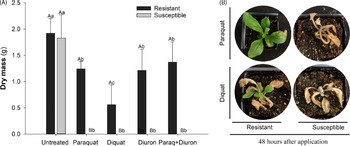
The control assays at recommended field doses showed that the susceptible biotype was effectively controlled by paraquat, diquat, diuron, and paraquat + diuron (Figure 1A). However, the resistant biotype was significantly less affected by all herbicides (Figure 1A). The dry-mass analysis of the C. sumatrensis resistant biotype when paraquat or diuron was used was similar to paraquat + diuron (Figure 1A). A previous report by our group confirmed that the C. sumatrensis biotype showed resistance to paraquat (resistance index of LD50 = 25.51 and GR50 = 51.83) and diuron (resistance index of LD50 = 7.29 and GR50 = 5.05) (Pinho et al. Reference Pinho, Leal, Dos Santos, Oliveira, Oliveira, Langaro, Machado, Christoffoleti and Zobiole2019). However, in this study, we first report the behavior of this biotype with paraquat and diuron in a tank mix, and this is the first report of C. sumatrensis resistance to diquat in Brazil, as diquat did not control the resistant biotype in our study (Figure 1A and B).
Dry mass (g) of resistant and susceptible Conyza sumatrensis biotypes in response to the application of paraquat, diquat, diuron, and paraquat + diuron herbicides at 42 d after application (A) and comparation of resistant and susceptible Conyza sumatrensis biotypes in response to the application of paraquat and diquat at 48 h after application (B). Means followed by the same uppercase letters between biotypes and lowercase letters among herbicides do not differ statistically from each other at P ≤ 0.05 by LSD test.

The symptoms observed in resistant plants after the application of diquat were completely different from those seen with paraquat (Supplementary Video S1). Whereas plants showed complete desiccation and regrowth in the axillary meristem a few days after diquat application, paraquat resulted in only a few necrotic spots on leaves (Figure 1B).
Diquat Dose Response
Based on LD50 and GR50 values, the resistance index to diquat was 26-fold and 6-fold, respectively, when compared with the susceptible biotype (Table 1; Figure 2). The dose–response curve confirmed resistance to the PSI-inhibiting herbicide diquat in the previously reported multiple-resistant C. sumatrensis biotype.
Parameter estimates of diquat dose–response curves indicating the herbicide dose that led to a 50% reduction of dry mass (GR50) and 50% reduction of control (LD50) for multiple-resistant and susceptible Conyza sumatrensis biotypes determined at 42 DAA.

a LD50: herbicide dose causing 50% control of plants; GR50: herbicide dose causing 50% growth reduction of plants.
b Resistance levels were indicated by the resistance factor (RF). RF (resistance factor) = R/S.
Diquat dose–response curves for the multiple-resistant (2,4-D, paraquat, diuron, saflufenacil, and glyphosate) (Res) and susceptible (Sus) Conyza sumatrensis biotypes. Percent of control (A) and plant dry mass (B) were obtained at 42 d after application. Vertical bars represent the standard error of the mean.

Populations resistant to paraquat are usually also resistant to diquat, another bipyridilium herbicide, but at reduced levels (Preston 1994), as observed in the present study. Conyza sumatrensis, hairy fleabane [Conyza bonariensis (L.) Cronquist; syn.: Erigeron bonariensis L.], and horseweed [Conyza canadensis (L.) Cronquist; syn.: Erigeron canadensis L.] biotypes with resistance to diquat and paraquat have been reported in Japan and Canada (Heap Reference Heap2021). This is the first case of C. sumatrensis with resistance to diquat, as well as paraquat, in Brazil.
Physiological Responses of Conyza sumatrensis Biotype Resistant to Paraquat
The paraquat-susceptible biotype developed typical symptoms within the first few hours after spraying. Among the symptoms quickly exhibited by plants in response to PSI inhibitors are the appearance of brown, desiccated, or chlorotic tissue and, eventually, complete necrosis of the leaf (Hawkes Reference Hawkes2014). At 3 and 5 HAA, the paraquat-susceptible biotype was injured within a range of 70% to 80%, with 100% control at 24 HAA (Figure 3). However, the paraquat-resistant biotype showed ≤20% injury from 3 to 48 HAA, resulting in only a few leaves with necrotic spots (Figure 3).
Control observed in paraquat-resistant and paraquat-susceptible Conyza sumatrensis biotypes treated with paraquat.

Normally, PSI-inhibiting herbicides cause the death of plants within a few days after application due to oxidative damage induced by ROS. Paraquat exerts phytotoxic effects by generating superoxide radicals, which in turn produce different ROS—H2O2 and hydroxyl radicals (Bromilow Reference Bromilow2004).
The accumulation of H2O2 in the paraquat-susceptible biotype was higher at all time points in comparison to the paraquat-resistant biotype (Figure 4). Also, at 3 and 5 HAA, there was accumulation of H2O2 in leaves of the paraquat-susceptible biotype compared with the untreated check, while whereas the paraquat-resistant biotype showed a difference between treated and untreated plants only at 5 HAA (Figure 4). In the paraquat-susceptible biotype, ROS have been identified as the main cause of plant death within a few hours after herbicide application (Hess Reference Hess2000), whereas the paraquat-resistant biotype showed lower H2O2 concentration and less visible injury in the present study.
Changes in hydrogen peroxide (H2O2) concentration in paraquat-resistant and paraquat-susceptible Conyza sumatrensis biotypes in response to paraquat at 1, 3, and 5 h after application. Means followed by the same lowercase letter between untreated and treated and uppercase letters between biotypes do not differ statistically from each other at P ≤ 0.05 by LSD test at each time point.

The overproduction of ROS in plants is generated by several abiotic or biotic stresses (Caverzan et al. Reference Caverzan, Piasecki, Chavarria, Stewart and Vargas2019; Gill and Tuteja Reference Gill and Tuteja2010), such as those caused by paraquat reported in this study. When there is an imbalance between ROS production and the detoxification capacity of the enzymatic antioxidant system, oxidative damage occurs (Gill and Tuteja Reference Gill and Tuteja2010). Overproduction of ROS in plants causes damage to DNA, proteins, and lipids, which can lead to cell death (Caverzan et al. Reference Caverzan, Piasecki, Chavarria, Stewart and Vargas2019).
Most of the plant distress caused by herbicides is related to ROS generation and consequent oxidative stress (Caverzan et al. Reference Caverzan, Piasecki, Chavarria, Stewart and Vargas2019). However, some reports have demonstrated the involvement of antioxidant systems in ROS detoxification in herbicide-resistant weeds (Caverzan et al. Reference Caverzan, Piasecki, Chavarria, Stewart and Vargas2019; Hawkes Reference Hawkes2014; Piasecki et al. Reference Piasecki, Carvalho, Cechin, Goulart, Maia, Agostinetto, Caverzan, Stewart and Vargas2019; Pyon et al. Reference Pyon, Piao, Roh, Shin and Kwak2004; Ye and Gressel Reference Ye and Gressel2000).
The paraquat-resistant biotype did not show an increase in the activity of CAT, SOD, and APX compared with the untreated check (Figure 5). Moreover, SOD and APX activity at 5 HAA was significantly higher in the paraquat-susceptible biotype compared with the untreated control. In this biotype, the increase observed in SOD at 5 HAA is more likely a response to the superoxide initially produced by paraquat, as reported by Niwa et al. (Reference Niwa, Ishimoto and Kanoh1990). The increase in APX may be a response to H2O2 produced after paraquat application. SOD enzymes are at the frontline in the defense against ROS, promoting the dismutation of the superoxide radical into H2O2 (Azevedo Neto et al. Reference Azevedo Neto, Prisco, Enéas-Filho, de Abreu and Gomes-Filho2006; Gill and Tuteja Reference Gill and Tuteja2010). APX and CAT play a key role in catalyzing the conversion of H2O2 to H2O (Apel and Hirt Reference Apel and Hirt2004).
Change in catalase (CAT; A), superoxide dismutase (SOD; B), and ascorbate peroxidase (APX; C) activity in paraquat-resistant and paraquat-susceptible Conyza sumatrensis biotypes following treatment with paraquat herbicide at 1, 3, and 5 h after application. Means followed by the same uppercase letters between biotypes and lowercase letters between untreated and treated do not differ statistically from each other at P ≤ 0.05 by LSD test at each time point.

The high activity of CAT, APX, and SOD may be correlated with the mechanism of resistance to paraquat (Pyon et al. Reference Pyon, Piao, Roh, Shin and Kwak2004; Ye and Gressel Reference Ye and Gressel2000). However, this experiment suggests that CAT, APX, and SOD may not provide antioxidative protection against oxidative damage caused by paraquat to the paraquat-resistant C. sumatrensis biotype, because the activity of these enzymes decreased or showed no difference in comparison with the untreated control. This result suggests that CAT, APX, and SOD are not involved in this C. sumatrensis biotype’s resistance to paraquat. The antioxidant enzyme activity (SOD and APX) was greater in the paraquat-susceptible biotype than in the paraquat-resistant biotype at 5 HAA. However, the paraquat-resistant biotype maintained other oxidative stress coping mechanisms, so antioxidant enzyme activity may not be directly involved in paraquat’s mechanism of action, as reported in studies of Tsuji et al. (Reference Tsuji, Hosokawa, Morita, Miura and Tominaga2013).
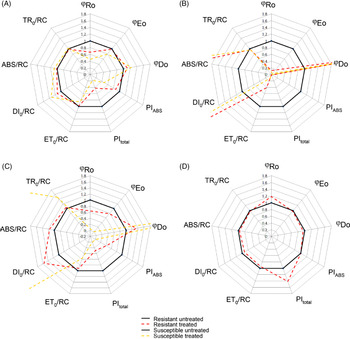
Paraquat acts as an electron acceptor by diverting them from PSI, leading to changes in the electron flow in the ETC of photosynthesis (Bromilow Reference Bromilow2004), which can be monitored by Chl a fluorescence measurement (Strasser et al. 1995, Reference Strasser, Tsimilli-Michael and Srivastava2004). Chl a fluorescence transient analysis provides detailed information on the structure and function of the photosynthetic apparatus from light absorption and electron transport to energy production (Strasser et al. Reference Strasser and Strasser1995). After application of paraquat herbicide, there was a decrease in quantum yield (a measure of the efficiency of photon emission as defined by the ratio of the number of photons emitted to the number of photons absorbed) of electron transport from quinine A (QA−) to the terminal electron acceptor of the PSI (ϕRo) (Figure 6A), and in the IP phase (Figure 7I), W IP shows that PSI-driven electron transfer occurs to the end electron acceptors on the PSI acceptor side, starting at PQH2 (plastoquinol).
Chlorophyll a fluorescence transient of paraquat-resistant and paraquat-susceptible Conyza sumatrensis biotypes treated with paraquat at 1 h after application (HAA) (A), 4 HAA (B), 24 HAA (C), and 14 d after application (D). Data correspond to nine structural and functional photosynthetic parameters (average values of 10 replicates) derived by the JIP test from the fluorescence transients. For each parameter and for both biotypes, the values were normalized, using the control as reference (untreated, black lines), presented in the panels by a regular polygon (all parameters equal to unity). The deviation of the behavior pattern (treated biotypes) from the regular polygon demonstrates the fractional impact compared with the untreated control. TR0/RC, maximum trapping rate per reaction center (RC); ABS/RC, absorption flux (of antenna chlorophyll) per RC; DI0/RC, dissipation of an active RC; ET0/RC, electron transport of an active RC; PIABS, performance index (potential) for energy conservation from exciton to the reduction of intersystem electron acceptors; PItotal, performance index (potential) for energy conservation from exciton to the reduction of PSI end acceptors; ϕDo, maximum quantum yield of nonphotochemical de-excitation; ϕEo, quantum yield for electron transport (ET); ϕRo, quantum yield for reduction of end electron acceptors at the PSI acceptor side.

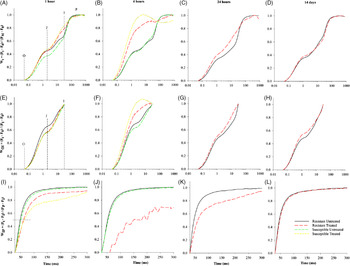
Chlorophyll a fluorescence transient of paraquat-resistant and paraquat-susceptible Conyza sumatrensis biotypes at 1 h after application (HAA) (A, E, and I), 4 HAA (B, F, and J), 24 HAA (C, G, and K), and 14 d after application (D, H, and L) of paraquat. Data correspond to: the photosynthetic parameters deduced by the JIP test analysis of the fluorescence transients normalized using the reference the control (W t ) (A–D); and the relative variable fluorescence between steps O and I (W OI) (E–H) and steps I and P (W IP) (I–L) on a logarithmic timescale.

A decline in photosynthetic total performance index (PItotal: performance index [potential] for energy conservation from the exciton to the reduction of PSI end acceptors) and an increase both in energy dissipation flux as heat (DI0/RC [reaction center]) (Figure 6A) and relative variable fluorescence (Figure 7A) were observed for both biotypes at 1 HAA. The photosynthetic performance index (PIABS: performance index [potential] for energy conservation from exciton to the reduction of intersystem electron acceptors) decreased 60% in the paraquat-susceptible biotype compared with the paraquat-resistant biotype, indicating that PIABS was a good parameter for detecting stress caused by paraquat. A previous study showed the same results in common cocklebur (Xanthium strumarium L.) (Hassannejad et al. Reference Hassannejad, Lotfi, Ghafarbi, Oukarroum, Abbasi, Kalaji and Rastogi2020). The photosynthetic performance index can be a very suitable and sensitive parameter for investigating a plant’s overall photosynthetic efficiency under different abiotic stresses (Kalaji et al. Reference Kalaji, Schansker, Ladle, Goltsev, Bosa, Allakhverdiev, Brestic, Bussotti, Calatayud, Dąbrowski, Elsheery, Ferroni, Guidi, Hogewoning and Jajoo2014; Strasser et al. 1995, Reference Strasser, Tsimilli-Michael and Srivastava2004). Szigeti et al. (Reference Szigeti, Richter and Lichtenthaler1996) observed differences in chlorophyll fluorescence characteristics of paraquat-sensitive C. canadensis biotypes using a multichannel chlorophyll spectrofluorometer.
At 4 HAA, there was an increase in the excitation captured by the RCs until the reduction of plastoquinone (PQ) (OI phase; W OI presented as relative variable fluorescence show the sequence of events from exciton trapping [energy captured by the RC capable to drive photochemistry reactions] by photosystem II (PSII) up to PQ reduction]) in both biotypes (Figure 7F). Nevertheless, the intensity of fluorescence levels in J step (parameters derived from the OJIP steps; Figure 7B) demonstrated the interruption of the electron flow due to PSI-inhibiting herbicide, which suggests that most of the QA is completely reduced (Strasser et al. Reference Strasser and Strasser1995) in both biotypes. Decrease of 100% in quantum yield of electron transport from QA− to the intersystem electron acceptors (ϕEo), ϕRo (Figure 6B), and IP phase (Figure 7J) were detected, resulting in a 100% reduction of photosynthetic performance. Furthermore, all energy was dissipated as heat (ϕDo) (Figure 6B) and variable fluorescence (Figure 7B).
Besides the decrease in functionality (PI) in the resistant biotype, the structural components of photosystems might not be affected, allowing the biotype to recover within 24 HAA. Although the mechanism of resistance in this biotype remains to be elucidated, it is possible to suggest that vacuolar sequestration of paraquat is mediated by transporters that can operate to compartmentalize paraquat in the cell, precluding its action on PSI (Brunharo and Hanson Reference Brunharo and Hanson2017). On the other hand, besides losses of functionality in the susceptible biotype, the increase in ROS probably affected structural components leading to death in this biotype within 24 HAA (Figures 6C and 7G–K).
In addition to the recovery of the functionality of the photosynthetic ETC in the paraquat-resistant biotype within 24 HAA (Figures 6C and 7G–K), photosynthesis was completely stabilized within 14 DAA (Figures 6D and 7D–I). Chl a fluorescence transient analysis could be applied to monitor for paraquat-resistant biotypes, as shown in this study. To determine whether paraquat was active within the plant cells, the photosynthetic performance was assessed after paraquat application using the parameters of fluorescence. In addition, the maximum quantum yield of PSII (F v/F m) has been reported to monitor paraquat effects on plants until paraquat is transiently in cells, which leads to a decline in F v/F m up to 5 HAA. The recovery of the photosynthetic performance was reported within 48 h, whereas F v/F m values in susceptible plants dropped to zero by 48 HAA. Therefore, paraquat reaches the chloroplasts of the resistant biotype, as indicated by the transitory inhibition of photosynthetic activity in the resistant biotype’s leaves (Brunharo et al. Reference Brunharo, Patterson, Carrijo, Melo, Nicolai, Gaines, Nissen and Christoffoleti2016). Moreover, an alternative hypothesis of exclusion of paraquat from leaf cells has been proposed in hare barley [Hordeum murinum L. ssp. leporinum (Link) Arcang.; syn.: Hordeum leporinum Link] (Preston 1994). Paraquat exclusion would explain less damage to leaf cells and hence less translocation of paraquat (Preston et al. Reference Preston, Soar, Hidayat, Greenfield and Powles2005).
Although the proper mechanism of C. sumatrensis resistance remains to be elucidated, the use of the Chl a fluorescence technique has been used in several studies regarding the effects of PSI-inhibiting herbicides on weeds (Dayan and Zaccaro Reference Dayan and Zaccaro2012) and could provide information or early diagnosis of herbicide resistance and management of weeds, as Chl a fluorescence is a quick, easy, and nondestructive tool that can be also applied in the field. In addition, molecular analysis can provide insights into resistance mechanisms, especially those related to non-target sites, to understand how plants reduce the number of herbicide molecules that reach the herbicide target site.
Dose–response experiments confirmed resistance of an C. sumatrensis biotype to PSI-inhibiting herbicides (paraquat and diquat). In the paraquat-susceptible biotype, H2O2 accumulation led to plant death within a few hours after herbicide treatment, whereas the paraquat-resistant biotype showed lower H2O2 concentration, which resulted in the appearance of few symptoms. Paraquat application did not induce antioxidative enzymes in the paraquat-resistant biotype. However, the paraquat-resistant biotype showed a fast recovery of photosynthetic parameters, as well as continuous growth when subjected to paraquat, while the paraquat-susceptible biotype did not survive. Fluorescence parameters provided information about the photosynthetic apparatus, enabling diagnosis of the paraquat-resistant biotype. Our results showed that it is possible to detect recovery of the paraquat-resistant biotype at 24 HAA, while the paraquat-susceptible biotype did not recover from the stress caused by paraquat.
Supplementary material
To view supplementary material for this article, please visit https://doi.org/10.1017/wsc.2021.70
Acknowledgments
This study was financed in part by the [1] Coordenação de Aperfeiçoamento de Pessoal de Nível Superior–Brasil (CAPES)–Finance Code 001, [2] Fundação Carlos Chagas Filho de Amparo à Pesquisa do Estado do Rio de Janeiro (FAPERJ), and [3] Corteva Agriscience. The authors declare that no conflicts of interest have been declared.