




No CrossRef data available.
Article contents
A single step duplex PCR to distinguish Entamoeba histolytica from Entamoeba dispar
Published online by Cambridge University Press: 13 May 2004
Abstract
In this study, a single-step duplex polymerase chain reaction procedure was developed for rapid, specific and sensitive identification of Entamoeba histolytica and for its diagnostic differentiation from E. dispar. Specific oligonucleotide primers were combined for the amplification of a cysteine proteinase 5 gene target sequence of 242 bp, present only in E. histolytica. Additionally, another oligonucleotide primer pair for both the E. histolytica and E. dispar actin gene target of 300 bp was designed to amplify only from amoebae DNA. The PCR developed was specific and efficiently identified and differentiated these parasites from each other in either cultured parasites or from stool material.
Information
- Type
- Research Article
- Information
- Copyright
- 2004 Cambridge University Press
INTRODUCTION
Entamoeba histolytica is a protozoan parasite of the human intestine causing the disease known as amoebiasis. Approximately 100000 people may die yearly due to this parasite infection world-wide (Walsh, 1986). Morphologically similar to E. histolytica and also found in the human intestine is E. dispar. However, this parasite does not cause disease. Diagnostic methodology to distinguish these two species from each other is a priority in amoebic infections and a number of approaches have been proposed (Haque et al. 1995; Britten et al. 1997; Verweij et al. 2000; Nunez et al. 2001; Blessmann et al. 2002). The majority of these methods are costly and are time consuming due to many protocol steps. Recently, we have described (Gomes et al. 1999) a simple and rapid PCR protocol to identify E. histolytica from E. dispar, based on conformational polymorphism of the 482 bp fragment from the M17 gene (Edman et al. 1990). In the present study we propose a single-step double PCR protocol with two distinct target fragments. One of them of 242 bp from cysteine proteinase 5 of E. histolytica (Bruchhaus et al. 1996) and the other with 300 bp from actin of E. histolytica (Edman, Meza & Agabian, 1987; Huber et al. 1987) and E. dispar.
MATERIALS AND METHODS
Entamoeba strains and cell culture conditions
Five strains of E. histolytica (CSP, 462, 32, RPS and 452) and 4 of E. dispar (JCAO, VEJ, ADO and WIL) were used. E. moshkovskii strain EMCR was also used. All were isolated at the Laboratory of Amoebiasis, Department of Parasitology of the Institute of Biological Sciences, UFMG (LADP-ICB/UFMG), Brazil. The E. histolytica strains have been maintained in TYI-S-33 medium (Diamond, Harlow & Cunnick, 1978) and the E. dispar and EMCR in YE polyxenic medium (Silva & Mayrink, 1974). Parasites from culture were identified by zymodeme (Sargeaunt, Williams & Grene, 1978) and their DNA was extracted using 1×10⁶ cells by the GenomicPrep System (Amersham, USA) following the manufacturer's instructions.
Stool samples
Human stool samples were collected from the LADP-ICB/UFMG. The E. histolytica/E. dispar cysts were obtained from microscopically positive faecal samples using a formalin–ether sedimentation procedure (Ridley & Hawgood, 1956). From each of 8 positive and 1 negative faecal samples 0·2 g was used. The specificity of primers was confirmed by using samples containing cysts of E. coli, Endolimax nana, Blastocystis hominis, Giardia duodenalis or eggs of Ascaris lumbricoides. The DNA from cysts (or eggs) was extracted using the QIAamp DNA stool mini kit (Quiagen, Germany) according to the manufacturer's instructions.
Duplex PCR
Two gene sequences were targeted simultaneously in this PCR procedure. One comprised an internal segment of 242 bp of the cysteine proteinase 5 (EhCP5) gene, present only in E. histolytica (EhCP5), and the oligonucleotide primers designed were EhCP6F forward (5′GTTGCTGCTGAAGAAACTTG3′) and reverse EhCP6R (5′GTACCATAACCAACTACTGC3′). Another PCR target was a 300 bp sequence within the actin gene, and the oligonucleotide primers designed were Act3 forward (5′GGGACGATATGGAAAAGATC3′) and Act5 reverse (5′CAAGTCTAAGAATAGCATGTG3′), common to both E. histolytica and E. dispar. Five pmols of each primer were used in a mixture containing 10 mM Tris–HCl, pH 9·0, 1·5 mM MgCl2, 0·2 mM dNTPs, 0·1% Triton X–100, 0·1 U of Taq DNA polymerase (Promega, USA) and 2 μl of DNA extracted from a stool sample or 50 ng from culture, in a final reaction volume of 10 μl. Thermal cycling was performed as follows: 30 cycles of 95 °C/30 s, 60 °C/30 s and 72 °C/45 s. The PCR products were submitted to electrophoresis in 4% polyacrylamide gel and amplicons were visualized by silver staining.
RESULTS
Duplex PCR amplicons are shown in Fig. 1. Parasites from culture identified as E. histolytica or E. dispar by zymodeme were confirmed by PCR (wells 2–10). Among positive faecal samples chosen for this study 2 were identified by PCR as being E. histolytica (wells 17 and 18) and the other 6 samples as E. dispar (wells 11–16). The negative sample by optical microscopy did not yield any PCR amplification (well 19). No amplification product was observed for any of the samples from E. moshkovskii and other parasites (data not shown).

Fig. 1. Typical duplex PCR results showing diagnostic differentiation of Entamoeba histolytica from E. dispar following silver-stained polyacrylamide gel electrophoresis. The amplicons from the actin gene, common to both amoebae, and the ehcp5 specific to E. histolytica, are identified as 300 bp and 242 bp, respectively. Lane 1 is 100-bp DNA ladder marker. Other lanes are: (2–10) cultivated samples; (11–18) positive fecal samples; (19) negative fecal sample by optical microscopy. E. histolytica was identified in cultivated samples 2–6 and fecal samples 17–18 as well. Lanes 12 and 13 from samples containing just 1 cyst.
DISCUSSION
E. dispar parasitizes the human intestine but does not cause illness. Its morphological similarity to E. histolytica, which is responsible for amoebic dysentery, does not allow differentiation of these two organisms from each other by means of optical microscopy. Before the confirmation of E. dispar as a distinct species (WHO, 1997), it was estimated that 0·5 billion people were infected around the world by E. histolytica. Of these, 50 million were symptomatic and 100000 died annually (Walsh, 1986). Adapting these data to the present, one could say that at least 500 million people might be infected by E. histolytica. However, the percentage of infection due to either E. histolytica or E. dispar among the remaining 450 million cannot be estimated. In this regard, any apparently asymptomatic person may develop the disease and become symptomatic, that is, the parasite may change its behaviour, becoming virulent and start to cause lesions. Therefore, the development of fast and sensitive methods to distinguish the amoebae is urgent as this differentiation is crucial for selecting treatment protocols for these patients.
Recently, differences between E. histolytica and E. dispar in the expression patterns of proteins thought to be involved in the virulent behaviour of E. histolytica have been shown (Reed et al. 1995; Jacobs et al. 1998; Hellberg et al. 2001; Bruchhaus et al. 2002). Among them are two cysteine proteinases that are exclusively expressed in E. histolytica. EhCP5 is one of these proteins that presents as a good candidate for differentiating the parasites either by protein expression levels or by gene structure since its gene is highly degenerate in E. dispar (Willhoeft, Hamann & Tannich, 1999). A 242 bp internal sequence of this gene was chosen since no PCR product should be obtained from E. dispar DNA, from other strains of amoebae or from protozoa from the human gut. In addition, we included a segment of actin gene as a second marker that amplifies only from amoebae DNA. Actin is one of the most abundantly expressed proteins in E. histolytica (Huber et al. 1987) and we also observed it in E. dispar. Thus, in the present work, we propose a double PCR of the EhCP5 gene target sequence that specifically detects E. histolytica. Combined with the actin gene for both amoebae, this PCR was demonstrated to be a very selective strategy to detect and distinguish E. histolytica from E. dispar in a rapid single-step procedure that could be completed in a very short time-period (60 min).
In this study polyxenic and axenic cultures of E. histolytica and E. dispar were used and identified by zymodeme analysis. All samples identified as E. histolytica or E. dispar by zymodeme were confirmed by PCR. Considering the possibility that E. moshkovskii may be infecting the human gut (Ali et al. 2003), the specificity of our primers was tested with one E. moshkovskii strain. The results showing no amplification product attested this, and additionally, showed that this duplex PCR approach may be applied also to stool samples, confirming either positives or negatives as determined by optical microscopy, with the sensitivity to detect just one cyst in the sample (wells 12 and 13). In conclusion, these results demonstrate the potential (i) to facilitate the separation of these two parasites in positive samples, and (ii) to provide a tool for important diagnostic differentiation.
This work was supported with grants from CNPq, FAEP and FAPEMIG.
References
REFERENCES
ALI, I. K.,
HOSSAIN, M. B.,
ROY, S.,
AYEH-KUMI, P. F.,
PETRI, W. A. Jr.,
HAQUE, R. &
CLARK, C. G.
(
2003).
Entamoeba moshkovskii infections in children, Bangladesh.
Emerging Infectious Diseases 9, 580–584.CrossRefGoogle Scholar
BLESSMANN, J.,
BUSS, H.,
TON NU, P. A.,
DINH, B. T.,
VIET NGO, Q. T.,
VAN, A. L.,
ABD ALLA, M. D.,
JACKSON, T. F. H. G.,
RAVDIN, J. I. &
TANNICH, E. (
2002).
Real-time PCR for detection and differentiation of Entamoeba histolytica and Entamoeba dispar in fecal samples.
Journal of Clinical Microbiology 40, 4413–4417.CrossRefGoogle Scholar
BRITTEN, D.,
WILSON, S. M.,
McNERNEY, R.,
MOODY, A. H.,
CHIODINI, P. L. &
ACKERS, J. P.
(
1997).
An improved colorimetric PCR-based method for detection and differentiation of Entamoeba histolytica and Entamoeba dispar in feces.
Journal of Clinical Microbiology 35, 1108–1111.Google Scholar
BRUCHHAUS, I.,
JACOBS, T.,
LEIPPE, M. &
TANNICH, E.
(
1996).
Entamoeba histolytica and E. dispar: differences in numbers and expression of cysteine proteinase genes.
Molecular Microbiology 22, 255–263.Google Scholar
BRUCHHAUS, I.,
ROEDER, T.,
LOTTER, H.,
SCHWERDTFEGER, M. &
TANNICH, E.
(
2002).
Differential gene expression in Entamoeba histolytica isolated from amoebic liver abscess.
Molecular Microbiology 44, 1063–1072.CrossRefGoogle Scholar
DIAMOND, L. S.,
HARLOW, D. R. &
CUNNICK, C. C.
(
1978).
A new medium for the axenic cultivation of Entamoeba histolytica and other Entamoeba.
Transactions of the Royal Society of Tropical Medicine and Hygiene 86, 170–176.CrossRefGoogle Scholar
EDMAN, U.,
MEZA, I. &
AGABIAN, N.
(
1987).
Genomic and cDNA actin sequences from a virulent strain of Entamoeba histolytica.
Proceedings of the National Academy of Sciences, USA 84, 3024–3028.CrossRefGoogle Scholar
EDMAN, U.,
MERAZ, M. A.,
RAUSSER, S.,
AGABIAN, N. &
MEZA, I.
(
1990).
Characterization of an immuno-dominant variable surface antigen from pathogenic and nonpathogenic Entamoeba histolytica.
Journal of Experimental Parasitology 172, 879–888.CrossRefGoogle Scholar
GOMES, M. A.,
PESQUERO, J. B.,
FURST, C.,
VALLE, P. R.,
PESQUERO, J. L. &
SILVA, E. F.
(
1999).
An improved method to distinguish Entamoeba histolytica and Entamoeba dispar.
Parasitology 119, 359–362.CrossRefGoogle Scholar
HAQUE, R. L.,
NEVILLE, L. M.,
HAHN, P. &
PETRI, W. A. Jr.
(
1995).
Rapid diagnosis of Entamoeba infection by using Entamoeba and Entamoeba histolytica stool antigen detection kits.
Journal of Clinical Microbiology 33, 2558–2561.Google Scholar
HELLBERG, A.,
NICKEL, R.,
LOTTER, H.,
TANNICH, E. &
BRUCHHAUS, I. (
2001).
Overexpression of cysteine proteinase 2 in Entamoeba histolytica or Entamoeba dispar increases amoeba-induced monolayer destruction in vitro but does not augment amoebic liver abscess formation in gerbils.
Cellular Microbiology 3, 13–20.CrossRefGoogle Scholar
HUBER, M.,
GARFINKEL, L.,
GITLER, C.,
MIRELMAN, D.,
REVEL, M. &
ROZEMBLATT, S.
(
1987).
Entamoeba histolytica cloning and characterization of actin cDNA.
Molecular and Biochemical Parasitology 24, 227–235.CrossRefGoogle Scholar
JACOBS, T.,
BRUCHHAUS, I.,
DANDEKAS, T.,
TANNICH, E. &
LEIPE, M.
(
1998).
Isolation and molecular characterization of a surface-bound proteinase of Entamoeba histolytica.
Molecular Microbiology 27, 269–276.CrossRefGoogle Scholar
NÚÑEZ, Y. O.,
FERNANDEZ, M. A.,
TORREZ-NUNEZ, D.,
SILVA, J. A.,
MONTANO, I.,
MAESTRE, J. L. &
FONTE, L.
(
2001).
Multiplex polymerase chain reaction amplification and differentiation of Entamoeba histolytica and Entamoeba dispar DNA from stool samples.
American Journal of Tropical Medicine and Hygiene 64, 293–297.CrossRefGoogle Scholar
SILVA, E. F. &
MAYRINK, W.
(
1974).
Estudos sobre a Entamoeba moshkovskii. Novos focos em diversos tipos de coleções hídricas no Brasil e Uruguai.
Revista do Instituto de Medicina Tropical de São Paulo 16, 203–221.Google Scholar
RIDLEY, D. S. &
HAWGOOD, B. C.
(
1956).
The value of formol–ether concentration of faecal cysts and ova.
Journal of Clinical Pathology 9, 74–76.CrossRefGoogle Scholar
REED, S. L.,
EMBER, J. A.,
HERDMAN, D. S.,
DISAPIO, R. G.,
HUGLI, T. E. &
GIGLI, I.
(
1995).
The extracellular neutral cysteine proteinase of Entamoeba histolytica degrades anaphylatoxins C3a and C5a.
Journal of Immunology 155, 266–274.Google Scholar
SARGEAUNT, P. G.,
WILLIAMS, J. E. &
GRENE, J. D.
(
1978).
The differentiation of invasive and non-invasive Entamoeba histolytica by isoenzyme electrophoresis.
Transactions of the Royal Society of Tropical Medicine and Hygiene 72, 519–521.CrossRefGoogle Scholar
VERWEIJ, J. J.,
BLOTKAMP, J.,
BRIENEN, E. A.,
AGUIRRE, A. &
POLDERMAN, A. M.
(
2000).
Differentiation of Entamoeba histolytica and Entamoeba dispar cysts using polymerase chain reaction on DNA isolated from faeces with spin columns.
European Journal of Clinical Microbiology and Infectious Diseases 19, 358–361.CrossRefGoogle Scholar
WALSH, J. A.
(
1986).
Problems in recognition and diagnosis of amoebiasis. Estimation of the global magnitude of morbidity and mortality.
Reviews of Infectious Diseases 66, 228–238.Google Scholar
WHO/PAN AMERICA HEALTH ORGANIZATION (
1997).
Expert consulation on amoebiasis: Amoebiasis.
WHO Weekly Epidemiological Record 72, 97–100.
WILLHOEFT, U.,
HAMANN, L. &
TANNICH, E.
(
1999).
A DNA sequence corresponding to the gene encoding cysteine proteinase 5 in Entamoeba histolytica is present and positionally conserved but highly degenerated in Entamoeba dispar.
Infection and Immunity 67, 5925–5929.Google Scholar
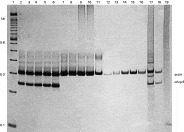
Fig. 1. Typical duplex PCR results showing diagnostic differentiation of Entamoeba histolytica from E. dispar following silver-stained polyacrylamide gel electrophoresis. The amplicons from the actin gene, common to both amoebae, and the ehcp5 specific to E. histolytica, are identified as 300 bp and 242 bp, respectively. Lane 1 is 100-bp DNA ladder marker. Other lanes are: (2–10) cultivated samples; (11–18) positive fecal samples; (19) negative fecal sample by optical microscopy. E. histolytica was identified in cultivated samples 2–6 and fecal samples 17–18 as well. Lanes 12 and 13 from samples containing just 1 cyst.
 You have
Access
- 17
- Cited by