On 7 October 2003, the voters of California recalled Governor Gray Davis and elected Arnold Schwarzenegger to replace him. This election provides an excellent setting for the investigation of basic propositions, derived from rational choice theory, concerning voters’ preferences and various forms of sophisticated voting. In the ten days preceding the recall election we collected survey data from 1,500 registered California voters in order to test these propositions. Details concerning the administration of this survey are reported in the Appendix.
Part I of our study investigates how closely individual preference orderings conform to the basic tenets of rationality. Whatever else it might mean to be rational, rationality requires that preference orderings be transitive. Voters whose preferences are not transitive essentially have voting cycles in their heads, and we cannot establish a rational basis for their choices. Social choice theory has established that social orderings do not recapitulate the transitivity that is assumed to characterize the preference orderings of rational individuals. If this assumption is in turn problematic, and many voters do have intransitive preferences, the problems confronted by social choice theory may be even more intractable.
In undertaking this investigation, it was critical that we identify preference orderings as accurately as possible. Survey research has relied heavily upon ‘feeling thermometers’ to infer voters’ preferences, but these measures are problematic in several ways. We therefore employed a different method for eliciting preferences. Respondents were asked to make a series of pairwise choices involving the four major candidates in the election, and preference orderings were inferred by combining their answers. This method yielded extremely accurate assessments of preference orderings.
Given the importance of preference transitivity to the rational choice approach, it is remarkable that previous research on the empirical status of transitivity is limited to a couple of studies published many years ago. These studies, by Brady and Ansolabehere and by Radcliff, report that few voters in the samples they analysed exhibited intransitive preference orderings.Footnote 1 Our findings concerning California recall voters were similar but even more striking, as we observed an even lower incidence of intransitivity than there had been in these two previous studies.
In the weeks leading up to election day, there was considerable concern that the winner of the election might not be a Condorcet winner, i.e. the winner of pairwise contests against all other candidates. This concern was due, in part, to the unusual structure of the ballot, which required voters to make two separate choices: (1) to recall Gray Davis or not, and (2) to select a replacement for him. The plurality winner of the replacement election would become governor only if a majority voted in favour of recalling Davis. Davis himself could not be a candidate in the replacement election.Footnote 2 Some speculated that Davis might be the Condorcet winner, but would not muster a majority against his recall. Another possibility was that with 135 candidates running in the replacement election, the plurality winner of this contest might well fail to satisfy the Condorcet criterion. Our survey data show that Schwarzenegger was in fact preferred to all other major candidates, and was thus the Condorcet winner.
In Part II of our study we employ the data on preference orderings generated in Part I to investigate the choices that voters made in the second, replacement part of the election. Since publication of Farquharson’s seminal work, scholars working from a rational choice perspective have focused on what he termed ‘sophisticated’ voting.Footnote 3 The most common manifestation of voter sophistication is tactical voting (otherwise known as strategic voting), which occurs in multi-candidate, plurality rule elections when voters believe that their most preferred candidate does not have a realistic chance of winning. So as not to ‘waste their vote’, they opt instead for a less preferred (but more competitive and still acceptable) candidate in order to counter an even lesser preferred candidate.Footnote 4 In a three-candidate setting this decision can be expressed in expected utility terms as:

where V 1 is a vote for one’s first choice, V 2 a vote for one’s second choice, the u terms the utilities derived from each of the three candidates in order of preference, and the p terms the probabilities of casting the pivotal vote that would bring about their victory.Footnote 5 Voters vote tactically for their second choice when this expression is negative, i.e., EU(V 2) > EU(V 1).
As rational choice theorists and their critics have long noted, there is an inconvenient truth that must be confronted here. In elections involving millions of voters, even extremely close elections, the probability of casting the pivotal vote that decides the outcome of the election is effectively zero.Footnote 6 The standard rational choice model of tactical voting thus requires that voters harbour the illusion of possibly being pivotal, which hardly seems consistent with a theory that purports to be based upon principles of rationality. Turning out to vote can be reconciled with expected utility calculations by adding a D > 0 consumption term,Footnote 7 but this is just another way of saying that voters vote because, for one reason or another, they enjoy doing so. The zero likelihood of being pivotal has led some to argue that it makes no sense to cast a tactical vote,Footnote 8 but it is also the case that not casting a tactical vote has the same, utterly inconsequential impact on the outcome of a large-scale election.
Our study, however, is concerned with determining empirically what real voters actually do, and not with the controversy as to what a rational voter should or should not do. What we already know from a vast amount of previous research is that voters do cast tactical votes. Alvarez and Nagler list ten studies that detect tactical voting in British parliamentary elections, in addition to their own.Footnote 9 Dozens of other studies also document tactical voting in US presidential primaries and presidential contests with third-party candidates.Footnote 10 As indicated above, however, the decision to vote for a lesser preferred candidate is apparently based upon a contingency, i.e. being pivotal, that has no likelihood of ever occurring. So what do we make of this?
For now, we think it is best to characterize tactical voters as ‘rationalistic’: while they may have well-behaved preference orderings and make choices that are logically consistent with these orderings, they make the choice to vote for lesser preferred candidates as if they were (or might reasonably expect to be) the pivotal voter, even though the laws of probability make this an impossibility. The results of the analyses reported in this article provide additional evidence that voters’ choices do not incorporate probability assessments in a realistic, consistent fashion. This leads us to suspect that the key element of our definition of what it means to be rationalistic is the ‘as if’ phrase, and that voters’ choices may not involve probability assessments at all.
While much evidence confirms the existence of tactical voting, we clearly need to learn more about how the interaction between preferences and candidates’ standings plays out in voters’ minds. How poorly must a candidate be doing before supporters conclude that voting for him or her is tantamount to throwing away their vote? According to Palfrey’s theoretical treatment of Duverger’s law, the probability of being pivotal is positive only when one votes for one of the top two candidates, and so candidates other than the top two should receive no votes whatsoever.Footnote 11 Given that the probability of being pivotal in a large electorate is effectively zero no matter what a voter does, a more realistic variation on this reasoning holds that votes received by minor candidates are those cast by diehard supporters who do not care that their favourite candidate is certain to lose. If we assume that all minor candidates have similar proportions of such hard-core supporters, all minor candidates should suffer similar rates of defection. We shall call this the uniform rate hypothesis.
But voters may not believe that all minor candidates are equally non-viable. Some voters may view minor candidates with relatively high levels of support as more deserving of loyalty than those with lower levels. Voters might erroneously interpret vote intention percentages as indicative of the probability of winning. Relatively stronger minor candidates also receive more media attention, which may also lead some of their supporters to infer that they have a chance of winning. In any case, we examine an alternative, declining rate hypothesis concerning tactical voting: the higher the level of support for a minor candidate, the less that candidate suffers from defections due to tactical voting.
As in previous studies of tactical voting, the hypotheses we have formulated concern only the relatively small number of voters who most preferred one of the minor candidates. In Part III of this study we investigate another type of sophisticated voting, relevant to a much larger number of voters, that arose from the two-part structure of the ballot, i.e. the initial recall question followed by the replacement election. In the case of voters whose most preferred candidate was not Davis, the candidate they preferred in the replacement election could win only if Davis lost. Voting straightforwardly would thus mean voting in favour of the recall. But some voters whose most preferred candidate was not Davis might also have believed that Davis was not that bad – or at least not bad enough to deserve being recalled. Supporters of other candidates might have also feared that someone they liked even less than Davis might win the replacement election. Consequently, some voters, even though they preferred another candidate over Davis, might have voted against the recall. We refer to such voters as ‘hedge voters’.
As suggested above, we can distinguish at least two different motives for hedge voting, and use the data on preference orderings developed in Part I to test two competing hypotheses. The first, the simple hedge voting hypothesis, holds that voters’ decisions concerning the recall question are purely a function of the utility they would receive from Davis retaining office. Operationally, this implies that the higher that voters rank Davis in their preference orderings, the more likely they are to vote against the recall. The second, the conditional hedge voting hypothesis, holds that hedge voting was also motivated by fear of an alternative worse than Davis: voters who believed that a candidate they disliked more than Davis had a good chance of winning the replacement election should have also been more likely to cast a hedge vote against Davis’s recall. The results of our analyses provide strong support for the simple hedge voting hypothesis, but no evidence of conditional hedge voting could be detected.
I: Transitivity in individual preference orderings
We begin by considering some basic questions about this election. First, to what extent were the preference orderings of Californian recall voters transitive? The California recall ballot listed 136 candidates – Gray Davis, and 135 candidates vying to replace him. As a practical matter it was impossible to elicit preferences over all of them, and in any case the vast majority of these candidates were unknown to all but a small handful of voters. Our analysis is thus restricted, for the most part, to the four most important candidates:
1. Gray Davis, the incumbent governor subject to the recall, was an established figure in Californian Democratic politics. Davis served as state controller and lieutenant governor before being elected governor in 1998. He was re-elected in 2002 in a closely contested race, but efforts to recall him commenced soon after his re-election.
2. Arnold Schwarzenegger, a moderate Republican, was best known prior to 2003 for his roles in action-oriented blockbuster films. His initial foray into Californian politics came in 2002, when he led the campaign for Proposition 49, a measure that increased funding for after-school programmes.
3. Cruz Bustamante was a well-known Democratic politician. After serving in the legislature and becoming Speaker of the Assembly, he was elected lieutenant governor in 1998, becoming the first Latino elected to statewide office in California in more than a century.
4. Tom McClintock was an established Republican member of the California legislature, most recently serving as state senator from a district located in northwestern Los Angeles County. Vowing to reduce taxes and cut expenditures, McClintock narrowly lost the election for state controller in 2002.
The question of recalling Davis was favoured by 55.4 per cent of the voters. Schwarzenegger, Bustamante and McClintock won 48.6 per cent, 31.5 per cent and 13.4 per cent of the vote, respectively, in the replacement election. The only other candidate to receive more than 1 per cent in that contest was Green party candidate Peter Camejo, with 2.8 per cent.
In addition to being transitive or not, individual preference orderings can be more or less complete. While some individuals may be able to order all relevant alternatives, others may be indifferent between one or more choices. Allowing for indifference requires the following relations to hold if transitivity is to be satisfied:
Preference for A over B and for B over C implies preference for A over C.

Indifference between A and B and between B and C implies indifference between A and C.

Preference for A over B and indifference between B and C implies preference for A over C.

Despite the fundamental importance of preference transitivity to the rational choice approach, there are only two previous studies that explicitly address this matter. Brady and Ansolabehere report that about 7 per cent of the respondents who ranked a list of five candidates in the 1976 presidential primaries (Brown, Carter, Humphrey, Jackson and Udall) exhibited violations of transitivity.Footnote 12 The rate of intransitivity rose to over 20 per cent when a sixth candidate (Ford) was added to the list. They also observed that preference orderings were more deficient in terms of completeness, i.e. an inability or unwillingness to choose one candidate over another. Radcliff finds that virtually no respondents in the 1972–84 American National Election Studies violated transitivity when evaluating sets of three candidates, but about 8 per cent did so in their orderings over four candidates.Footnote 13 When five candidates were being evaluated this rate rose to over 15 per cent, which is more than twice the rate of intransitivity detected by Brady and Ansolabehere. In any case, both studies suggest that the more alternatives people have to consider, the more likely their preference orderings are to be intransitive.
In undertaking this analysis, it was imperative that we ascertained voters’ preference orderings as accurately as possible. Survey research has relied heavily upon ‘feeling thermometers’ to assess voters’ preferences. These measures ask respondents to rate candidates on a 0–100 scale according to how warmly they feel towards them. Assigning one candidate a higher thermometer score than another is assumed to indicate preference for that candidate over the other. But warm feelings do not necessarily translate into preferences. In Weisberg and Miller’s study, about 20 per cent of the respondents expressed an intention to vote for a candidate other than the one to whom they had assigned the highest thermometer score.Footnote 14 Bartels reports that 10 per cent of respondents intended to vote for the candidate to whom they had assigned the lowest thermometer score,Footnote 15 while over 5 per cent indicated that they would vote for a candidate whom they had not even rated on the thermometer measure. Other studies have also found discrepancies of varying magnitudes between voting choices and thermometer scores.Footnote 16
Even if measurement problems were negligible, feeling thermometers cannot be used to gauge the extent to which voters have transitive preference orderings because transitivity is locked in a priori. Assume that when asked to assign thermometer scores, a respondent picks a random number between 0 and 100 for each candidate. The resultant numbers, arranged from highest to lowest, necessarily yield a transitive preference ordering.
For these reasons we use a different method for identifying preference orderings. On both measurement groundsFootnote 17 and in terms of consistency with rational choice theory,Footnote 18 the gold standard for eliciting preferences is to present respondents with a series of pairwise choices involving all the alternatives in the choice set. Their responses are then correlated to yield an overall preference ordering. For the four main candidates involved in the recall (Davis, Schwarzenegger, Bustamante and McClintock) only six pairwise comparisons are required. The pairwise comparison questions were posed as follows:
We would like to begin by having you make a series of one-on-one comparisons between the major candidates. Regardless of whom you actually intend to vote for, please tell me which candidate you most prefer in the pairs I will present to you … How about Gray Davis and Arnold Schwarzenegger? Do you prefer Davis over Schwarzenegger or Schwarzenegger over Davis?
This was followed by the other pairwise comparisons. CATI technology allowed us to systematically rotate the order of the six questions. As in the Brady and Ansolabehere study, we did not explicitly offer respondents the choice of indifference between candidates, but coded them as being indifferent if they did not choose one over the other.Footnote 19
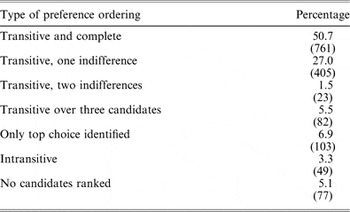
Table 1 reports the preference orderings derived from choices made in these comparisons. Nearly 51 per cent of the respondents exhibited complete, transitive preference orderings, a figure that is very similar to the 52 per cent in Brady and Ansolabehere’s five-candidate sample. Another 27 per cent had transitive orderings, but were indifferent between one pair of candidates – a figure that was also similar to that obtained by Brady and Ansolabehere. Those in the ‘transitive, two indifferences’ category also had no problems with intransitivity, but they grouped the four candidates into a top and bottom pair in a party-based fashion. Twenty-two of these twenty-three respondents were indifferent between Schwarzenegger and McClintock, and also indifferent between Davis and Bustamante, but ranked one pair over the other.
Preference Orderings over Candidates in the California Recall Election

Note: The number of observations in each category is reported in parentheses below each percentage entry.
Placement in the ‘transitive over three’ category means that the respondent ranked three candidates transitively, but could not rank the remaining candidate. One such respondent, for example, preferred Schwarzenegger to Davis and Davis to Bustamante, and also preferred Schwarzenegger to McClintock, but expressed no preference in the comparisons between McClintock and Davis or McClintock and Bustamante. Brady and Ansolabehere describe such preference orderings as ‘interval-ordered’, while Radcliff labels them ‘quasi-transitive’.Footnote 20 They believe, as do we, that this pattern arises when respondents have transitive preferences but ‘thick’ indifference curves involving some of the candidate choices. In these cases, a most preferred candidate can still be identified. Confidence that these respondents had coherent preferences is bolstered by the vote choices they reported. Only two of the eighty-two respondents in this category made choices that were not sensible, for example, not voting for Schwarzenegger when Schwarzenegger was the candidate they most preferred. As we shall see, this error rate is on a par with the overall error rates we observed in our survey.
Although preference ordering may seem like too strong a term to characterize those in the ‘Only top choice identified’ category, they do satisfy, albeit minimally, the canons of rationality. The respondents here always reported a preference for one particular candidate in comparisons with the other three candidates, but that is all. In all comparisons not involving their favourite candidate, they were indifferent between the two candidates presented to them.
Remarkably, only 3.3 per cent of the respondents manifested intransitivity in their preference orderings. Most were afflicted by an explicit preference cycle, while some violated transitivity with an inappropriate indifference relation, such as preferring Schwarzenegger over Davis, indifferent between Davis and Bustamante, but preferring Bustamante over Schwarzenegger. Some exhibited both pathologies. The 3.3 per cent figure that we observed is considerably lower than the amount of intransitivity detected in the two previous studies of voter preference transitivity, and the levels they reported were already very low. Of all the assumptions that are commonly made by rational choice theorists, the assumption that individual preference orderings are transitive may well be the most realistic.
Why did we observe less intransitivity? It could be because we elicited preferences over only four candidates, as opposed to Brady and Ansolabehere’s batteries of five and six candidates, and because Radcliff used a different method for deriving preference orderings. Another possible reason why respondents in our survey were less prone to intransitivity might have been because the candidate choices were more distinctive, particularly on ideological grounds, but there are reasons to believe this was not the case. Radcliff’s batteries of choices involved candidates from both parties, for example, Reagan, Mondale and Hart in 1984, as well as the independent Anderson in 1980. The rate of intransitivity that Brady and Ansolabehere report rises significantly when a sixth candidate is added to the group of five 1976 Democratic primary contenders, but this sixth candidate was the Republican president Gerald Ford, who was presumably quite easy to distinguish from the others. It is also possible that our more impressive lack of intransitivity was due to the fact that the pairwise comparison questions were the first ones asked on the survey, and were thus less likely to be answered by respondents who had become tired or bored. In any case, only a tiny minority of the respondents in our survey displayed intransitivity in their preference orderings.
The voting choices of many individuals who exhibited intransitivity in their preference orderings over the four major candidates were not necessarily afflicted by this pathology. In addition to the six pairwise comparisons questions, we also asked respondents, ‘Is there any other candidate on the ballot whom you prefer over all the candidates I’ve mentioned so far?’ Five of the forty-nine respondents in the intransitive category reported that they intended to vote for Camejo or one of the other lesser candidates. Intransitivity is not necessarily a problem when the alternatives involved are all dominated by another choice. Two other respondents had a clear favourite among the major candidates, as the intransitivity in their preference orderings was confined to lesser preferred candidates. Nine others indicated that they did not intend to vote in the recall election.
Previous studies have found that higher levels of indifference are associated with lower rates of turnout.Footnote 21 This was also true in the case of California recall voters. Of those respondents who were indifferent between none of the candidate pairs, 87 per cent reported that they intended to vote (or that they had already voted) in the recall election.Footnote 22 Turnout declined steadily in each successive category displayed in Table 1, down to 70 per cent among those respondents whose preference orderings were so incomplete that only a top choice could be identified. Only 32 per cent of the small number of respondents who were unable or unwilling to rank any of the candidates above any of the others said that they would vote in the recall election. We surmise that there is a nexus of positive associations linking higher rates of political participation with more interest in politics, more political information and more consistent and fully articulated preference orderings. Unfortunately, we did not include questions in our survey that would have allowed a fuller investigation of these relationships.
The outcomes of the pairwise comparisons necessarily reveal which of the candidates, if any, was the Condorcet winner. Many speculated before the election that the structure of the recall ballot, which partitioned the ballot into an up-or-down vote on Davis followed by the separate replacement election, would lead to the selection of a candidate who did not satisfy the Condorcet criterion. One possibility was that Davis was the Condorcet winner, but would not prevail on the initial recall question. It also seemed possible that with 135 candidates competing in the replacement election, the plurality winner would not satisfy the Condorcet criterion. And of course it is always necessary to entertain the possibility of a voting cycle, in which case a Condorcet winner does not exist.
As it turned out, there was a Condorcet winner in the 2003 California recall. Schwarzenegger topped all the other major candidates – Davis, Bustamante and McClintock – in the pairwise comparisons. The unusual nature of the election and the peculiar structure of the ballot thus did not prevent Californian voters from electing the Condorcet winner. One factor that made it extremely likely that a Condorcet winner was present at all is that a majority of voters exhibited single-peaked preferences over the four major candidates along a single, liberal–conservative dimension. According to Niemi, even a small amount of unidimensionality in voters’ preferences dramatically reduces the likelihood of a voting cycle.Footnote 23 Assuming that Bustamante, Davis, Schwarzenegger and McClintock are positioned from left to right along this dimension, we calculate that 59.4 per cent of the respondents who could rank order three or more candidates had single-peaked preferences. This is very similar to the 58.2 per cent figure obtained by Niemi and Wright in a similar analysis of four-candidate groupings of leading US presidential candidates in the pre-election wave of the 1980 National Election Study.Footnote 24 To some, of course, it may seem more remarkable that over four out of ten respondents in both studies did not appear to use an underlying liberal–conservative dimension in evaluating candidates.
II: Tactical voting in the replacement election
Although pre-election commercial polls regarding the recall election were fairly volatile, Schwarzenegger and Bustamante were always the top two candidates in the replacement election. To the extent supporters of minor candidates decided that they would be wasting their vote if they did not vote for one of the front-runners, Schwarzenegger and Bustamante would both benefit from tactical voting. But how exactly is it that supporters of minor candidates decide to cast a tactical vote? Palfrey’s treatment of Duverger’s Law holds that in equilibrium, when voters take into account the strategic behaviour of others, only the top two candidates in a plurality rule contest have a chance of winning.Footnote 25 Thus the probability of being pivotal in an election is positive only when one casts a vote for one of the top two candidates, and is zero if one instead votes for a minor candidate. Minor candidates should therefore receive no votes whatsoever. Given that voters in a large election have an effectively zero chance of being pivotal regardless of what they do, a more realistic variation on this line of reasoning holds that the votes received by minor candidates are those cast by supporters who are intent on ‘sending a message’ and are undeterred by the prospect of certain defeat. Jackman finds that those who voted for Ralph Nader in 2000 were indeed diehards.Footnote 26 After the election, fewer than one in ten Nader voters reported that if they had it to do over again they would have voted for either Gore or Bush. Assuming that all minor candidates have similar shares of diehard supporters, all minor candidates should suffer similar, high rates of strategic defection. We call this the ‘uniform rate’ hypothesis.
But voters may not believe that all minor candidates are equally non-viable. Some voters may instead view minor candidates with relatively high levels of support as more deserving of loyalty than minor candidates with lower levels of support. This could happen if voters interpret vote-intention percentages as indicative of the probability of winning. They may believe, for example, that a candidate supported by 15 per cent of the respondents in a pre-election poll has a 15 per cent chance of winning, while a candidate supported by 5 per cent of those polled has a 5 per cent chance of winning. Relatively stronger minor candidates also receive more media attention, which may also lead their supporters to infer that they have at least some chance of winning. In any case, what we call the declining rate hypothesis holds that the higher the level of support there is for a minor candidate, the less that candidate suffers from tactical voting.
As indicated earlier in our discussion of the motivation for tactical voting, we characterize tactical voters as rationalistic: whether their behaviour conforms more closely to the uniform rate or to the declining rate hypothesis, they decide to vote for a lesser-preferred candidate as if they are (or might reasonably expect to be) the pivotal voter, even though the probability of this actually being the case is zero. In the scenario described above, in an election with two major candidates garnering most of the votes, a minor candidate registering 15 per cent support in the polls has the same chance of winning as a candidate supported by 5 per cent, and that chance is zero. The declining rate hypothesis nonetheless posits that the first candidate will suffer a lower rate of losses from tactical voting than the second. Evidence for the declining rate hypothesis would thus be indicative of another manifestation of rationalistic decision making, in that it implies voters react to perceived differences in probability that are not actually present.
We are able to test the relative merits of these competing hypotheses with data from our survey because the many minor candidates in the contest to replace Davis differed markedly in their levels of support. Tom McClintock ran well behind both Schwarzenegger and Bustamante in pre-election polls, but consistently polled in the double digits. Green candidate Peter Camejo polled well behind McClintock, and support for all other candidates was in the trace element range. In the end, McClintock received 13.5 per cent, Camejo followed with 2.8 per cent and the 131 candidates in the peloton (or pack) garnered the residual 3.6 per cent.
Did McClintock, Camejo and all the other minor candidates experience similar defection rates, as the uniform rate hypothesis would predict? Or, in line with the declining rate hypothesis, did Camejo suffer from a higher rate of strategic defection than McClintock, and the many fringe candidates higher rates of defection than Camejo? Comparing the candidate preference orderings and vote declarations of respondents in our survey allows us to assess the relative merits of these two competing hypotheses.Footnote 27 Preferences for Schwarzenegger, Bustamante, McClintock and Davis were derived from responses to the six pairwise comparisons. An additional follow-up question allowed respondents to identify their most preferred candidate as someone other than those four.
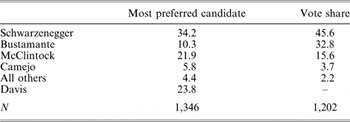
The figures in the first column of Table 2 show that a third of the respondents most preferred Schwarzenegger, a fifth chose McClintock, and only one in ten most preferred Bustamante. Not quite 6 per cent selected Camejo, while another 4.4 per cent named one of several others. Voters’ preferences reflected their partisan affiliations and ideological leanings, which we gauged by asking them (a) a standard party identification question, and (b) whether their views on political issues were conservative, moderate or liberal, and, if conservative or liberal, whether they were strongly or moderately so. McClintock supporters were more Republican and more conservative than Schwarzenegger supporters, and Schwarzenegger supporters more Republican and more conservative than supporters of Davis and Bustamante.
Most Preferred Candidate and Vote Shares in the Replacement Election (in Percentages)

Tactical voting benefits the top two candidates in an election, and all others are correspondingly hurt by defection of their supporters to the top two. The entries in Table 2 show that the percentage of voters who most preferred Schwarzenegger was larger than the percentage of voters who voted for Bustamante. This implies that he would have won the replacement election even if he had received no tactical votes, but a substantial share of his votes did come from those voters who cast tactical votes in his favour. Bustamante, the first choice of only one in ten voters, received over two-thirds of his votes from those who most preferred another candidate. Most of them were Davis supporters, who were necessarily constrained to vote for someone else. The combination of Bustamante and Davis supporters sums to 34.1 per cent, which closely approximates Bustamante’s 32.8 per cent share of the votes in the replacement election.
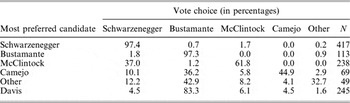
A more complete picture of tactical voting in the replacement election emerges from Table 3, which reports the choices of voters broken down by which candidate they most preferred. Theoretically, Schwarzenegger and Bustamante should have suffered no strategic defections, and the entries in the first two rows of Table 3 show that less than 3 per cent of their supporters reported voted for someone else. We were of course curious as to why any of Schwarzenegger’s or Bustamante’s supporters would choose to vote for someone else, and closely examined the small number of cases in which this occurred. Those who made such choices – eleven of Schwarzenegger’s supporters, three of Bustamante’s – were not distinctive in terms of education, income, ideology, gender or ethnicity.
Tactical Voting in the Replacement Election

It is our sense that discrepancies between preferences and vote choice involving the top two candidates represent a small but irreducible rate of error in survey response.Footnote 28 Respondents sometimes do not hear a question clearly or misunderstand it. Interviewers occasionally read questions incorrectly, or mistype a keystroke. Perhaps a small number of respondents change their rankings of candidates during the course of the interview. Others may be distracted or not be paying close attention to the questions.Footnote 29 In any case, these results indicate that the preference orderings we inferred from the candidate pairwise comparisons are far more accurate and reliable than orderings derived from feeling thermometers. Fewer than 3 per cent of the voters in our survey whose most preferred candidate was Bustamante or Schwarzenegger reported that they had voted or intended to vote for someone else. Previous studies using feeling thermometers to estimate preference orderings typically report percentages of respondents not voting for their most preferred candidate (in situations where tactical voting is not a consideration) ranging between 10 per cent to 20 per cent.Footnote 30
The remaining rows of Table 3 report the vote decisions of those whose most preferred candidate was not one of the frontrunners in the replacement election. The uniform rate hypothesis holds that because none of the minor candidates had a chance of winning, the votes they received are confined to those cast by diehard supporters undeterred by the prospect of certain defeat. Assuming that each candidate had about the same share of diehards, McClintock, Camejo and the many other minor candidates should have suffered rates of defection. The declining rate hypothesis, in contrast, posits that voters are more loyal to minor candidates with relatively high levels of support than to those with lower levels of support. For a number of reasons, it may seem more reasonable to voters to remain loyal to a serious third-place candidate like McClintock than to a more obscure politician like Camejo, and another thing entirely to vote for a candidate whose support is in the trace element range. If so, Camejo should have suffered a higher rate of defection than McClintock, and the fringe candidates a higher rate than Camejo.
The evidence reported in Table 3 supports the declining rate hypothesis: the rate of tactical voting varies directly with the candidate’s level of support. While nearly 62 per cent of those who most preferred McClintock voted for him as well, Camejo retained less than half of those who most preferred him. Supporters of less prominent candidates were even more inclined to cast a tactical vote, as over two-thirds of those in the ‘other’ category indicated voting for a less preferred candidate. Differences between the rate of tactical voting by McClintock supporters and Camejo supporters, as well as between McClintock supporters and supporters of the many fringe candidates, were statistically significant at the p < 0.05 level. Because of the small number of observations involved, the difference between the rates of strategic voting by Camejo supporters and the fringe candidate supporters was not significant. Overall, though, our data indicate that minor candidates do not, as implied by the uniform rate hypothesis, all fall off the same cliff of non-viability.
The declining rate hypothesis thus offers some hope to minor-party candidates in winner-take-all plurality elections, in that the better they do in terms of support in the electorate, the better they do in terms of lowering the rate of tactical defection.Footnote 31 The results of our analysis indicate that minor candidates can muster a decent showing at the polls even though they have no chance of winning. This being the case, they may be able to survive until the next election cycle, continue to command media attention, and perhaps ultimately become successful. That tactical voting works in this way may be one reason why third (or fourth) parties are so often present in plurality regimes, why some eventually attain major-party status, and why Duverger’s ‘Law’ is more accurately characterized as a general tendency.Footnote 32
The last row of Table 3 reports the voting decisions in the replacement election of those who most preferred Gray Davis, whom they were unable to vote for. As the entries in Table 2 presaged, most (83.3 per cent) supported Bustamante, while fewer than 5 per cent opted for Schwarzenegger. Davis supporters who voted for either Bustamante or Schwarzenegger were almost always opting for their second choice. The choice confronting the small number of Davis supporters whose next preference was McClintock was more interesting: vote for McClintock, even though he had no chance of winning, or vote for their third choice, such as Bustamante, to counter the candidate they favoured least, for example, Schwarzenegger. It turns out that only 24 per cent of them (four out of seventeen) dropped down to their third choice to vote for Bustamante, and none did so to vote for Schwarzenegger. A few Davis supporters voted for Camejo (4.5 per cent) or one of the other minor candidates (1.6 per cent).
McClintock supporters comprised by far the largest group of voters who were in a position to cast a tactical vote in the replacement election, and so we performed some additional analyses of their choices. Given that the key rationale in the conventional account of tactical voting is the realization that one’s most preferred candidate has no realistic chance of winning, we asked respondents in our survey how likely each of the major replacement election candidates were to win. McClintock supporters who were more optimistic about his chances were more loyal. Of the McClintock supporters who reported a belief that McClintock was ‘very likely’ or ‘somewhat likely’ to win the election, 74 per cent remained loyal to McClintock, compared to only 54 per cent of his supporters who perceived him to be ‘somewhat unlikely’ or ‘very unlikely’ to win.
It is unwise, however, to take these respondents’ subjective probabilities at face value. First, the plain fact is that McClintock, who always ran far behind both Schwarzenegger and Bustamante in the polls, was far more likely to win the state lottery than he was to win this election. Secondly, voters whose most preferred candidate was McClintock were more than twice as likely as non-supporters to report that McClintock was ‘very likely’ or ‘somewhat likely’ to win. Many McClintock supporters were clearly engaging in wishful thinking. Supporters of all other major candidates in the recall election (Davis, Bustamante and Schwarzenegger) were also much more optimistic about their candidates’ chances than were non-supporters. Wishful thinking by voters has been documented in several previous studies, and may largely be a costless expression of enthusiasm for one’s favourite candidate.Footnote 33
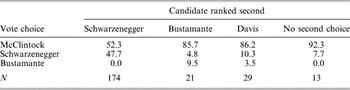
Table 4, which breaks down the choices of McClintock supporters by whom they ranked second in their preference orderings, presents a more telling look at their voting decisions. Nearly three out of four McClintock supporters ranked Schwarzenegger second, which is not surprising. Schwarzenegger lacked the conservative credentials of McClintock, but he was surely ideologically more palatable to McClintock voters than Bustamante. Nearly half of these voters cast a tactical vote for Schwarzenegger. McClintock supporters who ranked Bustamante or Davis next in their preference orderings were far less common, and all but a few of them voted sincerely for McClintock. The last column in Table 4 shows, as one would expect, that voters who ranked McClintock first but failed to rank any other candidate were also extremely loyal to McClintock.
Voting Decisions of McClintock Supporters (in Percentages)

We infer from these results that McClintock supporters who ranked Davis or Bustamante ahead of Schwarzenegger objected to Schwarzenegger primarily on non-ideological grounds. Perhaps they were put off by accounts of his antics as a movie star, saw him as an opportunist, or were suspicious that he had married Maria Shriver, a scion of the most prominent Democratic family (the Kennedys) in the country. Whatever their reasons, after rejecting Schwarzenegger, most found the prospect of voting for the liberal Bustamante unpalatable.
In sum, the pattern of tactical voting observed in the replacement election adds credence to the concept that voters are rationalistic. They have clear, consistent preference orderings over the major candidates, and the choices they make logically follow from their preference orderings. As indicated previously, however, the many voters in our survey who cast tactical votes appear to be acting as if they believe their vote might be pivotal even though there is no possibility of this being the case. Empirical support for the declining rate hypothesis, furthermore, suggests that voters make choices that are conditioned upon perceived differences in probabilities that are not actually present. Additionally, voters’ assessments of the likelihood that their preferred candidate would win often reflected highly unrealistic, wishful thinking.
III: Hedge voting and the recall question
As in previous studies of tactical voting, our analysis of the replacement election concerns only voters who most preferred one of the minor candidates. In the 2003 recall, however, the two-part structure of the ballot – the question of whether or not to recall Gray Davis, followed by a plurality election to select a replacement – extended the opportunity to vote sophisticatedly to a much larger share of the electorate. While those who most preferred Davis could not vote for him in the replacement election, the tables were turned on the initial recall question. Here voters had only Davis to vote for or against. Those voters whose favourite candidate was Davis presumably would vote sincerely in accordance with their preferences and oppose the recall, and we would expect those whose least favourite was Davis to vote sincerely in favour of Davis’s recall.
All other voters, i.e. the 41 per cent of the voters who ranked Davis neither first nor last, confronted an interesting choice. Given that the candidate they preferred in the replacement election could win only if Davis lost the recall contest, voting straightforwardly would mean voting in favour of recalling him. We refer to such voters as ‘bullet’ voters. But what if voters, even though they preferred someone else to Davis, did not think he was that bad – or at least not bad enough to deserve being recalled? Supporters of other candidates might have also feared that someone they liked even less than Davis might win the replacement election. Even though they preferred another candidate over Davis, some might have hedged their bets and voted against the recall. By their reasoning, it would be ideal if their preferred candidate became governor, but it would be better to retain Davis than end up with an even worse alternative. We refer to such voters as ‘hedge’ voters.
Bustamante, at least at the beginning of his campaign, called upon his supporters to cast a hedge vote and to oppose the recall of fellow Democrat Davis. But how many followed this directive? For hedge voters, the candidate they supported in the replacement election could become governor only if the outcome of the recall (Davis is recalled) ran counter to how they voted (against the recall). This cognitive dissonance might have been troubling to some voters, making hedge voting less attractive than conventional tactical voting. Similarly, Davis supporters believed that, while many Democratic voters would reluctantly back Davis on a simple up-or-down vote, a Democratic alternative to Davis would let them off the hook, so to speak. Because they were going to back their party’s candidate in the replacement election, they could vote for Davis’s recall without feeling disloyal.Footnote 34 Davis supporters understood that for Bustamante, the ‘vote for me but against the recall’ message was not incentive-compatible, and they perceived, correctly we think, that the Bustamante campaign ultimately spent little time and effort in opposing Davis’s recall.
We test two alternative hypotheses concerning hedge voting. The first, the ‘simple hedge voting’ hypothesis, holds that voters engage in hedge voting purely as a function of the relative amount of utility they would receive from Davis retaining office. How good or bad is Davis compared to the other candidates available? Operationally, this implies that the lower that voters rank Davis in their preference orderings, the more likely they are to vote for the recall.
The second, the ‘conditional hedge voting’ hypothesis, holds that hedge voting was also motivated by fear of an alternative worse than Davis. According to this hypothesis, voters who believed that a candidate they disliked more than Davis had a good chance of winning the replacement election would have been more likely, ceteris paribus, to cast a hedge vote against Davis’s recall than were those who believed that this opponent was likely to lose the replacement election. The hypothesis takes operational form by positing that for Bustamante supporters, the more likely they were to think that Schwarzenegger would win the replacement election, the more likely they should be to cast hedge votes against Davis’s recall. In the case of Schwarzenegger and McClintock supporters, the more likely they were to think that Bustamante would win the replacement election, the more likely they should be to cast hedge votes against the recall. Both sets of voters, of course, must also prefer Davis to their favourite candidate’s major opponent in the replacement election.
Voters’ decisions concerning the recall question potentially depended upon many considerations – the utility derived from retaining Davis, the utility derived from the election of the candidate they supported in the replacement election (not necessarily their favourite), and the utility derived from the election of other candidates. The standard theory of tactical voting holds that they should also evaluate the probabilities of casting a pivotal vote under different scenarios. In principle, then, a complete analysis of voters’ decisions regarding the recall would entail consideration of their entire preference ordering and the probabilities of winning associated with each candidate – a daunting prospect, as voters in our survey reported eighty-four distinct patterns of preferences over the four major candidates (Davis, Schwarzenegger, Bustamante and McClintock), and dozens more were we to consider the preference orderings of those who most favoured a minor candidate.
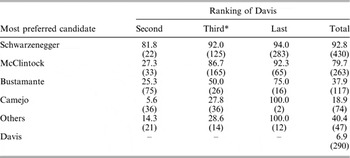
Fortunately, we can simplify matters greatly by taking an initial look at the data purely in terms of the simple hedge voting hypothesis. This hypothesis implies that the major contours of voting patterns on the recall question can be discerned by aggregating preference orderings according to the voters’ utility of retaining Gray Davis in office relative to that of electing various other candidates. In Table 5 we report the percentage of each candidate’s supporters who voted for the recall, broken down by their ranking of Davis – second, third or last.
Support for the Recall of Gray Davis: Simple Hedge Voting (Percentage Voting Yes)

Note: The number of observations in each category is reported in parentheses below each percentage entry.
*Respondents who are coded as ranking Davis third also ranked another candidate below him. A small number of respondents ranked Davis third, but only revealed a preference ordering over three candidates (see Table 1). In these cases, they were classified as having ranked Davis last. Those who were indifferent between Davis and another candidate but ranked the pair of them last were also deemed to have ranked Davis last.
Looking first at Schwarzenegger supporters, we see that few of these voters ranked Davis second, and nearly two-thirds of them ranked him last. Those who ranked Davis either third or at the bottom voted overwhelmingly for the recall, but Davis fared badly even among the small number of Schwarzenegger’s supporters who ranked him second: over 80 per cent of these voters also cast a bullet vote in favour of recalling Davis. McClintock supporters were a bit more likely than Schwarzenegger’s to rank Davis second, but nearly 90 per cent of them still put Davis third or last in their rankings. However, the degree to which McClintock supporters favoured the recall varied dramatically with their ranking of Davis. Only 27 per cent of McClintock’s supporters who ranked Davis second favoured the recall, compared to nearly 90 per cent of those who ranked him lower. Voters whose favourite was Camejo or one of the minor candidates generally placed Davis higher in their orderings than did McClintock supporters, and their support for the recall was also sensitive to Davis’s ranking. Few who ranked Davis second favoured his recall, but those who put him at the bottom of their list favoured the recall unanimously.
Not surprisingly, supporters of fellow Democrat Cruz Bustamante tended to rank Davis higher than did supporters of the Republican candidates, as most ranked him second and few ranked him last. Nearly 75 per cent of the Bustamante supporters who ranked Davis second cast a hedge vote against Davis’s recall. In contrast, half of the Bustamante supporters who ranked Davis third cast a bullet vote in favour of the recall, as did three out of four who ranked Davis last.
As impressive as the amount of hedge voting might be to voting theorists, supporters of Gray Davis were not impressed by what they viewed to be a lack of reciprocity on the part of Bustamante supporters. Although 83 per cent of Davis’s supporters backed Bustamante in the replacement election (see Table 3), overall only 62 per cent of Bustamante’s supporters backed Davis by voting against the recall. It must be kept in mind, however, that for most Davis supporters, voting for Bustamante in the replacement election was a straightforward, sincere vote. Yet for Bustamante supporters, voting against Davis’s recall was a sophisticated vote that entailed some degree of cognitive dissonance and bad incentives.
Did the lack of support from Bustamante’s supporters cost Davis the governorship? Voters whose favourite candidate was Bustamante accounted for about 10 per cent of the electorate. If they had voted against the recall at the same rate that Davis supporters backed Bustamante in the replacement election (83 per cent), the vote against the recall would have been about 2 per cent higher, i.e., around 47 per cent – closer, but not a different outcome.
The second hypothesis to consider here, that of conditional hedge voting, holds that voters were more likely to cast a hedge vote against Davis’s recall if they perceived that someone they liked less than Davis might win the replacement election. To engage in conditional hedge voting requires ranking a major opponent to one’s favourite candidate below Davis. In our analysis we restrict our attention to Schwarzenegger and McClintock supporters who ranked Davis ahead of Bustamante, and Bustamante supporters who ranked Davis ahead of Schwarzenegger. This excludes few Bustamante supporters, as 89 per cent of them ranked Davis over Schwarzenegger. But 58 per cent of McClintock supporters and 76 per cent of the Schwarzenegger supporters ranked Davis behind Bustamante, and so were not in a position to engage in conditional hedge voting.
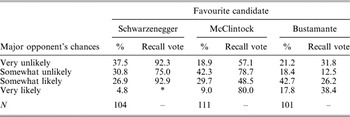
For those supporters of each major candidate in the replacement election whose preference orderings make conditional hedge voting an appropriate strategy, we report two columns of data in Table 6. The first column is the percentage of respondents who perceive that their favourite candidate’s major opponent in the replacement election (Bustamante in the case of Schwarzenegger and McClintock supporters, and Schwarzenegger in the case of Bustamante supporters) was either ‘very likely’ to receive the most votes in the replacement election, ‘somewhat likely,’ ‘somewhat unlikely,’ or ‘very unlikely’. The entry in the second column reports the percentage of voters in each of these categories that favoured Davis’s recall.
Conditional Hedge Voting

*Insufficient data.
As indicated previously, voters’ assessments of the likelihood that their favourite candidate would win the election were strongly biased by wishful thinking. Their assessments of how likely other candidates were to win the election also reflected some degree of ‘reverse’ wishful thinking, i.e., perceptions that candidates they did not like were more likely to lose. Nearly 40 per cent of Bustamante supporters, for instance, reported a belief that Schwarzenegger was likely to lose. Still, most McClintock and Schwarzenegger supporters believed Bustamante was unlikely to win, while most Bustamante supporters believed Schwarzenegger was likely to win.
We see little support in Table 6 for the conditional hedge voting hypothesis. Few of the Schwarzenegger supporters who ranked Davis ahead of Bustamante and who were thus in a position to engage in conditional hedge voting appear to have done so. Those who thought Bustamante was at least somewhat likely to win the replacement election supported Davis’s recall by the same overwhelming margin as those who thought a Bustamante win was very unlikely. McClintock and Bustamante voters also exhibited no consistent tendency to condition their vote on Davis’s recall upon the perceived likelihood that a candidate they ranked below Davis would win the replacement election.
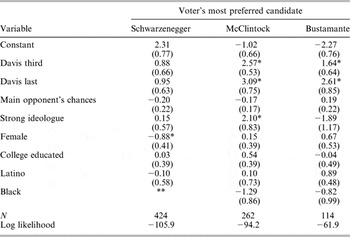
In order to conduct a joint test of the simple and conditional hedge voting hypotheses, we estimated logit equations of decisions on the recall question made by supporters of Schwarzenegger, McClintock and Bustamante, respectively. Votes on the recall question were coded 0 if ‘no’ and 1 if ‘yes’. Positive coefficients indicate more support for Davis’s recall. In order to register the information reported in Table 5 regarding simple hedge voting, i.e., voters’ utility for retaining Davis, each equation specified two dummy variables indicating whether the voter ranked Davis third or last (the suppressed reference category was composed of those ranking Davis second). The variable that was specified to estimate the extent of conditional hedge voting was the voters’ perceptions of the likelihood that their favourite candidate’s main opponent – Bustamante in the case of Schwarzenegger and McClintock supporters, Schwarzenegger in the case of Bustamante supporters – would win the replacement election. Responses of ‘very unlikely’, ‘somewhat unlikely’, ‘somewhat likely’ and ‘very likely’ were coded 1, 2, 3 and 4, respectively. In each case, this variable was specified only for voters who ranked Davis ahead of their favourite candidate’s main opponent.
The three equations also included a set of dummy variables to register demographic and ideological characteristics that are generally associated with voting decisions. These include dummy variables for voters who are female, Latino, black, have a college degree or even more education, and are strongly ideological – strongly conservative in the case of Schwarzenegger and McClintock supporters, strongly liberal in the case of Bustamante supporters. Results are reported in Table 7.
Logit Analysis of Simple vs. Conditional Hedge Voting

Note: The numbers in parentheses below each coefficient are standard errors.
*p < 0.05
**Insufficient data.
Coefficients of the dummy variables indicating Davis’s placement in voters’ preference orderings confirm the strong support for the simple hedge voting hypothesis that was apparent in Table 5. Across all three equations, compared to voters in the suppressed reference group who ranked Davis second behind their favourite candidate, those who ranked him third were much more supportive of his recall, and those who ranked him last were more supportive than those who ranked him third. As was also evident in Table 5, this effect was much more pronounced among McClintock’s and Bustamante’s supporters than among Schwarzenegger’s.
In contrast, coefficients of the ‘Main opponent’s chances’ variable were small and insignificant, and the positive sign of the coefficient in the Bustamante equation is the opposite of what the conditional hedge voting hypothesis would predict. In short, whether or not supporters of other major candidates in the replacement election cast hedge votes against Davis’s recall depended heavily upon how favourably or unfavourably they ranked Davis in their preference orderings. Hedge voting did not appear to be motivated by perceptions that a candidate they liked even less than Davis was likely to win the replacement election. In contrast to the findings concerning the declining rate hypothesis of tactical voting in the replacement election, which imply that voters based their decisions upon differences in probability that did not exist, these results imply that voters’ decisions on the recall question incorporated no probability assessments whatsoever.
The demographic and ideological measures included in these equations were also linked to votes on the recall question as expected. Among McClintock supporters, strong conservatives were considerably more supportive of Davis’s recall, while among Bustamante supporters strong liberals were considerably more opposed. Women whose favourite candidate was Schwarzenegger were less supportive of the recall than men. Voting on the recall by Bustamante supporters also lined up along ethnic and racial lines, with Latinos more supportive and blacks more opposed (both coefficients were just short of achieving conventional levels of statistical significance).
At this point we turn attention back to Table 5. The bottom entry in the last row, which reflects the votes on the recall question of those who favoured Davis, shows that 6.9 per cent of them voted for his recall. This is not a large number, but why would any Davis supporter favour his recall? Similarly, if we sum across supporters of all other candidates, we find that 6.5 per cent of those who ranked Davis last voted against the recall. Data always contain error, but we suspect that some of the anomalous voting decisions on the recall question were the result of voter confusion as to whether ‘recalling’ Davis meant that he would lose office or retain it. This problem characterizes many direct ballot measures, i.e., that being in favour of something requires casting a ‘no’ vote. In this case, a vote in favour of Davis meant voting ‘no’ on the recall. But there are additional problems with the word itself. If one is auditioning for a role in a movie or play it is good to be recalled, because it means that you have survived a cut. If so, some voters might have inferred that voting to recall Davis would keep him in office.
Fortunately, the wording of the recall question as it actually appeared on the ballot was more helpful in this regard than was the question we posed in our survey. We asked, ‘How are you going to vote [did you vote] on the question to recall Gray Davis as governor of California? Are you going to vote [did you vote] for the recall of Davis, or against it?’ The question voters confronted on the ballot was ‘Should Gray Davis be recalled (removed) from the Office of Governor?’ Insertion of the word ‘removed’ may have lessened the ambiguity about the meaning of the word recall, and thus voters at the polls should have made fewer mistakes than our survey respondents. Still, such confusion might have been present in the actual election: election officials noted that ‘recall’ does not translate well into the Asian languages used in this election, and precincts with large numbers of immigrants experienced greater residual vote rates (spoiled ballots) on the recall question.Footnote 35
Discussion
Our analysis of survey data concerning preferences over the major candidates in the 2003 California recall election confirms that one fundamental assumption of rational choice theory is eminently reasonable: individuals’ preference orderings over major candidates are, with few exceptions, transitive. Our results also confirm the findings of dozens of previous studies, in that we found that large numbers of voters responded to the choices presented to them in the California recall by voting tactically. In the replacement part of the election, supporters of minor candidates engaged in conventional tactical voting by opting to vote for one of the two leading contenders. Many voters also engaged in hedge voting on the recall question itself, choosing to vote against Davis’s recall even though they ranked a candidate (or candidates) running in the replacement election ahead of Davis.
Voters’ choices, however, were not conditioned upon probability assessments in a realistic and consistent fashion. The standard account of tactical voting holds that voters make the choice to vote for a lesser preferred candidate as if they were (or might reasonably expect to be) the pivotal voter, even though in large elections involving millions of voters, the probability of this contingency occurring is effectively zero. It is for this reason that we characterize tactical voting as ‘rationalistic’. Furthermore, empirical support for the declining rate hypothesis of tactical voting in the replacement election indicates that voters’ choices appeared to be conditioned upon perceived differences in probabilities that did not actually exist. On the initial recall question, however, whether or not supporters of other major candidates in the replacement election cast hedge votes against Davis’s recall depended upon where they ranked Davis in their preference orderings, but were not motivated by the perceived likelihood that someone they liked even less than Davis could win the replacement election.
An inconsistent pattern of results also emerged when we directly asked respondents about their probability assessments. McClintock voters who believed that McClintock had at least some chance of winning the replacement election were more likely to stay loyal to him, but such beliefs were obviously a function of unrealistic, wishful thinking. Voters’ assessments of other candidates’ chances were somewhat more realistic, but, as we have just reported, did not appear to influence their decisions on how to vote on the initial recall question.
One might conclude from these results concerning voters’ use of probability assessments that probability is something that voters are just not very good at. Studies in social psychology frequently find that people systematically overestimate the probability of rare events and underestimate the probability of common events, so perhaps our results are just another demonstration that for most people, probability is problematic. But it occurs to us that another explanation for this entirely inconsistent pattern of results is that voters are not conditioning their decisions upon perceived probabilities at all. In our analysis of hedge voting on the recall, of course, voters do not appear to have taken probabilities into account. But if voters are not conditioning their choices upon perceived probabilities, how can we explain tactical voting in the replacement election, or in the dozens of other elections in which it has been detected? Tactical voting has long been seen as the consequence of voters deciding that because their favourite candidate has no chance of winning but their second choice does, it is better to vote for their second choice.
Perhaps a better way of thinking about tactical voting is to begin with the fact that in a plurality election, voters are constrained by the ballot to cast one vote for one candidate, and thus are able to convey only one single piece of information about their preferences over all the candidates contesting that election. What tactical voters may therefore be doing is casting their vote in such a way as to convey what they believe to be the single most important bit of information about their preferences. A tactical vote, then, is not based upon the voters’ sense that if they want to have a chance of being pivotal they should vote for their second-preferred candidate. It may simply reflect a decision that the one single piece of information they want to report about their preferences is not their favourite candidate, but which one of the two leading candidates they favour. This view of tactical voting can be consistent with the ‘declining rate’ pattern observed in our study. It requires only that the lower the level of support that there is for a minor candidate, the more likely his or her supporters are to conclude that it is better to use their single vote to convey information about which of the major candidates they like or dislike. Seen in this way, tactical voting might be particularly attractive to voters who strongly disapprove of one of the major candidates. The ballot does not allow them to directly cast a negative vote, but they can register their disapproval indirectly by voting for that candidates’ most serious opponent instead of for their favourite (but minor) candidate. A tactical vote can thus serve as a means of casting a negative vote on a ballot that does not permit negative votes. In our view, this alternative explanation for tactical voting is much more congenial to rational choice theory than is the conventional account, which holds that voters operate under the grand illusion that they might be pivotal.
Appendix
This survey was implemented by Interviewing Services of America (ISA), using list-assisted random digit dialling (RDD) survey methodologies and trained interviewers. A Spanish-language version of the questionnaire was available, and nine respondents were interviewed in Spanish.
The sample is comprised of 1,500 California adults who reported that they were registered to vote. To obtain the 1,500 completed interviews, ISA utilized a list of 20,765 Californian residential telephone numbers. Using the standard American Association for Public Opinion Research (AAPOR) guidelines, the co-operation rate for eligible respondents, i.e., those who reported they were registered, was 54.5 per cent, which is high by contemporary standards. The two standard response rate estimates for RDD telephone surveys, RR1 and RR2, were 9.8 per cent and 10.5 per cent, respectively. These low response rates can be attributed to several sources, the largest being the 7,443 telephone numbers that were never resolved, either because no one ever answered despite repeated callbacks (4,976), because the number was sampled but never dialled (2,058), or for other reasons. Removing these 7,443 numbers of unknown eligibility from the computation produces response rates of 19.3 per cent and 20.5 per cent for RR1 and RR2, respectively. Another 5,540 numbers were ineligible because they had been disconnected (2,924), were business numbers (978), or faxes and modems (959). There were also 4,835 unsuccessful contact attempts, which includes calls picked up by answering machines (2,665), or attempts by the interviewers to call back later but which never yielded an interview (2,170).
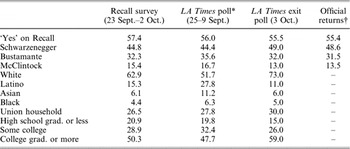
Table A1 lists responses to the vote questions and some key demographic characteristics from our survey (the first column), and compares these figures to those obtained from the final Los Angeles Times pre-election poll, the Los Angeles Times exit poll conducted on election day, and the official returns reported by the California Secretary of State. The Times pre-election poll contains a large over-sample of Latino and other minority group respondents, but the entries reported in the rest of the cells are based upon a re-weighted sample intended to reflect major demographic characteristics of the Californian electorate. The Times exit poll data were weighted to match the official returns.
Comparison of Sample Surveys and Official Returns

*This poll contained a large over-sample of minority respondents. Entries in this column other than those for race and ethnicity are based on observations that were weighted so as to approximate actual population characteristics.
†As announced by the Secretary of State.
Respondents in our survey registered a slightly higher ‘yes’ vote on the recall than did respondents in the other polls and, as shown in the official returns column, than what turned out to be the case. Our survey and the Times pre-election phone poll also under-estimated Schwarzenegger’s vote share and over-estimated McClintock’s, but again, not by very much. The large over-sample of Latinos and other minorities in the Times phone poll means that its race and ethnicity figures are not comparable to ours. Compared to the Times exit poll, however, our sample contained a larger percentage of Latinos and a smaller percentage of whites. The educational attainment of respondents in our survey was also somewhat less than of respondents in the two Los Angeles Times polls, and a slightly smaller percentage of respondents indicated that they or someone else in their household belonged to a trade union. In general, then, the discrepancies between our survey, the Los Angeles Times polls and the official returns are minor. It thus appears that respondents in our survey were statistically a good representative sample of the Californian electorate in October 2003.