I. INTRODUCTION
Laves-phase intermetallics are of great potential to be used as high-temperature structural materials. Reference Xue, Li, Zhong and Fu1–Reference Jia, Weng, Li, Hong, Su and Zhang3 The NbCr2 is a typical Laves phase compound, and is of particular interest for such application due to its high-melting point (2003 K), high creep resistance, and excellent high-temperature strength. Reference Lu, Zheng and Fu4–Reference Nie, Lu, Wang, Chen and Niu8 However, the NbCr2 Laves phase by itself generally has poor ductility and fracture toughness at room temperatures. Therefore, substantial attempts have been conducted to improve the fracture toughness of NbCr2 by composition designing and preparing method optimizing, Reference Lu, Zheng and Fu4,Reference Nie, Lu and Wang5,Reference Lu, Zheng, Deng and Yao9–Reference Xiao, Lu, Hu, Huang, Nie and Fu11 and these works showed that the powder metallurgy route has a beneficial effect on the room temperature fracture toughness of NbCr2 Laves phase. Reference Lu, Zheng and Fu4,Reference Nie, Lu and Wang5,Reference Nie, Lu, Wang, Chen and Niu8,Reference Lu, Zheng, Deng and Yao9,Reference Xiao, Lu, Hu, Huang, Nie and Fu11 The room-temperature fracture toughness of NbCr2 Laves phase was increased to 4.7 MPa·m1/2 by hot pressing, Reference Xiao, Lu, Hu, Huang, Nie and Fu11 which is increased remarkably compared to the alloy prepared by conventional arc melting. However, the traditional powder metallurgy routes often produce relatively low sintered density, coarsen microstructure, and consequently degrade the desired mechanical properties. Reference Nie, Lu and Wang5,Reference Xiao, Lu, Hu, Huang, Nie and Fu11
These problems can be alleviated by spark plasma sintering (hereafter abbreviated as SPS), Reference Ge, Subhash, Baney and Tulenko12,Reference Wang, Cheng and Zhao13 which is a comparatively novel sintering process characterized by the synthesis of bulk materials from powders at low temperature with short heating, holding and cooling time when compared to conventional sintering processes. Reference Zhang, Ahmed, Holzhüter and Burkel14–Reference Orrù, Licheri, Locci, Cincotti and Cao16 It is now successfully used to prepare advanced alloys, ceramics, composites, and even functional materials with high mechanical properties mainly because of obtaining near full densities and ultrafine microstructure. Reference Karthiselva, Murty and Bakshi17–Reference Bolarín-Miró, Sánchez-De Jesús, Cortés-Escobedo, Díaz-De la Torre and Valenzuela20 Liu Reference Liu, Fu and Sha21 found that the Nb–Si alloys are produced by SPS with nearly full dense and improved yield strength and fracture toughness. Couret Reference Couret, Molénat, Galy and Thomas22 suggested that the SPS technique can be used to fabricate fine grain TiAl alloys with promising tensile properties at room temperature. However, a review of the published studies demonstrates that the mechanisms that govern the reaction synthesis of intermetallic compounds with stoichiometric ratios during SPS remain heretofore poorly understood as most of the recent works on SPS have been concentrated on the grain refinement, and the mechanisms involved in densification and grain growth. Reference Chawake, Koundinya, Srivastav and Kottada23–Reference Bu, Jönsson and Zhao25
The current study was motivated by two important questions. First, the applicability of production of NbCr2 Laves phase (with a stoichiometric ratio of 1:2) through SPS and the conditions required for a complete reaction to be attained. Second, what is the influence of SPS on the grain refinement and subsequently, effect on the room temperature fracture toughness of NbCr2 Laves phase. This investigation is an attempt to understand the synthesis of NbCr2 Laves phase by SPS, which is done by relating the experimental observations to the composition distribution in the particles.
II. EXPERIMENTAL
A. Alloy preparation
Chromium (∼38 μm, 99.5%) and niobium (∼48 μm, 99.9%) powders were mixed in a stoichiometric ratio of 2:1 by atom to synthesize the NbCr2 Laves phase. The powders were dry milled in corundum medium in a shaker ball mill (GN-2, Shenyang Zhongbei Vacuum Tech Co., Ltd., Shenyang City, China) with both vial and balls made of hardened steel. Milling was performed for 0.5 h with a ball to powder ratio of 10:1 at a milling speed of 400 rpm. Then the mixtures were poured into a cylindrical graphite die with an inner diameter of 20 mm. Thin graphite foils were placed between powders and graphite die surfaces to prevent welding and facilitate easy removal of the sintered compact. The mixtures were sintered under 30 MPa for 5 min at various temperatures (1173, 1473, and 1773 K) in conditions of vacuum (1 Pa) with a constant heating rate of 100 K/min using a SPS apparatus (SPS, 331Lx, Fuji Electronic Industrial Co., Ltd., Tokyo, Japan). The sintering temperature was measured by a sheathed NiCr–NiSi thermocouple between 300 and 1273 K, and after 1273 K, it was measured by an infrared temperature monitor. The synthesized compacts had a thickness of 4–5 mm.
B. Microstructure characterization
The samples were ground with 300-grit emery papers and finally cleaned in an ultrasonic ethanol bath to remove surface contamination from graphite foil. Then, the sintered compacts were cut using electro discharge machining and the density was determined by Archimedes' method using water immersion. X-ray diffraction (XRD) was carried out on the polished compacts using a diffractometer (XRD, TD-3500, Dandong Tongda Science and Technology Co., Ltd., Liaoning, China) employing Cu Kα radiation (λ = 1.5406 Å).
Then, the metallographic process involved grinding, mechanical polishing, and chemical etching with a solution of 15 g KOH, 15 g K3Fe (CN)6, and 90 mL H2O. A scanning electron microscopy (SEM, JSM-6700F, JEOL Ltd., Tokyo, Japan) equipped with an energy dispersive spectrometer was used to identify the phases in the compacts and characterize the microstructures.
C. Nanoindentation
Nanoindentation experiments were performed on a MTS Nano Indenter® XP instrument (G200, Keysight Technologies, Palo Alto, California) with a three-sided pyramidal Berkovich indenter by using the continuous stiffness measurement technique. Reference Couret, Molénat, Galy and Thomas22,Reference Li and Bhushan26 To get reliable mechanical properties and prevent interference from environmental fluctuation, each test was performed when the thermal drift dropped down to 0.01 nm/s. At least 20 indentations were performed on each sample and the distance between the adjacent indents was kept at least 25 μm apart to avoid mutual interferences.
D. Room temperature fracture toughness
The fracture toughness of the samples was evaluated at room-temperature by a microhardness tester with a Vickers indenter (Duramin-A300, Duramin Struers, Copenhagen, Denmark), the tests were carried out at a load of 1000 g and at a constant dwell time of 15 s. The data on each sample were averages of ten indentations. The impression diagonals and the introduced crack length were observed using an optical microscope (Lecia DM4000M, Leica Microsystems, Wetzlar, Germany). The room-temperature fracture toughness values (K IC) were calculated from the following equations Reference Anstis, Chantikul, Lawn and Marshall27 :
 $${K_{{\rm{IC}}}} = A{\left( {{E \over {{H_{\rm{v}}}}}} \right)^n}\left( {{P \over {{C^{3/2}}}}} \right)\quad ,$$
where P is the load; H v, the hardness value; C, the average crack length; E, Young's modulus, which can be obtained from the Nano Indenter test; A and n are constants, which are taken as 0.016 and 0.5, respectively, for relatively brittle materials. Reference Orrù, Licheri, Locci, Cincotti and Cao16 At least six points on each disk were selected for Vickers hardness testing.
III. RESULTS AND DISCUSSION
A. XRD analysis
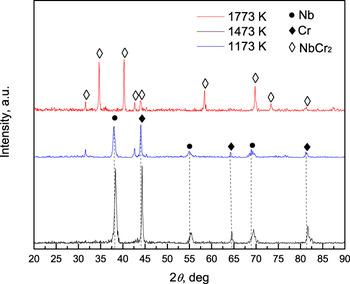
Figure 1 displays the detailed XRD patterns of the samples consolidated under different temperatures. The XRD peaks of the sample sintered at 1173 K are identical to those of Nb (ICDD card PDF#35-0789) and Cr phase (ICDD card PDF#06-0694). With increasing the sintering temperature to 1473 K, the bulk sample reveals two weak peaks of NbCr2 Laves phase, which suggests the formation of NbCr2 Laves phase, but with limited content. Increasing the sintering temperature to 1773 K, still far lower than the melting points of Nb, Cr, and NbCr2 Laves phase, the diffraction peaks of Nb and Cr phases disappeared completely and only diffraction peaks of NbCr2 were observed, which suggests the formation of pure NbCr2 Laves phase.
XRD patterns of the bulk Nb–Cr samples consolidated at different temperatures.

B. Microstructure characterization of the sintered sample
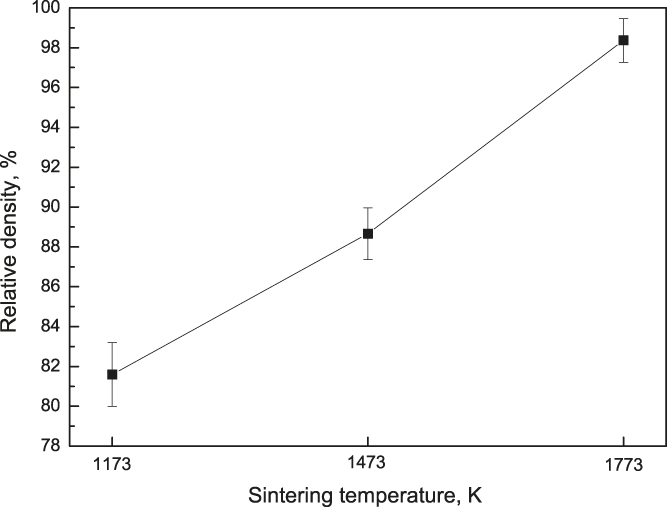
The relative density with respect to sintering temperature is shown in Fig. 2. The plot reveals that the sintering temperature has a significant effect on the densification of these samples. The relative density increased from 81.6 to 88.7% and then 99.4% as increasing the sintering temperature from 1173 to 1473 K and then 1773 K, which suggested the pores close gradually at higher temperature and result in the enhancement of densification.
Relative densities of the sintered Nb–Cr samples as a function of sintering temperature.

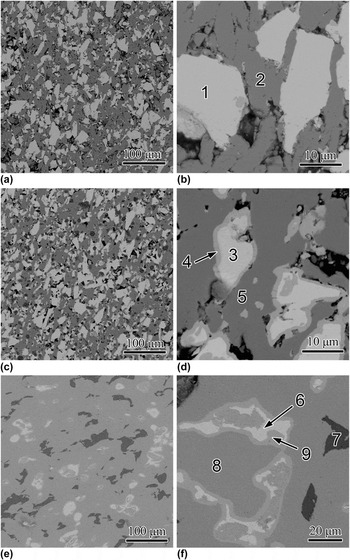
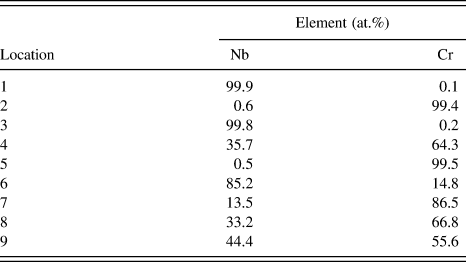
As shown in Figs. 1 and 2, the sintering temperature has a significant influence on the synthesis and characterization of NbCr2 Laves phase. By analyzing the microstructure evolution of the Nb–Cr samples sintered at different temperatures, the formation mechanism of NbCr2 Laves phase in the SPS process may be revealed. Figure 3 illustrates the backscattered electron micrographs of the samples sintered at different temperatures. Combined with the energy dispersive spectrometer (EDS) analysis showing in Table I, only Nb and Cr phases exist in the sample sintered at 1173 K [Figs. 3(a) and 3(b)], while three phases (Nb, Cr, and NbCr2), differing in contrast, exist in the compact sintered at 1473 and 1773 K [Figs. 3(d) and 3(f)]. The reason for not seeing the Nb and Cr phases in the compact sintered at 1773 K by the XRD is due to the fact that their contents are below the detection limit of the XRD analysis method.
SEM micrographs of the sintered samples at different temperatures (a and b) 1173 K, (c and d) 1473 K and (e and f) 1773 K.

EDS results of positions showing in Fig. 3.

As shown in Figs. 3(e) and 3(f), the fabrication of NbCr2 Laves phase by SPS is always accompanied with trace amounts of Nb and Cr solid solutions even the relative density attains 99.4%, which suggests that the SPS methods may be unsuitable for the synthesis of pure intermetallic compounds with stoichiometric ratios. In this condition, the emphasis is focus on the reaction completion rate of Nb and Cr at various temperatures and the temperature distribution in the powder particles.
The reaction between Cr and Nb can be represented as follows:
 $${\rm{Nb}} + {\rm{Cr}} \to {\rm{NbC}}{{\rm{r}}_2}\quad .$$
The reaction progress can be described by Jander's solid-state reaction model, Reference Groza28,Reference Tsuchida, Furuichi and Ishii29 which assumed that the Nb particles are embedded in a quasicontinuous Cr medium. The reaction rate of NbCr2 formed from Nb and Cr is diffusion controlled and hence follows the parabolic rate law:
 $${\left[ {1 - {{\left( {1 - W} \right)}^{1/3}}} \right]^2} = 2{k_{\rm{p}}} \cdot {t \mathord{\left/ {\vphantom {t {{r_0}^2}}} \right. \kern-\nulldelimiterspace} {{r_0}^2}}\quad ,$$
where W is the weight fraction of reacted Nb, k p is the parabolic rate constant, t is the reaction time, and r 0 is the particle size of the Nb powder. The practical parabolic rate constant k p is described by the Arrhenius law Reference Groza28,Reference Tsuchida, Furuichi and Ishii29 :
 $${k_{\rm{p}}} = A \cdot {{\rm{e}}^{ - {{{E_{\rm{a}}}} \over {RT}}}}\quad ,$$
where A is the pre-exponential factor, E a is the activation energy, R is the gas constant, and T is temperature.
By combining Eqs. (1) and (2), one can obtain the following equation Reference Groza28,Reference Tsuchida, Furuichi and Ishii29 :
 $$W = 1 - {\left[ {1 - {{\left( {2A \cdot t} \right)}^{1/2}} \cdot {{\rm{e}}^{{{ - {E_{\rm{a}}}} \over {RT}}}} \cdot {r_0}^{ - 1}} \right]^3}\quad .$$
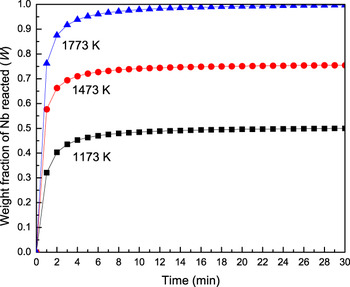
The parameters A and E a were taken to be 18,576 μm2/min and E a to be 1.84 eV, Reference Schmetterer, Khvan, Jacob, Hallstedt and Markus30 r 0 is the average particle size of the Nb powder, and its value is 37 μm in this study. Using Eq. (4), the fraction of reacted Nb can be plotted as a function of time, as shown in Fig. 4.
The calculated weight fraction of Nb reacted with Cr as a function of sintering temperature.

The reaction speed of Nb and Cr correlates well with the sintering temperature, i.e., increasing reaction speed with increasing sintering temperature. Keeping the sintering time constant at 5 min, the compact sintered at 1773 K shows nearly 100% reaction of Nb with Cr while the compact sintered at 1473 and 1173 K shows only 72.3 and 46.4%, which is in reasonable agreement of the density determination. This indicates that the Nb powder cannot fully react with the Cr powder in the compacts sintered at low temperatures even under additional sintering time. Thus, the formation of NbCr2 Laves phase may attribute to the special sintering mechanism of SPS technique.
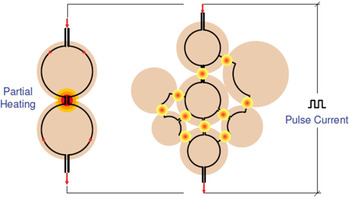
From the microscopic scale point of view, energy is required at the contact points of the powder particles, which is generated by Joule heat and discharge during the SPS process (see in Fig. 5). According to the studies reporting on SPS, Reference Liu, Song and Zhang31,Reference Suárez, Fernández, Menéndez, Torrecillas, Kessel, Hennicke, Kirchner, Kessel and Ertuğ32 the temperature increase (ΔT) in the region from the particle-contacting surface toward the center of the particle follows the equation,
 $$\Delta T = {{16} \over \pi }{{{I^2}\rho \Delta t} \over {{C_{\rm{V}}}{\rho _{\rm{m}}}{{\left[ {{r^2} - {{\left( {r - x} \right)}^2}} \right]}^2}}}\quad ,$$
where Δt is the duration of the pulsed current, C V is the specific heat capacity at constant pressure of Nb, ρm is the density of Nb, x is the distance to the contacting surface, and I is the local intensity of the current passing through the two particles can be estimated as:
 $${I_{\rm{p}}} = {{4{r^2}} \over {{\phi ^2}}}{I_{\rm{S}}}\quad ,$$
where ϕ is the diameter of the sample, and I S is the intensity of the output current pass though the sample:
 $${I_{\rm{S}}} = {I_{\rm{T}}}{{{1 \mathord{\left/ {\vphantom {1 {{R_{\rm{S}}}}}} \right. \kern-\nulldelimiterspace} {{R_{\rm{S}}}}}} \over {{1 \mathord{\left/ {\vphantom {1 {{R_{\rm{d}}}}}} \right. \kern-\nulldelimiterspace} {{R_{\rm{d}}}}} + {1 \mathord{\left/ {\vphantom {1 {{R_{\rm{S}}}}}} \right. \kern-\nulldelimiterspace} {{R_{\rm{S}}}}}}} = {I_{\rm{T}}}{{{\rho _{\rm{d}}}{S_{\rm{S}}}} \over {{\rho _{\rm{S}}}{S_{\rm{d}}} + {\rho _{\rm{d}}}{S_{\rm{S}}}}}\quad ,$$
where I T is the total input current intensity, S s and S d are the cross-sectional areas, and ρS and ρd are the resistivities of the sample and die, respectively.
Energy dissipation in the microscopic scale. Reference Groza28

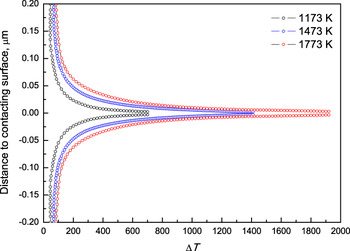
Substituting the parameters listed in the Appendix into Eq. (5), the distribution of the temperature increase in the particle is shown in Fig. 6. It can be seen from Fig. 6 that there is a considerable inhomogeneous distribution of the temperature increase in the particle when pulsed current passes through the two contacting particles. The temperature was highest at the contacting surfaces of the two particles, and decreased sharply inside the surface layer. As predicted by the calculations, in contrast to only a small temperature increase of about 100 K at the center of the particle, the temperature increase may attain as high as about 1900 K at the particle-contacting surface, which results in the temperature at the particle-contacting zone that exceeds the melting points of Nb and Cr powders. Thus, partial melting would occur on the surface of the powder and lead to the rapid consummation of Nb and Cr powders.
The calculated distribution of temperature increase in the particle during SPS.

It is worth noting that the temperature increase at the center of Nb and Cr particles during the SPS process are merely about 200 K. In these areas, the Nb and Cr particles mainly reacted through atomic diffusion, which would result in the formation Nb and Cr solid solutions rather than NbCr2 Laves phase. Indeed, the theoretical analysis is in reasonable agreement with the microstructure determination [Figs. 3(e) and 3(f)].
C. Mechanical properties
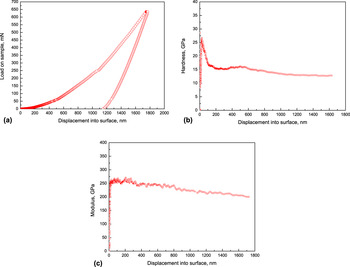
The hardness and Young's modulus of the bulk samples were investigated by nanoindentation measurements on the polished surfaces of the bulk samples. Figure 7(a) shows the load–displacement (P–h) together with the variation of hardness (H) and Young's modulus (E) with the indentation depth for the samples consolidated at 1673 K. According to Oliver and Pharr, Reference Oliver and Pharr33 the hardness H can be calculated from the equation
 $$H = {{{P_{\max }}} \over {{A_{\rm{c}}}}}\quad ,$$
where A c represents the contact area and P max is the maximum load.
(a) Load–displacement curve of the bulk sample consolidated at 1673 K; hardness (b) and Young's modulus (c) of the bulk sample with the indentation depth.

By measuring the unloading stiffness S, the reduced elastic modulus E r can be defined from the relation
 $$S = 2\beta \sqrt {{{{A_{\rm{c}}}} \over \pi }} {E_{\rm{r}}}\quad ,$$
where β is denoted as the contact stiffness of material and a geometric constant with β = 1.034 for Berkovich indenter. Reference Oliver and Pharr33
The Young's modulus (E) is related to E r by the following equation:
 $${1 \over {{E_{\rm{r}}}}} = {{1 - {\upsilon ^2}} \over E} + {{1 - {\upsilon _{\rm{i}}}^2} \over {{E_{\rm{i}}}}}\quad,$$
where E and ν are the elastic modulus and Poissoǹs ratio for the sample, respectively, and E i and νi are the same quantities for the indenter. For diamond indenter tip, E i = 1141 GPa and νi = 0.07. Reference Oliver and Pharr33,Reference Tabor34
With reference to Eqs. (5)–(7), analyses of the load–displacement curves (Fig. 5) resulted in a hardness of H = 14.05 ± 0.67 GPa and a Young's modulus of E = 226.8 ± 10.6 GPa. The measured Young's modulus is basically the same as the reported value of 241 GPa. Reference Chu, He, Thoma and Mitchell35 However, the hardness of the sample sintered at 1773 K increased by about 63% over the as-cast NbCr2 Laves phase [8.6 GPa (Ref. Reference Takeyama and Liu7)]. In addition to H and E, the value of H/E ratio reached 0.062, which was also higher than that of the NbCr2 Laves phase (0.035). The higher H/E ratio is a reliable indicator of fracture toughness, therefore, the fracture toughness of the SPS-processed NbCr2 Laves phase may be enhanced.
According to Eq. (1), the fracture toughness of the bulk sample consolidated at 1773 K was evaluated to be 8.9 MPa·m1/2, which was about 7.4 times higher than that of the as-cast NbCr2 Laves phase [1.2 MPa·m1/2 (Ref. Reference Takeyama and Liu7)]. In this case, the emphasis is focused on the toughening mechanism of NbCr2 Laves phase by SPS. Based on the microstructure analysis, the significant enhancement in mechanical properties of the NbCr2 Laves phase fabricated by SPS can be ascribed to fine grain toughening and dual ductile phase toughening.
The average grain size (D) can be estimated from the full-width at half-maximum (FWHM) of the most intense peak of the (311) plane of NbCr2 Laves phase using the Debye–Scherrer formula,
 $$D = {\raise0.7ex\hbox{${0.89\lambda }$} \!\mathord{\left/ {\vphantom {{0.89\lambda } {\beta \cos \theta }}}\right.\kern-\nulldelimiterspace}\!\lower0.7ex\hbox{${\beta \,\cos \theta }$}}\quad ,$$
where λ is the wave length (for Cu Kα, λ = 0.154), β is the FWHM of an observed peak, and θ is the diffraction angle. From this equation, the average grain size was estimated to be 138 nm, which is far smaller than the samples prepared by mechanical alloying and hot pressing. Reference Nie, Lu, Wang, Chen and Niu8 The significant grain refinement can be attributed to the following reason. The surface of the powder particles underwent a severe plastic deformation during milling, which led to a higher activation of recrystallization during SPS.
In this case, the grain boundaries and associated interfaces begin to dominate the mechanical properties. Compared with monolithic NbCr2 Laves phase, there was grain size refinement with an associated increase in the fracture toughness and hardness values. Meanwhile, the presence of Nb and Cr solid solutions further enlarged the fracture toughness since both the Cr and Nb solid solutions have quite low hardness, but exhibit excellent ductility, which can bear large deformation to absorb the crack energy and resulted into substantial increases in the hardness and fracture toughness of the NbCr2 Laves phase matrix. In addition, the Cr solid solution and Nb solid solution with the bcc crystal structure have been indicated effective in preventing cracks that propagate, originating in the NbCr2 Laves phase. Reference Lee, Liaw, Liu and Chou36
Furthermore, it can predict that there will be downsides in mechanical properties of the SPS-processed NbCr2 Laves phase when we keep increasing the sintering temperature according to the present results. This is due to the following two reasons. Firstly, the grain will be coarsened under higher sintering temperature. In this case, the amount of grain boundaries will be remarkably reduced, which will decrease the fracture toughness due to the weakening of fine-grain toughening. Secondly, the amounts of Nb and Cr solid solutions will be reduced with the increasing of sintering temperature, which will limit the deformation ability of NbCr2 Laves phase and further decrease the mechanical properties.
IV. CONCLUSION
In the present work, the synthesis and characterization of NbCr2 Laves phase fabricated by SPS using spherical Nb and Cr powders were investigated. The SPS was indicated to have a beneficial effect on the mechanical properties of the NbCr2 Laves phase. The SPS-processed NbCr2 Laves phase exhibited a hardness of 14.05 ± 0.67 GPa and a very high fracture toughness 8.9 MPa·m1/2, which were 1.6 and 7.4 times of the as-cast NbCr2 Laves phase (1.2 MPa·m1/2). Based on the microstructure analysis, the remarkable enhancement in mechanical properties of the SPS-processed NbCr2 Laves phase was attributed to fine-grain strengthening and the formation of Nb and Cr solid solutions.
ACKNOWLEDGMENTS
This research was financially supported by the fund of the State Key Laboratory of Solidification Processing in NWPU (SKLSP201507, SKLSP201516), the Youth Foundation of Taiyuan University of Technology (2014TD010) and the Qualified Personnel Foundation of Taiyuan University of Technology (tyut-rc201421a).
APPENDIX
The sintering setup, thermophysical, and electrical parameters used in the modeling are listed below:
-
d (sample diameter, m) = 2.0 × 10⁻²
-
S s (sample cross-sectional area, m2) = 3.14 × 10⁻⁴
-
S d (die cross-sectional area, m2) = 1.26 × 10⁻³
-
ρs1 (Cr electrical resistivity, Ω m) = 1.29 ×10⁻⁷ + 3.87 × 10⁻¹⁰ T
-
ρs2 (Nb electrical resistivity, Ω m) = 1.25 × 10⁻⁷ + 5.0 × 10⁻¹⁰ T
-
ρsd (graphite electrical resistivity, Ω m) = 21 − 3 × 10⁻² T + 2 × 10⁻⁵ T 2 − 6.4 × 10⁻⁹ T 3 + 7.8 × 10⁻¹³ T 4
-
Δt (current duration, ms) = 40 × 3.3 = 132
-
C P,graphite [specific heat capacity at constant pressure of graphite, J/(g K)] = 0.71
-
C P,Nb [specific heat capacity at constant pressure of Nb, J/(g K)] = 0.26
-
C P,Cr [specific heat capacity at constant pressure of Cr, J/(g K)] = 0.45
-
ρm,graphite (mass density of graphite, g/m3) = 2.1 × 10⁶
-
ρm,Nb (mass density of Nb, g/m3) = 8.57 × 10⁶
-
ρm,Cr (mass density of Cr, g/m3) = 7.22 × 10⁶