INTRODUCTION
Herbivory is an important process structuring coral reef communities (Hixon, Reference Hixon and Reaka1983; John et al., Reference John, Price, Lawson, John, Hawkins and Price1992; Mumby et al., Reference Mumby, Dahlgren, Harborne, Happel, Micheli, Brumbaugh, Holmes, Mendes, Broad, Sanchirico, Buch, Box, Stoffle and Gill2006). High grazing rates by herbivorous fish and sea urchins are thought to benefit corals because these herbivores consume algae which can outcompete coral for space (Miller & Hay, Reference Miller and Hay1998; Kuffner et al., Reference Kuffner, Walters, Becerro, Paul, Ritson-Williams and Beach2006) or light (McCook, Reference McCook1999; McCook et al., Reference McCook, Jompa and Diaz-Pulido2001), and which can cause coral diseases (Smith et al., Reference Smith, Shaw, Edwards, Obura, Pantos, Sala, Sandin, Smriga, Hatay and Rohwer2006). On many Caribbean coral reefs, ‘phase shifts’ have occurred, with reefs previously dominated by hermatypic corals becoming instead dominated by macroalgae (e.g. Littler & Littler, Reference Littler and Littler1984; Lapointe, Reference Lapointe1989; Done, Reference Done1992; Hughes, Reference Hughes1994; Miller & Hay, Reference Miller and Hay1998). Although the exact cause of these shifts is widely debated, many have coincided with the near-disappearance of the sea urchin Diadema antillarum, a previously abundant herbivore (Lessios et al., Reference Lessios, Cubit, Robertson, Shulman, Parker, Garrity and Levings1984). Since the demise of D. antillarum, the role of fish as herbivores on Caribbean reefs has become more important.
Not all herbivorous fish species are equivalent in terms of their impact on algae. Steneck & Dethier (Reference Steneck and Dethier1994) define functional groups as collections of species that perform a similar function, irrespective of their taxonomic affinities. From this functional perspective, herbivorous fish on coral reefs can be divided into three groups which play different and complementary roles in altering reef substratum composition to facilitate coral maintenance and recovery. Bioeroding species remove dead coral, potentially eroding reef topography, adding to the reef sediment pool and exposing the hard reef matrix, which facilitates the settlement of corals and coralline algae. The latter is important to reef growth, since the larvae of many corals can only settle on surfaces that have been previously colonized by coralline algae (Harrington et al., Reference Harrington, Fabricius, De’Ath and Negri2004). Scrapers crop closely epilithic algae, leaving the basal portion (Bellwood & Choat, Reference Bellwood and Choat1990). The impacts of this type of herbivory are not completely clear, but the newly available space could also facilitate settlement, growth and survival of coralline algae and corals. By contrast, grazers (also known as croppers or browsers) remove macroalgae, reducing coral overgrowth and shading (Bellwood et al., Reference Bellwood, Hughes, Folke and Nyström2004).
There is a growing appreciation of the fact that functional diversity can exist even among closely related species. Among the 24 species of parrotfish on the Great Barrier Reef, for example, seven are bioeroders (Bellwood & Choat, Reference Bellwood and Choat1990), and one of these has an overwhelming impact on the calcium carbonate budget of outer shelf reefs (Bellwood et al., Reference Bellwood, Hoey and Choat2003). Functional diversity probably also exists among the less diverse Caribbean parrotfish, given reported differences in feeding preferences among species (e.g. McAfee & Morgan, Reference McAfee and Morgan1996), but these differences in resource use have seldom been interpreted from a functional perspective.
The aim of this study was to assess the extent of functional diversity in Caribbean parrotfish. To do so, we carried out detailed observations of foraging parrotfish on Barbadian fringing reefs to derive information on foraging techniques, rates, and targets. Interspecific comparisons then allowed the functional categorization of parrotfish species. This characterization provides an opportunity to infer the role of these herbivores for major coral reef processes.
MATERIALS AND METHODS
Study site and species
The study was conducted on four fringing reefs along the west coast of Barbados, West Indies, between March and November 2005. The north and south Bellairs fringing reefs are adjacent to each other and are located within the Folkestone Marine Reserve, a 2.2 km-long marine protected area established in 1981. Two additional fringing reefs, Glitter Bay and Tropicana, are around 1 and 2 km, respectively, from the northern boundary of the reserve. The reefs ranged in area from 30,000 to 60,000 m2, and maximum depth was 6–7 m. All four reefs showed a typical spur-and-groove development at their seaward edge, and all were degraded, with relatively low live coral cover and high algal cover.
Seven species of parrotfish were found on our study reefs: Scarus vetula, Sc. taeniopterus, Sc. iserti, Sparisoma aurofrenatum, Sp. rubripinne, Sp. chrysopterum and Sp. viride. All these species exhibit sex change, switching from a relatively drab-coloured initial phase (IP) characteristic of females (and primary males in some species) to a brilliantly coloured, usually larger male terminal phase (TP) (Deloach, Reference Deloach1999).
Behavioural observations
Data on parrotfish foraging behaviour were collected between 10.00 and 17.00 hours through focal observations of individual fish. Focal parrotfish were selected haphazardly by a roving SCUBA diver and observations began immediately upon sighting. Each individual was observed for a maximum of 30 minutes, with a SCUBA diver following the focal fish at a minimum distance of 2–3 m away. Casual observations made by a snorkeller at the surface suggested that parrotfish behaviour did not appear to be altered by the presence of a nearby diver. During focal fish observations, we recorded: individual size (estimated visually), colour phase (initial or terminal), number of bites taken on the substratum and the target of each bite (i.e. live coral, turf algae (<1 cm height), macroalgae (>1 cm in height), sponge or coralline algae). Common macroalgal species at the sites included Lobophora variegata and Dictyota spp.
We usually observed 5–7 individuals per species per reef, for a total of 163 parrotfish (or 81.5 hours of observations). We tried to sample equal numbers of IP and TP individuals on each study reef. Sample sizes were sometimes smaller if species were particularly rare on some reefs. Because parrotfish were not tagged during the study, it is possible that individuals were observed more than once but the relatively high density of parrotfish on each reef makes this very unlikely.
Statistical analysis
For each individual parrotfish, we calculated the number of bites per 10 minutes of observation and the proportion of all bites taken on each substratum type. Bite rates were log-transformed to achieve normality. A general linear model (GLM) was used to examine the effects of study reef, parrotfish species and colour phase on bite rate. Significant differences among pairs of species were then identified using Bonferroni post-hoc tests. The proportion of bites taken on specific substratum types could not be transformed to meet the assumptions of parametric testing. We, therefore, examined sequentially the effects of reef, species, and phase on the proportion of bites taken on each substratum type using Kruskal–Wallis tests.
To compare the overall composition of foraging targets by parrotfish of different species, we performed analyses of similarity (ANOSIMs) based on square-root-transformed proportions of bites taken on different substrata, using the software PRIMER (Plymouth Routines in Multivariate Ecological Research v.5.2.4; PRIMER-E Ltd, Plymouth Marine Laboratory, England). For this analysis, we considered the proportions of bites taken on live coral, macroalgae, turf algae, sponge and coralline algae. Only species with more than 10 individuals observed over all study reefs combined were considered, reducing the sample to six parrotfish species. Each individual parrotfish was considered a sample, and Bray–Curtis similarity coefficients between pairs of samples were computed (Clark & Warwick, Reference Clark and Warwick1994). The non-parametric permutation procedure ANOSIM was then carried out on the similarity matrix to compare individuals among species. ANOSIM generates an R statistic, which usually varies between 0 (as much similarity within as between species) and 1 (all individuals within species are more similar to each other than any individuals across species) and which is tested for difference from 0 with a permutation test (Nmax = 999 permutations).
RESULTS
Foraging techniques
There were qualitative differences in foraging technique among parrotfish species. Four species made contact with the reef surface while foraging, as their bites were clearly audible by diving and snorkelling observers. Scarus taeniopterus usually took small bites, scraping the target substratum with its beak. Scarus vetula had a similar foraging technique as Sc. taeniopterus but took larger bites. Scarus iserti took small bites, removing foraging targets by close cropping. Sparisoma viride usually took large, strong bites on selected targets, leaving visible marks on the reef surface. We, therefore, grouped these four species as ‘contact foragers’. The other three species, Sp. aurofrenatum, Sp. rubripinne and Sp. chrysopterum, shared the same foraging technique: they took small bites on fleshy targets without making contact with the reef framework. These were, therefore, grouped as ‘non-contact foragers’. Species-specific foraging techniques appeared not to vary between colour phases or among reefs.
Foraging rates
Foraging rate did not vary with body size. This was the case for all parrotfish combined (Pearson's correlation test: R = 0.08; P = 0.34; N = 163) and for individual species (Pearson's correlation test: R < 0.76; P > 0.08; N = 5). The only exception was Sc. vetula, for which bite rate decreased with body size (Pearson's correlation test: R = −0.45; P = 0.02; N = 28). Body size was therefore not considered further.
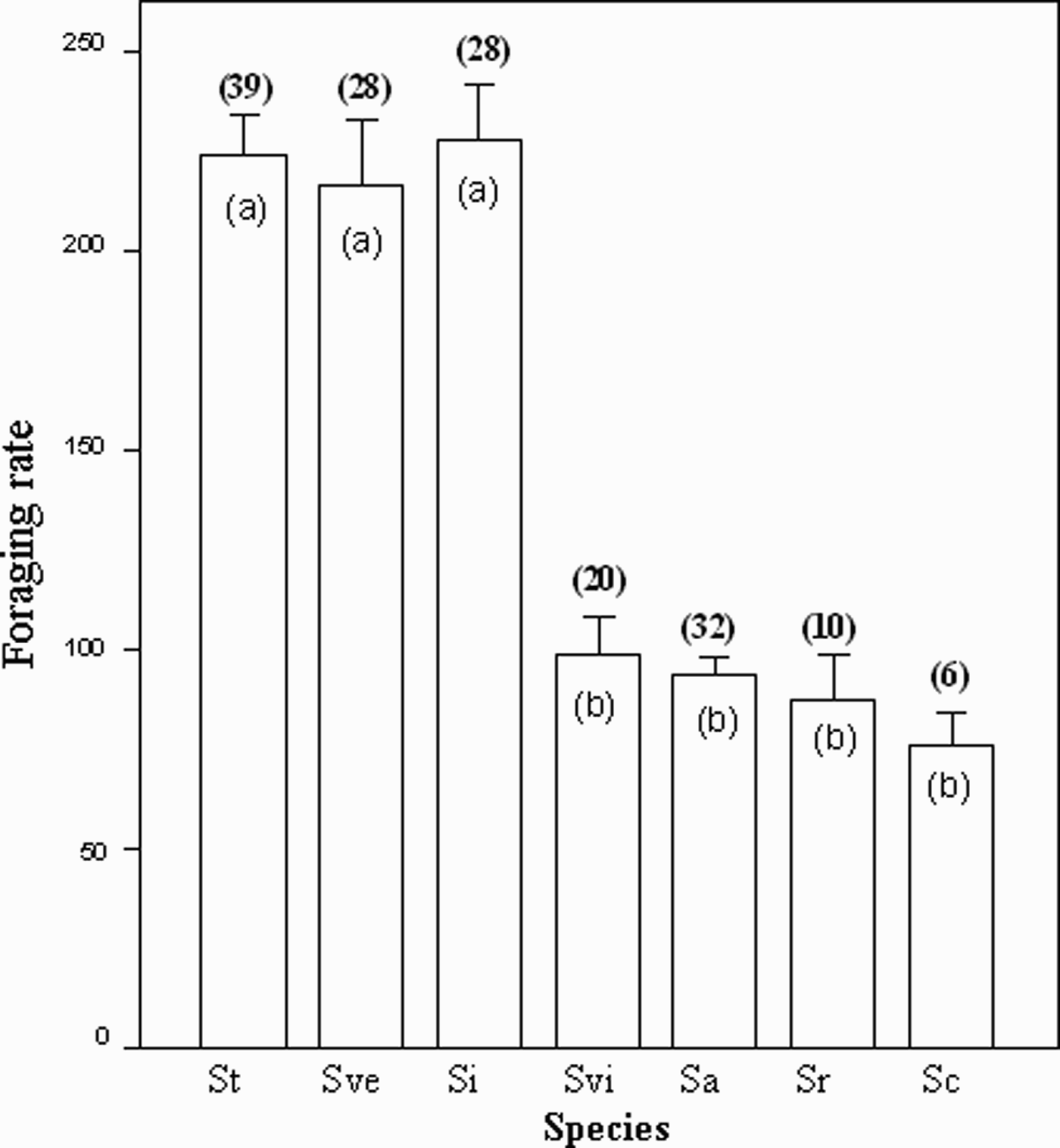
Foraging rates differed significantly among species (GLM, F6,119 = 13.05; P < 0.001). Parrotfish species fell into two groups: those with high foraging rates (Sc. taeniopterus, Sc. vetula and Sc. iserti; range of means: 215 to 250 bites/10 minutes), and those with lower foraging rates (Sp. viride, Sp. aurofrenatum, Sp. rubripinne and Sp. chrysopterum; range of means: 75 to 90 bites/10 minutes) (Figure 1). Foraging rate did not vary significantly between colour phases (GLM, F1,119 = 3.45; P = 0.06) and there was no interaction between species and colour phase (GLM, F6,119 = 0.41; P = 0.87). We, therefore, combined all individuals within species for subsequent analyses.
Foraging rate (number of bites per 10 minutes of observation) of seven species of parrotfish from four Barbadian reefs. Means of untransformed foraging rates are shown±1 SE. Sample sizes are given in parentheses. Means with different subscripts were significantly different from each other in Bonferroni post-hoc tests. St, Scarus taeniopterus; Sve, Sc. vetula; Si, Sc. iserti; Svi, Sparisoma viride; Sa, Sp. aurofrenatum; Sr, Sp. rubripinne; Sc, Sp. chrysopterum.

Foraging targets
Parrotfish targeted three main items: turf algae, macroalgae and live coral. Sponge and coralline algae were also taken but at very low frequencies.
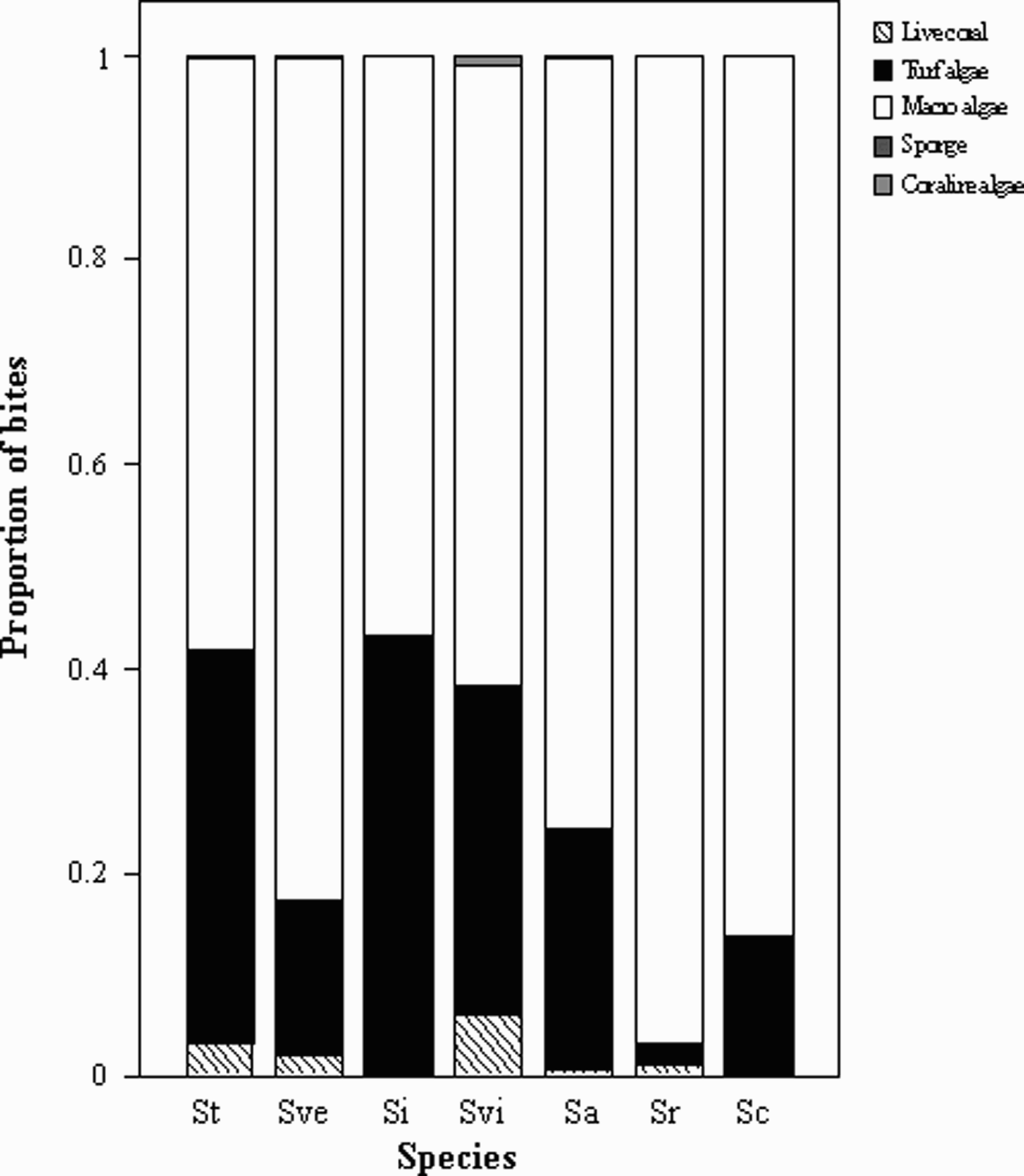
Different species exhibited different foraging targets (Figure 2). There were significant overall differences among species in the proportions of macroalgae and turf algae taken (Kruskal–Wallis tests, for macroalgae: χ2 = 25.31; df = 6; P < 0.001; for turf algae: χ2 = 25.31; df = 6; P < 0.001). The proportion of macroalgae taken was significantly different between Sc. taeniopterus and Sc. vetula (Mann–Whitney U-test, U = 304; P = 0.005; Nst = 37; Nsv = 28), Sc. taeniopterus and Sp. rubripinne (U = 103; P = 0.03; Nst = 37; Nsc = 10), Sc. vetula and Sc. iserti (U = 225; P = 0.01; Nsv = 28; Nsi = 27) and Sc. vetula and Sp. viride (U = 177; P = 0.03; Nsv = 28; Nsvi = 20). The proportions of turf algae and live coral taken were also significantly different between the majority of paired species comparisons (11 of 21 and 12 of 21 possible paired comparisons, respectively). These differences suggest three approximate groups: one of primarily macroalgal foragers (Sp. rubripinne and Sp. chrysopterum), one that incorporates relatively high amounts of turf algae (Sc. taeniopterus, Sc. iserti and Sp. viride) and a third group with a more mixed diet (Sc. vetula and Sp. aurofrenatum) (Figure 2). The proportion of bites taken on live coral also varied significantly among species (χ2 = 44.17; df = 6; P < 0.001; Figure 2). Scarus iserti and Sp. chrysopterum rarely took bites on live coral (<3% of total bites), while Sc. taeniopterus, Sc. vetula and Sp. viride, in particular, targeted this type of substratum more frequently (approximately 3 to 10% of all bites).
Proportion of foraging bites taken on different substrata by each of seven species of parrotfish from four Barbadian reefs. Species abbreviations are given in Figure 1.

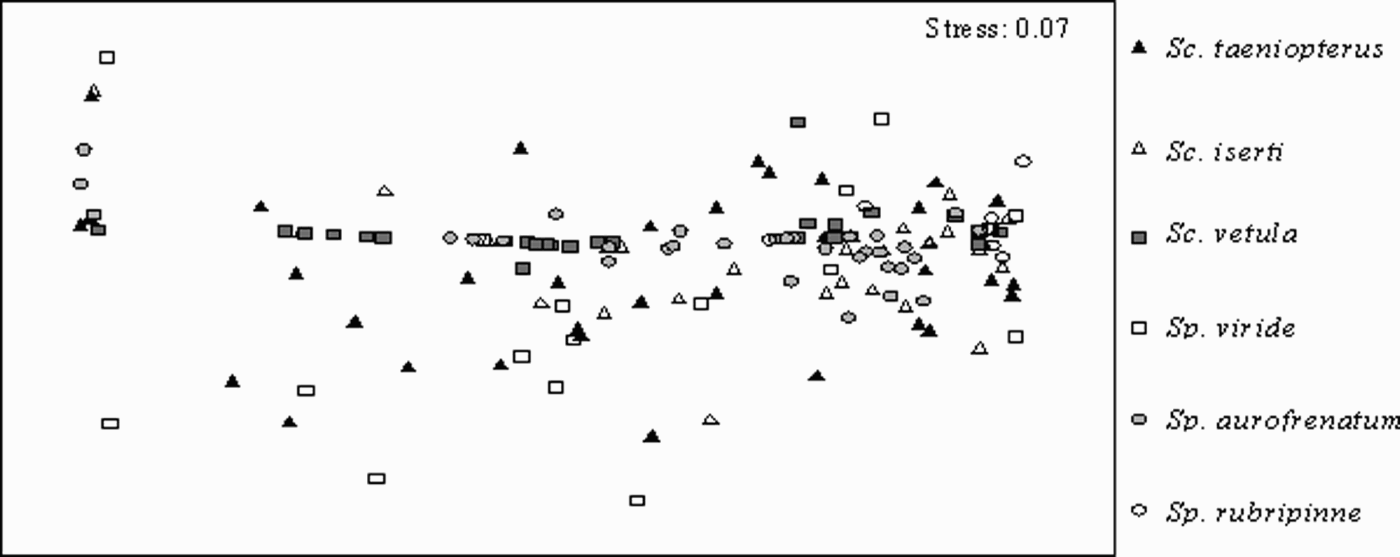
When all foraging targets were considered simultaneously, there were significant differences in diet among species (one-away ANOSIM, R = 0.054; P = 0.006). The low stress value (0.07) of the multidimensional scaling plot generated to examine these differences visually (Figure 3) indicates that the distances among samples shown in the two-dimensional depiction reflect accurately the similarities among samples. Figure 3 shows much overlap among species, although all samples of Sp. rubripinne form a small, distinct cluster, while Sc. vetula and Sp. aurofrenatum share an overlapping, narrow distribution.
Multidimensional scaling plot of foraging targets of Caribbean parrotfish, separately for each species. Each point represents the diet of an individual parrotfish, and the distance between points reflects the similarity in foraging targets among fish.

DISCUSSION
We observed differences in foraging techniques, rates and targets among the seven parrotfish species inhabiting Barbadian coral reefs. The three species within the genus Scarus exhibited higher foraging rates than the four species of the genus Sparisoma. All species included a large amount of macroalgae in their diet, which was surprising given that several of these species are known to avoid macroalgae at other Caribbean locations (e.g. Bruggeman et al., Reference Bruggemann, Vanoppen and Breeman1994; McAfee & Morgan, Reference McAfee and Morgan1996). Variation in foraging rate, combined with functional group affiliation, allows us to make predictions regarding the ecological impact of different parrotfish species on reef benthic characteristics.
Assignment of reef fish species to functional groups is usually made largely on the basis of foraging target, with the removal of each food type having a specific impact on coral growth conditions (Bellwood et al., Reference Bellwood, Hughes, Folke and Nyström2004). There were significant differences in diet among the parrotfish species in this study, but the diets did not always align clearly with conventional foraging functional groups or match previous foraging descriptions for these species. For example, Sp. rubripinne and Sp. chrysopterum commonly feed on seagrasses (McAfee & Morgan, Reference McAfee and Morgan1996). In Barbados, where few seagrass meadows remain (Government of Barbados, 2001, 2002), these two species were associated with coral reefs and were primarily macroalgal foragers, which aligns them with the conventional functional group of grazers (McAfee & Morgan, Reference McAfee and Morgan1996; Bellwood et al., Reference Bellwood, Hughes, Folke and Nyström2004; Maciá & Robinson, Reference Maciá and Robinson2005). By contrast, Sc. taeniopterus, Sc. iserti and Sp. viride took a relatively large proportion of turf algae, as scrapers usually do (Bruggemann et al., Reference Bruggemann, van Kessel, van Rooij and Breeman1996; McAfee & Morgan, Reference McAfee and Morgan1996), but their diet remained dominated by macroalgae. Scarus vetula and Sp. aurofrenatum ingested intermediate amounts of turf and macroalgae (see also McAfee & Morgan, Reference McAfee and Morgan1996). Five of the species also included live coral in their diet, although most did so rarely. One exception was Sp. viride, the largest species in our study, which took nearly 10% of its bites on live coral. Sparisoma viride is known to feed on several massive coral species on Caribbean reefs (e.g. Reyes-Nivia et al., Reference Reyes-Nivia, Garzón-Ferreira and Rodrigues-Ramíres2004). It can cause significant coral tissue loss (Bruckner & Bruckner, Reference Bruckner and Bruckner1998; Bruckner et al., Reference Bruckner, Bruckner and Sollins2000; Rotjan & Lewis, Reference Rotjan and Lewis2006) and can exclude coral species from some reef areas (Miller & Hay, Reference Miller and Hay1998). Sparisoma viride is clearly an important bioeroder, although its diet consists mainly of macro- and turf algae, rather than dead (or live) coral.
A functional categorization based initially on direct impact on the substratum rather than on diet may be more relevant for depicting the ecological roles of parrotfish species on Barbadian coral reefs. Observations of foraging behaviour reveal two distinct foraging techniques, which divide species into those that make contact with the reef surface (Sc. taeniopterus, Sc. vetula, Sc. iserti and Sp. viride) and those that do not (Sp. aurofrenatum, Sp. rubripinne and Sp. chrysopterum). Species that make contact with the reef framework while foraging (‘contact foragers’) remove virtually all epilithic material, and sometimes some of the coralline rock itself, leaving bare substratum that facilitates the settlement and growth of coralline algae and corals (Hunte & Wittenberg, Reference Hunte and Wittenberg1992). By contrast, non-contact foragers remove algae, which reduce coral shading and overgrowth by macroalgae (Bellwood et al., Reference Bellwood, Hughes, Folke and Nyström2004). Therefore, coral reefs with high densities of contact foragers are likely to exhibit reduced cover of turf algae and intact dead coral, more coralline algae and coral recruits, as well as low rugosity. In contrast, coral reefs with high densities of non-contact foragers should have more turf algae, less macroalgae and macroalgae–coral contacts, and higher rugosity.
The initial characterization of parrotfish functional role on the basis of contact with the reef framework can be further refined by diet and foraging rate. In fact, all non-contact foraging species ate significant amounts of macroalgae. In conventional terms, these would be labelled as grazers (Bellwood et al., Reference Bellwood, Hughes, Folke and Nyström2004). By contrast, contact foragers showed diet and technique differences among species. Scarus taeniopterus and Sc. iserti did not leave visible marks on the substratum, although they scraped the foraging area, and consumed more turf than other species. These species exhibit the functional characteristics of scrapers (Bruggemann et al., Reference Bruggemann, van Kessel, van Rooij and Breeman1996; McAfee & Morgan, Reference McAfee and Morgan1996; Bellwood et al., Reference Bellwood, Hughes, Folke and Nyström2004). Both S. viride and S. vetula (the two largest species) left visible foraging marks on the reef, but their differing diets suggest different functional impacts. In addition to biting into coralline rock, Sp. viride targeted live coral. Both observations suggest that this species is a bioeroder (Bruggemann et al., Reference Bruggemann, van Kessel, van Rooij and Breeman1996; Bruckner et al., Reference Bruckner, Bruckner and Sollins2000; Bellwood et al., Reference Bellwood, Hughes, Folke and Nyström2004), although the consequences for coral recovery of removing live coral and coralline rock will be very different. On the other hand, Sc. vetula acts as a bioeroder by leaving scars on the substratum, but it also targeted turf and macroalgae. The latter is particularly surprising since macroalgal ingestion has not been reported previously for this species, although it is commonly associated with Sparisoma species (Bonaldo et al., Reference Bonaldo, Krajewski, Sazima and Sazima2006). Despite the relatively high proportion of macroalgae eaten, Sc. vetula consumed higher amounts of turf algae than most parrotfish species in this study. Therefore, we suggest that Sc. vetula can be considered a bioeroder/scraper in Barbados.
Different functional categories of parrotfish species are expected to have different impacts on coral reef benthic communities. However, such impacts can only be predicted by combining functional categorization with an index of impact frequency. This index should be related not only to relative numerical abundance of each species but also to their feeding frequency. In this context, it is interesting to note that bioeroding and grazing species exhibited significantly lower bite rates than scrapers. This variation in bite rate largely reflects differences between different parrotfish genera and might be due to the fact that Sparisoma spp. are in general more aggressive, spending more time defending their territory and less time foraging (Mumby & Wabnitz, Reference Mumby and Wabnitz2002). These species prefer more nutritious targets, such as macroalgae, which might compensate for their lower foraging rate.
Our results suggest considerable functional diversity in Caribbean parrotfish. High functional diversity is usually expected in ecosystems with high species diversity (Halpern & Floeter, Reference Halpern and Floeter2008), and such ecosystems are also expected to be relatively stable because of functional redundancy, i.e. the capacity of one species to compensate functionally for the loss of another (Nyström, Reference Nyström2006). On the basis of species diversity alone, one should expect a lower degree of functional redundancy on Caribbean than on Indo-Pacific reefs, and indeed we found only two parrotfish species acting as bioeroders in Barbados versus seven on Indo-Pacific reefs (Bellwood et al., Reference Bellwood, Hoey and Choat2003). However, within some functional groups, some species may play a more important role than others, and actual redundancy potential may be substantially lower than suggested by species richness (Bellwood et al., Reference Bellwood, Hoey and Choat2003; Hoey & Bellwood, Reference Hoey and Bellwood2008). Inequalities among Caribbean parrotfish species in their contributions to specific reef functions have not yet been examined, but establishing whether these exist is essential to better predict the impact of these herbivores on major coral reef processes.
ACKNOWLEDGEMENTS
We thank the staff of Bellairs Research Institute for logistical support. Thanks to Michelle Paddack for discussions and comments on the manuscript and to Phil Molloy for his help with statistical analysis. This study was partially funded by Fundação para a Ciência e Tecnologia from the Portuguese Ministry of Science and Technology.