Introduction
The body temperature of ectothermic animals is determined by ambient temperature (Hill et al., Reference Hill, Wyse and Anderson2008). As the rates of all biochemical and physiological processes are temperature-dependent (Hill et al., Reference Hill, Wyse and Anderson2008), temperature plays a critical role in the life history of all ectothermic animals, including insects (Chown & Nicolson, Reference Chown and Nicolson2004). Temperature affects development (the differentiation of cells that leads to the maturation of tissues and organs) and growth (the synthesis of new tissue that causes an increase in an organism's mass) of ectotherms, with higher temperatures resulting in faster growth and development rates (Atkinson, Reference Atkinson, Begon and Fitter1994; Sibly & Atkinson, Reference Sibly and Atkinson1994; van der Have & de Jong, Reference van der Have and de Jong1996; Jarosik et al., Reference Jarosik, Kratochvil, Honek and Dixon2004; Booth & Kiddell, Reference Booth and Kiddell2007). The rates of change of growth and development with temperature are different, so that at any equivalent development stage, ectotherms reared at lower temperature are physically larger (in dimensions and mass) than those reared at a higher temperature, a phenomenon known as the temperature size rule (Atkinson, Reference Atkinson, Begon and Fitter1994). However, how rearing temperature affects ecologically important characteristics, such as the total energy required to complete growth and adult fecundity, is largely unknown. Lower temperatures could be expected to result in lower absolute rates of energy use because of slower growth rates and the lower costs of maintaining metabolism relative to higher temperatures. However, the extended development period at lower temperatures could result in increased energy use, so the overall total energy expenditure could be similar at low and high temperatures. The fact that rearing ectotherms at lower temperatures causes larger body size at equivalent developmental stages complicates assessment of the energetic cost of development. One method to overcome this is to make comparisons using the production cost, defined as the total amount of energy consumed during development per unit dry mass of the organism at the end of development (Booth & Kiddell, Reference Booth and Kiddell2007).
Insects are arguably the world's most diverse and successful ectothermic terrestrial inhabitants. There are more than 1,000,000 described species (Foottit & Adler, Reference Foottit and Adler2009) and they play major roles in all terrestrial ecosystems (Foottit & Adler, Reference Foottit and Adler2009). Given the broad range of climates found in terrestrial ecosystems, it is not surprising that much research has focused on the influence that temperature has on insect biology (e.g., Beck, Reference Beck1983; Hodek, Reference Hodek and Hodková1988; Bale et al., Reference Bale, Masters, Hodkinson, Awmack, Bezemer, Brown, Butterfield, Buse, Coulson, Farrar, Good, Harrington, Hartley, Jones, Lindroth, Press, Symrnioudis, Watt and Whittaker2002; Damos, Reference Damos2012). However, the effect of rearing temperature on daily energy expenditure in insects, particularly during growth and development, when energy expenditure is at its highest (Fink, Reference Fink1925; Schneiderman & Williams, Reference Schneiderman and Williams1953), is largely unexplored. Obtaining and utilizing energy is a vital aspect of every organism's life. Growing organisms use energy in many ways: in the biosynthesis and maintenance of cells and tissues and for activities such as locomotion and digestion (Peterson et al., Reference Peterson, Walton and A.F. Bennett1999; Chown & Nicolson, Reference Chown and Nicolson2004; Booth & Kiddell, Reference Booth and Kiddell2007). Rearing temperature is likely to influence each of these components, but little is known how these various components might interact to affect overall energy expenditure. Few studies have compared the influence of rearing temperature on overall energy expenditure, but in those that have, production costs tend to increase at lower temperatures (Booth & Kiddell, Reference Booth and Kiddell2007).
Herbivorous insects consume more plant material than any other group of terrestrial animals, and many species are major pests of agricultural crops. The diamondback moth (Plutella xylostella) is a global pest of cruciferous crops (Furlong et al., Reference Furlong, Dosdall and Wright2013) with an extremely wide thermal tolerance (Liu et al., Reference Liu, Chen and Zalucki2002; Bahar et al., Reference Bahar, Soroka, Grenkow and Dosdall2014), and it is estimated to cost the world economy $4–5 billion a year (Zalucki et al., Reference Zalucki, Shabbir, Silva, Adamson, Liu and Furlong2012). Despite considerable research on its management (Furlong et al., Reference Furlong, Dosdall and Wright2013), studies on its biology have been surprisingly limited. However, it is known that rearing P. xylostella at high temperature produces smaller adults (Shirai, Reference Shirai1993) that have a lower fecundity (Shirai, Reference Shirai2000) and the intrinsic optimum temperature (the temperature at which instantaneous growth rate is maximal) has been determined to be 19.4°C (Shi et al., Reference Shi, Li and Ge2012, Reference Shi, Sandhu and Ge2013).
The aim of the present study was to discover how rearing temperature affects the ecologically relevant attributes of development time, body size and total energy used for development and fecundity in P. xylostella. We expected rearing at low temperatures to result in longer development time, larger body size and consequently greater fecundity, and to result in higher production costs because of the prolonged development period.
Methods and materials
Plants and insects
Commercial cabbage seedlings (Brassica oleracea var. capitata cv. sugarloaf) were purchased from a local nursery (Pohlmans Nursery Pty Ltd, Gatton, QLD, Australia) and transplanted into 20 cm diameter pots containing organic potting mix (Pohlmans Nursery Pty Ltd). Potted plants were treated with a slow release fertilizer [Osmocote (N:P:K, 16:35:10) Scotts Australia Pty Ltd, Baulkham Hills, NSW, Australia] and grown in a glasshouse. Plants were grown to the 8–10 leaf stage for insect rearing and use in experiments.
P. xylostella were obtained from a laboratory culture that was established from field material collected in Southeast Queensland in 2003 and which has since been regularly (>1 year−1) supplemented with field collected insects. Larvae were reared on leaves of glasshouse grown potted cabbage plants in ventilated plastic containers (30 × 20 × 15 cm3) in controlled environment cabinets [23 ± 2°C, 12:12 (L:D) h, 60% relative humidity (RH)]. Pupae were collected from rearing containers and transferred to oviposition cages (60 × 45 × 45 cm3) prior to adult eclosion and maintained in an incubator [23 ± 2°C, 12:12 (L:D) h, 60% RH]. Moths were fed on aqueous honey solution [10% (w:v)] and supplied with fresh potted cabbage plants for oviposition daily.
Oxygen consumption and production costs of P. xylostella at constant rearing temperatures
Freshly laid eggs were collected from the culture and incubated at 20°C in clean Petri dishes (5 cm diameter) and neonate larvae collected within 12 h of hatching. Batches of five larvae were reared on cabbage leaf discs (4.2 cm diameter) in Petri dishes (5 cm diameter) that were lined with moist filter paper. Insects were reared at one of five constant test temperatures 10, 15, 20, 25 and 30°C. Leaf discs were replaced every 4th day during experiments and there was always excess food for larvae.
Oxygen consumption by 2nd, 3rd and 4th instar larvae in a 24 h period in the middle of each instar was measured in a 60 ml syringe by closed system respirometry (Vleck, Reference Vleck1987). The oxygen consumption of five larvae of a given instar at a given test temperature was determined by placing the larvae and a small drop of water into a syringe. The syringe was then sealed and held at the test rearing temperature for 24 h; each instar/rearing temperature combination was replicated five times. Barometric pressure was recorded upon sealing the syringe. At the end of the measurement period, 30 ml of air from the syringe was injected through soda lime and Drierite® into an oxygen analyser (Helox 2 Paramagnetic Oxygen Analyser, MBE Electronic, AG, Switzerland) calibrated with high purity nitrogen and room air. Oxygen consumption for the 24 h measurement period was calculated using equation (9) in Vleck (Reference Vleck1987) assuming the chamber air was saturated with water vapour and carbon dioxide concentration was 0.03% and corrected to standard temperature and pressure (STP). The oxygen consumption by an individual larva was calculated by dividing the group oxygen consumption by five. Immediately on completion of an oxygen consumption measurement, larvae were frozen and wet masses determined to 10−6 g using a Mettler Toledo XS3DU precision balance. Larvae were then desiccated in a glass jar containing Drierite® for 48 h and then reweighed to determine dry mass. Total oxygen consumed during the entire larval period was calculated by integrating the area under the curve-relating oxygen consumption to rearing period. Production cost was calculated by first converting total oxygen consumed to joules, assuming a respiratory quotient of 0.8 and using a conversion factor of 20.1 kJ ml−1 of oxygen consumed (Lighton, Reference Lighton2008), and dividing this number by the dry mass of the 4th instar larvae.
Effect of rearing temperature on size, mass and fecundity of P. xylostella
Pupae were collected from the batches of insects reared at each temperature; individuals were weighed and placed into separate, labelled Petri dishes. When adults emerged single males and females from each rearing temperature were paired in a Petri dish with a dental wick saturated with distilled water and a cabbage leaf disc (4.5 cm). The moths were then moved to 20°C. Each day the leaf disc was removed, the number of eggs laid overnight was counted and a new leaf disc placed into the dish. This was repeated until the number of eggs laid over three consecutive days was less than five, or the female moths died. The forewing length of the female moths was then measured using a dissection microscope (×20 magnification) fitted with a micrometre eyepiece.
Statistical analyses
The effect of rearing temperature on all reported variables except forewing length was assessed using one-way ANOVA. To determine if rearing temperatures influenced the relative size of forewings, forewing length was analysed using one-way ANCOVA with pupal mass as the covariate. Post-hoc comparisons were made using the Tukey procedure. Normality of data was tested using Kologorov–Smirnov tests and homogeneity of variance tested using Levene's tests before using ANOVA. Linear regression was used to assess the relationship between pupal mass and fecundity within each rearing temperature. All statistical analyses were performed using Statistica Version 12 and results considered significant if P < 0.05.
Results
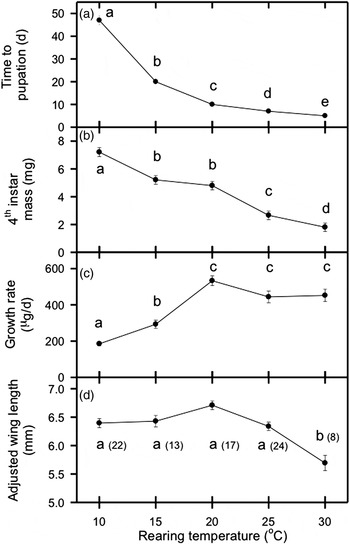
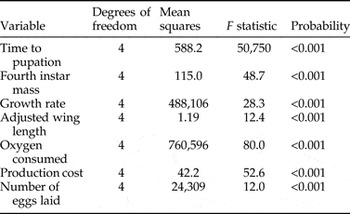
Rearing temperature significantly influenced all variables measured (table 1). Both development time and 4th instar larval mass increased with decreasing rearing temperature (fig. 1a, b) and larval growth rate increased with rearing temperature between 10 and 20°C but was similar at temperatures of 20, 25 and 30°C (fig. 1c). Forewing length, once adjusted for differences in body size by ANCOVA, was similar at all rearing temperatures except 30°C where it was conspicuously shorter (fig. 1d).
Relationships between rearing temperature and (a) development time, (b) 4th instar wet mass, (c) growth rate and (d) forewing length adjusted by ANCOVA to a mean pupae mass of 7.8 mg of Plutella xylostella. Error bars represent ± SE. Different letters associated with temperature means indicate significant differences as indicated by Tukey post-hoc comparisons. Sample size was 25 at each temperature in panels (a, b, c). Sample size indicated in brackets in panel (d).

Summary of ANOVA/ANCOVA statistics for the influence of rearing temperature on variables tested.

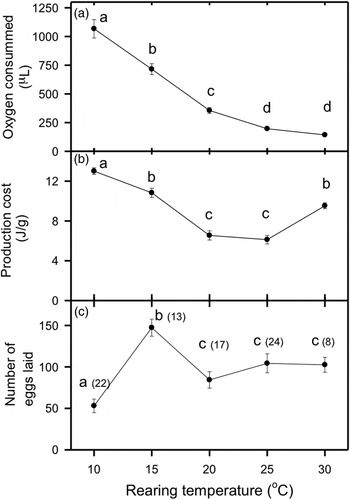
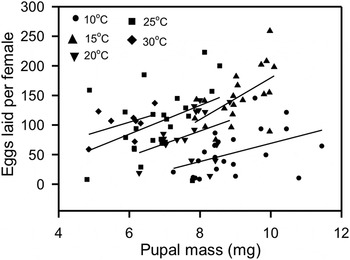
Total oxygen consumed increased with decreasing rearing temperature (fig. 2a). Production cost was similar at rearing temperatures of 20 and 25°C, but increased at temperatures above and below these temperatures (fig. 2b). The number of eggs laid by moths was minimal at 10°C, maximal at 15°C and intermediate at rearing temperatures of 20, 25 and 30°C (fig. 2c). Within a rearing temperature fecundity was correlated with pupal mass (fig. 3) and the majority of eggs were laid on the first day of oviposition at all rearing temperatures (table 2). Longevity of female moths varied with larval rearing temperature, moths living longest in larvae from 15°C, and longevity decreasing above and below this temperature (table 2). Longevity of female moths was positively correlated with their body mass (R 2 = 0.88, P = 0.018, n = 5), but there was no correlation between the number of eggs laid and longevity (R 2 = 0.10, P = 0.832, n = 5).
Relationships between rearing temperature and (a) total oxygen consumed, (b) production cost and (c) fecundity of Plutella xylostella. Error bars represent ± SE. Different letters associated with temperature means indicate significant differences as indicated by Tukey post-hoc comparisons. Sample size was 5 at each temperature in panels (a, b). Sample size indicated in brackets for panel (c).

Relationships between wet pupae mass and fecundity of Plutella xylostella that emerged from pupae reared at different constant temperatures. Least-square regressions used to fit lines to data collected from each rearing temperature. All regression relationships were significant at P < 0.05.

Longevity (days alive after adult eclosion) and fecundity of Plutella xylostella reared at different temperatures. Days indicate the total number of eggs laid (averaged per moth) from the day of their first oviposition event (day 1 = day on which eggs first laid).

1 exact data for longevity of moths at 15°C are unavailable as the egg count ended after 9 days and the moths were killed; however at this time all 40 moths used for this fecundity experiment were still alive.
Discussion
Larvae reared at higher temperatures reached maturity faster (fig. 1a) but had a smaller body size at each stage of development than those reared at lower temperatures (fig. 1b), a finding supporting the temperature size rule (Atkinson, Reference Atkinson, Begon and Fitter1994). Fourth instar mass at 20°C was slightly greater than the general trend as predicted, and as a consequence the growth rate was also faster at this temperature (fig. 1b, c). The fitting of a thermodynamic Sharpe-Schoolfield-Ikemoto (SSI) model (Ikemoto et al., Reference Ikemoto, Kurahashi and Shi2013) to P. xylostella temperature-growth data, indicates that the intrinsic optimal temperature (i.e., the temperature at which the fastest intrinsic growth rate occurs) is close to 20°C for this species (Shi et al., Reference Shi, Li and Ge2012, Reference Shi, Sandhu and Ge2013). This may explain the greater than expected growth performance we observed at this temperature. Development time was greatest at 10°C and decreased rapidly with increased temperature, as has been described previously for P. xylostella (Shirai, Reference Shirai1993; Liu et al., Reference Liu, Chen and Zalucki2002; Bahar et al., Reference Bahar, Soroka, Grenkow and Dosdall2014). The patterns of growth were similar across all rearing temperatures, relatively slow growth through the early instars followed by rapid growth during the 4th instar, during which most of the larval mass was added. This pattern of exponential growth is typical of insects (Davidowitz & Nijhout, Reference Davidowitz and Nijhout2004; Booth & Kiddell, Reference Booth and Kiddell2007) and indicates that it is the final instar that is the most crucial in influencing adult insect body mass and, by implication, traits associated with body size such as fecundity.
The relationship between total oxygen consumed [≈ energy expenditure in animals using aerobic metabolism (Lighton, Reference Lighton2008)] during development and rearing temperature (fig. 2a) was similar to that between development time and rearing temperature (fig. 1a). Oxygen consumption was greatest at 10°C and declined with increasing temperature (fig. 2a); a similar phenomenon has previously been reported in the house cricket (Booth & Kiddell, Reference Booth and Kiddell2007). The increased total oxygen consumed at lower temperatures was the result of both larger body size and more prolonged development times.
The relationship between production cost and rearing temperature in P. xylostella was more complex than expected. The highest production cost was incurred at 10°C, it decreased as temperature increased above10°C, was lowest at 20 and 25°C, and then increased again at 30°C (fig. 2b). The production costs of house cricket nymphs and blowfly larvae also varied with rearing temperature (Booth & Kiddell, Reference Booth and Kiddell2007). It appears that there is an optimal rearing temperature range over which production costs are minimized, and at temperatures below and above this optimum production costs increase. This temperature range is close to the intrinsic optimum temperature for P. xylostella and may reflect the rearing temperature for optimal fitness of individuals (Shi et al., Reference Shi, Li and Ge2012, Reference Shi, Sandhu and Ge2013). The increased cost at low temperatures is likely due to a disproportionate increase in the larval period compared with the reduction in overall metabolism, but the increase at high temperatures must be caused by factors such as additional energy spent to repair high-temperature-induced teratogenic cellular damage or increased activity. The ecological implication for this finding is that more food resources must be found and consumed during the development period at sub-optimal temperatures.
Lower rearing temperatures resulted in large pupae and adult body sizes, and it is often assumed that insect fecundity is directly related to adult body size as larger bodies allow greater egg production (Akey et al., Reference Akey, Potter and Jones1978; Leather, Reference Leather1988; Carroll & Quiring, Reference Carroll and Quiring1993). However, despite the fact that within a rearing temperature there was a direct relationship between pupal mass and fecundity (fig. 3) and although body mass increased with decreased rearing temperature (fig. 1b), fecundity did not increase with a decrease in rearing temperature (fig. 2c). Indeed the moths reared at 10°C had the largest body mass but the lowest fecundity. This may be due to more energy being devoted to the manufacture, maintenance and repair of body tissue at 10°C, which is close to the lower developmental threshold temperature for this species (Liu et al., Reference Liu, Chen and Zalucki2002). As a consequence, relatively little energy is available for reproduction at this sub-optimal rearing temperature (Braby & Jones, Reference Braby and Jones1995; Bochdanovits & De Jong, Reference Bochdanovits and De Jong2003). Interestingly, as previously reported by Shirai (Reference Shirai2000), we found that P. xylostella fecundity was highest at 15°C (fig. 2c), a temperature below the optimal temperature range for production cost (fig. 2b). When production costs are minimized, less energy is channelled into tissue manufacture and maintenance. Thus, the energy available for egg production should be maximized, thereby liberating more energy for egg production. Hence, we expected to find greatest fecundity at rearing temperatures of 20 and 25°C. There was no relationship between the number of eggs laid and longevity, indicating that living longer did not increase fecundity. This can be explained by the fact that the vast majority of eggs were laid within the first 2 days after eclosion (table 2), and that relatively few eggs were laid after this time, even if months survived for long periods.
Adult P. xylostella developing from larvae reared at 15°C had the greatest longevity and longevity then decreased steadily as larval rearing temperature increased above this temperature (table 2). This is consistent with the previous work (Shirai, Reference Shirai1995), which showed that P. xylostella reared at 15°C lived three times longer, were larger and laid more eggs than those reared at 25°C. We also found a direct positive relationship between body mass and longevity. Presumably a larger body contains more energy and this can be used to supply routine metabolism for longer periods resulting in increased adult longevity. Adult P. xylostella derived from the larvae reared at 30°C died earlier than the insects reared at any other temperature, suggesting decreased fitness; however, they did produce a large number of eggs in the few days that they were alive (table 2). This may be an adaptation that allows moths to maximize their fecundity at this extreme temperature, while their fitness has been compromised and their lifespan greatly reduced.
An unexpected effect of rearing temperature on body size was the dramatic reduction in relative forewing length recorded at 30°C. Smaller relative wing length at higher rearing temperatures has been reported in fruit flies (Drosophila melanogaster) (De Moed et al., Reference De Moed, De Jong and Scharloo1997), but this relationship was relatively constant across rearing temperatures rather than the abrupt effect caused by rearing P. xylostella at 30°C. In laboratory flight mill studies on P. xylostella, flight duration and total distance were positively correlated with forewing length (Shirai, Reference Shirai1993). As a consequence the flying ability of moths developing from larvae reared at 30°C would be expected to be poorer than that of moths reared at lower temperatures. This hypothesis was not tested in this study but, if moths reared at 30°C are poor fliers, then this could affect both their local dispersal ability (Shirai, Reference Shirai1993) and their longer range migrations during which moths position themselves, presumably by powered flight, at the top of nocturnal temperature inversions where air temperatures are optimal for flight and wind speeds are often greatest (Chapman et al., Reference Chapman, Reynolds, Smith, Riley, Pedgley and Woiwod2002).
P. xylostella has a worldwide distribution (Furlong, Reference Furlong, Dosdall and Wright2013) and in the northern hemisphere it regularly expands its range from its core distribution into higher latitudes when conditions are seasonally suitable, only to die out during winter in most years (Li et al., Reference Li, Feng, Liu, You and Furlong2016). Quiescent moths can overwinter at the margins of the core distribution (Hardy, Reference Hardy1938; Honda, Reference Honda and Talekar1992) but at the northern extremes of its range expansion, females collected in late autumn–early winter have decreased fecundity, and this decreased fecundity has been linked to photoperiod-mediated effects on host plant quality (Harcourt & Cass Reference Harcourt and Cass1966; Harcourt, Reference Harcourt, Talekar and Griggs1986). This reduced egg laying contributes to the seasonal local extinctions. Our study suggests that low temperatures may also contribute to the seasonal decrease in fecundity of northern P. xylostella populations. Recent global temperature rises have been implicated in the pole-ward range shift of more than 20 species of European Lepidoptera (Parmesan et al., Reference Parmesan, Ryrholm, Stefanescu, Hill, Thomas, Descimon, Huntley, Kaila, Kullberg, Tammaru, Tennent, Thomas and Warren1999). Increased temperatures at the margins of the current core distribution of P. xylostella will ameliorate seasonal effects on fecundity, increasing the probability of winter survival, resulting in more resilient range expansion and an increased probability of pest outbreaks.
Acknowledgements
This work was partly funded by ACIAR projects PC/2004/063 and HORT/2010/090.