INTRODUCTION
Hurricane Katrina called attention to the extent of poverty in our affluent society more than any event in recent decades. President Bush's first major public statement about poverty since he took office came from Jackson Square about ten days after New Orleans flooded. He declared:
There is also some deep, persistent poverty in this region … And that poverty has its roots in a history of racial discrimination, which cut off generations from the opportunity of America. We have a duty to confront this poverty with bold action. So let us restore all that we have cherished from yesterday, and let us rise above the legacy of inequality (Bush 2005).
These comments were right on target. The official U.S. Census Bureau poverty rate among African Americans in 2004, 24.7%, is somewhat higher than the 1959 rate for all Americans, 22.4%, and more than twice the 2004 rate for Whites, 10.8%.2
The official poverty line varies by family size and has been updated each year since it was established in the late 1960s to account only for inflation. In 2004, the poverty line was $9,060 for a single elderly person, $15,219 for a single mother with two children, and $19,157 for a family of four persons.
We have not had a national dialogue about the nature of the federal social safety net, except for issues relating to welfare reform for single mothers, in many decades. As a result, it would take powerful political leadership to launch a renewed antipoverty effort today. Despite the compassionate public response that Katrina generated toward the poor, particularly the large contributions to charities, there have been no calls for a Presidential Commission or an Interagency Task Force or a National Academy of Sciences study to consider which policies have the greatest potential to reduce poverty, in general, or how to help the poor displaced by national disasters, in particular.
Indeed, to the extent that the media and policymakers have discussed the disadvantaged post-Katrina, the discourse has focused on housing assistance, not the exhaustion of eligibility for unemployment insurance, the loss of employer-provided medical coverage, nor the provision of cash assistance, all of which are problems for the poor across the nation and are much more serious for those displaced by natural disasters. In addition to this lack of focus on the needs of the poor, the current discourse about disaster relief is based on flawed evidence.
First, most “talking heads” seemed to assume that the poverty of the Ninth Ward in New Orleans was representative of poverty throughout the country. The inner-city residents of New Orleans and many other large metropolitan areas do represent the poorest of the poor. They tend to be isolated from the mainstream economy; they live in areas that are racially segregated and have extremely high poverty rates (Wilson 1987, 1996; Jargowsky 2003). They do represent the part of our poverty problem most difficult to resolve, but they do not represent the typical poor person.
Paul Jargowsky (1997, 2003) has conducted careful studies of concentrated poverty using data from the decennial U.S. Censuses. He finds that, in 2000, only about 10% of the nation's poverty population lived in areas of concentrated poverty like the Ninth Ward of New Orleans; only about 19% of the African American poor lived in high-poverty tracts.3
An area of concentrated poverty is defined as a census tract where the poverty rate is 40% or more (a census tract contains about 4000 persons).
The poor who are scattered across every community in the country form a heterogeneous group. For example, in 2004 there were about 17 million poor White non-Hispanics, about 9 million poor African Americans, and about 9 million poor Hispanics. The overall poverty rate was 12.7%, with the rate for Whites at 8.6%, and the rate for both African Americans and Hispanics around 23%. Most of the nonelderly poor work hard to support their families. It would be relatively straightforward to implement or to expand existing policies to raise their incomes above the poverty line.
Second, some analysts blame concentrated poverty in New Orleans on government social programs. For example, the Director of Health and Welfare Studies at the Cato Institute, Michael Tanner, wrote in the Washington Times:
In the wake of Hurricane Katrina, there will justifiably be calls to do something about the poverty that existed unseen in New Orleans and still exists in so many cities across America. Most of those speaking longest and loudest will be telling us to pour more money into various welfare programs. Doing so will … do little to help these people escape poverty…. The poor of New Orleans have been victims twice: of the storm and of the failed welfare state (Tanner 2005).
Tanner assumes that antipoverty policies must involve an expansion of cash welfare. Below, we describe antipoverty proposals that do not involve the major welfare program (Temporary Assistance to Needy Families), and which could make a substantial reduction in the overall poverty rate among the nonelderly. Antipoverty initiatives can focus on policies to raise the incomes of those working at low wages, reduce their work-related child-care costs, and ensure that low-wage workers have access to subsidized health insurance. We propose a disaster-assistance safety net for victims of natural disasters that would provide cash assistance, but, by definition, this special program would be triggered only by a presidential declaration of disaster. It would end when the economic problems caused by the disaster were resolved.
Ample empirical research demonstrates that the high level of poverty among the nonelderly in the United States has little to do with the failure of the poor to seize available opportunities. Even if one accepts the most negative critiques of Aid to Families with Dependent Children (the pre-1996 cash welfare program), welfare no longer gives the poor a license to reject available jobs. The 1996 federal welfare reform transformed the safety net so dramatically that it is now very difficult for the able-bodied, even single mothers with very young children, to receive cash welfare for more than a few years. Millions of single mothers made the transition from welfare to work in the aftermath of the 1996 reform. And their poverty rate has fallen, which is good news. However, the bad news is that, in any given month, from 20% to 30% of these mothers are without work and, despite their increased work hours and earnings, about 40% remain poor.4
Consider the effects of welfare reform on welfare receipt, work, and poverty among single mothers with a high school degree or less, i.e., the group representing the majority of the cash welfare caseload. Between 1993 and 2004, the percentages receiving welfare at some time during the year fell from 50% to 17% for African Americans and from 31% to 9% for Whites; the percentage working at some time during the year increased from 54% to 66% for African Americans and from 69% to 77% for Whites; their official poverty rate fell from 67% to 52% for African Americans and from 41% to 37% for Whites.
LABOR MARKET CHANGES AND PERSISTING POVERTY
Income poverty remains high even though the economy has grown over the past thirty years (Danziger and Gottschalk, 2005). Inflation-adjusted per capita income increased by 55% between 1973 and 2003, two years with very similar official poverty rates.5
See 〈http://www.census.gov/hhes/income/histinc/p01ar.html〉 (accessed May 14, 2006).
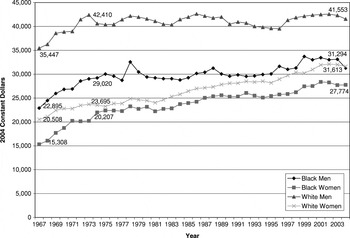
Figure 1 presents U.S. Census Bureau data that document our view that labor market changes are the source of the poverty problem. The figure shows inflation-adjusted median annual earnings of African American and White men and women who are full-time, year-round workers for each year from 1967 to 2004. Real earnings grew rapidly between 1967 and 1973 for all four race/gender groups. This was a period of rapid economic growth for the economy as a whole, rapid earnings growth for all workers, and a period of especially rapid gains for African Americans, due in part to the success of the civil rights movement in reducing discriminatory labor market barriers. Median annual earnings increased by 20% and 15%, respectively, for White men and women, and by 27% and 32%, respectively, for African American men and women.

Median Earnings, Full-Time, Year-Round Workers, 1967–2004
For men, real median earnings have stagnated since the early 1970s. Indeed, for White male full-time, year-round workers, the median in 2004, $41,553, was slightly lower than the 1973 median, $42,410. This lack of economic progress for White full-time, year-round workers cannot be blamed on government programs that reduce willingness to work—these workers do not receive welfare or unemployment insurance. Median earnings for male African American full-time workers grew slightly more than for similar Whites over these three decades; the median in 2004 was $31,294, about 8% more than in 1973. Note the contrast with the earlier period—the median for African American men rose by 27% in the first six years shown, and then by only 8% over the next thirty-one years.
Real median earnings for women who work full-time, year-round increased over the last three decades, by 33% for Whites and by 37% for African Americans. The rate of earnings growth was slower after 1973 than in the years from 1967 to 1973, but was nonetheless dramatically better than the male experience. Because the earnings of White men stagnated after 1973, the ratio for White women to White men increased from 58% to 76% over the 1967–2004 period, and that for Black women to White men from 43% to 67%; the ratio of the earnings of Black to White men increased, but at a slower rate, from 65% to 75%.6
If data similar to that in Figure 1 are viewed for all workers instead of full-time, full-year workers (data not shown), the relative gains of women would be even larger. Over these decades, more women have entered the labor force, but more men, especially African American men, have left the labor force. And, the average annual hours of work of women has increased relative to that of men.
The median earnings of White workers has not increased, and the median for African American workers has grown little since 1973 as a result of several dramatic labor market changes. These include (1) the spread of labor-saving technological innovations; (2) declining transportation costs and information technology changes that facilitated the globalization of goods and services; (3) the resulting declines in the percentage of employment accounted for by manufacturing industries, especially unionized jobs; and (4) declines in the value of the inflation-adjusted minimum wage. These changes have reduced the employment and earnings prospects for less-educated male workers whose economic gains in the quarter century following World War II were largely based on employment in unionized, high-wage manufacturing jobs.
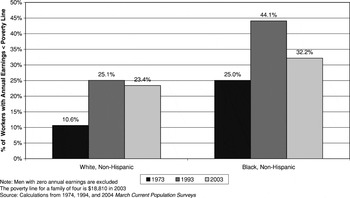
These economic changes have been particularly devastating for workers most at risk of poverty: men with a high school degree or less. Figure 2, based on computations from the March Current Population Survey data, shows the percentage of male workers between the ages of twenty-five and fifty-four who earned less than the poverty line for a family of four in 1973, 1993, and 2003. The official poverty line represents the same amount of purchasing power each year, as it has been adjusted only for inflation since it was adopted in the late 1960s. Its value was $18,810 in 2003. A man working full-time, full-year at an hourly wage of $9.00 or lower would fall below this threshold. Some men who earn higher wages also fall below this threshold because they do not work full-time all year.

Male Workers, High School Degree or Less, Ages 25–54, Earnings Less Than Poverty Line for a Family of Four Persons, 1973–2003
Less-educated men have had increasing difficulty earning enough to support a family at the poverty line. For non-Hispanic Whites, this proportion roughly doubled between 1973 and 2003 from 10.6% to 23.4%. Note that the extent of low earnings among Whites in 2003 was about the same as for non-Hispanic African Americans in 1973 (23.4% and 25.0%, respectively). For both Whites and African Americans, all of the increase in low earnings occurred between 1973 and 1993. Low earnings among African American men increased from 25.0% to 44.1% between 1973 and 1993, and then fell to 32.2% by 2003. As has been the case historically, when the economy is booming, African American workers experience faster earnings growth than other workers. Even though economic expansions are a prerequisite for economic advancement, they no longer provide large enough wage gains for many less-educated workers to be able to escape poverty.
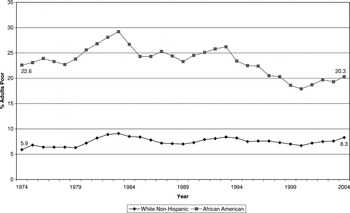
Figure 3 shows the official poverty rate for adults between the ages of eighteen and sixty-four. The official poverty rate in 2004, like the median annual earnings of men, is not much different than it was thirty years earlier. The poverty rate for non-Hispanic Whites was 5.9% in 1974 and 8.3% in 2004; for non-Hispanic African Americans the rate was 22.6% in 1974 and 20.3% in 2004. There is some cyclicality over the business cycle, especially for African Americans, with rates rising to a peak during the severe recession of the early 1980s, and then rising again during the recession of the early 1990s and during the recent 2001 recession.

Official Poverty Rates, Persons Ages 18–64, 1974–2004
The major conclusion of this brief review of data on earnings and income is that, even though the economy grew on average over the last three decades, the inflation-adjusted earnings of full-time, full-year workers and the official poverty rate of adults changed little, and the ability of less-educated men to earn enough to support a family above the poverty line diminished. The failure of poverty to fall in a growing economy and the failure of the African American/White gap in economic status to further narrow are not due to flaws in current antipoverty policies, as many critics of social policies claim (e.g., Murray 2006). Poverty remains high because of a failure of economic growth to lift all boats, and because government policies have not done enough in the face of the changing labor market to help low-wage workers and the unemployed (Danziger and Gottschalk, 1995).
The only population subgroup with a substantially lower poverty rate today than it had thirty years ago, and the only group to have universal access to health care is the elderly. Between 1973 and 2004, poverty among the White elderly fell from 14.4% to 8.3% and among the African American elderly, from 37.1% to 23.8%.7
Poverty also fell dramatically for the elderly between declaration of the War on Poverty (in 1964) and 1973. The 1966 rate was 26.4% for Whites and 62.3% for African Americans.
For the nonelderly, antipoverty programs are no more effective now than they were thirty years ago, and they are much less effective than those in other advanced industrialized economies. Smeeding (2006) reports that the United States spends a smaller share of its Gross Domestic Product (GDP) on antipoverty programs that provide cash and near cash income for the nonelderly than do other industrialized countries. In 2000, the United States spent 2.3% of the GDP on these programs, compared to 5.8% in Canada, 7.1% in the United Kingdom, and 10% or more in the Netherlands, Finland, and Sweden (see also Rainwater and Smeeding, 2003).
ANTIPOVERTY POLICY REFORMS TO REDUCE THE NEED FOR A DISASTER-ASSISTANCE SAFETY NET
For several decades there has been relatively little political or public interest in launching a major antipoverty initiative. Yet, given how the economy operates, we conclude that poverty will not be substantially reduced and the African American/White gap in economic status will not be substantially narrowed unless government does more to help all low-income workers and the unemployed. If there were less poverty and less unemployment in “normal” times, the effects of natural disasters would not be as large as the effects generated by Hurricane Katrina. Thus, we first propose several modifications to current policies that are designed to “Make Work Pay,” that is, to help those who work but earn too little to escape poverty. These policies are modest—they do not set out to stop or reverse the processes of globalization and technological change that continue to transform our economy. They accept the fact that the economy generates economic hardship for millions of workers but contend that government policies should do more to cushion those negatively affected by the evolving restructuring of the global economy. In the following section, we then discuss our proposals for a disaster-assistance safety net.
Despite the research findings cited above, and despite the attention focused on poverty in the aftermath of Hurricane Katrina, the public, like policymakers, is not convinced that the government should do more to help the poor. When surveyed, the public tends to place responsibility for poverty more on the poor themselves than on the labor market changes discussed here. A review of opinion polls concluded that Americans “are inclined to the idea that opportunity is present to those who avail themselves of it. As a result, they are unsympathetic to government redistribution of wealth” (Ladd and Bowman, 1998, p. 115). A 1992 poll asked: “Do you agree or disagree that it is the responsibility of the government to reduce the differences in income between people with high incomes and those with low incomes?” and “Do you agree or disagree that the government should provide everyone with a guaranteed income?” The percentages reporting “agree” plus “strongly agree” were lower in the U.S. (38% and 35%, respectively), than in Australia (43% and 51%), Sweden (53% and 46%) the U.K. (66% and 68%) and West Germany (66% and 58%).
There is recent evidence that these views have not changed over the last decade. A 2003 poll for the Pew Research Center for the People and the Press reported:
While Americans support a government safety net, a large majority (71%) continues to think that poor people have become too dependent on government assistance. But that number has declined significantly since reaching a peak in 1994 (85%). And a steady six-in-ten believe that many people think they can get ahead without working hard (Pew Research Center 2003, p. 40).
In addition, a September 2005 Pew poll fielded after Katrina reported that “Americans who view government as almost always wasteful and inefficient” increased from 47% to 56% between December 2004 and September 2005. Thus, even if more people thought that government should do more to help the poor, they might conclude that government could not do so effectively.
Despite these concerns, there is evidence that, if we had the political will, we could substantially reduce income poverty by expanding programs and policies that have been implemented here and in the United Kingdom, Canada, and other industrialized countries. These polices are neither race- nor place-specific, as they seek to raise the incomes of all low-wage workers. However, they would disproportionately benefit African Americans and other racial/ethnic groups who have lower-than-average earnings and higher-than-average poverty rates, including those who live in areas of concentrated poverty. Examples of policies to make work pay include raising the minimum wage; expanding the earned income tax credit, especially for childless workers, married couples, and those with three or more children; subsidizing health insurance for low income workers not covered by Medicaid; making the child credit and the day-care credits in the federal income tax refundable; and changing the unemployment insurance program to cover a greater percentage of low-wage, laid-off workers.
Raising the minimum wage provides a simple example. The federal minimum wage, $5.15 per hour, has not been raised since 1997. The minimum wage was typically about 50% of the average U.S. wage from the early 1950s to the early 1970s. It is now only about one-third of the average wage. In inflation-adjusted terms, the minimum wage was above $6.00 per hour in every year between 1962 and 1983; it reached a maximum of $7.44 in today's dollars in 1968 (Bernstein and Shapiro, 2005).
In contrast, the government of Prime Minister Blair implemented a minimum wage in the U.K. in April of 1999 and has increased it each year. In October 2005, it was about 50% higher than it was six years earlier: 5.05£, or about $8.85. And, about fifteen state governments have recently increased their state minimum wages above the federal minimum. These include Wisconsin ($5.70), Florida ($6.15), and Oregon ($7.25). Their economies have not, as a result of this higher minimum wage, lagged behind those of similar states. There is strong economic evidence to suggest that an increase in the minimum wage to about $7.00 would help millions of workers and have relatively small employment reduction effects (Card and Krueger, 1995).
A second example is the State Child Health Insurance Program (SCHIP) implemented in 1997. SCHIP and a series of Medicaid expansions from the late 1980s to the mid-1990s guarantee subsidized health-care coverage to all poor and near-poor children. Between 1987 and 2004, the percentage of children who were not insured fell from 12.9% to 11.2%; in contrast, for all persons, it rose from 12.9% to 15.7%. In 2004, the uninsurance rate was 11.2% of children under age eighteen, 31.4% for those from eighteen to twenty-four, and 25.9% for those from twenty-five to thirty-four years of age. Under Republican Governor Tommy Thompson, Wisconsin adopted a program, Badger Care, which allows low-income adults to buy into SCHIP along with their children. Lack of insurance has fallen for children over the last fifteen years because the government has done more to help them; at the same time, lack of health insurance for adults has increased, as many employers no longer provide this as a fringe benefit.
Even if we were willing to spend the money to adopt these and other policies to “Make Work Pay,” poverty would remain very high in inner-city Detroit, New Orleans, Newark, Atlanta, and elsewhere. It has proven much more difficult to develop programs to deconcentrate poverty—that is, to spread poor people out of high-poverty neighborhoods—precisely because such policies would be place- and race-specific. Government has had relatively limited success with place-specific policies over the past forty years. For example, a key focus of the War on Poverty was to deconcentrate poverty in Appalachia, a region still characterized by high poverty rates.
The place-specific programs that seem to have promise—such as the Movement to Opportunity Program or other housing voucher programs, including the Section 8 program—typically face resistance from predominantly White communities (Yinger 2002). Most Whites report that they do not want more than a small number of African Americans to move into their neighborhoods; in addition, many poor people prefer to live in areas where they are not socially isolated from friends and relatives. Desegregation of middle- and upper-income Blacks has proceeded only slowly over the past thirty years (Logan et al., 2004). As more middle-class African Americans move from highly segregated inner cities to inner-ring suburbs, middle-class Whites tend to move further out.
A FEDERALLY FINANCED DISASTER-ASSISTANCE SAFETY NET
Our current social safety net is relatively ineffective, except for those programs that focus on the elderly. The Food Stamp program is the only federally financed, widely available income-tested program for nonelderly low-income families. This means that a larger group of poor and near-poor people experience hardship when a natural disaster strikes than would be the case in other countries with more effective safety nets. If we had in place the policies mentioned above, the devastating effects of Katrina on evacuees would have been less severe than they were: more of those whose jobs were swept away would have received unemployment insurance and fewer would have lost health insurance.
In addition, the way the U.S. safety net is financed has especially negative effects during natural disasters. Most other countries have a federally financed safety net. In contrast, our safety net requires state governments to pay a substantial share of the benefits in return for state autonomy in setting many program parameters. For example, unemployment insurance, Medicaid, and cash welfare (now Temporary Assistance for Needy Families) typically require most states to pay for about one-half of the total spending on the program. Since a natural disaster, by definition, devastates a specific geographic region, current policy places an undue fiscal burden on the affected states. The disaster disrupts the ability of state and local governments to raise funds, while at the same time disrupting the ability of workers to support themselves. The result is that many of the displaced, especially the poor, find themselves without access to shelter, medical care, and cash assistance.
Most policymakers and the public assume that rebuilding the levees of New Orleans will be paid for primarily with federal funds. It seems logical that the federal government should also be primarily responsible for paying for increased unemployment compensation benefits for those who lost their jobs, increased medical expenses for those whose health insurance coverage was washed away along with their jobs, and increased cash assistance for those not covered by unemployment insurance.
Because the pre-disaster poverty rate was high, and because of the shared state-federal financing mechanisms, we propose the development of a federally funded, federally administered, disaster social safety net. Like the current social safety net, the disaster-assistance safety net could make a distinction between those who were working and those not working at the time of the disaster, i.e., it could have a social-insurance component for those who were employed at the time of the disaster and a public-assistance component for those in need who were not employed at the time.
Social-Insurance Component Is Not Income Tested for Those Who Lose Jobs
For those working at the time of the disaster, there would be a federal disaster unemployment-insurance program (a federalization and expansion of the current disaster unemployment-assistance program) augmented by a program to pay the employer share of the health-care premiums for workers in firms that are put out of business by the disaster. These workers would then continue to get health-insurance coverage through their private plans. An alternative would be to cover unemployed workers under Medicaid, with the federal government paying the full costs (Swartz 2005).
An expanded disaster-assistance unemployment program could pay benefits similar to the amounts that the affected state's programs currently pay. There is a rationale, however, for providing an unemployment insurance benefit that is higher than the regular benefit, as many displaced families have short-run emergency expenses that are higher than normal. Some disasters will also require a longer period of unemployment compensation. Current law restricts benefit receipt to twenty-six weeks. Given the devastation caused by Katrina, many evacuees were still without jobs six months after the storm hit.8
In March 2006, President Bush signed a law that created a federal extension of unemployment benefits for an additional thirteen weeks to workers who lost jobs because of Hurricanes Katrina and Rita.
A Public-Assistance Component for Needy Nonworkers
For persons not working at the time of the disaster, or those who lose jobs and are not eligible for unemployment compensation, a federal program should provide a minimum cash payment that would be reduced as income increases. Such a cash payment could be provided through the current Food Stamp program rules and administrative structure. A family with limited income would apply for both food stamps and the disaster-assistance cash supplement. The cash amount could be set equal to the amount of food stamps to which the family was entitled. If the cash payment were equal to the food-stamp payment, the family would have a safety-net income of about two-thirds of their poverty line. Currently, the Food Stamp program has a work test and restrictions on eligibility for adults without children. These should be waived during the period of the disaster.
Any negative work savings and family-structure disincentives for a disaster-assistance welfare program should be of less concern than they would be for a welfare program during “normal” times. Much of the impetus for reforming welfare in 1996 was to limit receipt of cash assistance, so that welfare would not be “a way of life.” Those who received federal disaster assistance would not have chosen welfare over work. The assistance would be provided only for events over which individuals have no control, and the benefits would be time limited, with time limits determined by the severity of the disaster.
DISCUSSION
We have emphasized a set of race-neutral policies to reduce poverty among today's low-wage workers and to provide more assistance to the economically vulnerable in the event of future natural disasters. However, a comprehensive antipoverty agenda requires an analysis of not only policies to make work pay for today's low-skill workers but also policies to raise the educational attainment and skills of the young so that they will have higher wages when they enter the labor force. Such a discussion is beyond the scope of this paper.
There remains an important role for policies designed to narrow the racial gaps in poverty and economic status, although we have not discussed those policies here. Almost twenty years ago, the Committee on the Status of Black Americans of the National Research Council, issued a report, A Common Destiny: Blacks and American Society (Jaynes and Williams, 1989). The report presented a comprehensive review of changes in the social, economic, and political status of Black Americans between 1940 and the mid-1980s. The committee concluded:
This report documents the unfinished agenda of a nation still struggling to come to terms with the consequences of its history of relations between black and white Americans. In many ways this history has left a legacy of pain, and the report would be remiss if it did not emphasize that fact. In the pages that follow, we describe many improvements in the economic, political and social position of black Americans. We also describe the continuance of conditions of poverty, segregation, discrimination, and social fragmentation of the most serious proportion (Jaynes and Williams, 1989, p. ix).
When the committee was deliberating, data on the relative economic status of African Americans and Whites was available up to the mid-1980s. The U.S. economy had performed poorly during the period from the mid-1970s to the mid-1980s, as unemployment and inflation rates had been high, and earnings and income inequalities within both the White and Black populations had increased. Against this background, the report's conclusions were pessimistic:
Barring unforeseen events or changes in present conditions—that is, no changes in educational policies and opportunities, no increased income and employment opportunities, and no major national programs to deal directly with the problems of economic dependency—our findings imply several negative developments for blacks in the near future (Jaynes and Williams, 1989, p. 26).
This paper has documented that the report's conclusions are still relevant. The economy did experience an “unforeseen” long economic boom in the late 1990s, during which time income and employment growth as well as poverty reduction were somewhat higher among African Americans than among Whites. But, neither before nor after Hurricane Katrina have we engaged in a national dialogue focused on how to improve educational or employment opportunities for racial and ethnic minorities. As a result, the gaps between Whites and African Americans remain so large that (borrowing the key phrase from the committee) “barring unforeseen events or changes in present conditions,” economic parity remains decades away. The committee's key policy implications remain as true today as they were in the late 1980s and as true as they have been since the height of the civil rights struggles of the 1960s:
Macroeconomic growth and reduced joblessness create favorable conditions, but they do not remove some crucial barriers that exist for blacks. Improvement depends also on active promotion and vigorous enforcement of antidiscrimination laws and administrative measures to reduce discrimination in employment, education and housing… Both the removal of barriers and compensatory programs are needed for full equality of opportunity (Jaynes and Williams, 1989, p. 29).
CONCLUSION
We have shown that economic growth is necessary, but not sufficient, for reducing the high rate of poverty for all Americans; rapid economic growth did reduce racial disparities during the economic booms of the 1960s and the 1990s. But years of economic stagnation for less-educated workers and racial/ethnic minorities have been much more common than years of rapid growth over the last three decades. Thus, if the large gaps between the White non-Hispanic majority and other racial/ethnic groups are to be narrowed, increased policy attention will have to be focused on removing barriers to equal opportunity and raising the relative educational levels and skills of poor children. In addition, we have documented the need for enhanced antipoverty policies for the working poor, and for new disaster-assistance policies for those who experience loss of jobs, health insurance, and income after such events.
Despite some economic progress over the past forty years, especially for the most educated African Americans, the United States remains divided along racial and class lines. As one analyst of racial attitudes and race relations recently noted:
We have high ideals, but cannot agree on the depth of the remaining problem—we are open to integration, but in very limited terms and only in specific areas. There is political stagnation over some types of affirmative action, and persistent negative stereotyping of racial minorities; and a wide gulf in perceptions regarding the importance of racial discrimination remains (Bobo 2001, p. 294).
Hurricane Katrina did not sweep away this “gulf in perceptions.”
We have suggested that there is a range of policy options that can be implemented to reduce poverty. What remains absent is the political will to take bold action to confront poverty and inequality. These policy options require a substantial infusion of public funds. Yet, as long as the public considers poverty to be due primarily to a failure of the poor to avail themselves of existing opportunities, and as long as government is viewed as unable to effectively combat poverty, it is unlikely that these initiatives, no matter how effective they might be in theory, will soon be implemented.
More than forty years ago, the “paradox of poverty amidst plenty” troubled President Kennedy and led him to instruct his Council of Economic Advisers to plan the antipoverty initiatives that would become the foundation for the War on Poverty declared by President Johnson in 1964. Kennedy is said to have been strongly influenced by Michael Harrington's influential book The Other America (1962), which advocated the importance of reducing poverty on moral grounds:
It is an ethical proposition, and it can be simply stated: In a nation with a technology that could provide every citizen with a decent life, it is an outrage and a scandal that there should be such social misery…. We must perceive passionately, if this blindness is to be lifted from us. A fact can be rationalized and explained away; an indignity cannot…. I want to tell every well-fed and optimistic American that it is intolerable that so many millions should be maimed in body and in spirit when it is not necessary that they should be (Harrington 1962, p. 19).
Despite the compassionate public response to the poverty revealed by Hurricane Katrina, our tolerance for poverty amidst plenty and inequality seems to be much higher today than it was forty years ago.