

INTRODUCTION
In many parts of the world, including the Middle-East and North Africa, cereals such as durum wheat are cultivated under mainly rain-fed, semi-arid conditions (Biradar et al., Reference Biradar, Thenkabail, Noojipady, Li, Dheeravath, Turral, Velpuri, Gumma, Gangalakunta, Cai, Xiao, Schulli, Alankara, Gunasinghe and Mohideen2009; Passioura and Angus, Reference Passioura, Angus and Sparks2010), where total rainfall is low and very variable within the growing season and from one year to another (Thornthwaite, Reference Thornthwaite1948). Inadequate water supply often constitutes the main limiting factor to growth of cereals, resulting in low and variable yield and grain quality (Araus et al., Reference Araus, Slafer, Reynolds and Royo2002; Latiri et al., Reference Latiri, Lhomme, Annabi and Setter2010). For cereals in most semi-arid areas, the grain filling period is one of the driest parts of the growing season, during which rainfall is not only particularly low and irregular, but evaporative demand and temperatures are high, resulting in a strongly negative water balance (Bortoli et al., Reference Bortoli, Gounot and Jacquinet1969): these conditions often cause restriction to grain filling (as well as some decrease in grain number) and yield (Blum, Reference Blum1998).
Dry matter production and grain yield of cereals integrate the effects of environmental conditions over the whole growing season (Evans, Reference Evans and Evans1975) and are the result of plant physiological processes occurring at different times during the growing season. During vegetative development, leaf growth determines assimilation. Assimilates accumulate in stems before grain filling, constituting ‘stored assimilates’ largely as fructans, which can be subsequently remobilised to the grains as they grow (Asseng and van Herwaarden, Reference Asseng and van Herwaarden2003; Bidinger et al., Reference Bidinger, Musgrave and Fisher1977). Assimilates are also used directly by the grains as they fill (current assimilates).
When assimilates are not limiting and under ideal conditions, the potential yield of a crop can be regarded as the potential ‘sink capacity’. The grain number (the sink), the short-term assimilate supply and the long-term remobilisation (the source) are variable. The availability of stored assimilates (fructans) largely depends on the storage capacity of the stems and involves biochemical factors. Fructans accumulate in extended stems mainly before anthesis, when assimilate production is large and demand small (Hogan and Hendrix, Reference Hogan and Hendrix1986) and the timing and magnitude of the process depends on the balance between supply of assimilate and demand (Pollock and Cairns, Reference Pollock and Cairns1991; Willenbrink et al., Reference Willenbrink, Bonnett, Willenbrink and Wardlaw1988). The potential maximum storage is unknown, but is expected to be related to the mass of the stem achieved under the best conditions for assimilation. The dynamics of these different processes are very important for understanding the production of yield; they involve contrasting mechanisms depending on the cultivar and related to sink capacity, storage and remobilisation of assimilates (Rebetzke et al., Reference Rebetzke, van Herwaarden, Jenkins, Weiss, Lewis, Ruuska, Tabe, Fettell and Richards2008). Also, as different processes are involved and as grain number and leaf area index (LAI) are determined before grain filling, the potential for large variability between crops, even of the same variety, is considerable depending on locations, season, fertility and water supply. Under semi-arid conditions, while yield is closely related to grain number, yield potential could be increased through remobilisation (Acreche and Safer, Reference Acreche and Safer2011; Foulkes et al., Reference Foulkes, Slafer, Davies, Berry, Sylveste-Bradley, Martre, Calderini, Griffiths and Reynolds2011).
Water and nitrogen deficiencies are the two most important environmental factors affecting cereal crops under field conditions (Lawlor et al., Reference Lawlor, Kontturi and Young1989). Nitrogen supply affects not only the formation of ears and grains and the composition of grains through remobilisation (Triboi and Triboi-Blondel, Reference Triboi and Triboi-Blondel2002) but also leaf area and its longevity, which determine assimilate production. When water is limiting and nitrogen is deficient, current assimilate supply may be restricted and be less than that required to maintain the rate of grain filling (set by biochemical factors within the grain and by temperature). Then, a greater proportion of stored assimilate is used for grain growth (Ahmadi et al., Reference Ahmadi, Joudi and Janmohammadi2009; Ehdaie et al., Reference Ehdaie, Alloush and Waines2008; Setter, Reference Setter and Buxton1993). However, the contribution of stored assimilates may not offset the loss of current assimilate, thereby slowing the rate and duration of grain filling and so resulting in variable yields. As each of these processes is determined by environmental and biological factors, there is considerable scope for variation in their contribution to grain filling and yield (Reynolds et al., Reference Reynolds, Pietragalla, Setter, Condon, Reynolds, Pietragalla and Braun2008).
On the basis of field experiments carried out on durum wheat (Triticum durum) in northern Tunisia during two growing seasons and under different conditions of water and nitrogen supply, the analysis focuses on the partitioning of assimilates during grain filling and on their link with other yield characteristics. Using field data, the study outlines mechanisms that occur during the grain filling phase of durum wheat given environment and agronomic management. Results from this work will provide better understanding of physiological mechanisms and cultivar traits capable of improving yield under water limited conditions. These results can be used for selection of cultivars with potential to increase yield through larger mass per grain and better water use efficiency. The specific aim is to assess the contribution of assimilates stored in stems to grain growth, thereby testing the hypothesis that stem reserves balance the deficit in current assimilates during the grain filling period. In addition, by considering the variations in mass separately for straw and grain observed in field experiments, the analysis aims at clarifying the dynamics and importance of the remobilisation process in relation to crop characteristics. The paper does not consider nitrogen remobilisation.
MATERIALS AND METHODS
Field experiments
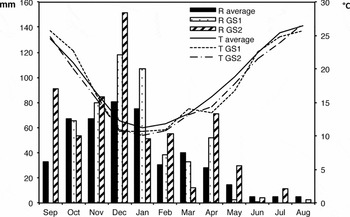
Field experiments were conducted at Nabeul (longitude: 10°40′15″ E, latitude: 36°27′30″ N, altitude: 24 m) in the south of Cap Bon peninsula. This area is part of northern Tunisia, which is the main wheat-growing region. The experiments were in two consecutive growing seasons (GS1: 1990–1991, GS2: 1991–1992) with 1 plot in GS1 and 2 plots in GS2 denoted by P1 and P2. Thus, for instance, the experiment in 90–91 in plot P1 is designated as P1GS1. Mean annual rainfall in Nabeul is about 450 mm with a mean daily temperature around 11–12 °C in January and 26–27 °C in August. Rainfall and air temperature data were recorded using standard meteorological equipment. During the two years of the experiment the growing season (from November to June) coincided with different periods of drought (Figure 1). In GS1, annual rainfall (from September to August) was 494 mm: winter was wet but May and June were dry. In GS2, rainfall was above average (603 mm) and irregular with high rainfall in December followed by periods of drought in January and May. The grain filling period was drier in GS1 than in GS2. The soil of both plots is a sandy and homogeneous fluvisol (Chaabouni, Reference Chaabouni1983) with low organic matter content (1.9%). Its water holding capacity is small (70 mm at a depth of 120 cm) with a water table at two metres depth. The experiments were on durum wheat (cv Karim), which is widely used in Tunisia and Morocco. The experimental design was a randomised split-plot with 4 blocks and 2 factors: irrigation (2 levels: I+ with irrigation and I– without irrigation) and nitrogen supply (2 levels also: N+ with nitrogen and N– without). In the irrigated treatments, 180 mm were applied in growing season 1 and 240 mm in growing season 2. For the nitrogen treatments, 66 kg ha−1 were applied. With 4 blocks and 4 treatments corresponding to each level of the combination of the 2 experimental treatments, the plot was divided into 16 subplots with size of 8 × 8 m at P1 and 11 × 12 m at P2.
Monthly rainfall (R) and average temperature (T) for the two growing seasons (GS1 and GS2) and for the period 1982–1991.

Crop management and measurements
The plots were sown from mid-November to early December with 220 kg seed per hectare (to give 500 plants per square metre). These amounts are greater than those commonly used in the area. The plots were harvested in June. In each experiment, shortly after sowing, flood irrigation from a well (supplied by the water table) was applied to all the treatments to ensure uniform germination and emergence. In the I– treatment, no further irrigation was applied after the sowing irrigation. In the I+ treatment, water was applied by flood irrigation whenever soil water content was about 2/3 of the maximum water storage capacity determined through measurements of soil water content using both gravimetric and neutron probe methods (Latiri-Souki et al., Reference Latiri-Souki, Nortcliff and Lawlor1998): 30–45 mm of water was applied on each of 6 occasions, slightly in excess of field capacity in order to meet all the water requirements of the crop. In the N– treatment, the crop depended only on the nitrogen present in the soil. In the N+ treatment, nitrogen was sufficient to provide maximum yield on the basis of previous experiments. Nitrogen was applied by hand in the form of ammonium nitrate at a concentration of 33% with two applications of 66 kg ha−1 (one when the crop had 2–3 leaves and the other when it had 5–6 leaves). The crops were sampled from December to May only in plot P1 during the first growing season (GS1) and in both plots (P1 and P2) during the second growing season (GS2). Growth was measured approximately every two weeks during the vegetative growth and every week during the grain filling period. Samples were taken from 0.5 m of three adjacent rows (an area of 0.25 m2) and from 1 m of three adjacent rows (0.5 m2) at anthesis and final harvest. The shoot was cut-off at the crown level and divided into its component parts for measurement. Leaf area was measured with a planimeter (LI 3050-A, Li-COR Inc, Lincoln, NE, USA). During grain filling, ears were separated into grains, chaff and awns. Each part was dried for 48 h in an oven at 80 °C and then weighed.
A conceptual model of grain fill
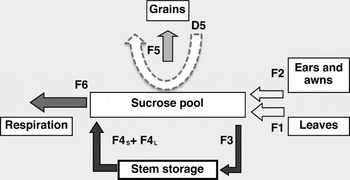
A conceptual model (Figure 2) has been designed to represent the different fluxes of assimilates going to the grains and allowing their growth. Current assimilates, mainly from leaves, but also from awns and ears, are shown as F1 and F2, respectively. They pass via a common pool of sucrose to the grain (F5), to storage in the straw (F3) and to respiration of different organs including roots (F6). The temporary storage of assimilates (F3) occurs when assimilate production (source) exceeds demands (sink) for grain filling, respiration and growth of other organs, e.g. when grains storage capacity is limited or when leaves, ears and awns are photosynthetically very active (Schnyder, Reference Schnyder1993). The excess of assimilate is converted into fructans, which are stored in the stem and the straw (F3) (Pollock and Cairns, Reference Pollock and Cairns1991), before possible remobilisation to the grain via the sucrose pool (F4). Total storage capacity for the flux F3 (which is variable) depends on the amount of straw and its characteristics (Blum, Reference Blum1998). Remobilisation of stored assimilate from the stems to grains (F4) is separated into two components: F4L (long-term, mainly deposited before anthesis) and F4S (short-term, deposited after anthesis). The rate and duration of remobilisation is determined by complex control mechanisms and by the environment (Alvaro et al., Reference Alvaro, Royo, Garcia del Moral and Villegas2008; Yang et al., Reference Yang, Zhang, Huang, Zhu and Wang2000). Immediately after anthesis, when growth of the embryo occurs, there is relatively little accumulation of dry matter (especially carbohydrates) (Jenner et al., Reference Jenner, Ugalde and Aspinall1991), but a relatively large amount of energy is used and requires carbohydrates. Only after several days (depending on temperature) is the endosperm formed and then carbohydrates accumulation accelerates (Wardlaw, Reference Wardlaw1970). The flux D5 represents the demand required for potential grain fill. It is determined by the characteristics and numbers of grain and not by the supply of assimilates (F5). Matching F5 to D5 is critical to achieve the potential mass per grain and the total grain mass (yield).
Flow chart of assimilates for grain filling: F1 (assimilates synthetised from leaves), F2 (assimilates from ears and awns), F3 (temporary storage of assimilates), F4S (remobilisation of assimilates stored after anthesis), F4L (remobilisation of assimilates stored before anthesis), D5 (demand of assimilates), F5 (supply of assimilates to the grains), F6 (assimilates used by respiration).

Unlimited water and nitrogen supply during early growth results in large leaf area and biomass (tillers and leaves) and translates to large grain set. In return, the large biomass has substantial maintenance respiration and may slow and decrease grain filling (van Herwaarden et al., Reference van Herwaarden, Farquhar, Angus, Richards and Howe1998). If a large crop is subjected to drought (and heat) during grain filling, then severe loss of yield and shrunken grain often occur. The effects of environmental conditions (specifically different combinations of water and nitrogen supply) on the dynamics of grain and straw mass may be analysed from this model under similar radiation and temperature regimes.
RESULTS
Range of experimental data
The experimental treatments applied during two years in two plots provided a large variation in yield and its components as well as in the duration of the grain filling period. The different irrigation and nitrogen treatments affected plant development as well as the number and mass of the vegetative and reproductive organs (Latiri-Souki et al., Reference Latiri-Souki, Nortcliff and Lawlor1998). Average yields across treatments varied between 2.6 and 8.4 t ha−1 with grain number ranging from 6000 to 19,000 grains per m2 and grain size between 39 and 59 mg. A statistical analysis of these data is presented in Latiri-Souki et al. (Reference Latiri-Souki, Nortcliff and Lawlor1998). The variation observed in grain number was much greater than that observed in kernel weight. When grain number increased from 5000 to 25,000, grain yield increased from 200 to 1000 kg m−2. Irrigation and nitrogen have a positive effect on grain yield, the highest yields corresponding to I+N+ and the lowest to I–N–. The positive effect of nitrogen is also clear with or without irrigation since treatments I–N+ and I+N+ have larger yields than, respectively, I–N– and I+N–. The hierarchy established for grain yield (I+N+ > I+N– > I–N+ > I–N–) also applies to the grain filling duration, which varies concurrently. In all treatments, individual grains grow at very similar rate in the first two weeks of filling, but the duration of growth is shorter when assimilate production is limited. Also, the grain filling period is shortened by drought in rain-fed treatments (results not shown).
Types of assimilate remobilisation
Some of the fluxes represented in the conceptual model (Figure 2) can be quantified through growth analysis of straw and grain during the grain filling period. For that, symbols representing measurable quantities are used. The total dry matter production between anthesis and harvest (ΔTDM) is the sum of grain dry matter production (GDM) and the variation in straw dry matter (ΔSDM): ΔTDM = GDM+ΔSDM. The variation in straw dry matter ΔSDM between anthesis and harvest is the result both of its own growth with assimilates provided by the leaf (SG = F3) and of the remobilisation of storage materials to the grain (SR = F4 = F4S+F4L): ΔSDM = SG–SR can be either positive or negative. The transfer of assimilates from the straw to the grains (SR = F4) is done either through short- (SRS = F4S) or long-term (SRL = F4L) remobilisation. The latter corresponds to a reduction in straw dry matter between anthesis and harvest (ΔSDM < 0). Assuming the respiration flux (F6) can be neglected, the direct contribution to the sucrose pool (fluxes F1 and F2) can be estimated through the variation in straw dry matter: F1 + F2 = ΔSDM = ΔTDM – SG; the indirect contribution (F4) can be estimated similarly: F4 = SR = (SG–ΔSDM). Long-term remobilisation corresponds to a negative variation in straw dry matter (SRL = –ΔSDM = SR–SG).
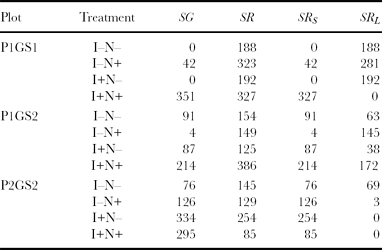
Straw growth (SG) during the early grain filling period occurred in almost all the treatments except two which were associated with N– treatments. The greatest growth occurred for irrigation treatments (up to 351 g m−2) (Table 1). Straw remobilisation (SR) always occurred, ranging from 85 to 386 g m−2. The pattern of short-term remobilisation (SRS) generally coincides with straw growth: the greater SG the greater SRS. Long-term remobilisation (SRL) occurred in almost all the treatments except three irrigated treatments. Demand exceeded supply under rain-fed conditions.
Straw growth and remobilisation during the grain filling period: SG (straw growth), SR (straw remobilisation), SRS (short-term remobilisation), SRL (long-term remobilisation), all expressed in g m−2.
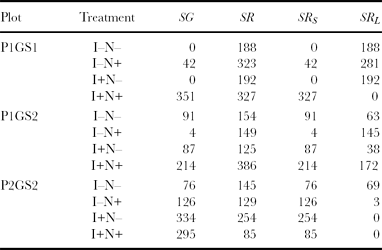
P1GS1: plot 1 in growing season 1 (1990–1991); P1GS2: plot 1 in growing season 2 (1991–1992); P2GS2: plot 2 in growing season 2.
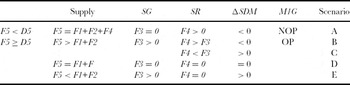
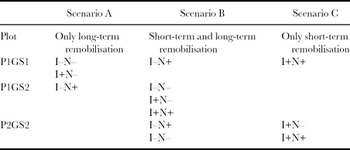
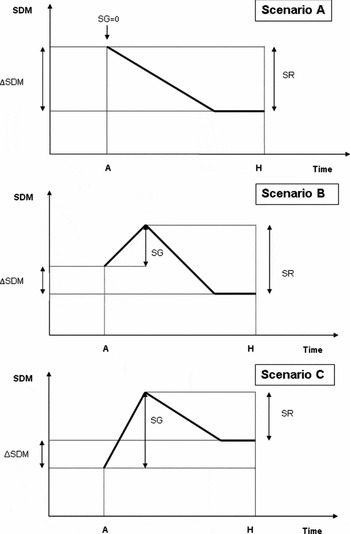
The accumulation and remobilisation of straw dry matter between anthesis and harvest occurred in a range of patterns, this due to the different fluxes occurring during the grain filling period (Figure 3). In scenario A (SG = 0 and SR ≥ 0), straw dry matter decreases constantly from anthesis to harvest (ΔSDM < 0): there is only long-term remobilisation and straw remobilisation SR is equal to the variation in straw dry matter SR = –ΔSDM = F4L. Photosynthesis is inadequate to meet the demand by the grain. In scenario B (SG > 0 and SR > SG), straw dry matter begins to increase (assimilate exceeds demand, so there is storage in straw, F3 > 0) and then decreases below its initial value at anthesis (ΔSDM < 0) (assimilate is less than demand, so storage is used, F4 > 0): there is both short- (F4S) and long-term (F4L) remobilisation. In scenario C (SG > 0 and SR ≤ SG), straw dry matter begins to increase and then decreases but remains above or equal to its initial value at anthesis (ΔSDM ≥ 0): there is only short-term remobilisation (F4S > 0 and F4L = 0, assimilate is in balance with demand but with some fluctuations). Two other scenarios are possible: D) when dry matter remains constant without remobilisation (ΔSDM = 0 and F4 = 0); or E) corresponding to a positive variation in straw dry matter without remobilisation (ΔSDM > 0 and F4 = 0). These scenarios, however, were not encountered in the experimental data. Table 2 represents the links in terms of fluxes between the conceptual model (Figure 2) and the five types of remobilisation described above. The different cases encountered in the experiments in relation with these scenarios are shown in Table 3. Scenario A (only long-term remobilisation) was observed in rain-fed treatments P1GS1 (I–N–) and P1GS2 (I–N+), and also in an irrigated one P1GS1 (I+N–) but with a low LAI (maximum value of 0.20). Scenario C (only short-term remobilisation) was observed only for irrigated treatments. Scenario B (both types of remobilisation) was the most frequent and occurred in rain-fed and irrigated treatments.
Links in terms of flux between the conceptual framework of Figure 2 and the different scenarios of remobilisation: SG (straw growth), SR (straw remobilisation), ∆SDM (variation of straw dry matter), M1G (mass of one grain); (OP) optimal; (NOP) non optimal. The different fluxes are defined in Figure 2.

Remobilisation processes: occurrences of the different scenarios of remobilisation described in Figure 3 as observed in the experiments (plots, years and treatments).

The three types of remobilisation processes for grain filling encountered in the experiments: SDM (straw dry matter), SG (straw growth), SR (straw remobilisation), A (anthesis), H (harvest). Scenario A: only long-term remobilisation (ΔSDM < 0). Scenario B: short- and long-term remobilisation (ΔSDM < 0). Scenario C: only short-term remobilisation (ΔSDM ≥ 0).

Relationships between assimilate fluxes and crop characteristics
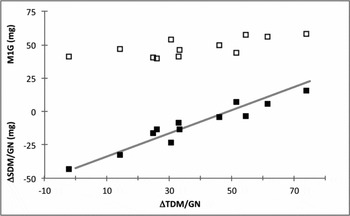
For all the experimental treatments considered together, Figure 4 (as in Gallagher et al., Reference Gallagher, Biscoe and Hunter1975; Lawlor et al., Reference Lawlor, Day, Johnston, Legg and Parkinson1981) shows the relationships between the variation in straw dry matter per grain between anthesis and harvest (ΔSDM/GN) and the corresponding variation in total dry matter (ΔTDM/GN) in parallel with the mass per grain at harvest. While the mass per grain is relatively stable, the variation in straw dry matter is closely related to that in total dry matter. Hence, when ΔTDM/GN is small (<50 mg) grain growth stability was ensured by remobilisation of assimilates from the straw to the grain (ΔSDM/GN < 0). Alternatively, when a large amount of assimilates was available during the grain filling period (ΔTDM/GN > 50 mg), grain growth stability was related to a positive change in straw dry matter (ΔSDM/GN > 0), but without allowing a significantly larger mass per grain. Scenarios A and B correspond to the negative part of the trend line ΔSDM/GN < 0, whereas scenario C corresponds to the positive part ΔSDM/GN > 0.
Relation between mass per grain (M1G) and the variation in total dry matter per grain (ΔTDM/GN) during the grain filling period (open square) and relation between the variation in straw dry matter per grain (ΔSDM/GN) and (ΔTDM/GN) (filled square) (mean value per treatment, per year and per plot, r 2 = 0.92, n = 12, significant at 1% level).

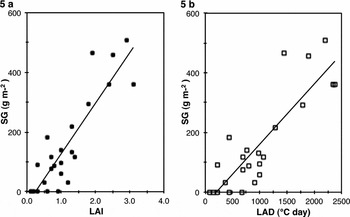
Straw growth after anthesis (SG = F3) was investigated in relation with several crop characteristics. Under rain-fed conditions, significant correlations were found with the leaf area index at anthesis (LAI) and the leaf area duration between anthesis and harvest (LAD), defined as the mean LAI of this period multiplied by the corresponding duration expressed in thermal time. Straw growth is positively and highly significantly correlated with LAI (r 2 = 0.78) and LAD (r 2 = 0.75), as shown in Figure 5, where the treatments with applied nitrogen had larger LAI at anthesis. In contrast, the correlations for irrigated treatments were poor (results not shown), which implies that LAI was not a limiting factor in such conditions. Under rain-fed conditions, grain dry matter (GDM) was positively correlated with straw growth after anthesis (r 2 = 0.66), when a portion of the leaf area is still active. This storage (probably in relation to the predominance of F3 at the beginning of the grain filling period) allows better yield through short-term remobilisation (F4S). Under irrigated conditions, photosynthesis (F1, F2) and respiration (F6) might be maintained longer together and grain growth is not related to remobilisation.
Straw growth after anthesis (SG) in rain-fed treatments as a function of: (a) leaf area index (LAI) at anthesis (r 2 = 0.78, n = 24) and (b) leaf area duration (LAD) (r 2 = 0.75, n = 24, significant at 1% level).

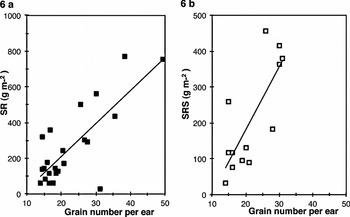
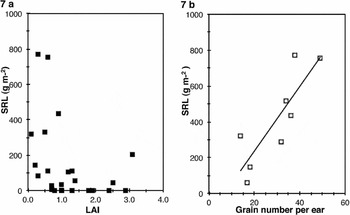
There was a positive correlation under rain-fed conditions (Figure 6a) between straw remobilisation (SR = F4) and the grain number per ear which represents the sink demand (D5), remobilisation increasing with the grain number per ear. The relationship was less significant with grain number and not significant with ears number. In scenario B (Figure 3), where both long-term and short-term remobilisation are present, short-term remobilisation (SRS = F4S) tends also to increase with the grain number per ear (Figure 6b). In case C (only short-term remobilisation), the correlation was not evident in relation to the excess of assimilate. In case A, there is no short-term remobilisation. The long-term remobilisation during grain filling (SRL = F4L) tended to decrease with leaf area at anthesis under rain-fed conditions (Figure 7a). This demonstrates that long-term remobilisation mainly occurs when LAI is small. When there is adequate leaf area at anthesis some straw growth is possible, allowing grain growth, and long-term remobilisation from stems does not occur. But when leaf area is small or not active, remobilisation from the straw takes place. In case A (only long-term remobilisation), remobilisation increases with the grain number per ear (Figure 7b). Consequently, grain number played an important role in the different scenarios as the sink determining factor for short- or long-term remobilisation.
(a) Straw remobilisation SR (long-term + short-term) as a function of grain number per ear in rain-fed treatments (r 2 = 0.61, n = 24); (b) short-term remobilisation SRS as a function of grain number per ear in scenario B, where both types of remobilisation (short-term and long-term) occur (r 2 = 0.61, n = 14, significant at 1% level).

Long-term remobilisation (SRL): (a) as a function of LAI at anthesis in rain-fed treatments; (b) as a function of grain number per ear in scenario A, when only long-term remobilisation occurs (r 2 = 0.72, n = 8, significant at 1% level).

DISCUSSION
Grain filling is a balance between a ‘sink’ demand, represented by the grain number and the biochemically determined requirement for assimilate and a ‘source’ supply of assimilates provided both by the current photosynthetic production (leaves, ears and awns) and by the remobilisation of assimilates stored either prior to or after anthesis. Potential grain number is determined by pre-anthesis growth and has a key role in determining yield (Aggarwal et al., Reference Aggarwal, Fisher and Liboon1990); potential mass per grain is probably determined by conditions during the early phases of grain formation and growth (Jenner et al., Reference Jenner, Ugalde and Aspinall1991). Actual grain number and kernel size depend on the production of assimilate by leaves and ears and on the remobilisation of stored assimilates which enter the grain during the filling period. The balance between the sources of assimilate (photosynthate from leaves and remobilisation from stems) depends on environmental conditions and on cultivar (Alvaro et al., Reference Alvaro, Royo, Garcia del Moral and Villegas2008), the potential for remobilisation being subject to variation between contrasting genotypes (Rebetzke et al., Reference Rebetzke, van Herwaarden, Jenkins, Weiss, Lewis, Ruuska, Tabe, Fettell and Richards2008). When environmental conditions, such as drought, decrease the leaf area, this severely limits current assimilate production. Remobilisation of stored assimilates provides a buffer enabling grain growth to be maintained (Asseng and van Herwaarden, Reference Asseng and van Herwaarden2003). Under Mediterranean conditions, it has been observed that the potential for translocation of assimilates increased in modern variety of durum wheat (Alvaro et al., Reference Alvaro, Royo, Garcia del Moral and Villegas2008) and that this process might contribute to better yields in such environment. However, when this potential is limited or when there is severe drought or high temperature, grain growth may cease prematurely, shortening the period of grain-fill and resulting in reduced kernel size.
In our experiments on the cultivar Karim, three types of behaviour have been encountered in relation to the balance between demand for assimilate and supply: (1) only long-term remobilisation, (2) only short-term remobilisation and (3) both fluxes (together or consecutively). Conditions at anthesis play an important role in the fluxes of assimilates during the grain filling period. A photosynthetically active leaf area produces ample assimilates and their direct contribution to yield is observed through the correlations between LAI at anthesis and grain yield and straw growth (hence a strong correlation between grain yield and straw production). In semi-arid areas, drought during the grain filling period is almost always present. When there is no or a small LAI at anthesis, remobilisation is always observed and plays a key role in the grain filling process. Both short- and long-term remobilisation are linked to the grain set, where greater grain number per ear increases the requirement for remobilisation. Having encountered three types of behaviour for the same cultivar in field experiments with different water and nitrogen supply shows the potential to allow remobilisation mechanisms through agronomic practices.
CONCLUSION
Grain yield and quality depend on genetic and environmental controls. Maximising production under a variable water supply by plant breeding and crop management (such as fertiliser application) will ultimately require an understanding of the mechanisms which control growth and grain filling process in water limited environments, together with multidisciplinary approaches based upon modelling and phenotyping. In this study, remobilisation during the grain filling period is quantified and correlations with favourable factors are investigated. This provides elements that might be used to improve mass per grain and yield under adverse conditions such as a dry environment. The study also provides some elements for a better simulation of mechanisms that take place in dry conditions. Increasing the storage capacity of assimilates as fructans in straw and their remobilisation ability, together with the sink potential represented by the cumulative grain number, should be included in traits required for drought tolerance in semi-arid areas. However, optimising dry matter at anthesis is a complex issue (Passioura and Angus, Reference Passioura, Angus and Sparks2010) and improving yield in dry environments is a challenge (Rebetzke et al., Reference Rebetzke, Chapman, McIntyre, Richards, Condon, Watt, van Herwaarden and Carver2009). There is a need for integrated approaches including choice of cultivars and agronomic practices in order to optimise the balance between source and sink and the trade-offs between dry matter at anthesis, potential grain number, grain number per ear and yield.