1. Introduction
Given the work of Robert MacArthur and his followers, some skeptical ecologists charge that theoretical modeling building has gone evidentially unconstrained. That is, models are often constructed which resist empirical testing. In this essay, using an example of chaos-producing models that have been tested against the dynamics of flour beetle populations, I argue that “bottle experiments” do provide model building with important evidential constraints. Critics reply, however, that this and other bottle experiments are importantly unlike and irrelevant to nonmanipulated systems in nature. I provide two possible responses to this view. Finally, I provide a practical suggestion for how to move the debate forward.
2. Simberloff's Worry
The ever skeptical ecologist Daniel Simberloff writes, “Ecology is awash in all manner of untested (and often untestable) models, most claiming to be heuristic, many simple elaborations of earlier untested models. Entire journals are devoted to such work, and are as remote from biological reality as are faith-healers” (Reference Simberloff1981). We can represent his argument in the following way:
1. If models are to be of use—even as heuristics—they must ultimately answer to data.
2. However, many models are built which have not been tested, and they themselves are built from models that have not been tested either.
3. Hence, these models are not being tested and thus are of little or no use.
In other work (Odenbaugh Reference Odenbaugh2006a), I have argued that premises 1 and 2 are false. First, with regard to premise 1, it is certainly true that some ecological models resist empirical testing. However, they can be heuristically useful by allowing biologists to explore various possibilities and provide conceptual frameworks (Wimsatt Reference Wimsatt, Nitecki and Hoffman1987; Cooper Reference Cooper2003). Second, with regard to premise 2, we must not focus simply on single models but on families of them.Footnote 1 With inspection of examples, we often find that untestable models serve as templates for testable models. That is sufficient to show that scientific fields like ecology can be empirically constrained. In this essay, I want to further criticize premise 2. Many models have been tested and can be tested through bottle experiments.
3. Bottle Experiments
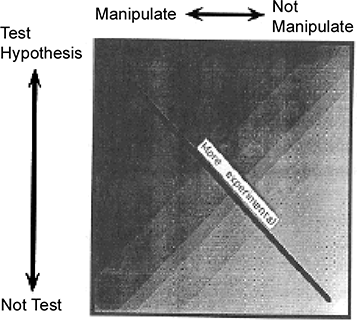
Following the work of Robert Brandon (Reference Brandon1995) and his analysis of experimentation in evolutionary biology, we can characterize experiments at least along two dimensions. First, there is the degree to which an empirical study tests a hypothesis. Second, there is the degree to which an empirical study manipulates the variables of the system of interest (Figure 1).
Figure 1.

Traditionally, the more testing and manipulation we have in an empirical study, the more experimental it is. So we can define a bottle experiment in the following way:
A bottle experiment is a study of a population, community, or ecosystem constructed and maintained under controlled conditions in order to test the predictions and assumptions of theory.
Bottle experiments typically involve the following:
• Organisms that can reproduce extremely fast,
• Organisms that have minimal demographic and genetic structure, and
• Organisms that have small spatial scales (maybe many generations through).
There are many famous examples of bottle experiments in the history of ecology. For example, there are G. F. Gauses's competitive exclusion experiments with two species of laboratory populations of paramecium, A. J. Nicholson's experiments on density-dependent population cycles in blowfly populations, and Thomas Park's experiments on predatory-prey populations and spatial refugia. I now want to consider a more recent example of chaotic dynamics in flour beetles.
4. The Possibility of Chaos
Ecologist Lord Robert May demonstrated in the 1970s that simple discrete difference equations could exhibit chaotic dynamics. Here chaos will be loosely characterized as occurring in a system when there is extreme sensitivity to initial conditions and behavior which is unstable and aperiodic. An example that May analyzed is the following:

Here N t represents population size or density at time t, K is the carrying capacity of the population, and R is the net rate of reproductive increase. In this model, if
 $R\geq 2.57$
, then the model exhibits a stable equilibrium and stable cycles. If
 $R> 2.57$
, then chaos occurs.
One of the most significant implications of May's work concerns its implications for debates over population regulation.Footnote 2 In the early part of the twentieth century, Australian ecologists Hugh Andrewartha and Charles Birch argued that populations are regulated by density-independent mechanisms, and Nicholson argued that populations are regulated by density-dependent mechanisms. A population is regulated when its abundance exhibits small variation over time. From a mechanistic point of view, Nicholson thought that such temporal stability was the product of negative feedbacks from intraspecific competition. Similarly, it was also claimed that if density-independent mechanisms like weather were at work where the changes were not a function of population size, then the population abundances would fluctuate wildly. Thus, if we examined sufficiently long times series statistically, we could infer what mechanisms were at work governing population dynamics.
May's work on chaos demonstrated that this debate was misconceived in at least one important way. He writes, “These studies of the Logistic Map revolutionized ecologists’ understanding of the fluctuations of animal populations. … With the insights of the Logistic Map, it was clear that the Nicholson-Birch controversy was misconceived. Both parties missed the point: population-density effects can, if sufficiently strong …, look identical to the effect of external disturbances. It's not a question of either/or” (May Reference May and Farmelo2002, 39–40). Thus, a fundamental implication of May's analysis of chaotic models was that density-dependent mechanisms can generate wildly fluctuating numbers. The traditional Nicholson-Birch controversy ignored an important alternative.Footnote 3
5. Chaotic Dynamics and Tribolium: The Larval-Pupal-Adult Model and Experiment
In the 1990s, R. F. Constantino et al. tested a “chaotic model” against the controlled dynamics of Tribolium populations. They wanted to evaluate if “specific sequences of transitions among qualitatively different dynamical regimes occur in response to changing biological parameters” (Reference Constantino, Desharnais, Cushing and Dennis1997, 389). The model they employed involves three stochastic difference equations governing the larval, pupal, and adult stage of an insect population. Formally, the model is as follows:

In this model, L t is the number of feeding larvae at time t; P t is the number of large larvae, nonfeeding larvae, pupae, and callow adults at time t; and A t is the number of sexually mature adults at time t. The parameter b is the number of larval recruits per adult per unit time in the absence of cannibalism. The parameters μl and μa are the larval and adult rates of mortality in one unit of time. The fractions
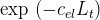 $\mathrm{exp}\,\left(-c_{el}L_{t}\right)$
and
 $\mathrm{exp}\,\left(-c_{ea}A_{t}\right)$
are the probabilities that an egg is not eaten in the presence of L t larvae and A t adults in one time unit. The fraction
 $\mathrm{exp}\,\left(-c_{pa}A_{t}\right)$
is the survival probability of a pupa in the presence of A t adults in one time unit. Finally, the terms E 1t, E 2t, and E 3t are random noise variables which have a joint multivariate normal distribution with means of zero.
With one unmanipulated control treatment, Constantino et al. (Reference Constantino, Desharnais, Cushing and Dennis1997) had 24 cultures of Tribolium castaneum initiated with 250 small larvae, five pupae, and 100 young adults, where three populations were randomly assigned to each of the eight treatments. They manipulated the recruitment rate into adult stage c pa at values predicted to produce a sequence of dynamic behaviors including a stable equilibrium, quasiperiodic and periodic cycles, and chaos. Every 2 weeks the L, P, and A stages were censused, and the dead adults were counted and removed with the procedure continuing for 80 weeks.
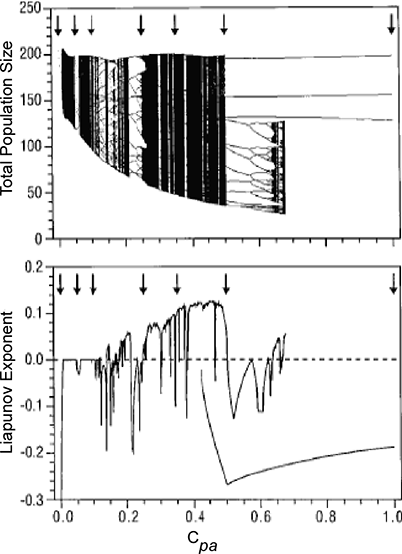
The Larval-Pupal-Adult (LPA) model was fitted to time series data with maximum likelihood parameter estimation. Using the model and the estimates, Constantino et al. (Reference Constantino, Desharnais, Cushing and Dennis1997) determined a bifurcation diagram and Liapunov exponents. In the following graphs, solid bands indicate quasiperiodicity or chaos, and open areas containing lines indicate the result of periodic cycles. The Liapunov exponent measures the exponential rate of convergence or divergence of nearby initial conditions. Stable equilibria and periodic cycles have negative Liapunov exponents, quasiperiodic loops have zero Liapunov exponents, and chaos has positive Liapunov exponents (Figure 2).
Figure 2.

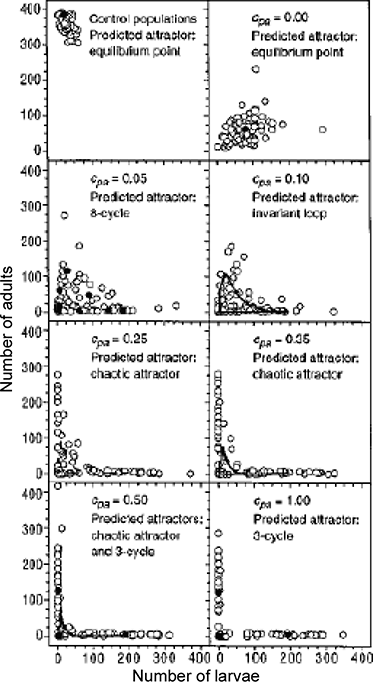
We can now compare model predictions with observed data. Different c pa values generate different models predictions, as we have seen. Here is a list of the values and model predictions.
•
 $0.00\rightarrow $
stable equilibrium
•
$0.05\rightarrow $
eight-cycle•
$0.10\rightarrow $
invariant loop•
$0.25\rightarrow $
chaotic attractor•
$0.35\rightarrow $
chaotic attractor•
$0.5\rightarrow $
chaotic attractor and three-cycle•
$1.0\rightarrow $
three-cycle


Here is a graph (Figure 3) comparing observed values (○) and model predictions (•). We can see that the LPA model is highly confirmed—one can even argue that it is the only uncontroversial confirmation of chaos in a biological population.
Figure 3.

6. Further Criticisms
In Section 2, I discussed an argument of Daniel Simberloff, and I claimed that models in sciences like ecology are evidentially constrained, especially when we consider bottle experiments. Thus, provided that my example is the rule and not the exception, we have turned back some of the skepticism that arises around theoretical ecology. However, there are further criticisms to consider. Ecologists Elisabeth Crone and Jane Molofsky present such criticism in the following passage explicitly considering the chaos experiments: “This [experiment] is one step beyond computer simulations of interactions, in that there is some possibility that flour beetles could never have been forced to mimic theoretical models. Nonetheless, in these experiments, it would be more surprising if the experimental populations did not display the predicted dynamics” (Reference Crone and Molofsky1999, 210). Similarly, ecologist Steven Carpenter writes, “Microcosms are easily justified to colleagues in arguments for ecological appointments. But a molecular biologist who isolates ribosomes is working on ribosomes; an ecologist who isolates organisms in a bottle may not be working on communities or ecosystems in any relevant sense” (Reference Carpenter1996, 678). Finally, ecologist John Lawton writes, “Critics argue, in contrast, that despite these (and other advantages), the artificial nature of the laboratory system, the restricted nature of their inhabitants, the general absence of environmental disturbances, and the small scale mean that experiments carried out in them are at best a harmless game and at worst a waste of time and money” (Reference Lawton, Resetarits and Bernardo1998, 178).
Each of these criticisms represents the view that microcosms or bottle experiments are importantly different from natural systems.Footnote 4 Even if a model can accurately represent the dynamics of such an artificial system, this has little bearing if any on the status of such models on natural systems. I want to conclude by considering two philosophical responses and a suggestion.
First, there is what I call the pragmatic response.
If a model cannot describe what happens inside a laboratory or in a controlled setting, then there is little hope that it could describe what happens outside a laboratory.
Microcosms are “stripped down” natural systems. They differ from their more complex counterparts in virtue of certain variables and parameters being controlled by human interventions. Thus, one cannot simply extrapolate from the lab to the wild without independently justified claims that their differences are irrelevant. However, if a model accurately represents a complex population of a certain type, then the model must also accurately represent a simple population of the same type. Suppose the model accurately represents the more complex population. The model must also accurately represent the microcosm since certain variables and parameters are negligible and unimportant. So, bottle experiments can be the first step in testing the empirical accuracy of ecological models. They are much more than computer simulations and are not a harmless game.
The second philosophical response is what I call the dappled response (Cartwright Reference Cartwright1999; Cooper Reference Cooper2003).
Models describe the natures, dispositions, or tendencies of objects and how they would behave in simplified circumstances.
Given the complexity of systems outside the lab, one can argue that natures are manifested only in controlled circumstances. Thus, in the absence of natural systems which are as simple as artificial ones, we may only be able to predict and explain what happens in human controlled experiments. The skeptics have faulty expectations since scientific knowledge is largely about what happens in bottles.Footnote 5
The positions differ since the pragmatic response is largely epistemic and the dappled response is foremost a metaphysical view. However, from a more empirical point of view, there is a way in which scientists can justifiably move from claims about the empirical credentials of models representing lab populations to natural ones. First, identify the dominant causes in an ecological experiment. Second, formulate a robust mechanistic model to explain nonmanipulated field populations. If the model is robust in the sense that it represents the major causes of a population's dynamics, then small perturbations of other variables will have negligible effects. Thus, the differences between the experimental population and field population will be of little relevance. This may be difficult to do in many studies, but it is one method of exporting the success of a model in an evidentially constrained way.
7. Conclusion
In the essay, I have argued contrary to some skeptics that ecological models can be tested through the use of bottle experiments. One such example is the testing of chaotic models by flour beetle data. However, critics of such experiments claim that artificial systems are irrelevant to the dynamics of natural systems. There are several responses one can offer to such a criticism. First, if a model is to be empirically accurate of a natural system, then it must be empirically accurate of a simpler system. Thus, modeling artificial systems is an important step in evaluating our models. Second, there may be metaphysical or ontological reasons for thinking that models can only capture the natures and tendencies of systems that we can control. In this case, the critics are asking for something that ecologists simply cannot do. Ecological knowledge is of what happens in the lab. Finally, if ecologists can show that the differences between the artificial and natural systems are irrelevant and that the model of interest can accurately represent the dynamics of the former, then there is no reason to believe that it cannot do so with respect to the latter. Ecological models are evidentially constrained.